Condition NISSAN TEANA 2008 Service Manual
[x] Cancel search | Manufacturer: NISSAN, Model Year: 2008, Model line: TEANA, Model: NISSAN TEANA 2008Pages: 5121, PDF Size: 69.03 MB
Page 1084 of 5121
![NISSAN TEANA 2008 Service Manual UNEXPECTED PEDAL REACTION
BRC-143
< SYMPTOM DIAGNOSIS >[VDC/TCS/ABS]
C
D
E
G
H
I
J
K
L
MA
B
BRC
N
O
P
UNEXPECTED PEDAL REACTION
Diagnosis ProcedureINFOID:0000000003767024
1.CHECK BRAKE PEDAL STROKE
Ch](/img/5/57391/w960_57391-1083.png "NISSAN TEANA 2008 Service Manual UNEXPECTED PEDAL REACTION
BRC-143
< SYMPTOM DIAGNOSIS >[VDC/TCS/ABS]
C
D
E
G
H
I
J
K
L
MA
B
BRC
N
O
P
UNEXPECTED PEDAL REACTION
Diagnosis ProcedureINFOID:0000000003767024
1.CHECK BRAKE PEDAL STROKE
Ch")
UNEXPECTED PEDAL REACTION
BRC-143
< SYMPTOM DIAGNOSIS >[VDC/TCS/ABS]
C
D
E
G
H
I
J
K
L
MA
B
BRC
N
O
P
UNEXPECTED PEDAL REACTION
Diagnosis ProcedureINFOID:0000000003767024
1.CHECK BRAKE PEDAL STROKE
Check brake pedal stroke. Refer to BR-6, "
Inspection and Adjustment".
Is the stroke too large?
YES >> Bleed air from brake tube and hose. Refer to BR-10, "Bleeding Brake System".
Check brake pedal, brake booster, and master cylinder for mount play, looseness, brake system
fluid leakage, etc.
- Brake pedal: Refer to BR-6, "
Inspection and Adjustment".
- Brake booster: Refer to BR-12, "
Inspection".
- Brake master cylinder: Refer to BR-11, "
Inspection".
NO >> GO TO 2.
2.CHECK FUNCTION
Disconnect ABS actuator and electric unit (control unit) connector to deactivate ABS. Check if braking force is
normal in this condition. Connect connector after inspection.
Is the inspection result normal?
YES >> Normal
NO >> Check brake system.
Page 1085 of 5121
![NISSAN TEANA 2008 Service Manual BRC-144
< SYMPTOM DIAGNOSIS >[VDC/TCS/ABS]
THE BRAKING DISTANCE IS LONG
THE BRAKING DISTANCE IS LONG
Diagnosis ProcedureINFOID:0000000003767025
CAUTION:
The stopping distance on slippery road surfaces](/img/5/57391/w960_57391-1084.png "NISSAN TEANA 2008 Service Manual BRC-144
< SYMPTOM DIAGNOSIS >[VDC/TCS/ABS]
THE BRAKING DISTANCE IS LONG
THE BRAKING DISTANCE IS LONG
Diagnosis ProcedureINFOID:0000000003767025
CAUTION:
The stopping distance on slippery road surfaces")
BRC-144
< SYMPTOM DIAGNOSIS >[VDC/TCS/ABS]
THE BRAKING DISTANCE IS LONG
THE BRAKING DISTANCE IS LONG
Diagnosis ProcedureINFOID:0000000003767025
CAUTION:
The stopping distance on slippery road surfaces might be longer when the ABS is operating than
when the ABS is not operating.
1.CHECK FUNCTION
Turn the ignition switch OFF and disconnect ABS actuator and electric unit (control unit) connector to deacti-
vate ABS. In this condition, check stopping distance. After inspection, connect connector.
Is the inspection result normal?
YES >> Normal
NO >> Check brake system.
Page 1087 of 5121
![NISSAN TEANA 2008 Service Manual BRC-146
< SYMPTOM DIAGNOSIS >[VDC/TCS/ABS]
PEDAL VIBRATION OR ABS OPERATION SOUND OCCURS
PEDAL VIBRATION OR ABS OPERATION SOUND OCCURS
Diagnosis ProcedureINFOID:0000000003767027
CAUTION:
Under the fol](/img/5/57391/w960_57391-1086.png "NISSAN TEANA 2008 Service Manual BRC-146
< SYMPTOM DIAGNOSIS >[VDC/TCS/ABS]
PEDAL VIBRATION OR ABS OPERATION SOUND OCCURS
PEDAL VIBRATION OR ABS OPERATION SOUND OCCURS
Diagnosis ProcedureINFOID:0000000003767027
CAUTION:
Under the fol")
BRC-146
< SYMPTOM DIAGNOSIS >[VDC/TCS/ABS]
PEDAL VIBRATION OR ABS OPERATION SOUND OCCURS
PEDAL VIBRATION OR ABS OPERATION SOUND OCCURS
Diagnosis ProcedureINFOID:0000000003767027
CAUTION:
Under the following conditions, ABS is activated and vibration is felt when brake pedal is lightly
depressed (just place a foot on it). However, this is normal.
When shifting gears
When driving on slippery road
During cornering at high speed
When passing over bumps or grooves [at approximately 50 mm (1.97 in) or more]
When pulling away just after starting engine [at approximately 10 km/h (6 MPH) or higher]
1.SYMPTOM CHECK 1
Check that there are pedal vibrations when the engine is started.
Do vibrations occur?
YES >> GO TO 2.
NO >> Inspect the brake pedal.
2.SYMPTOM CHECK 2
Check that there are ABS operation noises when the engine is started.
Do the operation noises occur?
YES >> GO TO 3.
NO >> Perform self-diagnosis.
3.SYMPTOM CHECK 3
Check symptoms when electrical component (headlamps, etc.) switches are operated.
Do symptoms occur?
YES >> Check if there is a radio, antenna, antenna lead wire, or wiring close to the control unit. If there is,
move it farther away.
NO >> Normal
Page 1089 of 5121
![NISSAN TEANA 2008 Service Manual BRC-148
< SYMPTOM DIAGNOSIS >[VDC/TCS/ABS]
NORMAL OPERATING CONDITION
NORMAL OPERATING CONDITION
DescriptionINFOID:0000000003767029
Symptom Result
Slight vibrations are felt on the brake pedal and the](/img/5/57391/w960_57391-1088.png "NISSAN TEANA 2008 Service Manual BRC-148
< SYMPTOM DIAGNOSIS >[VDC/TCS/ABS]
NORMAL OPERATING CONDITION
NORMAL OPERATING CONDITION
DescriptionINFOID:0000000003767029
Symptom Result
Slight vibrations are felt on the brake pedal and the")
BRC-148
< SYMPTOM DIAGNOSIS >[VDC/TCS/ABS]
NORMAL OPERATING CONDITION
NORMAL OPERATING CONDITION
DescriptionINFOID:0000000003767029
Symptom Result
Slight vibrations are felt on the brake pedal and the operation noises occur, when VDC, TCS or ABS is acti-
vated.
This is a normal condi-
tion due to the VDC,
TCS or ABS activation. Stopping distance is longer than that of vehicles without ABS when the vehicle drives on rough, gravel, or
snow-covered (fresh, deep snow) roads.
The brake pedal moves and generates noises, when TCS or VDC is activated due to rapid acceleration or
sharp turn.
The brake pedal vibrates and motor operation noises occur from the engine room, after the engine starts and
just after the vehicle starts.This is a normal, and it is
caused by the ABS op-
eration check.
Depending on the road conditions, the driver may experience a sluggish feel. This is normal, because
TCS places the highest
priority on the optimum
traction (stability). TCS may activate momentarily if wheel speed changes when driving over location where friction coefficient
varies, when downshifting, or when fully depressing accelerator pedal.
The ABS warning lamp, VDC OFF indicator lamp and SLIP indicator lamp may turn ON when the vehicle is
subject to strong shaking or large vibration, such as when the vehicle is rotating on a turntable or located on
a ship while the engine is running. In this case, restart the
engine on a normal
road. If the normal con-
dition is restored, there
is no malfunction. At
that time, erase the self-
diagnosis memory. VDC may not operate normally or the ABS warning lamp, VDC OFF indicator lamp, and SLIP indicator lamp
may illuminate, when running on a special road that is extremely slanted (e.g. bank in a circuit course).
A malfunction may occur in the yaw rate/side G sensor system, when the vehicle turns sharply, such as dur-
ing a spin turn, axle turn, or drift driving, while the VDC function is off (VDC OFF indicator lamp illuminated).
The vehicle speed will not increase even though the accelerator pedal is depressed, when inspecting the
speedometer on a 2-wheel chassis dynamometer. Normal (Deactivate the
VDC/TCS function be-
fore performing an in-
spection on a chassis
dynamometer.)
VDC OFF indicator lamp and SLIP indicator lamp may simultaneously turn on when low tire pressure warn-
ing lamp turns on.This is not a VDC sys-
tem error but results
from characteristic
change of tire.
Page 1091 of 5121
![NISSAN TEANA 2008 Service Manual BRC-150
< PRECAUTION >[VDC/TCS/ABS]
PRECAUTIONS
Precaution for Brake Control
INFOID:0000000003767032
When starting engine or when starting vehicle just after starting engine, brake pedal may vibrate](/img/5/57391/w960_57391-1090.png "NISSAN TEANA 2008 Service Manual BRC-150
< PRECAUTION >[VDC/TCS/ABS]
PRECAUTIONS
Precaution for Brake Control
INFOID:0000000003767032
When starting engine or when starting vehicle just after starting engine, brake pedal may vibrate")
BRC-150
< PRECAUTION >[VDC/TCS/ABS]
PRECAUTIONS
Precaution for Brake Control
INFOID:0000000003767032
When starting engine or when starting vehicle just after starting engine, brake pedal may vibrate or motor
operating noise may be heard from engine compartment. This is normal condition.
When an error is indicated by ABS or another warning lamp, collect all necessary information from customer
(what symptoms are present under what conditions) and check for estimate causes before starting diagnos-
tic servicing. Besides electrical system inspection, check brake booster operation, brake fluid level, and oil
leaks.
If tire size and type are used in an improper combination, or brake pads are not Genuine NISSAN parts,
stopping distance or steering stability may deteriorate.
ABS might be out of order or malfunctions by putting a radio (wiring inclusive), an antenna and a lead-in wire
near the control unit.
If aftermarket parts (car stereo, CD player, etc.) have been installed, check for incidents such as harness
pinches, open circuits, and improper wiring.
VDC system may not operate normally or a VDC OFF indicator lamp or SLIP indicator lamp may light.
- When replacing the following parts with parts other than genuine parts or making modifications: Suspension
related parts (shock absorber, spring, bushing, etc.), tires, wheels (other than specified sizes), brake-related
parts (pad, rotor, caliper, etc.), engine-related parts (muffler, ECM, etc.) and body reinforcement-related parts
(roll bar, tower bar, etc.).
- When driving with worn or deteriorated suspension, tires and brake-related parts.
Precautions for Harness RepairINFOID:0000000003843440
COMMUNICATION LINE
Solder the repaired area and wrap tape around the soldered area.
NOTE:
A fray of twisted lines must be within 110 mm (4.33 in).
Bypass connection is never allowed at the repaired area.
NOTE:
Bypass connection may cause communication error as spliced
wires that are separate from the main line or twisted lines lose
noise immunity.
Replace the applicable harness as an assembly if error is detected
on the shield lines of communication line.
SKIB8766E
SKIB8767E
Page 1102 of 5121
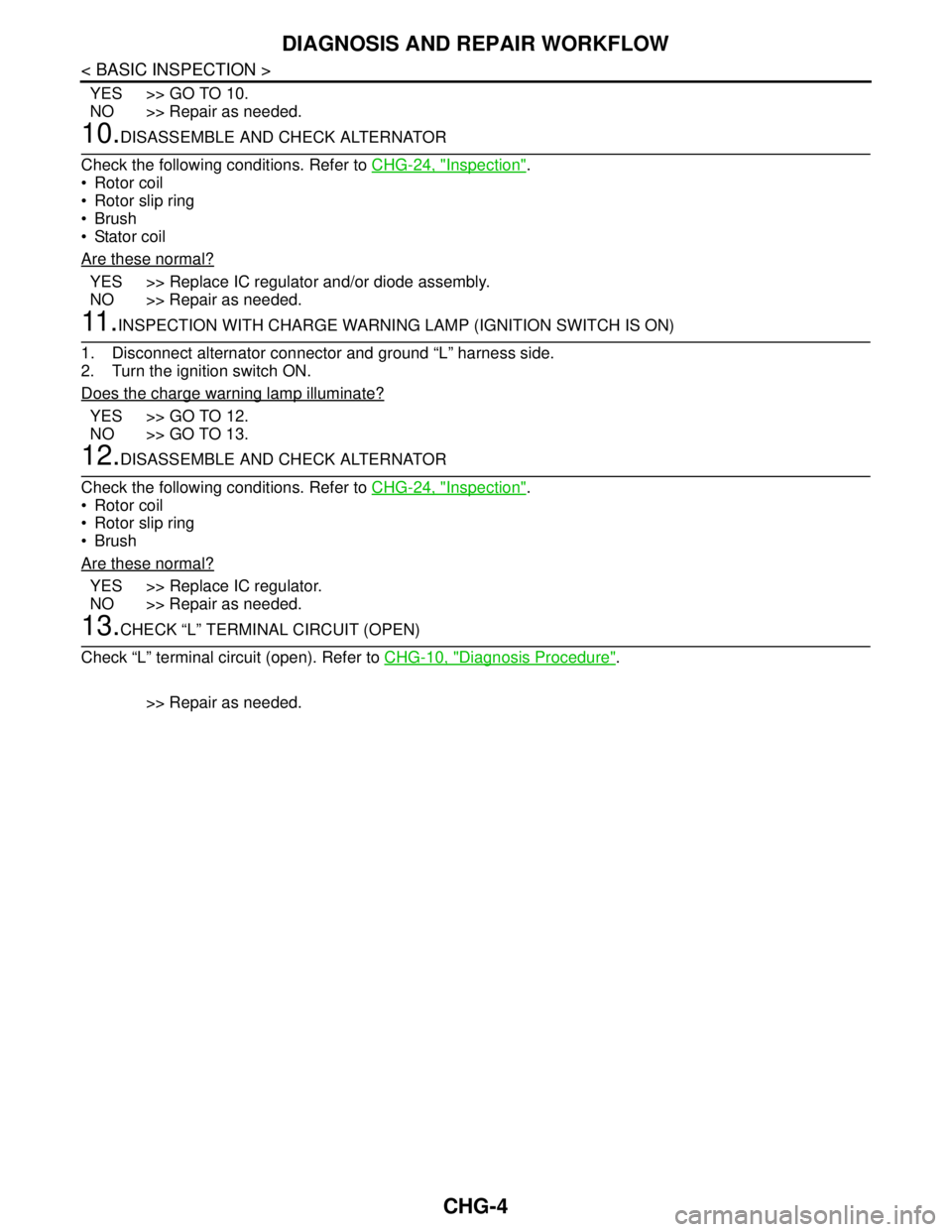
CHG-4
< BASIC INSPECTION >
DIAGNOSIS AND REPAIR WORKFLOW
YES >> GO TO 10.
NO >> Repair as needed.
10.DISASSEMBLE AND CHECK ALTERNATOR
Check the following conditions. Refer to CHG-24, "
Inspection".
Rotor coil
Rotor slip ring
Brush
Stator coil
Are these normal?
YES >> Replace IC regulator and/or diode assembly.
NO >> Repair as needed.
11 .INSPECTION WITH CHARGE WARNING LAMP (IGNITION SWITCH IS ON)
1. Disconnect alternator connector and ground “L” harness side.
2. Turn the ignition switch ON.
Does the charge warning lamp illuminate?
YES >> GO TO 12.
NO >> GO TO 13.
12.DISASSEMBLE AND CHECK ALTERNATOR
Check the following conditions. Refer to CHG-24, "
Inspection".
Rotor coil
Rotor slip ring
Brush
Are these normal?
YES >> Replace IC regulator.
NO >> Repair as needed.
13.CHECK “L” TERMINAL CIRCUIT (OPEN)
Check “L” terminal circuit (open). Refer to CHG-10, "
Diagnosis Procedure".
>> Repair as needed.
Page 1106 of 5121

CHG-8
< FUNCTION DIAGNOSIS >
POWER GENERATION VOLTAGE VARIABLE CONTROL SYSTEM
Component Description
INFOID:0000000003860520
Component part Description
Battery current sensorBattery current sensor is installed to the battery cable at the neg-
ative terminal, and it detects the charging/discharging current of
the battery and sends the voltage signal to ECM according to the
current value.
ECMBattery current sensor detects the charging/discharging current of
the battery. ECM judges the battery condition based on this signal.
ECM judges whether to perform the power generation voltage
variable control according to the battery condition.
When performing the power generation voltage variable control,
ECM calculates the target power generation voltage according to
the battery condition and sends the calculated value as the power
generation command value to IPDM E/R.
IPDM E/RIPDM E/R converts the received power generation command val-
ue into the power generation command signal (PWM signal) and
sends it to the IC voltage regulator.
Alternator (IC voltage regulator)IC voltage regulator controls the power generation voltage by the
target power generation voltage based on the received power gen-
eration command signal.
When there is no power generation command signal, the alterna-
tor performs the normal power generation according to the char-
acteristic of the IC voltage regulator.
Page 1108 of 5121
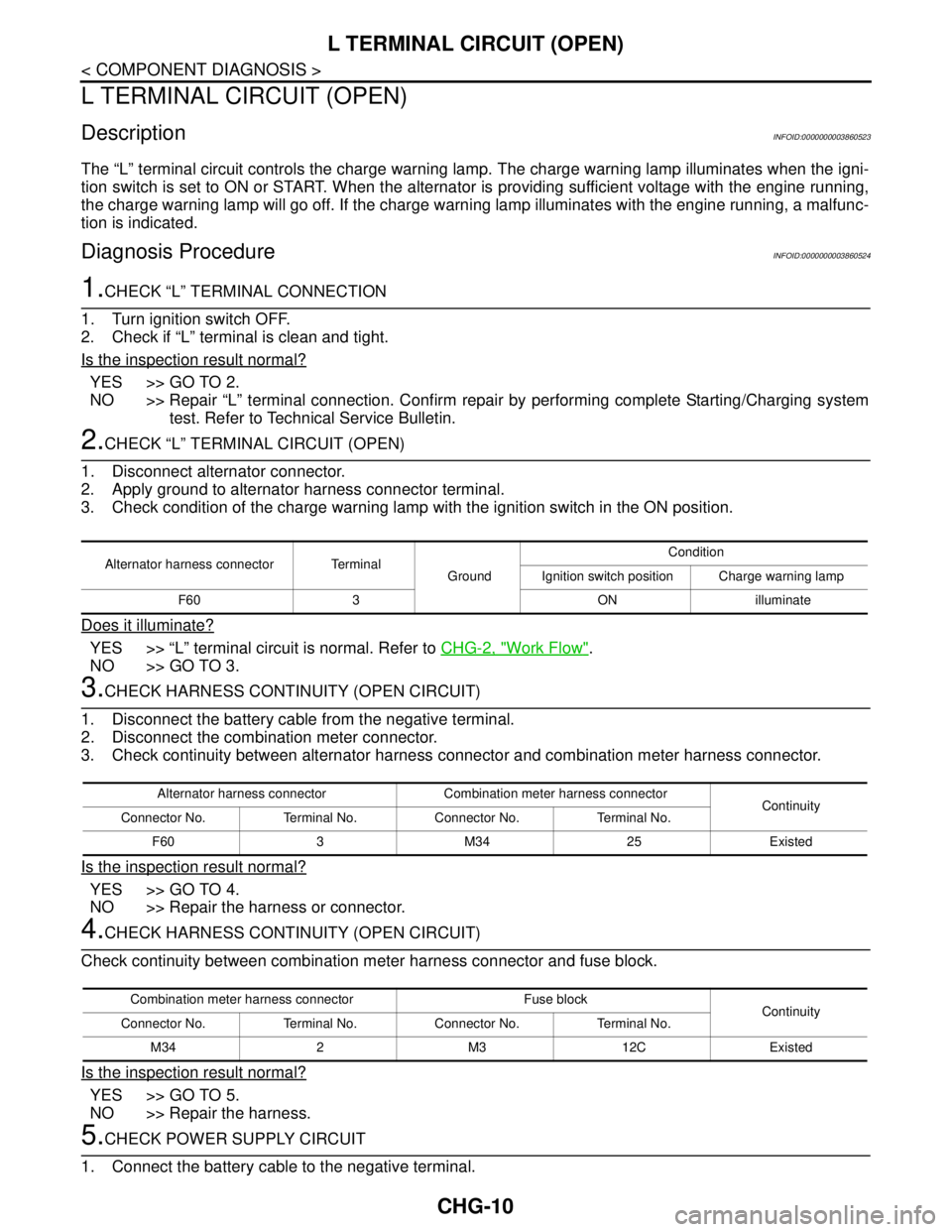
CHG-10
< COMPONENT DIAGNOSIS >
L TERMINAL CIRCUIT (OPEN)
L TERMINAL CIRCUIT (OPEN)
DescriptionINFOID:0000000003860523
The “L” terminal circuit controls the charge warning lamp. The charge warning lamp illuminates when the igni-
tion switch is set to ON or START. When the alternator is providing sufficient voltage with the engine running,
the charge warning lamp will go off. If the charge warning lamp illuminates with the engine running, a malfunc-
tion is indicated.
Diagnosis ProcedureINFOID:0000000003860524
1.CHECK “L” TERMINAL CONNECTION
1. Turn ignition switch OFF.
2. Check if “L” terminal is clean and tight.
Is the inspection result normal?
YES >> GO TO 2.
NO >> Repair “L” terminal connection. Confirm repair by performing complete Starting/Charging system
test. Refer to Technical Service Bulletin.
2.CHECK “L” TERMINAL CIRCUIT (OPEN)
1. Disconnect alternator connector.
2. Apply ground to alternator harness connector terminal.
3. Check condition of the charge warning lamp with the ignition switch in the ON position.
Does it illuminate?
YES >> “L” terminal circuit is normal. Refer to CHG-2, "Work Flow".
NO >> GO TO 3.
3.CHECK HARNESS CONTINUITY (OPEN CIRCUIT)
1. Disconnect the battery cable from the negative terminal.
2. Disconnect the combination meter connector.
3. Check continuity between alternator harness connector and combination meter harness connector.
Is the inspection result normal?
YES >> GO TO 4.
NO >> Repair the harness or connector.
4.CHECK HARNESS CONTINUITY (OPEN CIRCUIT)
Check continuity between combination meter harness connector and fuse block.
Is the inspection result normal?
YES >> GO TO 5.
NO >> Repair the harness.
5.CHECK POWER SUPPLY CIRCUIT
1. Connect the battery cable to the negative terminal.
Alternator harness connector Terminal
GroundCondition
Ignition switch position Charge warning lamp
F60 3 ON illuminate
Alternator harness connector Combination meter harness connector
Continuity
Connector No. Terminal No. Connector No. Terminal No.
F60 3 M34 25 Existed
Combination meter harness connector Fuse block
Continuity
Connector No. Terminal No. Connector No. Terminal No.
M34 2 M3 12C Existed
Page 1109 of 5121
CHG
L TERMINAL CIRCUIT (OPEN)
CHG-11
< COMPONENT DIAGNOSIS >
C
D
E
F
G
H
I
J
K
L B A
O
P N
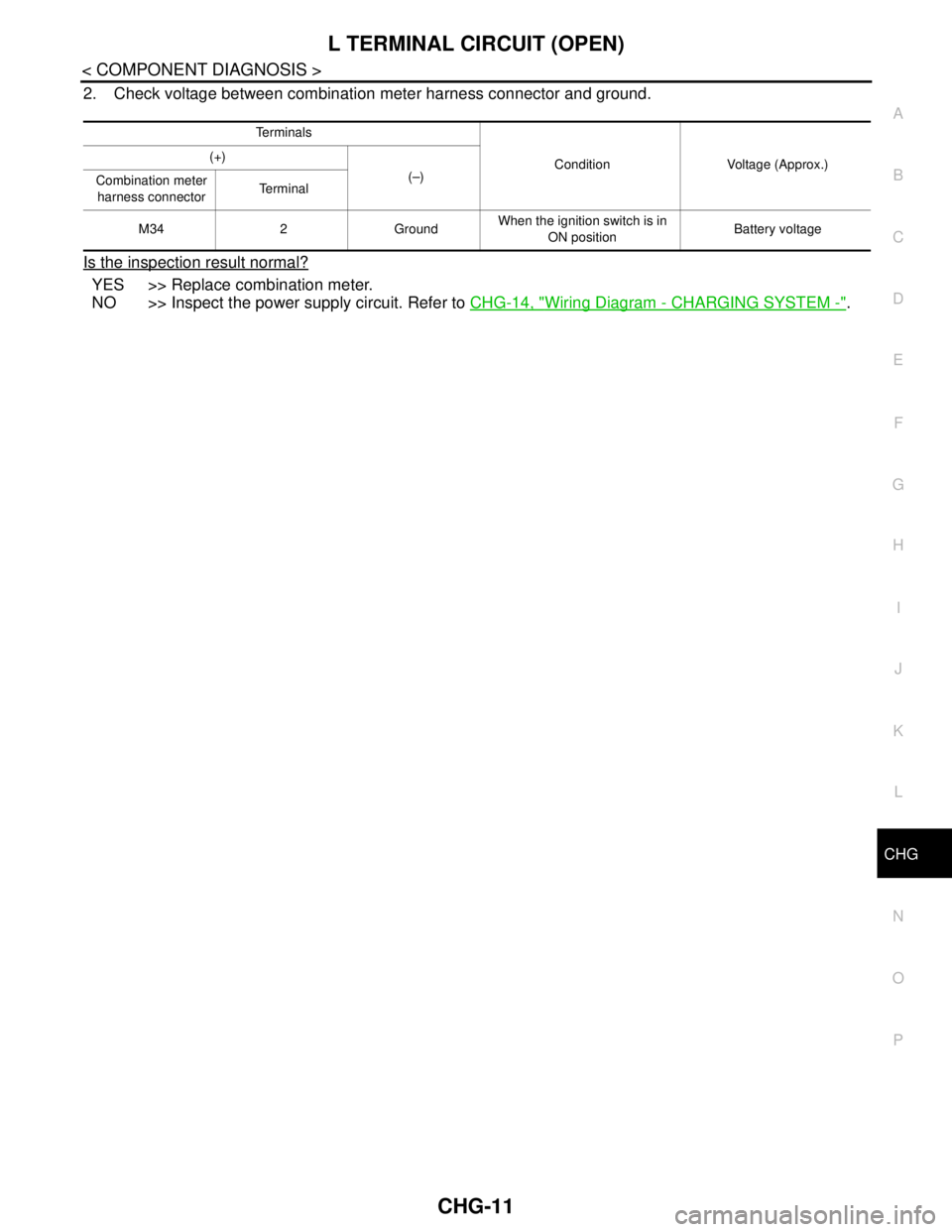
2. Check voltage between combination meter harness connector and ground.
Is the inspection result normal?
YES >> Replace combination meter.
NO >> Inspect the power supply circuit. Refer to CHG-14, "
Wiring Diagram - CHARGING SYSTEM -".
Te r m i n a l s
Condition Voltage (Approx.) (+)
(–)
Combination meter
harness connectorTe r m i n a l
M34 2 GroundWhen the ignition switch is in
ON positionBattery voltage
Page 1133 of 5121
CO-10
< ON-VEHICLE MAINTENANCE >
ENGINE COOLANT
6. Install air duct assembly and air cleaner cases (upper and lower) assembly. Refer to EM-26, "Exploded
View".
7. Install radiator cap.
8. Warm up engine until opening thermostat. Standard for warming-up time is approximately 10 minutes at
3,000 rpm.
Check thermostat opening condition by touching radiator hose (lower) to see a flow of warm water.
CAUTION:
Watch water temperature gauge so as not to overheat engine.
9. Stop the engine and cool down to less than approximately 50°C (122°F).
Cool down using fan to reduce the time.
If necessary, refill radiator up to filler neck with engine coolant.
CAUTION:
Never adhere the engine coolant to electronic equipments. (alternator etc.)
10. Refill reservoir tank to “MAX” level line with engine coolant.
11. Repeat steps 7 through 10 two or more times with radiator cap installed until engine coolant level no
longer drops.
12. Check cooling system for leakage with engine running.
13. Warm up the engine, and check for sound of engine coolant flow while running engine from idle up to
3,000 rpm with heater temperature controller set at several position between “COOL” and “WARM”.
Sound may be noticeable at heater unit.
14. Repeat step 13 three times.
15. If sound is heard, bleed air from cooling system by repeating step 5, and steps from 7 to 14 until engine
coolant level no longer drops.
FlushingINFOID:0000000003793169
1. Install reservoir tank if removed, and radiator drain plug.
CAUTION:
Be sure to clean drain plug and install with new O-ring.
If water drain plugs on cylinder block are removed, close and tighten them. Refer to EM-110, "
Dis-
assembly and Assembly".
2. Remove air duct assembly and air cleaner cases (upper and lower) assembly. Refer to EM-26, "
Exploded
View".
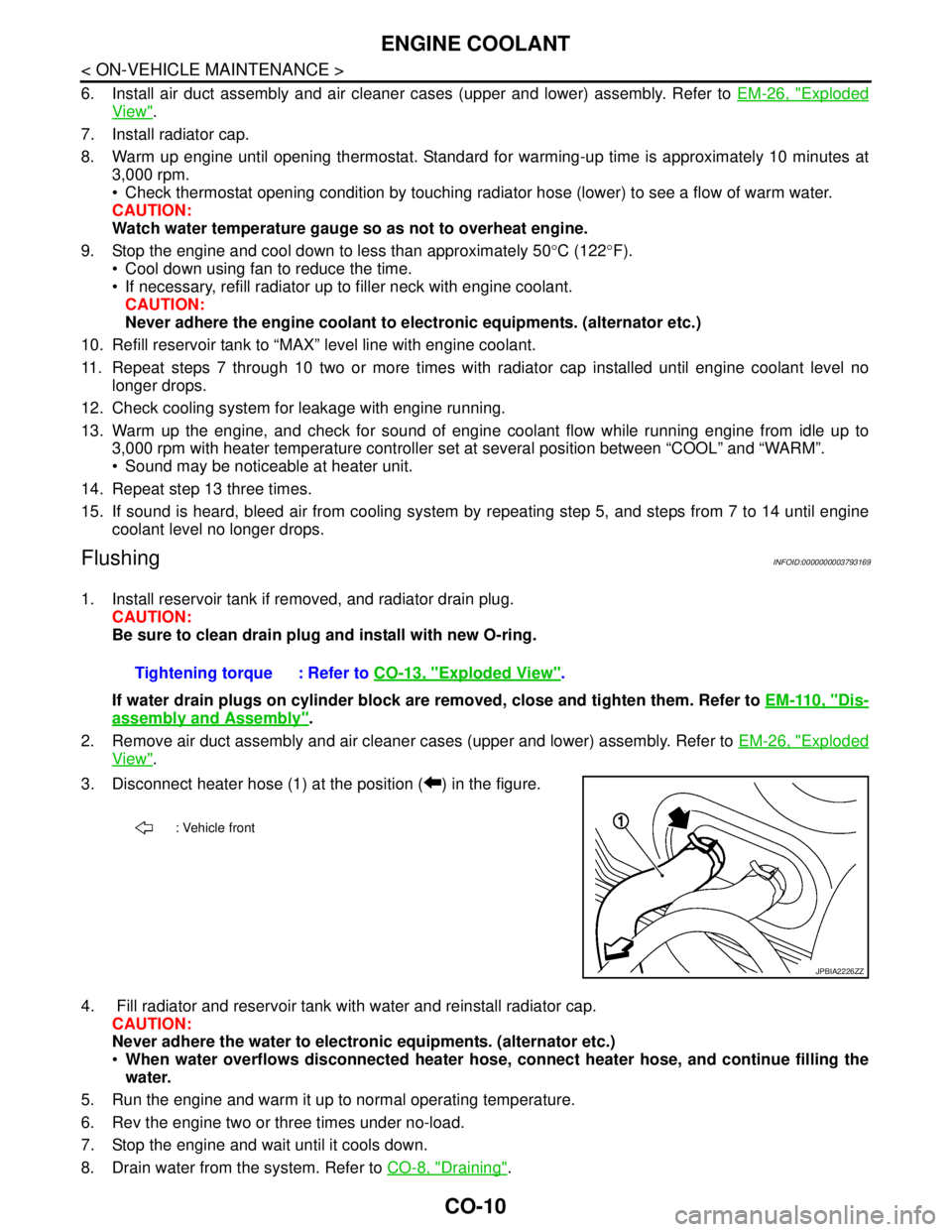
3. Disconnect heater hose (1) at the position ( ) in the figure.
4. Fill radiator and reservoir tank with water and reinstall radiator cap.
CAUTION:
Never adhere the water to electronic equipments. (alternator etc.)
When water overflows disconnected heater hose, connect heater hose, and continue filling the
water.
5. Run the engine and warm it up to normal operating temperature.
6. Rev the engine two or three times under no-load.
7. Stop the engine and wait until it cools down.
8. Drain water from the system. Refer to CO-8, "
Draining". Tightening torque : Refer to CO-13, "
Exploded View".
: Vehicle front
JPBIA2226ZZ