ECU NISSAN TEANA 2008 Service Manual
[x] Cancel search | Manufacturer: NISSAN, Model Year: 2008, Model line: TEANA, Model: NISSAN TEANA 2008Pages: 5121, PDF Size: 69.03 MB
Page 2458 of 5121
FAX-30
< ON-VEHICLE REPAIR >
FRONT DRIVE SHAFT
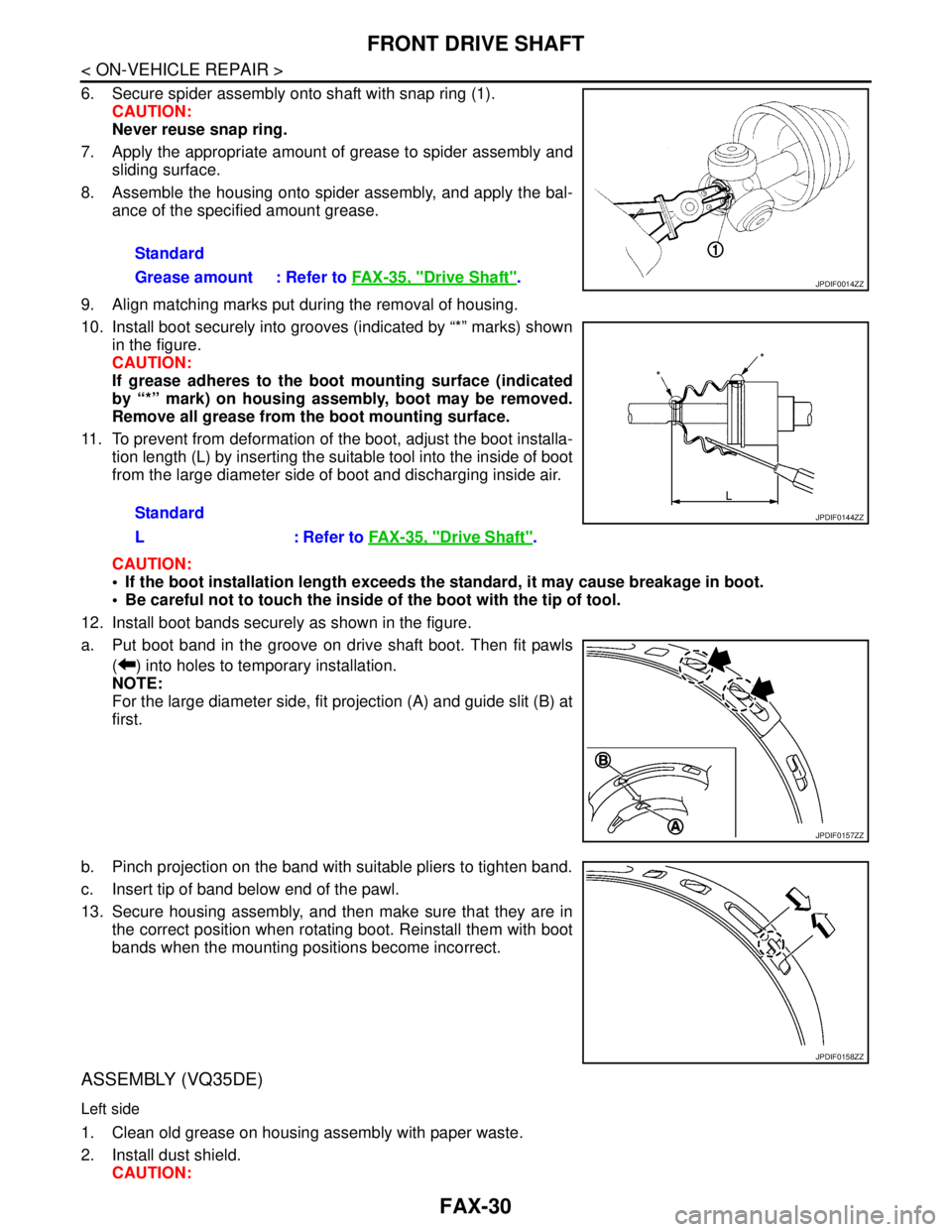
6. Secure spider assembly onto shaft with snap ring (1).
CAUTION:
Never reuse snap ring.
7. Apply the appropriate amount of grease to spider assembly and
sliding surface.
8. Assemble the housing onto spider assembly, and apply the bal-
ance of the specified amount grease.
9. Align matching marks put during the removal of housing.
10. Install boot securely into grooves (indicated by “*” marks) shown
in the figure.
CAUTION:
If grease adheres to the boot mounting surface (indicated
by “*” mark) on housing assembly, boot may be removed.
Remove all grease from the boot mounting surface.
11. To prevent from deformation of the boot, adjust the boot installa-
tion length (L) by inserting the suitable tool into the inside of boot
from the large diameter side of boot and discharging inside air.
CAUTION:
If the boot installation length exceeds the standard, it may cause breakage in boot.
Be careful not to touch the inside of the boot with the tip of tool.
12. Install boot bands securely as shown in the figure.
a. Put boot band in the groove on drive shaft boot. Then fit pawls
( ) into holes to temporary installation.
NOTE:
For the large diameter side, fit projection (A) and guide slit (B) at
first.
b. Pinch projection on the band with suitable pliers to tighten band.
c. Insert tip of band below end of the pawl.
13. Secure housing assembly, and then make sure that they are in
the correct position when rotating boot. Reinstall them with boot
bands when the mounting positions become incorrect.
ASSEMBLY (VQ35DE)
Left side
1. Clean old grease on housing assembly with paper waste.
2. Install dust shield.
CAUTION:Standard
Grease amount : Refer to FAX-35, "
Drive Shaft".
Standard
L: Refer to FAX-35, "
Drive Shaft".
JPDIF0014ZZ
JPDIF0144ZZ
JPDIF0157ZZ
JPDIF0158ZZ
Page 2459 of 5121
FRONT DRIVE SHAFT
FAX-31
< ON-VEHICLE REPAIR >
C
E
F
G
H
I
J
K
L
MA
B
FA X
N
O
P
Never reuse dust shield.
3. Install circular clip.
CAUTION:
Never reuse circular clip.
4. Apply balance of the specified amount grease to housing assembly.
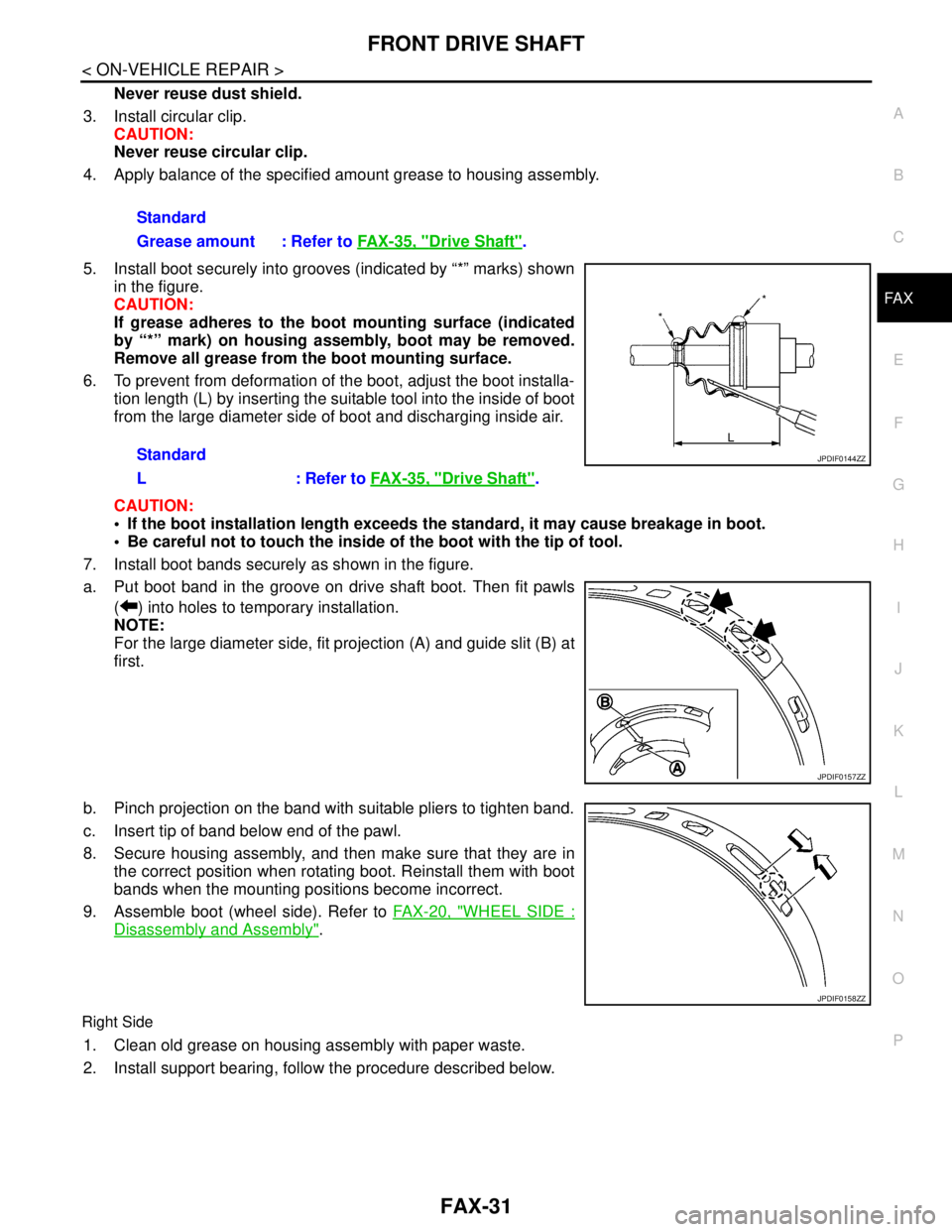
5. Install boot securely into grooves (indicated by “*” marks) shown
in the figure.
CAUTION:
If grease adheres to the boot mounting surface (indicated
by “*” mark) on housing assembly, boot may be removed.
Remove all grease from the boot mounting surface.
6. To prevent from deformation of the boot, adjust the boot installa-
tion length (L) by inserting the suitable tool into the inside of boot
from the large diameter side of boot and discharging inside air.
CAUTION:
If the boot installation length exceeds the standard, it may cause breakage in boot.
Be careful not to touch the inside of the boot with the tip of tool.
7. Install boot bands securely as shown in the figure.
a. Put boot band in the groove on drive shaft boot. Then fit pawls
( ) into holes to temporary installation.
NOTE:
For the large diameter side, fit projection (A) and guide slit (B) at
first.
b. Pinch projection on the band with suitable pliers to tighten band.
c. Insert tip of band below end of the pawl.
8. Secure housing assembly, and then make sure that they are in
the correct position when rotating boot. Reinstall them with boot
bands when the mounting positions become incorrect.
9. Assemble boot (wheel side). Refer to FAX-20, "
WHEEL SIDE :
Disassembly and Assembly".
Right Side
1. Clean old grease on housing assembly with paper waste.
2. Install support bearing, follow the procedure described below. Standard
Grease amount : Refer to FAX-35, "
Drive Shaft".
Standard
L : Refer to FAX-35, "
Drive Shaft".
JPDIF0144ZZ
JPDIF0157ZZ
JPDIF0158ZZ
Page 2460 of 5121
FAX-32
< ON-VEHICLE REPAIR >
FRONT DRIVE SHAFT
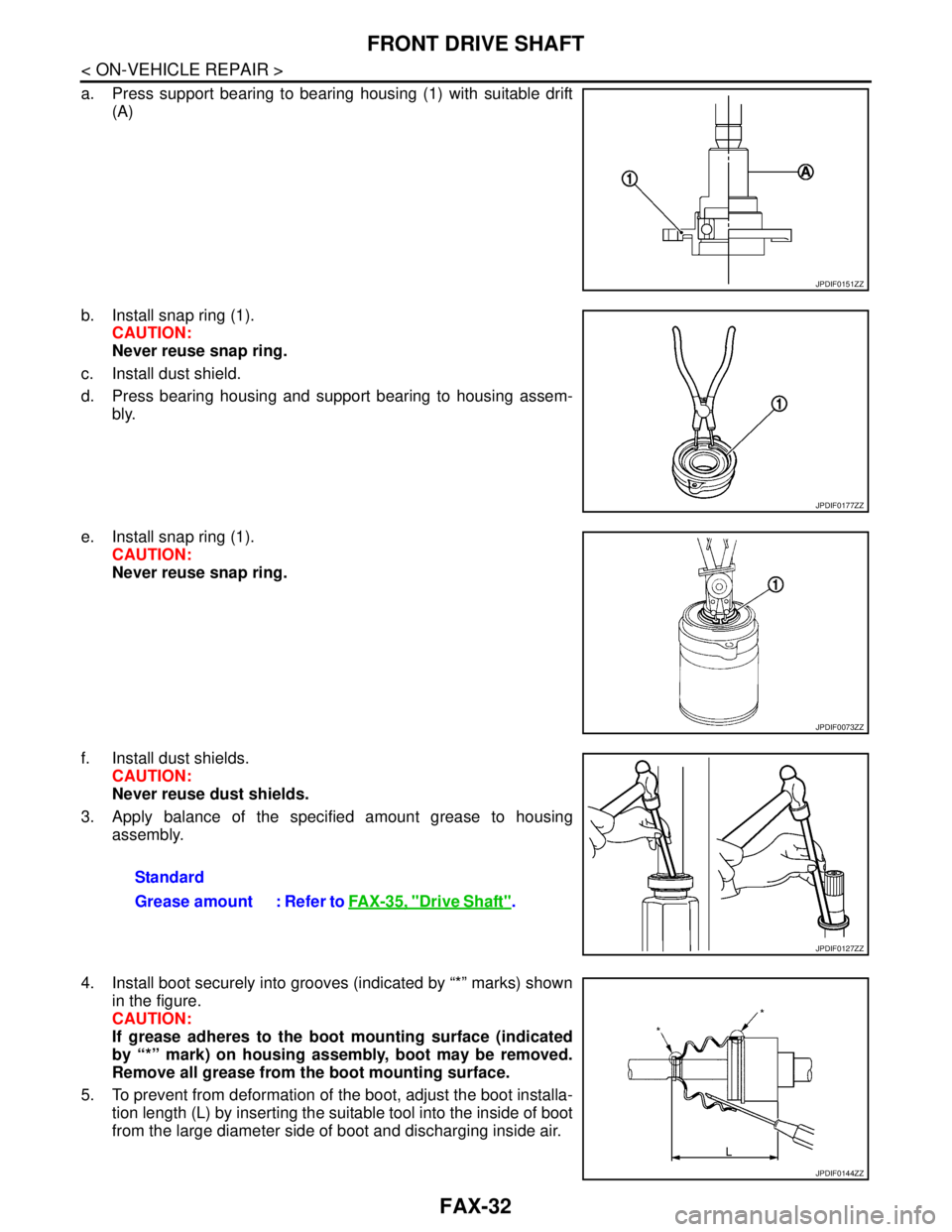
a. Press support bearing to bearing housing (1) with suitable drift
(A)
b. Install snap ring (1).
CAUTION:
Never reuse snap ring.
c. Install dust shield.
d. Press bearing housing and support bearing to housing assem-
bly.
e. Install snap ring (1).
CAUTION:
Never reuse snap ring.
f. Install dust shields.
CAUTION:
Never reuse dust shields.
3. Apply balance of the specified amount grease to housing
assembly.
4. Install boot securely into grooves (indicated by “*” marks) shown
in the figure.
CAUTION:
If grease adheres to the boot mounting surface (indicated
by “*” mark) on housing assembly, boot may be removed.
Remove all grease from the boot mounting surface.
5. To prevent from deformation of the boot, adjust the boot installa-
tion length (L) by inserting the suitable tool into the inside of boot
from the large diameter side of boot and discharging inside air.
JPDIF0151ZZ
JPDIF0177ZZ
JPDIF0073ZZ
Standard
Grease amount : Refer to FAX-35, "
Drive Shaft".
JPDIF0127ZZ
JPDIF0144ZZ
Page 2461 of 5121
FRONT DRIVE SHAFT
FAX-33
< ON-VEHICLE REPAIR >
C
E
F
G
H
I
J
K
L
MA
B
FA X
N
O
P
CAUTION:
If the boot installation length exceeds the standard, it may cause breakage in boot.
Be careful not to touch the inside of the boot with the tip of tool.
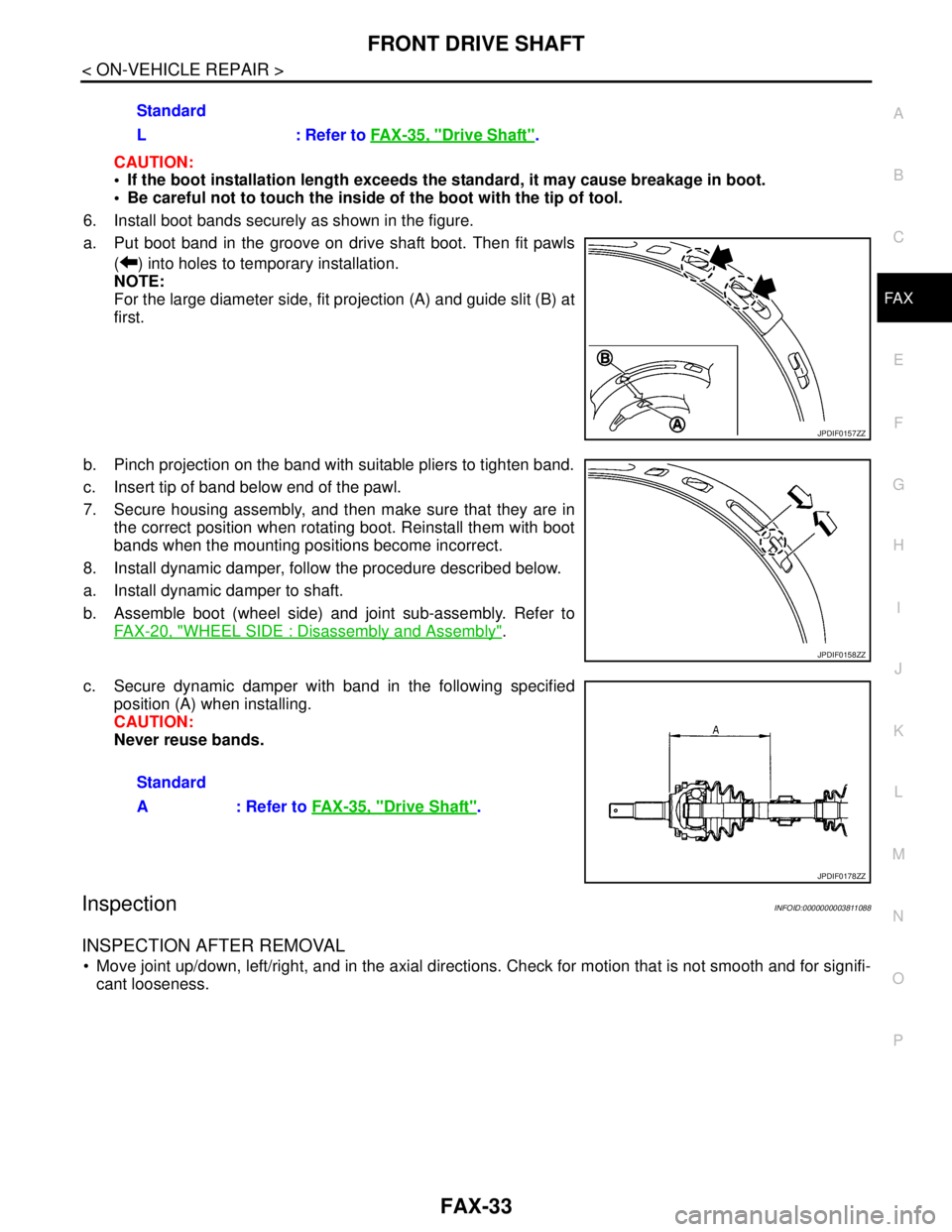
6. Install boot bands securely as shown in the figure.
a. Put boot band in the groove on drive shaft boot. Then fit pawls
( ) into holes to temporary installation.
NOTE:
For the large diameter side, fit projection (A) and guide slit (B) at
first.
b. Pinch projection on the band with suitable pliers to tighten band.
c. Insert tip of band below end of the pawl.
7. Secure housing assembly, and then make sure that they are in
the correct position when rotating boot. Reinstall them with boot
bands when the mounting positions become incorrect.
8. Install dynamic damper, follow the procedure described below.
a. Install dynamic damper to shaft.
b. Assemble boot (wheel side) and joint sub-assembly. Refer to
FAX-20, "
WHEEL SIDE : Disassembly and Assembly".
c. Secure dynamic damper with band in the following specified
position (A) when installing.
CAUTION:
Never reuse bands.
InspectionINFOID:0000000003811088
INSPECTION AFTER REMOVAL
Move joint up/down, left/right, and in the axial directions. Check for motion that is not smooth and for signifi-
cant looseness.Standard
L : Refer to FAX-35, "
Drive Shaft".
JPDIF0157ZZ
JPDIF0158ZZ
Standard
A : Refer to FAX-35, "
Drive Shaft".
JPDIF0178ZZ
Page 2465 of 5121
FL-2
< PRECAUTION >
PRECAUTIONS
PRECAUTION
PRECAUTIONS
General PrecautionsINFOID:0000000003793245
WARNING:
When replacing fuel line parts, be sure to observe the following.
• Put a “CAUTION: FLAMMABLE” sign in the workshop.
Be sure to work in a well ventilated area and furnish workshop with a CO
2 fire extinguisher.
Never smoke while servicing fuel system. Keep open flames and sparks away from the work area.
CAUTION:
Use gasoline required by the regulations for octane number. Refer to GI-29, "
Fuel".
Before removing fuel line parts, perform out the following procedures:
- Put drained fuel in an explosion-proof container and put the lid on securely. Keep the container in
safe area.
- Release fuel pressure from the fuel lines. Refer to EC-411, "
Inspection".
- Disconnect the battery cable from the negative terminal.
Always replace O-ring and clamps with new ones.
Never kink or twist tubes when they are being installed.
Never tighten hose clamps excessively to avoid damaging hoses.
After installing tubes, check there is no fuel leakage at connections in the following steps.
- Apply fuel pressure to fuel lines with turning ignition switch “ON” (with engine stopped). Then check
for fuel leakage at connections.
- Start engine and rev it up and check for fuel leakage at connections.
Use only a genuine NISSAN fuel filler cap as a replacement. If an incorrect fuel filler cap is used, the
“MI” may come on.
For servicing “Evaporative Emission System” parts, refer to EC-76, "
System Diagram".
Page 2467 of 5121
FL-4
< ON-VEHICLE MAINTENANCE >
FUEL SYSTEM
ON-VEHICLE MAINTENANCE
FUEL SYSTEM
InspectionINFOID:0000000003793248
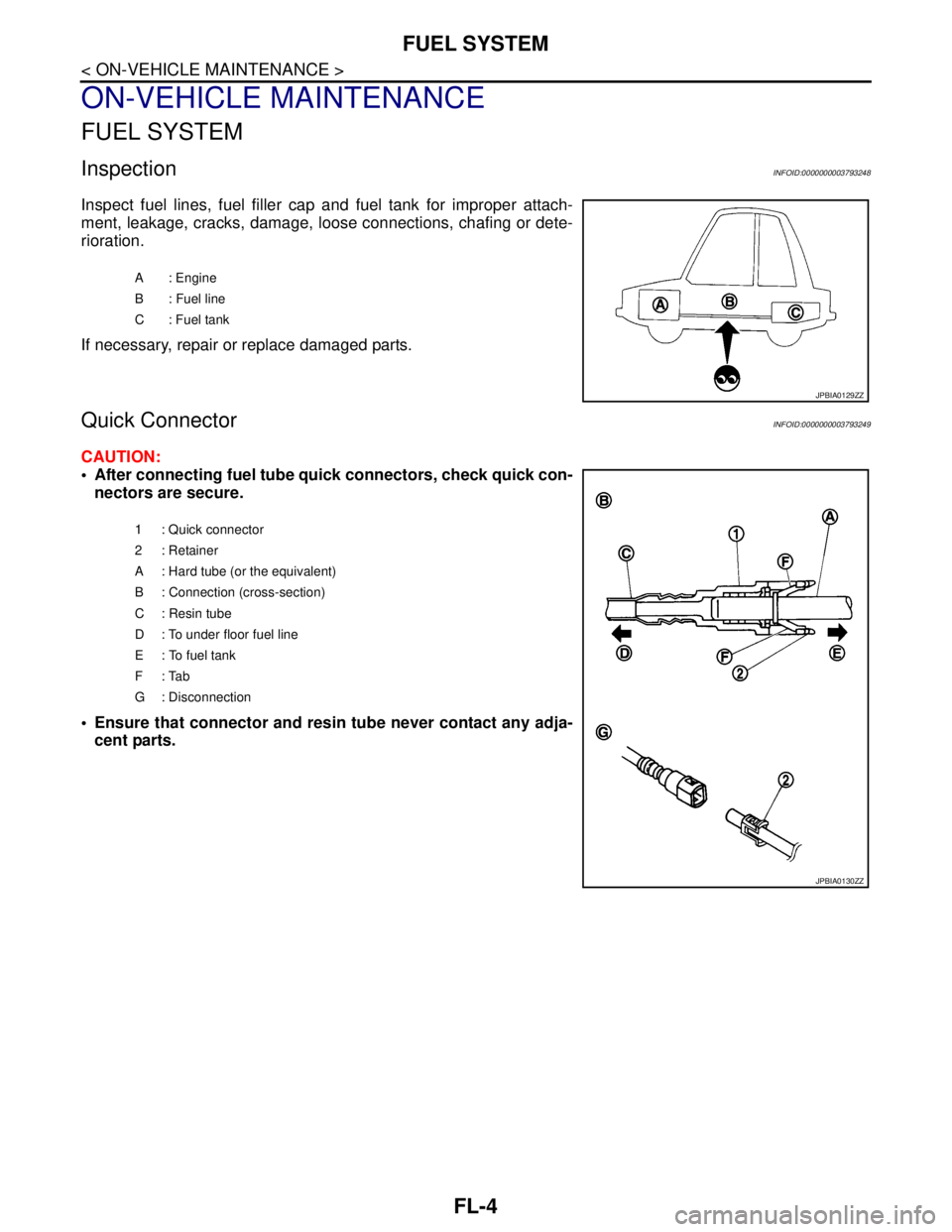
Inspect fuel lines, fuel filler cap and fuel tank for improper attach-
ment, leakage, cracks, damage, loose connections, chafing or dete-
rioration.
If necessary, repair or replace damaged parts.
Quick ConnectorINFOID:0000000003793249
CAUTION:
After connecting fuel tube quick connectors, check quick con-
nectors are secure.
Ensure that connector and resin tube never contact any adja-
cent parts.
A : Engine
B : Fuel line
C: Fuel tank
JPBIA0129ZZ
1 : Quick connector
2: Retainer
A : Hard tube (or the equivalent)
B : Connection (cross-section)
C : Resin tube
D : To under floor fuel line
E : To fuel tank
F: Tab
G : Disconnection
JPBIA0130ZZ
Page 2471 of 5121
FL-8
< ON-VEHICLE REPAIR >
FUEL LEVEL SENSOR UNIT, FUEL FILTER AND FUEL PUMP ASSEMBLY
INSTALLATION
Note to the following, and install in the reverse order of removal.
Fuel Level Sensor Unit
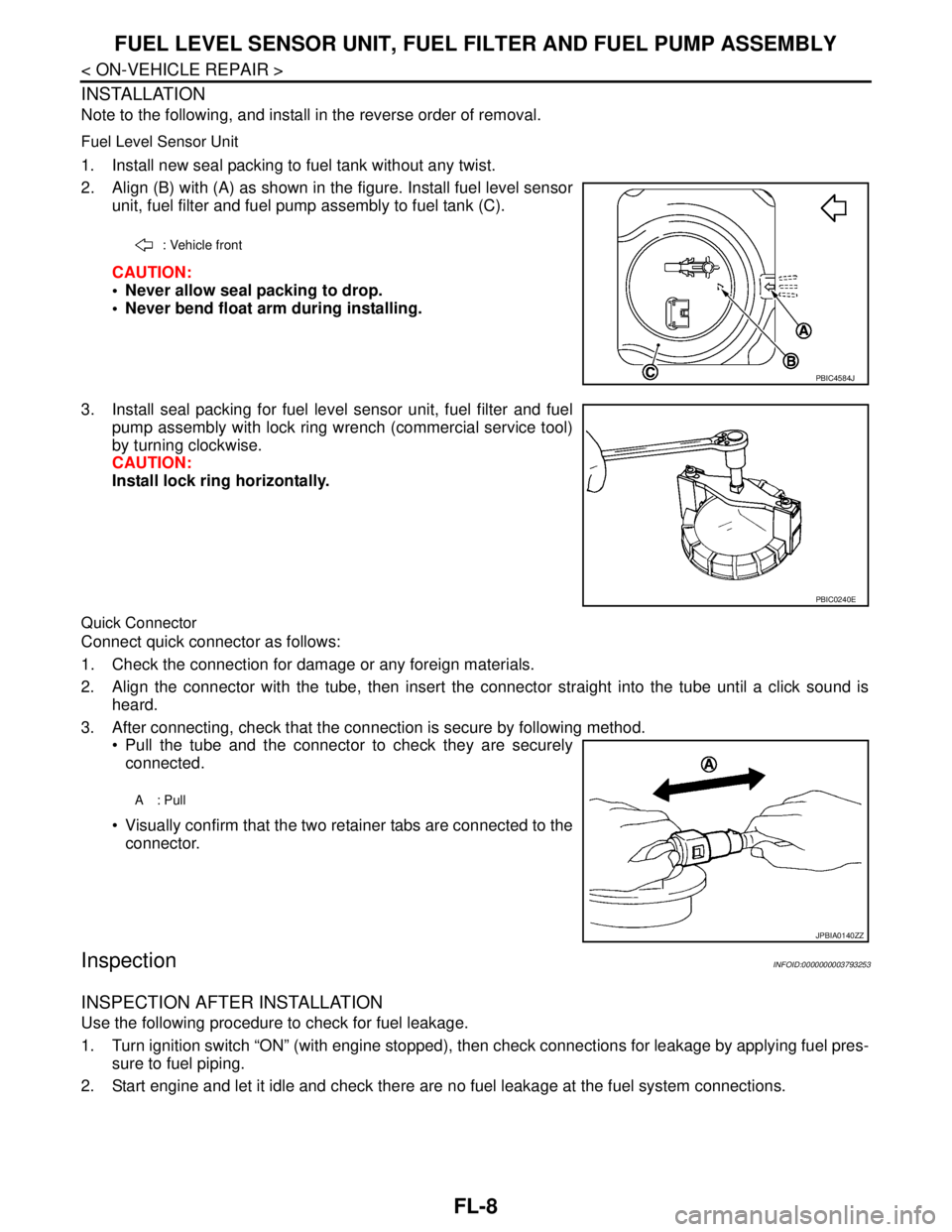
1. Install new seal packing to fuel tank without any twist.
2. Align (B) with (A) as shown in the figure. Install fuel level sensor
unit, fuel filter and fuel pump assembly to fuel tank (C).
CAUTION:
Never allow seal packing to drop.
Never bend float arm during installing.
3. Install seal packing for fuel level sensor unit, fuel filter and fuel
pump assembly with lock ring wrench (commercial service tool)
by turning clockwise.
CAUTION:
Install lock ring horizontally.
Quick Connector
Connect quick connector as follows:
1. Check the connection for damage or any foreign materials.
2. Align the connector with the tube, then insert the connector straight into the tube until a click sound is
heard.
3. After connecting, check that the connection is secure by following method.
Pull the tube and the connector to check they are securely
connected.
Visually confirm that the two retainer tabs are connected to the
connector.
InspectionINFOID:0000000003793253
INSPECTION AFTER INSTALLATION
Use the following procedure to check for fuel leakage.
1. Turn ignition switch “ON” (with engine stopped), then check connections for leakage by applying fuel pres-
sure to fuel piping.
2. Start engine and let it idle and check there are no fuel leakage at the fuel system connections.
: Vehicle front
PBIC4584J
PBIC0240E
A: Pull
JPBIA0140ZZ
Page 2484 of 5121
FSU-10
< ON-VEHICLE REPAIR >
FRONT COIL SPRING AND STRUT
Disassembly and Assembly
INFOID:0000000003811118
DISASSEMBLY
CAUTION:
Never damage strut assembly piston rod when removing components from strut assembly.
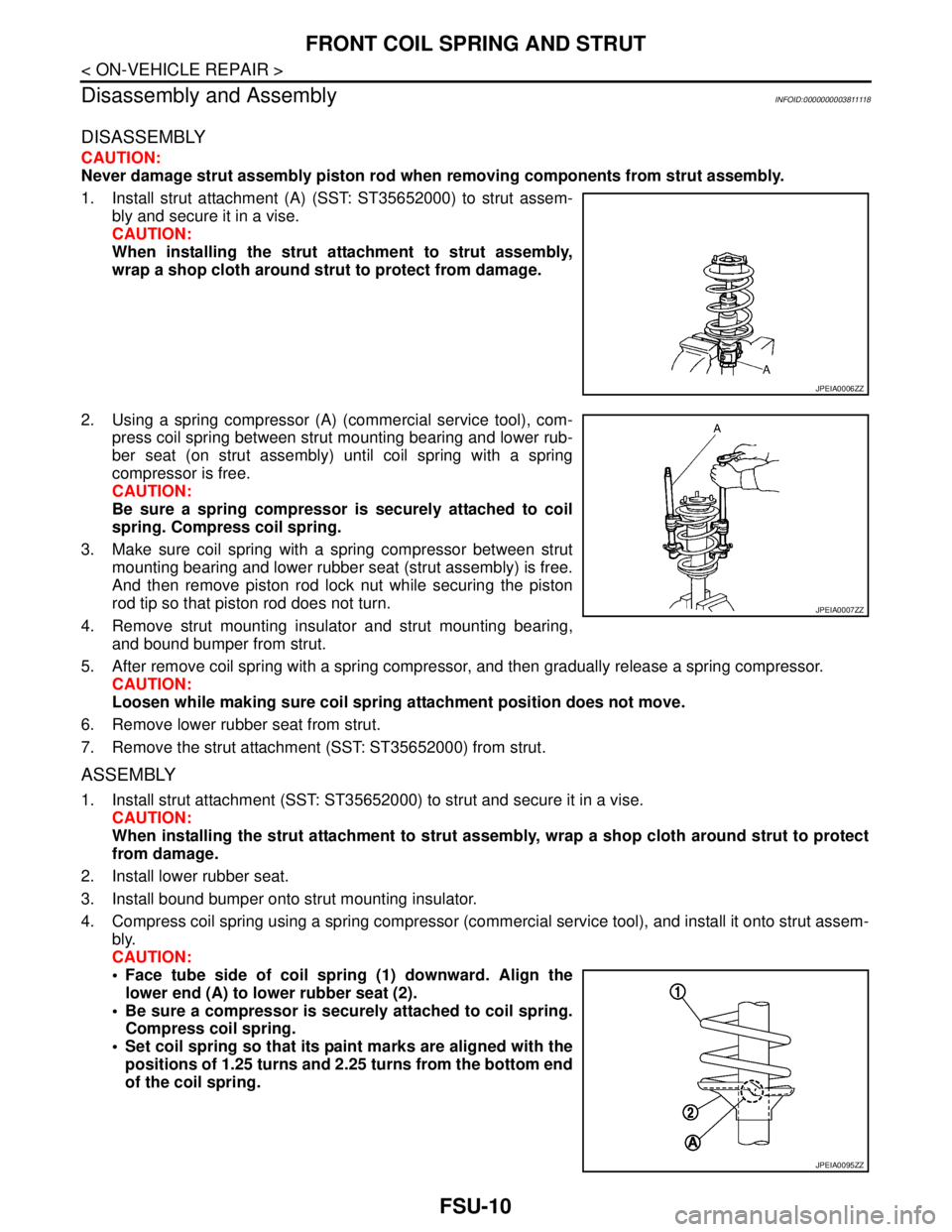
1. Install strut attachment (A) (SST: ST35652000) to strut assem-
bly and secure it in a vise.
CAUTION:
When installing the strut attachment to strut assembly,
wrap a shop cloth around strut to protect from damage.
2. Using a spring compressor (A) (commercial service tool), com-
press coil spring between strut mounting bearing and lower rub-
ber seat (on strut assembly) until coil spring with a spring
compressor is free.
CAUTION:
Be sure a spring compressor is securely attached to coil
spring. Compress coil spring.
3. Make sure coil spring with a spring compressor between strut
mounting bearing and lower rubber seat (strut assembly) is free.
And then remove piston rod lock nut while securing the piston
rod tip so that piston rod does not turn.
4. Remove strut mounting insulator and strut mounting bearing,
and bound bumper from strut.
5. After remove coil spring with a spring compressor, and then gradually release a spring compressor.
CAUTION:
Loosen while making sure coil spring attachment position does not move.
6. Remove lower rubber seat from strut.
7. Remove the strut attachment (SST: ST35652000) from strut.
ASSEMBLY
1. Install strut attachment (SST: ST35652000) to strut and secure it in a vise.
CAUTION:
When installing the strut attachment to strut assembly, wrap a shop cloth around strut to protect
from damage.
2. Install lower rubber seat.
3. Install bound bumper onto strut mounting insulator.
4. Compress coil spring using a spring compressor (commercial service tool), and install it onto strut assem-
bly.
CAUTION:
Face tube side of coil spring (1) downward. Align the
lower end (A) to lower rubber seat (2).
Be sure a compressor is securely attached to coil spring.
Compress coil spring.
Set coil spring so that its paint marks are aligned with the
positions of 1.25 turns and 2.25 turns from the bottom end
of the coil spring.
JPEIA0006ZZ
JPEIA0007ZZ
JPEIA0095ZZ
Page 2485 of 5121
FRONT COIL SPRING AND STRUT
FSU-11
< ON-VEHICLE REPAIR >
C
D
F
G
H
I
J
K
L
MA
B
FSU
N
O
P
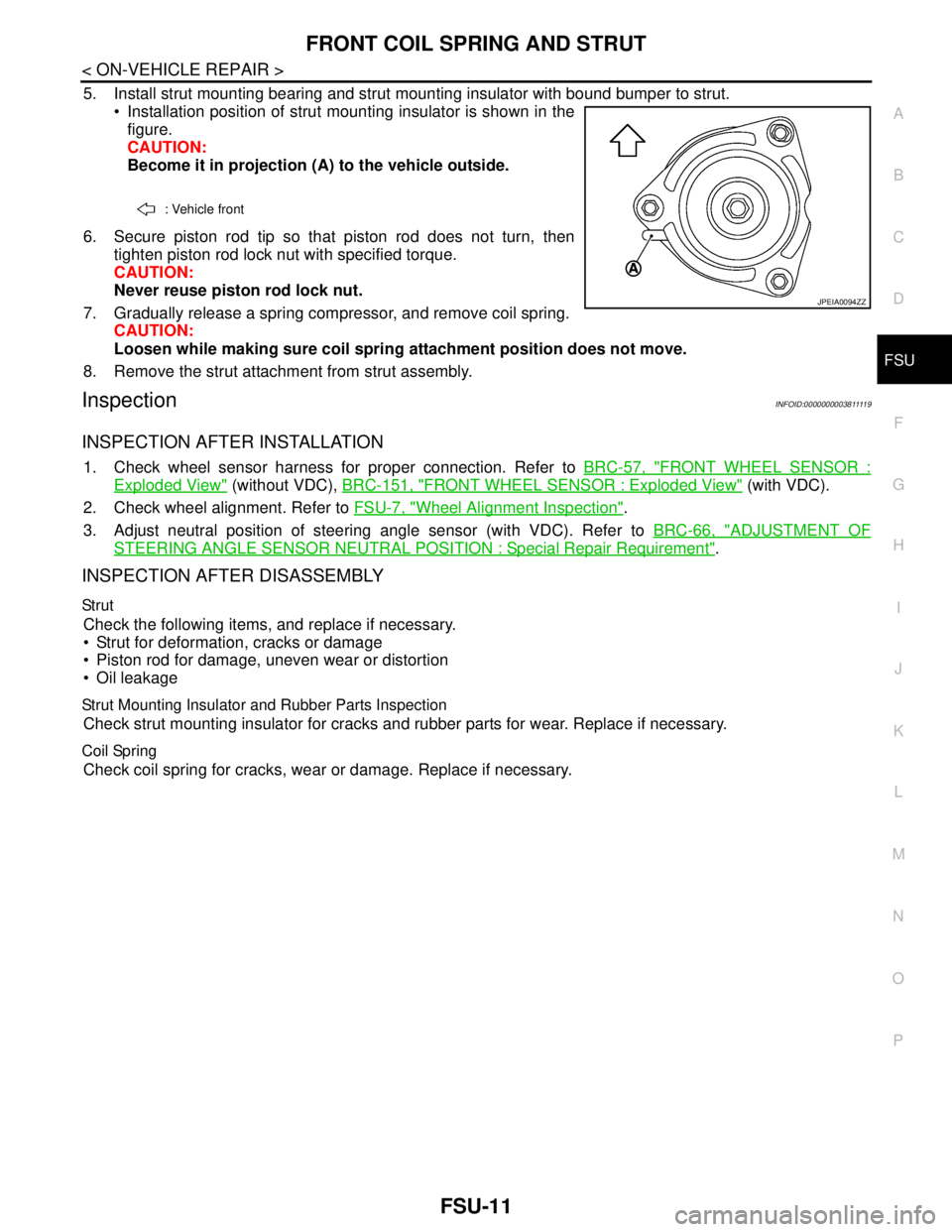
5. Install strut mounting bearing and strut mounting insulator with bound bumper to strut.
Installation position of strut mounting insulator is shown in the
figure.
CAUTION:
Become it in projection (A) to the vehicle outside.
6. Secure piston rod tip so that piston rod does not turn, then
tighten piston rod lock nut with specified torque.
CAUTION:
Never reuse piston rod lock nut.
7. Gradually release a spring compressor, and remove coil spring.
CAUTION:
Loosen while making sure coil spring attachment position does not move.
8. Remove the strut attachment from strut assembly.
InspectionINFOID:000000000381111 9
INSPECTION AFTER INSTALLATION
1. Check wheel sensor harness for proper connection. Refer to BRC-57, "FRONT WHEEL SENSOR :
Exploded View" (without VDC), BRC-151, "FRONT WHEEL SENSOR : Exploded View" (with VDC).
2. Check wheel alignment. Refer to FSU-7, "
Wheel Alignment Inspection".
3. Adjust neutral position of steering angle sensor (with VDC). Refer to BRC-66, "
ADJUSTMENT OF
STEERING ANGLE SENSOR NEUTRAL POSITION : Special Repair Requirement".
INSPECTION AFTER DISASSEMBLY
Str ut
Check the following items, and replace if necessary.
Strut for deformation, cracks or damage
Piston rod for damage, uneven wear or distortion
Oil leakage
Strut Mounting Insulator and Rubber Parts Inspection
Check strut mounting insulator for cracks and rubber parts for wear. Replace if necessary.
Coil Spring
Check coil spring for cracks, wear or damage. Replace if necessary.
: Vehicle front
JPEIA0094ZZ
Page 2517 of 5121
GI-24
< PRECAUTION >
PRECAUTIONS
PRECAUTION
PRECAUTIONS
DescriptionINFOID:0000000003852776
Observe the following precautions to ensure safe and proper servicing. These precautions are not
described in each individual section.
Precaution for Supplemental Restraint System (SRS) "AIR BAG" and "SEAT BELT
PRE-TENSIONER"
INFOID:0000000003852830
The Supplemental Restraint System such as “AIR BAG” and “SEAT BELT PRE-TENSIONER”, used along
with a front seat belt, helps to reduce the risk or severity of injury to the driver and front passenger for certain
types of collision. Information necessary to service the system safely is included in the “SRS AIRBAG” and
“SEAT BELT” of this Service Manual.
WARNING:
To avoid rendering the SRS inoperative, which could increase the risk of personal injury or death in
the event of a collision which would result in air bag inflation, all maintenance must be performed by
an authorized NISSAN/INFINITI dealer.
Improper maintenance, including incorrect removal and installation of the SRS, can lead to personal
injury caused by unintentional activation of the system. For removal of Spiral Cable and Air Bag
Module, see the “SRS AIRBAG”.
Never use electrical test equipment on any circuit related to the SRS unless instructed to in this Ser-
vice Manual. SRS wiring harnesses can be identified by yellow and/or orange harnesses or harness
connectors.
Precautions For Xenon Headlamp ServiceINFOID:0000000003852778
WARNING:
Comply with the following warnings to prevent any serious accident.
Disconnect the battery cable (negative terminal) or the power supply fuse before installing, remov-
ing, or touching the xenon headlamp (bulb included). The xenon headlamp contains high-voltage
generated parts.
Never work with wet hands.
Check the xenon headlamp ON-OFF status after assembling it to the vehicle. Never turn the xenon
headlamp ON in other conditions. Connect the power supply to the vehicle-side connector.
(Turning it ON outside the lamp case may cause fire or visual impairments.)
Never touch the bulb glass immediately after turning it OFF. It is extremely hot.
CAUTION:
Comply with the following cautions to prevent any error and malfunction.
Install the xenon bulb securely. (Insufficient bulb socket installation may melt the bulb, the connec-
tor, the housing, etc. by high-voltage leakage or corona discharge.)
Never perform HID circuit inspection with a tester.
Never touch the xenon bulb glass with hands. Never put oil and grease on it.
Dispose of the used xenon bulb after packing it in thick vinyl without breaking it.
Never wipe out dirt and contamination with organic solvent (thinner, gasoline, etc.).
Precaution Necessary for Steering Wheel Rotation after Battery Disconnect
INFOID:0000000003852856
NOTE:
Before removing and installing any control units, first turn the push-button ignition switch to the LOCK posi-
tion, then disconnect both battery cables.
After finishing work, confirm that all control unit connectors are connected properly, then re-connect both
battery cables.
Always use CONSULT-III to perform self-diagnosis as a part of each function inspection after finishing work.
If a DTC is detected, perform trouble diagnosis according to self-diagnosis results.
This vehicle is equipped with a push-button ignition switch and a steering lock unit.
If the battery is disconnected or discharged, the steering wheel will lock and cannot be turned.