ECU NISSAN TEANA 2008 Service Manual
[x] Cancel search | Manufacturer: NISSAN, Model Year: 2008, Model line: TEANA, Model: NISSAN TEANA 2008Pages: 5121, PDF Size: 69.03 MB
Page 2355 of 5121
![NISSAN TEANA 2008 Service Manual EXL-326
< ECU DIAGNOSIS >[HALOGEN TYPE]
IPDM E/R (INTELLIGENT POWER DISTRIBUTION MODULE ENGINE ROOM)
If No CAN Communication Is Available With BCM
IGNITION RELAY MALFUNCTION DETECTION FUNCTION
IPDM](/img/5/57391/w960_57391-2354.png "NISSAN TEANA 2008 Service Manual EXL-326
< ECU DIAGNOSIS >[HALOGEN TYPE]
IPDM E/R (INTELLIGENT POWER DISTRIBUTION MODULE ENGINE ROOM)
If No CAN Communication Is Available With BCM
IGNITION RELAY MALFUNCTION DETECTION FUNCTION
IPDM")
EXL-326
< ECU DIAGNOSIS >[HALOGEN TYPE]
IPDM E/R (INTELLIGENT POWER DISTRIBUTION MODULE ENGINE ROOM)
If No CAN Communication Is Available With BCM
IGNITION RELAY MALFUNCTION DETECTION FUNCTION
IPDM E/R monitors the voltage at the contact circuit and excitation coil circuit of the ignition relay inside it.
IPDM E/R judges the ignition relay error if the voltage differs between the contact circuit and the excitation
coil circuit.
If the ignition relay cannot turn OFF due to contact seizure, it activates the tail lamp relay for 10 minutes to
alert the user to the ignition relay malfunction when the ignition switch is turned OFF.
FRONT WIPER CONTROL
IPDM E/R detects front wiper stop position by a front wiper auto stop signal.
When a front wiper auto stop signal is in the conditions listed below, IPDM E/R stops power supply to wiper
after repeating a front wiper 10 seconds activation and 20 seconds stop five times.
Control part Fail-safe operation
Cooling fan Turns ON the cooling fan relay-2 and the cooling fan relay-3 when ignition switch is
turned ON (Cooling fan operates at HI)
Turns OFF the cooling fan relay-1, the cooling fan relay-2 and the cooling fan relay-3
when the ignition switch is turned OFF (Cooling fan does not operate)
A/C compressor A/C relay OFF
Alternator Outputs the power generation command signal (PWM signal) 0%
Control part Fail-safe operation
Headlamp Turns ON the headlamp low relay when the ignition switch is turned ON
Turns OFF the headlamp low relay when the ignition switch is turned OFF
Headlamp high relay OFF
Parking lamps
License plate lamps
Illuminations
Tail lamps Turns ON the tail lamp relay when the ignition switch is turned ON
Turns OFF the tail lamp relay when the ignition switch is turned OFF
Front wiper The status just before activation of fail-safe control is maintained until the ignition
switch is turned OFF while the front wiper is operating at LO or HI speed.
The wiper is operated at LO speed until the ignition switch is turned OFF if the fail-
safe control is activated while the front wiper is set in the INT mode and the front wiper
motor is operating.
Front fog lamps Front fog lamp relay OFF
Horn Horn OFF
Ignition relay The status just before activation of fail-safe is maintained.
Starter motor Starter control relay OFF
Steering lock unit Steering lock relay OFF
Headlamp washer relay Headlamp washer relay OFF
Voltage judgment
IPDM E/R judgment Operation
Ignition relay contact sideIgnition relay excitation coil
side
ON ON Ignition relay ON normal —
OFF OFF Ignition relay OFF normal —
ON OFF Ignition relay ON stuck Detects DTC “B2098: IGN RELAY ON”
Turns ON the tail lamp relay for 10 min-
utes
OFF ON Ignition relay OFF stuck Detects DTC “B2099: IGN RELAY OFF”
Page 2356 of 5121
![NISSAN TEANA 2008 Service Manual IPDM E/R (INTELLIGENT POWER DISTRIBUTION MODULE ENGINE ROOM)
EXL-327
< ECU DIAGNOSIS >[HALOGEN TYPE]
C
D
E
F
G
H
I
J
K
MA
B
EXL
N
O
P
NOTE:
This operation status can be confirmed on the IPDM E/R “Da](/img/5/57391/w960_57391-2355.png "NISSAN TEANA 2008 Service Manual IPDM E/R (INTELLIGENT POWER DISTRIBUTION MODULE ENGINE ROOM)
EXL-327
< ECU DIAGNOSIS >[HALOGEN TYPE]
C
D
E
F
G
H
I
J
K
MA
B
EXL
N
O
P
NOTE:
This operation status can be confirmed on the IPDM E/R “Da")
IPDM E/R (INTELLIGENT POWER DISTRIBUTION MODULE ENGINE ROOM)
EXL-327
< ECU DIAGNOSIS >[HALOGEN TYPE]
C
D
E
F
G
H
I
J
K
MA
B
EXL
N
O
P
NOTE:
This operation status can be confirmed on the IPDM E/R “Data Monitor” that displays “BLOCK” for the item
“WIP PROT” while the wiper is stopped.
STARTER MOTOR PROTECTION FUNCTION
IPDM E/R turns OFF the starter control relay to protect the starter motor when the starter control relay remains
active for 90 seconds.
DTC IndexINFOID:0000000003894353
NOTE:
The details of time display are as follows.
- CRNT: A malfunction is detected now
- PAST: A malfunction was detected in the past.
IGN counter is displayed on FFD (Freeze Frame data).
- The number is 0 when is detected now
- The number increases like 1 → 2 ··· 38 → 39 after returning to the normal condition whenever IGN OFF →
ON.
- The number is fixed to 39 until the self-diagnosis results are erased if it is over 39.
×: Applicable
Ignition switch Front wiper switch Front wiper auto stop signal
ONOFFThe front wiper auto stop signal (stop posi-
tion) cannot be input for 10 seconds.
ONThe front wiper auto stop signal does not
change for 10 seconds.
CONSULT display Fail-safe Refer to
No DTC is detected.
further testing
may be required.——
U1000: CAN COMM CIRCUIT×PCS-16
B2098: IGN RELAY ON×PCS-17
B2099: IGN RELAY OFF —PCS-18
B2108: STRG LCK RELAY ON —SEC-96
B2109: STRG LCK RELAY OFF —SEC-97
B210A: STRG LCK STATE SW —SEC-98
B210B: START CONT RLY ON —SEC-102
B210C: START CONT RLY OFF —SEC-103
B210D: STARTER RELAY ON —SEC-104
B210E: STARTER RELAY OFF —SEC-105
B210F: INTRLCK/PNP SW ON —SEC-107
B2110: INTRLCK/PNP SW OFF —SEC-109
Page 2373 of 5121
![NISSAN TEANA 2008 Service Manual EXL-344
< ON-VEHICLE REPAIR >[HALOGEN TYPE]
FRONT COMBINATION LAMP
1. Remove the front bumper fascia. Refer to EXT-11, "Exploded View".
2. Remove the headlamp mounting bolts.
3. Remove the harness cli](/img/5/57391/w960_57391-2372.png "NISSAN TEANA 2008 Service Manual EXL-344
< ON-VEHICLE REPAIR >[HALOGEN TYPE]
FRONT COMBINATION LAMP
1. Remove the front bumper fascia. Refer to EXT-11, \"Exploded View\".
2. Remove the headlamp mounting bolts.
3. Remove the harness cli")
EXL-344
< ON-VEHICLE REPAIR >[HALOGEN TYPE]
FRONT COMBINATION LAMP
1. Remove the front bumper fascia. Refer to EXT-11, "Exploded View".
2. Remove the headlamp mounting bolts.
3. Remove the harness clips from the headlamp housing.
4. Pull out the headlamp assembly forward the vehicle.
5. Disconnect the connector before removing the headlamp assembly.
INSTALLATION
Install in the reverse order of removal.
NOTE:
After installation, perform aiming adjustment. Refer to EXL-336, "
Description".
ReplacementINFOID:0000000003773732
CAUTION:
Disconnect the battery negative terminal or remove the fuse.
After installing the bulb, install the resin cap and the bulb socket securely for watertightness.
Never touch the glass of bulb directly by hand. Keep grease and other oily matters away from it.
Never touch bulb by hand while it is lit or right after being turned off.
Never leave bulb out of lamp reflector for a long time because dust, moisture smoke, etc. may affect
the performance of lamp. When replacing bulb, be sure to replace it with new one.
HEADLAMP BULB (LO)
1. Remove the fender protector. Keep a service area. Refer to EXT-22, "FENDER PROTECTOR : Exploded
View".
2. Rotate the resin cap counterclockwise and unlock it.
3. Disconnect the headlamp bulb (LO) connector.
4. Rotate the bulb counterclockwise and unlock it.
5. Remove the bulb from the headlamp housing.
HEADLAMP BULB (HI)
1. Remove the fender protector. Keep a service area. Refer to EXT-22, "FENDER PROTECTOR : Exploded
View".
2. Disconnect the headlamp bulb (HI) connector.
3. Rotate the bulb counterclockwise and unlock it.
4. Remove the bulb from the headlamp housing.
PARKING LAMP BULB
1. Remove the fender protector. Keep a service area. Refer to EXT-22, "FENDER PROTECTOR : Exploded
View".
2. Rotate the parking lamp bulb socket counterclockwise and unlock it.
3. Remove the bulb from the parking lamp bulb socket.
FRONT TURN SIGNAL LAMP BULB
1. Remove the relay box cover*. Refer to PCS-34, "Exploded View".
*: When replace a left
2. Rotate the front turn signal lamp bulb socket counterclockwise and unlock it.
3. Remove the bulb from the front turn signal lamp bulb socket.
Disassembly and AssemblyINFOID:0000000003773733
DISASSEMBLY
1. Rotate the resin cap counterclockwise and unlock it
2. Disconnect the headlamp bulb (LO) connector.
3. Rotate the headlamp bulb (LO) counterclockwise and unlock it
4. Remove the bulb from the headlamp housing.
5. Rotate the headlamp bulb (HI) counterclockwise and unlock it
Page 2390 of 5121

EXT-1
BODY EXTERIOR, DOORS, ROOF & VEHICLE SECURITY
C
D
E
F
G H
I
J
L
M
SECTION EXT
A
B
EXT
N
O P
CONTENTS
EXTERIOR
SYMPTOM DIAGNOSIS ..... ..........................2
SQUEAK AND RATTLE TROUBLE DIAG-
NOSES ........................ ........................................
2
Work Flow ........................................................... ......2
Inspection Procedure ................................................4
Diagnostic Worksheet ...............................................6
PRECAUTION ...............................................8
PRECAUTIONS .............................................. .....8
Precaution for Supplemental Restraint System
(SRS) "AIR BAG" and "SEAT BELT PRE-TEN-
SIONER" ............................................................. ......
8
Precaution Necessary for Steering Wheel Rota-
tion after Battery Disconnect .....................................
8
Precaution for Procedure without Cowl Top Cover ......9
Precaution for Work ..................................................9
PREPARATION ...........................................10
PREPARATION .............................................. ....10
Commercial Service Tools ................................. ....10
ON-VEHICLE REPAIR .................................11
FRONT BUMPER ........................................... ....11
Exploded View .................................................... ....11
Removal and Installation .........................................12
REAR BUMPER .................................................15
Exploded View .................................................... ....15
Removal and Installation .........................................16
FRONT GRILLE .................................................18
Exploded View .................................................... ....18
Removal and Installation .........................................18
COWL TOP .........................................................20
Exploded View .................................................... ....20
Removal and Installation .........................................20
FENDER PROTECTOR ......................................22
FENDER PROTECTOR ......................................... ....22
FENDER PROTECTOR : Exploded View ...............22
FENDER PROTECTOR : Removal and Installa-
tion ...........................................................................
22
REAR WHEEL HOUSE PROTECTOR .................. ....23
REAR WHEEL HOUSE PROTECTOR : Exploded
View .........................................................................
24
REAR WHEEL HOUSE PROTECTOR : Removal
and Installation ........................................................
24
CENTER MUD GUARD .....................................26
Exploded View .........................................................26
Removal and Installation .........................................26
FLOOR SIDE FAIRING .....................................28
Exploded View .........................................................28
Removal and Installation .........................................28
ROOF SIDE MOLDING .....................................29
Exploded View .........................................................29
Removal and Installation .........................................29
DRIP MOLDING ................................................32
Exploded View .........................................................32
Removal and Installation .........................................32
DOOR OUTSIDE MOLDING .............................33
Exploded View .........................................................33
Removal and Installation .........................................33
DOOR PARTING SEAL ....................................35
Exploded View .........................................................35
Removal and Installation .........................................35
SIDE GUARD MOLDING ..................................36
Component Parts Location .................................. ....36
Removal and Installation .........................................36
TRUNK LID FINISHER ......................................38
Exploded View .........................................................38
Removal and Installation .........................................38
Page 2392 of 5121
SQUEAK AND RATTLE TROUBLE DIAGNOSES
EXT-3
< SYMPTOM DIAGNOSIS >
C
D
E
F
G
H
I
J
L
MA
B
EXT
N
O
P
If possible, drive the vehicle with the customer until the noise is duplicated. Note any additional information on
the Diagnostic Worksheet regarding the conditions or location of the noise. This information can be used to
duplicate the same conditions when confirm the repair.
If the noise can be duplicated easily during the test drive, to help identify the source of the noise, try to dupli-
cate the noise with the vehicle stopped by doing one or all of the following:
1) Close a door.
2) Tap or push/pull around the area where the noise appears to be coming from.
3) Rev the engine.
4) Use a floor jack to recreate vehicle “twist”.
5) At idle, apply engine load (electrical load, half-clutch on M/T model, drive position on A/T model).
6) Raise the vehicle on a hoist and hit a tire with a rubber hammer.
Drive the vehicle and attempt to duplicate the conditions the customer states when the noise occurs.
If it is difficult to duplicate the noise, drive the vehicle slowly on an undulating or rough road to stress the
vehicle body.
LOCATE THE NOISE AND IDENTIFY THE ROOT CAUSE
1. Narrow down the noise to a general area. To help pinpoint the source of the noise, use a listening tool
(Engine Ear or mechanics stethoscope).
2. Narrow down the noise to a more specific area and identify the cause of the noise by:
Removing the components in the area that is suspected of the noise is coming from.
Do not use too much force when removing clips and fasteners, otherwise clips and fastener can brake or lost
during the repair, resulting in the creation of new noise.
Tapping or pushing/pulling the component that are suspected of causing the noise.
Do not tap or push/pull the component with excessive force, otherwise the noise will be eliminated only tem-
porarily.
Feeling for a vibration by hand by touching the component(s) that is are suspected to be the cause of the
noise.
Placing a piece of paper between components that is are suspected to be the cause of the noise.
Looking for loose components and contact marks.
Refer to EXT-4, "
Inspection Procedure".
REPAIR THE CAUSE
If the cause is a loose component, tighten the component securely.
If the cause is insufficient clearance between components:
- Separate components by repositioning or loosening and retightening the component, if possible.
- Insulate components with a suitable insulator such as urethane pads, foam blocks, felt cloth tape or ure-
thane tape. These insulators are available through the authorized NISSAN Parts Department.
CAUTION:
Never use excessive force as many components are constructed of plastic and may be damaged.
NOTE:
URETHANE PADS
Insulates connectors, harness, etc.
INSULATOR (Foam blocks)
Insulates components from contact. Can be used to fill space behind a panel.
INSULATOR (Light foam block)
FELT CLOTHTAPE
Use to insulate where movement does not occur. Ideal for instrument panel applications.
The following materials, not available through NISSAN Parts Department, can also be used to repair
squeaks and rattles.
UHMW(TEFLON) TAPE
Insulates where slight movement is present. Ideal for instrument panel applications.
SILICONE GREASE
Use in place of UHMW tape that is be visible or does not fit.
Note: Will only last a few months.
SILICONE SPRAY
Use when grease cannot be applied.
DUCT TAPE
Use to eliminate movement.
CONFIRM THE REPAIR
Page 2393 of 5121

EXT-4
< SYMPTOM DIAGNOSIS >
SQUEAK AND RATTLE TROUBLE DIAGNOSES
Check that the cause of a noise is repaired by test driving the vehicle. Operate the vehicle under the same
conditions as when the noise originally occurred. Refer to the notes on the Diagnostic Worksheet.
Inspection ProcedureINFOID:0000000003941540
Refer to Table of Contents for specific component removal and installation information.
INSTRUMENT PANEL
Most incidents are caused by contact and movement between:
1. Cluster lid A and instrument panel
2. Acrylic lens and combination meter housing
3. Instrument panel to front pillar garnish
4. Instrument panel to windshield
5. Instrument panel mounting pins
6. Wiring harnesses behind the combination meter
7. A/C defroster duct and duct joint
These incidents can usually be located by tapping or moving the components to duplicate the noise or by
pressing on the components while driving to stop the noise. Most of these incidents can be repaired by apply-
ing felt cloth tape or silicon spray (in hard to reach areas). Urethane pads can be used to insulate wiring har-
ness.
CAUTION:
Never use silicone spray to isolate a squeak or rattle. If the area is saturated with silicone, the recheck
of repair becomes impossible.
CENTER CONSOLE
Components to pay attention to include:
1. Shifter assembly cover to finisher
2. A/C control unit and cluster lid C
3. Wiring harnesses behind audio and A/C control unit
The instrument panel repair and isolation procedures also apply to the center console.
DOORS
Pay attention to the following:
1. Finisher and inner panel making a slapping noise
2. Inside handle escutcheon to door finisher
3. Wiring harnesses tapping
4. Door striker out of alignment causing a popping noise on starts and stops
Tapping or moving the components or pressing on them while driving to duplicate the conditions can isolate
many of these incidents. Usually insulate the areas with felt cloth tape or insulator foam blocks to repair the
noise.
TRUNK
Trunk noises are often caused by a loose jack or loose items put into the trunk by the customer.
In addition look for the following:
1. Trunk lid dumpers out of adjustment
2. Trunk lid striker out of adjustment
3. Trunk lid torsion bars knocking together
4. A loose license plate or bracket
Most of these incidents can be repaired by adjusting, securing or insulating the item(s) or component(s) caus-
ing the noise.
SUNROOF/HEADLINING
Noises in the sunroof/headlining area can often be traced to one of the following:
1. Sunroof lid, rail, linkage or seals making a rattle or light knocking noise
2. Sunvisor shaft shaking in the holder
3. Front or rear windshield touching headlining and squeaking
Page 2394 of 5121

SQUEAK AND RATTLE TROUBLE DIAGNOSES
EXT-5
< SYMPTOM DIAGNOSIS >
C
D
E
F
G
H
I
J
L
MA
B
EXT
N
O
P
Again, pressing on the components to stop the noise while duplicating the conditions can isolate most of these
incidents. Repairs usually consist of insulating with felt cloth tape.
SEATS
When isolating seat noise it is important to note the position the seat is in and the load placed on the seat
when the noise occurs. These conditions must duplicated when verifying and isolating the cause of the noise.
Cause of seat noise include:
1. Headrest rods and holder
2. A squeak between the seat pad cushion and frame
3. Rear seatback lock and bracket
These noises can be isolated by moving or pressing on the suspected components while duplicating the con-
ditions under which the noise occurs. Most of these incidents can be repaired by repositioning the component
or applying urethane tape to the contact area.
UNDERHOOD
Some interior noise may be caused by components under the hood or on the engine wall. The noise is then
transmitted into the passenger compartment.
Causes of transmitted underhood noise include:
1. Any component mounted to the engine wall
2. Components that pass through the engine wall
3. Engine wall mounts and connectors
4. Loose radiator mounting pins
5. Hood bumpers out of adjustment
6. Hood striker out of adjustment
These noises can be difficult to isolate since they cannot be reached from the interior of the vehicle. The best
method is to secure, move or insulate one component at a time and test drive the vehicle. Also, engine RPM
or load can be changed to isolate the noise. Repairs can usually be made by moving, adjusting, securing, or
insulating the component causing the noise.
Page 2410 of 5121
COWL TOP
EXT-21
< ON-VEHICLE REPAIR >
C
D
E
F
G
H
I
J
L
MA
B
EXT
N
O
P
6. Remove cowl top cover fixing clips on cowl top cover top side.
7. Remove cowl top end rubbers (LH/RH) from cowl top cover.
CAUTION:
Replace double-faced adhesive tape on cowl top end rubber with a new tape if cowl top end rub-
ber is reused.
To secure contact, never wash vehicle within 24 hours after installation.
INSTALLATION
Install in the reverse order of removal.
CAUTION:
After installing, perform adjustment of wiper arm. Refer to WW-105, "
Adjustment".
Always replace cowl top cover EPT sealer on rear of vehicle with a new one when installing old cowl
top cover.
Page 2416 of 5121
CENTER MUD GUARD
EXT-27
< ON-VEHICLE REPAIR >
C
D
E
F
G
H
I
J
L
MA
B
EXT
N
O
P
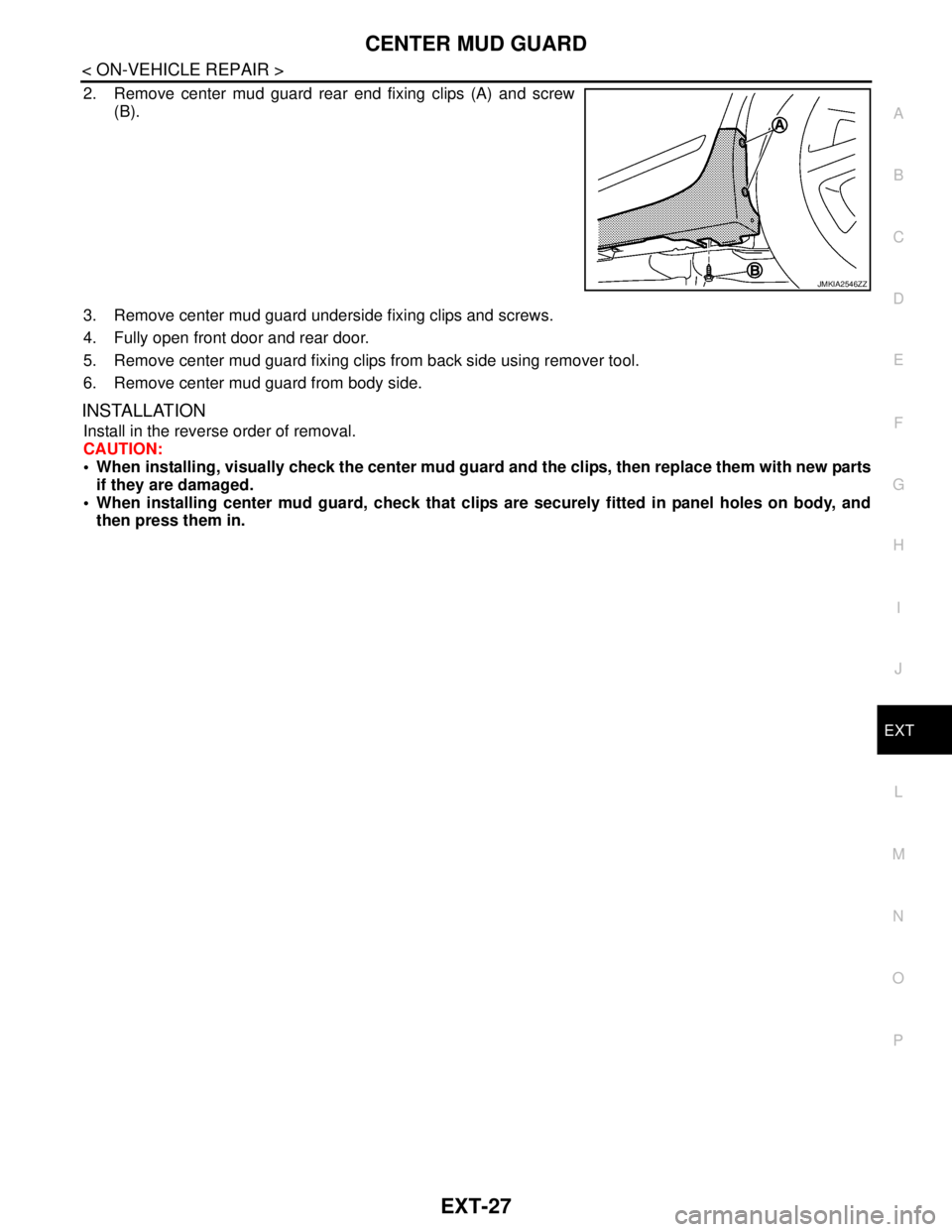
2. Remove center mud guard rear end fixing clips (A) and screw
(B).
3. Remove center mud guard underside fixing clips and screws.
4. Fully open front door and rear door.
5. Remove center mud guard fixing clips from back side using remover tool.
6. Remove center mud guard from body side.
INSTALLATION
Install in the reverse order of removal.
CAUTION:
When installing, visually check the center mud guard and the clips, then replace them with new parts
if they are damaged.
When installing center mud guard, check that clips are securely fitted in panel holes on body, and
then press them in.
JMKIA2546ZZ
Page 2419 of 5121
EXT-30
< ON-VEHICLE REPAIR >
ROOF SIDE MOLDING
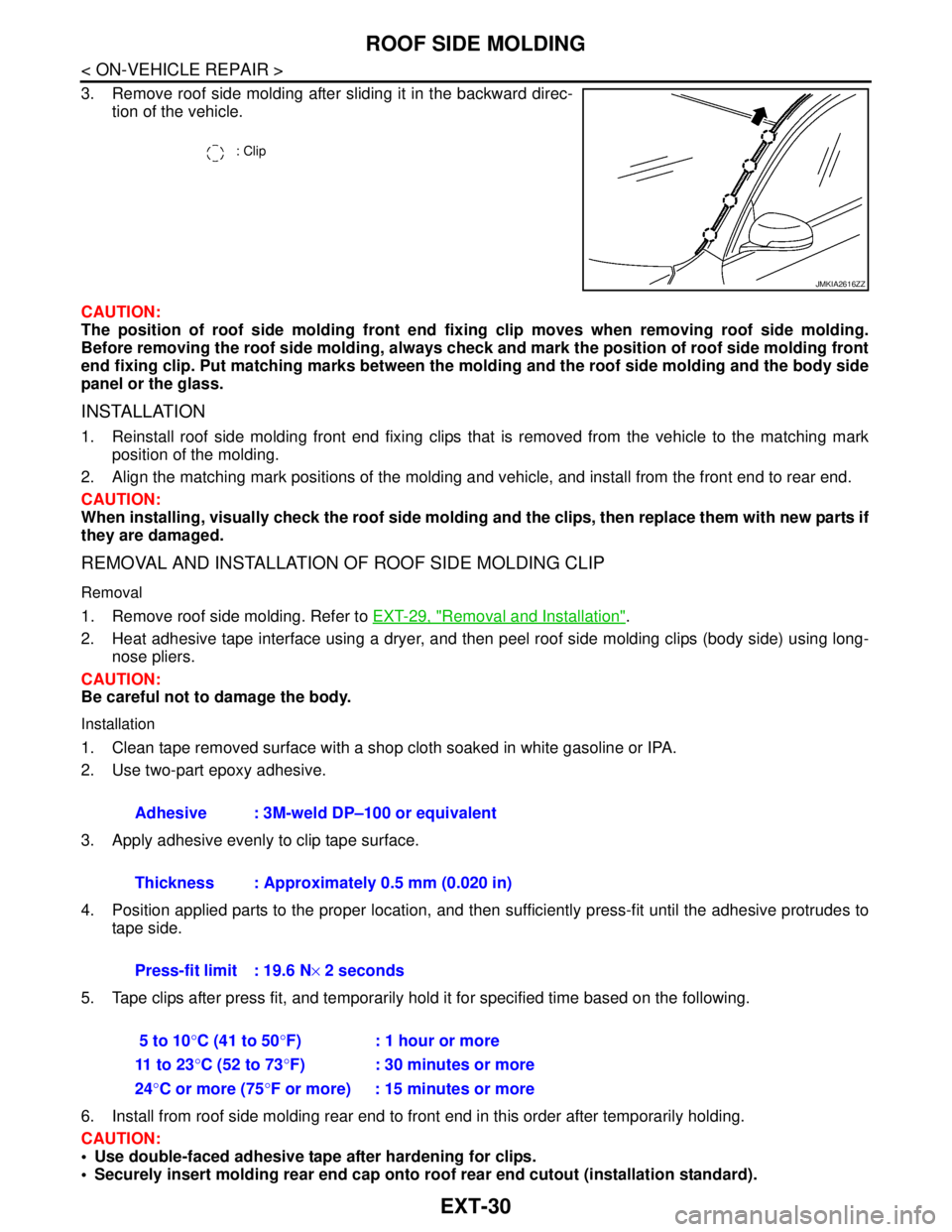
3. Remove roof side molding after sliding it in the backward direc-
tion of the vehicle.
CAUTION:
The position of roof side molding front end fixing clip moves when removing roof side molding.
Before removing the roof side molding, always check and mark the position of roof side molding front
end fixing clip. Put matching marks between the molding and the roof side molding and the body side
panel or the glass.
INSTALLATION
1. Reinstall roof side molding front end fixing clips that is removed from the vehicle to the matching mark
position of the molding.
2. Align the matching mark positions of the molding and vehicle, and install from the front end to rear end.
CAUTION:
When installing, visually check the roof side molding and the clips, then replace them with new parts if
they are damaged.
REMOVAL AND INSTALLATION OF ROOF SIDE MOLDING CLIP
Removal
1. Remove roof side molding. Refer to EXT-29, "Removal and Installation".
2. Heat adhesive tape interface using a dryer, and then peel roof side molding clips (body side) using long-
nose pliers.
CAUTION:
Be careful not to damage the body.
Installation
1. Clean tape removed surface with a shop cloth soaked in white gasoline or IPA.
2. Use two-part epoxy adhesive.
3. Apply adhesive evenly to clip tape surface.
4. Position applied parts to the proper location, and then sufficiently press-fit until the adhesive protrudes to
tape side.
5. Tape clips after press fit, and temporarily hold it for specified time based on the following.
6. Install from roof side molding rear end to front end in this order after temporarily holding.
CAUTION:
Use double-faced adhesive tape after hardening for clips.
Securely insert molding rear end cap onto roof rear end cutout (installation standard).
: Clip
JMKIA2616ZZ
Adhesive : 3M-weld DP–100 or equivalent
Thickness : Approximately 0.5 mm (0.020 in)
Press-fit limit : 19.6 N× 2 seconds
5 to 10°C (41 to 50°F) : 1 hour or more
11 t o 2 3°C (52 to 73°F) : 30 minutes or more
24°C or more (75°F or more) : 15 minutes or more