ECU NISSAN TEANA 2008 Service Manual
[x] Cancel search | Manufacturer: NISSAN, Model Year: 2008, Model line: TEANA, Model: NISSAN TEANA 2008Pages: 5121, PDF Size: 69.03 MB
Page 2561 of 5121
GW-18
< ON-VEHICLE REPAIR >
FRONT DOOR GLASS
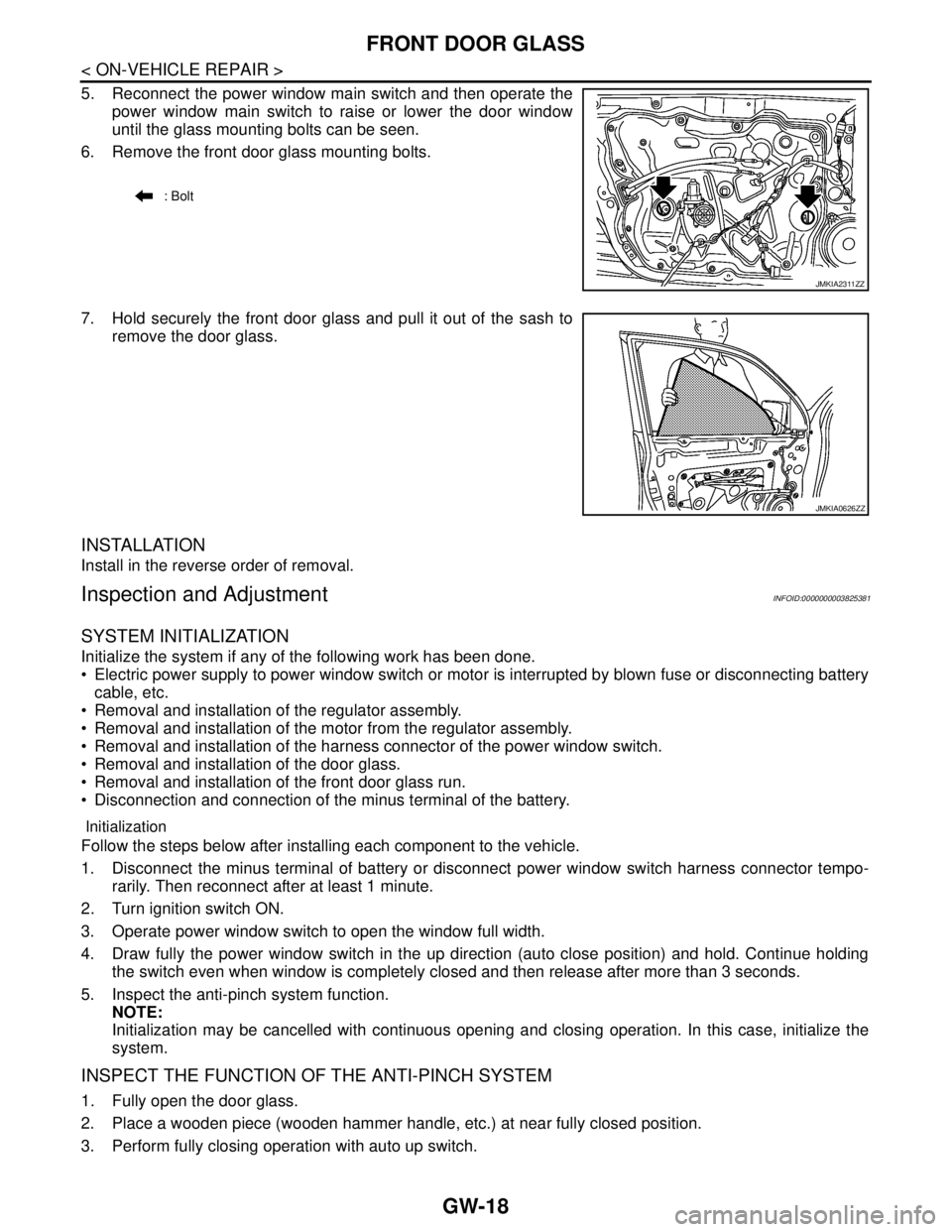
5. Reconnect the power window main switch and then operate the
power window main switch to raise or lower the door window
until the glass mounting bolts can be seen.
6. Remove the front door glass mounting bolts.
7. Hold securely the front door glass and pull it out of the sash to
remove the door glass.
INSTALLATION
Install in the reverse order of removal.
Inspection and AdjustmentINFOID:0000000003825381
SYSTEM INITIALIZATION
Initialize the system if any of the following work has been done.
Electric power supply to power window switch or motor is interrupted by blown fuse or disconnecting battery
cable, etc.
Removal and installation of the regulator assembly.
Removal and installation of the motor from the regulator assembly.
Removal and installation of the harness connector of the power window switch.
Removal and installation of the door glass.
Removal and installation of the front door glass run.
Disconnection and connection of the minus terminal of the battery.
Initialization
Follow the steps below after installing each component to the vehicle.
1. Disconnect the minus terminal of battery or disconnect power window switch harness connector tempo-
rarily. Then reconnect after at least 1 minute.
2. Turn ignition switch ON.
3. Operate power window switch to open the window full width.
4. Draw fully the power window switch in the up direction (auto close position) and hold. Continue holding
the switch even when window is completely closed and then release after more than 3 seconds.
5. Inspect the anti-pinch system function.
NOTE:
Initialization may be cancelled with continuous opening and closing operation. In this case, initialize the
system.
INSPECT THE FUNCTION OF THE ANTI-PINCH SYSTEM
1. Fully open the door glass.
2. Place a wooden piece (wooden hammer handle, etc.) at near fully closed position.
3. Perform fully closing operation with auto up switch.
: Bolt
JMKIA2311ZZ
JMKIA0626ZZ
Page 2562 of 5121

FRONT DOOR GLASS
GW-19
< ON-VEHICLE REPAIR >
C
D
E
F
G
H
I
J
L
MA
B
GW
N
O
P
Check that the glass reverses without pinching the wooden piece, is lowered approximately 150 mm (5.906
in) or for more than 2 seconds and then stops.
The glass should not be raised with power window main switch operated while it is reversing or lowering.
CAUTION:
Be careful not to be pinched.
When performing the inspection after the system initialization, check that the auto up function is
normal. Then, start the inspection.
FITTING INSPECTION
Check that the glass is fit securely into the sash groove.
Lower the glass slightly [approximately 10 to 20 mm (0.394 to 0.787 in)], and check that the clearance to the
sash is parallel. Loosen the regulator mounting bolts, guide rail mounting bolts, and glass and guide rail
mounting bolts to correct the glass position if the clearance between the glass and sash is not parallel.
Page 2565 of 5121

GW-22
< ON-VEHICLE REPAIR >
FRONT REGULATOR
2. Place a wooden piece (wooden hammer handle, etc.) at near fully closed position.
3. Perform fully closing operation with auto up switch.
Check that the glass reverses without pinching the wooden piece, is lowered approximately 150 mm (5.906
in) or for more than 2 seconds and then stops.
The glass should not be raised with power window main switch operated while it is reversing or lowering.
CAUTION:
Be careful not to be pinched.
When performing the inspection after the system initialization, check that the auto up function is
normal. Then, start the inspection.
FITTING INSPECTION
Check that the glass is fit securely into the sash groove.
Lower the glass slightly [approximately 10 to 20 mm (0.394 to 0.787 in)], and check that the clearance to the
sash is parallel. Loosen the regulator mounting bolts, guide rail mounting bolts, and glass and guide rail
mounting bolts to correct the glass position if the clearance between the glass and sash is not parallel.
Page 2567 of 5121
GW-24
< ON-VEHICLE REPAIR >
REAR DOOR GLASS
4. Remove the bolt fixing the corner piece assembly lower side to
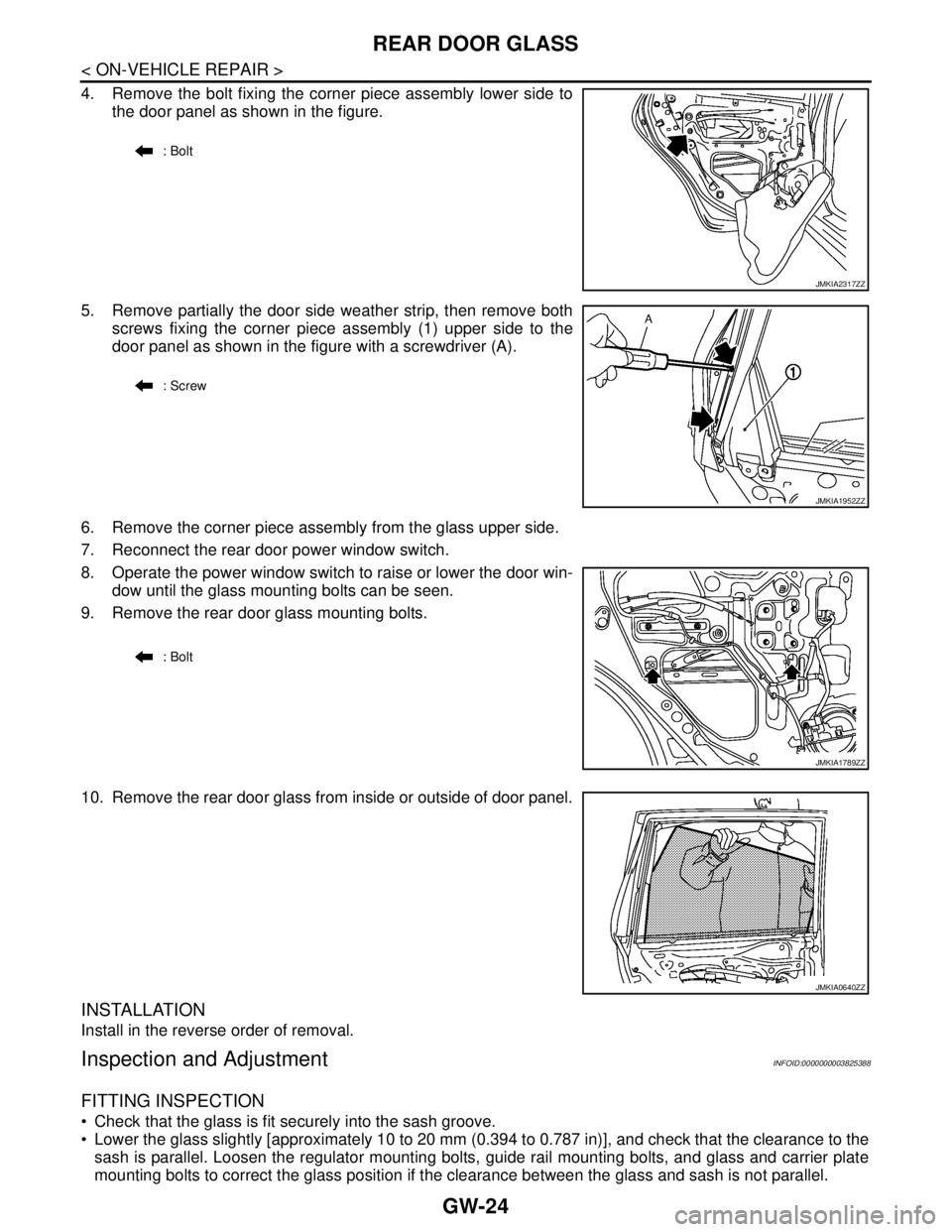
the door panel as shown in the figure.
5. Remove partially the door side weather strip, then remove both
screws fixing the corner piece assembly (1) upper side to the
door panel as shown in the figure with a screwdriver (A).
6. Remove the corner piece assembly from the glass upper side.
7. Reconnect the rear door power window switch.
8. Operate the power window switch to raise or lower the door win-
dow until the glass mounting bolts can be seen.
9. Remove the rear door glass mounting bolts.
10. Remove the rear door glass from inside or outside of door panel.
INSTALLATION
Install in the reverse order of removal.
Inspection and AdjustmentINFOID:0000000003825388
FITTING INSPECTION
Check that the glass is fit securely into the sash groove.
Lower the glass slightly [approximately 10 to 20 mm (0.394 to 0.787 in)], and check that the clearance to the
sash is parallel. Loosen the regulator mounting bolts, guide rail mounting bolts, and glass and carrier plate
mounting bolts to correct the glass position if the clearance between the glass and sash is not parallel.
: Bolt
JMKIA2317ZZ
: Screw
JMKIA1952ZZ
: Bolt
JMKIA1789ZZ
JMKIA0640ZZ
Page 2569 of 5121
GW-26
< ON-VEHICLE REPAIR >
REAR REGULATOR
Install in the reverse order of removal.
Disassembly and AssemblyINFOID:0000000003825391
DISASSEMBLY
Remove power window motor from regulator assembly.
ASSEMBLY
Assemble in the reverse order of disassembly.
Inspection and AdjustmentINFOID:0000000003825392
Inspection after Removal
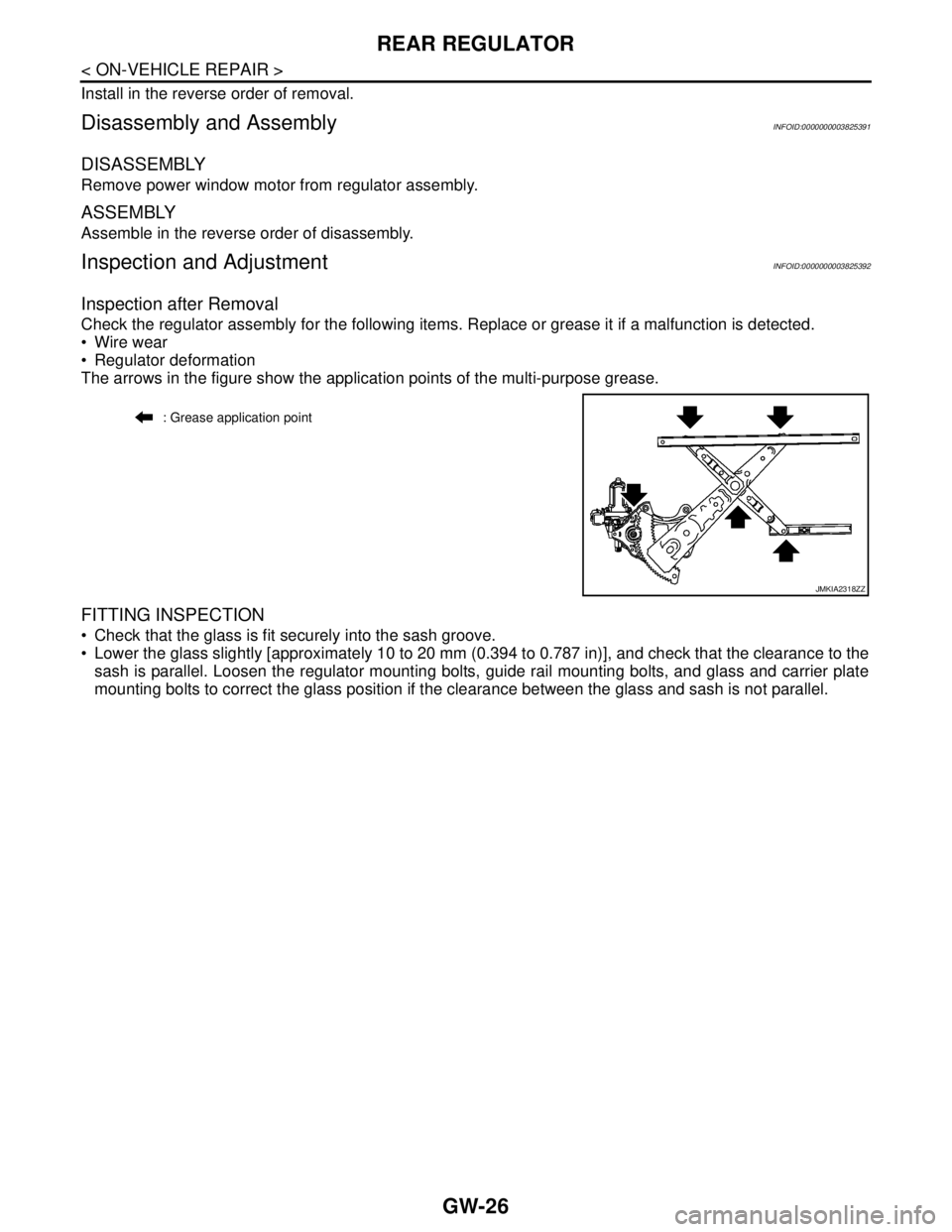
Check the regulator assembly for the following items. Replace or grease it if a malfunction is detected.
Wire wear
Regulator deformation
The arrows in the figure show the application points of the multi-purpose grease.
FITTING INSPECTION
Check that the glass is fit securely into the sash groove.
Lower the glass slightly [approximately 10 to 20 mm (0.394 to 0.787 in)], and check that the clearance to the
sash is parallel. Loosen the regulator mounting bolts, guide rail mounting bolts, and glass and carrier plate
mounting bolts to correct the glass position if the clearance between the glass and sash is not parallel.
: Grease application point
JMKIA2318ZZ
Page 2582 of 5121
PRECAUTIONS
HA-13
< PRECAUTION >
C
D
E
F
G
H
J
K
L
MA
B
HA
N
O
P
Precaution for Procedure without Cowl Top CoverINFOID:0000000003795884
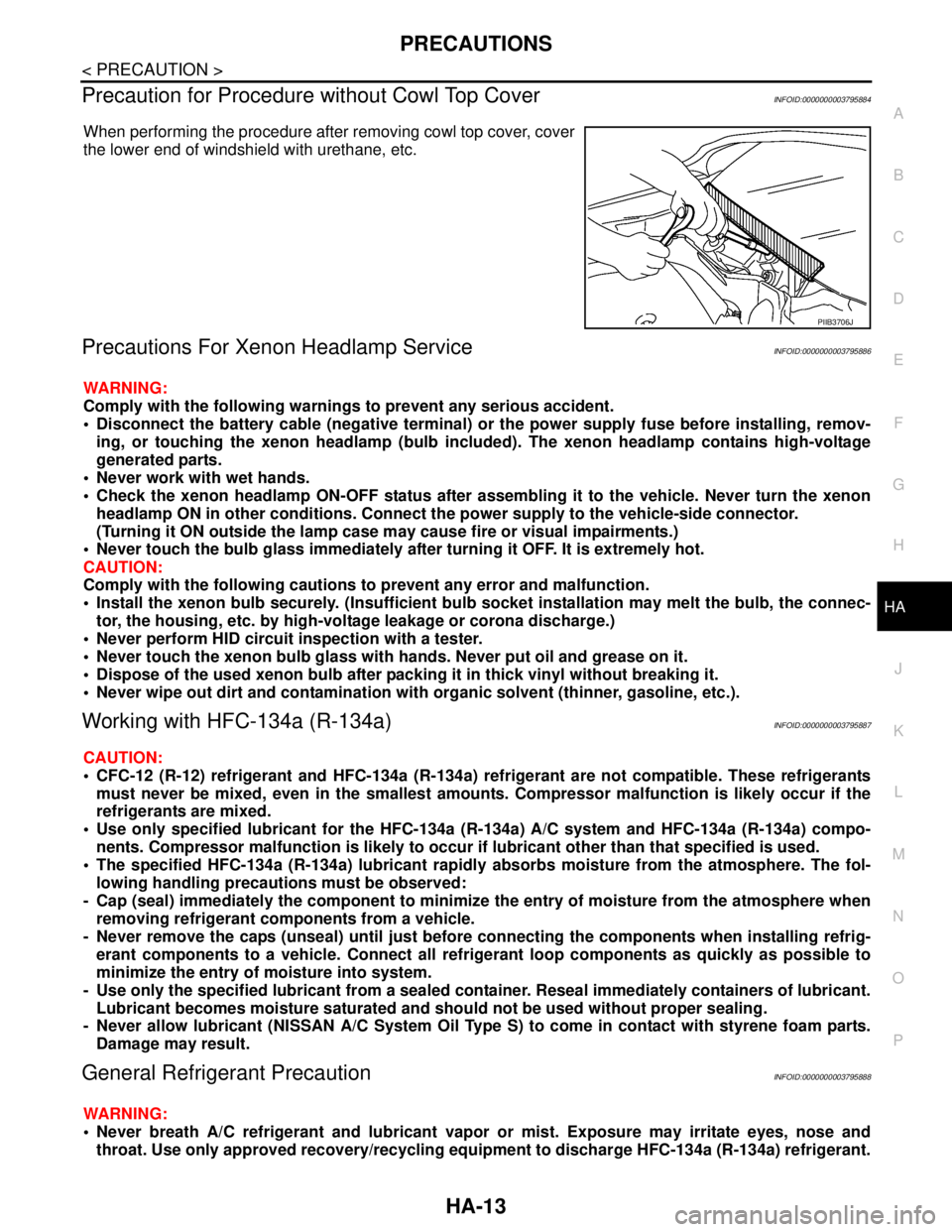
When performing the procedure after removing cowl top cover, cover
the lower end of windshield with urethane, etc.
Precautions For Xenon Headlamp ServiceINFOID:0000000003795886
WARNING:
Comply with the following warnings to prevent any serious accident.
Disconnect the battery cable (negative terminal) or the power supply fuse before installing, remov-
ing, or touching the xenon headlamp (bulb included). The xenon headlamp contains high-voltage
generated parts.
Never work with wet hands.
Check the xenon headlamp ON-OFF status after assembling it to the vehicle. Never turn the xenon
headlamp ON in other conditions. Connect the power supply to the vehicle-side connector.
(Turning it ON outside the lamp case may cause fire or visual impairments.)
Never touch the bulb glass immediately after turning it OFF. It is extremely hot.
CAUTION:
Comply with the following cautions to prevent any error and malfunction.
Install the xenon bulb securely. (Insufficient bulb socket installation may melt the bulb, the connec-
tor, the housing, etc. by high-voltage leakage or corona discharge.)
Never perform HID circuit inspection with a tester.
Never touch the xenon bulb glass with hands. Never put oil and grease on it.
Dispose of the used xenon bulb after packing it in thick vinyl without breaking it.
Never wipe out dirt and contamination with organic solvent (thinner, gasoline, etc.).
Working with HFC-134a (R-134a)INFOID:0000000003795887
CAUTION:
CFC-12 (R-12) refrigerant and HFC-134a (R-134a) refrigerant are not compatible. These refrigerants
must never be mixed, even in the smallest amounts. Compressor malfunction is likely occur if the
refrigerants are mixed.
Use only specified lubricant for the HFC-134a (R-134a) A/C system and HFC-134a (R-134a) compo-
nents. Compressor malfunction is likely to occur if lubricant other than that specified is used.
The specified HFC-134a (R-134a) lubricant rapidly absorbs moisture from the atmosphere. The fol-
lowing handling precautions must be observed:
- Cap (seal) immediately the component to minimize the entry of moisture from the atmosphere when
removing refrigerant components from a vehicle.
- Never remove the caps (unseal) until just before connecting the components when installing refrig-
erant components to a vehicle. Connect all refrigerant loop components as quickly as possible to
minimize the entry of moisture into system.
- Use only the specified lubricant from a sealed container. Reseal immediately containers of lubricant.
Lubricant becomes moisture saturated and should not be used without proper sealing.
- Never allow lubricant (NISSAN A/C System Oil Type S) to come in contact with styrene foam parts.
Damage may result.
General Refrigerant PrecautionINFOID:0000000003795888
WARNING:
Never breath A/C refrigerant and lubricant vapor or mist. Exposure may irritate eyes, nose and
throat. Use only approved recovery/recycling equipment to discharge HFC-134a (R-134a) refrigerant.
PIIB3706J
Page 2603 of 5121
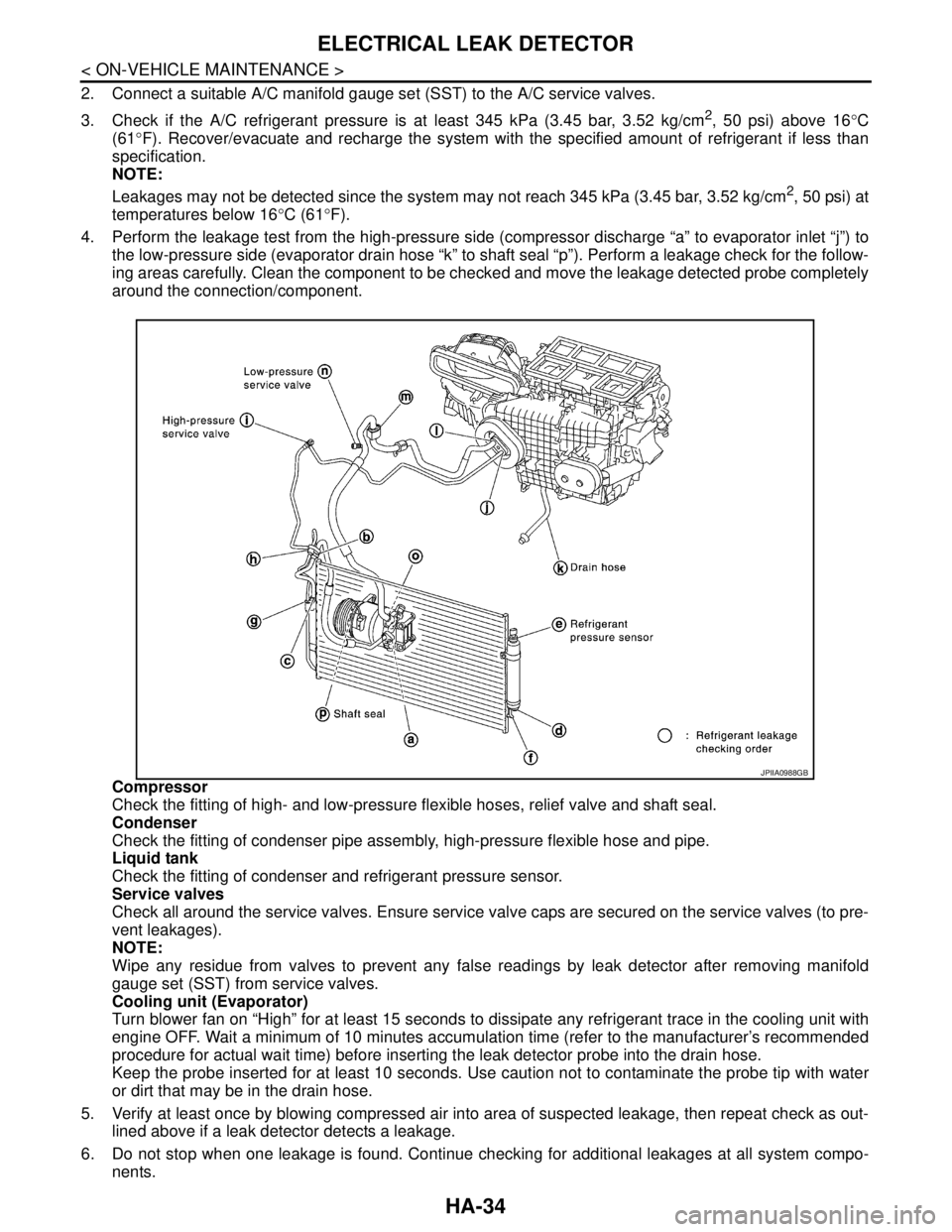
HA-34
< ON-VEHICLE MAINTENANCE >
ELECTRICAL LEAK DETECTOR
2. Connect a suitable A/C manifold gauge set (SST) to the A/C service valves.
3. Check if the A/C refrigerant pressure is at least 345 kPa (3.45 bar, 3.52 kg/cm
2, 50 psi) above 16°C
(61°F). Recover/evacuate and recharge the system with the specified amount of refrigerant if less than
specification.
NOTE:
Leakages may not be detected since the system may not reach 345 kPa (3.45 bar, 3.52 kg/cm
2, 50 psi) at
temperatures below 16°C (61°F).
4. Perform the leakage test from the high-pressure side (compressor discharge “a” to evaporator inlet “j”) to
the low-pressure side (evaporator drain hose “k” to shaft seal “p”). Perform a leakage check for the follow-
ing areas carefully. Clean the component to be checked and move the leakage detected probe completely
around the connection/component.
Compressor
Check the fitting of high- and low-pressure flexible hoses, relief valve and shaft seal.
Condenser
Check the fitting of condenser pipe assembly, high-pressure flexible hose and pipe.
Liquid tank
Check the fitting of condenser and refrigerant pressure sensor.
Service valves
Check all around the service valves. Ensure service valve caps are secured on the service valves (to pre-
vent leakages).
NOTE:
Wipe any residue from valves to prevent any false readings by leak detector after removing manifold
gauge set (SST) from service valves.
Cooling unit (Evaporator)
Turn blower fan on “High” for at least 15 seconds to dissipate any refrigerant trace in the cooling unit with
engine OFF. Wait a minimum of 10 minutes accumulation time (refer to the manufacturer’s recommended
procedure for actual wait time) before inserting the leak detector probe into the drain hose.
Keep the probe inserted for at least 10 seconds. Use caution not to contaminate the probe tip with water
or dirt that may be in the drain hose.
5. Verify at least once by blowing compressed air into area of suspected leakage, then repeat check as out-
lined above if a leak detector detects a leakage.
6. Do not stop when one leakage is found. Continue checking for additional leakages at all system compo-
nents.
JPIIA0988GB
Page 2630 of 5121

HAC-2
DTC Logic ...............................................................53
Diagnosis Procedure ..............................................54
Component Inspection ............................................55
B2632, B2633 AIR MIX DOOR MOTOR
(DRIVER SIDE) ..................................................
56
Description ..............................................................56
DTC Logic ...............................................................56
Diagnosis Procedure ..............................................57
B2634, B2635 AIR MIX DOOR MOTOR (PAS-
SENGER SIDE) ..................................................
58
Description ..............................................................58
DTC Logic ...............................................................58
Diagnosis Procedure ..............................................59
B2636, B2637, B2638, B2639, B2654, B2655
MODE DOOR MOTOR ......................................
60
Description ..............................................................60
DTC Logic ...............................................................60
Diagnosis Procedure ..............................................61
B263D B263E, B263F, B2656 INTAKE DOOR
MOTOR ..............................................................
63
Description ..............................................................63
DTC Logic ...............................................................63
Diagnosis Procedure ..............................................64
POWER SUPPLY AND GROUND CIRCUIT .....65
A/C AUTO AMP. .......................................................65
A/C AUTO AMP. : Diagnosis Procedure ................65
A/C CONTROL ..........................................................65
A/C CONTROL : Diagnosis Procedure ...................65
A/C DISPLAY ............................................................66
A/C DISPLAY : Diagnosis Procedure .....................66
A/C AUTO AMP. ................................................67
Description ..............................................................67
Component Function Check ...................................67
Diagnosis Procedure ..............................................67
BLOWER MOTOR .............................................68
Description ..............................................................68
Component Function Check .................................68
Diagnosis Procedure ..............................................68
Component Inspection ............................................71
MAGNET CLUTCH ............................................72
Description ..............................................................72
Component Function Check ...................................72
Diagnosis Procedure ..............................................72
A/C CONTROL SIGNAL CIRCUIT ....................74
Diagnosis Procedure ..............................................74
ECU DIAGNOSIS ........................................75
A/C AUTO AMP. ................................................75
Reference Value .....................................................75
Wiring Diagram - AIR CONDITIONER CONTROL
SYSTEM - ...............................................................
77
Fail-Safe ..................................................................84
DTC Inspection Priority Chart ...............................85
DTC Index ...............................................................85
SYMPTOM DIAGNOSIS ............................87
AIR CONDITIONER CONTROL ........................87
Diagnosis Chart By Symptom .................................87
INSUFFICIENT COOLING .................................88
Description ..............................................................88
Inspection procedure ..............................................88
INSUFFICIENT HEATING .................................91
Description ..............................................................91
Inspection procedure ..............................................91
NOISE ................................................................94
Description ..............................................................94
Inspection procedure ..............................................94
MEMORY FUNCTION DOES NOT OPERATE ...96
Description ..............................................................96
Inspection procedure ..............................................96
PRECAUTION ............................................97
PRECAUTIONS .................................................97
Precaution for Supplemental Restraint System
(SRS) "AIR BAG" and "SEAT BELT PRE-TEN-
SIONER" .................................................................
97
Precaution Necessary for Steering Wheel Rota-
tion after Battery Disconnect ...................................
97
Precaution for Procedure without Cowl Top Cover ...98
Precautions For Xenon Headlamp Service .............98
Working with HFC-134a (R-134a) ...........................98
General Refrigerant Precaution ..............................99
Refrigerant Connection ...........................................99
Service Equipment ................................................101
COMPRESSOR ................................................104
General Precautions .............................................104
FLUORESCENT LEAK DETECTOR ................105
General Precautions .............................................105
WITH 7 INCH DISPLAY
BASIC INSPECTION .................................
106
DIAGNOSIS AND REPAIR WORKFLOW ........106
Work Flow .............................................................106
INSPECTION AND ADJUSTMENT ..................108
WITHOUT INTELLIGENT AIR CONDITIONER
SYSTEM ..................................................................
108
WITHOUT INTELLIGENT AIR CONDITIONER
SYSTEM : Description & Inspection .....................
108
WITHOUT INTELLIGENT AIR CONDITIONER
SYSTEM : Temperature Setting Trimmer .............
110
Page 2632 of 5121

HAC-4
DTC Logic ..............................................................164
Diagnosis Procedure ............................................164
U1010 CONTROL UNIT (CAN) .......................165
Description .............................................................165
DTC Logic ..............................................................165
Diagnosis Procedure .............................................165
B257B, B257C AMBIENT SENSOR ...............166
Description .............................................................166
DTC Logic ..............................................................166
Diagnosis Procedure .............................................167
Component Inspection ...........................................168
B2578, B2579 IN-VEHICLE SENSOR .............169
Description .............................................................169
DTC Logic ..............................................................169
Diagnosis Procedure .............................................170
Component Inspection ...........................................171
B2581, B2582 INTAKE SENSOR ....................172
Description .............................................................172
DTC Logic ..............................................................172
Diagnosis Procedure .............................................172
Component Inspection ...........................................173
B262A, B262B, B2657, B2658 GAS SENSOR .175
WITH INTELLIGENT AIR CONDITIONER SYS-
TEM ..........................................................................
175
WITH INTELLIGENT AIR CONDITIONER SYS-
TEM : Description ..................................................
175
WITH INTELLIGENT AIR CONDITIONER SYS-
TEM : DTC Logic ...................................................
175
WITH INTELLIGENT AIR CONDITIONER SYS-
TEM : Diagnosis Procedure ...................................
176
B2630, B2631 SUNLOAD SENSOR ...............178
Description .............................................................178
DTC Logic ..............................................................178
Diagnosis Procedure .............................................179
Component Inspection ...........................................180
B2632, B2633 AIR MIX DOOR MOTOR
(DRIVER SIDE) ................................................
181
Description .............................................................181
DTC Logic ..............................................................181
Diagnosis Procedure .............................................182
B2634, B2635 AIR MIX DOOR MOTOR (PAS-
SENGER SIDE) ................................................
183
Description .............................................................183
DTC Logic ..............................................................183
Diagnosis Procedure .............................................184
B2636, B2637, B2638, B2639, B2654, B2655
MODE DOOR MOTOR ....................................
185
Description .............................................................185
DTC Logic ..............................................................185
Diagnosis Procedure .............................................186
B263D B263E, B263F, B2656 INTAKE DOOR
MOTOR .............................................................
188
Description ............................................................188
DTC Logic .............................................................188
Diagnosis Procedure .............................................189
POWER SUPPLY AND GROUND CIRCUIT ....191
A/C AUTO AMP. ......................................................191
A/C AUTO AMP. : Diagnosis Procedure ...............191
A/C AUTO AMP. ...............................................192
Description ............................................................192
Component Function Check .................................192
Diagnosis Procedure .............................................192
BLOWER MOTOR ............................................193
Description ............................................................193
Component Function Check ................................193
Diagnosis Procedure .............................................193
Component Inspection ..........................................196
MAGNET CLUTCH ...........................................197
Description ............................................................197
Component Function Check .................................197
Diagnosis Procedure .............................................197
IONIZER ............................................................199
WITH INTELLIGENT AIR CONDITIONER SYS-
TEM .........................................................................
199
WITH INTELLIGENT AIR CONDITIONER SYS-
TEM : Description .................................................
199
WITH INTELLIGENT AIR CONDITIONER SYS-
TEM : Component Function Check .......................
199
WITH INTELLIGENT AIR CONDITIONER SYS-
TEM : Diagnosis Procedure ..................................
199
ECU DIAGNOSIS ......................................202
A/C AUTO AMP. ...............................................202
WITHOUT INTELLIGENT AIR CONDITIONER
SYSTEM ..................................................................
202
WITHOUT INTELLIGENT AIR CONDITIONER
SYSTEM : Reference Value .................................
202
WITHOUT INTELLIGENT AIR CONDITIONER
SYSTEM : Wiring Diagram - AIR CONDITIONER
CONTROL SYSTEM - ..........................................
203
WITHOUT INTELLIGENT AIR CONDITIONER
SYSTEM : Fail-Safe ..............................................
211
WITHOUT INTELLIGENT AIR CONDITIONER
SYSTEM : DTC Inspection Priority Chart ...........
212
WITHOUT INTELLIGENT AIR CONDITIONER
SYSTEM : DTC Index ...........................................
212
WITH INTELLIGENT AIR CONDITIONER SYS-
TEM .........................................................................
213
WITH INTELLIGENT AIR CONDITIONER SYS-
TEM : Reference Value .........................................
213
Page 2651 of 5121
![NISSAN TEANA 2008 Service Manual AUTOMATIC AIR CONDITIONER SYSTEM
HAC-23
< FUNCTION DIAGNOSIS >[WITHOUT 7 INCH DISPLAY]
C
D
E
F
G
H
J
K
L
MA
B
HAC
N
O
P
Decision (A/C auto amp. indicated value and motor opening angle comparison)
Op](/img/5/57391/w960_57391-2650.png "NISSAN TEANA 2008 Service Manual AUTOMATIC AIR CONDITIONER SYSTEM
HAC-23
< FUNCTION DIAGNOSIS >[WITHOUT 7 INCH DISPLAY]
C
D
E
F
G
H
J
K
L
MA
B
HAC
N
O
P
Decision (A/C auto amp. indicated value and motor opening angle comparison)
Op")
AUTOMATIC AIR CONDITIONER SYSTEM
HAC-23
< FUNCTION DIAGNOSIS >[WITHOUT 7 INCH DISPLAY]
C
D
E
F
G
H
J
K
L
MA
B
HAC
N
O
P
Decision (A/C auto amp. indicated value and motor opening angle comparison)
Operation
The A/C auto amp. receives data from each of the sensors. The A/C auto amp. sends mode door, the air mix
door and the intake door opening angle data to the mode door motor LCU, the air mix door motor LCUs and
the intake door motor LCU.
The mode door motor, the air mix door motors and the intake door motor read their respective signals accord-
ing to the address signal. Opening angle indication signals received from the A/C auto amp. and each of the
motor position sensors is compared by the LCUs in each door motor with the existing decision and opening
angles. Next, HOT/COLD, DEF/VENT, OPEN/SHUT or FRE/REC operation is selected. The new selection
data is returned to the A/C auto amp.
Transmission Data and Transmission Order
A/C auto amp. data is transmitted consecutively to each of the door motors following the form as shown in the
figure below.
START: Initial compulsory signal is sent to each of the door motors.
ADDRESS: Data sent from the A/C auto amp. is selected according to data-based decisions made by the mode door
motor, the air mix door motors and the intake door motor.
If the addresses are identical, the opening angle data and error check signals are received by the door motor
LCUs. The LCUs then make the appropriate error decision. If the opening angle data has no error, door con-
trol begins.
If an error exists, the received data is rejected and the corrected data received. Finally, door control is based
upon the corrected opening angle data.
OPENING ANGLE:
Data that shows the indicated door opening angle of each door motor.
ERROR CHECK: In this procedure, transmitted and received data is checked for errors. Error data is then compiled. The error
check prevents corrupted data from being used by the mode door motor, the air mix door motors and the
intake door motor. Error data can be related to the following symptoms.
- Malfunction of electrical frequency
- Poor electrical connections
- Signal leakage from transmission lines
- Signal level fluctuation
STOP SIGNAL:
JSIIA1130GB
JSIIA1131GB