service NISSAN TEANA 2014 Service Manual
[x] Cancel search | Manufacturer: NISSAN, Model Year: 2014, Model line: TEANA, Model: NISSAN TEANA 2014Pages: 4801, PDF Size: 51.2 MB
Page 929 of 4801
HAZARD FUNCTIONDLK-161
< SYMPTOM DIAGNOSIS >
C
D E
F
G H
I
J
L
M A
B
DLK
N
O P
HAZARD FUNCTION
Symptom TableINFOID:0000000009461916
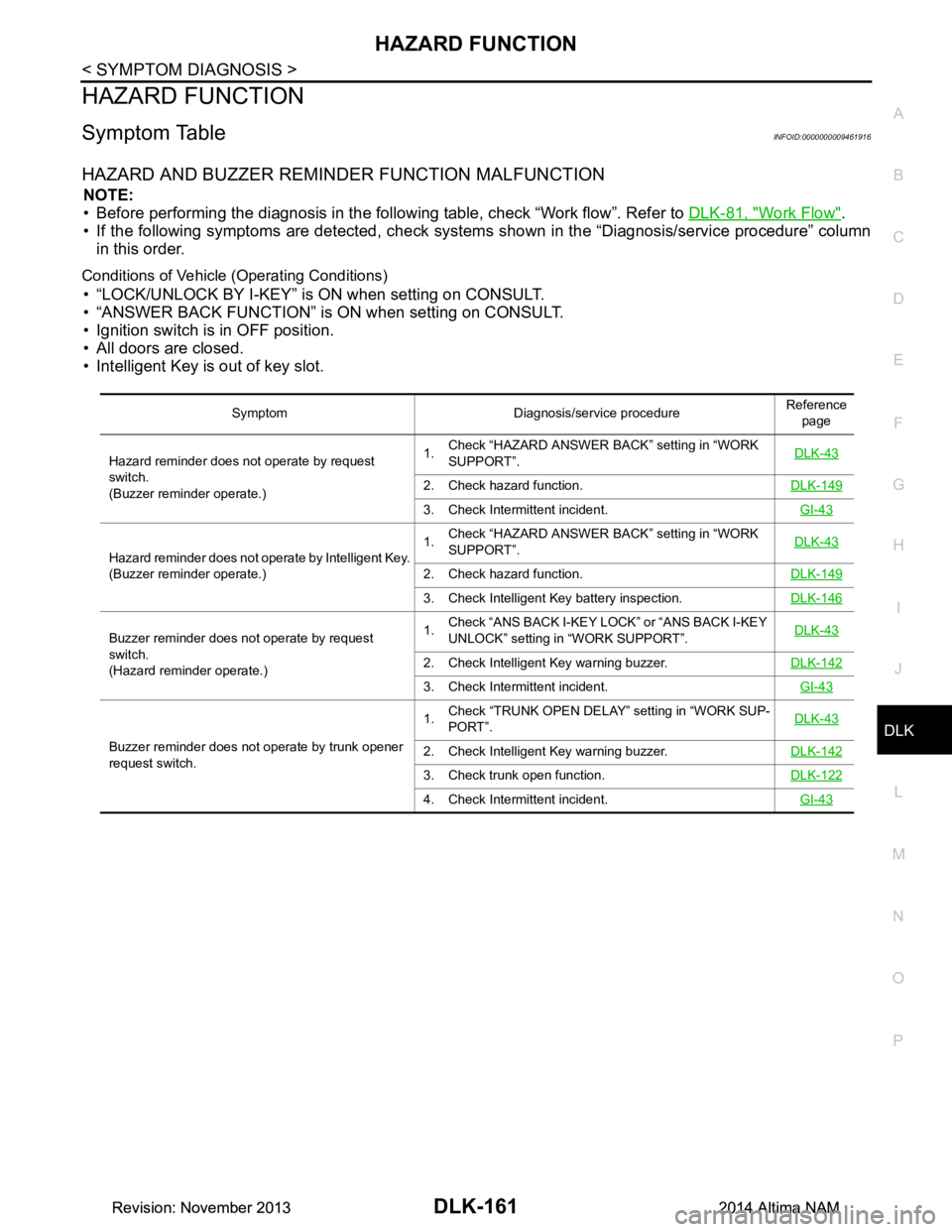
HAZARD AND BUZZER REMINDER FUNCTION MALFUNCTION
NOTE:
• Before performing the diagnosis in the following table, check “Work flow”. Refer to DLK-81, "Work Flow"
.
• If the following symptoms are detec ted, check systems shown in the “Diagnosis/service procedure” column
in this order.
Conditions of Vehicle (Operating Conditions)
• “LOCK/UNLOCK BY I-KEY” is ON when setting on CONSULT.
• “ANSWER BACK FUNCTION” is ON when setting on CONSULT.
• Ignition switch is in OFF position.
• All doors are closed.
• Intelligent Key is out of key slot.
Symptom Diagnosis/service procedure Reference
page
Hazard reminder does not operate by request
switch.
(Buzzer reminder operate.) 1.
Check “HAZARD ANSWER BACK” setting in “WORK
SUPPORT”. DLK-43
2. Check hazard function.
DLK-149
3. Check Intermittent incident. GI-43
Hazard reminder does not operate by Intelligent Key.
(Buzzer reminder operate.) 1.
Check “HAZARD ANSWER BACK” setting in “WORK
SUPPORT”. DLK-43
2. Check hazard function.
DLK-149
3. Check Intelligent Key battery inspection.DLK-146
Buzzer reminder does not operate by request
switch.
(Hazard reminder operate.) 1.
Check “ANS BACK I-KEY LOCK” or “ANS BACK I-KEY
UNLOCK” setting in “WORK SUPPORT”. DLK-43
2. Check Intelligent Key warning buzzer.
DLK-142
3. Check Intermittent incident. GI-43
Buzzer reminder does not operate by trunk opener
request switch. 1.
Check “TRUNK OPEN DELAY” setting in “WORK SUP-
PORT”. DLK-432. Check Intelligent Key warning buzzer.
DLK-142
3. Check trunk open function.DLK-122
4. Check Intermittent incident. GI-43
Revision: November 20132014 Altima NAMRevision: November 20132014 Altima NAM
Page 930 of 4801
DLK-162
< SYMPTOM DIAGNOSIS >
HORN FUNCTION
HORN FUNCTION
Symptom TableINFOID:0000000009461917
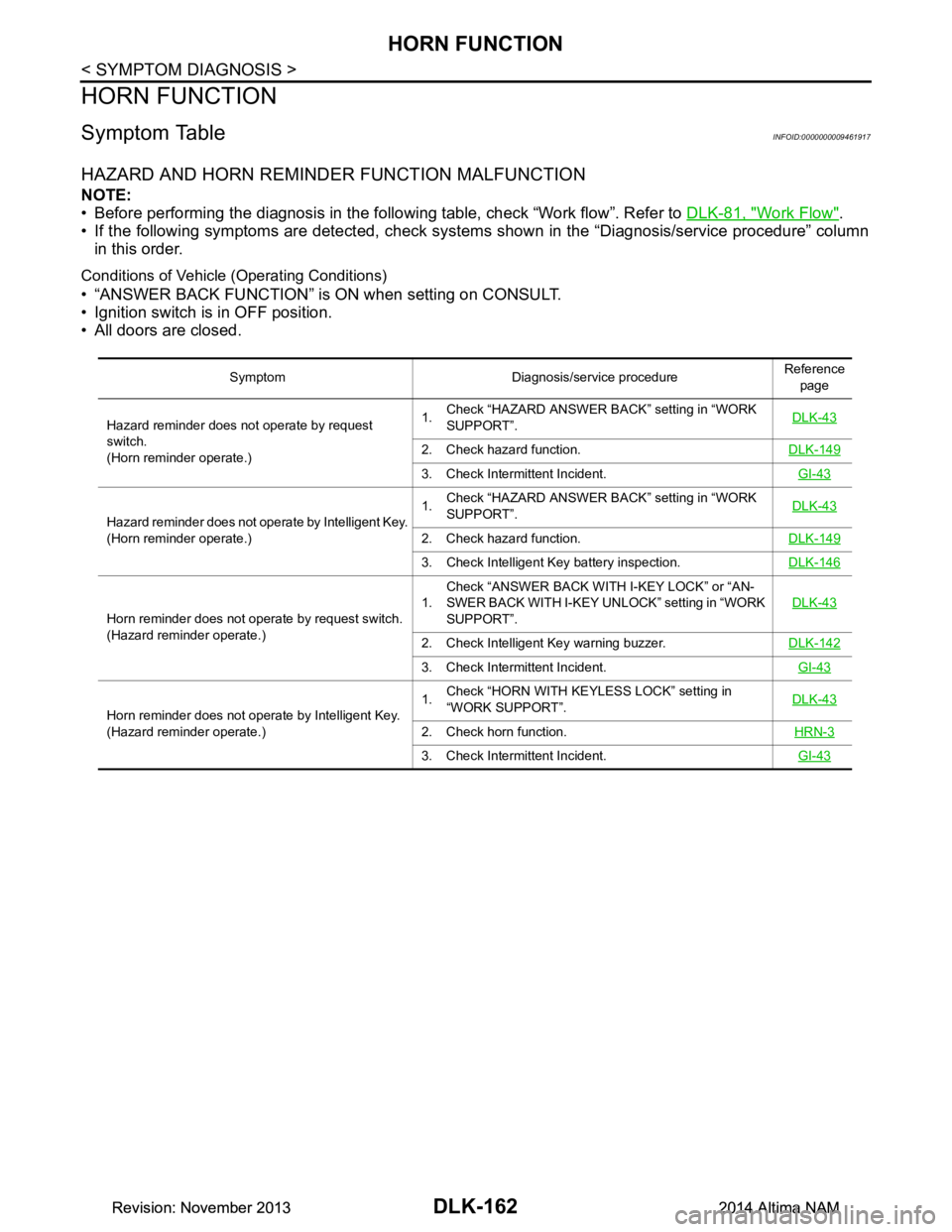
HAZARD AND HORN REMINDER FUNCTION MALFUNCTION
NOTE:
• Before performing the diagnosis in the follo wing table, check “Work flow”. Refer to DLK-81, "Work Flow"
.
• If the following symptoms are detected, check syst ems shown in the “Diagnosis/service procedure” column
in this order.
Conditions of Vehicle (Operating Conditions)
• “ANSWER BACK FUNCTION” is ON when setting on CONSULT.
• Ignition switch is in OFF position.
• All doors are closed.
Symptom Diagnosis/service procedure Reference
page
Hazard reminder does not operate by request
switch.
(Horn reminder operate.) 1.
Check “HAZARD ANSWER BACK” setting in “WORK
SUPPORT”. DLK-43
2. Check hazard function.
DLK-149
3. Check Intermittent Incident. GI-43
Hazard reminder does not operate by Intelligent Key.
(Horn reminder operate.) 1.
Check “HAZARD ANSWER BACK” setting in “WORK
SUPPORT”. DLK-43
2. Check hazard function.
DLK-149
3. Check Intelligent Key battery inspection.DLK-146
Horn reminder does not operate by request switch.
(Hazard reminder operate.) 1.
Check “ANSWER BACK WITH I-KEY LOCK” or “AN-
SWER BACK WITH I-KEY UNLOCK” setting in “WORK
SUPPORT”. DLK-43
2. Check Intelligent Key warning buzzer.
DLK-142
3. Check Intermittent Incident. GI-43
Horn reminder does not operate by Intelligent Key.
(Hazard reminder operate.) 1.
Check “HORN WITH KEYLESS LOCK” setting in
“WORK SUPPORT”. DLK-43
2. Check horn function.
HRN-3
3. Check Intermittent Incident. GI-43
Revision: November 20132014 Altima NAMRevision: November 20132014 Altima NAM
Page 931 of 4801
INTEGRATED HOMELINK TRANSMITTERDLK-163
< SYMPTOM DIAGNOSIS >
C
D E
F
G H
I
J
L
M A
B
DLK
N
O P
INTEGRATED HOMELINK TRANSMITTER
Symptom TableINFOID:0000000009461918
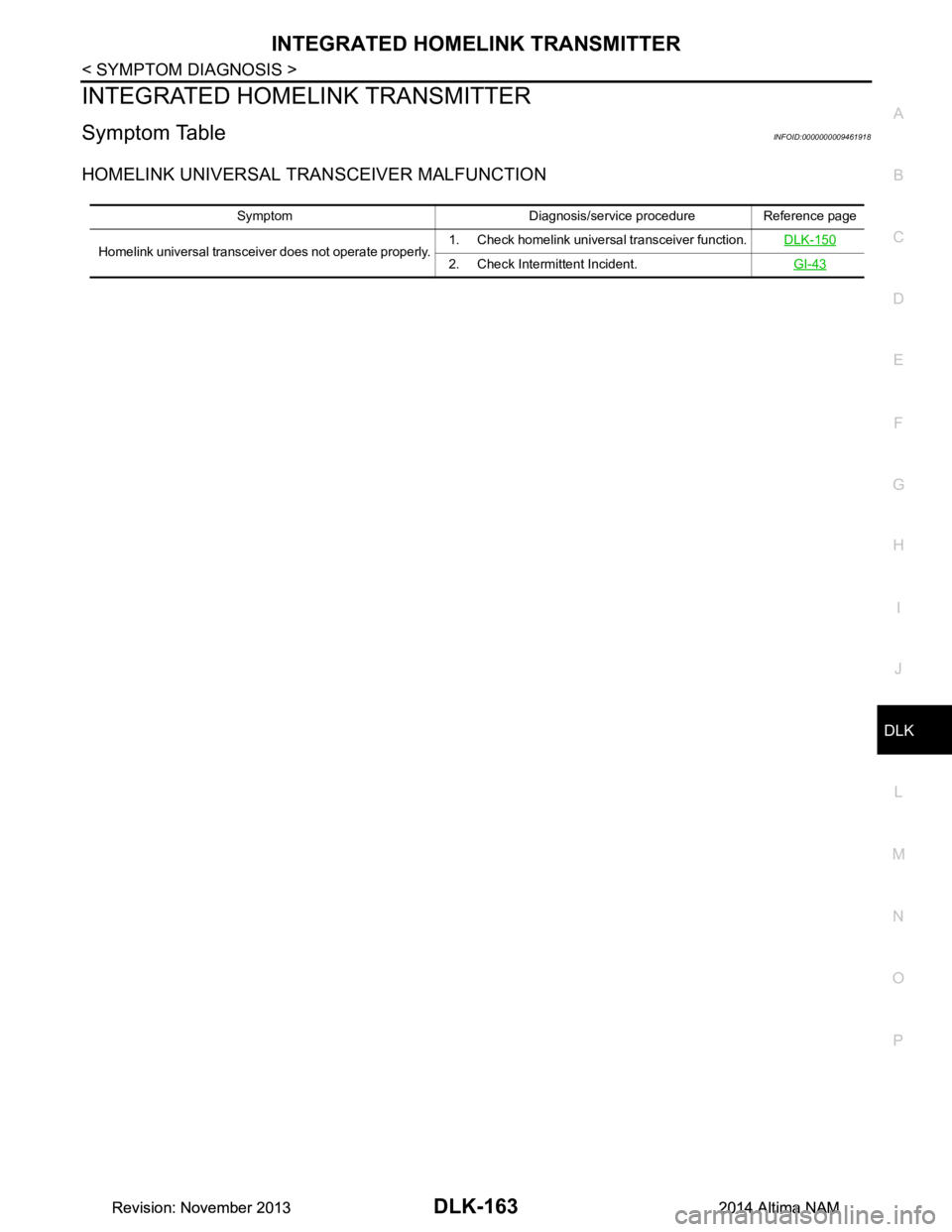
HOMELINK UNIVERSAL TRANSCEIVER MALFUNCTION
Symptom Diagnosis/service procedure Reference page
Homelink universal transceiver does not operate properly. 1. Check homelink universal transceiver function.
DLK-150
2. Check Intermittent Incident. GI-43
Revision: November 20132014 Altima NAMRevision: November 20132014 Altima NAM
Page 932 of 4801
DLK-164
< SYMPTOM DIAGNOSIS >
SQUEAK AND RATTLE TROUBLE DIAGNOSES
SQUEAK AND RATTLE TROUBLE DIAGNOSES
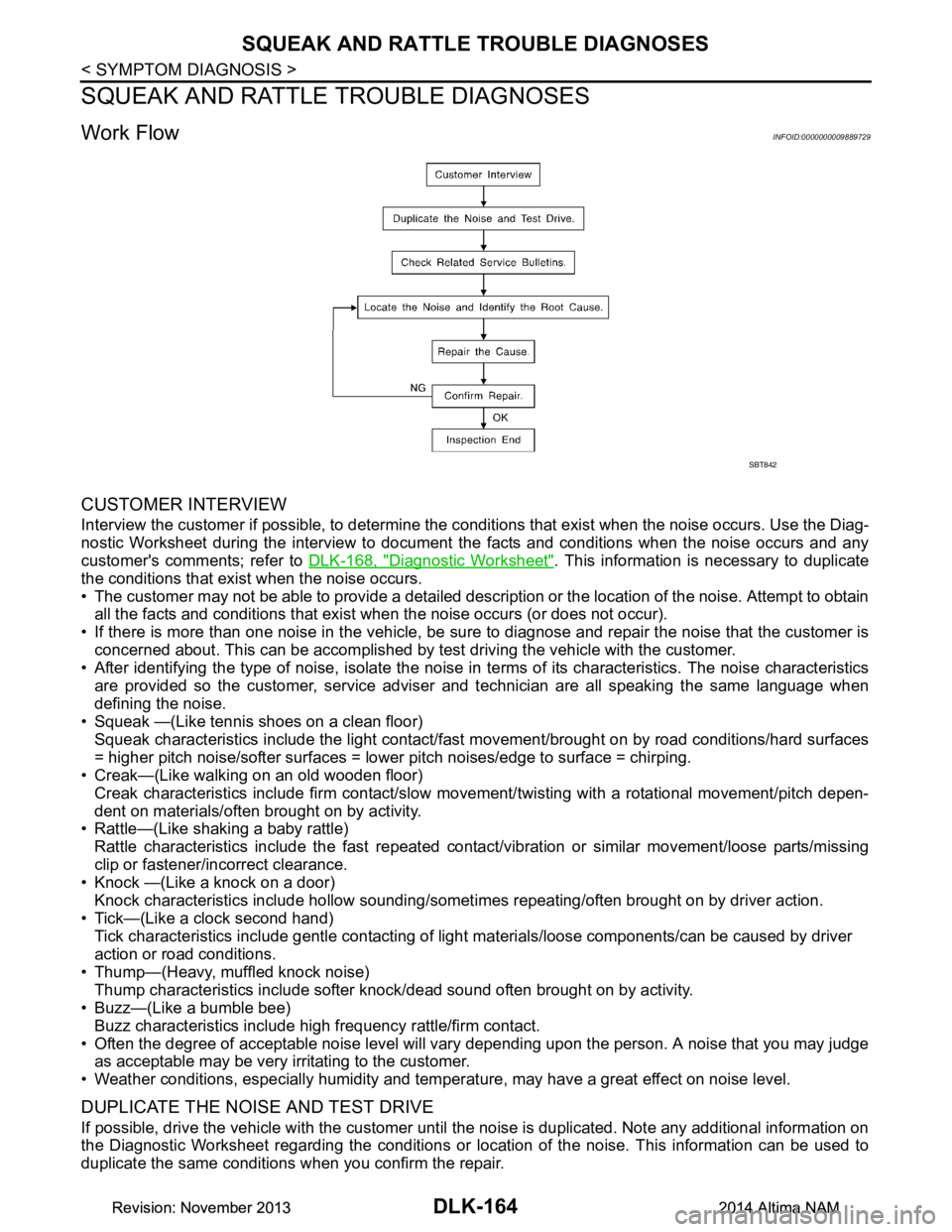
Work FlowINFOID:0000000009889729
CUSTOMER INTERVIEW
Interview the customer if possible, to determine the conditions that exist when the noise occurs. Use the Diag-
nostic Worksheet during the interview to document the facts and conditions when the noise occurs and any
customer's comments; refer to DLK-168, "Diagnostic Worksheet"
. This information is necessary to duplicate
the conditions that exist when the noise occurs.
• The customer may not be able to provide a detailed description or the location of the noise. Attempt to obtain all the facts and conditions that exist w hen the noise occurs (or does not occur).
• If there is more than one noise in the vehicle, be sure to diagnose and repair the noise that the customer is
concerned about. This can be accomplished by test driving the vehicle with the customer.
• After identifying the type of noise, isolate the noise in terms of its characteristics. The noise characteristics
are provided so the customer, service adviser and technician are all speaking the same language when
defining the noise.
• Squeak —(Like tennis shoes on a clean floor)
Squeak characteristics include the light contact/fast movement/brought on by road conditions/hard surfaces
= higher pitch noise/softer surfaces = lower pitch noises/edge to surface = chirping.
• Creak—(Like walking on an old wooden floor)
Creak characteristics include firm contact/slow mo vement/twisting with a rotational movement/pitch depen-
dent on materials/often brought on by activity.
• Rattle—(Like shaking a baby rattle)
Rattle characteristics include the fast repeated contac t/vibration or similar movement/loose parts/missing
clip or fastener/incorrect clearance.
• Knock —(Like a knock on a door)
Knock characteristics include hollow sounding/someti mes repeating/often brought on by driver action.
• Tick—(Like a clock second hand) Tick characteristics include gentle contacting of light materials/loose components/can be caused by driver
action or road conditions.
• Thump—(Heavy, muffled knock noise) Thump characteristics include softer k nock/dead sound often brought on by activity.
• Buzz—(Like a bumble bee)
Buzz characteristics include hi gh frequency rattle/firm contact.
• Often the degree of acceptable noise level will vary depending upon the person. A noise that you may judge as acceptable may be very irritating to the customer.
• Weather conditions, especially humidity and temperat ure, may have a great effect on noise level.
DUPLICATE THE NOISE AND TEST DRIVE
If possible, drive the vehicle with the customer until the noise is duplicated. Note any additional information on
the Diagnostic Worksheet regarding the conditions or lo cation of the noise. This information can be used to
duplicate the same conditions when you confirm the repair.
SBT842
Revision: November 20132014 Altima NAMRevision: November 20132014 Altima NAM
Page 933 of 4801
SQUEAK AND RATTLE TROUBLE DIAGNOSESDLK-165
< SYMPTOM DIAGNOSIS >
C
D E
F
G H
I
J
L
M A
B
DLK
N
O P
If the noise can be duplicated easily during the test drive, to help identify the source of the noise, try to dupli-
cate the noise with the vehicle stopped by doing one or all of the following:
1) Close a door.
2) Tap or push/pull around the area where the noise appears to be coming from.
3) Rev the engine.
4) Use a floor jack to recreate vehicle “twist”.
5) At idle, apply engine load (electrical load, half-clutch on M/T model, drive position on CVT and A/T models).
6) Raise the vehicle on a hoist and hit a tire with a rubber hammer.
• Drive the vehicle and attempt to duplicate the conditions the customer states exist when the noise occurs.
• If it is difficult to duplicate the noise, drive the vehicle slowly on an undulating or rough road to stress the vehicle body.
CHECK RELATED SERVICE BULLETINS
After verifying the customer concern or symptom, che ck ASIST for Technical Service Bulletins (TSBs) related
to that concern or symptom.
If a TSB relates to the symptom, follow the procedure to repair the noise.
LOCATE THE NOISE AND IDENTIFY THE ROOT CAUSE
1. Narrow down the noise to a general area. To help pi npoint the source of the noise, use a listening tool
(Chassis Ear: J-39570, Engine Ear: J-39565 and mechanic's stethoscope).
2. Narrow down the noise to a more specific area and identify the cause of the noise by: • removing the components in the area that you suspect the noise is coming from.
Do not use too much force when removing clips and fasteners, otherwise clips and fasteners can be
broken or lost during the repair, resulting in the creation of new noise.
• tapping or pushing/pulling the component that you suspect is causing the noise.
Do not tap or push/pull the component with excessive force, otherwise the noise will be eliminated only
temporarily.
• feeling for a vibration with your hand by touching the component(s) that you suspect is (are) causing the
noise.
• placing a piece of paper between components that you suspect are causing the noise.
• looking for loose components and contact marks. Refer to DLK-165, "Generic Squeak and Rattle Troubleshooting"
.
REPAIR THE CAUSE
• If the cause is a loose component, tighten the component securely.
• If the cause is insufficient clearance between components:
- separate components by repositioning or loos ening and retightening the component, if possible.
- insulate components with a suitable insulator such as urethane pads, foam blocks, felt cloth tape or urethane tape. A NISSAN Squeak and Rattle Kit (J-50397) is av ailable through your authorized NISSAN Parts Depart-
ment.
CAUTION:
Do not use excessive force as many components are constructed of plastic and may be damaged.
NOTE:
• Always check with the Parts Department for the latest parts information.
• The materials contained in the NISSAN Squeak and Rattle Kit (J-50397) are listed on the inside cover of the
kit; and can each be ordered seperately as needed.
• The following materials not found in the kit can also be used to repair squeaks and rattles.
- SILICONE GREASE: Use instead of UHMW tape that will be visible or does not fit. The silicone grease will
only last a few months.
- SILICONE SPRAY: Use when grease cannot be applied.
- DUCT TAPE: Use to eliminate movement.
CONFIRM THE REPAIR
Confirm that the cause of a noise is repaired by test driving the vehicle. Operate the vehicle under the same
conditions as when the noise originally occurred. Refer to the notes on the Diagnostic Worksheet.
Generic Squeak and Rattle TroubleshootingINFOID:0000000009889730
Refer to Table of Contents for specific component removal and installation information.
INSTRUMENT PANEL
Most incidents are caused by contact and movement between:
Revision: November 20132014 Altima NAMRevision: November 20132014 Altima NAM
Page 989 of 4801
OUTSIDE KEY ANTENNADLK-221
< REMOVAL AND INSTALLATION >
C
D E
F
G H
I
J
L
M A
B
DLK
N
O P
OUTSIDE KEY ANTENNA
DRIVER SIDE
DRIVER SIDE : Removal and InstallationINFOID:0000000009461970
REMOVAL
The driver side outside key antenna and driver side outside handle are serviced as an assembly. Refer to
DLK-198, "FRONT DOOR HANDLE : Removal and Installation - Outside Handle"
.
INSTALLATION
Installation is in the reverse order of removal.
PASSENGER SIDE
PASSENGER SIDE : Removal and InstallationINFOID:0000000009461971
REMOVAL
The passenger side outside key antenna and passenger side outside handle are serviced as an assembly.
Refer to DLK-198, "FRONT DOOR HANDLE : Removal and Installation - Outside Handle"
.
INSTALLATION
Installation is in the reverse order of removal.
REAR BUMPER
REAR BUMPER : Remo val and InstallationINFOID:0000000009461972
REMOVAL
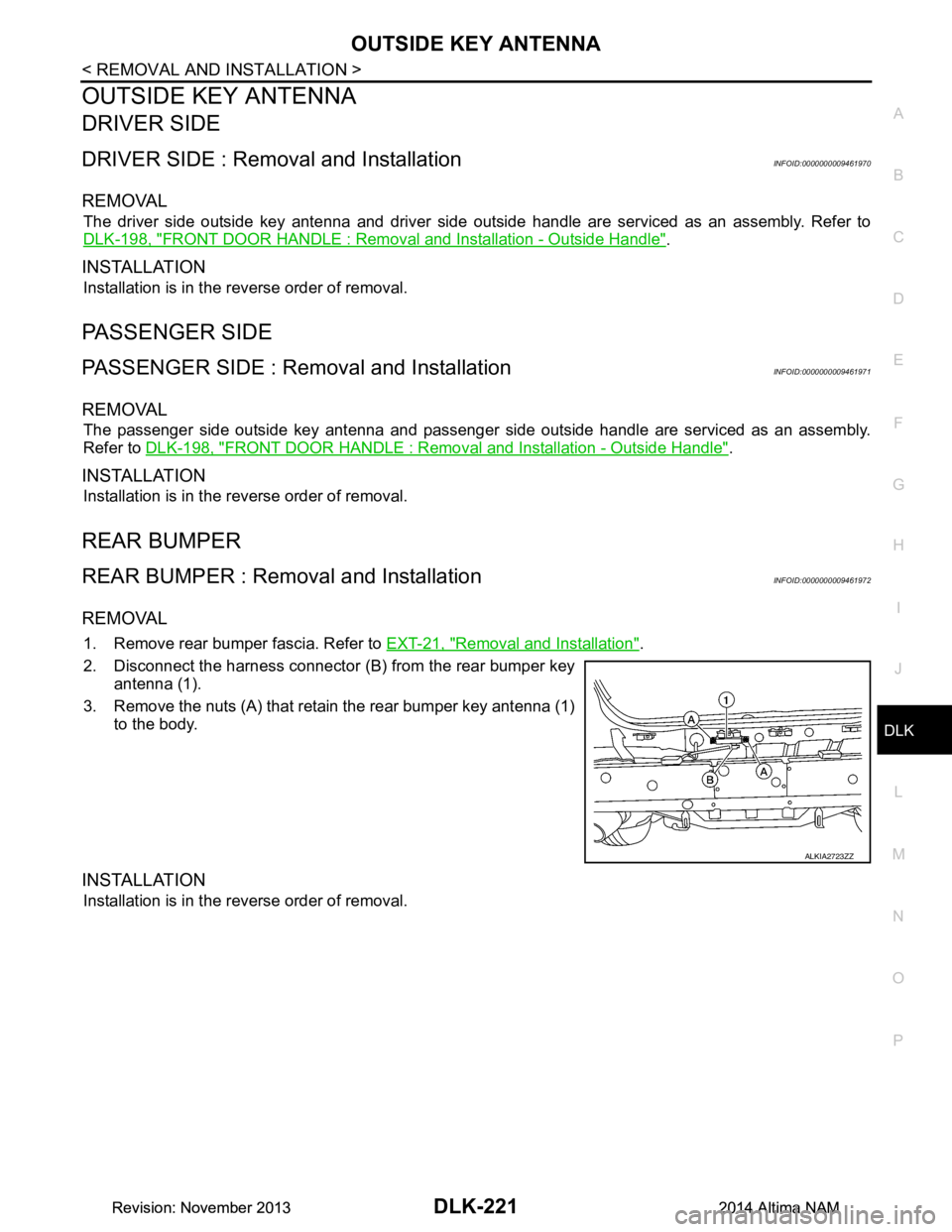
1. Remove rear bumper fascia. Refer to EXT-21, "Removal and Installation".
2. Disconnect the harness connector (B) from the rear bumper key
antenna (1).
3. Remove the nuts (A) that retain the rear bumper key antenna (1) to the body.
INSTALLATION
Installation is in the reverse order of removal.
ALKIA2723ZZ
Revision: November 20132014 Altima NAMRevision: November 20132014 Altima NAM
Page 990 of 4801
DLK-222
< REMOVAL AND INSTALLATION >
DOOR REQUEST SWITCH
DOOR REQUEST SWITCH
DRIVER SIDE
DRIVER SIDE : Removal and InstallationINFOID:0000000009461973
REMOVAL
The driver side door request switch and driver side outside handle are serviced as an assembly. Refer to DLK-
198, "FRONT DOOR HANDLE : Removal and Installation - Outside Handle".
INSTALLATION
Installation is in the reverse order of removal.
PASSENGER SIDE
PASSENGER SIDE : Removal and InstallationINFOID:0000000009461974
REMOVAL
The passenger side door request switch and passenger side outside handle are serviced as an assembly.
Refer to DLK-198, "FRONT DOOR HANDLE : Removal and Installation - Outside Handle"
.
INSTALLATION
Installation is in the reverse order of removal.
Revision: November 20132014 Altima NAMRevision: November 20132014 Altima NAM
Page 1001 of 4801

EC-1
ENGINE
C
D E
F
G H
I
J
K L
M
SECTION EC
A
EC
N
O P
CONTENTS
ENGINE CONTROL SYSTEM
QR25DE
PRECAUTION ................ ..............................
15
PRECAUTIONS .............................................. ....15
Precaution for Supplemental Restraint System
(SRS) "AIR BAG" and "SEAT BELT PRE-TEN-
SIONER" ............................................................. ....
15
Precaution for Procedure without Cowl Top Cover ....15
On Board Diagnostic (OBD) System of Engine
and CVT .............................................................. ....
15
General Precautions ...............................................16
PREPARATION ...........................................19
PREPARATION .............................................. ....19
Special Service Tools .......................................... ....19
Commercial Service Tools ......................................19
SYSTEM DESCRIPTION .............................21
COMPONENT PARTS ................................... ....21
Component Parts Location ................................ ....21
ECM ........................................................................25
Accelerator Pedal Position Sensor ...................... ....25
Electric Throttle Control Actuator ........................ ....25
Ignition Coil With Power Transistor .........................26
Fuel Injector ........................................................ ....26
Fuel Level Sensor Unit and Fuel Pump .............. ....26
Fuel Tank Temperature Sensor .......................... ....27
Mass Air Flow Sensor (With Intake Air Tempera-
ture Sensor) ........................................................ ....
27
Manifold Absolute Pressure Sensor ........................28
Engine Coolant Temperature Sensor .................. ....28
Crankshaft Position Sensor (POS) ..........................29
Camshaft Position Sens or (PHASE) .......................29
Intake Valve Timing Cont rol Solenoid Valve ...........30
Intake Valve Timing Intermediate Lock Control
Solenoid Valve .................................................... ....
30
Exhaust Valve Timing Control Position Sensor .......30
Exhaust Valve Timing Control Solenoid Valve ........31
Intake Manifold Runner Control Valve ................. ....31
Intake Manifold Tuning Valve ..................................31
Air Fuel Ratio (A/F) Sensor 1 ..................................32
Heated Oxygen Sensor 2 ........................................32
Knock Sensor ..........................................................33
Engine Oil Pressure Sensor ....................................33
Engine Oil Temperature Sensor .......................... ....33
Cooling Fan .............................................................34
EVAP Canister .........................................................34
EVAP Canister Purge Volu me Control Solenoid
Valve .................................................................... ....
34
EVAP Canister Vent Control Valve ..........................35
EVAP Control System Pres sure Sensor ..................35
Battery Current Sensor (With Battery Tempera-
ture Sensor) ......................................................... ....
35
Malfunction Indicator lamp (MIL) .............................36
Oil Pressure Warning Lamp ....................................36
Refrigerant Pressure Sensor ............................... ....36
Stop Lamp Switch & Brake Pedal Position Switch ....36
ASCD Steering Switch .............................................37
Information Display ..................................................37
STRUCTURE AND OPERATION .....................38
Positive Crankcase Ventilation ................................38
On Board Refueling Vapor Recovery (ORVR) ........39
SYSTEM ............................................................40
ENGINE CONTROL SYSTEM ........................ ...........40
ENGINE CONTROL SYSTEM : System Descrip-
tion ....................................................................... ....
40
ENGINE CONTROL SYSTEM : Fail Safe ..............41
MULTIPORT FUEL INJECTION SYSTEM ................43
MULTIPORT FUEL INJECTION SYSTEM : Sys-
tem Description (with auto matic air conditioner) ......
43
MULTIPORT FUEL INJECTION SYSTEM : Sys-
tem Description (with manual air conditioner) .........
46
ELECTRIC IGNITION SYSTEM .................................48
ELECTRIC IGNITION SYSTEM : System De-
scription ............................................................... ....
48
Revision: November 20132014 Altima NAMRevision: November 20132014 Altima NAM
Page 1002 of 4801

EC-2
INTAKE VALVE TIMING CONTROL ........................49
INTAKE VALVE TIMING CONTROL : System De-
scription ............................................................... ...
49
EXHAUST VALVE TIMING CONTROL ................. ...52
EXHAUST VALVE TIMING CONTROL : System
Description ........................................................... ...
52
INTAKE MANIFOLD RUNNER CONTROL ........... ...53
INTAKE MANIFOLD RUNNER CONTROL : Sys-
tem Description .................................................... ...
53
INTAKE MANIFOLD TUNING SYSTEM ...................54
INTAKE MANIFOLD TUNI NG SYSTEM : System
Description ........................................................... ...
54
ENGINE PROTECTION CONTROL AT LOW EN-
GINE OIL PRESSURE ....... .......................................
55
ENGINE PROTECTION CONTROL AT LOW EN-
GINE OIL PRESSURE : S ystem Description .........
55
FUEL FILLER CAP WARNING SYSTEM .............. ...55
FUEL FILLER CAP WARNING SYSTEM : System
Description ........................................................... ...
56
AIR CONDITIONING CUT CONTROL ................... ...56
AIR CONDITIONING CUT CONTROL : System
Description (with automatic air conditioner) ......... ...
56
AIR CONDITIONING CUT CONTROL : System
Description (with manual air conditioner) ................
57
COOLING FAN CONTROL .................................... ...58
COOLING FAN CONTROL : System Description
(with automatic air condit ioner) ...............................
59
COOLING FAN CONTROL : System Description
(with manual air conditio ner) ..................................
60
EVAPORATIVE EMISSION SYSTEM .................... ...61
EVAPORATIVE EMISSION SYSTEM : System
Description ........................................................... ...
62
AUTOMATIC SPEED CONTROL DEVICE (ASCD) ...63
AUTOMATIC SPEED CONTROL DEVICE (AS-
CD) : System Description .................................... ...
63
CAN COMMUNICATION ........................................ ...64
CAN COMMUNICATION : System Description ......64
OPERATION ................................................... ...65
AUTOMATIC SPEED CONTROL DEVICE (ASCD) ...65
AUTOMATIC SPEED CONTROL DEVICE (AS-
CD) : Switch Name and Function ........................ ...
65
ON BOARD DIAGNOSTIC (OBD) SYSTEM .....66
Diagnosis Description .......................................... ...66
GST (Generic Scan Tool) .......................................66
DIAGNOSIS SYSTEM (ECM) ............................67
DIAGNOSIS DESCRIPTION .................................. ...67
DIAGNOSIS DESCRIPTION : 1st Trip Detection
Logic and Two Trip Detection Logic .................... ...
67
DIAGNOSIS DESCRIPTION : DTC and Freeze
Frame Data .......................................................... ...
67
DIAGNOSIS DESCRIPTION : Counter System ......68
DIAGNOSIS DESCRIPTION : Driving Pattern ........71
DIAGNOSIS DESCRIPTION : System Readiness
Test (SRT) Code .................................................. ...
72
DIAGNOSIS DESCRIPTION : Permanent Diag-
nostic Trouble Code (Permanent DTC) ............... ...
73
DIAGNOSIS DESCRIPTION : Malfunction Indica-
tor Lamp (MIL) ..................................................... ...
74
On Board Diagnosis Function .................................74
CONSULT Function ................................................77
ECU DIAGNOSIS INFORMATION .............88
ECM ...................................................................88
Reference Value .................................................. ...88
Fail Safe ...............................................................101
DTC Inspection Priority Chart .............................104
DTC Index ............................................................105
Test Value and Test Limit .....................................109
WIRING DIAGRAM ...................................117
ENGINE CONTROL SYSTEM ........................ ..117
Wiring Diagram .................................................... .117
BASIC INSPECTION .................................165
DIAGNOSIS AND REPAIR WORKFLOW ...... ..165
Work Flow ............................................................ .165
Diagnostic Work Sheet .........................................168
BASIC INSPECTION ...................................... ..170
Work Procedure ................................................... .170
ADDITIONAL SERVICE WHEN REPLACING
ECM ................................................................ ..
174
Description ........................................................... .174
Work Procedure ....................................................174
VIN REGISTRATION ........................................176
Description ........................................................... .176
Work Procedure ....................................................176
ACCELERATOR PEDAL RELEASED POSI-
TION LEARNING ............................................ ..
177
Description ........................................................... .177
Work Procedure ....................................................177
THROTTLE VALVE CLOSED POSITION
LEARNING ..................................................... ..
178
Description ........................................................... .178
Work Procedure ....................................................178
IDLE AIR VOLUME LEARNING .......................179
Description ........................................................... .179
Work Procedure ....................................................179
MIXTURE RATIO SELF-LEARNING VALUE
CLEAR ............................................................ ..
181
Revision: November 20132014 Altima NAMRevision: November 20132014 Altima NAM
Page 1008 of 4801

EC-8
POSITIVE CRANKCASE VENTILATION ........539
Inspection ............................................................ ..539
REMOVAL AND INSTALLATION ..............540
ECM ................................................................ .540
Removal and Installation ..................................... ..540
SERVICE DATA AND SPECIFICATIONS
(SDS) .............. ............................................
541
SERVICE DATA AND SPECIFICATIONS
(SDS) ............................................................... .
541
Idle Speed ........................................................... ..541
Ignition Timing .......................................................541
Calculated Load Value ..........................................541
Mass Air Flow Sensor ............................................541
VQ35DE
PRECAUTION .............. ..............................
542
PRECAUTIONS .............................................. .542
Precaution for Supplemental Restraint System
(SRS) "AIR BAG" and "SEAT BELT PRE-TEN-
SIONER" .............................................................. ..
542
On Board Diagnostic (OBD) System of Engine
and CVT .............................................................. ..
542
General Precautions ..............................................543
PREPARATION ..........................................546
PREPARATION .............................................. .546
Special Service Tools .......................................... ..546
Commercial Service Tools .....................................546
SYSTEM DESCRIPTION ...........................548
COMPONENT PARTS .................................... .548
ENGINE CONTROL SYSTEM .................................548
ENGINE CONTROL SYSTEM : Component Parts
Location ............................................................... ..
548
Accelerator Pedal Position Sensor ........................552
Air Fuel Ratio (A/F) Sensor 1 ................................552
ASCD Steering Switch ...........................................553
Battery Current Sensor (With Battery Tempera-
ture Sensor) ......................................................... ..
553
Camshaft Position Sensor (PHASE) .....................554
Cooling Fan ......................................................... ..554
Crankshaft Position Sensor (POS) ........................554
ECM .......................................................................555
Electric Throttle Control Actuator ......................... ..555
Electronic Controlled Engine Mount .................... ..556
Engine Coolant Temperature Sensor ....................556
Engine Oil Pressure Sensor ................................ ..557
Engine Oil Temperature Sensor ............................557
EVAP Canister ..................................... ..................557
EVAP Canister Purge Volu me Control Solenoid
Valve .................................................................... ..
557
EVAP Canister Vent Control Valve ........................558
EVAP Control System Pressu re Sensor ................558
Fuel Injector ......................................................... .558
Fuel Level Sensor Unit and Fuel Pump (With Fuel
Tank Temperature Sensor) .................................. .
558
Heated Oxygen Sensor 2 ......................................559
Ignition Coil (With Power Transistor) ....................560
Intake Valve Timing Control Solenoid Valve .........560
Knock Sensor ....................................................... .560
Malfunction Indicator lamp (MIL) ...........................560
Mass Air Flow Sensor (With Intake Air Tempera-
ture Sensor) ......................................................... .
560
Oil Pressure Warning Lamp ..................................561
Power Valve Actuator 1 and 2 ..............................561
Refrigerant Pressure Sensor ................................562
Stop Lamp Switch & Brak e Pedal Position Switch .562
VIAS Control Solenoid Valve 1 and 2 .................. .562
STRUCTURE AND OPERATION .....................563
Positive Crankcase Ventilation (PCV) ...................563
On Board Refueling Vapor Recovery (ORVR) ..... .564
SYSTEM ...........................................................565
ENGINE CONTROL SYSTEM ................................ .565
ENGINE CONTROL SYSTEM : System Descrip-
tion ....................................................................... .
565
ENGINE CONTROL SYSTEM : Fail-safe .............566
MULTIPORT FUEL INJECTION SYSTEM ............. .568
MULTIPORT FUEL INJECTION SYSTEM : Sys-
tem Description .................................................... .
568
ELECTRIC IGNITION SYSTEM ............................. .571
ELECTRIC IGNITION SYSTEM : System De-
scription ................................................................ .
571
AIR CONDITIONING CUT CONTROL ................... .572
AIR CONDITIONING CUT CONTROL : System
Description ........................................................... .
573
AUTOMATIC SPEED CONTROL DEVICE (ASCD) .574
AUTOMATIC SPEED CONTROL DEVICE (AS-
CD) : System Description ..................................... .
574
COOLING FAN CONTROL .................................... .575
COOLING FAN CONTROL : System Description .575
ELECTRONIC CONTROLLED ENGINE MOUNT .. .577
ELECTRONIC CONTROLLED ENGINE MOUNT
: System Description ............................................ .
577
EVAPORATIVE EMISSION SYSTEM .....................579
EVAPORATIVE EMISSION SYSTEM : System
Description ........................................................... .
580
THROTTLE CONTROL ...........................................581
THROTTLE CONTROL : Syst em Description ......581
INTAKE VALVE TIMING CONTROL ..................... .582
INTAKE VALVE TIMING CONTROL : System De-
scription ................................................................ .
583
ENGINE PROTECTION CONTROL AT LOW EN-
GINE OIL PRESSURE ........................................... .
583
Revision: November 20132014 Altima NAMRevision: November 20132014 Altima NAM