warning NISSAN TERRANO 2004 Service Owner's Manual
[x] Cancel search | Manufacturer: NISSAN, Model Year: 2004, Model line: TERRANO, Model: NISSAN TERRANO 2004Pages: 1833, PDF Size: 53.42 MB
Page 300 of 1833
Installation
IInstall the injection tubes, referring to the markings made dur-
ing removal.
I Install the injection tubes in the order of No. 3, No. 4, No. 1, and
No. 2.
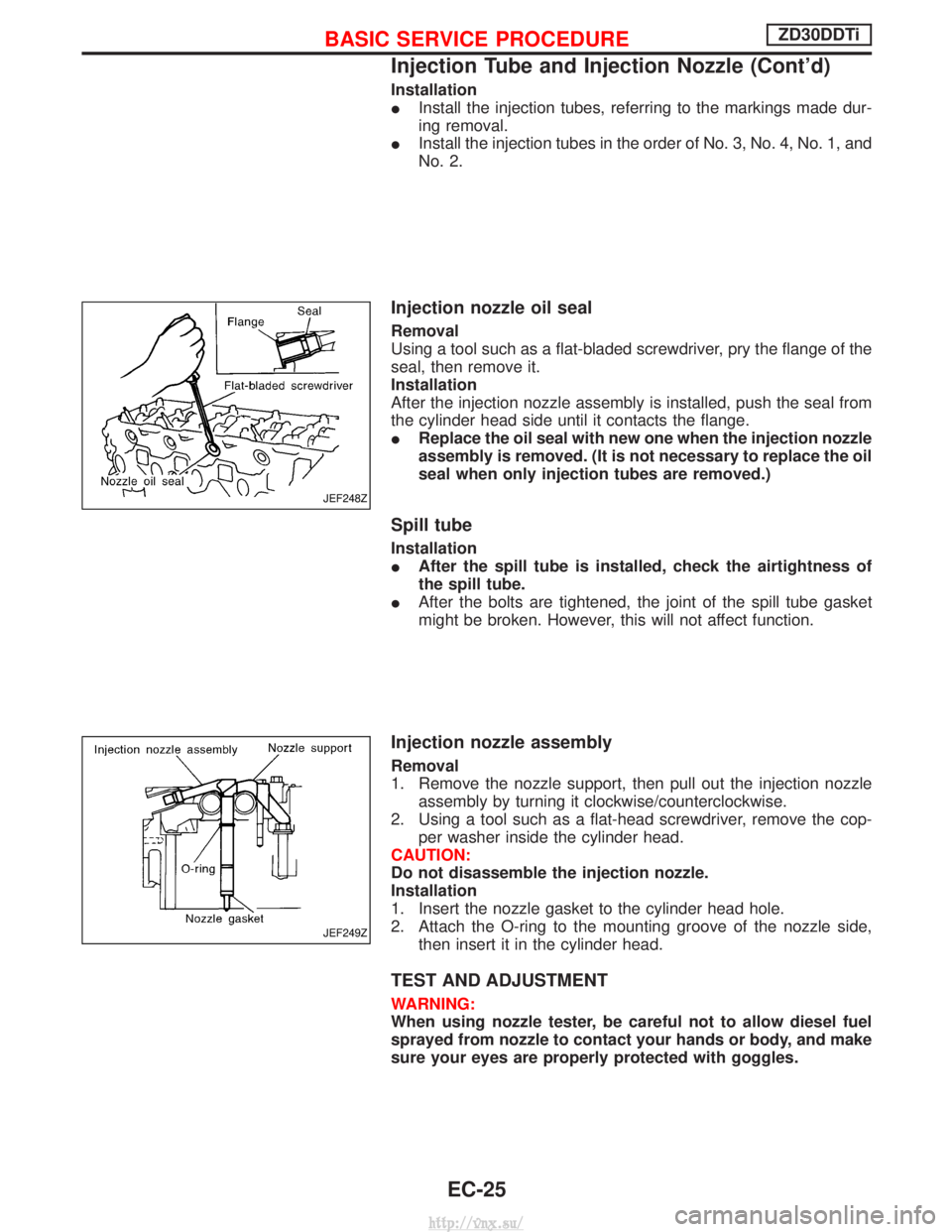
Injection nozzle oil seal
Removal
Using a tool such as a flat-bladed screwdriver, pry the flange of the
seal, then remove it.
Installation
After the injection nozzle assembly is installed, push the seal from
the cylinder head side until it contacts the flange.
IReplace the oil seal with new one when the injection nozzle
assembly is removed. (It is not necessary to replace the oil
seal when only injection tubes are removed.)
Spill tube
Installation
IAfter the spill tube is installed, check the airtightness of
the spill tube.
I After the bolts are tightened, the joint of the spill tube gasket
might be broken. However, this will not affect function.
Injection nozzle assembly
Removal
1. Remove the nozzle support, then pull out the injection nozzle
assembly by turning it clockwise/counterclockwise.
2. Using a tool such as a flat-head screwdriver, remove the cop- per washer inside the cylinder head.
CAUTION:
Do not disassemble the injection nozzle.
Installation
1. Insert the nozzle gasket to the cylinder head hole.
2. Attach the O-ring to the mounting groove of the nozzle side, then insert it in the cylinder head.
TEST AND ADJUSTMENT
WARNING:
When using nozzle tester, be careful not to allow diesel fuel
sprayed from nozzle to contact your hands or body, and make
sure your eyes are properly protected with goggles.
JEF248Z
JEF249Z
BASIC SERVICE PROCEDUREZD30DDTi
Injection Tube and Injection Nozzle (Cont'd)
EC-25
http://vnx.su/
Page 309 of 1833
IIf the battery is disconnected, the emission-related diagnostic information will be lost after approx.
24 hours.
I Erasing the emission-related diagnostic information using CONSULT-II is easier and quicker than
switching the diagnostic test mode using the data link connector.
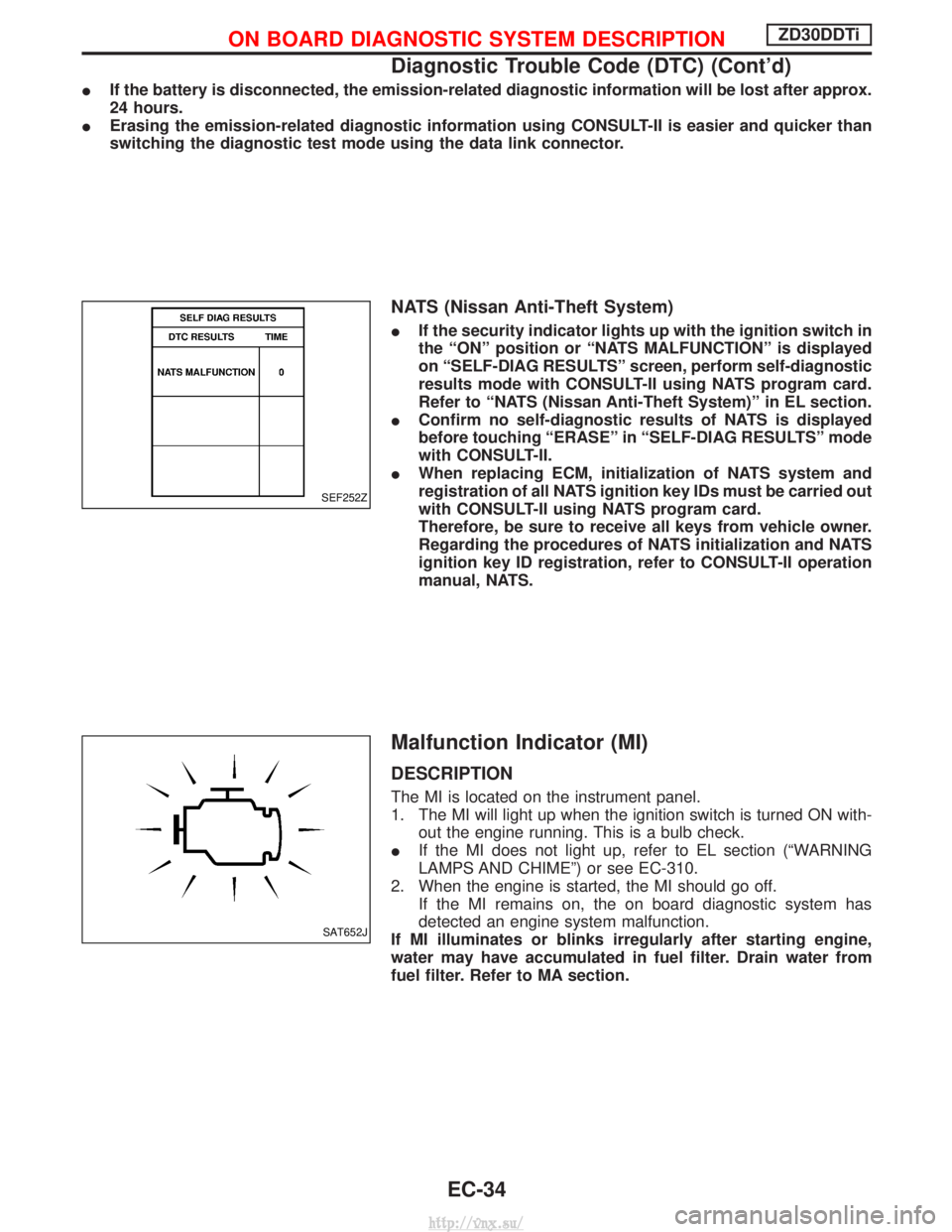
NATS (Nissan Anti-Theft System)
IIf the security indicator lights up with the ignition switch in
the ªONº position or ªNATS MALFUNCTIONº is displayed
on ªSELF-DIAG RESULTSº screen, perform self-diagnostic
results mode with CONSULT-II using NATS program card.
Refer to ªNATS (Nissan Anti-Theft System)º in EL section.
I Confirm no self-diagnostic results of NATS is displayed
before touching ªERASEº in ªSELF-DIAG RESULTSº mode
with CONSULT-II.
I When replacing ECM, initialization of NATS system and
registration of all NATS ignition key IDs must be carried out
with CONSULT-II using NATS program card.
Therefore, be sure to receive all keys from vehicle owner.
Regarding the procedures of NATS initialization and NATS
ignition key ID registration, refer to CONSULT-II operation
manual, NATS.
Malfunction Indicator (MI)
DESCRIPTION
The MI is located on the instrument panel.
1. The MI will light up when the ignition switch is turned ON with-
out the engine running. This is a bulb check.
I If the MI does not light up, refer to EL section (ªWARNING
LAMPS AND CHIMEº) or see EC-310.
2. When the engine is started, the MI should go off. If the MI remains on, the on board diagnostic system has
detected an engine system malfunction.
If MI illuminates or blinks irregularly after starting engine,
water may have accumulated in fuel filter. Drain water from
fuel filter. Refer to MA section.
SEF252Z
SAT652J
ON BOARD DIAGNOSTIC SYSTEM DESCRIPTIONZD30DDTi
Diagnostic Trouble Code (DTC) (Cont'd)
EC-34
http://vnx.su/
Page 310 of 1833
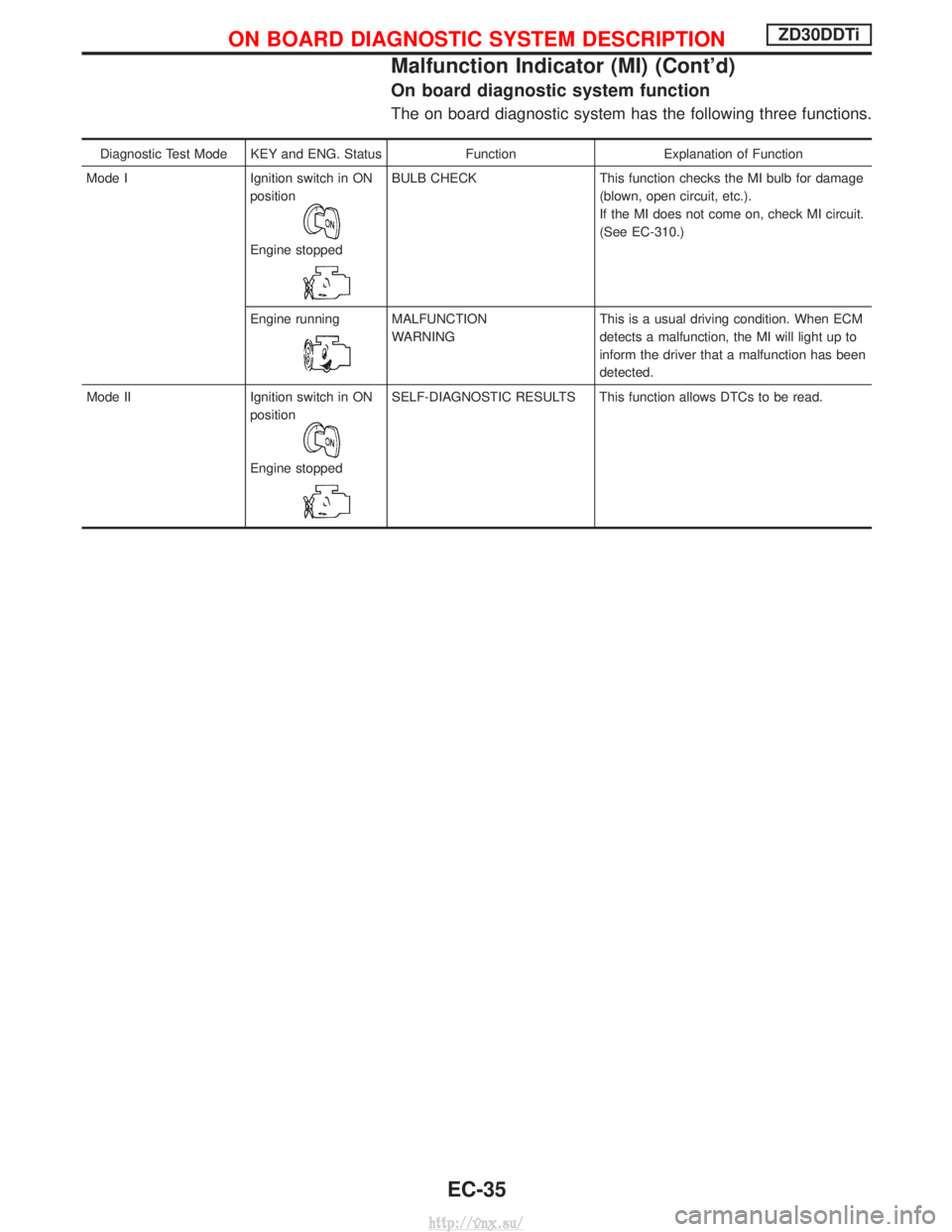
On board diagnostic system function
The on board diagnostic system has the following three functions.
Diagnostic Test Mode KEY and ENG. StatusFunctionExplanation of Function
Mode I Ignition switch in ON
position
Engine stopped
BULB CHECK This function checks the MI bulb for damage
(blown, open circuit, etc.).
If the MI does not come on, check MI circuit.
(See EC-310.)
Engine running
MALFUNCTION
WARNING This is a usual driving condition. When ECM
detects a malfunction, the MI will light up to
inform the driver that a malfunction has been
detected.
Mode II Ignition switch in ON position
Engine stopped
SELF-DIAGNOSTIC RESULTS This function allows DTCs to be read.
ON BOARD DIAGNOSTIC SYSTEM DESCRIPTIONZD30DDTi
Malfunction Indicator (MI) (Cont'd)
EC-35
http://vnx.su/
Page 312 of 1833
Diagnostic test mode I Ð Bulb check
In this mode, the MI on the instrument panel should stay ON. If it remains OFF, check the bulb. Refer to EL
section, ªWARNING LAMPS AND CHIMEº or see EC-310.
Diagnostic test mode I Ð Malfunction warning
MICondition
ON When the malfunction is detected or the ECM's CPU is malfunctioning.
OFF No malfunction.
Diagnostic test mode II Ð Self-diagnostic results
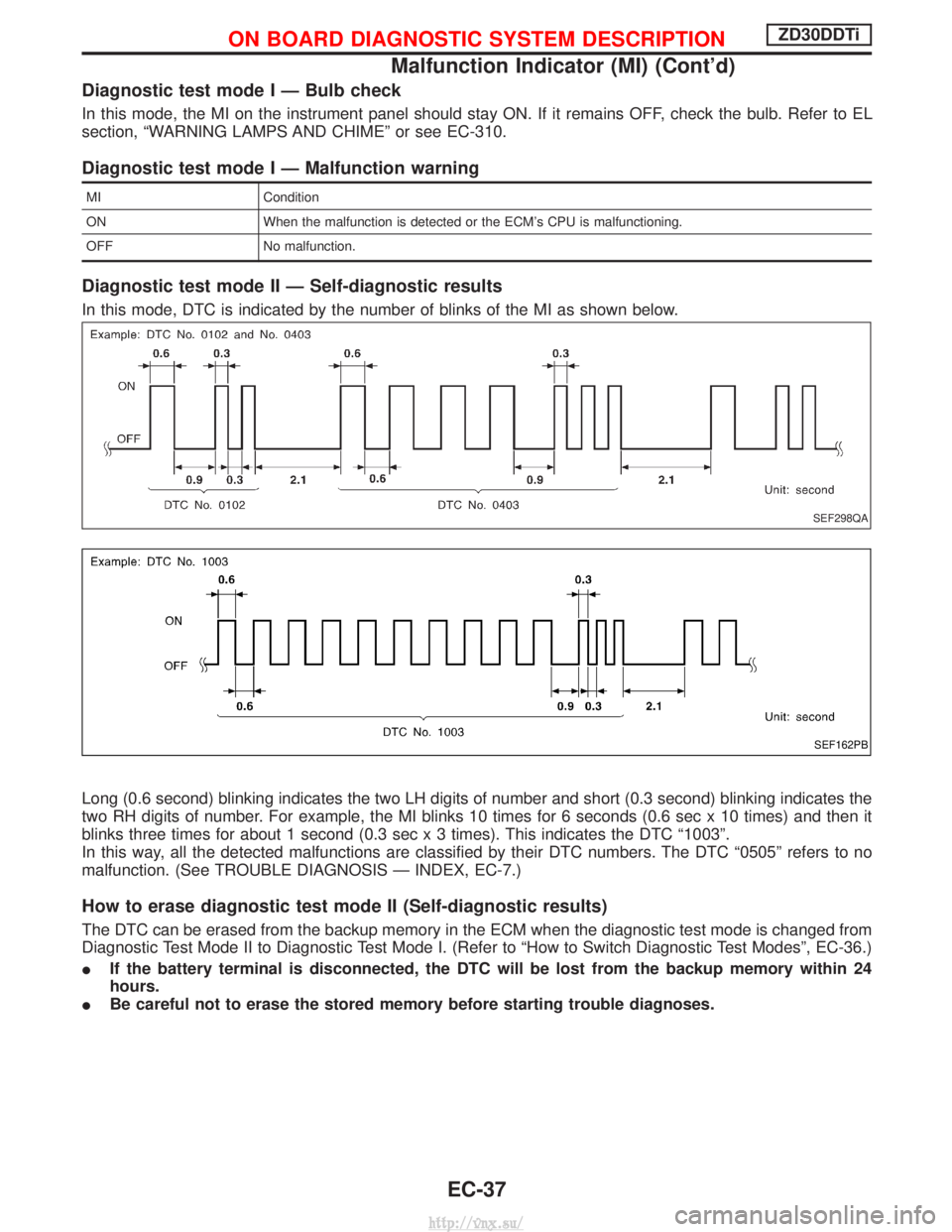
In this mode, DTC is indicated by the number of blinks of the MI as shown below.
Long (0.6 second) blinking indicates the two LH digits of number and short (0.3 second) blinking indicates the
two RH digits of number. For example, the MI blinks 10 times for 6 seconds (0.6 sec x 10 times) and then it
blinks three times for about 1 second (0.3 sec x 3 times). This indicates the DTC ª1003º.
In this way, all the detected malfunctions are classified by their DTC numbers. The DTC ª0505º refers to no
malfunction. (See TROUBLE DIAGNOSIS Ð INDEX, EC-7.)
How to erase diagnostic test mode II (Self-diagnostic results)
The DTC can be erased from the backup memory in the ECM when the diagnostic test mode is changed from
Diagnostic Test Mode II to Diagnostic Test Mode I. (Refer to ªHow to Switch Diagnostic Test Modesº, EC-36.)
I If the battery terminal is disconnected, the DTC will be lost from the backup memory within 24
hours.
I Be careful not to erase the stored memory before starting trouble diagnoses.
SEF298QA
SEF162PB
ON BOARD DIAGNOSTIC SYSTEM DESCRIPTIONZD30DDTi
Malfunction Indicator (MI) (Cont'd)
EC-37
http://vnx.su/
Page 386 of 1833
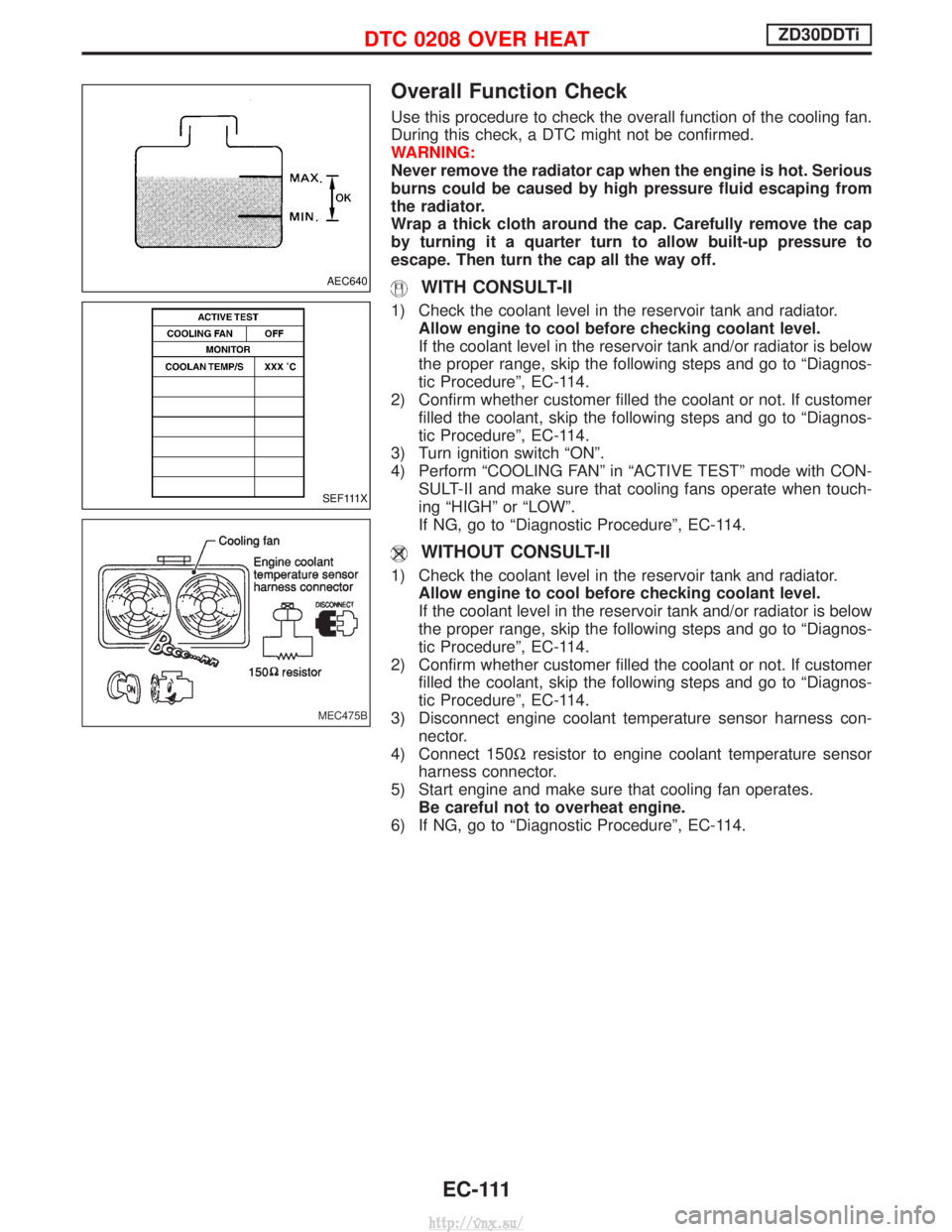
Overall Function Check
Use this procedure to check the overall function of the cooling fan.
During this check, a DTC might not be confirmed.
WARNING:
Never remove the radiator cap when the engine is hot. Serious
burns could be caused by high pressure fluid escaping from
the radiator.
Wrap a thick cloth around the cap. Carefully remove the cap
by turning it a quarter turn to allow built-up pressure to
escape. Then turn the cap all the way off.
WITH CONSULT-II
1) Check the coolant level in the reservoir tank and radiator.Allow engine to cool before checking coolant level.
If the coolant level in the reservoir tank and/or radiator is below
the proper range, skip the following steps and go to ªDiagnos-
tic Procedureº, EC-114.
2) Confirm whether customer filled the coolant or not. If customer filled the coolant, skip the following steps and go to ªDiagnos-
tic Procedureº, EC-114.
3) Turn ignition switch ªONº.
4) Perform ªCOOLING FANº in ªACTIVE TESTº mode with CON- SULT-II and make sure that cooling fans operate when touch-
ing ªHIGHº or ªLOWº.
If NG, go to ªDiagnostic Procedureº, EC-114.
WITHOUT CONSULT-II
1) Check the coolant level in the reservoir tank and radiator.Allow engine to cool before checking coolant level.
If the coolant level in the reservoir tank and/or radiator is below
the proper range, skip the following steps and go to ªDiagnos-
tic Procedureº, EC-114.
2) Confirm whether customer filled the coolant or not. If customer filled the coolant, skip the following steps and go to ªDiagnos-
tic Procedureº, EC-114.
3) Disconnect engine coolant temperature sensor harness con- nector.
4) Connect 150W resistor to engine coolant temperature sensor
harness connector.
5) Start engine and make sure that cooling fan operates. Be careful not to overheat engine.
6) If NG, go to ªDiagnostic Procedureº, EC-114.
AEC640
SEF111X
MEC475B
DTC 0208 OVER HEATZD30DDTi
EC-111
http://vnx.su/
Page 519 of 1833
Description
SYSTEM DESCRIPTION
Sensor Input Signal to ECMECM
Function Actuator
Crankshaft position
sensor (TDC) Engine speed
Glow
control Glow lamp,
Glow relay "
Glow plugs
Engine coolant tem-
perature sensor Engine coolant tem-
perature
When engine coolant temperature is more than approximately 75ÉC
(167ÉF), the glow relay turns off, inactivating the quick-glow control
until coolant temperature drops below approximately 55ÉC (131ÉF).
When coolant temperature is lower than approximately 75ÉC
(167ÉF):
I
Ignition switch ON
After ignition switch has turned to ON, the glow relay turns ON
for a certain period of time in relation to engine coolant
temperature, allowing current to flow through glow plug.
I Cranking
The glow relay turns ON, allowing current to flow through glow
plug.
I Starting
After engine has started, current continues to flow through glow
plug (after-glow mode) for a certain period in relation to engine
coolant temperature.
When engine speed exceeds approximately 4,800 rpm, current
flow through glow plug is interrupted.
The glow indicator lamp turns ON for a certain period of time in
relation to engine coolant temperature at the time glow relay is
turned ON.
COMPONENT DESCRIPTION
Glow plug
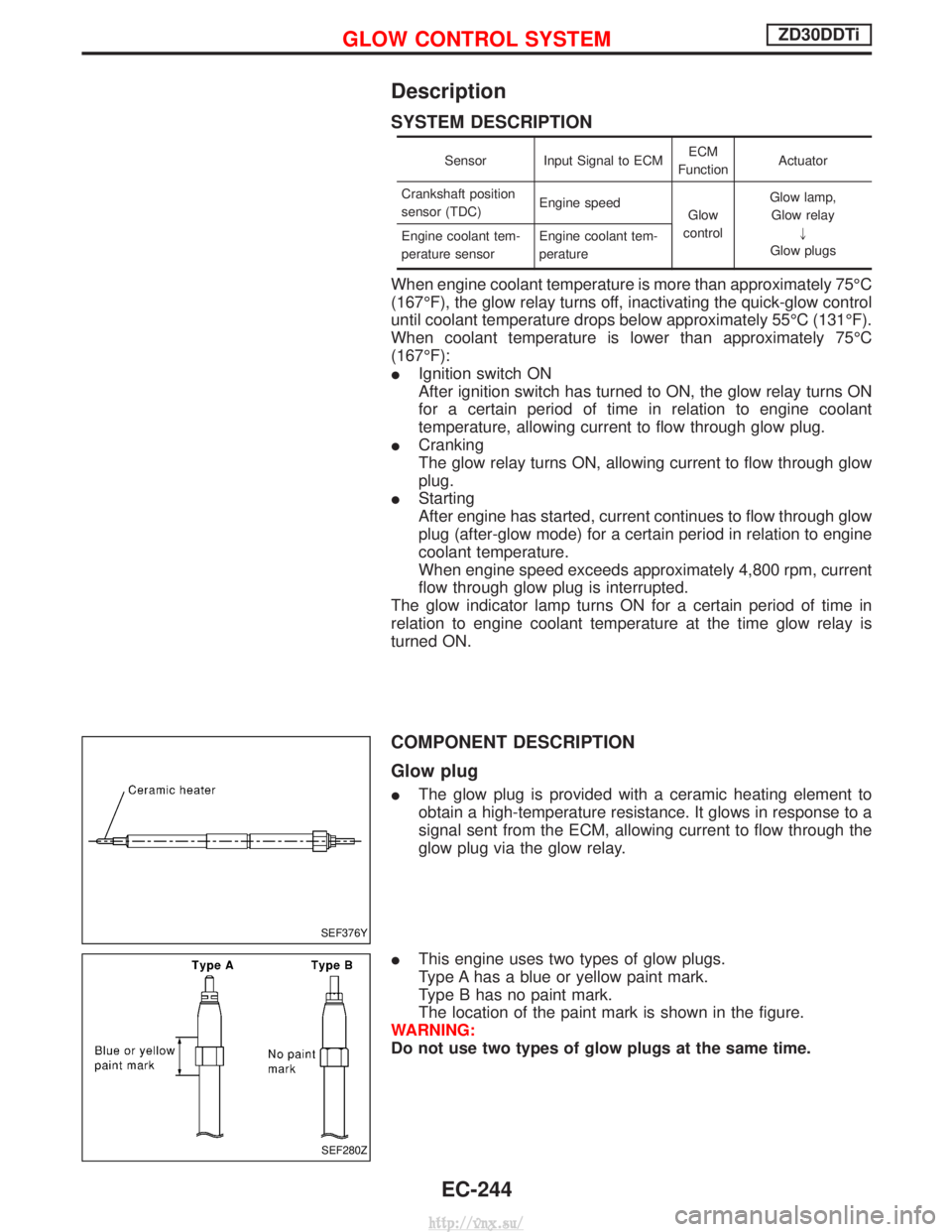
I The glow plug is provided with a ceramic heating element to
obtain a high-temperature resistance. It glows in response to a
signal sent from the ECM, allowing current to flow through the
glow plug via the glow relay.
I This engine uses two types of glow plugs.
Type A has a blue or yellow paint mark.
Type B has no paint mark.
The location of the paint mark is shown in the figure.
WARNING:
Do not use two types of glow plugs at the same time.
SEF376Y
SEF280Z
GLOW CONTROL SYSTEMZD30DDTi
EC-244
http://vnx.su/
Page 572 of 1833
Component Description
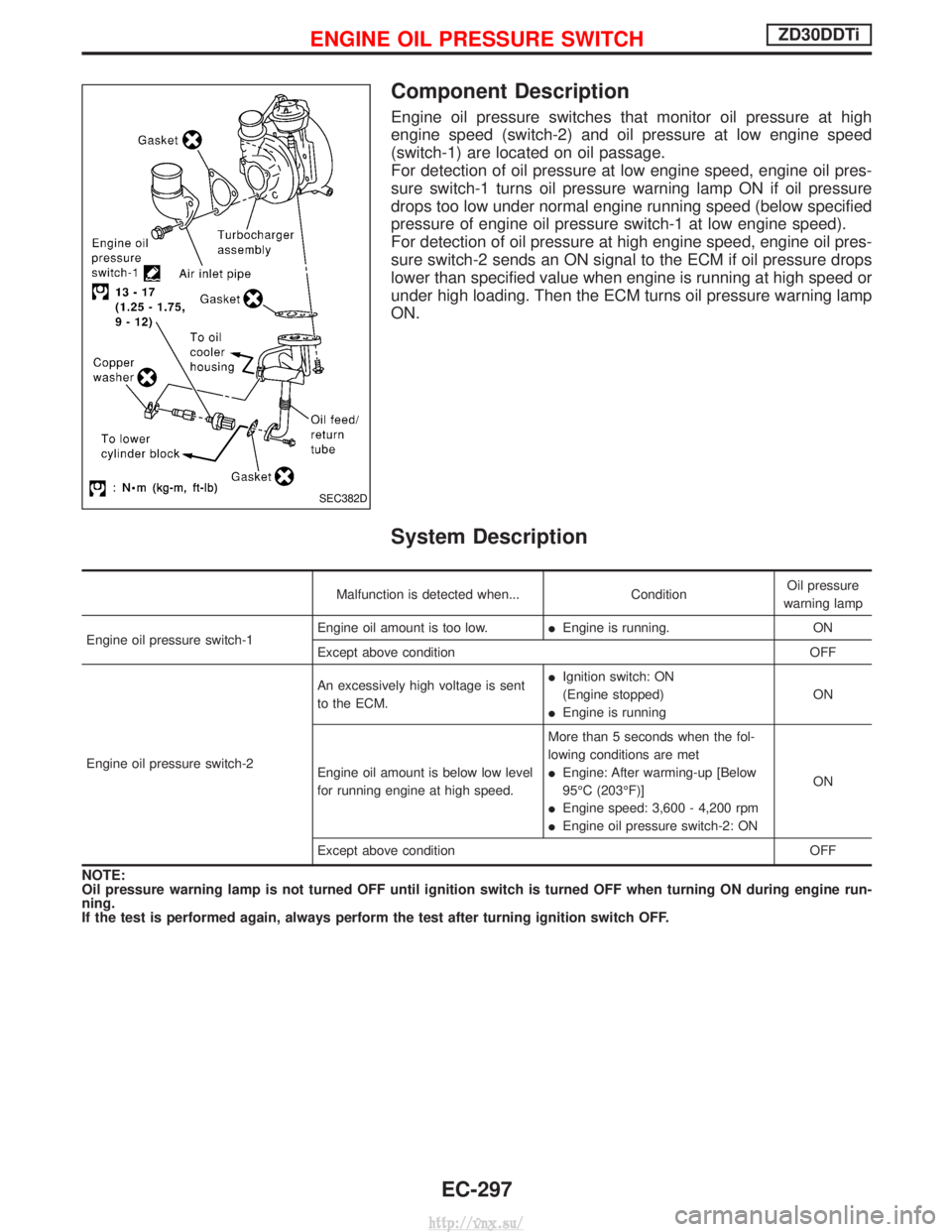
Engine oil pressure switches that monitor oil pressure at high
engine speed (switch-2) and oil pressure at low engine speed
(switch-1) are located on oil passage.
For detection of oil pressure at low engine speed, engine oil pres-
sure switch-1 turns oil pressure warning lamp ON if oil pressure
drops too low under normal engine running speed (below specified
pressure of engine oil pressure switch-1 at low engine speed).
For detection of oil pressure at high engine speed, engine oil pres-
sure switch-2 sends an ON signal to the ECM if oil pressure drops
lower than specified value when engine is running at high speed or
under high loading. Then the ECM turns oil pressure warning lamp
ON.
System Description
Malfunction is detected when...ConditionOil pressure
warning lamp
Engine oil pressure switch-1 Engine oil amount is too low.
IEngine is running. ON
Except above condition OFF
Engine oil pressure switch-2 An excessively high voltage is sent
to the ECM.
I
Ignition switch: ON
(Engine stopped)
I Engine is running ON
Engine oil amount is below low level
for running engine at high speed. More than 5 seconds when the fol-
lowing conditions are met
I
Engine: After warming-up [Below
95ÉC (203ÉF)]
I Engine speed: 3,600 - 4,200 rpm
I Engine oil pressure switch-2: ON ON
Except above condition OFF
NOTE:
Oil pressure warning lamp is not turned OFF until ignition switch is turned OFF when turning ON during engine run-
ning.
If the test is performed again, always perform the test after turning ignition switch OFF.
SEC382D
ENGINE OIL PRESSURE SWITCHZD30DDTi
EC-297
http://vnx.su/
Page 573 of 1833
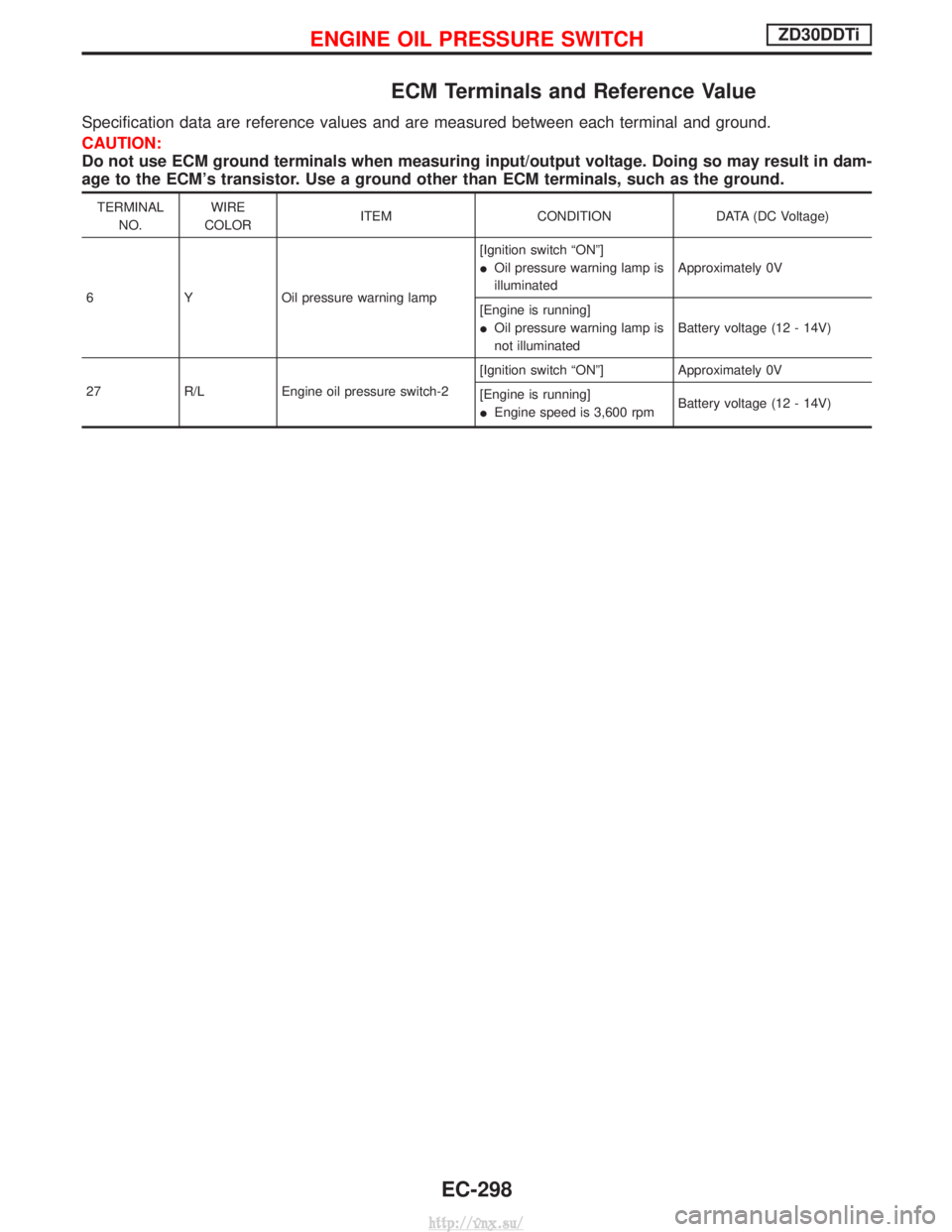
ECM Terminals and Reference Value
Specification data are reference values and are measured between each terminal and ground.
CAUTION:
Do not use ECM ground terminals when measuring input/output voltage. Doing so may result in dam-
age to the ECM's transistor. Use a ground other than ECM terminals, such as the ground.
TERMINALNO. WIRE
COLOR ITEM CONDITION DATA (DC Voltage)
6 Y Oil pressure warning lamp [Ignition switch ªONº]
I
Oil pressure warning lamp is
illuminated Approximately 0V
[Engine is running]
I Oil pressure warning lamp is
not illuminated Battery voltage (12 - 14V)
27 R/L Engine oil pressure switch-2 [Ignition switch ªONº] Approximately 0V
[Engine is running]
I
Engine speed is 3,600 rpm Battery voltage (12 - 14V)
ENGINE OIL PRESSURE SWITCHZD30DDTi
EC-298
http://vnx.su/
Page 576 of 1833
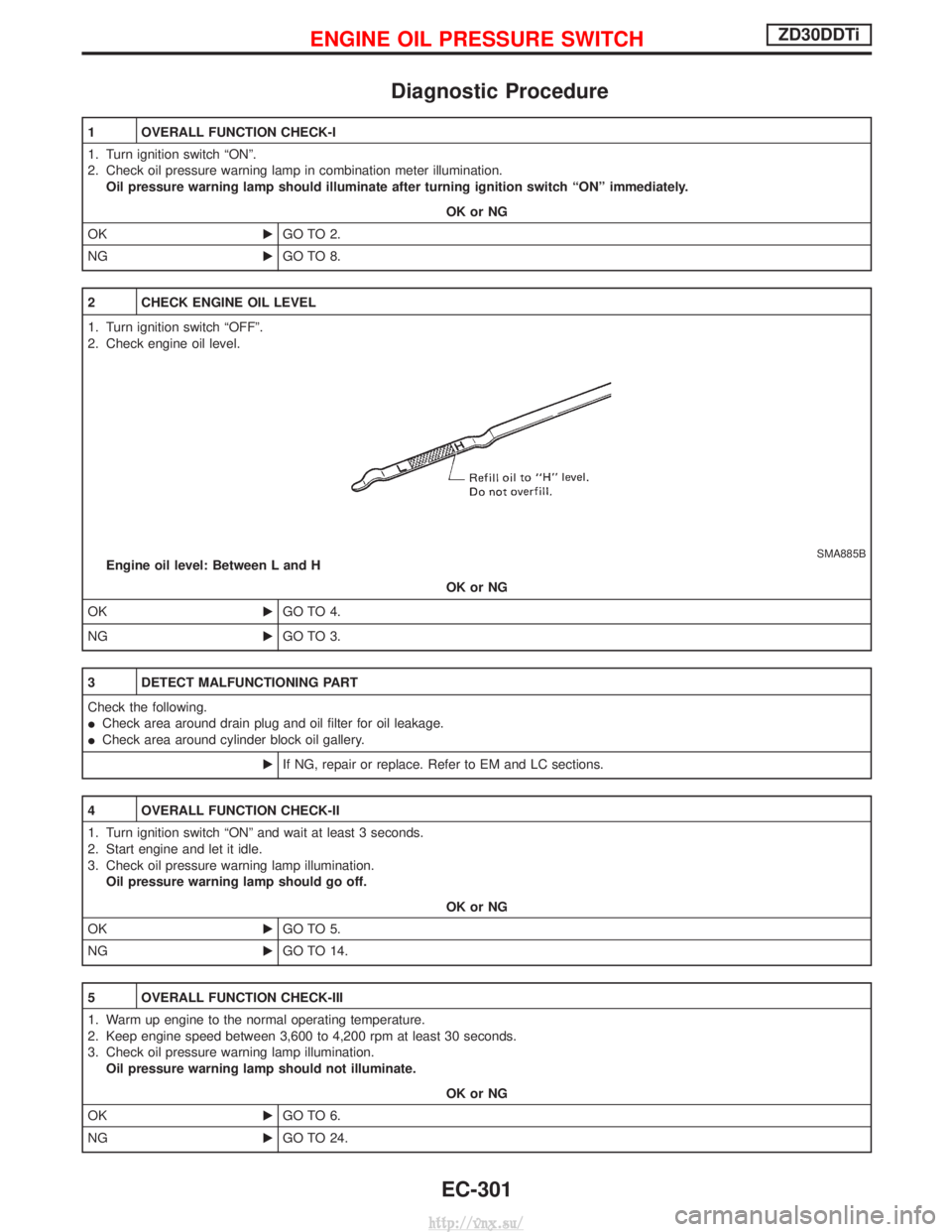
Diagnostic Procedure
1 OVERALL FUNCTION CHECK-I
1. Turn ignition switch ªONº.
2. Check oil pressure warning lamp in combination meter illumination.Oil pressure warning lamp should illuminate after turning ignition switch ªONº immediately.
OK or NG
OK EGO TO 2.
NG EGO TO 8.
2 CHECK ENGINE OIL LEVEL
1. Turn ignition switch ªOFFº.
2. Check engine oil level.
SMA885BEngine oil level: Between L and H
OK or NG
OK EGO TO 4.
NG EGO TO 3.
3 DETECT MALFUNCTIONING PART
Check the following.
ICheck area around drain plug and oil filter for oil leakage.
I Check area around cylinder block oil gallery.
EIf NG, repair or replace. Refer to EM and LC sections.
4 OVERALL FUNCTION CHECK-II
1. Turn ignition switch ªONº and wait at least 3 seconds.
2. Start engine and let it idle.
3. Check oil pressure warning lamp illumination.
Oil pressure warning lamp should go off.
OK or NG
OK EGO TO 5.
NG EGO TO 14.
5 OVERALL FUNCTION CHECK-III
1. Warm up engine to the normal operating temperature.
2. Keep engine speed between 3,600 to 4,200 rpm at least 30 seconds.
3. Check oil pressure warning lamp illumination.
Oil pressure warning lamp should not illuminate.
OK or NG
OK EGO TO 6.
NG EGO TO 24.
ENGINE OIL PRESSURE SWITCHZD30DDTi
EC-301
http://vnx.su/
Page 579 of 1833
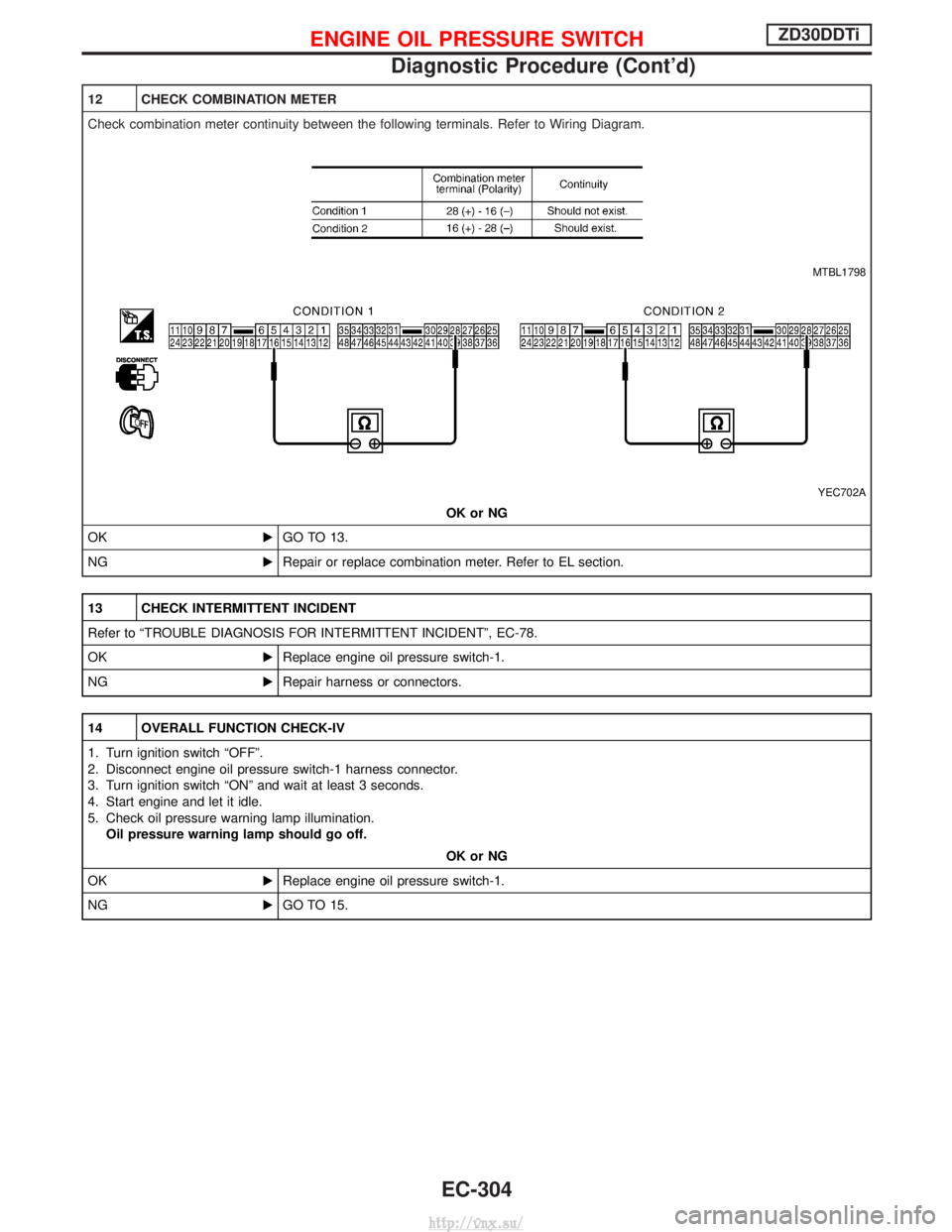
12 CHECK COMBINATION METER
Check combination meter continuity between the following terminals. Refer to Wiring Diagram.
MTBL1798
YEC702A
OK or NG
OK EGO TO 13.
NG ERepair or replace combination meter. Refer to EL section.
13 CHECK INTERMITTENT INCIDENT
Refer to ªTROUBLE DIAGNOSIS FOR INTERMITTENT INCIDENTº, EC-78.
OK EReplace engine oil pressure switch-1.
NG ERepair harness or connectors.
14 OVERALL FUNCTION CHECK-IV
1. Turn ignition switch ªOFFº.
2. Disconnect engine oil pressure switch-1 harness connector.
3. Turn ignition switch ªONº and wait at least 3 seconds.
4. Start engine and let it idle.
5. Check oil pressure warning lamp illumination.
Oil pressure warning lamp should go off.
OK or NG
OK EReplace engine oil pressure switch-1.
NG EGO TO 15.
ENGINE OIL PRESSURE SWITCHZD30DDTi
Diagnostic Procedure (Cont'd)
EC-304
http://vnx.su/