light NISSAN TIIDA 2007 Service Service Manual
[x] Cancel search | Manufacturer: NISSAN, Model Year: 2007, Model line: TIIDA, Model: NISSAN TIIDA 2007Pages: 5883, PDF Size: 78.95 MB
Page 411 of 5883
![NISSAN TIIDA 2007 Service Service Manual BRC-178
< SYMPTOM DIAGNOSIS >[ESP/TCS/ABS]
NORMAL OPERATING CONDITION
NORMAL OPERATING CONDITION
DescriptionINFOID:0000000001731207
Symptom Result
Slight vibrations are felt on the brake pedal and the](/img/5/57395/w960_57395-410.png "NISSAN TIIDA 2007 Service Service Manual BRC-178
< SYMPTOM DIAGNOSIS >[ESP/TCS/ABS]
NORMAL OPERATING CONDITION
NORMAL OPERATING CONDITION
DescriptionINFOID:0000000001731207
Symptom Result
Slight vibrations are felt on the brake pedal and the")
BRC-178
< SYMPTOM DIAGNOSIS >[ESP/TCS/ABS]
NORMAL OPERATING CONDITION
NORMAL OPERATING CONDITION
DescriptionINFOID:0000000001731207
Symptom Result
Slight vibrations are felt on the brake pedal and the operation noises occur, when VDC, TCS or ABS is acti-
vated.
This is a normal condi-
tion due to the VDC,
TCS or ABS activation. Stopping distance is longer than that of vehicles without ABS when the vehicle drives on rough, gravel, or
snow-covered (fresh, deep snow) roads.
The brake pedal moves and generates noises, when TCS or VDC is activated due to rapid acceleration or
sharp turn.
The brake pedal vibrates and motor operation noises occur from the engine room, after the engine starts and
just after the vehicle starts.This is normal, and it is
caused by the ABS op-
eration check.
Depending on the road conditions, the driver may experience a sluggish feel. This is normal, because
TCS places the highest
priority on the optimum
traction (stability). TCS may activate momentarily if wheel speed changes when driving over location where friction coefficient
varies, when downshifting, or when fully depressing accelerator pedal.
The ABS warning lamp, VDC OFF indicator lamp and SLIP indicator lamp may turn ON when the vehicle is
subject to strong shaking or large vibration, such as when the vehicle is rotating on a turntable or located on
a ship while the engine is running. In this case, restart the
engine on a normal
road. If the normal con-
dition is restored, there
is no malfunction. At
that time, erase the self-
diagnosis memory. VDC may not operate normally or the ABS warning lamp, VDC OFF indicator lamp, and SLIP indicator lamp
may illuminate, when running on a special road that is extremely slanted (e.g. bank in a circuit course).
A malfunction may occur in the yaw rate/side/decel G sensor system, when the vehicle turns sharply, such
as during a spin turn, axle turn, or drift driving, while the VDC function is off (VDC OFF indicator lamp illumi-
nated).
The vehicle speed will not increase even though the accelerator pedal is depressed, when inspecting the
speedometer on a 2-wheel chassis dynamometer. Normal (Deactivate the
VDC/TCS function be-
fore performing an in-
spection on a chassis
dynamometer.)
VDC OFF indicator lamp and SLIP indicator lamp may simultaneously turn on when low tire pressure warn-
ing lamp turns on.This is not a VDC sys-
tem error but results
from characteristic
change of tire.
Page 412 of 5883
![NISSAN TIIDA 2007 Service Service Manual PRECAUTIONS
BRC-179
< PRECAUTION >[ESP/TCS/ABS]
C
D
E
G
H
I
J
K
L
MA
B
BRC
N
O
P
PRECAUTION
PRECAUTIONS
Precaution for Supplemental Restraint System (SRS) "AIR BAG" and "SEAT BELT
PRE-TENSIONER"
INFO](/img/5/57395/w960_57395-411.png "NISSAN TIIDA 2007 Service Service Manual PRECAUTIONS
BRC-179
< PRECAUTION >[ESP/TCS/ABS]
C
D
E
G
H
I
J
K
L
MA
B
BRC
N
O
P
PRECAUTION
PRECAUTIONS
Precaution for Supplemental Restraint System (SRS) \"AIR BAG\" and \"SEAT BELT
PRE-TENSIONER\"
INFO")
PRECAUTIONS
BRC-179
< PRECAUTION >[ESP/TCS/ABS]
C
D
E
G
H
I
J
K
L
MA
B
BRC
N
O
P
PRECAUTION
PRECAUTIONS
Precaution for Supplemental Restraint System (SRS) "AIR BAG" and "SEAT BELT
PRE-TENSIONER"
INFOID:0000000001691411
The Supplemental Restraint System such as “AIR BAG” and “SEAT BELT PRE-TENSIONER”, used along
with a front seat belt, helps to reduce the risk or severity of injury to the driver and front passenger for certain
types of collision. Information necessary to service the system safely is included in the SRS and SB section of
this Service Manual.
WARNING:
To avoid rendering the SRS inoperative, which could increase the risk of personal injury or death in
the event of a collision which would result in air bag inflation, all maintenance must be performed by
an authorized NISSAN/INFINITI dealer.
Improper maintenance, including incorrect removal and installation of the SRS, can lead to personal
injury caused by unintentional activation of the system. For removal of Spiral Cable and Air Bag
Module, see the SRS section.
Do not use electrical test equipment on any circuit related to the SRS unless instructed to in this
Service Manual. SRS wiring harnesses can be identified by yellow and/or orange harnesses or har-
ness connectors.
Precaution for Brake SystemINFOID:0000000001691412
Recommended fluid is Genuine NISSAN Fluid, DOT 3 or DOT 4 (US FMVSS No. 116).
Do not reuse drained brake fluid.
Be careful not to splash brake fluid on painted areas such as body. If brake fluid is splashed, wipe it off and
flush area with water immediately.
Do not use mineral oils such as gasoline or kerosene to clean. They will ruin rubber parts and cause
improper operation.
Using a flare nut torque wrench, securely tighten brake tube flare
nuts.
Brake system is an important safety part. If a brake fluid leak is
detected, always disassemble the affected part. If a malfunction is
detected, replace part with a new one.
Before working, turn ignition switch OFF and disconnect electrical
connectors of ABS actuator and electric unit (control unit) or bat-
tery negative terminals.
When installing brake piping, be sure to check torque.
After removing/installing any hydraulic parts of the brake or ESP
system (such as actuator and piping parts, etc), bleed air from the
system.
Precaution for Brake ControlINFOID:0000000001691413
During ESP/TCS/ABS operation, brake pedal lightly vibrates and a mechanical noise may be heard. This is
normal.
When starting engine, or just after starting vehicle, brake pedal may vibrate or motor operating noise may be
heard from engine room. This is a normal status of operation check.
Stopping distance may be longer than that of vehicles without ABS when vehicle drives on rough, gravel, or
snow-covered (fresh, deep snow) roads.
When an error is indicated by ABS or another warning lamp, collect all necessary information from the cus-
tomer (what symptoms are present under what conditions) and check for simple causes before starting diag-
nostic servicing. Besides the electrical system inspection, check booster operation, brake fluid level, and
fluid leaks.
If tire size and type are used in an improper combination, or brake pads are not Genuine NISSAN parts,
stopping distance or steering stability may deteriorate.
If there is a radio, antenna, or antenna lead-in wire (including wiring) near control module, ESP/TCS/ABS
function may have a malfunction or error.
If aftermarket parts (car stereo, CD player, etc.) have been installed, check for incidents such as harness
pinches, open circuits, and improper wiring.
SBR820BA
Page 479 of 5883
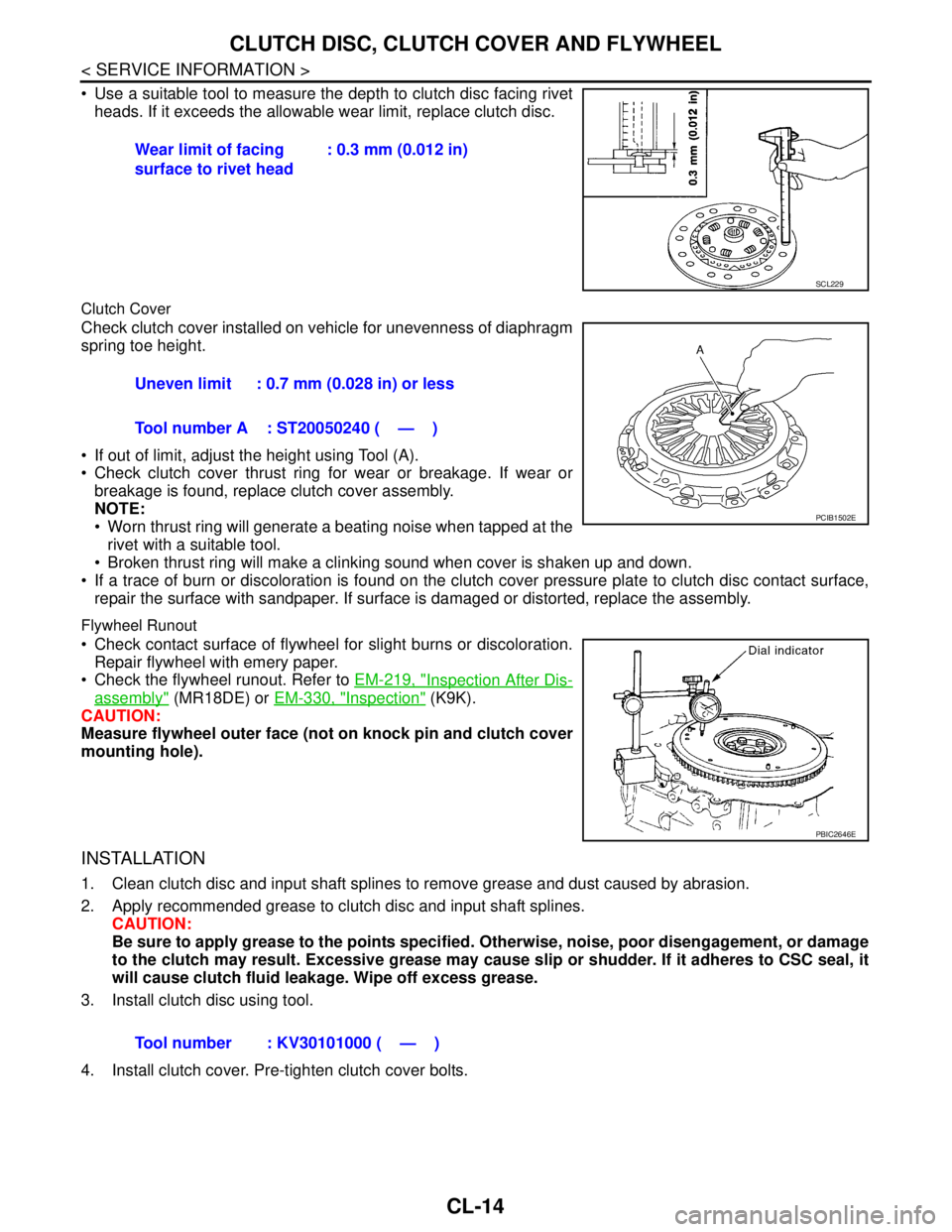
CL-14
< SERVICE INFORMATION >
CLUTCH DISC, CLUTCH COVER AND FLYWHEEL
Use a suitable tool to measure the depth to clutch disc facing rivet
heads. If it exceeds the allowable wear limit, replace clutch disc.
Clutch Cover
Check clutch cover installed on vehicle for unevenness of diaphragm
spring toe height.
If out of limit, adjust the height using Tool (A).
Check clutch cover thrust ring for wear or breakage. If wear or
breakage is found, replace clutch cover assembly.
NOTE:
Worn thrust ring will generate a beating noise when tapped at the
rivet with a suitable tool.
Broken thrust ring will make a clinking sound when cover is shaken up and down.
If a trace of burn or discoloration is found on the clutch cover pressure plate to clutch disc contact surface,
repair the surface with sandpaper. If surface is damaged or distorted, replace the assembly.
Flywheel Runout
Check contact surface of flywheel for slight burns or discoloration.
Repair flywheel with emery paper.
Check the flywheel runout. Refer to EM-219, "
Inspection After Dis-
assembly" (MR18DE) or EM-330, "Inspection" (K9K).
CAUTION:
Measure flywheel outer face (not on knock pin and clutch cover
mounting hole).
INSTALLATION
1. Clean clutch disc and input shaft splines to remove grease and dust caused by abrasion.
2. Apply recommended grease to clutch disc and input shaft splines.
CAUTION:
Be sure to apply grease to the points specified. Otherwise, noise, poor disengagement, or damage
to the clutch may result. Excessive grease may cause slip or shudder. If it adheres to CSC seal, it
will cause clutch fluid leakage. Wipe off excess grease.
3. Install clutch disc using tool.
4. Install clutch cover. Pre-tighten clutch cover bolts.Wear limit of facing
surface to rivet head: 0.3 mm (0.012 in)
SCL229
Uneven limit : 0.7 mm (0.028 in) or less
Tool number A : ST20050240 ( — )
PCIB1502E
PBIC2646E
Tool number : KV30101000 ( — )
Page 490 of 5883
![NISSAN TIIDA 2007 Service Service Manual PRECAUTIONS
CO-9
< PRECAUTION >[HR16DE]
C
D
E
F
G
H
I
J
K
L
MA
CO
N
P O
CAUTION:
Be careful not to damage the mating surfaces.
Tap Tool to insert it (1), and then slide it by tapping on the side (2)](/img/5/57395/w960_57395-489.png "NISSAN TIIDA 2007 Service Service Manual PRECAUTIONS
CO-9
< PRECAUTION >[HR16DE]
C
D
E
F
G
H
I
J
K
L
MA
CO
N
P O
CAUTION:
Be careful not to damage the mating surfaces.
Tap Tool to insert it (1), and then slide it by tapping on the side (2)")
PRECAUTIONS
CO-9
< PRECAUTION >[HR16DE]
C
D
E
F
G
H
I
J
K
L
MA
CO
N
P O
CAUTION:
Be careful not to damage the mating surfaces.
Tap Tool to insert it (1), and then slide it by tapping on the side (2)
as shown.
In areas where Tool is difficult to use, use plastic hammer to lightly
tap the parts, to remove it.
CAUTION:
If for some unavoidable reason suitable tool such as screw-
driver is used, be careful not to damage the mating surfaces.
LIQUID GASKET APPLICATION PROCEDURE
1. Remove old liquid gasket adhering to the liquid gasket applica-
tion surface and the mating surface, using scraper.
Remove liquid gasket completely from the groove of the liquid
gasket application surface, bolts, and bolt holes.
2. Thoroughly clean the mating surfaces and remove adhering
moisture, grease and foreign materials.
3. Attach liquid gasket tube to Tool.
Use Genuine RTV Silicone Sealant or equivalent. Refer to GI-27, "
Recommended Chemical Prod-
ucts and Sealants".
4. Apply liquid gasket without breaks to the specified location with the specified dimensions.
If there is a groove for the liquid gasket application, apply liquid gasket to the groove.
As for the bolt holes, normally apply liquid gasket inside the
holes. Occasionally, it should be applied outside the holes.
Make sure to read the text of service manual.
Within five minutes of liquid gasket application, install the mat-
ing component.
If liquid gasket protrudes, wipe it off immediately.
Do not retighten nuts or bolts after the installation.
After 30 minutes or more have passed from the installation, fill
engine oil and engine coolant.
CAUTION:
If there are specific instructions in this manual, observe them. Tool number : KV10111100 (J-37228)
WBIA0566E
Tool number : WS39930000 ( — )
PBIC0003E
WBIA0567E
SEM159F
Page 514 of 5883
![NISSAN TIIDA 2007 Service Service Manual PRECAUTIONS
CO-33
< PRECAUTION >[MR18DE]
C
D
E
F
G
H
I
J
K
L
MA
CO
N
P O
CAUTION:
Be careful not to damage the mating surfaces.
Tap Tool to insert it (1), and then slide it by tapping on the side (2](/img/5/57395/w960_57395-513.png "NISSAN TIIDA 2007 Service Service Manual PRECAUTIONS
CO-33
< PRECAUTION >[MR18DE]
C
D
E
F
G
H
I
J
K
L
MA
CO
N
P O
CAUTION:
Be careful not to damage the mating surfaces.
Tap Tool to insert it (1), and then slide it by tapping on the side (2")
PRECAUTIONS
CO-33
< PRECAUTION >[MR18DE]
C
D
E
F
G
H
I
J
K
L
MA
CO
N
P O
CAUTION:
Be careful not to damage the mating surfaces.
Tap Tool to insert it (1), and then slide it by tapping on the side (2)
as shown.
In areas where Tool is difficult to use, use plastic hammer to lightly
tap the parts, to remove it.
CAUTION:
If for some unavoidable reason suitable tool such as screw-
driver is used, be careful not to damage the mating surfaces.
LIQUID GASKET APPLICATION PROCEDURE
1. Remove old liquid gasket adhering to the liquid gasket applica-
tion surface and the mating surface, using scraper.
Remove liquid gasket completely from the groove of the liquid
gasket application surface, bolts, and bolt holes.
2. Thoroughly clean the mating surfaces and remove adhering
moisture, grease and foreign materials.
3. Attach liquid gasket tube to Tool.
Use Genuine RTV Silicone Sealant or equivalent. Refer to GI-27, "
Recommended Chemical Prod-
ucts and Sealants".
4. Apply liquid gasket without breaks to the specified location with the specified dimensions.
If there is a groove for the liquid gasket application, apply liquid gasket to the groove.
As for the bolt holes, normally apply liquid gasket inside the
holes. Occasionally, it should be applied outside the holes.
Make sure to read the text of service manual.
Within five minutes of liquid gasket application, install the mat-
ing component.
If liquid gasket protrudes, wipe it off immediately.
Do not retighten nuts or bolts after the installation.
After 30 minutes or more have passed from the installation, fill
engine oil and engine coolant.
CAUTION:
If there are specific instructions in this manual, observe them. Tool number : KV10111100 (J-37228)
WBIA0566E
Tool number : WS39930000 ( — )
PBIC0003E
WBIA0567E
SEM159F
Page 537 of 5883
![NISSAN TIIDA 2007 Service Service Manual CO-56
< PRECAUTION >[K9K]
PRECAUTIONS
CAUTION:
Be careful not to damage the mating surfaces.
Tap Tool to insert it (1), and then slide it by tapping on the side (2)
as shown.
In areas where Tool i](/img/5/57395/w960_57395-536.png "NISSAN TIIDA 2007 Service Service Manual CO-56
< PRECAUTION >[K9K]
PRECAUTIONS
CAUTION:
Be careful not to damage the mating surfaces.
Tap Tool to insert it (1), and then slide it by tapping on the side (2)
as shown.
In areas where Tool i")
CO-56
< PRECAUTION >[K9K]
PRECAUTIONS
CAUTION:
Be careful not to damage the mating surfaces.
Tap Tool to insert it (1), and then slide it by tapping on the side (2)
as shown.
In areas where Tool is difficult to use, use plastic hammer to lightly
tap the parts, to remove it.
CAUTION:
If for some unavoidable reason suitable tool such as screw-
driver is used, be careful not to damage the mating surfaces.
LIQUID GASKET APPLICATION PROCEDURE
1. Remove old liquid gasket adhering to the liquid gasket applica-
tion surface and the mating surface, using scraper.
Remove liquid gasket completely from the groove of the liquid
gasket application surface, bolts, and bolt holes.
2. Thoroughly clean the mating surfaces and remove adhering
moisture, grease and foreign materials.
3. Attach liquid gasket tube to Tool.
Use Genuine RTV Silicone Sealant or equivalent. Refer to GI-27, "
Recommended Chemical Prod-
ucts and Sealants".
4. Apply liquid gasket without breaks to the specified location with the specified dimensions.
If there is a groove for the liquid gasket application, apply liquid gasket to the groove.
As for the bolt holes, normally apply liquid gasket inside the
holes. Occasionally, it should be applied outside the holes.
Make sure to read the text of service manual.
Within five minutes of liquid gasket application, install the mat-
ing component.
If liquid gasket protrudes, wipe it off immediately.
Do not retighten nuts or bolts after the installation.
After 30 minutes or more have passed from the installation, fill
engine oil and engine coolant.
CAUTION:
If there are specific instructions in this manual, observe them. Tool number : KV10111100 (J-37228)
WBIA0566E
Tool number : WS39930000 ( — )
PBIC0003E
WBIA0567E
SEM159F
Page 553 of 5883

DEF-2
PASSENGER SIDE DOOR MIRROR DEFOG-
GER DOES NOT OPERATE. ............................
33
Diagnosis Procedure ..............................................33
REAR WINDOW DEFOGGER SWITCH DOES
NOT LIGHT, BUT REAR WINDOW DEFOG-
GER OPERATES ...............................................
34
Diagnosis Procedure ..............................................34
PRECAUTION .............................................35
PRECAUTIONS .................................................35
Supplemental Restraint System (SRS) "AIR BAG"
and "SEAT BELT PRE-TENSIONER" ....................
35
ON-VEHICLE REPAIR ...............................36
FILAMENT .........................................................36
Inspection and Repair .............................................36
CONDENSER ....................................................38
Exploded View ........................................................38
Removal and Installation .........................................38
Page 585 of 5883

DEF-34
< SYMPTOM DIAGNOSIS >
REAR WINDOW DEFOGGER SWITCH DOES NOT LIGHT, BUT REAR WINDOW
DEFOGGER OPERATES
REAR WINDOW DEFOGGER SWITCH DOES NOT LIGHT, BUT REAR WIN-
DOW DEFOGGER OPERATES
Diagnosis ProcedureINFOID:0000000001697574
1.CHECK CONTROLLER (AUTO AMP.) (REAR WINDOW DEFOGGER SWITCH)
Check that the controller (auto amp.) (rear window defogger switch) is operating normally.
OK or NG
OK >> Refer to XX-XX, "*****".
NG >> Refer to DEF-11, "
Diagnosis Procedure".
Page 588 of 5883
FILAMENT
DEF-37
< ON-VEHICLE REPAIR >
C
D
E
F
G
H
I
J
K
MA
B
DEF
N
O
P
Ruler 30 cm (11.8 in) long
Drawing pen
Heat gun
Alcohol
Cloth
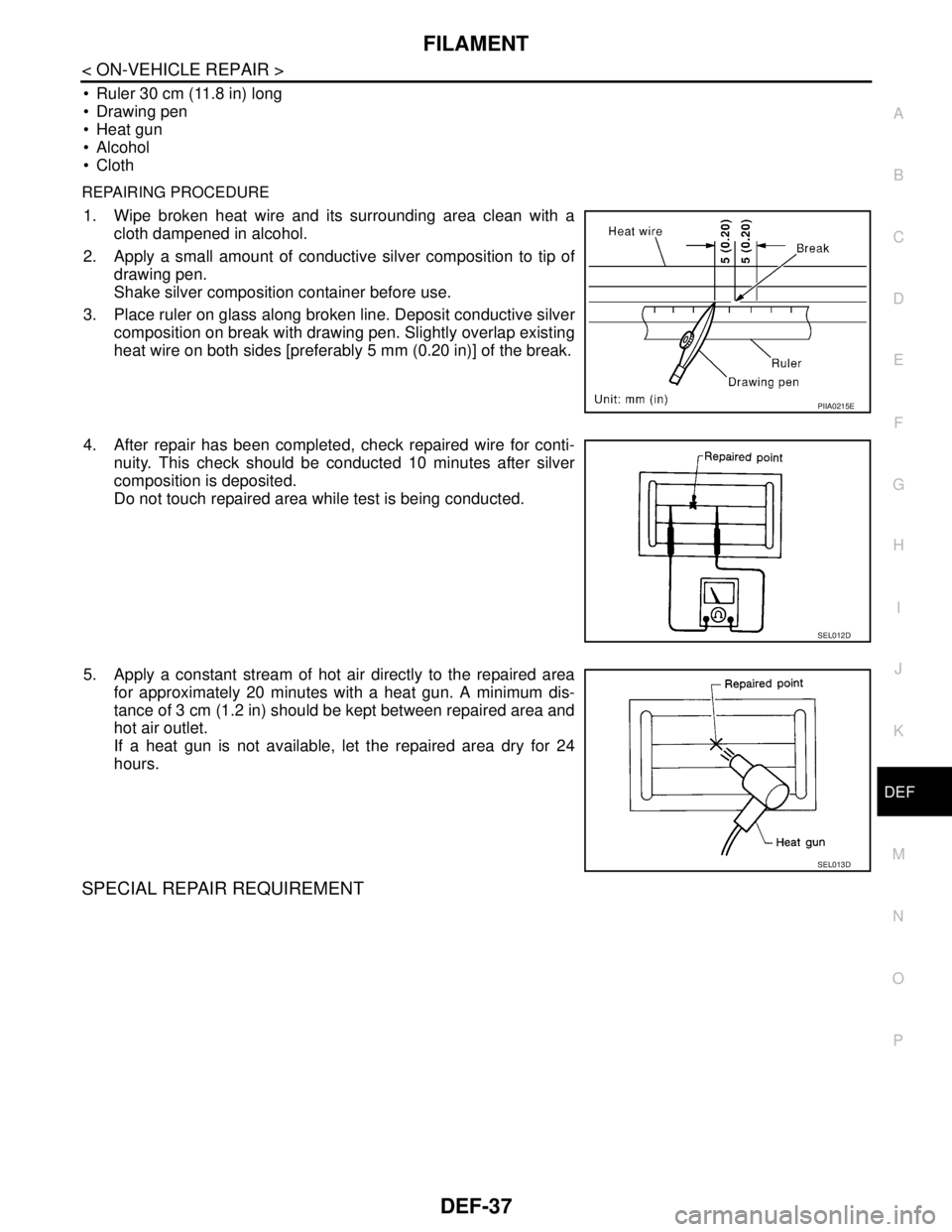
REPAIRING PROCEDURE
1. Wipe broken heat wire and its surrounding area clean with a
cloth dampened in alcohol.
2. Apply a small amount of conductive silver composition to tip of
drawing pen.
Shake silver composition container before use.
3. Place ruler on glass along broken line. Deposit conductive silver
composition on break with drawing pen. Slightly overlap existing
heat wire on both sides [preferably 5 mm (0.20 in)] of the break.
4. After repair has been completed, check repaired wire for conti-
nuity. This check should be conducted 10 minutes after silver
composition is deposited.
Do not touch repaired area while test is being conducted.
5. Apply a constant stream of hot air directly to the repaired area
for approximately 20 minutes with a heat gun. A minimum dis-
tance of 3 cm (1.2 in) should be kept between repaired area and
hot air outlet.
If a heat gun is not available, let the repaired area dry for 24
hours.
SPECIAL REPAIR REQUIREMENT
PIIA0215E
SEL012D
SEL013D
Page 630 of 5883
![NISSAN TIIDA 2007 Service Service Manual WARNING FUNCTION
DLK-41
< FUNCTION DIAGNOSIS >[WITH I-KEY, WITHOUT SUPER LOCK]
C
D
E
F
G
H
I
J
L
MA
B
DLK
N
O
P
KEY WARNING LAMP & LOCK WARNING LAMP
The key indicator and lock indicator indicates Inte](/img/5/57395/w960_57395-629.png "NISSAN TIIDA 2007 Service Service Manual WARNING FUNCTION
DLK-41
< FUNCTION DIAGNOSIS >[WITH I-KEY, WITHOUT SUPER LOCK]
C
D
E
F
G
H
I
J
L
MA
B
DLK
N
O
P
KEY WARNING LAMP & LOCK WARNING LAMP
The key indicator and lock indicator indicates Inte")
WARNING FUNCTION
DLK-41
< FUNCTION DIAGNOSIS >[WITH I-KEY, WITHOUT SUPER LOCK]
C
D
E
F
G
H
I
J
L
MA
B
DLK
N
O
P
KEY WARNING LAMP & LOCK WARNING LAMP
The key indicator and lock indicator indicates Intelligent Key system status.
Operation Condition
BACK DOOR/TRUNK OPEN WARNING OPERATION
When back door (hatchback) or trunk lid (sedan) opener switch is operated, when door lock is locked with door
lock and unlock switch, speed sensing lock or only driver side is unlocked with anti-hijack function, the buzzer
(built in combination meter) will sound.
KEY REMINDER OPERATION
The buzzer (combination meter) will sound and the doors will not lock if the door lock and unlock switch is
pressed while the driver door is open and mechanical key is inserted into ignition key cylinder.
The buzzer (combination meter) will sound and the doors will not lock if the door lock and unlock switch is
pressed while any door other than the driver door is open.
Door lock op-
eration warn-
ingRequest
switch opera-
tionWhen request switch is pushed (lock op-
eration) under the following conditions.
Door switch: ON (Any door is open).
Ignition switch is in ACC or OFF posi-
tion or ignition knob is pressed in
LOCK position or mechanical key is
inserted into ignition key cylinder.
Intelligent Key is inside vehicle.——Active for 2
seconds
(pipipi···)
Intelligent Key
button opera-
tionWhen Intelligent Key button is pushed
(lock operation) under the following con-
ditions.
Door switch: ON (Any door is open).
Ignition switch is in ACC or OFF posi-
tion or ignition knob is pressed in
LOCK position or mechanical key is
inserted into ignition key cylinder.——Active for 2
seconds
(pipipi···)
Intelligent Key low battery
warningWhen Intelligent Key battery voltage is
low, Intelligent Key unit is detected after
ignition switch is turned ON.“KEY”
(GREEN blink-
ing for 30 sec-
onds)—— Warning/Information functions Operation conditions Warning lampWarning chime
Combination
meter buzzerIntelligent Key
warning buzz-
er(s)
Behavior of lamps Operation condition
KEYGREENLightingAll the following conditions are satisfied.
Ignition knob is pushed in LOCK position. (Ignition knob switch is ON)
Ignition key is removed from ignition key cylinder. (Key switch is OFF)
Intelligent Key is detected inside of the vehicle.
KEY RED lighting/blinking conditions are not satisfied.
Blinking while Intelligent Key low battery warning is operating.
REDLightingAll the following conditions are satisfied.
Ignition knob is pushed. (Ignition knob switch is ON)
Ignition key is removed from ignition key cylinder. (Key switch is OFF)
Intelligent Key is not detected inside of the vehicle.
BlinkingAll the following conditions are satisfied.
Take away warning is operating.
KEY RED lighting condition is not satisfied.
LOCK Blinking While OFF position warning is operating.
KEY(RED) and LOCK lightingAll the following conditions are satisfied.
Ignition switch is ON.
Steering lock ID is NG.