Check engine NISSAN TIIDA 2007 Service Repair Manual
[x] Cancel search | Manufacturer: NISSAN, Model Year: 2007, Model line: TIIDA, Model: NISSAN TIIDA 2007Pages: 5883, PDF Size: 78.95 MB
Page 3320 of 5883
HA-38
< ON-VEHICLE REPAIR >
LOW-PRESSURE FLEXIBLE HOSE
LOW-PRESSURE FLEXIBLE HOSE
Removal and Installation of Low-Pressure Flexible Hose - MR18DE, HR16DE
INFOID:0000000001404150
REMOVAL
1. Use the recovery/recycling equipment to evacuate the refrigerant. Refer to HA-21, "HFC-134a (R-134a)
Service Procedure".
2. Remove engine cover.
3. Remove cowl top cover. Refer to EXT-20, "
Removal and Installation".
4. Remove lower dash insulator.
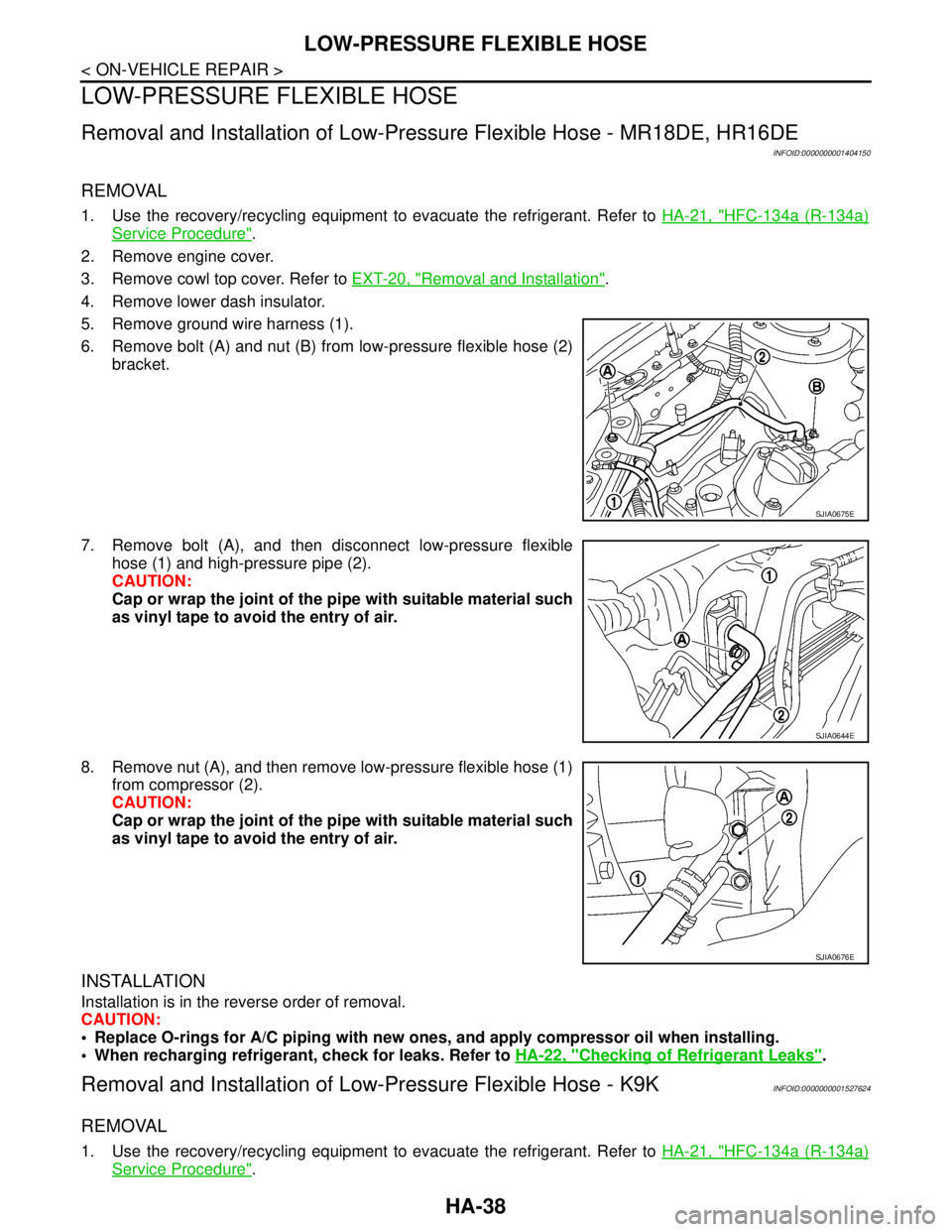
5. Remove ground wire harness (1).
6. Remove bolt (A) and nut (B) from low-pressure flexible hose (2)
bracket.
7. Remove bolt (A), and then disconnect low-pressure flexible
hose (1) and high-pressure pipe (2).
CAUTION:
Cap or wrap the joint of the pipe with suitable material such
as vinyl tape to avoid the entry of air.
8. Remove nut (A), and then remove low-pressure flexible hose (1)
from compressor (2).
CAUTION:
Cap or wrap the joint of the pipe with suitable material such
as vinyl tape to avoid the entry of air.
INSTALLATION
Installation is in the reverse order of removal.
CAUTION:
Replace O-rings for A/C piping with new ones, and apply compressor oil when installing.
When recharging refrigerant, check for leaks. Refer to HA-22, "
Checking of Refrigerant Leaks".
Removal and Installation of Low-Pressure Flexible Hose - K9KINFOID:0000000001527624
REMOVAL
1. Use the recovery/recycling equipment to evacuate the refrigerant. Refer to HA-21, "HFC-134a (R-134a)
Service Procedure".
SJIA0675E
SJIA0644E
SJIA0676E
Page 3321 of 5883
LOW-PRESSURE FLEXIBLE HOSE
HA-39
< ON-VEHICLE REPAIR >
C
D
E
F
G
H
J
K
L
MA
B
HA
N
O
P
2. Remove the engine cover.
3. Remove the front grille. Refer to EXT-19, "
Removal and Installation".
4. Reposition the RH air guide out of the way.
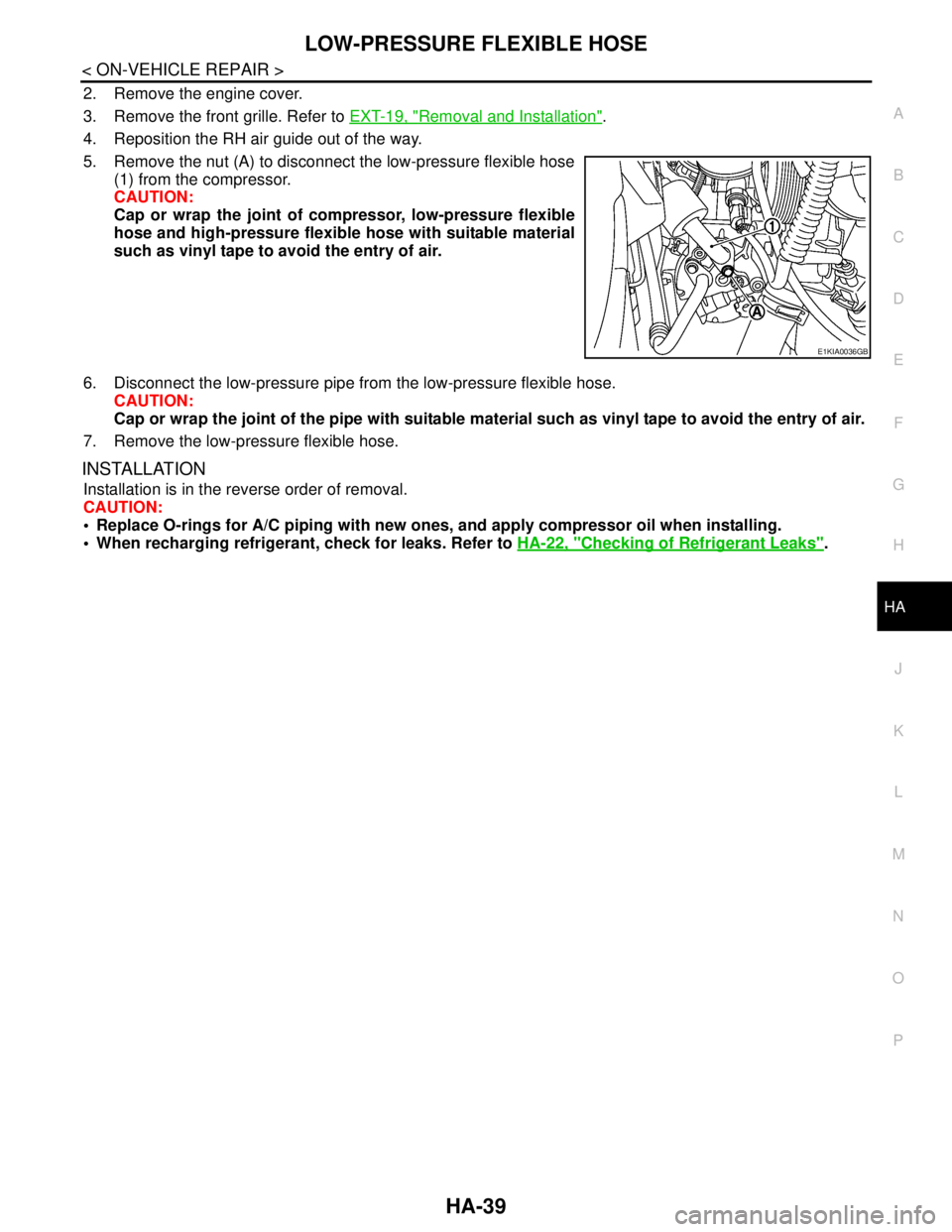
5. Remove the nut (A) to disconnect the low-pressure flexible hose
(1) from the compressor.
CAUTION:
Cap or wrap the joint of compressor, low-pressure flexible
hose and high-pressure flexible hose with suitable material
such as vinyl tape to avoid the entry of air.
6. Disconnect the low-pressure pipe from the low-pressure flexible hose.
CAUTION:
Cap or wrap the joint of the pipe with suitable material such as vinyl tape to avoid the entry of air.
7. Remove the low-pressure flexible hose.
INSTALLATION
Installation is in the reverse order of removal.
CAUTION:
Replace O-rings for A/C piping with new ones, and apply compressor oil when installing.
When recharging refrigerant, check for leaks. Refer to HA-22, "
Checking of Refrigerant Leaks".
E1KIA0036GB
Page 3322 of 5883
HA-40
< ON-VEHICLE REPAIR >
LOW-PRESSURE PIPE
LOW-PRESSURE PIPE
Removal and Installation of Low-Pressure Pipe - K9KINFOID:0000000001404236
REMOVAL
1. Use the recovery/recycling equipment to evacuate the refrigerant. Refer to HA-21, "HFC-134a (R-134a)
Service Procedure".
2. Remove engine cover.
3. Remove cowl top cover. Refer to EXT-20, "
Removal and Installation".
4. Reposition the lower dash insulator out of the way.
5. Remove the front grille. Refer to EXT-19, "
Removal and Installation".
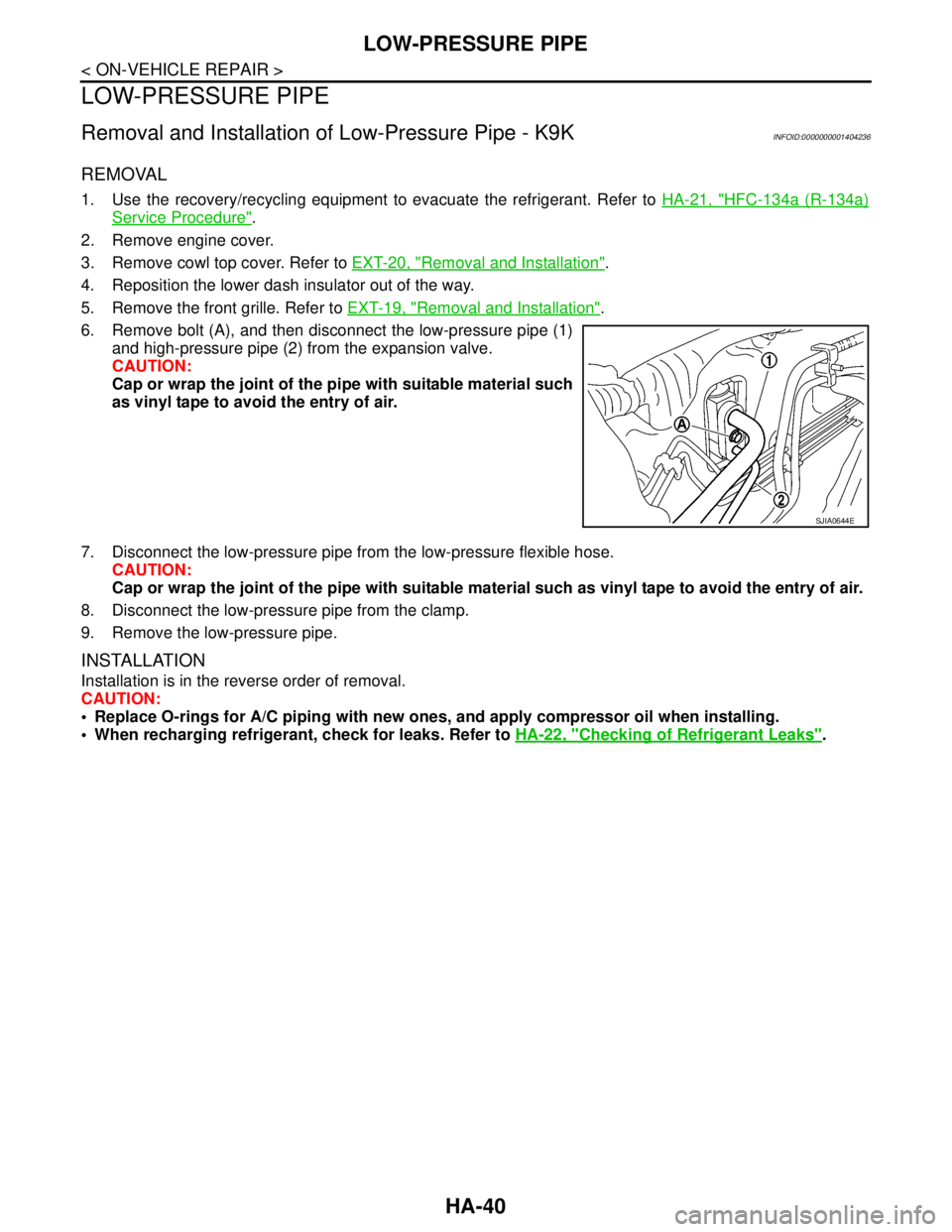
6. Remove bolt (A), and then disconnect the low-pressure pipe (1)
and high-pressure pipe (2) from the expansion valve.
CAUTION:
Cap or wrap the joint of the pipe with suitable material such
as vinyl tape to avoid the entry of air.
7. Disconnect the low-pressure pipe from the low-pressure flexible hose.
CAUTION:
Cap or wrap the joint of the pipe with suitable material such as vinyl tape to avoid the entry of air.
8. Disconnect the low-pressure pipe from the clamp.
9. Remove the low-pressure pipe.
INSTALLATION
Installation is in the reverse order of removal.
CAUTION:
Replace O-rings for A/C piping with new ones, and apply compressor oil when installing.
When recharging refrigerant, check for leaks. Refer to HA-22, "
Checking of Refrigerant Leaks".
SJIA0644E
Page 3323 of 5883
HIGH-PRESSURE FLEXIBLE HOSE
HA-41
< ON-VEHICLE REPAIR >
C
D
E
F
G
H
J
K
L
MA
B
HA
N
O
P
HIGH-PRESSURE FLEXIBLE HOSE
Removal and Installation of High-Pressure Flexible Hose - MR18DE, HR16DE
INFOID:0000000001404151
REMOVAL
1. Use the recovery/recycling equipment to evacuate the refrigerant. Refer to HA-21, "HFC-134a (R-134a)
Service Procedure".
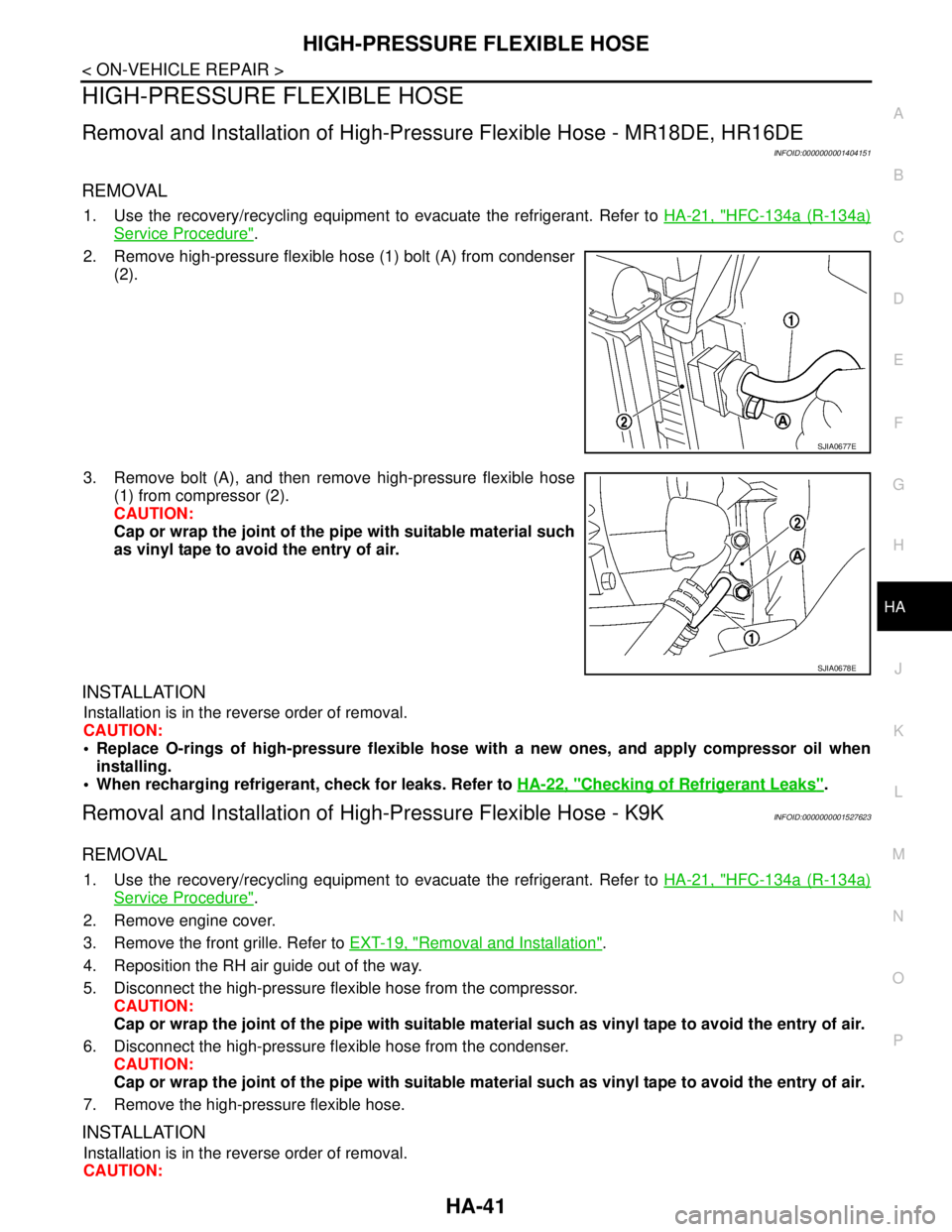
2. Remove high-pressure flexible hose (1) bolt (A) from condenser
(2).
3. Remove bolt (A), and then remove high-pressure flexible hose
(1) from compressor (2).
CAUTION:
Cap or wrap the joint of the pipe with suitable material such
as vinyl tape to avoid the entry of air.
INSTALLATION
Installation is in the reverse order of removal.
CAUTION:
Replace O-rings of high-pressure flexible hose with a new ones, and apply compressor oil when
installing.
When recharging refrigerant, check for leaks. Refer to HA-22, "
Checking of Refrigerant Leaks".
Removal and Installation of High-Pressure Flexible Hose - K9KINFOID:0000000001527623
REMOVAL
1. Use the recovery/recycling equipment to evacuate the refrigerant. Refer to HA-21, "HFC-134a (R-134a)
Service Procedure".
2. Remove engine cover.
3. Remove the front grille. Refer to EXT-19, "
Removal and Installation".
4. Reposition the RH air guide out of the way.
5. Disconnect the high-pressure flexible hose from the compressor.
CAUTION:
Cap or wrap the joint of the pipe with suitable material such as vinyl tape to avoid the entry of air.
6. Disconnect the high-pressure flexible hose from the condenser.
CAUTION:
Cap or wrap the joint of the pipe with suitable material such as vinyl tape to avoid the entry of air.
7. Remove the high-pressure flexible hose.
INSTALLATION
Installation is in the reverse order of removal.
CAUTION:
SJIA0677E
SJIA0678E
Page 3325 of 5883
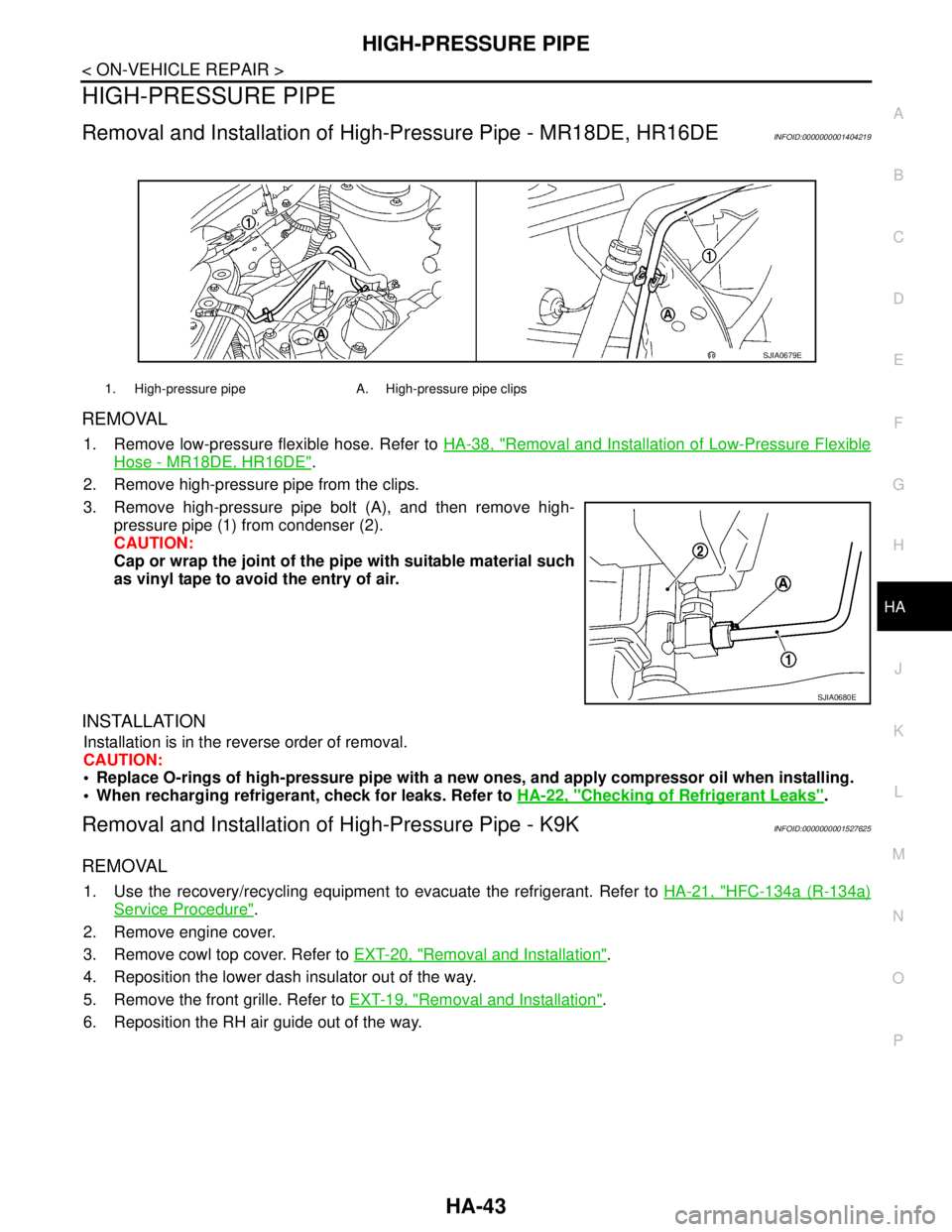
HIGH-PRESSURE PIPE
HA-43
< ON-VEHICLE REPAIR >
C
D
E
F
G
H
J
K
L
MA
B
HA
N
O
P
HIGH-PRESSURE PIPE
Removal and Installation of High-Pressure Pipe - MR18DE, HR16DEINFOID:0000000001404219
REMOVAL
1. Remove low-pressure flexible hose. Refer to HA-38, "Removal and Installation of Low-Pressure Flexible
Hose - MR18DE, HR16DE".
2. Remove high-pressure pipe from the clips.
3. Remove high-pressure pipe bolt (A), and then remove high-
pressure pipe (1) from condenser (2).
CAUTION:
Cap or wrap the joint of the pipe with suitable material such
as vinyl tape to avoid the entry of air.
INSTALLATION
Installation is in the reverse order of removal.
CAUTION:
Replace O-rings of high-pressure pipe with a new ones, and apply compressor oil when installing.
When recharging refrigerant, check for leaks. Refer to HA-22, "
Checking of Refrigerant Leaks".
Removal and Installation of High-Pressure Pipe - K9KINFOID:0000000001527625
REMOVAL
1. Use the recovery/recycling equipment to evacuate the refrigerant. Refer to HA-21, "HFC-134a (R-134a)
Service Procedure".
2. Remove engine cover.
3. Remove cowl top cover. Refer to EXT-20, "
Removal and Installation".
4. Reposition the lower dash insulator out of the way.
5. Remove the front grille. Refer to EXT-19, "
Removal and Installation".
6. Reposition the RH air guide out of the way.
1. High-pressure pipe A. High-pressure pipe clips
SJIA0679E
SJIA0680E
Page 3339 of 5883
![NISSAN TIIDA 2007 Service Repair Manual HAC-6
< BASIC INSPECTION >[MANUAL AIR CONDITIONER]
INSPECTION AND ADJUSTMENT
INSPECTION AND ADJUSTMENT
Operational CheckINFOID:0000000001203052
The purpose of the operational check is to confirm that](/img/5/57395/w960_57395-3338.png "NISSAN TIIDA 2007 Service Repair Manual HAC-6
< BASIC INSPECTION >[MANUAL AIR CONDITIONER]
INSPECTION AND ADJUSTMENT
INSPECTION AND ADJUSTMENT
Operational CheckINFOID:0000000001203052
The purpose of the operational check is to confirm that")
HAC-6
< BASIC INSPECTION >[MANUAL AIR CONDITIONER]
INSPECTION AND ADJUSTMENT
INSPECTION AND ADJUSTMENT
Operational CheckINFOID:0000000001203052
The purpose of the operational check is to confirm that the system operates properly.
CHECKING BLOWER
1. Turn blower control dial clockwise to "1" position. Blower should operate on low speed.
2. Turn blower control dial clockwise to "2" position, and continue checking blower speed until all speeds are
checked.
3. Leave blower on Maximum speed.
If NG, go to trouble diagnosis procedure for xxx BLOWER MOTOR CIR HAC-19, "
Front Blower Motor Diagno-
sis Procedure".
If OK, continue the check.
CHECKING DISCHARGE AIR
1. Turn mode door control dial to each position.
2. Confirm that discharge air comes out according to the air distribution table. Refer to XXXX DISCHARGE
AIR FLOW.
If NG, go to trouble diagnosis procedure for HAC-16, "
Mode Door Diagnostic Procedure".
If OK, continue the check.
CHECKING RECIRCULATION
1. Set intake door lever to REC position.
2. Operate intake door lever to FRE position.
3. Listen for intake door position change (you should hear blower sound change slightly).
If NG, go to trouble diagnosis procedure for XXXX INTAKE DOOR.
If OK, continue the check.
CHECKING TEMPERATURE DECREASE
1. Turn temperature control dial counterclockwise to full cold position.
2. Check for cold air at discharge air outlets.
If NG, go to trouble diagnosis procedure for XXXX INSUFFICIENT COOLING.
If OK, continue the check.
CHECKING TEMPERATURE INCREASE
1. Turn temperature control dial clockwise to full hot position.
2. Check for hot air at discharge air outlets.
If NG, go to trouble diagnosis procedure for XXXX INSUFFICIENT HEATING.
If OK, continue the check.
CHECKING A/C SWITCH (IF EQUIPPED)
1. Turn fan control dial to the desired (1 to 4 speed) position.
2. Press A/C switch.
3. A/C switch indicator will turn ON.
• Confirm that the compressor clutch engages (sound or visual inspection).
If NG, go to trouble diagnosis procedure for XXXX MAG CLUTCH CIR.
If OK, continue the check.
CHECKING DEFROST A/C SWITCH (IF EQUIPPED)
1. Turn fan control dial to the desired (1 to 4 speed) position.
2. Turn mode dial to ( ) DEF.
3. Confirm that the compressor clutch engages (sound or visual inspection). Conditions : Engine running at normal operating temperature
Page 3358 of 5883
![NISSAN TIIDA 2007 Service Repair Manual MAGNET CLUTCH
HAC-25
< COMPONENT DIAGNOSIS >[MANUAL AIR CONDITIONER]
C
D
E
F
G
H
J
K
L
MA
B
HAC
N
O
P
1. Disconnect A/C compressor connector.
2. Start the engine.
3. Turn blower control dial and A/C s](/img/5/57395/w960_57395-3357.png "NISSAN TIIDA 2007 Service Repair Manual MAGNET CLUTCH
HAC-25
< COMPONENT DIAGNOSIS >[MANUAL AIR CONDITIONER]
C
D
E
F
G
H
J
K
L
MA
B
HAC
N
O
P
1. Disconnect A/C compressor connector.
2. Start the engine.
3. Turn blower control dial and A/C s")
MAGNET CLUTCH
HAC-25
< COMPONENT DIAGNOSIS >[MANUAL AIR CONDITIONER]
C
D
E
F
G
H
J
K
L
MA
B
HAC
N
O
P
1. Disconnect A/C compressor connector.
2. Start the engine.
3. Turn blower control dial and A/C switch ON.
4. Check voltage between A/C compressor harness connector F3
terminal 1 and ground.
OK or NG
OK >> Replace magnet clutch. Refer to XX.
NG >> GO TO 4.
4.CHECK CIRCUIT CONTINUITY BETWEEN IPDM E/R AND COMPRESSOR
1. Turn ignition switch OFF.
2. Disconnect IPDM E/R connector.
3. Check continuity between A/C compressor harness connector
F3 (A) terminal 1 and IPDM E/R harness connector E43 (B) ter-
minal 11.
OK or NG
OK >> Replace IPDM E/R. Refer to XX.
NG >> Repair harness or connector.
5.CHECK DEFROST A/C SWITCH
1. Start the engine.
2. Turn the mode control dial to (DEF) position.
Does the magnet clutch operate
OK >> GO TO 6.
NG >> GO TO 19.
6.CHECK BCM INPUT (COMPRESSOR ON) SIGNAL
1. Turn ignition switch OFF.
2. Check compressor ON/OFF signal. Refer to HAC-15, "
CONSULT-III Function (BCM)".
OK or NG
OK >> GO TO 8.
NG >> GO TO 7.
7.CHECK CIRCUIT CONTINUITY BETWEEN FRONT AIR CONTROL AND BCM
1. Turn ignition switch OFF.
2. Disconnect front air control and BCM connector.
3. Check continuity between front air control harness connector
M33 (A) terminal 1and BCM harness connector M19 (B) termi-
nal 61.
OK or NG
OK >> GO TO 8.
NG >> Repair harness or connector.
8.CHECK REFRIGERANT PRESSURE SENSOR
1. Reconnect front air control connector and BCM connector.1 - Ground :Battery voltage
SJIA0743E
1 - 11 :Continuity should exist
WJIA2233E
A/C SW ON : AIR COND SW ON
A/C SW OFF : AIR COND SW OFF
1 - 61 :Continuity should exist
AWIIA0448ZZ
Page 3368 of 5883
![NISSAN TIIDA 2007 Service Repair Manual PTC HEATER CONTROL SYSTEM
HAC-35
< COMPONENT DIAGNOSIS >[MANUAL AIR CONDITIONER]
C
D
E
F
G
H
J
K
L
MA
B
HAC
N
O
P
The full hot switch is attached on the A/C unit assembly. When the
temperature control](/img/5/57395/w960_57395-3367.png "NISSAN TIIDA 2007 Service Repair Manual PTC HEATER CONTROL SYSTEM
HAC-35
< COMPONENT DIAGNOSIS >[MANUAL AIR CONDITIONER]
C
D
E
F
G
H
J
K
L
MA
B
HAC
N
O
P
The full hot switch is attached on the A/C unit assembly. When the
temperature control")
PTC HEATER CONTROL SYSTEM
HAC-35
< COMPONENT DIAGNOSIS >[MANUAL AIR CONDITIONER]
C
D
E
F
G
H
J
K
L
MA
B
HAC
N
O
P
The full hot switch is attached on the A/C unit assembly. When the
temperature control dial at full hot position, and then full hot switch
turned ON.
PTC HEATER (300 WATT) : PTC Heater (300 Watt) Diagnosis ProcedureINFOID:0000000001674173
DIAGNOSTIC PROCEDURE FOR PTC SYSTEM
SYMPTOM: PTC heater system operation is malfunction.
1.CHECK POWER SUPPLY FOR PTC RELAY-1
1. Turn ignition switch ON.
2. Check voltage between PTC relay-1 harness connector E61 ter-
minals 2, 3, and ground.
Is the inspection result normal
YES >> GO TO 2.
NO >> Check power supply circuit and 10A fuse and 40A fusible link (No. 2 and I, located in the fuse
block). Refer to XX.
If fuses are OK, check harness for open circuit. Repair or replace if necessary.
If fuses are NG, replace fuse and check harness for short circuit. Repair or replace if necessary.
2.CHECK PTC RELAY-1
1. Turn ignition switch OFF.
2. Check PTC relay-1. Refer to HAC-41, "
PTC HEATER (300 WATT) : PTC Heater (300 Watt) Component
Inspection".
Is the inspection result normal
YES >> GO TO 3.
NO >> Replace PTC relay-1. Refer to XX.
3.CHECK PTC RELAY-1 OUTPUT CIRCUIT
1. Disconnect ambient sensor, PTC heater and water temperature
sensor connectors.
2. Turn temperature control dial clockwise until full hot position.
3. Turn mode control dial to foot position.
4. Start the engine.
5. Turn blower control dial to maximum speed.
6. Check resistance between PTC relay-1 harness connector E61
terminal 1 and ground.
Is the inspection result normal
YES >> GO TO 5.
SJIA0909E
Te r m i n a l s
Vo l ta g e
(Approx.)
(+) (−)
Connector Terminal
Ground Battery voltage
PTC relay-1: E612
3
SJIA0913E
Connector Terminal
GroundContinuity
PTC relay-1: E61 1 Yes
AWIIA0455ZZ
Page 3373 of 5883
![NISSAN TIIDA 2007 Service Repair Manual HAC-40
< COMPONENT DIAGNOSIS >[MANUAL AIR CONDITIONER]
PTC HEATER CONTROL SYSTEM
19.CHECK CIRCUIT CONTINUITY BETWEEN AMBIENT TEMPERATURE SENSOR AND PTC CONTROL
UNIT
Check continuity between ambient te](/img/5/57395/w960_57395-3372.png "NISSAN TIIDA 2007 Service Repair Manual HAC-40
< COMPONENT DIAGNOSIS >[MANUAL AIR CONDITIONER]
PTC HEATER CONTROL SYSTEM
19.CHECK CIRCUIT CONTINUITY BETWEEN AMBIENT TEMPERATURE SENSOR AND PTC CONTROL
UNIT
Check continuity between ambient te")
HAC-40
< COMPONENT DIAGNOSIS >[MANUAL AIR CONDITIONER]
PTC HEATER CONTROL SYSTEM
19.CHECK CIRCUIT CONTINUITY BETWEEN AMBIENT TEMPERATURE SENSOR AND PTC CONTROL
UNIT
Check continuity between ambient temperature sensor harness con-
nector M60 (A) terminal 3 and PTC control unit harness connector
M84 (B) terminal 8.
Is the inspection result normal
YES >> 1. If equipped with manual transmission, GO TO 20.
2. If equipped with automatic transmission, GO TO 22.
NO >> Repair harness or connector.
20.CHECK ENGINE RPM SIGNAL (MANUAL TRANSMISSION)
1. Reconnect PTC control unit.
2. Start the engine.
3. Check voltage between PTC control unit harness connector
M84 terminal 4 and ground.
Is the inspection result normal
YES >> GO TO 22.
NO >> GO TO 21.
21.CHECK CONTINUITY OF ENGINE RPM CIRCUIT BETWEEN FRONT AIR CONNTROL AND PTC CON-
TROL UNIT (MANUAL TRANSMISSION)
1. Turn ignition switch OFF.
2. Disconnect ECM and PTC control unit connector.
3. Check continuity between PTC control unit harness connector
M84 (A) terminal 4 and ECM harness connector F10 (B) termi-
nal 13.
4. Check continuity between PTC control unit harness connector
M84 (A) terminal 4 and ground.
Is the inspection result normal
YES >> Replace ECM. Refer to XX.
NO >> Repair harness or connector.
22.CHECK BCM INPUT (FAN ON) SIGNAL
AB
Continuity
Connector Terminal Connector Terminal
Ambient temperature
sensor: M643PTC control unit:
M848Yes
AWIIA0464ZZ
Te r m i n a l s
Vo l ta g e
(Approx.) (+) (−)
Connector Terminal
Ground
PTC control unit: M84 4 4.2V
SJIA0924E
AB
Continuity
Connector Terminal Connector Terminal
PTC control unit: M84 4 ECM: F10 13 Yes
A
GroundContinuity
Connector Terminal
PTC control unit: M84 4 No
SJIA0925E
Page 3376 of 5883
![NISSAN TIIDA 2007 Service Repair Manual PTC HEATER CONTROL SYSTEM
HAC-43
< COMPONENT DIAGNOSIS >[MANUAL AIR CONDITIONER]
C
D
E
F
G
H
J
K
L
MA
B
HAC
N
O
P
After disconnecting full hot switch connector M65, check continuity
between terminals](/img/5/57395/w960_57395-3375.png "NISSAN TIIDA 2007 Service Repair Manual PTC HEATER CONTROL SYSTEM
HAC-43
< COMPONENT DIAGNOSIS >[MANUAL AIR CONDITIONER]
C
D
E
F
G
H
J
K
L
MA
B
HAC
N
O
P
After disconnecting full hot switch connector M65, check continuity
between terminals")
PTC HEATER CONTROL SYSTEM
HAC-43
< COMPONENT DIAGNOSIS >[MANUAL AIR CONDITIONER]
C
D
E
F
G
H
J
K
L
MA
B
HAC
N
O
P
After disconnecting full hot switch connector M65, check continuity
between terminals 1 and 2 at switch side.
If NG, replace full hot switch. Refer to XX.
PTC relay-1
Check continuity between terminal Nos. 3 and 5.
If NG, replace PTC relay-1. Refer to XX.
PTC HEATER (1500 WATT)
PTC HEATER (1500 WATT) : System DescriptionINFOID:0000000001682730
SYSTEM DESCRIPTION
The PTC heater system is controlled by ambient temperature, water temperature, FAN ON signal. Hot air is
supplied to a discharge air outlet by PTC heater that generates heat electrically even when engine coolant
temperature is low.
Component Parts
PTC heater system components are: PTC control unit
Connector Terminals Condition Continuity
Full hot switch:
M6512Temperature control dial:
Full hot positionYe s
Temperature control dial:
Except full hot positionNo
SJIA0930E
Condition Continuity
12V direct current supply between terminal Nos. 1 and 2 Yes
No current supply No
SJIA0931E