check engine light NISSAN TIIDA 2007 Service Manual PDF
[x] Cancel search | Manufacturer: NISSAN, Model Year: 2007, Model line: TIIDA, Model: NISSAN TIIDA 2007Pages: 5883, PDF Size: 78.95 MB
Page 2685 of 5883
![NISSAN TIIDA 2007 Service Manual PDF EM-38
< ON-VEHICLE REPAIR >[HR16DE]
FUEL INJECTOR AND FUEL TUBE
2. Install the fuel injector (4) onto the fuel tube (1) with the following
procedure:
a. Insert the clips (2) into the clip mounting gro](/img/5/57395/w960_57395-2684.png "NISSAN TIIDA 2007 Service Manual PDF EM-38
< ON-VEHICLE REPAIR >[HR16DE]
FUEL INJECTOR AND FUEL TUBE
2. Install the fuel injector (4) onto the fuel tube (1) with the following
procedure:
a. Insert the clips (2) into the clip mounting gro")
EM-38
< ON-VEHICLE REPAIR >[HR16DE]
FUEL INJECTOR AND FUEL TUBE
2. Install the fuel injector (4) onto the fuel tube (1) with the following
procedure:
a. Insert the clips (2) into the clip mounting grooves on the fuel
injector.
Insert clip cut-out (D) into fuel injector protrusion (F).
CAUTION:
Always replace clip with new one.
Make sure that the clip does not interfere with the O-
ring. If interference occurs, replace the O-ring.
b. Insert the fuel injector into the fuel tube with clip attached.
Make sure that the axis is lined up when inserting.
Insert clip cut-out (C) into fuel tube protrusion (B).
Make sure that the flange (A) on the fuel tube fits securely in
the clip flange fixing groove (E).
c. Make sure that installation is complete by checking that fuel
injector does not rotate or come off.
3. Install fuel tube and injector assembly onto cylinder head.
Tighten bolts in the numerical order shown.
CAUTION:
Be careful not to let tip of injector nozzle interfere with
other parts.
4. Install fuel tube protector.
Tighten bolts in the numerical order shown.
5. Connect harness connector to fuel injector.
6. Connect fuel feed hose with the following procedure.
a. Check for damage or foreign material on the fuel tube and quick connector.
b. Apply new engine oil lightly to area around the top of fuel tube.
3 : O-ring (Black)
5 : O-ring (Green)
PBIC3668E
: Engine front
PBIC3666E
: Engine front
PBIC3665E
Page 2686 of 5883
![NISSAN TIIDA 2007 Service Manual PDF FUEL INJECTOR AND FUEL TUBE
EM-39
< ON-VEHICLE REPAIR >[HR16DE]
C
D
E
F
G
H
I
J
K
L
MA
EM
N
P O
c. Align center to insert quick connector straightly into fuel tube.
Insert quick connector to fuel tu](/img/5/57395/w960_57395-2685.png "NISSAN TIIDA 2007 Service Manual PDF FUEL INJECTOR AND FUEL TUBE
EM-39
< ON-VEHICLE REPAIR >[HR16DE]
C
D
E
F
G
H
I
J
K
L
MA
EM
N
P O
c. Align center to insert quick connector straightly into fuel tube.
Insert quick connector to fuel tu")
FUEL INJECTOR AND FUEL TUBE
EM-39
< ON-VEHICLE REPAIR >[HR16DE]
C
D
E
F
G
H
I
J
K
L
MA
EM
N
P O
c. Align center to insert quick connector straightly into fuel tube.
Insert quick connector to fuel tube until the top spool on fuel
tube is inserted completely and the 2nd level spool is posi-
tioned slightly below quick connector bottom end.
CAUTION:
Hold “A” position shown when inserting fuel tube into
quick connector.
Carefully align center to avoid inclined insertion to pre-
vent damage to O-ring inside quick connector.
Insert until you hear a “click” sound and actually feel
the engagement.
To avoid misidentification of engagement with a similar
sound, be sure to perform the next step.
d. Before clamping fuel feed hose with hose clamp, pull quick connector hard by hand holding “A” position.
Make sure it is completely engaged (connected) so that it does not come out from fuel tube.
e. Install quick connector cap (1) to quick connector connection.
Install quick connector cap with the side arrow facing quick
connector side (fuel feed hose side).
CAUTION:
Make sure that the quick connector and fuel tube are
securely engaged with the quick connector cap mount-
ing groove.
Quick connector may not be connected correctly if
quick connector cap cannot be installed easily. Remove
the quick connector cap, and then check the connection
of quick connector again.
f. Install fuel feed hose to hose clamp.
7. Installation is in the reverse order of removal, for the remaining parts.
InspectionINFOID:0000000001381405
INSPECTION AFTER INSTALLATION
Check on Fuel Leakage
1. Turn ignition switch “ON” (with the engine stopped). With fuel pressure applied to fuel piping, make sure
there are no fuel leaks at connection points.
NOTE:
Use mirrors for checking at points out of clear sight.
2. Start the engine. With engine speed increased, make sure again that there are no fuel leaks at connection
points.
CAUTION:
Never touch the engine immediately after stopped, as the engine becomes extremely hot.
KBIA0272E
PBIC3664E
Page 2710 of 5883
![NISSAN TIIDA 2007 Service Manual PDF CAMSHAFT
EM-63
< ON-VEHICLE REPAIR >[HR16DE]
C
D
E
F
G
H
I
J
K
L
MA
EM
N
P O
If the lock pin is not released by hands, tap the camshaft
sprocket (INT) lightly with a plastic hammer (A).
If the cam](/img/5/57395/w960_57395-2709.png "NISSAN TIIDA 2007 Service Manual PDF CAMSHAFT
EM-63
< ON-VEHICLE REPAIR >[HR16DE]
C
D
E
F
G
H
I
J
K
L
MA
EM
N
P O
If the lock pin is not released by hands, tap the camshaft
sprocket (INT) lightly with a plastic hammer (A).
If the cam")
CAMSHAFT
EM-63
< ON-VEHICLE REPAIR >[HR16DE]
C
D
E
F
G
H
I
J
K
L
MA
EM
N
P O
If the lock pin is not released by hands, tap the camshaft
sprocket (INT) lightly with a plastic hammer (A).
If the camshaft sprocket (INT) is not rotated counterclockwise
even if the above procedures are performed, check the air
pressure and the oil hole position.
d. While doing the above, once you hear a click (the sound of the
internal lock pin disengaging) from inside the camshaft sprocket
(INT), start turning the camshaft sprocket (INT) in the counter-
clockwise direction in the most advanced angle position.
Keep the air pressure on.
If there is no click, as soon as the vane-side (camshaft side)
starts moving independently of the sprocket, the lock pin has
become disengaged.
Make sure that it is in the most advanced angle position by
seeing if the stopper pin groove (A) and the stopper pin hole (B) are matched up as shown.
e. Complete the applying procedure of air pressure and the holding procedure of camshaft (INT).
f. Insert the stopper pin (A) into the stopper pin holes in the cam-
shaft sprocket (INT) and lock in the most advanced angle posi-
tion.
CAUTION:
No load is exerted on the stopper pin (spring reaction, etc.).
Since it comes out easily, secure it with tape (B) to prevent
it from coming out.
NOTE:
The stopper pin shows one example of a hexagonal wrench for
2.5 mm (0.098 in) [length of inserted section: approximately15
mm (0.59 in)].
13. Remove camshaft brackets (No. 2 to 5).
Loosen bolts in several steps in the reverse of the order
shown.
NOTE:
The camshaft bracket (No. 1) has been already removed.
14. Remove camshaft (EXH).
AWBIA0106ZZ
C : Most retarded angle (lock pin engaged)
D : Most advanced angle
PBIC3684E
AWBIA0107ZZ
A : EXH side
B : INT side
: Engine front
PBIC3686E
Page 2829 of 5883
![NISSAN TIIDA 2007 Service Manual PDF EM-182
< ON-VEHICLE REPAIR >[MR18DE]
TIMING CHAIN
4. Hold the WAF part of oil pump shaft (A), and then tighten the oil
pump sprocket bolt.
CAUTION:
Secure the oil pump shaft with the WAF part.
Nev](/img/5/57395/w960_57395-2828.png "NISSAN TIIDA 2007 Service Manual PDF EM-182
< ON-VEHICLE REPAIR >[MR18DE]
TIMING CHAIN
4. Hold the WAF part of oil pump shaft (A), and then tighten the oil
pump sprocket bolt.
CAUTION:
Secure the oil pump shaft with the WAF part.
Nev")
EM-182
< ON-VEHICLE REPAIR >[MR18DE]
TIMING CHAIN
4. Hold the WAF part of oil pump shaft (A), and then tighten the oil
pump sprocket bolt.
CAUTION:
Secure the oil pump shaft with the WAF part.
Never loosen the oil pump sprocket bolt by tightening the
oil pump drive chain.
5. Install chain tensioner (for oil pump) (1).
Fix the plunger at the most compressed position using a stop-
per pin (A), and then install it.
Securely pull out ( ) the stopper pin after installing the chain
tensioner (for oil pump).
Check matching mark position of oil pump drive chain and
each sprocket again.
6. Align the matching marks of each sprocket with the matching
marks of timing chain.
NOTE:
*: There are 2 outer grooves in camshaft sprocket (INT). The
wider one is a matching mark.
If these matching marks are not aligned, rotate the camshaft
slightly by holding the hexagonal portion to correct the posi-
tion.
CAUTION:
Check matching mark position of each sprocket and timing
chain again after installing the timing chain.
1 : Oil pan (upper)
2: Oil pump
: Engine front
PBIC3539J
AWBIA0139ZZ
1 : Camshaft sprocket (EXH)
2 : Camshaft sprocket (INT)
3 : Timing chain
A : Matching mark (dark blue link)
B : Matching mark (stamping)
C : Matching mark (outer groove*)
D : Matching mark (orange link)
E : Matching mark (stamping)
PBIC3172J
Page 2857 of 5883
![NISSAN TIIDA 2007 Service Manual PDF EM-210
< REMOVAL AND INSTALLATION >[MR18DE]
ENGINE ASSEMBLY
When installation directions are specified, install parts according to the directions. Refer to EM-207, "Com-
ponent".
Prior to installi](/img/5/57395/w960_57395-2856.png "NISSAN TIIDA 2007 Service Manual PDF EM-210
< REMOVAL AND INSTALLATION >[MR18DE]
ENGINE ASSEMBLY
When installation directions are specified, install parts according to the directions. Refer to EM-207, \"Com-
ponent\".
Prior to installi")
EM-210
< REMOVAL AND INSTALLATION >[MR18DE]
ENGINE ASSEMBLY
When installation directions are specified, install parts according to the directions. Refer to EM-207, "Com-
ponent".
Prior to installing the upper torque rod, apply a light coat of silicone
lubricant (A) to the washer facing side of the bushing inner tube as
shown.
NOTE:
Apply silicone lubricant (A) by dabbing the outward facing tube
surface with a sponge or suitable tool.
Do not apply excess lubricant.
Make sure that each mounting insulator is seated properly, and tighten nuts and bolts.
Tighten engine mounting insulator (RH) bolts in the numerical
order shown.
INSPECTION AFTER INSTALLATION
Inspection for Leaks
The following are procedures for checking fluids leak, lubricates leak and exhaust gases leak.
Before starting engine, check oil/fluid levels including engine coolant and engine oil. If less than required
quantity, fill to the specified level. Refer to LU-15, "
Inspection", CO-35, "Inspection".
Use procedure below to check for fuel leakage.
- Turn ignition switch “ON” (with engine stopped). With fuel pressure applied to fuel piping, check for fuel leak-
age at connection points.
- Start engine. With engine speed increased, check again for fuel leakage at connection points.
Run engine to check for unusual noise and vibration.
Warm up engine thoroughly to make sure there is no leakage of fuel, exhaust gases, or any oil/fluids includ-
ing engine oil and engine coolant.
Bleed air from lines and hoses of applicable lines, such as in cooling system.
After cooling down engine, again check oil/fluid levels including engine oil and engine coolant. Refill to the
specified level, if necessary.
Summary of the inspection items:
* Transmission/transaxle fluid, power steering fluid, brake fluid, etc.: Vehicle front
LBIA0470E
: Vehicle front
WBIA0785E
Item Before starting engine Engine running After engine stopped
Engine coolant Level Leakage Level
Engine oil Level Leakage Level
Other oils and fluid* Level Leakage Level
Fuel Leakage Leakage Leakage
Exhaust gases — Leakage —
Page 2903 of 5883
![NISSAN TIIDA 2007 Service Manual PDF EM-256
< PRECAUTION >[K9K]
PRECAUTIONS
SPECIAL FEATURES
CAUTION:
The engine must not operate with:
- Diesel engine fuel containing more than 10% diester,
- Petrol, even in tiny quantities.
The sys](/img/5/57395/w960_57395-2902.png "NISSAN TIIDA 2007 Service Manual PDF EM-256
< PRECAUTION >[K9K]
PRECAUTIONS
SPECIAL FEATURES
CAUTION:
The engine must not operate with:
- Diesel engine fuel containing more than 10% diester,
- Petrol, even in tiny quantities.
The sys")
EM-256
< PRECAUTION >[K9K]
PRECAUTIONS
SPECIAL FEATURES
CAUTION:
The engine must not operate with:
- Diesel engine fuel containing more than 10% diester,
- Petrol, even in tiny quantities.
The system can inject the diesel into the engine at a pressure up to 1400 bars. Before carrying out
any work, check that the injector rail is not under pressure and that the fuel temperature is not too
high.
You must respect the cleaning and safety advice specified in this document for any work on the high
pressure injection system.
Removal of the interior of the pump and injectors is prohibited. Only the flow actuator, the fuel tem-
perature sensor and the venturi can be replaced.
For safety reasons, it is strictly forbidden to slacken a injection tube union when the engine is run-
ning.
It is not possible to remove the pressure sensor from the fuel rail because this may cause circuit
contamination malfunctions. If the pressure sensor fails, the pressure sensor, the rail and the five
injection tubes must be replaced.
It is strictly forbidden to remove any high pressure supply pump pulley marked number 070 575. If
the pump is being replaced, the pulley must be replaced.
It is forbidden to repair the wiring connecting the knock sensor (accelerometer) and the CKP sensor
(engine speed sensor). If the wiring should fail, it has to be replaced with new wiring.
Applying 12 volts directly to any component in the system is prohibited.
Ultrasonic carbon removal and cleaning are prohibited.
Never start the engine without the battery being connected correctly.
It is essential to replace all the disconnected air inlet plastic pipes.
INSTRUCTIONS FOR INJECTION TUBES
CAUTION:
All the injection tube removed must be systematically replaced along with the clips.
TIGHTENING THE INJECTION TUBES
NOTE:
fit the pump/rail pipe before the rail/injector pipes.
Rail-pump pipe
Undo the rail,
Grease the threads of the injection tube nuts,
Insert the injection tube olive into the taper of the high pressure pump outlet,
Insert the injection tube olive into the taper of the high pressure rail inlet.
Move the nut into position by hand, on the rail side then the pump side,
Tighten the rail,
Tighten the injection tube nuts on the rail side then on the pump side.
Rail/injector pipes
Undo the rail,
Grease the threads of the injection tube nuts,
Insert the injection tube olive into the taper of the high pressure injector inlet,
Insert the injection tube olive into the taper of the high pressure rail outlet,
Move the nuts into position by hand, on the injector side then the rail side,
Tighten the rail,
Ensure that the new clip, supplied with the new injection tube, is fitted,
Tighten the nuts of the injection tubes on the injector side first and then on the fuel rail side.
NOTE:
Before fitting a new injection tube, move back the nuts on the pipe then lightly lubricate the nut
threads with the oil from the sachet provided in the parts kit.
CHECKING SEALING AFTER REPAIR
CAUTION:
After any operation, check that there are no diesel leaks.
Reprime the circuit using the priming pump.
Start the engine and allow to warm up at idle speed, visually inspecting for any fuel leaks.
Apply tracing fluid around the high pressure connections of the pipe that has been replaced.
Once the engine coolant temperature is above 50°C and provided there are no malfunctions present, carry
out a road test, taking the engine speed up to 4000 rpm at least once to check that there are no leaks.
Perform a visual inspection after the road test to make sure that there are no high pressure leaks.
Clean off the tracing fluid.
Page 3003 of 5883

EXL-2
FLASHER : CONSULT-III Function (BCM -
FLASHER) ..............................................................
27
COMB SW .................................................................28
COMB SW : CONSULT-III Function (BCM -
COMB SW) .............................................................
28
BATTERY SAVER ....................................................28
BATTERY SAVER : CONSULT-III Function (BCM
- BATTERY SAVER) ..............................................
28
DIAGNOSIS SYSTEM (IPDM E/R) ....................30
CONSULT - III Function (IPDM E/R) ......................30
DIAGNOSIS SYSTEM (HEADLAMP LEVEL-
IZER) ..................................................................
31
CONSULT-III Function ...........................................31
COMPONENT DIAGNOSIS ........................32
POWER SUPPLY AND GROUND CIRCUIT .....32
BCM (BODY CONTROL MODULE) .........................32
BCM (BODY CONTROL MODULE) : Diagnosis
Procedure ...............................................................
32
IPDM E/R (INTELLIGENT POWER DISTRIBU-
TION MODULE ENGINE ROOM) .............................
32
IPDM E/R (INTELLIGENT POWER DISTRIBU-
TION MODULE ENGINE ROOM) : Diagnosis Pro-
cedure .....................................................................
32
HEADLAMP (HI) CIRCUIT ................................33
HEADLAMP (HALOGEN) .........................................33
HEADLAMP (HALOGEN) : Description ..................33
HEADLAMP (HALOGEN) : Component Function
Check .....................................................................
33
HEADLAMP (HALOGEN) : Diagnosis Procedure ...33
HEADLAMP (XENON) ..............................................34
HEADLAMP (XENON) : Description .......................34
HEADLAMP (XENON) : Component Function
Check .....................................................................
34
HEADLAMP (XENON) : Diagnosis Procedure .......35
HEADLAMP (LO) CIRCUIT ...............................37
HEADLAMP (HALOGEN) .........................................37
HEADLAMP (HALOGEN) : Description ..................37
HEADLAMP (HALOGEN) : Component Function
Check .....................................................................
37
HEADLAMP (HALOGEN) : Diagnosis Procedure ...37
HEADLAMP (XENON) ..............................................38
HEADLAMP (XENON) : Description .......................38
HEADLAMP (XENON) : Component Function
Check .....................................................................
38
HEADLAMP (XENON) : Diagnosis Procedure .......39
FRONT FOG LAMP CIRCUIT ...........................41
Description ..............................................................41
Component Function Check ...................................41
Diagnosis Procedure ...............................................41
REAR FOG LAMP CIRCUIT .............................43
Description ..............................................................43
Component Function Check ...................................43
Diagnosis Procedure ...............................................43
PARKING LAMP CIRCUIT ................................46
WITH DAYTIME LIGHT SYSTEM .............................46
WITH DAYTIME LIGHT SYSTEM : Description .....46
WITH DAYTIME LIGHT SYSTEM : Component
Function Check .......................................................
46
WITH DAYTIME LIGHT SYSTEM : Diagnosis Pro-
cedure .....................................................................
46
WITHOUT DAYTIME LIGHT SYSTEM .....................48
WITHOUT DAYTIME LIGHT SYSTEM : Descrip-
tion ..........................................................................
48
WITHOUT DAYTIME LIGHT SYSTEM : Compo-
nent Function Check ...............................................
48
WITHOUT DAYTIME LIGHT SYSTEM : Diagno-
sis Procedure ..........................................................
49
TURN SIGNAL LAMP CIRCUIT ........................52
Description ..............................................................52
Component Function Check ...................................52
Diagnosis Procedure ...............................................52
LIGHT & RAIN SENSOR ...................................55
Description ..............................................................55
Component Function Check ...................................55
Diagnosis Procedure ...............................................55
HEADLAMP AIMER SWITCH ...........................57
Description ..............................................................57
Diagnosis Procedure ...............................................57
HEADLAMP (HALOGEN) .................................58
Wiring Diagram .......................................................58
HEADLAMP (XENON) .......................................59
Wiring Diagram .......................................................59
AUTO LIGHT SYSTEM .....................................60
Wiring Diagram .......................................................60
HEADLAMP AIMING SYSTEM (MANUAL) ......61
Wiring Diagram .......................................................61
HEADLAMP AIMING SYSTEM (AUTOMAT-
IC) ......................................................................
62
Wiring Diagram .......................................................62
DAYTIME LIGHT SYSTEM ...............................63
Wiring Diagram .......................................................63
FRONT FOG LAMP ...........................................64
Wiring Diagram .......................................................64
REAR FOG LAMP .............................................65
Wiring Diagram .......................................................65
Page 3047 of 5883
EXL-46
< COMPONENT DIAGNOSIS >
PARKING LAMP CIRCUIT
PARKING LAMP CIRCUIT
WITH DAYTIME LIGHT SYSTEM
WITH DAYTIME LIGHT SYSTEM : DescriptionINFOID:0000000001523268
The IPDM E/R (Intelligent Power Distribution Module Engine Room) controls the daytime light relay based on
inputs from the BCM via the CAN communication lines. When the daytime light relay is energized power flows
to the front and rear combination lamps and the license plate lamps.
WITH DAYTIME LIGHT SYSTEM : Component Function CheckINFOID:0000000001523269
1.CHECK PARKING LAMP OPERATION
CONSULT-III
1. Select "TAIL LAMP" of IPDM E/R active test item.
2. With test items operating, check that the parking lamps are turned ON.
Is the parking lamp turned ON?
YES >> Parking lamp circuit is normal.
NO >> Refer to EXL-46, "
WITH DAYTIME LIGHT SYSTEM : Diagnosis Procedure".
WITH DAYTIME LIGHT SYSTEM : Diagnosis ProcedureINFOID:0000000001523270
1.CHECK PARKING LAMP FUSE
1. Turn the ignition switch OFF.
2. Check that the following fuse is not open.
Is the fuse open?
YES >> Repair the harness and replace the fuse.
NO >> GO TO 2
2.CHECK DAYTIME LIGHT RELAY OUTPUT (VOLTAGE)
CONSULT-III
1. Turn the ignition switch OFF.
2. Disconnect the front or rear combination lamp connectors.
3. Turn the ignition switch ON.
4. Select "TAIL LAMP" of IPDM E/R active test item.
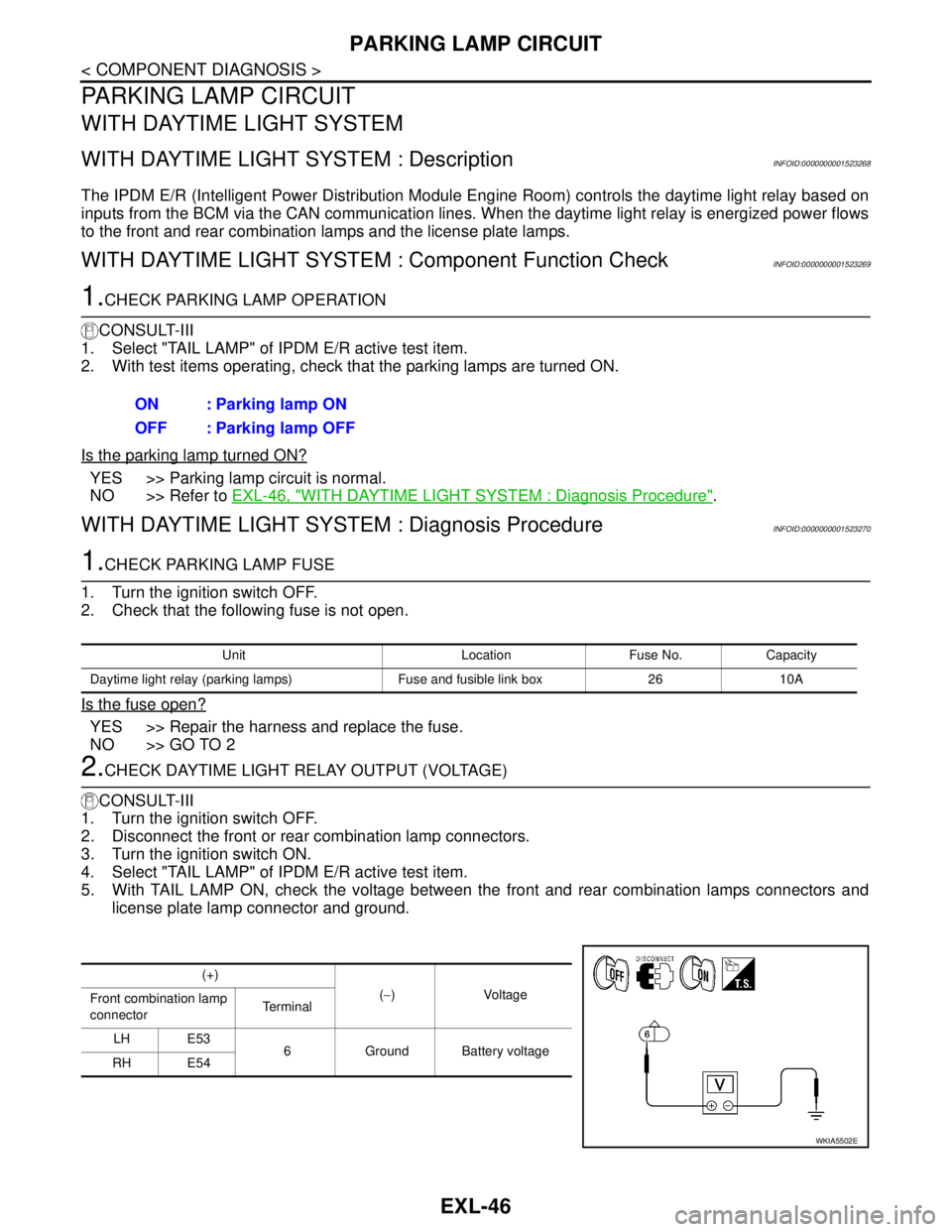
5. With TAIL LAMP ON, check the voltage between the front and rear combination lamps connectors and
license plate lamp connector and ground.ON : Parking lamp ON
OFF : Parking lamp OFF
Unit Location Fuse No. Capacity
Daytime light relay (parking lamps) Fuse and fusible link box 26 10A
(+)
(−)Voltage
Front combination lamp
connectorTe r m i n a l
LH E53
6 Ground Battery voltage
RH E54
WKIA5502E
Page 3049 of 5883
EXL-48
< COMPONENT DIAGNOSIS >
PARKING LAMP CIRCUIT
2. Disconnect the front combination lamp connectors, rear combination lamp connectors or license plate
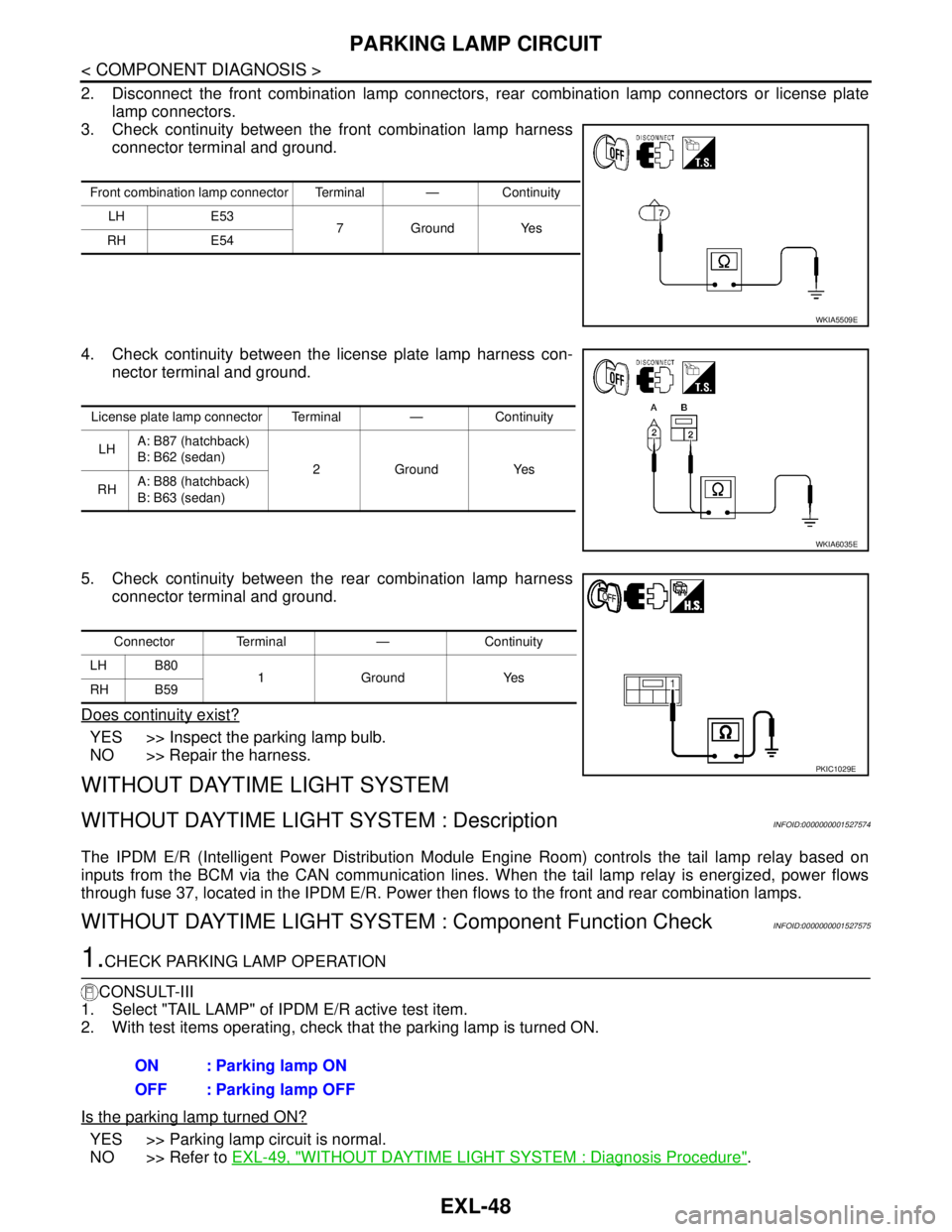
lamp connectors.
3. Check continuity between the front combination lamp harness
connector terminal and ground.
4. Check continuity between the license plate lamp harness con-
nector terminal and ground.
5. Check continuity between the rear combination lamp harness
connector terminal and ground.
Does continuity exist?
YES >> Inspect the parking lamp bulb.
NO >> Repair the harness.
WITHOUT DAYTIME LIGHT SYSTEM
WITHOUT DAYTIME LIGHT SYSTEM : DescriptionINFOID:0000000001527574
The IPDM E/R (Intelligent Power Distribution Module Engine Room) controls the tail lamp relay based on
inputs from the BCM via the CAN communication lines. When the tail lamp relay is energized, power flows
through fuse 37, located in the IPDM E/R. Power then flows to the front and rear combination lamps.
WITHOUT DAYTIME LIGHT SYSTEM : Component Function CheckINFOID:0000000001527575
1.CHECK PARKING LAMP OPERATION
CONSULT-III
1. Select "TAIL LAMP" of IPDM E/R active test item.
2. With test items operating, check that the parking lamp is turned ON.
Is the parking lamp turned ON?
YES >> Parking lamp circuit is normal.
NO >> Refer to EXL-49, "
WITHOUT DAYTIME LIGHT SYSTEM : Diagnosis Procedure".
Front combination lamp connector Terminal — Continuity
LH E53
7GroundYes
RH E54
WKIA5509E
License plate lamp connector Terminal — Continuity
LHA: B87 (hatchback)
B: B62 (sedan)
2GroundYes
RHA: B88 (hatchback)
B: B63 (sedan)
WKIA6035E
Connector Terminal — Continuity
LH B80
1Ground Yes
RH B59
PKIC1029E
ON : Parking lamp ON
OFF : Parking lamp OFF
Page 3082 of 5883
HEADLAMP
EXL-81
< ON-VEHICLE MAINTENANCE >
C
D
E
F
G
H
I
J
K
MA
B
EXL
N
O
P
ON-VEHICLE MAINTENANCE
HEADLAMP
Aiming AdjustmentINFOID:0000000001529251
PREPARATION BEFORE ADJUSTING
Before performing aiming adjustment, check the following.
1. Keep all tires inflated to correct pressures.
2. Place vehicle on level surface.
3. Set that there is no-load in vehicle other than the driver (or equivalent weight placed in driver's position).
Coolant, engine oil filled up to correct level and full fuel tank.
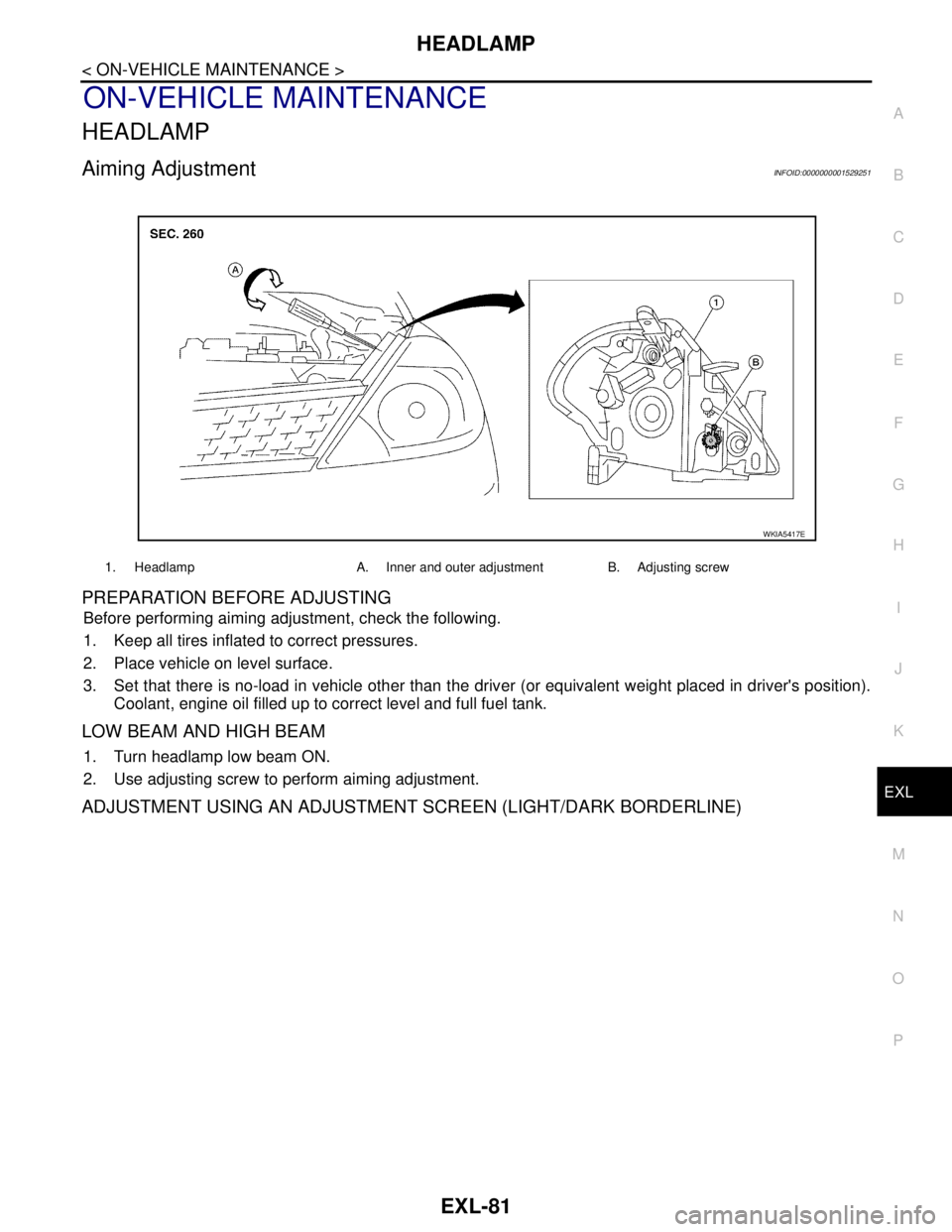
LOW BEAM AND HIGH BEAM
1. Turn headlamp low beam ON.
2. Use adjusting screw to perform aiming adjustment.
ADJUSTMENT USING AN ADJUSTMENT SCREEN (LIGHT/DARK BORDERLINE)
1. Headlamp A. Inner and outer adjustment B. Adjusting screw
WKIA5417E