stop start NISSAN TITAN 2019 Owner´s Manual
[x] Cancel search | Manufacturer: NISSAN, Model Year: 2019, Model line: TITAN, Model: NISSAN TITAN 2019Pages: 682, PDF Size: 7.99 MB
Page 584 of 682
∙ While going downhill, the weight of thetrailer pushing on the tow vehicle may
decrease overall stability. Therefore, to
maintain adequate control, reduce your
speed and shif t to a lower gear. Avoid
long or repeated use of the brakes
when descending a hill, as this reduces
their effectiveness and could cause
overheating. Shif ting to a lower gear in-
stead provides “engine braking” and re-
duces the need to brake as frequently.
∙ If the engine coolant temperature rises to a high temperature, refer to “If your
vehicle overheats” in the “In case of
emergency” section of this owner’s
manual.
∙ Trailer towing requires more fuel than normal circumstances.
∙ Avoid towing a trailer for your vehicle’s first 500 miles (805 km).
∙ For the first 500 miles (805 km) that you do tow, do not drive over 50 mph
(80 km/h).
∙ Have your vehicle serviced more of ten than at intervals specified. For addi-
tional information, refer to “Mainte-
nance schedules” in the “Maintenance
and schedule” section of this manual. ∙ When making a turn, your trailer wheels
will be closer to the inside of the turn
than your vehicle wheels. To compen-
sate for this, make a larger than normal
turning radius during the turn.
∙ Crosswinds and rough roads will ad- versely affect vehicle/trailer handling,
possibly causing vehicle sway. When
being passed by larger vehicles, be pre-
pared for possible changes in cross-
winds that could affect vehicle han-
dling.
Trailer Sway Assist :
To minimize trailer sway, your vehicle may
apply braking to individual wheels based
on input from your vehicle sensors and ve-
hicle speed. Trailer sway control is a func-
tion of the Vehicle Dynamic Control (VDC)
system and is active when the VDC func-
tion is enabled.
CAUTION
If the VDC-OFF switch is on (meaning
VDC system OFF), the Trailer Sway As-
sist is also disabled When Trailer Sway Assist is in operation, the
VDC warning light blinks. When vehicle con-
trol is regained, VDC warning light will turn
OFF.
For additional information about the VDC
system, refer to “Vehicle Dynamic Control
(VDC) OFF switch” in the “Instruments and
controls” section and “Vehicle Dynamic
Control (VDC) system” in the “Starting and
driving” section of this manual.
If Trailer Sway Assist activates, do the fol-
lowing:
1. Take your foot off the accelerator pedal to allow the vehicle to coast and steer
as straight ahead as the road condi-
tions allow. This combination will help
stabilize the vehicle
CAUTION
Do not try to correct trailer sway by
steering or applying the brakes.
2. When the trailer sway stops, gently ap- ply the brakes and pull to the side of the
road in a safe area.
3. Try to rearrange the trailer load so it is balanced. For additional information,
refer to “Pre-towing tips” in this section.
Technical and consumer information10-61
Page 592 of 682
11 Index
A
Active Brake Limited Slip (ABLS)
system .....................5-58
Aimingcontrol,headlights.........2-52
Air bag (See supplemental restraint
system) .................... .1-53
Air bag system Front (See supplemental front impact
airbagsystem)...........1-60, 1-75
Air bag warning labels ............1-80
Airbagwarninglight..........1-81, 2-22
Air bag warning light,
supplemental ..............1-81, 2-22
Air cleaner ...................8-20
Air cleaner housing filter ..........8-20
Air conditioner Air conditioner operation ....4-33,4-39
Air conditioner specification label . .10-21
Air conditioner system refrigerant and
oil recommendations ..........10-8
Air conditioner system refrigerant
recommendations ............10-8
Heater and air conditioner (automatic)
(if so equipped) ..............4-38
Heater and air conditioner
controls ..................4-39
Servicing air conditioner ........4-43
Air flow charts .................4-34
Alarm system
(See vehicle security system) .......2-43
Anchor point locations ............1-31 Antenna
....................4-44
Antifreeze ...................5-68
Anti-lock brake warning light ........2-17
Anti-lock Braking System (ABS) ......5-56
Audible reminders ..............2-25
Autolightswitch ...............2-50
Automatic Automatic drive positioner . . .3-43, 3-45
Automatic power window switch . . .2-85
Driving with automatic
transmission ................5-17
Automatic anti-glare inside mirror . . . .3-34
Automatic door locks .............3-9
Automatic drive positioner .....3-43,3-45
Automatic transmission fluid temperature
gauge ......................2-10
B
Battery..................5-68,8-15 Charge warning light ...........2-19
Battery replacement .............8-27
Keyfob...................8-27
NISSAN Intelligent Key® .........8-27
Before starting the engine .........5-15
Belt(Seedrivebelt)..............8-19
Blind Spot Warning (BSW) ..........5-23
Block heater Engine ...................5-70
Booster seats .................1-49
Brake Anti-lock Braking System (ABS) ....5-56Brakefluid.................8-13
Brakelight(Seestoplight).......
8-32
Brakesystem...............5-55
Brakewarninglight............2-18
Brakewearindicators ......2-25,8-22
Parking brake operation ........5-23
Self-adjustingbrakes..........8-22
Brake Assist ..................5-57
Brakefluid...................8-13
Brakes .....................8-22
Brakesystem................ .5-55
Break-in schedule ..............5-43
Brightness control Instrument panel .............2-53
Bulb check/instrument panel .......2-17
Bulb replacement ..............
8-
32
C
Capacities and recommended fuel/
lubricants....................10-2
Cargolightswitch..............2-55
Cargo
(See vehicle loading information) ....10-23
Car phone or CB radio ...........4-89
Check tire pressure ..........2-37, 2-38
Childrestraints.......1-24, 1-25, 1-26, 1-29 LATCH (Lower Anchors and Tethers for
CHildren)System.............1-29
Precautions on child
restraints.....1-26, 1-34, 1-40, 1-44, 1-49
Page 597 of 682
SeatsAdjustment ..................1-2
Automatic drive positioner ....3-43,3-45
Frontseats..................1-2
Heatedseats................2-56
Manual front seat adjustment ......1-4
Rearseat...................1-4
Security indicator light ............2-25
Security system (NISSAN Vehicle Immobilizer
System), engine start ..........2-44,5-14
Security systems Vehicle security system .........2-43
Self-adjustingbrakes.............8-22
Service manual order form ........10-68
Servicing air conditioner ...........4-43
Shif ting Automatic transmission .........5-19
Shoulder belt height adjustment ......1-22
Side air bag system
(See supplemental side air bag, curtain and
rollover air bag systems) ...........1-78
Snowplow...................10-63
Spark plug replacement ...........8-19
Spark plugs ...................8-19
Specifications .................10-10
Speedometer ..................2-7
Speedometer and odometer ........2-6
SRS warning label ...............1-80
Stability control ................5-59
Standard maintenance ............9-8
Starting Before starting the engine ........5-15
Jumpstarting............6-14,8-18
Precautions when starting and
driving ..................5-2,5-9
Push starting ................6-16 Starting the engine (diesel only)
......5-16
Starting the engine
(gasoline engine only) .............5-15
Steering Powersteeringfluid............8-12
Powersteeringsystem..........5-55
Steering wheel .................3-30
Stoplight....................8-32
Storage......................2-71
Storagetray...................2-75
Sunglasses case ................2-77
Sunglasses holder ...............2-77
Sunvisors....................3-32
Supplemental air bag warning labels . . .1-80
Supplemental air bag warning
light.....................1-81, 2-22
Supplemental front impact air bag
system ...................1-60, 1-75
Supplemental restraint system Information and warning labels . . . .1-80
Precautions on supplemental restraint
system .................1-53, 1-68
Supplemental restraint system
(Supplemental air bag system) .......1-53
Switch Autolightswitch..............2-50
Automatic power window switch . . .2-85
Electronic locking rear differential (E-Lock)
system switch ...............2-62
Foglightswitch..............2-54
Hazard warning flasher switch ......6-2
Headlightaimingcontrol ........2-52
Headlight and turn signal switch ....2-49
Headlightcontrolswitch.........2-49
Hill descent control switch ........2-61
Instrument brightness control .....2-53Power door lock switch
..........3-7
Powerinverterswitch ..........2-63
Rear sonar system OFF switch .....2-64
T ow
mode switch .............2-65
Turn signal switch .............2-53
T
Tachometer ...................2-8
Tailgate..................3-39, 3-39
Temperature gauge Engine coolant temperature gauge . .2-8
Thef t (NISSAN Vehicle Immobilizer System),
engine start ...............2-44,5-14
Three-waycatalyst...............5-2
Tie down hooks ................3-43
Tire Flattire..................6-3,6-4
Spare tire .............6-5,6-6,8-46
Tire and Loading Information label . .10-21
Tire chains .................8-42
Tire pressure ................8-35
Tirerotation ................8-43
Tires of 4-wheel drive ...........8-45
Types of tires ................8-41
Uniform tire quality grading ......10-64
Wheels and tires ..........8-35,10-11
Wheel/tire size ...............10-11
Tirepressure..................8-35 Low tire pressure warning light .....2-20
Tire Pressure Monitoring System
(TPMS)....................5-3,6-3
Towing 2-wheel drive models ...........6-19
Flattowing.................10-63
11-6
Page 620 of 682
Table of
ContentsIntroduction
Instrument Panel
Starting and Stopping the Engine
Fuel and Refueling
In Case of Emergency
Vehicle Care
Do-it-yourself
Capacities and Specifications
Index
1
2
3
4
5
6
7
8
9
Page 624 of 682
The stage 1 fuel filter separates water and
filters impurities from the fuel. The stage 2
fuel filter filters finer impurities from the
diesel fuel. The stage 1 and stage 2 fuel
filters should be changed at the recom-
mended service interval or when indicated
by the information display. For additional
information, refer to “Maintenance and
schedules” and “Instruments and controls”
sections of the Titan Owner’s Manual.
The water/fuel separator should be
drained when indicated by illumination of
the water in fuel warning light.
NOTE:
Proper fuel filter maintenance and
prompt water draining when the water
in the fuel filter warning light illuminates
is essential to prevent damage to fuel
injection system components. Ignoring
the water in fuel warning light can cause
your vehicle to go into a reduced power
mode and has the potential for fuel sys-
tem damage.ENGINE PROTECTION MODE
The diesel engine in this vehicle is equipped
with electronically controlled fuel and
emission systems. Both systems monitor
engine temperatures and pressures, and
then modif y engine operation accordingly.
It is normal for the diesel engine to operate
under these modified conditions for short
durations of time. If the engine operates
under the modified conditions for ex-
tended periods of time, and the service en-
gine soon light is illuminated, have the sys-
tem checked. It is recommended that you
visit a NISSAN dealer for this service as
soon as possible.
LUBRICATION SYSTEM
It is important to change the engine oil at
the recommended service intervals to
maintain oil viscosity. Extending the oil and
filter change interval beyond the recom-
mended interval can negatively affect en-
gine performance, fuel economy and en-
gine life. For additional information, refer to
the “Do-it-yourself ” section of this manual.
GLOW PLUGS
The diesel engine glow plug system con-
sists of:∙ Eight Glow Plugs (one per cylinder)
∙ Glow Plug Control Module - Uses input from the Engine Coolant Temperature
Sensor
The glow plugs are energized momentarily
when the ignition is first turned on. The
length of time that the glow plugs are en-
ergized varies depending on engine and
environmental conditions. The required
time for the glow plugs to be energized
decreases as coolant temperature in-
creases. For additional information, refer to
the “Starting and stopping the engine” sec-
tion of this manual.
Introduction1-3
Page 632 of 682
9. DEF System Error 5MPH Speed LimitSee Dealer
10. Exhaust Filter Overloaded See Owner’s Manual For Drive Pattern
11. Exhaust Filter Regeneration Started
12. Exhaust Filter Overloaded Engine Power Reduced See Owner’s Manual
13. Exhaust Filter Overloaded Immediate Service Required
14. Engine Warming Keep Foot on Brake
15. Engine Shutdown Stop Safely
16. Engine Power Reduced
17. Service Air Filter
18. Engine Oil Service Due XX
19. Coolant Level Low: See Owner’s Manual
20. Low Fuel Pressure: See Owner’s Manual
DEF Low XX% Refill Soon
This message appears when the DEF be-
comes low. It is recommended that the
DEF be topped off. For additional informa-
tion, refer to “Diesel Exhaust Fluid (DEF)” in
the “Fueling and refueling” section of this
manual. DEF Low XX% Limited Engine Power
Soon
This message appears as the DEF be-
comes low. Engine power will be limited
soon. It is recommended that the DEF be
topped off. For additional information, refer
to “Diesel Exhaust Fluid (DEF)” in the “Fueling
and refueling” section of this manual.
DEF Low Limited Engine Power In XX
Miles
This message appears when the DEF be-
comes low. Engine power will be limited in
the approximate distance shown. It is rec-
ommended that the DEF be topped off. For
additional information, refer to “Diesel Ex-
haust Fluid (DEF)” in the “Fueling and refuel-
ing” section of this manual.
DEF Empty 5mph Limit Soon See Own-
er’s Manual
This message appears when the DEF be-
comes empty. It is recommended that the
DEF be refilled as soon as possible. The
following conditions will limit the vehicle
speed when this message is shown:
∙ Engine shutdown and restart
∙ Engine is idled for approximately 1 hour ∙ Control module detects a fuel level in-
crease For additional information, refer
to “Diesel Exhaust Fluid (DEF)” in the “Fu-
eling and refueling” section of this
manual.
DEF Empty Refill DEF See Owner’s
Manual
This message appears when the DEF is
empty and the vehicle speed is reduced to
a maximum of 5 mph. It is recommended
that the DEF be refilled as soon as possible.
For additional information, refer to “Diesel
Exhaust Fluid (DEF)” in the “Fueling and re-
fueling” section of this manual.
DEF System Error See Dealer
This message appears when the DEF sys-
tem encounters an error. It is recom-
mended that you have the system
checked by a NISSAN dealer or other quali-
fied technician. For additional information,
refer to “Diesel Exhaust Fluid (DEF)” in the
“Fueling and refueling” section of this
manual.
Instrument Panel2-5
Page 634 of 682
will be reduced. It is recommended that
you visit a NISSAN dealer or qualified tech-
nician immediately. For additional informa-
tion, refer to “Diesel Particulate Filter (DPF)”
in the “Do-it-yourself ” section of this
manual.
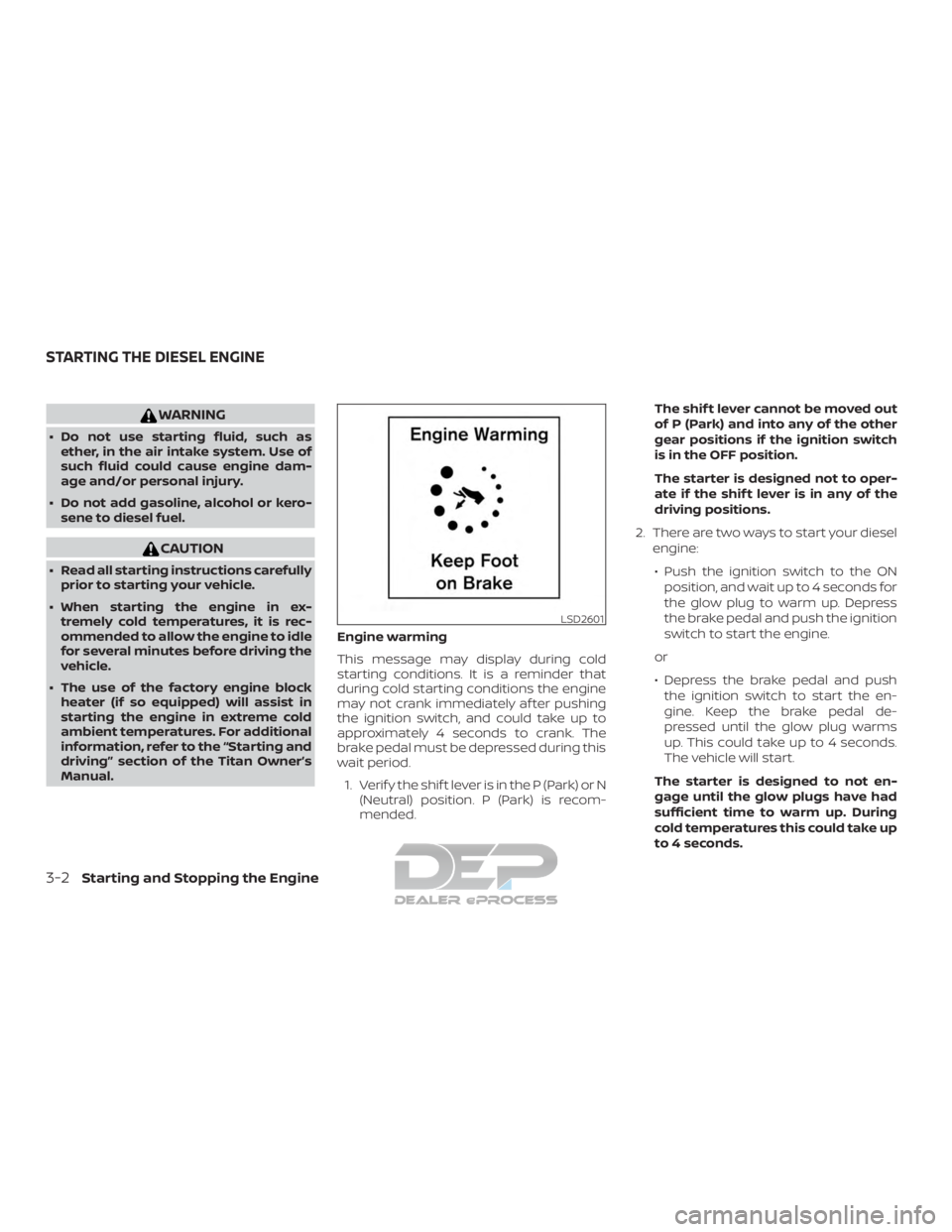
Engine Warming Keep Foot on Brake
This message appears during cold start
conditions when:∙ Brake pedal is depressed
∙ Push-button start button has been pressed
∙ Coolant temperature is below thresh- old
Keep foot on the brake until the engine
starts, which can take up to approximately
4 seconds. For additional information, refer
to “Starting the diesel engine” in the “Start-
ing and stopping the engine” section of this
manual. Engine Shutdown: Stop Safely
This message appears 30 seconds before
the vehicle is shutdown due to an above
normal operating exhaust temperature.
The Malfunction Indicator Light (MIL) and
malfunction warning light (red) will illumi-
nate. It is recommended that you visit a
NISSAN dealer or other qualified technician
immediately.
Engine Power Reduced
This message appears when the engine is
not operating under normal conditions. For
additional information, refer to “Engine Pro-
tection Mode” in the “Introduction” section
of this manual.
Service Air Filter
This warning appears when the air filter
needs to be serviced. For additional infor-
mation, refer to “Air cleaner” in the ”Mainte-
nance” section of the Titan Diesel Owner’s
Manual.Engine Oil Service due XX
This message is a count down of mileage
until the next engine oil service is due. Mile-
age until next required engine oil service
will be displayed by the vehicle information
display and will decrease at a higher rate as
vehicle operation severity (high duty cycle)
increases.
Coolant Level Low: See Owner’s Manual
This warning appears when the coolant
level in the reservoir is below the MIN level.
For additional information, refer to “Engine
Cooling System” in this manual.
Low Fuel Pressure: See Owner’s Manual
This message appears when low fuel pres-
sure has been detected downstream of
the stage 2 fuel filter. This message can
indicate the fuel filters are restricted and
require replacement. It is recommended
that you have the system checked by a
NISSAN dealer or other qualified technician.
Instrument Panel2-7
Page 636 of 682
3 Starting and Stopping the Engine
Starting the diesel engine.......................3-2
Switching engine off ..........................3-3
Engine break-in recommendations ...........3-3Remote Engine Start (if so equipped)
.........3-3
Engine block heater (if so equipped) ..........3-4
Page 637 of 682
WARNING
∙ Do not use starting fluid, such asether, in the air intake system. Use of
such fluid could cause engine dam-
age and/or personal injury.
∙ Do not add gasoline, alcohol or kero- sene to diesel fuel.
CAUTION
∙ Read all starting instructions carefullyprior to starting your vehicle.
∙ When starting the engine in ex- tremely cold temperatures, it is rec-
ommended to allow the engine to idle
for several minutes before driving the
vehicle.
∙ The use of the factory engine block heater (if so equipped) will assist in
starting the engine in extreme cold
ambient temperatures. For additional
information, refer to the “Starting and
driving” section of the Titan Owner’s
Manual. Engine warming
This message may display during cold
starting conditions. It is a reminder that
during cold starting conditions the engine
may not crank immediately af ter pushing
the ignition switch, and could take up to
approximately 4 seconds to crank. The
brake pedal must be depressed during this
wait period.
1. Verif y the shif t lever is in the P (Park) or N (Neutral) position. P (Park) is recom-
mended. The shif t lever cannot be moved out
of P (Park) and into any of the other
gear positions if the ignition switch
is in the OFF position.
The starter is designed not to oper-
ate if the shif t lever is in any of the
driving positions.
2. There are two ways to start your diesel engine:
∙ Push the ignition switch to the ON position, and wait up to 4 seconds for
the glow plug to warm up. Depress
the brake pedal and push the ignition
switch to start the engine.
or
∙ Depress the brake pedal and push the ignition switch to start the en-
gine. Keep the brake pedal de-
pressed until the glow plug warms
up. This could take up to 4 seconds.
The vehicle will start.
The starter is designed to not en-
gage until the glow plugs have had
sufficient time to warm up. During
cold temperatures this could take up
to 4 seconds.
LSD2601
STARTING THE DIESEL ENGINE
3-2Starting and Stopping the Engine
Page 638 of 682
CAUTION
If the engine does not start, place the
ignition switch in the OFF position and
wait 10 seconds before cranking again,
otherwise the starter could be
damaged.3. Allow the engine to idle for at least 30 seconds af ter starting. Do not race
the engine while warming it up. Drive at
a moderate speed for a short distance
first, especially in cold weather.
In cold weather, keep the engine run-
ning for a minimum of 2–3 minutes
before shutting it off. Starting and
stopping the engine over a short pe-
riod of time may make the vehicle
more difficult to start.
SWITCHING ENGINE OFF
Push the ignition switch to the OFF posi-
tion.
To prolong the engine life (especially af ter
extended high speed, high ambient tem-
perature, or during heavy load operation,
such as trailering), it is recommended that
a hot engine be idled for 3–5 minutes be-
fore shutting down. This allows the turbo-
charged engine to cool down.
ENGINE BREAK-IN
RECOMMENDATIONS
∙ Warm up the engine before operating it under load.
∙ Do not operate the engine at idle for extended periods.
∙ Prevent engine lugging by selecting the appropriate transmission gear.
∙ Monitor the vehicle oil pressure and temperature gauges.
∙ Check fluid levels frequently (oil and coolant).
∙ Vary the throttle position at highway speeds when carrying weight or tow-
ing.
NOTE:
Extended light or no load operation will
extend the time before the engine
reaches its full efficiency. If the engine is
operated in this manner, reduced fuel
economy and power may be observed.
The aforementioned procedure should be
observed for the first 6,000 miles. The en-
gine run-in is improved by operating the
vehicle under load.
REMOTE ENGINE START (if so
equipped)
CAUTION
Laws in some jurisdictions prohibit use
of Remote Engine Start.
Vehicles started with the Remote Engine
Start require the ignition switch to be
placed in the ON position before the shif t
lever can be moved from the P (Park) posi-
tion. To place the ignition switch in the ON
position, follow these steps: 1. Make sure that the Intelligent Key is on you.
2. Apply the brake.
3. Push the ignition switch once to the ON position.
For additional information, refer to “NISSAN
Intelligent Key®” in the “Pre-driving checks
and adjustments” section of the Titan
Owner’s Manual.
Starting and Stopping the Engine3-3