sensor NISSAN X-TRAIL 2003 Electronic Repair Manual
[x] Cancel search | Manufacturer: NISSAN, Model Year: 2003, Model line: X-TRAIL, Model: NISSAN X-TRAIL 2003Pages: 3066, PDF Size: 51.47 MB
Page 626 of 3066
ATC-48
TROUBLE DIAGNOSIS
13.CHECK MALFUNCTIONING SENSOR
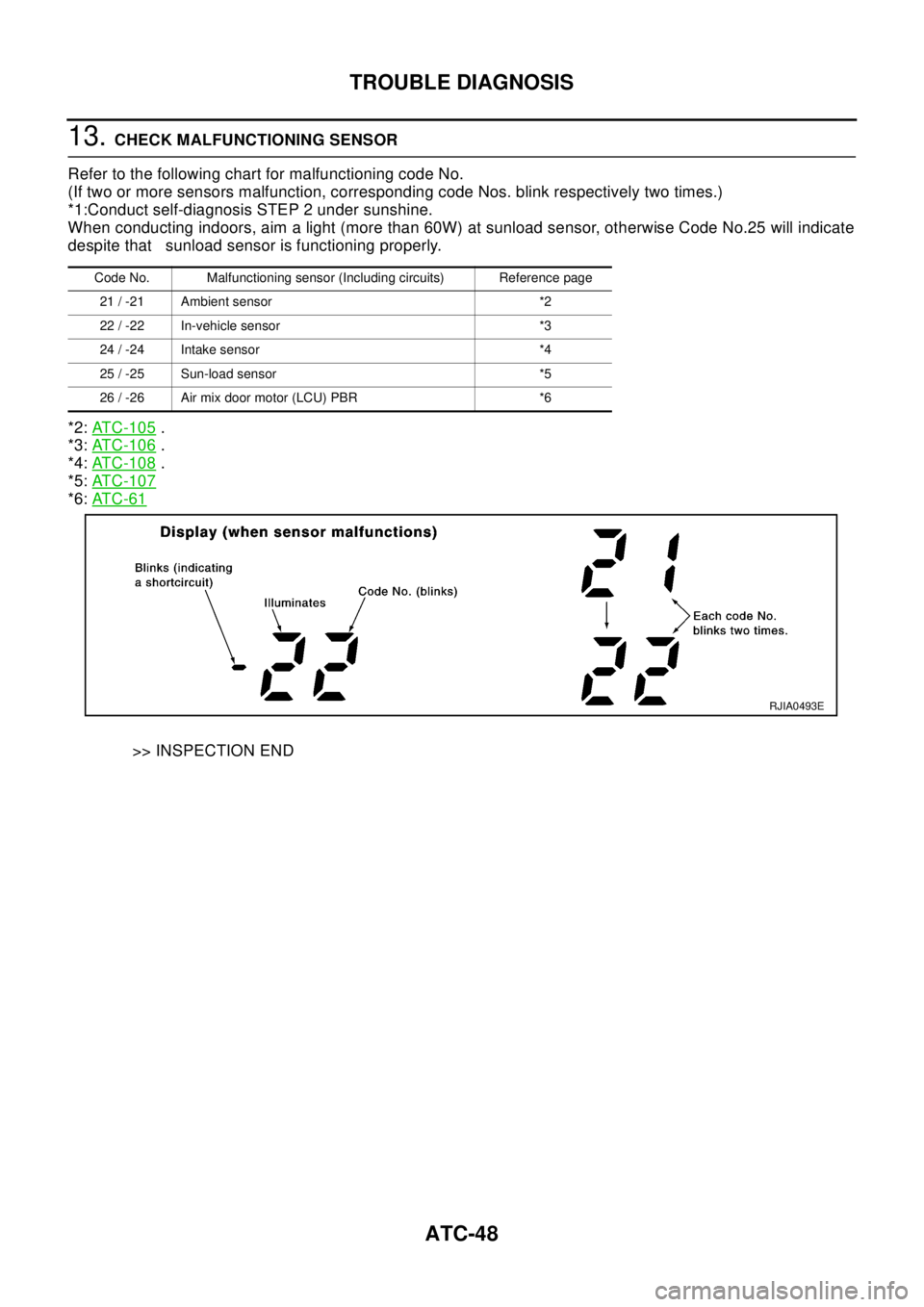
Refer to the following chart for malfunctioning code No.
(If two or more sensors malfunction, corresponding code Nos. blink respectively two times.)
*1:Conduct self-diagnosis STEP 2 under sunshine.
When conducting indoors, aim a light (more than 60W) at sunload sensor, otherwise Code No.25 will indicate
despite that sunload sensor is functioning properly.
*2:AT C - 1 0 5
.
*3:AT C - 1 0 6
.
*4:AT C - 1 0 8
.
*5:AT C - 1 0 7
*6:AT C - 6 1
>> INSPECTION END
Code No. Malfunctioning sensor (Including circuits) Reference page
21 / -21 Ambient sensor *2
22 / -22 In-vehicle sensor *3
24 / -24 Intake sensor *4
25 / -25 Sun-load sensor *5
26 / -26 Air mix door motor (LCU) PBR *6
RJIA0493E
Page 632 of 3066
ATC-54
TROUBLE DIAGNOSIS
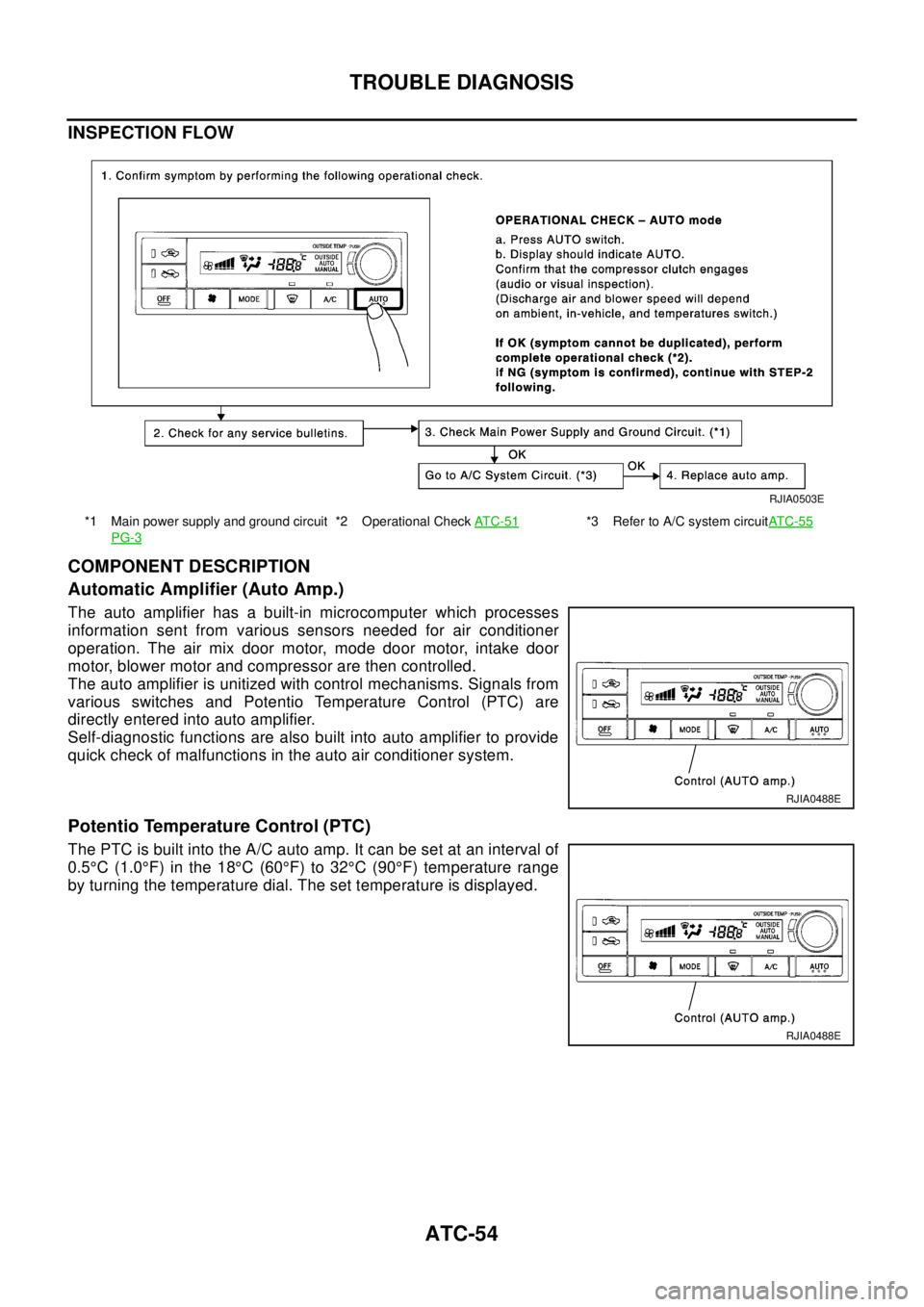
INSPECTION FLOW
COMPONENT DESCRIPTION
Automatic Amplifier (Auto Amp.)
The auto amplifier has a built-in microcomputer which processes
information sent from various sensors needed for air conditioner
operation. The air mix door motor, mode door motor, intake door
motor, blower motor and compressor are then controlled.
The auto amplifier is unitized with control mechanisms. Signals from
various switches and Potentio Temperature Control (PTC) are
directly entered into auto amplifier.
Self-diagnostic functions are also built into auto amplifier to provide
quick check of malfunctions in the auto air conditioner system.
Potentio Temperature Control (PTC)
The PTC is built into the A/C auto amp. It can be set at an interval of
0.5°C(1.0°F) in the 18°C(60°F) to 32°C(90°F) temperature range
by turning the temperature dial. The set temperature is displayed.
*1 Main power supply and ground circuit
PG-3*2 Operational CheckAT C - 5 1*3 Refer to A/C system circuitAT C - 5 5
RJIA0503E
RJIA0488E
RJIA0488E
Page 637 of 3066
TROUBLE DIAGNOSIS
ATC-59
C
D
E
F
G
H
I
K
L
MA
B
AT C
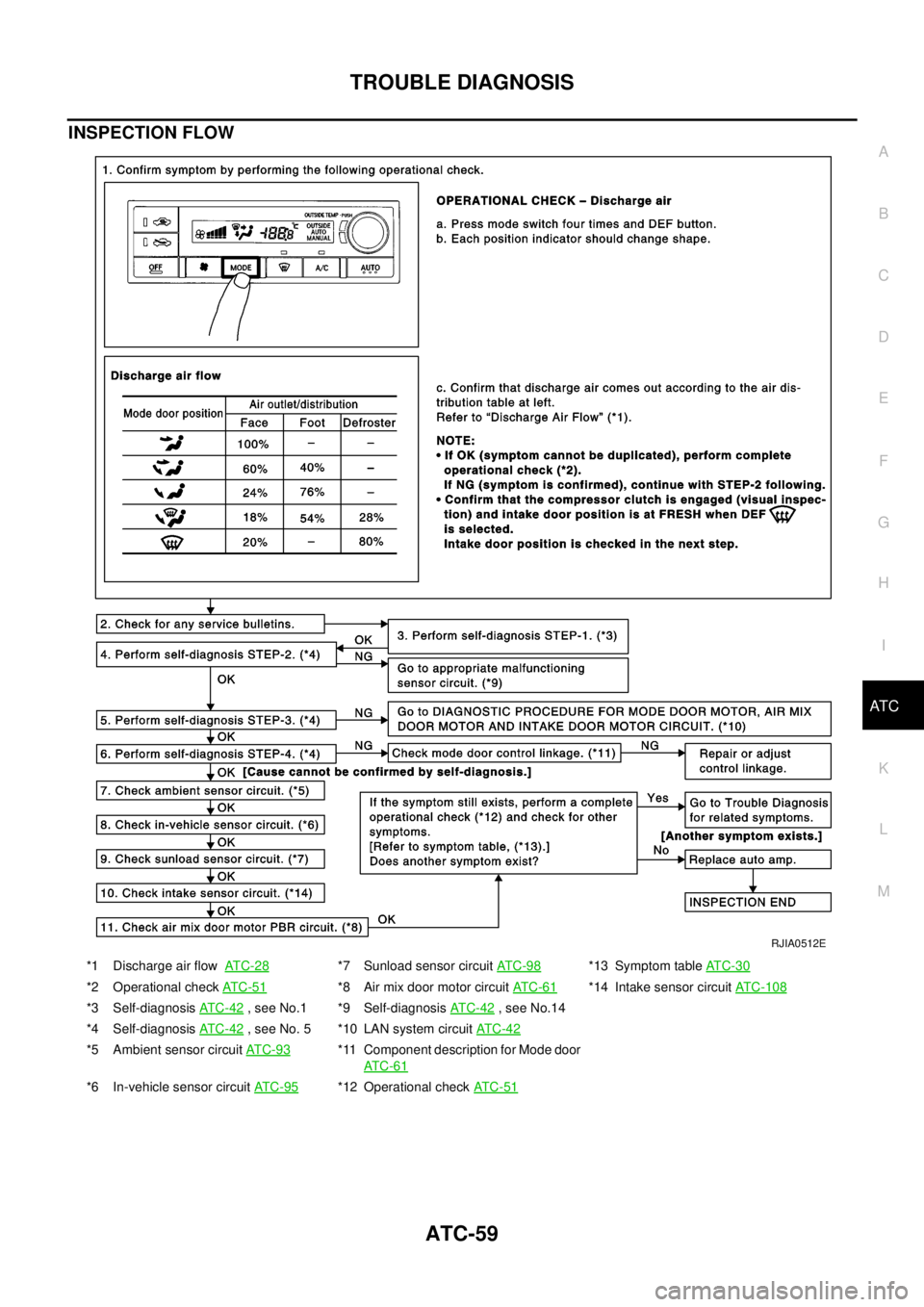
INSPECTION FLOW
*1 Discharge air flowAT C - 2 8*7 Sunload sensor circuitAT C -9 8*13 Symptom tableAT C - 3 0
*2 Operational checkAT C -5 1*8 Air mix door motor circuitAT C -6 1*14 Intake sensor circuitAT C - 1 0 8
*3 Self-diagnosisAT C - 4 2, see No.1 *9 Self-diagnosisAT C - 4 2,seeNo.14
*4 Self-diagnosisAT C - 4 2
, see No. 5 *10 LAN system circuitAT C -4 2
*5 Ambient sensor circuitAT C - 9 3*11 Component description for Mode door
AT C -6 1
*6 In-vehicle sensor circuitAT C - 9 5*12 Operational checkAT C - 5 1
RJIA0512E
Page 638 of 3066
ATC-60
TROUBLE DIAGNOSIS
SYSTEM DESCRIPTION
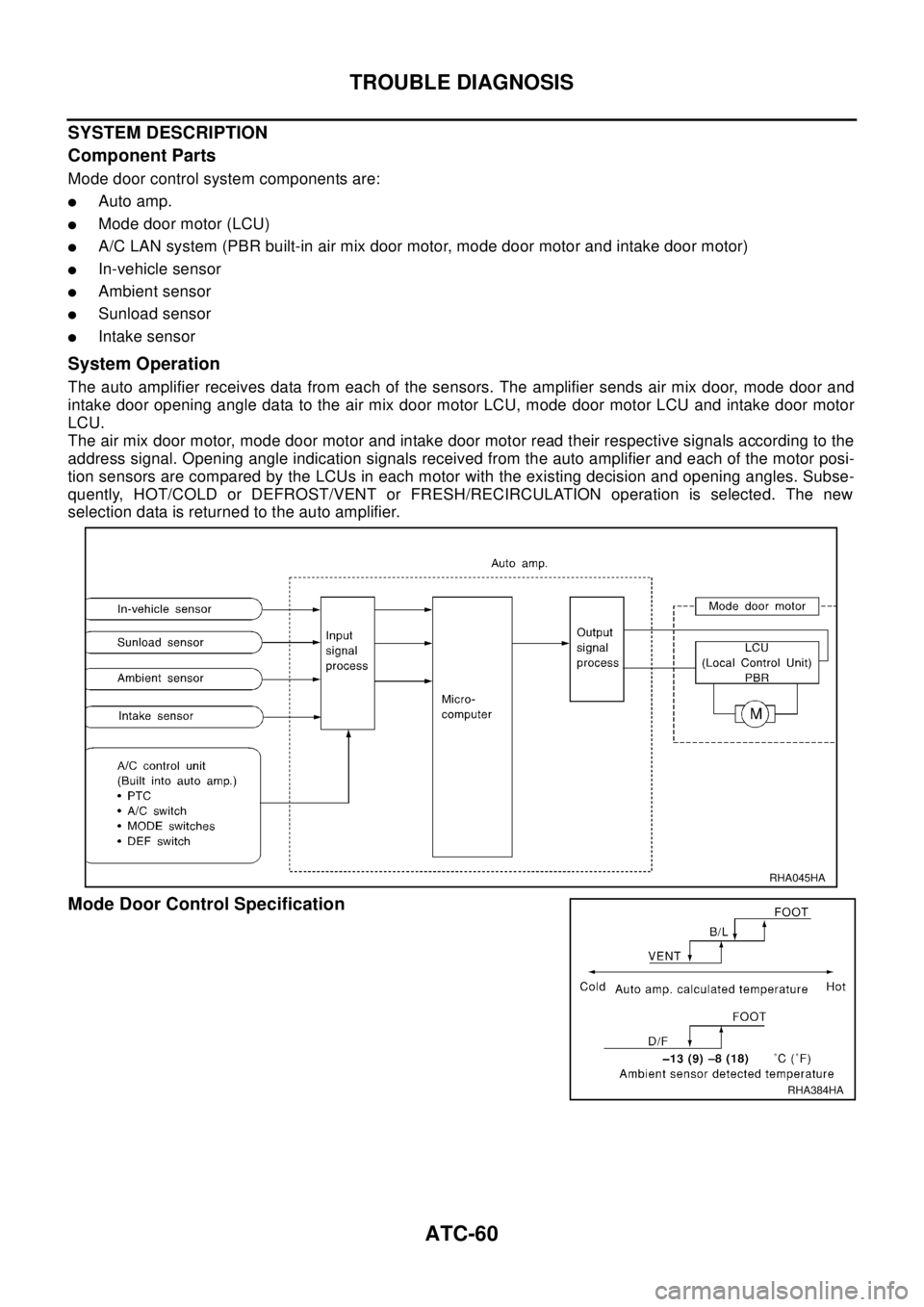
Component Parts
Mode door control system components are:
lAuto amp.
lMode door motor (LCU)
lA/C LAN system (PBR built-in air mix door motor, mode door motor and intake door motor)
lIn-vehicle sensor
lAmbient sensor
lSunload sensor
lIntake sensor
System Operation
The auto amplifier receives data from each of the sensors. The amplifier sends air mix door, mode door and
intake door opening angle data to the air mix door motor LCU, mode door motor LCU and intake door motor
LCU.
The air mix door motor, mode door motor and intake door motor read their respective signals according to the
address signal. Opening angle indication signals received from the auto amplifier and each of the motor posi-
tion sensors are compared by the LCUs in each motor with the existing decision and opening angles. Subse-
quently, HOT/COLD or DEFROST/VENT or FRESH/RECIRCULATION operation is selected. The new
selection data is returned to the auto amplifier.
Mode Door Control Specification
RHA045HA
RHA384HA
Page 640 of 3066
ATC-62
TROUBLE DIAGNOSIS
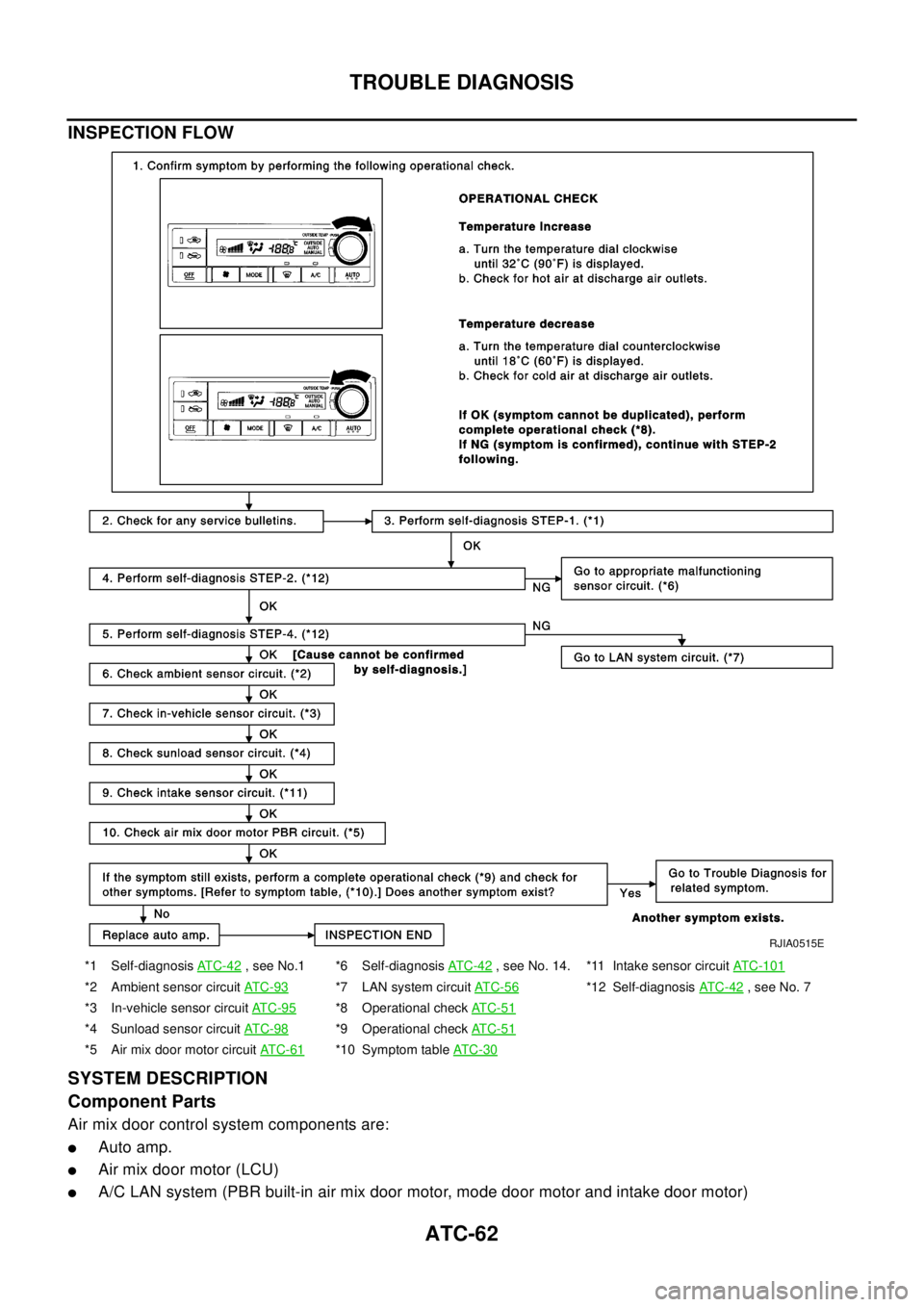
INSPECTION FLOW
SYSTEM DESCRIPTION
Component Parts
Air mix door control system components are:
lAuto amp.
lAir mix door motor (LCU)
lA/C LAN system (PBR built-in air mix door motor, mode door motor and intake door motor)
*1 Self-diagnosisAT C - 4 2, see No.1 *6 Self-diagnosisAT C -4 2, see No. 14. *11 Intake sensor circuitATC-101
*2 Ambient sensor circuitAT C - 9 3*7 LAN system circuitAT C - 5 6*12 Self-diagnosisAT C - 4 2,seeNo.7
*3 In-vehicle sensor circuitAT C - 9 5
*8 Operational checkAT C - 5 1
*4 Sunload sensor circuitAT C - 9 8*9 Operational checkAT C - 5 1
*5 Air mix door motor circuitAT C - 6 1*10 Symptom tableAT C - 3 0
RJIA0515E
Page 641 of 3066
TROUBLE DIAGNOSIS
ATC-63
C
D
E
F
G
H
I
K
L
MA
B
AT C
lIn-vehicle sensor
lAmbient sensor
lSunload sensor
lIntake sensor
System Operation
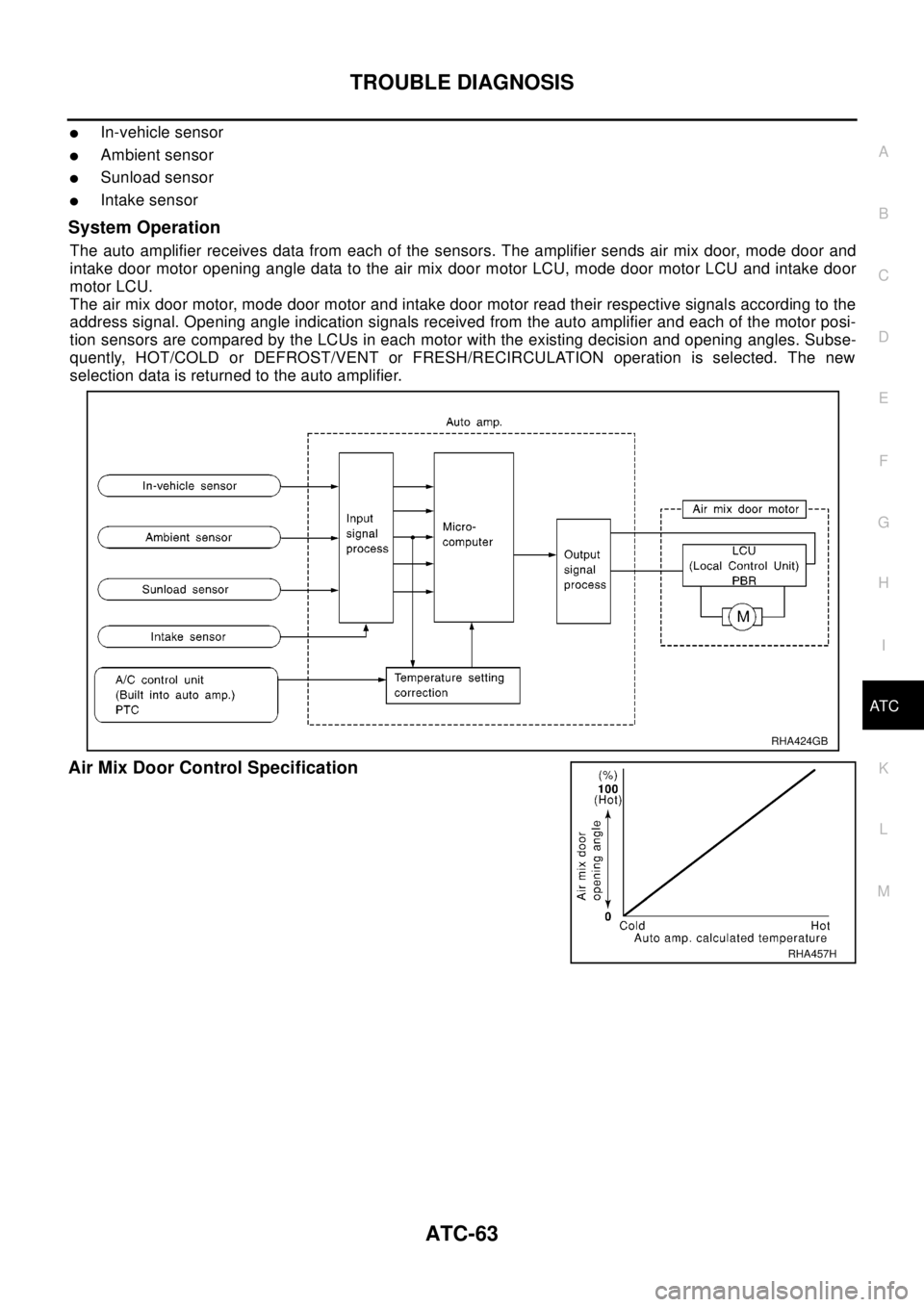
The auto amplifier receives data from each of the sensors. The amplifier sends air mix door, mode door and
intake door motor opening angle data to the air mix door motor LCU, mode door motor LCU and intake door
motor LCU.
The air mix door motor, mode door motor and intake door motor read their respective signals according to the
address signal. Opening angle indication signals received from the auto amplifier and each of the motor posi-
tion sensors are compared by the LCUs in each motor with the existing decision and opening angles. Subse-
quently, HOT/COLD or DEFROST/VENT or FRESH/RECIRCULATION operation is selected. The new
selection data is returned to the auto amplifier.
Air Mix Door Control Specification
RHA424GB
RHA457H
Page 643 of 3066
TROUBLE DIAGNOSIS
ATC-65
C
D
E
F
G
H
I
K
L
MA
B
AT C
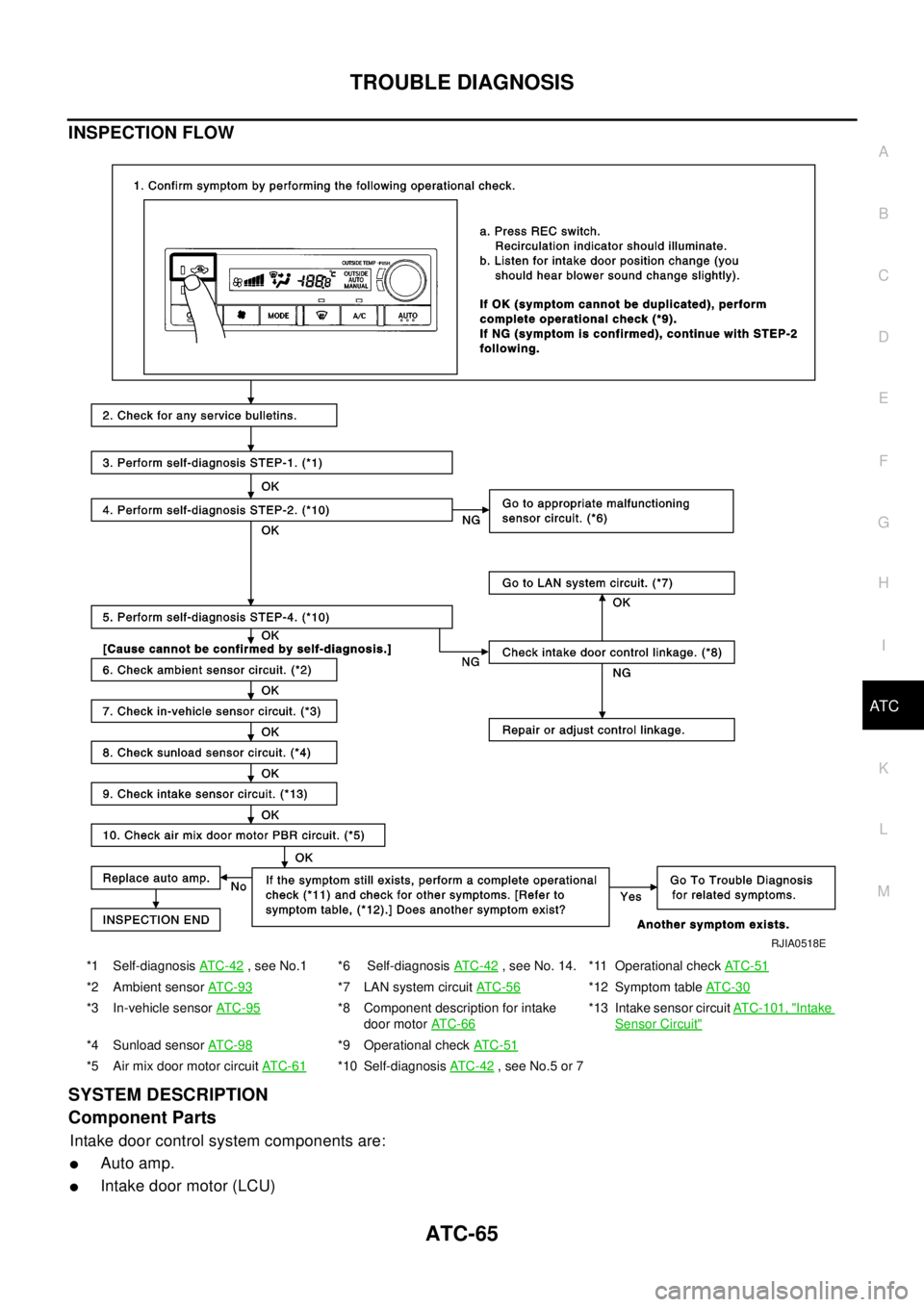
INSPECTION FLOW
SYSTEM DESCRIPTION
Component Parts
Intake door control system components are:
lAuto amp.
lIntake door motor (LCU)
*1 Self-diagnosisAT C - 4 2, see No.1 *6 Self-diagnosisAT C - 4 2, see No. 14. *11 Operational checkAT C - 5 1
*2 Ambient sensorAT C - 9 3*7 LAN system circuitAT C -5 6*12 Symptom tableAT C - 3 0
*3 In-vehicle sensorAT C - 9 5*8 Component description for intake
door motorAT C - 6 6*13 Intake sensor circuitATC-101, "Intake
Sensor Circuit"
*4 Sunload sensorAT C - 9 8*9 Operational checkAT C - 5 1
*5 Air mix door motor circuitAT C - 6 1*10 Self-diagnosisAT C - 4 2, see No.5 or 7
RJIA0518E
Page 644 of 3066
ATC-66
TROUBLE DIAGNOSIS
lA/C LAN system (PBR built-in air mix door motor, mode door motor and intake door motor)
lIn-vehicle sensor
lAmbient sensor
lSunload sensor
lIntake sensor
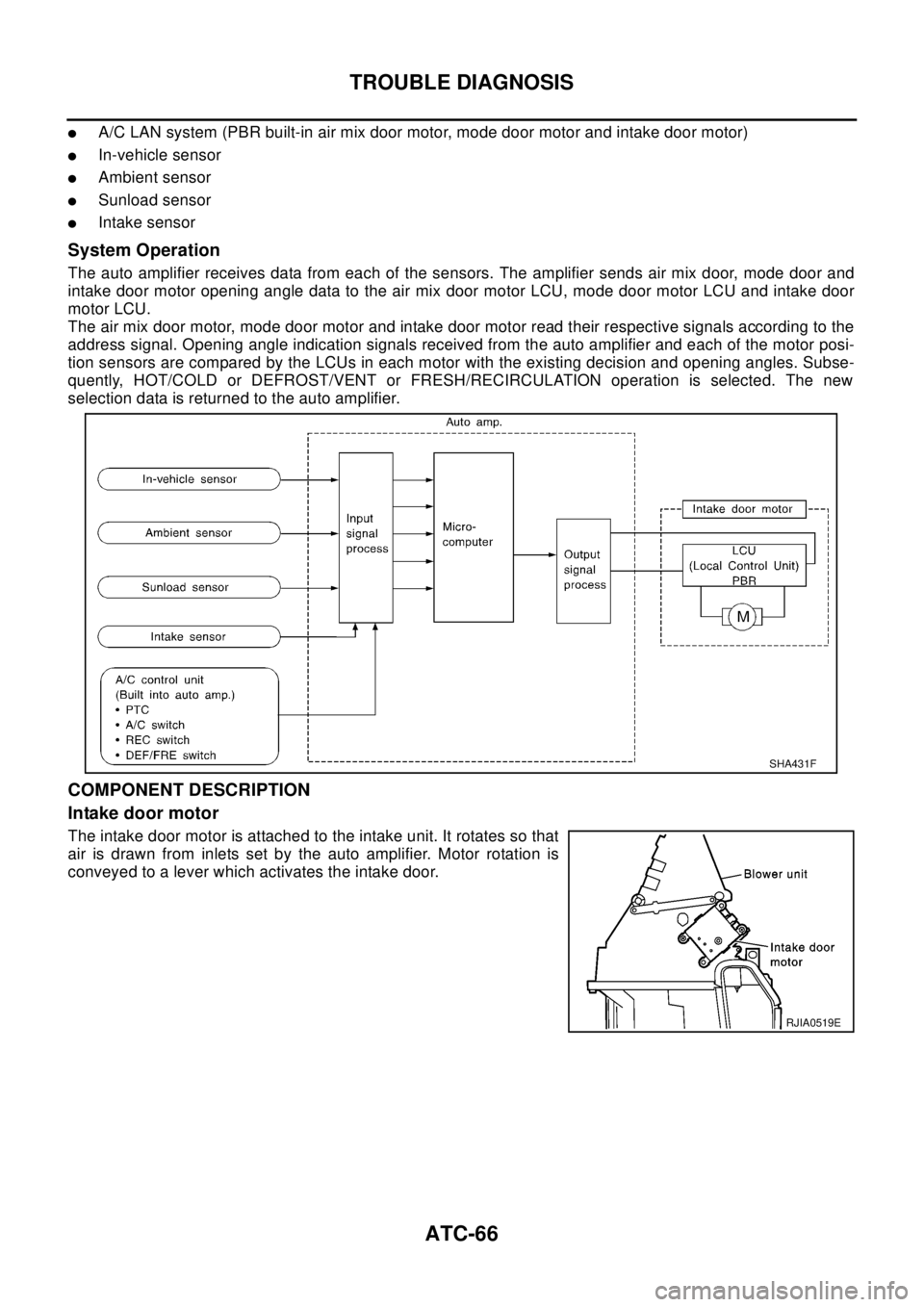
System Operation
The auto amplifier receives data from each of the sensors. The amplifier sends air mix door, mode door and
intake door motor opening angle data to the air mix door motor LCU, mode door motor LCU and intake door
motor LCU.
The air mix door motor, mode door motor and intake door motor read their respective signals according to the
address signal. Opening angle indication signals received from the auto amplifier and each of the motor posi-
tion sensors are compared by the LCUs in each motor with the existing decision and opening angles. Subse-
quently, HOT/COLD or DEFROST/VENT or FRESH/RECIRCULATION operation is selected. The new
selection data is returned to the auto amplifier.
COMPONENT DESCRIPTION
Intake door motor
The intake door motor is attached to the intake unit. It rotates so that
air is drawn from inlets set by the auto amplifier. Motor rotation is
conveyed to a lever which activates the intake door.
SHA431F
RJIA0519E
Page 646 of 3066
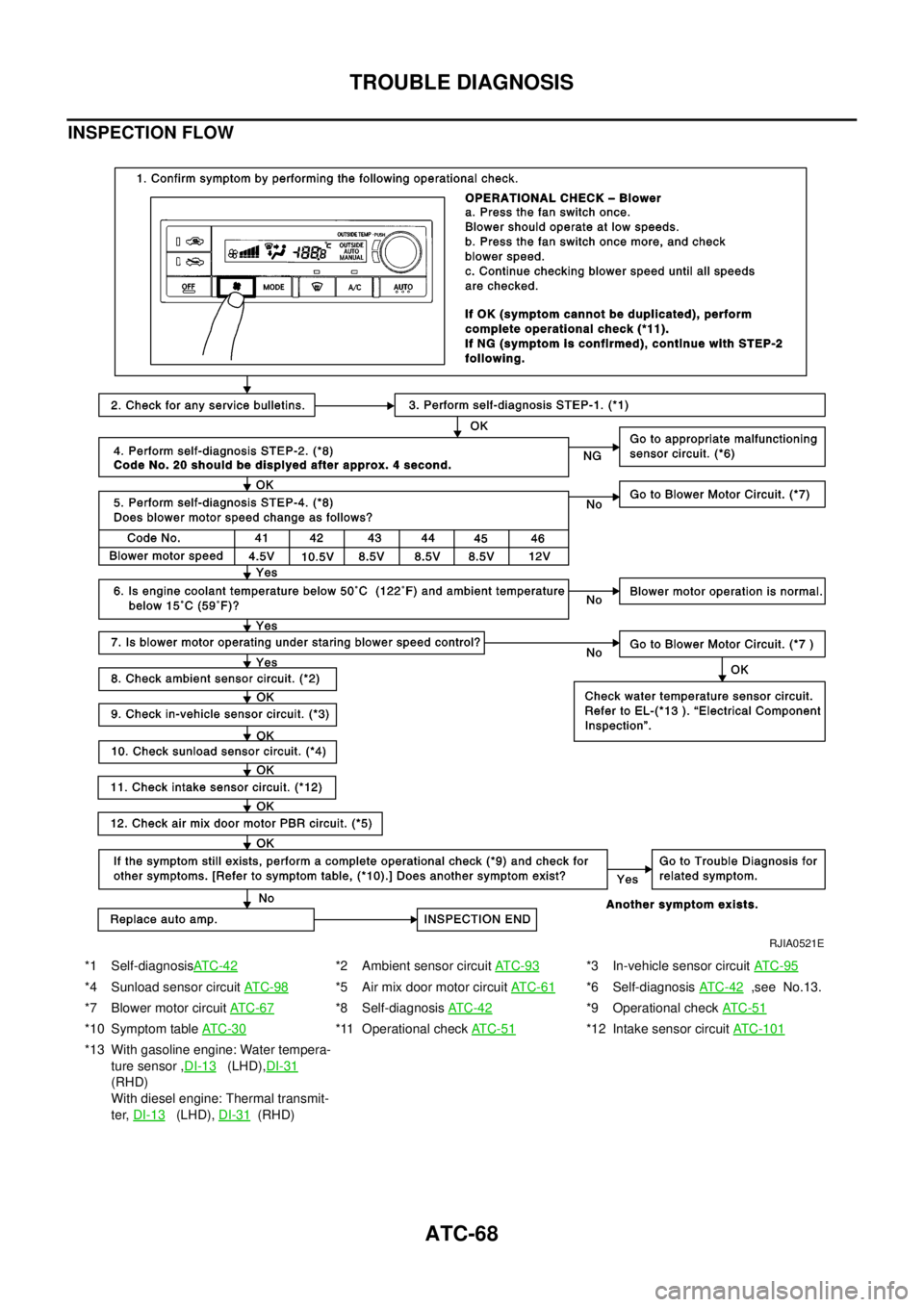
ATC-68
TROUBLE DIAGNOSIS
INSPECTION FLOW
*1 Self-diagnosisAT C -4 2*2 Ambient sensor circuitAT C - 9 3*3 In-vehicle sensor circuitAT C - 9 5
*4 Sunload sensor circuitAT C - 9 8*5 Air mix door motor circuitAT C - 6 1*6 Self-diagnosisAT C - 4 2,see No.13.
*7 Blower motor circuitAT C -6 7
*8 Self-diagnosisAT C -4 2*9 Operational checkAT C -5 1
*10 Symptom tableAT C -3 0*11 Operational checkAT C - 5 1*12 Intake sensor circuitATC-101
*13 With gasoline engine: Water tempera-
ture sensor ,DI-13
(LHD),DI-31
(RHD)
With diesel engine: Thermal transmit-
ter,DI-13
(LHD),DI-31(RHD)
RJIA0521E
Page 647 of 3066
TROUBLE DIAGNOSIS
ATC-69
C
D
E
F
G
H
I
K
L
MA
B
AT C
SYSTEM DESCRIPTION
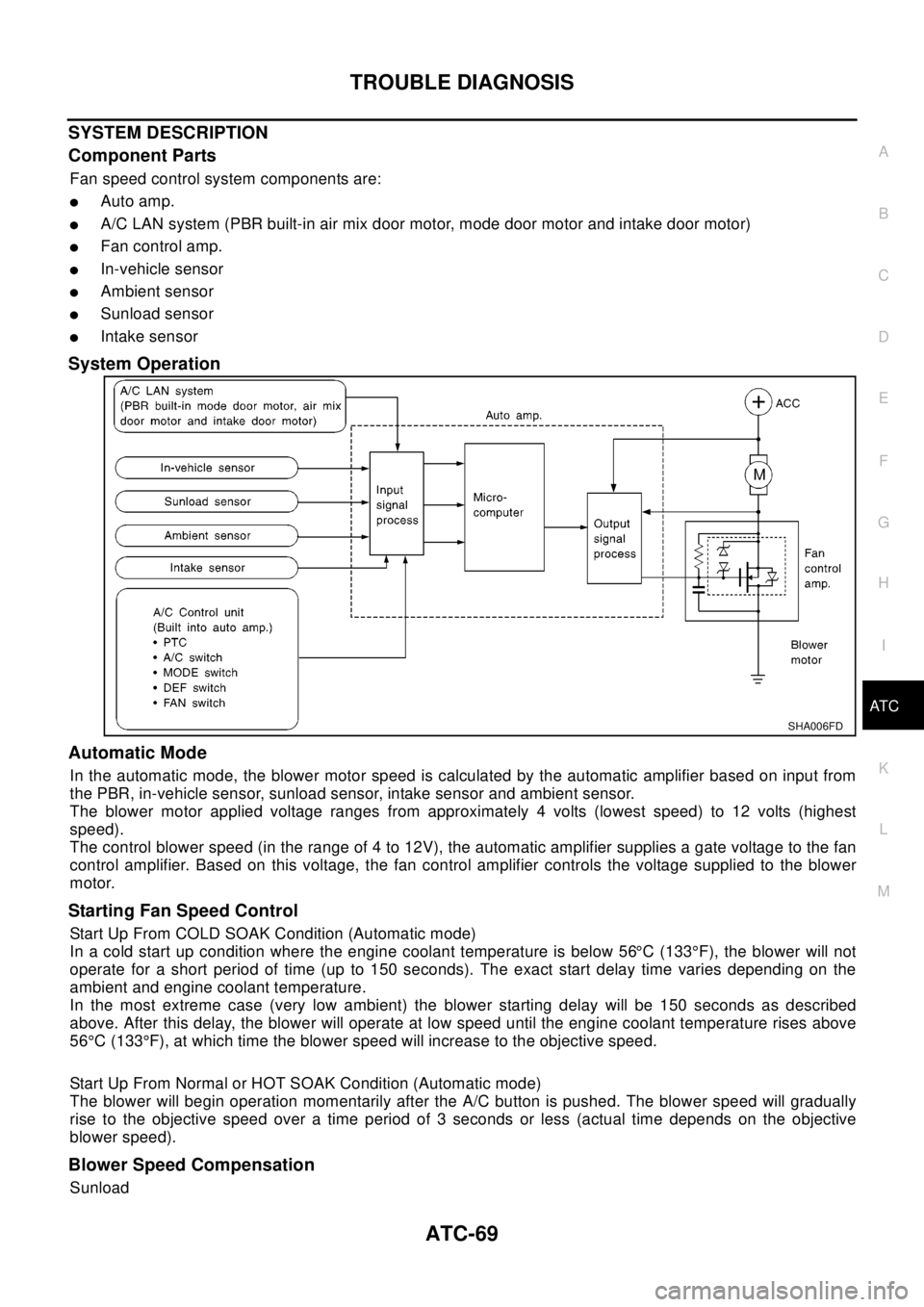
Component Parts
Fan speed control system components are:
lAuto amp.
lA/C LAN system (PBR built-in air mix door motor, mode door motor and intake door motor)
lFan control amp.
lIn-vehicle sensor
lAmbient sensor
lSunload sensor
lIntake sensor
System Operation
Automatic Mode
In the automatic mode, the blower motor speed is calculated by the automatic amplifier based on input from
the PBR, in-vehicle sensor, sunload sensor, intake sensor and ambient sensor.
The blower motor applied voltage ranges from approximately 4 volts (lowest speed) to 12 volts (highest
speed).
The control blower speed (in the range of 4 to 12V), the automatic amplifier supplies a gate voltage to the fan
control amplifier. Based on this voltage, the fan control amplifier controls the voltage supplied to the blower
motor.
Starting Fan Speed Control
Start Up From COLD SOAK Condition (Automatic mode)
In a cold start up condition where the engine coolant temperature is below 56°C (133°F), the blower will not
operate for a short period of time (up to 150 seconds). The exact start delay time varies depending on the
ambient and engine coolant temperature.
In the most extreme case (very low ambient) the blower starting delay will be 150 seconds as described
above. After this delay, the blower will operate at low speed until the engine coolant temperature rises above
56°C (133°F), at which time the blower speed will increase to the objective speed.
Start Up From Normal or HOT SOAK Condition (Automatic mode)
The blower will begin operation momentarily after the A/C button is pushed. The blower speed will gradually
rise to the objective speed over a time period of 3 seconds or less (actual time depends on the objective
blower speed).
Blower Speed Compensation
Sunload
SHA006FD