lock Oldsmobile Cutlass Supreme 1993 s Owner's Guide
[x] Cancel search | Manufacturer: OLDSMOBILE, Model Year: 1993, Model line: Cutlass Supreme, Model: Oldsmobile Cutlass Supreme 1993Pages: 340, PDF Size: 16.21 MB
Page 141 of 340
Part 4
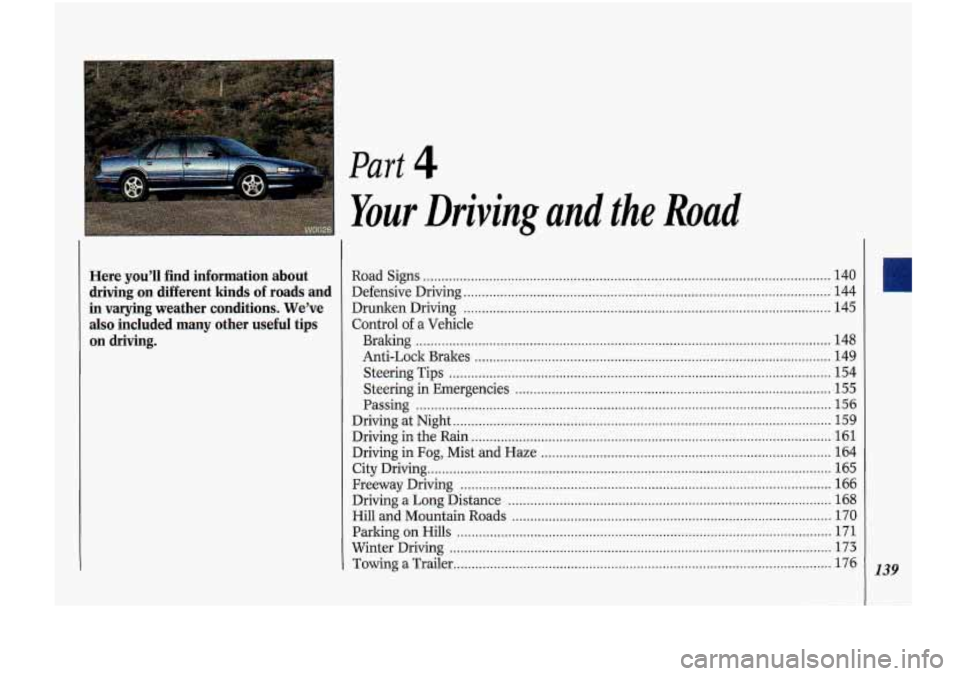
Here you’ll find information about driving on different kinds of roads and
in varying weather conditions
. We’ve
also included many other useful tips
on driving
.
Your Driving and the Road
Road Signs ........................................................................\
....................................... 140
Defensive Driving
........................................................................\
............................ 144
Drunken Driving
........................................................................\
............................ 145
Control of a Vehicle
Braking
........................................................................\
......................................... 148
Anti-Lock Brakes ........................................................................\
......................... 149
Steering Tips
........................................................................\
................................ 154
Steering in Emergencies
........................................................................\
.............. 155
Driving at Night
........................................................................\
............................... 159
Driving in the Rain
........................................................................\
.......................... 161
Passing ........................................................................\
......................................... 156
Driving in Fog, Mist and Haze
........................................................................\
....... 164
City Drmng
........................................................................\
...................................... 165 ..
Freeway Driving ........................................................................\
............................. 166
Driving a Long Distance ........................................................................\
................ 168
Hill and Mountain Roads ........................................................................\
............... 170
Winter Driving
........................................................................\
................................ 173
Parking
on Hills ........................................................................\
.............................. 171
Towing a Trailer
........................................................................\
............................... 176 139
Page 151 of 340
If you keep pace with the tr&c and
allow realistic following distances, you
will eliminate a lot of unnecessary
braking. That means better braking and
longer brake life.
If your engine ever stops while you’re
driving, brake normally but don’t
pump your brakes.
If you do, the
pedal may get harder to push down. If
your engine stops, you will still have
some power brake assist. But you will
use it when you brake. Once the
power assist is used up, it may take
longer to stop and the brake pedal will
be harder to push.
Anti-Lock Brakes (ABS) (OPTION)
If your Oldsmobile has this system, it
has an advanced electronic braking
system that
will help prevent skidding.
If you have an anti-lock brake system
(ABS), the brake pedal will say
so.
Page 152 of 340
Your Driving and the Road
150
Anti-Lock Brakes (CONT.)
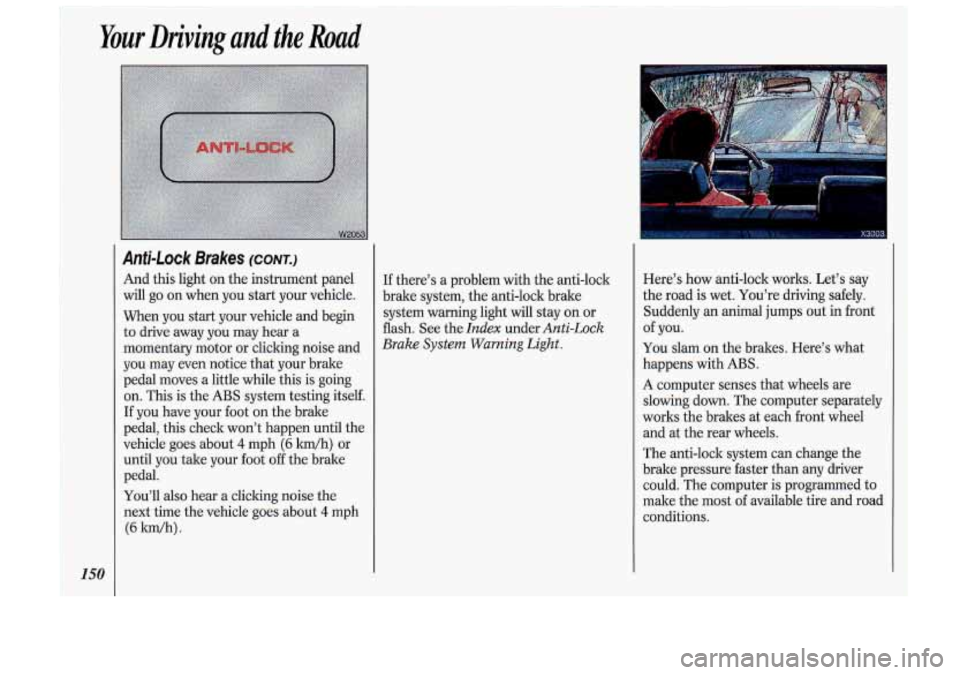
And this light on the instrument panel
will go on when you start your vehicle.
When you start your vehicle and begin
to drive away you may hear a
momentary motor or clicking noise and
you may even notice that your brake
pedal moves a little while this is going
on. This is the
ABS system testing itself.
If you have your foot on the brake
pedal, this check won’t happen until the
vehicle goes about
4 mph (6 lm/h) or
until you take your foot off the brake
pedal.
You’ll also hear a clicking noise the
next time the vehicle goes about
4 mph
(6 lun/h).
If there’s a problem with the anti-lock
brake system, the anti-lock brake
system warning light will stay on or
flash. See the
Index under Anti-Lock
Brake System Warning Light.
Here’s how anti-lock works. Let’s say
the road is wet. You’re driving safely.
Suddenly an animal jumps out in front
of you.
You slam on the brakes. Here’s what
happens with
ABS.
A computer senses that wheels are
slowing down. The computer separately
works the brakes at each front wheel
and at the rear wheels.
The anti-lock system can change the
brake pressure faster than any driver
could. The computer is programmed to
make the most of available tire and road
conditions.
Page 153 of 340
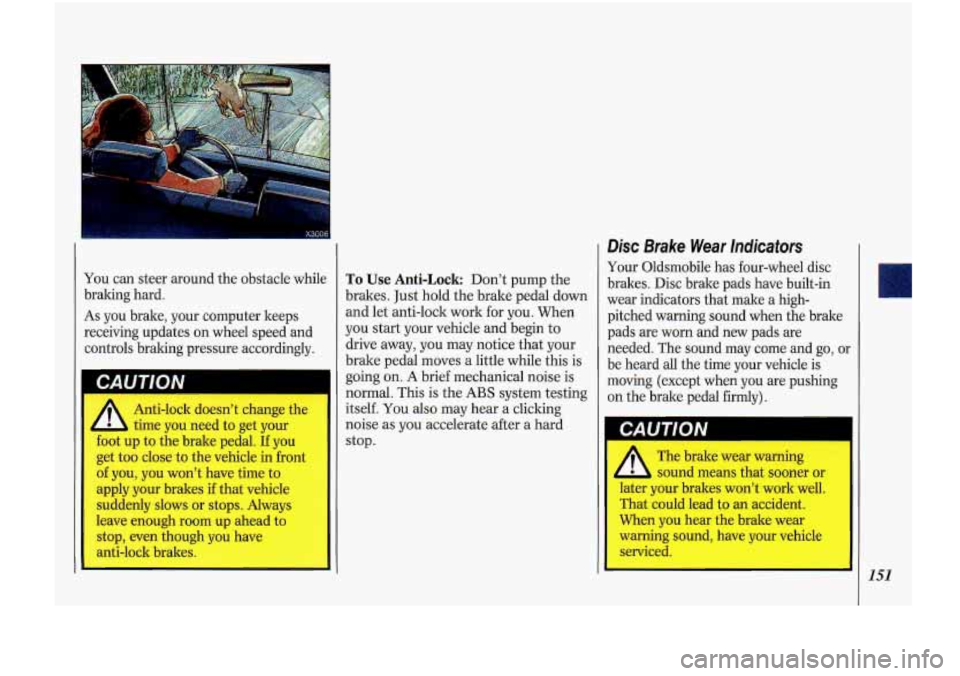
You can steer around the obstacle while
braking hard.
As you brake, your computer keeps
receiving updates on wheel speed and
controls braking pressure accordingly.
CAUTION
Anti-lock doesn’t change the
time you need to get your
foot up to the brake pedal.
If you
get too close to the vehicle in front
of you, you won’t have time to
apply your brakes if that vehicle
suddenly slows or stops. Always
leave enough room up ahead
to
stop, even though you have
anti-lock brakes.
To Use Anti-Lock: Don’t pump the
brakes. Just hold the brake pedal down
and let anti-lock work for you. When
you start your vehicle and begin to
drive away, you may notice that your
brake pedal moves a little while this is
going on. A brief mechanical noise is
normal. This is the
ABS system testing
itself.
You also may hear a clicking
noise as
you accelerate after a hard
stop.
Disc Brake Wear lndicafors
Your Oldsmobile has four-wheel disc
brakes. Disc brake pads have built-in
wear indicators that make a high-
pitched warning sound when the brake
pads are worn and new pads are
needed. The sound may come and go, or
be heard all the time your vehicle
is
moving (except when you are pushing
on the brake pedal firmly).
3
ne Ibr&eUrw walmhg
sound mans that sooner or
I later yaur hdes won’t work weU.
mt could llead to an accident.
hen you hear the brake wm
-l
1:
1
I 151
Page 156 of 340
Your Driving ad the Road
Steering Tips-Driving on Curves
154
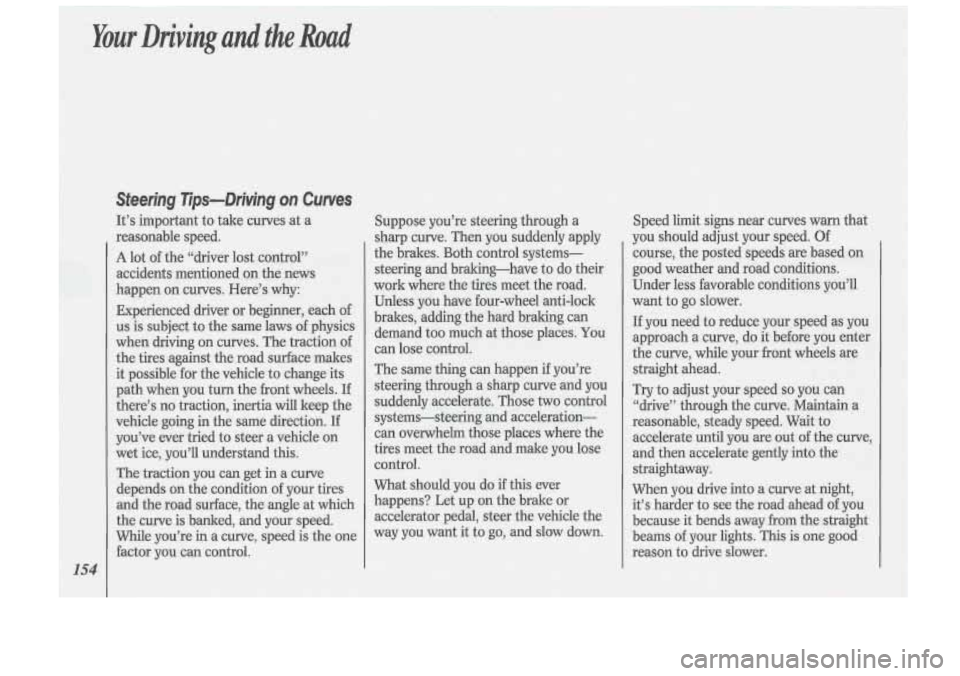
It’s important to take curves at a
reasonable speed.
A lot of the “driver lost control”
accidents mentioned on the news
happen on curves. Here’s why:
Experienced driver or beginner, each of
us is subject
to the same jaws of physics
when driving on curves. The traction of
the tires against the road surface makes
it possible
for the vehicle to change its
path when you turn the front wheels. If
there’s no traction, inertia will keep the
vehicle going in the same direction. If
you’ve ever tried to steer a vehicle on
wet ice, you’ll understand this.
The traction you can get in a curve
depends on the condition of your tires
and the road surface, the angle at which
the curve is banlted, and your speed.
While you’re in a curve, speed is the one
factor you can control. Suppose
you’re steering through a
sharp curve. Then you suddenly apply
the brakes. Both control systems-
steering and braking-have to do their
work where the tires meet the road.
Unless you have four-wheel anti-lock
brakes, adding the hard braking can
demand too much at those places.
You
can lose control.
The same thing can happen if you’re
steering through a sharp curve and you
suddenly accelerate. Those two control
systems-steering and acceleration-
can overwhelm those places where the
tires meet the road and make you lose
control.
What should you do if this ever
happens? Let up on the brake or
accelerator pedal, steer the vehicle the
way you want it to go, and slow down. Speed limit signs
near curves warn that
you should adjust your speed. Of
course, the posted speeds are based on
good weather and road conditions.
Under less favorable conditions you’ll
want
to go slower.
If you need to reduce your speed as you
approach a curve, do it before you enter
the curve, while your front wheels are
straight ahead.
Try to adjust your speed
so you can
“drive” through the curve. Maintain a
reasonable, steady speed. Wait to
accelerate until you are out
of the curve,
and then accelerate gently into the
straightaway.
When you drive into a curve at night,
it’s harder
to see the road ahead of you
because it bends away from the straight
beams of your lights. This is one good
reason to drive slower.
Page 157 of 340
I Steering in Emergencies
There are times when steering can be
more effective than braking. For
example, you come over a hill and find
a truck stopped
in your lane, or a car
suddenly pulls out from nowhere,
or a
child darts out from between parked
cars and stops right in front of
you. You
can avoid these problems by braking-if
you can stop in time. But sometimes
you can’t; there isn’t room. That’s the
time for evasive action-steering
around the problem.
Your Oldsmobile can perform very well
in emergencies like these. First apply
your brakes-but unless you have anti-
lock, not enough to lock your wheels. It is
better to remove as much speed as
you can from a possible collision. Then
steer around the problem, to the left or
right depending on the space available.
An emergency like this requires close
attention and a quick decision. If you
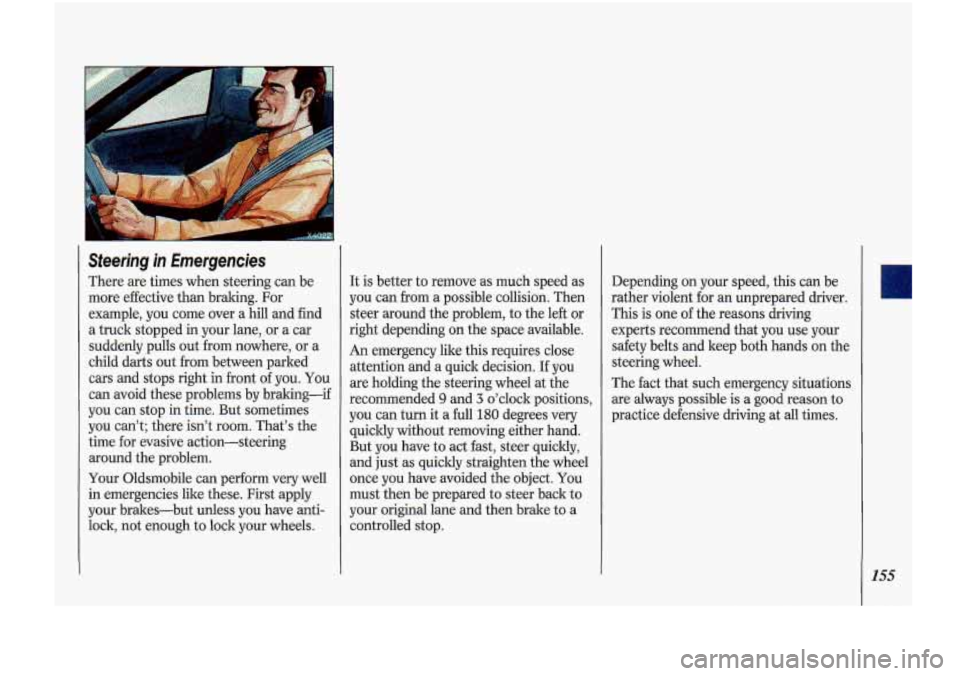
are holding the steering wheel at the
recommended
9 and 3 o’clock positions,
you can turn it a full
180 degrees very
quicldy without removing either hand.
But you have to act fast, steer quickly,
and just as quickly straighten the wheel
once you have avoided the object. You
must then be prepared to steer back to
your original lane and then brake to a
controlled stop. Depending
on your speed, this can be
rather violent for an unprepared driver.
This is one of the reasons driving
experts recommend that you use your
safety belts and keep both hands on the
steering wheel.
The fact that such emergency situations
are always possible is
a good reason to
practice defensive driving at all times.
155
Page 161 of 340
cause the tires to slide. You may not
realize the surface is slippery until your
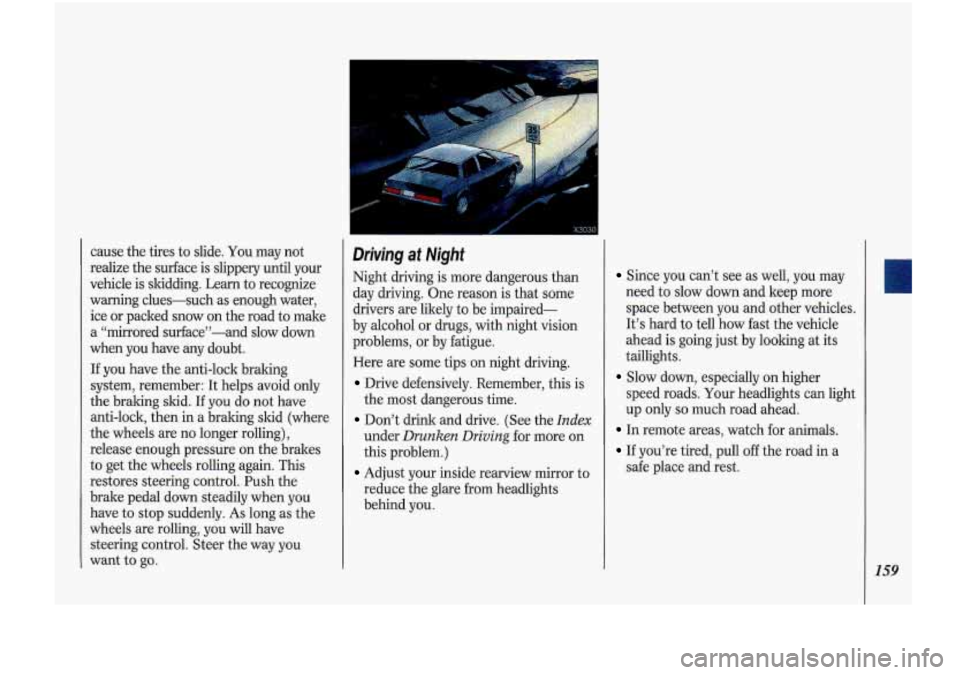
vehicle is skidding. Learn to recognize
warning clues-such as enough water,
ice or packed snow on the road to make
a “mirrored surface”-and slow down
when you have any doubt.
If you have the anti-lock braking
system, remember: It helps avoid only
the braking skid.
If you do not have
anti-lock, then in a braking skid (where
the wheels are no longer rolling),
release enough pressure on the brakes
to get the wheels rolling again. This
restores steering control. Push the
brake pedal down steadily when you
have to stop suddenly. As long as the
wheels are rolling, you will have
steering control. Steer the way you
want to go.
I .@ i 7“
Driving at Night
Night driving is more dangerous than
day driving. One reason is that some
drivers are likely to be impaired-
by alcohol or drugs, with night vision
problems, or by fatigue.
Here are some tips on night driving.
Drive defensively. Remember, this is
the most dangerous time.
Don’t drink and drive. (See the Index
under Drunken Driving for more on
this problem.)
Adjust your inside rearview mirror to
reduce the glare from headlights
behind you.
Since you can’t see as well, you may
need to slow down and keep more
space between you and other vehicles.
It’s hard to tell how fast the vehicle
ahead is going just by looking at its
taillights.
speed roads. Your headlights can light
up only
so much road ahead.
Slow down, especially on higher
In remote areas, watch for animals.
If you’re tired, pull off the road in a
safe place and rest.
1
159
Page 162 of 340
Your Driving and the Road
140
Night Vision
No one can see as well at night as in the
daytime. But as we get older these
differences increase.
A 50-year-old
driver may require at least twice as
much light to see the same thing at
night as a 20-year-old.
What you do in the daytime can also
affect your night vision. For example, if
you spend the day in bright sunshine
you are wise to wear sunglasses. Your
eyes will have less trouble adjusting to
night.
But if you’re driving, don’t wear
sunglasses at night. They may cut down
on glare from headlights, but they
also
make a lot of things invisible that
should remain visible-such as parked
cars, obstacles, pedestrians, or even
trains blocking railway crossings. You
may want to put
on your sunglasses
after you have pulled into a brightly- lighted service
or refreshment area.
Eyes shielded
from that glare may
adjust more quickly to darkness back
on the road. But be sure to remove your
sunglasses before you leave the service
area.
You
can be temporarily blinded by
approaching lights. It
can take a second
or two, or even several seconds, for
your eyes to readjust to the dark. When
you are faced with severe glare (as from
a driver who doesn’t lower the high
beams, or a vehicle with misaimed
headlights), slow down a little. Avoid
staring directly into the approaching
lights. If there is a line of opposing
traffic, make occasional glances over the
line of headlights
to make certain that
one of the vehicles isn’t starting to
move into your lane. Once you are past
the bright lights, give your eyes time to
readjust before resuming speed.
High Beams
If the vehicle approaching you has its
high beams
on, signal by flicking yours
to high and then back to low beam. This
is the usual signal to lower the
headlight beams. If the other driver still
doesn’t lower the beams, resist the
temptation to put your high beams
on.
This only makes two half-blinded
drivers.
On a freeway, use your high beams only
in remote areas where you won’t impair
approaching drivers. In some places,
like cities, using high beams is illegal.
When you follow another vehicle on a
freeway or highway, use low beams.
True, most vehicles now have day-night
mirrors that enable the driver to reduce
glare. But outside mirrors are not of this
type and high beams from behind can
bother the driver ahead.
Page 182 of 340
Your Driving and the Road
If You Do Decide to Pull a Trailer
(CONT.)
The bumpers on your vehicle are not
intended for hitches.
Do not attach
rental hitches or other bumper-type
hitches to them. Use only a frame-
mounted hitch that does not attach to
the bumper.
Safety Chains
You should always attach chains
between your vehicle and your trailer.
Cross the safety chains under the
tongue of the trailer
so that the tongue
will not drop to the road
if it becomes
separated from the hitch. Instructions
about safety chains may be provided by
the hitch manufacturer or by the trailer
manufacturer. Follow the manufacturer’s
recommendation for attaching safety
chains. Always leave just enough slack
so you can turn with your rig. And,
never allow safety chains to drag on the
ground.
Trailer Brakes
If your trailer weighs more than 1,000
pounds (450 kg) loaded, then it needs
its
own brakes-and they must be
adequate.
Be sure to read and follow the
instructions for the trailer brakes
so
you’ll be able to install, adjust and
maintain them properly.
If your vehicle has anti-lock brakes,
do not try to tap into your vehicle’s
brake system. If you do, both brake
systems won’t work well, or at all.
Even if your vehicle doesn’t have anti-
lock brakes, don’t tap into your
vehicle’s brake system if the trailer’s
brake system will use more than
0.02
cubic inch (0.3 cc) of fluid from your
Page 196 of 340
Problems on the Road
194
Towing Your Oldsmobile (CONTJ
When your vehicle is being towed, have
the ignition key
off. The steering wheel
should be clamped in
a straight-ahead
position, with
a clamping device
designed for towing service. Do not use
the vehicle’s steering column lock for
this. The transaxle should be in
N (Neutral), and the parking brake
released.
Don’t have your vehicle towed on the
front wheels, unless you must. If the
vehicle must be towed on the front
wheels, don’t go more than
35 mph
(56 km/h) or farther than 50 miles
(80 lun) or your transaxle will be
damaged.
If these limits must be
exceeded, then the front wheels have to
be supported on a dolly. A vehicle can fall from a
car
secured. This can cause a collision,
serious personal injury and vehicle
damage. The vehicle should be
tightly secured with chains or steel
cables before it is transported.
Don’t use substitutes (ropes,
leather straps, canvas webbing,
etc.) that can be cut by sharp edges
underneath the towed vehicle.
/A carrier if it isn’t properly
Towing from the Front-
Vehicle Hook-up
Before hooking up to a tow truck, be
sure
to read all the information on
Towing
Your Oldsmobile earlier in this
section.
All Models
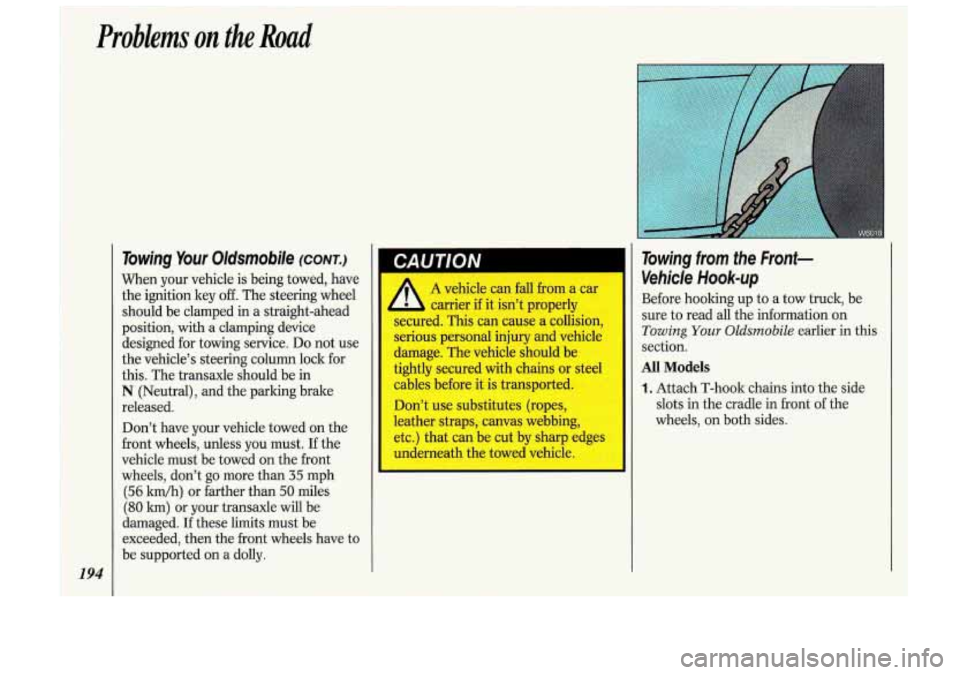
1. Attach T-hook chains into the side
slots in the cradle in front of the
wheels, on both sides.