wheel PEUGEOT 108 2015 Owner's Manual
[x] Cancel search | Manufacturer: PEUGEOT, Model Year: 2015, Model line: 108, Model: PEUGEOT 108 2015Pages: 271, PDF Size: 7.42 MB
Page 109 of 271
107
108_en_Chap07_securite_ed01-2015
the tRC and DSC systems offer
increased safety in normal driving, but
should not encourage the driver to take
extra risks or drive at high speed.
th
e correct operation of these
systems depends on observation of
the manufacturer's recommendations
regarding the wheels (tyres and rims),
the braking components, the electronic
components and the assembly and
repair procedures used by P
e
uge
Ot
dealers.
After an impact, have the system
checked by a P
e
uge
Ot
dealer or a
qualified workshop.
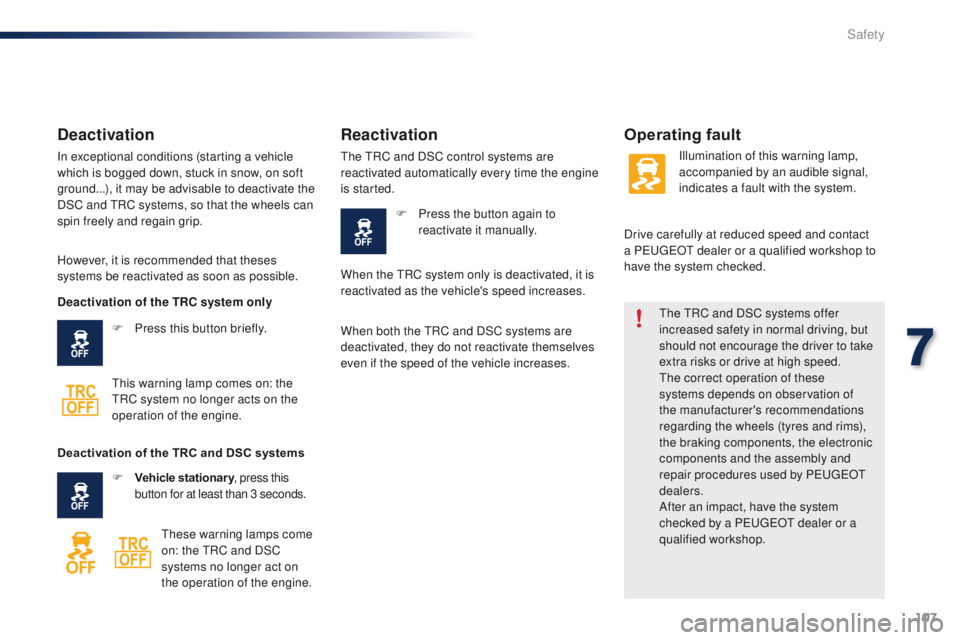
Deactivation
In exceptional conditions (starting a vehicle
which is bogged down, stuck in snow, on soft
ground...), it may be advisable to deactivate the
DSC and
t
R
C systems, so that the wheels can
spin freely and regain grip.
Operating fault
However, it is recommended that theses
systems be reactivated as soon as possible.
F
P
ress this button briefly.
th
is warning lamp comes on: the
tR
C system no longer acts on the
operation of the engine.
Reactivation
the tRC and DSC control systems are
reactivated automatically every time the engine
is started.
F
P
ress the button again to
reactivate it manually. Illumination of this warning lamp,
accompanied by an audible signal,
indicates a fault with the system.
Drive carefully at reduced speed and contact
a P
e
uge
Ot
dealer or a qualified workshop to
have the system checked.
Deactivation of the TRC system only
Deactivation of the TRC and DSC systems F
V
ehicle stationary , press this
button for at least than 3 seconds.
th
ese warning lamps come
on: the
t
R
C and DSC
systems no longer act on
the operation of the engine. When the
t
R
C system only is deactivated, it is
reactivated as the vehicle's speed increases.
When both the
t
R
C and DSC systems are
deactivated, they do not reactivate themselves
even if the speed of the vehicle increases.
7
Safety
Page 113 of 271
111
108_en_Chap07_securite_ed01-2015
Unwanted triggering of the system
It is possible for the system to detect a risk of
imminent collision and start working, in the
following conditions in particular:
-
d
etection of an object located close to the
outer edge of a bend (safety barrier, lamp
post or road sign),
-
d
etection of an object located at the top or
bottom of a steep slope,
-
d
etection of reflective objects (central
reservation...) in the road,
-
d
etection of the upper bar of a bridge or a
traffic light gantry,
-
d
etection of a vehicle on a bend travelling
in the other direction,
-
d
etection of a vehicle traveling in the other
direction, at a crossroads, when your
vehicle is turning left or right,
-
i
f the vehicle ahead of you sends up water
or snow,
-
i
f your vehicle stops very close to a wall or
other vehicles,
-
w
hen your vehicle closes rapidly on the
vehicle ahead,
-
i
f the vehicle is raised or lowered,
-
i
f the vehicle passes through a plastic curtain,
-
i
f driving through mist or smoke,
-
i
f the sensor is misaligned (following
replacement after a collision).
Never leave accumulations of snow or
any object projecting above the bonnet
or in front of the roof: this might fall into
the field of vision of the sensor and
generate a detection.
Operating limits
the system only detects vehicles
(cars, lorries)
that are stationary or moving in the same
direction as your vehicle. In difficult weather conditions (very
heavy rain, snow, fog, hail...), braking
distances increase, which can reduce
the ability of the system to avoid a
collision.
the
driver must therefore remain
particularly vigilant.
th
e system is not triggered or is interrupted if
the driver:
-
a
ccelerates strongly (even if the speed
limiter is on),
-
o
r turns the steering wheel suddenly
(avoiding manoeuvre).
Detection capability is less effective if:
-
y
ou are driving on roads with pronounced
bends and/or on roads in poor condition,
-
y
our vehicle is excessively loaded, as
this changes the horizontal attitude of the
vehicle. It does not detect small vehicles
(bicycles, motorcycles), pedestrians or
animals, nor non-reflective stationary
objects.
7
Safety
Page 119 of 271
117
108_en_Chap07_securite_ed01-2015
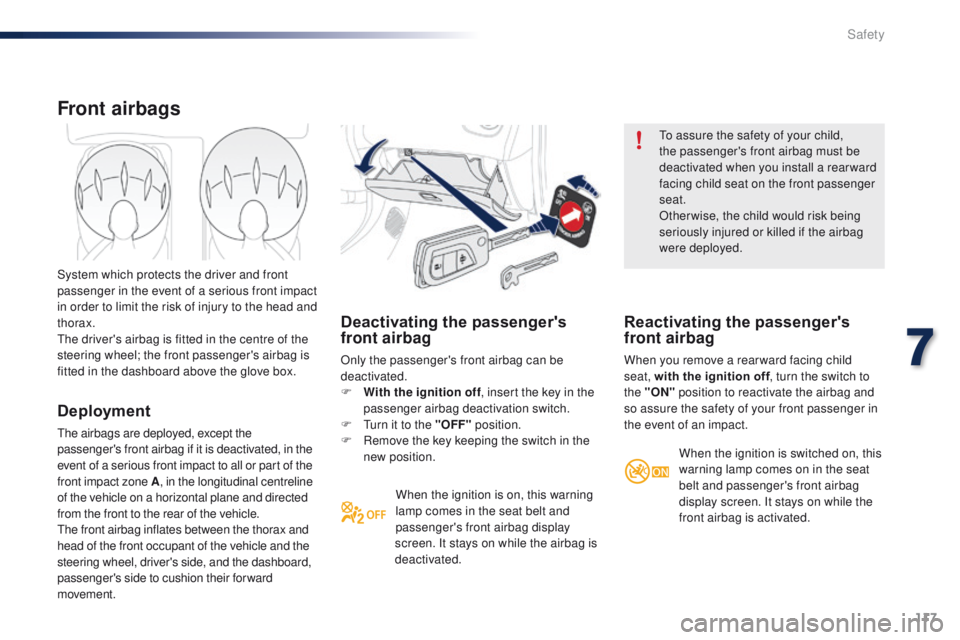
Deactivating the passenger's
front airbag
Only the passenger's front airbag can be
deactivated.
F
W
ith the ignition off , insert the key in the
passenger airbag deactivation switch.
F
t
u
rn it to the "OFF" position.
F
R
emove the key keeping the switch in the
new position.
When the ignition is on, this warning
lamp comes in the seat belt and
passenger's front airbag display
screen. It stays on while the airbag is
deactivated.
to a
ssure the safety of your child,
the passenger's front airbag must be
deactivated when you install a rear ward
facing child seat on the front passenger
seat.
Otherwise, the child would risk being
seriously injured or killed if the airbag
were deployed.
Reactivating the passenger's
front airbag
When you remove a rear ward facing child
seat, with the ignition off , turn the switch to
the
"ON" position to reactivate the airbag and
so assure the safety of your front passenger in
the event of an impact.
Front airbags
Deployment
the airbags are deployed, except the
passenger's front airbag if it is deactivated, in the
event of a serious front impact to all or part of the
front impact zone A , in the longitudinal centreline
of the vehicle on a horizontal plane and directed
from the front to the rear of the vehicle.
th
e front airbag inflates between the thorax and
head of the front occupant of the vehicle and the
steering wheel, driver's side, and the dashboard,
passenger's side to cushion their forward
movement. System which protects the driver and front
passenger in the event of a serious front impact
in order to limit the risk of injury to the head and
thorax.
th
e driver's airbag is fitted in the centre of the
steering wheel; the front passenger's airbag is
fitted in the dashboard above the glove box.
When the ignition is switched on, this
warning lamp comes on in the seat
belt and passenger's front airbag
display screen. It stays on while the
front airbag is activated.
7
Safety
Page 122 of 271
120
108_en_Chap07_securite_ed01-2015
Sit in a normal upright position.
Wear a correctly adjusted seat belt.
Do not leave anything between the
occupants and the airbags (a child, pet,
object...), nor fix or attach anything close to
the inflation trajectory of the airbags; this
could cause injuries during their deployment.
Never modify the original definition of your
vehicle, particularly in the area directly
around the airbags.
After an accident or if the vehicle has been
stolen or broken into, have the airbag
systems checked.
All work on the airbag system must be
carried out by a P
e
uge
Ot
dealer or a
qualified workshop.
ev
en if all of the precautions mentioned
are observed, a risk of injury or of minor
burns to the head, chest or arms when an
airbag is deployed cannot be ruled out.
t
h
e
bag inflates almost instantly (within a few
milliseconds) then deflates within the same
time discharging the hot gas via openings
provided for this purpose.Front airbags
Do not drive holding the steering wheel by its
spokes or resting your hands on the centre
part of the wheel.
Passengers must not place their feet on the
dashboard.
Do not smoke as deployment of the airbags
can cause burns or the risk of injury from a
cigarette or pipe.
Never remove or pierce the steering wheel or
hit it violently.
Do not fit or attach anything to the steering
wheel or dashboard, this could cause
injuries with deployment of the airbags.
For the airbags to be fully effective, observe the following safety rules:
Lateral airbags
use only approved covers on the seats,
compatible with the deployment the lateral
airbags. For information on the range of seat
covers suitable for your vehicle, you can
contact a P
e
uge
Ot
dealer.
Refer to the "Accessories" section.
Do not fix or attach anything to the seat
backs (clothing...).
t
h
is could cause injury
to the chest or arms if the lateral airbag is
deployed.
Do not sit with the upper part of the body any
nearer to the door than necessary.
Curtain airbags
Do not fix or attach anything to the roof. th is
could cause injury to the head if the curtain
airbag is deployed.
If fitted on your vehicle, do not remove the
grab handles installed on the roof, they play
a part in securing the curtain airbags.
Safety
Page 140 of 271
138
108_en_Chap09_info-pratiques_ed01-2015
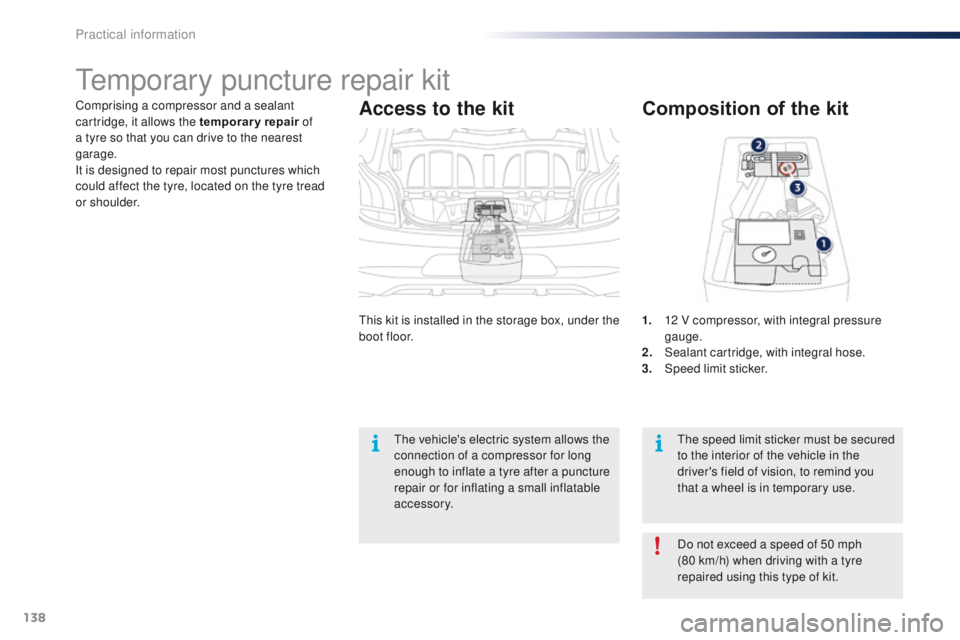
Comprising a compressor and a sealant
cartridge, it allows the temporary repair of
a tyre so that you can drive to the nearest
garage.
It is designed to repair most punctures which
could affect the tyre, located on the tyre tread
or shoulder.
temporary puncture repair kit
Composition of the kit
1. 12 V compressor, with integral pressure gauge.
2.
S
ealant cartridge, with integral hose.
3.
Spe
ed limit sticker.
th
e speed limit sticker must be secured
to the interior of the vehicle in the
driver's field of vision, to remind you
that a wheel is in temporary use.th
is kit is installed in the storage box, under the
boot floor.
th
e vehicle's electric system allows the
connection of a compressor for long
enough to inflate a tyre after a puncture
repair or for inflating a small inflatable
accessory.
Do not exceed a speed of 50 mph
(80
km/h) when driving with a tyre
repaired using this type of kit.
Access to the kit
Practical information
Page 145 of 271
143
108_en_Chap09_info-pratiques_ed01-2015
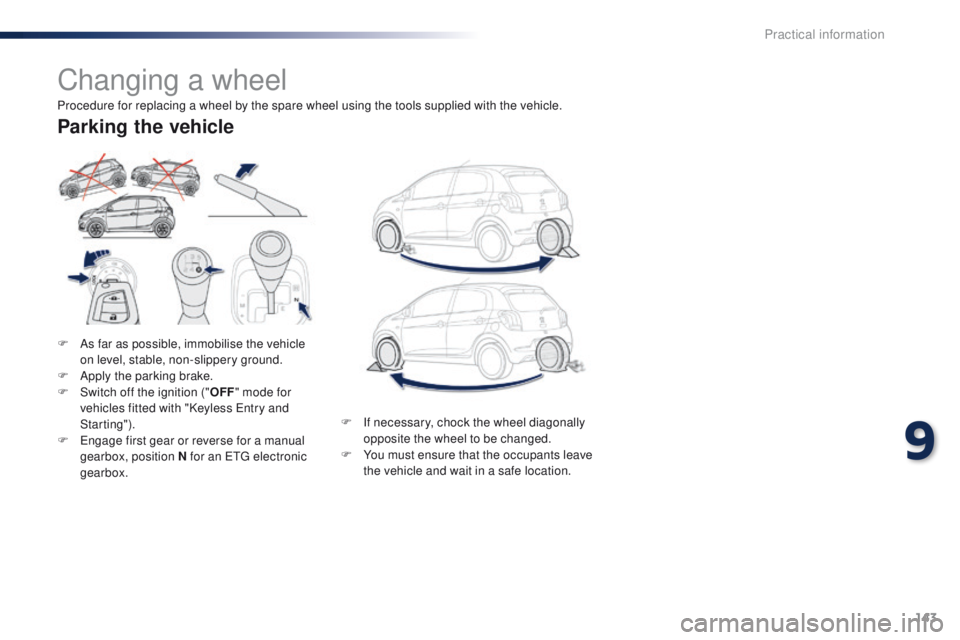
Changing a wheel
F As far as possible, immobilise the vehicle on level, stable, non-slippery ground.
F
A
pply the parking brake.
F
S
witch off the ignition (" OFF" mode for
vehicles fitted with "Keyless
e
n
try and
Starting").
F
e
n
gage first gear or reverse for a manual
gearbox, position N for an
etg electronic
gearbox.
Parking the vehicle
Procedure for replacing a wheel by the spare wheel using the tools supplied with the vehicle.
F
I
f necessary, chock the wheel diagonally
opposite the wheel to be changed.
F
Y
ou must ensure that the occupants leave
the vehicle and wait in a safe location.
9
Practical information
Page 146 of 271
144
108_en_Chap09_info-pratiques_ed01-2015
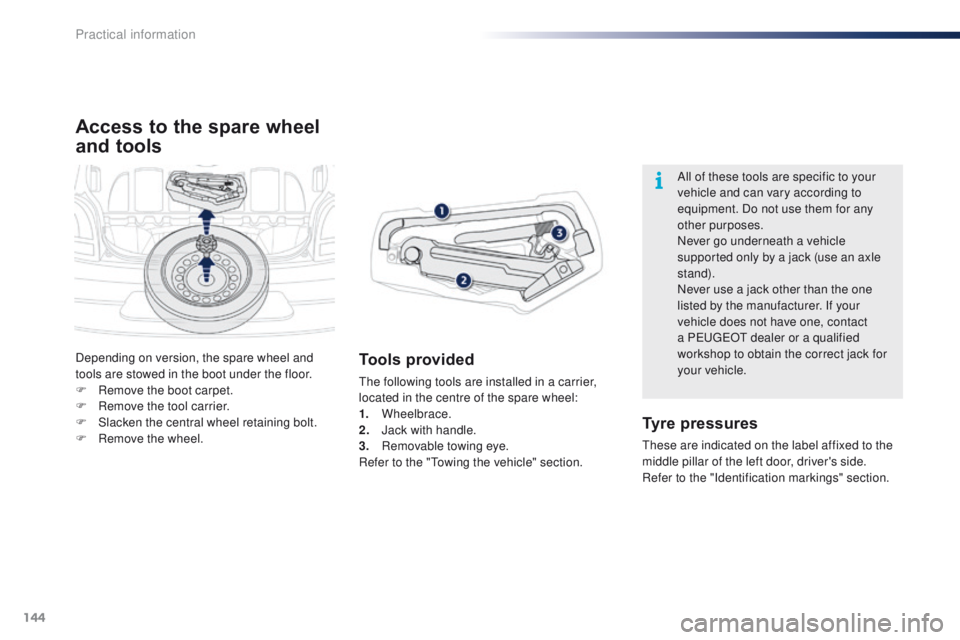
Access to the spare wheel
and tools
Tools provided
the following tools are installed in a carrier,
located in the centre of the spare wheel:
1.
Wheelbrace.
2.
J
ack with handle.
3.
R
emovable towing eye.
Refer to the "
to
wing the vehicle" section.
Tyre pressures
these are indicated on the label affixed to the
middle pillar of the left door, driver's side.
Refer to the "Identification markings" section.All of these tools are specific to your
vehicle and can vary according to
equipment. Do not use them for any
other purposes.
Never go underneath a vehicle
supported only by a jack (use an axle
stand).
Never use a jack other than the one
listed by the manufacturer. If your
vehicle does not have one, contact
a P
e
uge
Ot
dealer or a qualified
workshop to obtain the correct jack for
your vehicle.
Depending on version, the spare wheel and
tools are stowed in the boot under the floor.
F
R
emove the boot carpet.
F
R
emove the tool carrier.
F
S
lacken the central wheel retaining bolt.
F
R
emove the wheel.
Practical information
Page 147 of 271
145
108_en_Chap09_info-pratiques_ed01-2015
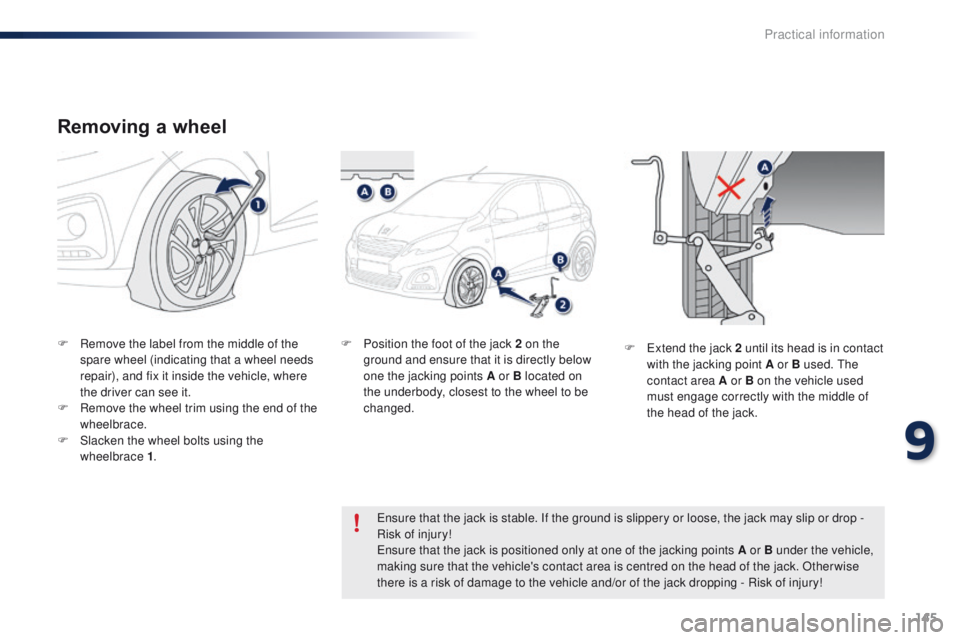
Removing a wheel
F Remove the label from the middle of the spare wheel (indicating that a wheel needs
repair), and fix it inside the vehicle, where
the driver can see it.
F
R
emove the wheel trim using the end of the
wheelbrace.
F
S
lacken the wheel bolts using the
wheelbrace 1 . F
P osition the foot of the jack 2 on the
ground and ensure that it is directly below
one the jacking points A or B located on
the underbody, closest to the wheel to be
changed.
en
sure that the jack is stable. If the ground is slippery or loose, the jack may slip or drop -
Risk of injury!
en
sure that the jack is positioned only at one of the jacking points A or B under the vehicle,
making sure that the vehicle's contact area is centred on the head of the jack. Other wise
there is a risk of damage to the vehicle and/or of the jack dropping - Risk of injury! F
ex tend the jack 2 until its head is in contact
with the jacking point A or B used.
t
h
e
contact area A or B on the vehicle used
must engage correctly with the middle of
the head of the jack.
9
Practical information
Page 148 of 271
146
108_en_Chap09_info-pratiques_ed01-2015
Fitting the "space-saver"
type spare wheel
If your vehicle is fitted with alloy wheels,
it is normal to notice when tightening
the wheel bolts that the washers do not
come into contact with the "space-
saver" type spare wheel.
t
h
e wheel is
secured by the conical contact sur face
on each bolt.
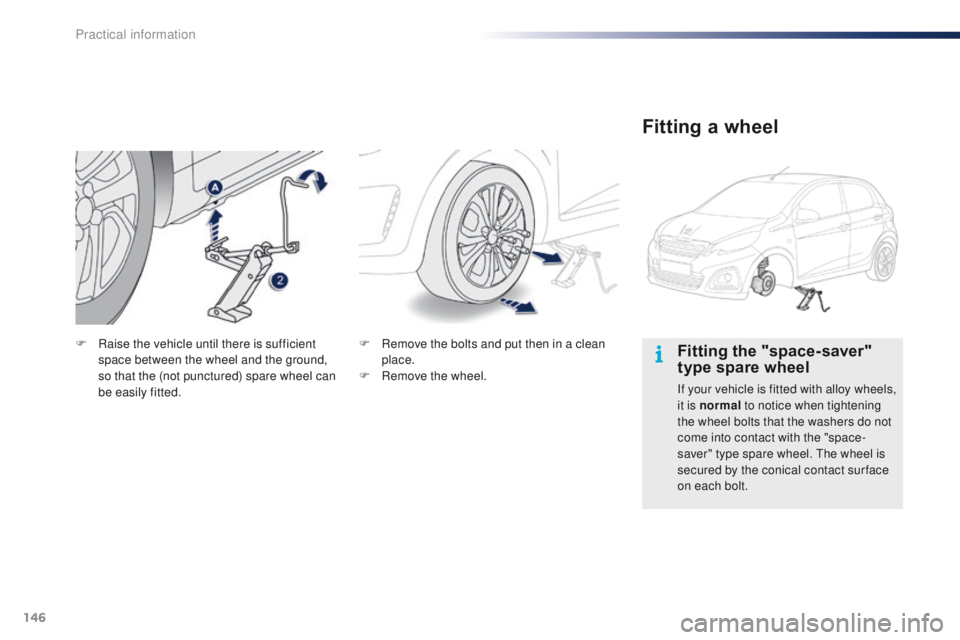
Fitting a wheel
F Remove the bolts and put then in a clean place.
F
R
emove the wheel.
F
Ra
ise the vehicle until there is sufficient
space between the wheel and the ground,
so that the (not punctured) spare wheel can
be easily fitted.
Practical information
Page 149 of 271
147
108_en_Chap09_info-pratiques_ed01-2015
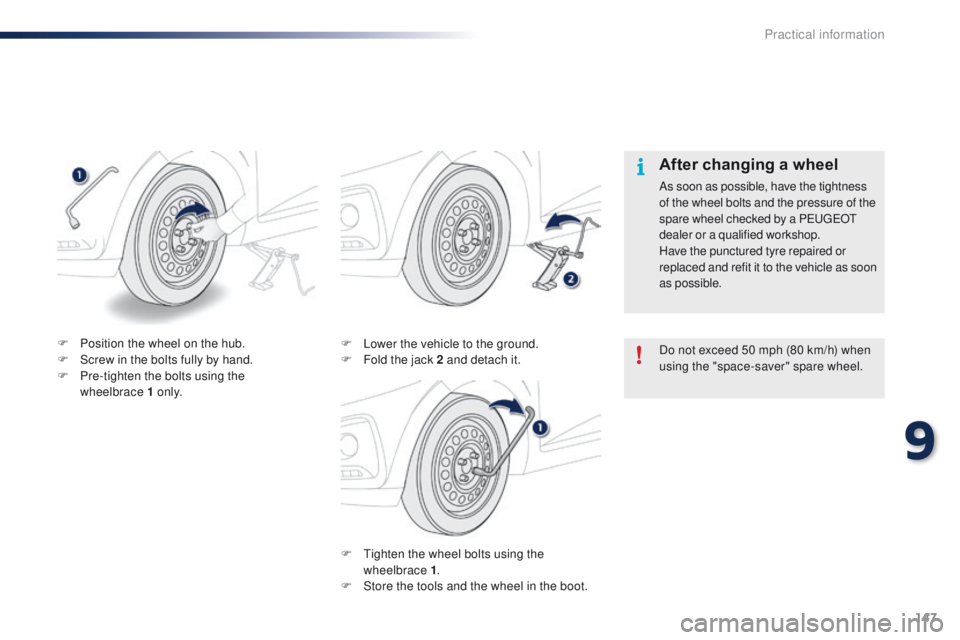
F tighten the wheel bolts using the wheelbrace 1 .
F
S
tore the tools and the wheel in the boot.
F
L
ower the vehicle to the ground.
F
F
old the jack 2 and detach it.
After changing a wheel
As soon as possible, have the tightness
of the wheel bolts and the pressure of the
spare wheel checked by a P
e
uge
Ot
d
ealer or a qualified workshop.
Have the punctured tyre repaired or
replaced and refit it to the vehicle as soon
as possible.
Do not exceed 50 mph (80 km/h) when
using the "space-saver" spare wheel.
F
P
osition the wheel on the hub.
F
S
crew in the bolts fully by hand.
F
P
re-tighten the bolts using the
wheelbrace
1 o n l y.
9
Practical information