seats Peugeot 508 2014 - RHD (UK, Australia) User Guide
[x] Cancel search | Manufacturer: PEUGEOT, Model Year: 2014, Model line: 508, Model: Peugeot 508 2014Pages: 352, PDF Size: 13.51 MB
Page 86 of 352
84
Comfort
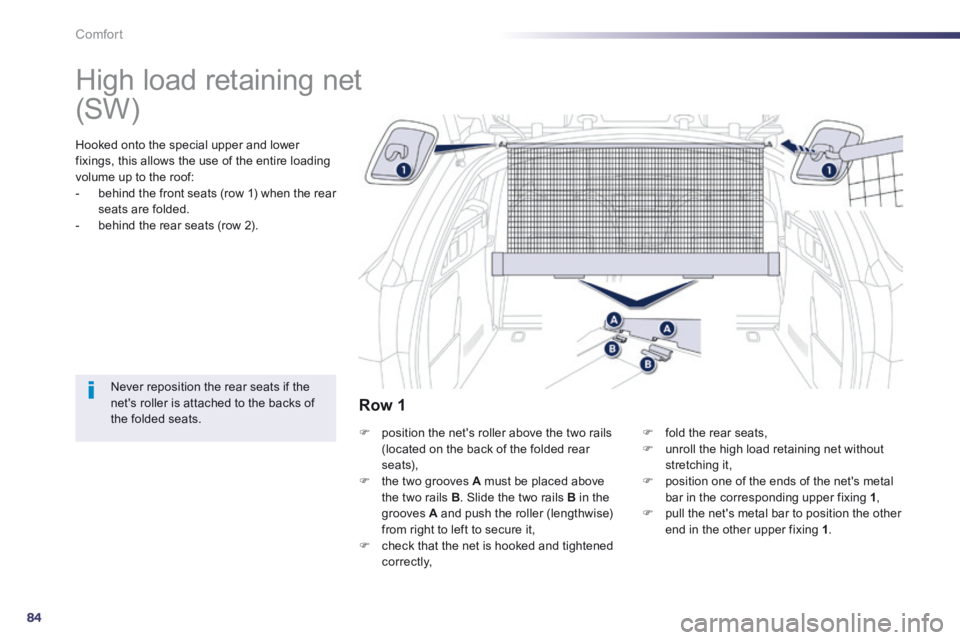
High load retaining net
Hooked onto the special upper and lower fixings, this allows the use of the entire loading volume up to the roof: - behind the front seats (row 1) when the rear seats are folded. - behind the rear seats (row 2).
Never reposition the rear seats if the net's roller is attached to the backs of the folded seats. position the net's roller above the two rails (located on the back of the folded rear seats), the two grooves A must be placed above the two rails B . Slide the two rails B in the grooves A and push the roller (lengthwise) from right to left to secure it,
check that the net is hooked and tightened c o r r e c t l y,
fold the rear seats, unroll the high load retaining net without stretching it, position one of the ends of the net's metal bar in the corresponding upper fixing 1 , pull the net's metal bar to position the other end in the other upper fixing 1 .
Row 1
(SW)
Page 155 of 352
6
153
Child safety
General points relating to child seats
For maximum safety, please observe the following recommendations: - in accordance with European regulations, all children under the age of 12 or less than one and a half metres tall must travel in approved child seats suited to their weight , on seats fitted with a seat belt or ISOFIX mountings * , - statistically, the safest seats in your vehicle for carr ying children are the rear seats, - a child weighing less than 9 kg must travel in the "rearward facing" position both in the front and in the rear.
PEUGEOT recommends that children should travel in the outer outer outerrear seats of your vehicle: - "rearwards-facing" up to the age of 2, - "forwards-facing" over the age of 2.
Although one of PEUGEOT main criteria when designing your vehicle, the safety of your children also depends on you.
* The rules for carrying children are specific to each country. Refer to the legislation in force in your country.
Page 158 of 352
156
Child safety
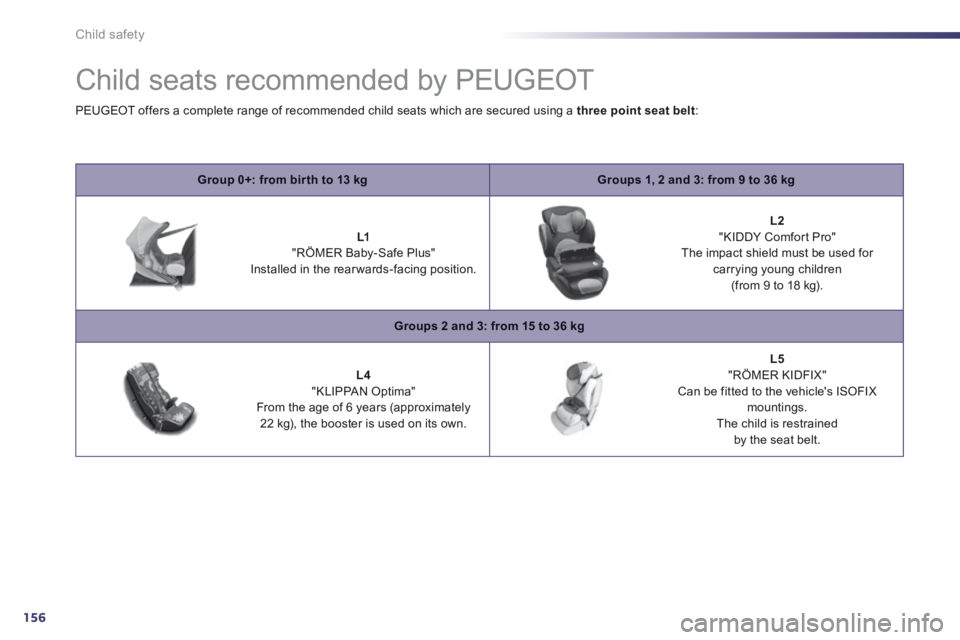
Child seats recommended by PEUGEOT
Group 0+: from bir th to 13 kgGroups 1, 2 and 3: from 9 to 36 kg
L1 "RÖMER Baby-Safe Plus" Installed in the rearwards-facing position.
L2 "KIDDY Comfort Pro" The impact shield must be used for carrying young children (from 9 to 18 kg).
Groups 2 and 3: from 15 to 36 kg
L4 "KLIPPAN Optima" From the age of 6 years (approximately 22 kg), the booster is used on its own.
L5 "RÖMER KIDFIX" Can be fitted to the vehicle's ISOFIX mountings. The child is restrained
by the seat belt.
PEUGEOT offers a complete range of recommended child seats which are secured using a three point seat belt :
Page 159 of 352
6
157. /..
Child safety
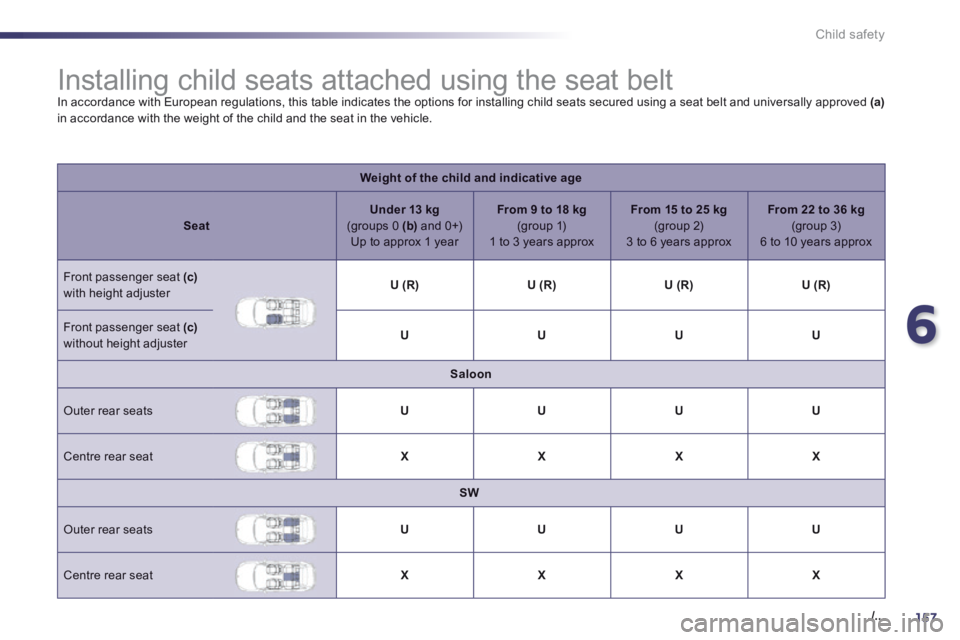
Installing child seats attached using the seat belt In accordance with European regulations, this table indicates the options for installing child seats secured using a seat belt and universally approved (a)in accordance with the weight of the child and the seat in the vehicle.
Weight of the child and indicative age
SeatUnder 13 kg (groups 0 ( b ) and 0+) Up to approx 1 year
From 9 to 18 kg (group 1) 1 to 3 years approx
From 15 to 25 kg (group 2) 3 to 6 years approx
From 22 to 36 kg (group 3) 6 to 10 years approx
Front passenger seat ( c )with height adjuster U (R)U (R)U (R)U (R)
Front passenger seat (c)without height adjuster UUUU
Saloon
Outer rear seats UUUU
Centre rear seat XXXX
SW
Outer rear seats UUUU
Centre rear seat XXXX
Page 160 of 352
158Child safety
a: universal child seat, child seat that can be installed in all vehicles using a seat belt. b: group 0, from birth to 10 kg. Shells seats and baby carriers cannot be installed in the front passenger seat. c: consult the legislation in force in your country before installing your child on this seat. U: seat suitable for the installation of a child seat secured using a seat belt and universally approved, "rear wards-facing" and/or "for wards-facing". U (R): idem U , with the vehicle's seat adjusted to the highest position and as far back as possible. X: seat position not suitable for installation of a child seat for the weight class indicated.
Page 161 of 352
6
159
Child safety
The incorrect installation of a child seat in a vehicle compromises the child's protection in the event of an accident. Remember to fasten the seat belts or the child seat harnesses keeping the slack relative to the child's body to a minimum, even for short journeys. When installing a child seat using the seat belt, ensure that the seat belt is tightened correctly on the child seat and that it secures the child seat firmly on the seat of your vehicle. If your passenger seat is adjustable, move it for wards if necessary. For optimum installation of the "forwards-facing" child seat, ensure that the back of the child seat is in contact with the back of the vehicle's seat and that the head restraint does not cause any discomfort. If the head restraint has to be removed,
ensure that it is stored or attached securely to prevent it from being thrown around the vehicle in the event of sharp braking.
Advice on child seats
As a safety precaution, do not leave: - a child or children alone and unsupervised in a vehicle, - a child or an animal in a vehicle which is exposed to the sun, with the windows closed, - the keys within reach of children inside the vehicle. To prevent accidental opening of the doors and rear windows, use the "Child lock". Take care not to open the rear windows by more than one third. To protect young children from the rays of the sun, fit side blinds on the rear windows.
Children under the age of 10 must not travel in the "for wards-facing" position on the front passenger seat, unless the rear seats are already occupied by other children, cannot be used or are absent. Deactivate the passenger airbag when a "rear wards-facing" child seat is installed on the front seat. Otherwise, the child would risk being seriously injured or killed if the airbag were to inflate.
Installing a booster seat
The chest part of the seat belt must be positioned on the child's shoulder without touching the neck. Ensure that the lap part of the seat belt passes correctly over the child's thighs. PEUGEOT recommends the use of a booster seat which has a back, fitted with a seat belt guide at shoulder level.
Page 162 of 352
160
!
Child safety
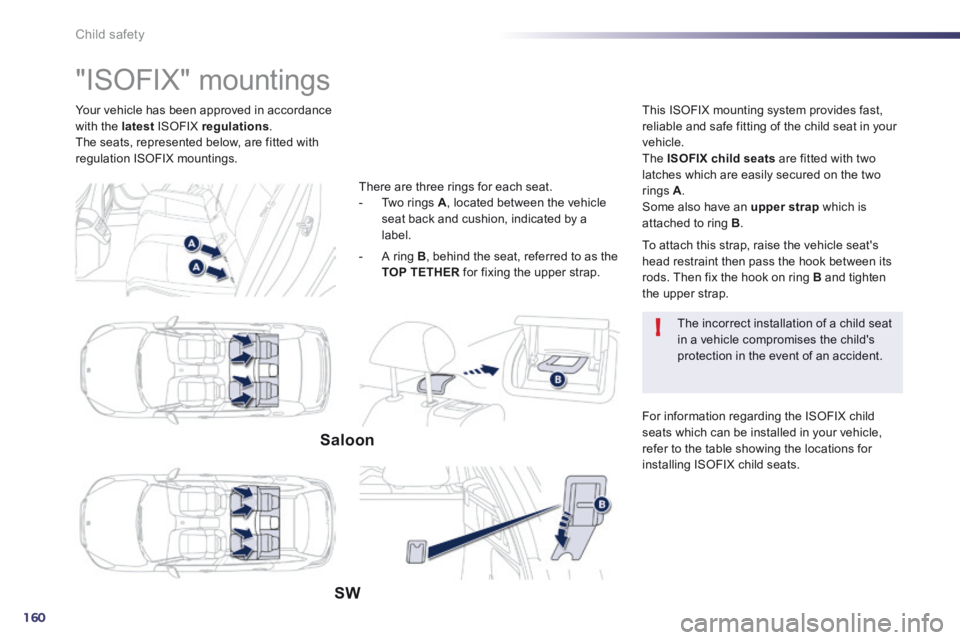
Your vehicle has been approved in accordance with the latest ISOFIX regulations . The seats, represented below, are fitted with regulation ISOFIX mountings.
"ISOFIX" mountings
There are three rings for each seat. - Two rings A , located between the vehicle seat back and cushion, indicated by a
label.
This ISOFIX mounting system provides fast, reliable and safe fitting of the child seat in your vehicle. The ISOFIX child seats are fitted with two latches which are easily secured on the two rings A . Some also have an upper strap which is attached to ring B .
Saloon
SW
The incorrect installation of a child seat in a vehicle compromises the child's protection in the event of an accident.
For information regarding the ISOFIX child seats which can be installed in your vehicle, refer to the table showing the locations for installing ISOFIX child seats.
- A ring B , behind the seat, referred to as the TOP TETHER for fixing the upper strap.
To attach this strap, raise the vehicle seat's head restraint then pass the hook between its rods. Then fix the hook on ring B and tighten the upper strap.
Page 163 of 352
6
161
Child safety
ISOFIX child seat
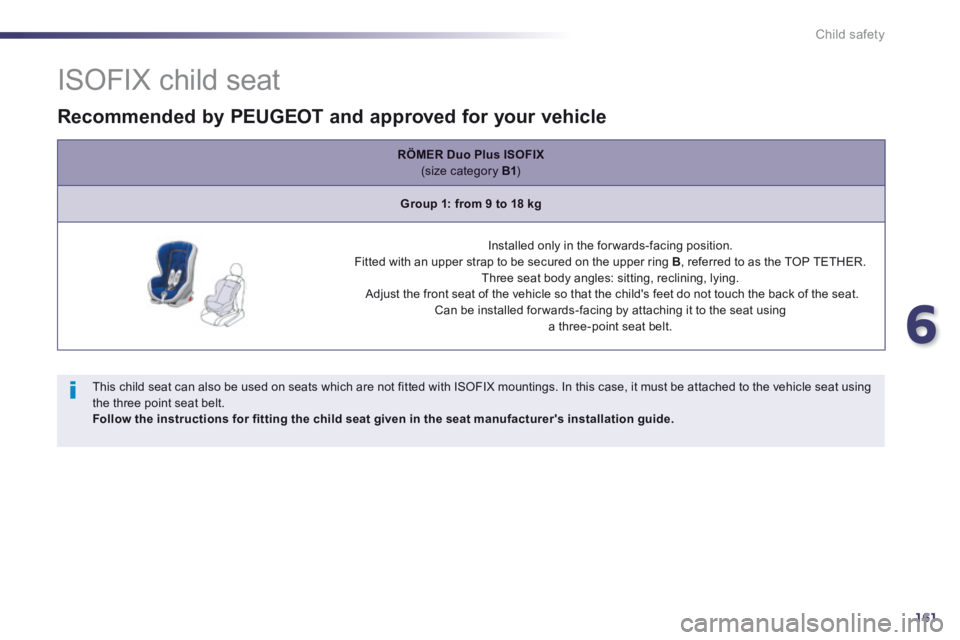
This child seat can also be used on seats which are not fitted with ISOFIX mountings. In this case, it must be attached to the vehicle seat using the three point seat belt. Follow the instructions for fitting the child seat given in the seat manufacturer's installation guide.
Recommended by PEUGEOT and approved for your vehicle
RÖMER Duo Plus ISOFIX (size category B1 )
Group 1: from 9 to 18 kg
Installed only in the forwards-facing position. Fitted with an upper strap to be secured on the upper ring B , referred to as the TOP TETHER. Three seat body angles: sitting, reclining, lying. Adjust the front seat of the vehicle so that the child's feet do not touch the back of the seat. Can be installed for wards-facing by attaching it to the seat using a three-point seat belt .
Page 164 of 352
162
Child safety
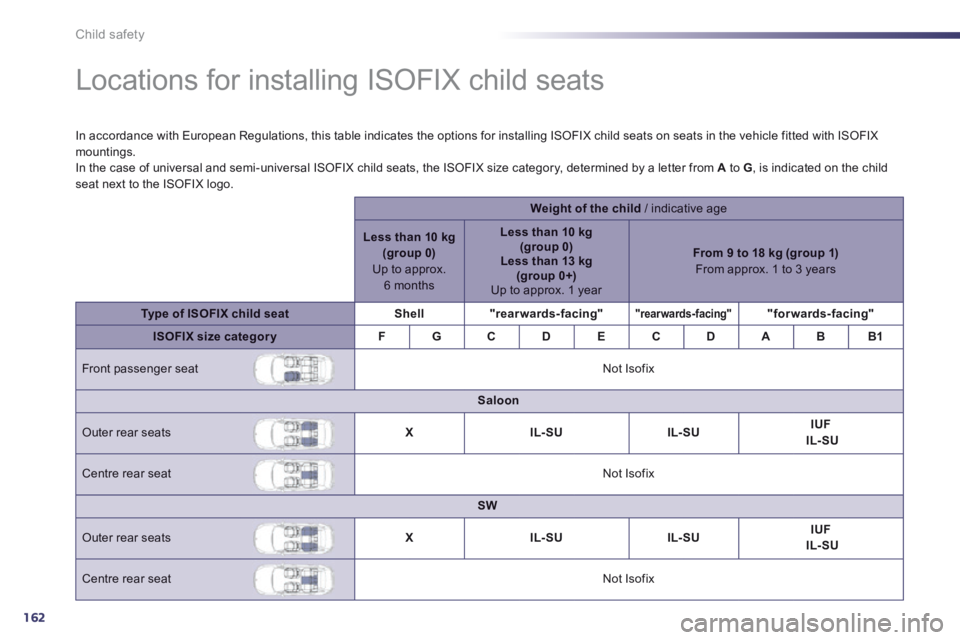
Locations for installing ISOFIX child seats
In accordance with European Regulations, this table indicates the options for installing ISOFIX child seats on seats in the vehicle fitted with ISOFIX mountings. In the case of universal and semi-universal ISOFIX child seats, the ISOFIX size category, determined by a letter from A to G , is indicated on the child seat next to the ISOFIX logo.
Weight of the child / indicative age
Less than 10 kg (group 0) Up to approx. 6 months
Less than 10 kg (group 0) Less than 13 kg (group 0+) Up to approx. 1 year
From 9 to 18 kg (group 1) From approx. 1 to 3 years
Type of ISOFIX child seatShell"rearwards-facing""rearwards-facing""forwards-facing"
ISOFIX size categor yFGCDECDABB1
Front passenger seat Not Isofix
Saloon
Outer rear seats XIL- SUIL- SUIUF IL- SU
Centre rear seat Not Isofix
SW
Outer rear seats XIL- SUIL- SUIUF IL- SU
Centre rear seat Not Isofix
Page 174 of 352
172
Safety
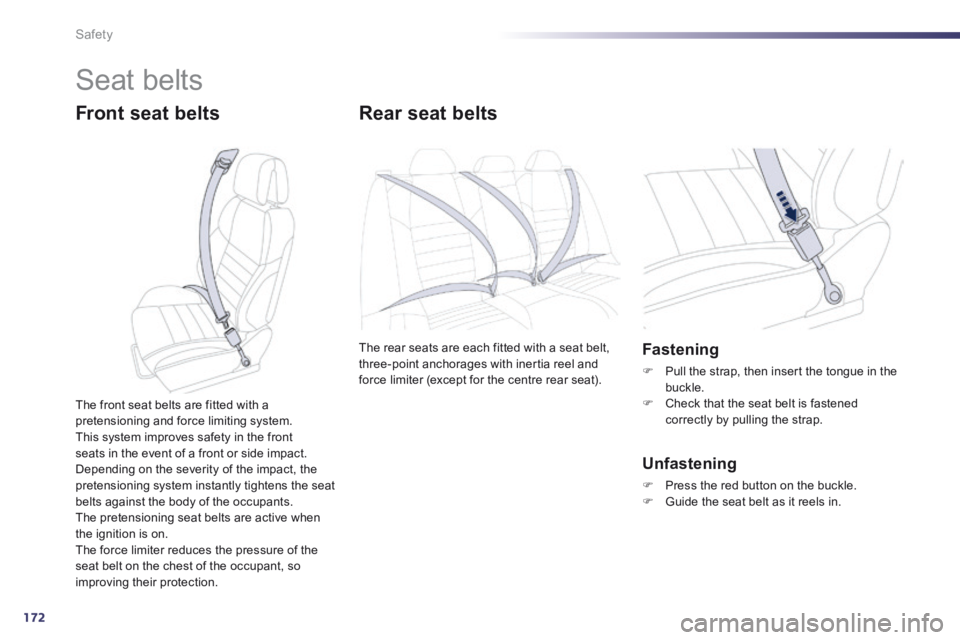
Seat belts
Front seat belts Rear seat belts
The rear seats are each fitted with a seat belt, three-point anchorages with inertia reel and force limiter (except for the centre rear seat).
Fastening
Pull the strap, then insert the tongue in the buckle. Check that the seat belt is fastened correctly by pulling the strap.
Unfastening
Press the red button on the buckle. Guide the seat belt as it reels in.
The front seat belts are fitted with a pretensioning and force limiting system. This system improves safety in the front seats in the event of a front or side impact. Depending on the severity of the impact, the pretensioning system instantly tightens the seat belts against the body of the occupants. The pretensioning seat belts are active when the ignition is on. The force limiter reduces the pressure of the seat belt on the chest of the occupant, so improving their protection.