engine Peugeot 508 RXH 2013 Owner's Manual
[x] Cancel search | Manufacturer: PEUGEOT, Model Year: 2013, Model line: 508 RXH, Model: Peugeot 508 RXH 2013Pages: 308, PDF Size: 8.95 MB
Page 5 of 308
.
.
Contents
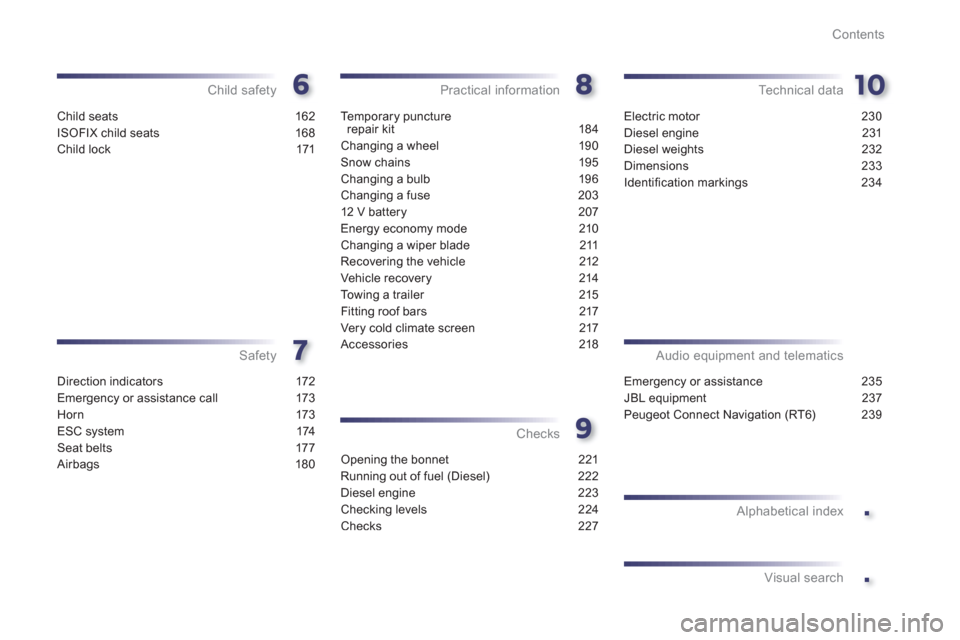
Child seats 162
ISOFIX child seats 168
Child lock 171
Child safety
Direction indicators 172
Emergency or assistance call 173
Horn 173
ESC system 174
Seat belts 177
Airbags 180
Safety
Te m p o r a ry puncture
repair kit 184
Changing a wheel 190
Snow chains 195
Changing a bulb 196
Changing a fuse 203
12 V battery 207
Energy economy mode 210
Changing a wiper blade 211
Recovering the vehicle 212
Vehicle recovery 214
Towing a trailer 215
Fitting roof bars 217
Very cold climate screen 217
Accessories 218
Practical information
Opening the bonnet 221
Running out of fuel (Diesel) 222
Diesel engine 223
Checking levels 224
Checks 227
Checks
Electric motor 230
Diesel engine 231
Diesel weights 232
Dimensions 233
Identifi cation markings 234
Technical data
Emergency or assistance 235
JBL equipment 237
Peugeot Connect Navigation (RT6) 239
Audio equipment and telematics
Alphabetical index
Visual search
Page 6 of 308
4
Familiarisation
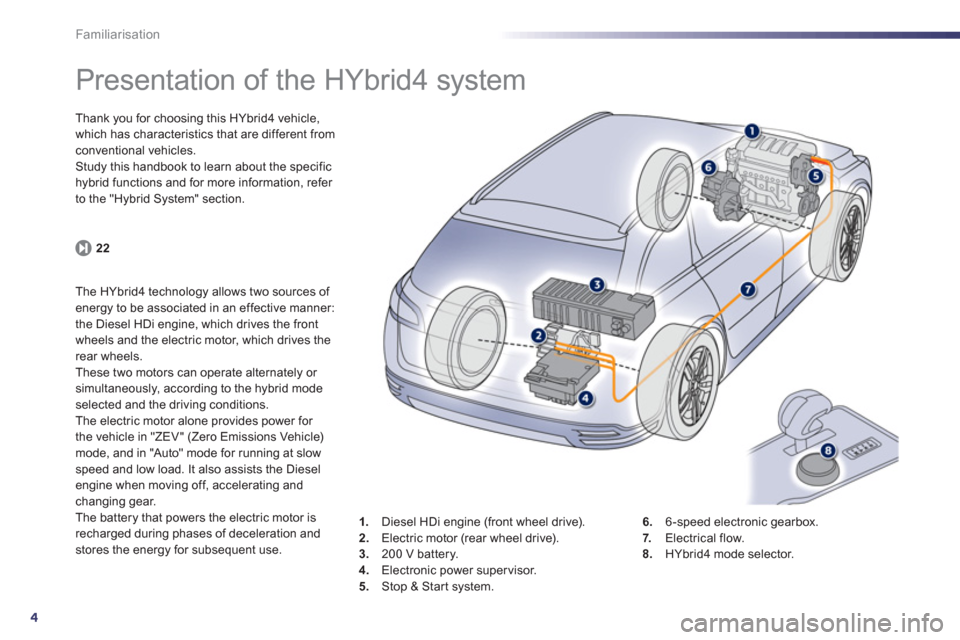
Presentation of the HYbrid4 system
Thank you for choosing this HYbrid4 vehicle,
which has characteristics that are different from conventional vehicles.
Study this handbook to learn about the specific hybrid functions and for more information, refer
to the "Hybrid System" section.
22
The HYbrid4 technology allows two sources of energy to be associated in an effective manner:
the Diesel HDi engine, which drives the front
wheels and the electric motor, which drives the
rear wheels.
These two motors can operate alternately or simultaneously, according to the hybrid modeselected and the driving conditions.
The electric motor alone provides power for
the vehicle in "ZEV" (Zero Emissions Vehicle) mode, and in "Auto" mode for running at slowspeed and low load. It also assists the Dieselengine when moving off, accelerating and changing gear.
The battery that powers the electric motor is
recharged during phases of deceleration andstores the energy for subsequent use.1
.Diesel HDi engine (front wheel drive). 2. Electric motor (rear wheel drive).3.
200 V battery.4.Electronic power supervisor.
5.Stop & Start system. 6
.6 -speed electronic gearbox.7. Electrical flow. 8.HYbrid4 mode selector.
Page 7 of 308
.
5
Familiarisation
For economical driving, caring for the environment
The fuel consumptionof a vehicle varies greatly:
- according to the driver's style of driving
(moderate, aggressive, fast, ...),
- according to the type of journeys
made (urban, main road, motorway, flowing, heavy traffic, …) and the speed.
Main recommendations for driving economically
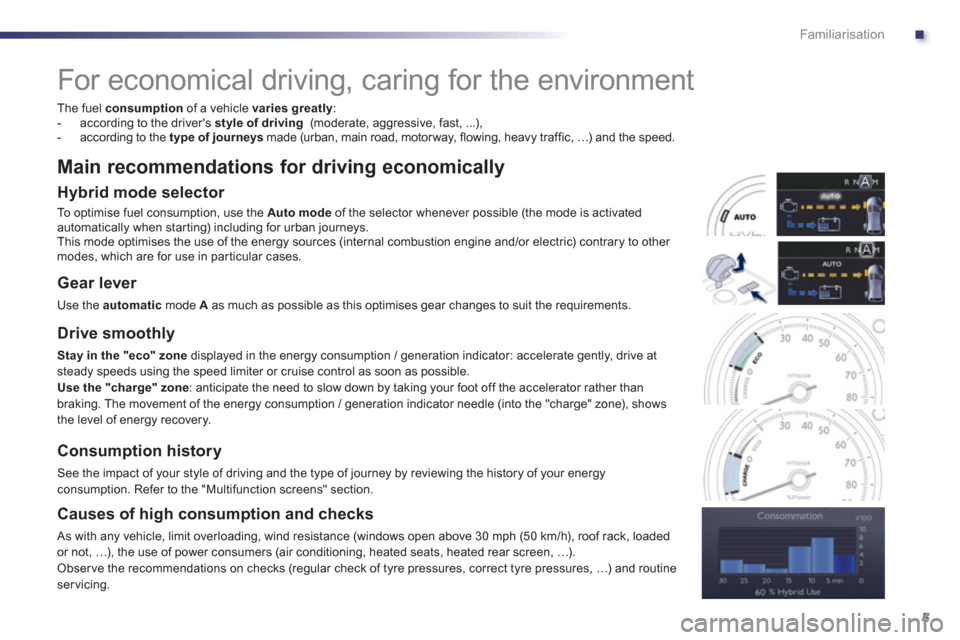
Hybrid mode selector
To optimise fuel consumption, use the Automodeof the selector whenever possible (the mode is activated
automatically when starting) including for urban journeys.
This mode optimises the use of the energy sources (internal combustion engine and/or electric) contrary to other modes, which are for use in par ticular cases.
Gear lever
Use the automatic
mode A
as much as possible as this optimises gear changes to suit the requirements.
Drive smoothly
Stay in the "eco" zone
displayed in the energy consumption / generation indicator: accelerate gently, drive atsteady speeds using the speed limiter or cruise control as soon as possible. Use the "charge" zone: anticipate the need to slow down by taking your foot off the accelerator rather than
braking. The movement of the energy consumption / generation indicator needle (into the "charge" zone), shows
the level of energy recovery.
Consumption history
See the impact of your style of driving and the type of journey by reviewing the history of your energyconsumption. Refer to the "Multifunction screens" section.
Causes of high consumption and checks
As with any vehicle, limit overloading, wind resistance (windows open above 30 mph (50 km/h), roof rack, loaded
or not, …), the use of power consumers (air conditioning, heated seats, heated rear screen, …).
Obser ve the recommendations on checks (regular check of tyre pressures, correct tyre pressures, …) and routine servicing.
Page 12 of 308
10
Familiarisation
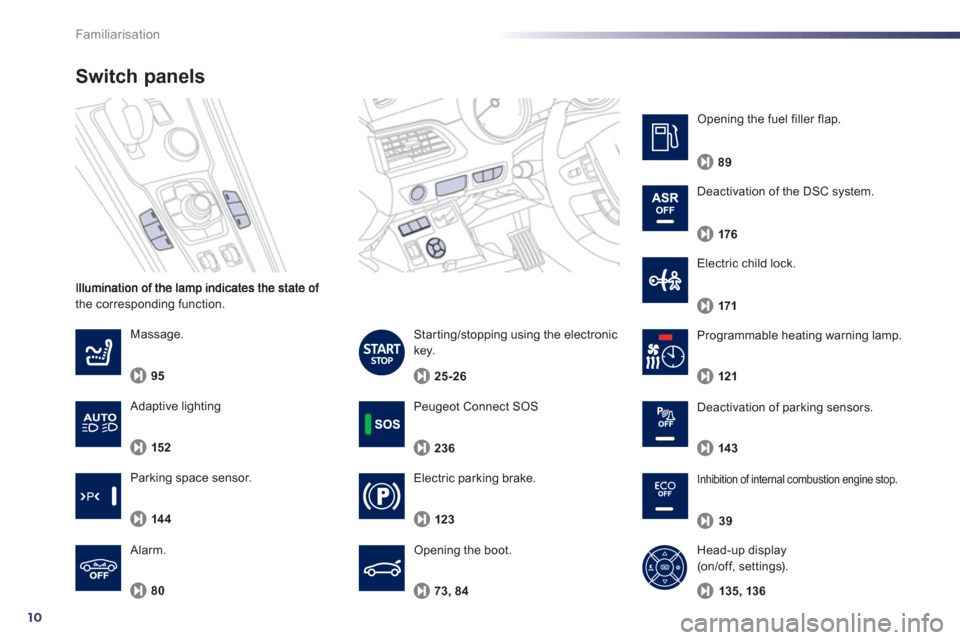
the corresponding function.
Switch panels
Electric parking brake.
Opening the boot.
123
Massa
ge.
95
80
Al
arm.
El
ectric child lock.
73
, 84
171
Peugeot Connect SOS
236
Starting/stopping using the electronic
key.
25-26
Deactivation of parking sensors.
143
Inhibition of internal combustion engine stop.
39
Programmable heating warning lamp.
121
Parkin
g space sensor.
14 4
Deactivation of the DSC system.
176
Opening the fuel filler flap.
89
Adaptive lighting
152
Head-up display (on/off, settings).
135
, 136
Page 19 of 308
.
17
Familiarisation
Monitoring
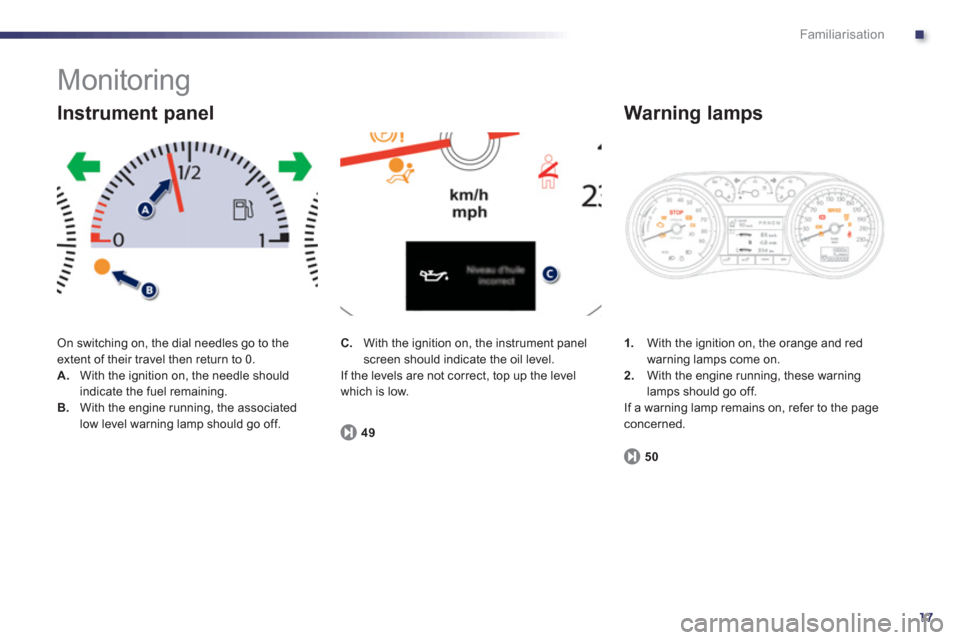
On switching on, the dial needles go to the extent of their travel then return to 0.
A.With the ignition on, the needle should
indicate the fuel remaining.B.With the engine running, the associatedlow level warning lamp should go off.
Instrument panel
1.
With the ignition on, the orange and red
warning lamps come on. 2.With the engine running, these warninglamps should go off.
If a warning lamp remains on, refer to the page concerned.
Warning lamps
50
C.
With the ignition on, the instrument panelscreen should indicate the oil level.
If the levels are not correct, top up the level
which is low.
49
Page 21 of 308
.
19
Familiarisation
Driving safely
Starting - stopping the engine
Before starting
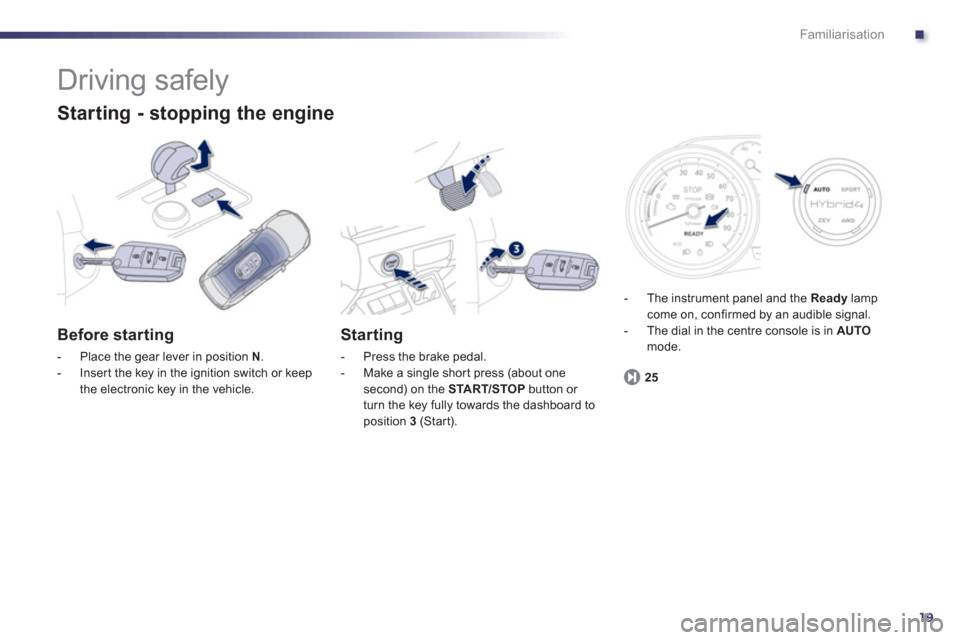
- Place the gear lever in position N.
- Inser t the key in the ignition switch or keep
the electronic key in the vehicle.
Starting
- Press the brake pedal.
- Make a single shor t press (about one second) on the START/STOP
button or
turn the key fully towards the dashboard toposition 3(Start).
25
- The instrument panel and the Read
ylampcome on, confirmed by an audible signal.
- The dial in the centre console is in AUTOmode.
Page 23 of 308
.
21
Familiarisation
Driving safely
Speed limiter "LIMIT"
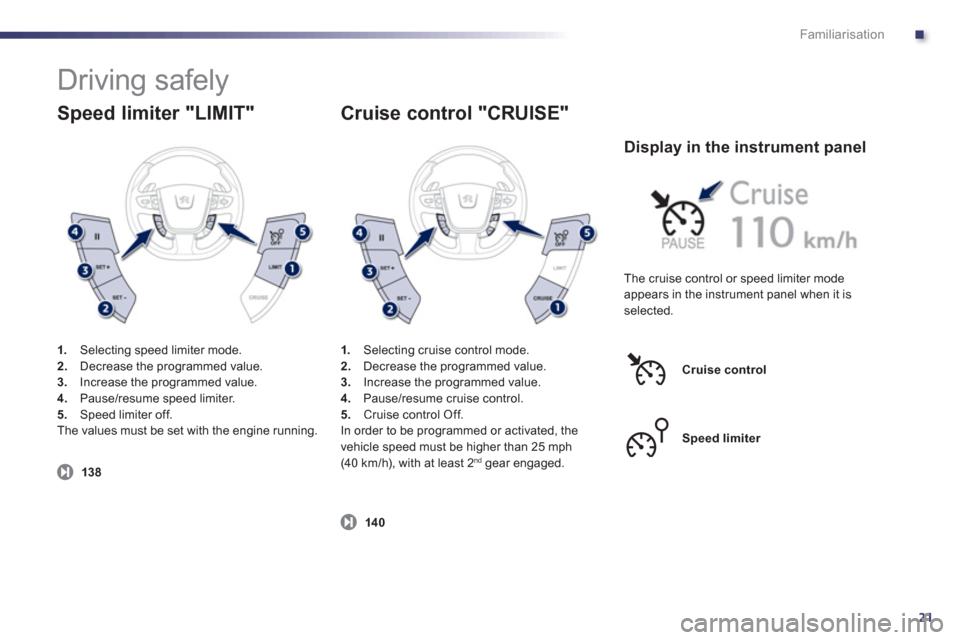
1.
Selecting speed limiter mode.2.Decrease the programmed value.3.Increase the programmed value.4.
Pause/resume speed limiter.
5. Speed limiter off.
The values must be set with the engine running.
13
8
140
Cruise control "CRUISE"
1.Selecting cruise control mode.2. Decrease the programmed value. 3.
Increase the programmed value.
4. Pause/resume cruise control.
5. Cruise control Off.
In order to be programmed or activated, the
vehicle speed must be higher than 25 mph (40 km/h), with at least 2 nd gear engaged.
Display in the instrument panel
The cruise control or speed limiter mode
appears in the instrument panel when it isselected.
Cruise contro
l
Speed limiter
Page 24 of 308
22
Hybrid system
Presentation
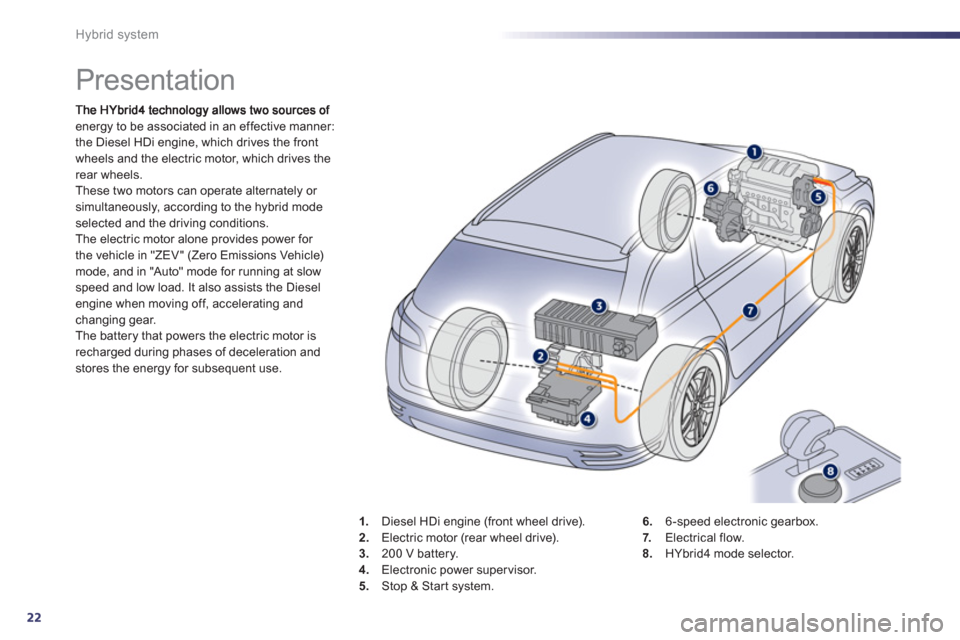
energy to be associated in an effective manner:
the Diesel HDi engine, which drives the front
wheels and the electric motor, which drives the rear wheels.These two motors can operate alternately or simultaneously, according to the hybrid modeselected and the driving conditions.
The electric motor alone provides power for
the vehicle in "ZEV" (Zero Emissions Vehicle) mode, and in "Auto" mode for running at slowspeed and low load. It also assists the Dieselengine when moving off, accelerating and changing gear.The battery that powers the electric motor is recharged during phases of deceleration andstores the energy for subsequent use.
1.Diesel HDi engine (front wheel drive). 2. Electric motor (rear wheel drive).3.
200 V battery.4.Electronic power supervisor.
5
.Stop & Start system. 6
.6 -speed electronic gearbox.7. Electrical flow. 8.HYbrid4 mode selector.
Page 25 of 308
.
23
Hybrid system
Main parts of the HYbrid4 system
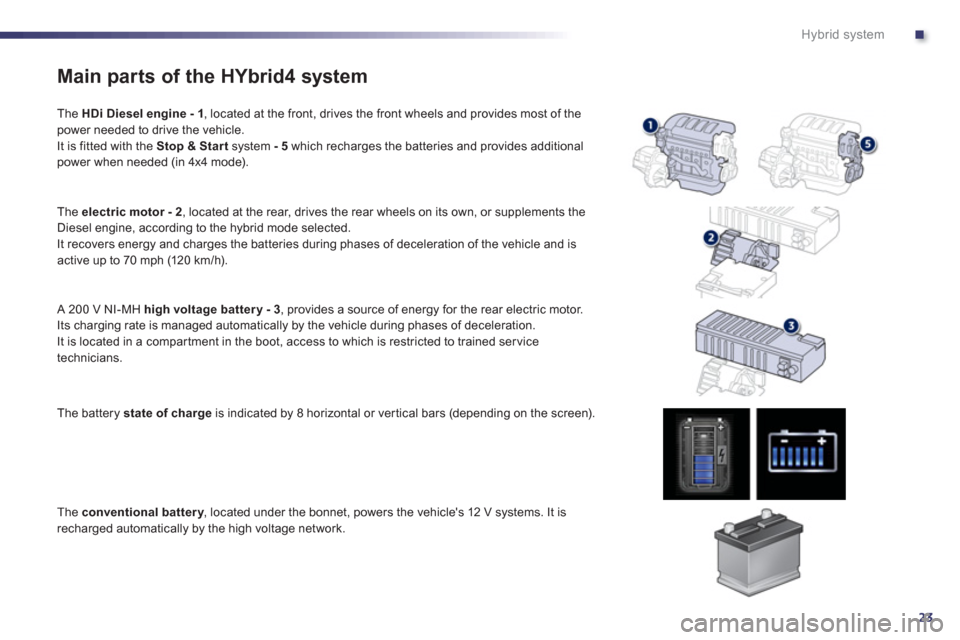
The HDi Diesel engine - 1
, located at the front, drives the front wheels and provides most of the power needed to drive the vehicle.
It is fitted with the Stop & Start
system - 5
which recharges the batteries and provides additional
power when needed (in 4x4 mode).
Th
e electric motor - 2
, located at the rear, drives the rear wheels on its own, or supplements the
Diesel engine, according to the hybrid mode selected.
It recovers energy and charges the batteries during phases of deceleration of the vehicle and is
active up to 70 mph (120 km / h).
A 200 V NI-MH high voltage battery - 3
, provides a source of energy for the rear electric motor.
Its charging rate is managed automatically by the vehicle during phases of deceleration.
It is located in a compar tment in the boot, access to which is restricted to trained service
technicians.
The batter
y state of chargeis indicated by 8 horizontal or vertical bars (depending on the screen).
The conventional battery, located under the bonnet, powers the vehicle's 12 V systems. It is yrecharged automatically by the high voltage network.
Page 26 of 308
24
Hybrid system
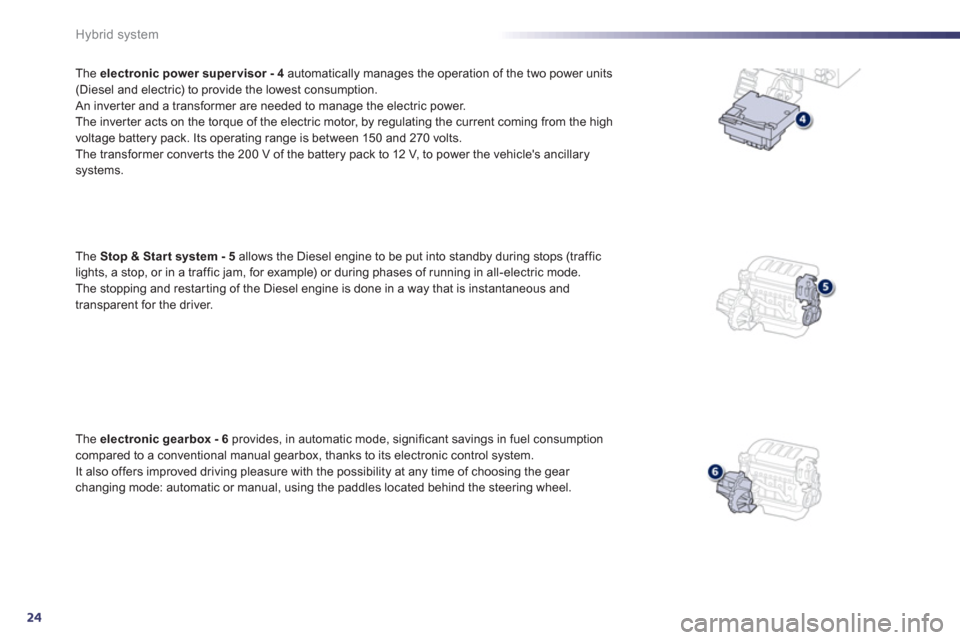
The electronic power super visor - 4automatically manages the operation of the two power units(Diesel and electric) to provide the lowest consumption.
An inver ter and a transformer are needed to manage the electric power.
The inver ter acts on the torque of the electric motor, by regulating the current coming from the high
voltage battery pack. Its operating range is between 150 and 270 volts.
The trans
former conver ts the 200 V of the battery pack to 12 V, to power the vehicle's ancillary
systems.
Th
e Stop & Star t system - 5
allows the Diesel engine to be put into standby during stops (traffic
lights, a stop, or in a traffic jam, for example) or during phases of running in all-electric mode.
The stopping and restar ting of the Diesel engine is done in a way that is instantaneous and
transparent for the driver.
Th
e electronic gearbox - 6provides, in automatic mode, significant savings in fuel consumption compared to a conventional manual gearbox, thanks to its electronic control system.
It also offers improved driving pleasure with the possibility at any time of choosing the gear changing mode: automatic or manual, using the paddles located behind the steering wheel.