check engine Peugeot 508 RXH 2014 User Guide
[x] Cancel search | Manufacturer: PEUGEOT, Model Year: 2014, Model line: 508 RXH, Model: Peugeot 508 RXH 2014Pages: 338, PDF Size: 10.81 MB
Page 58 of 338
56
Engine oil level indicator*
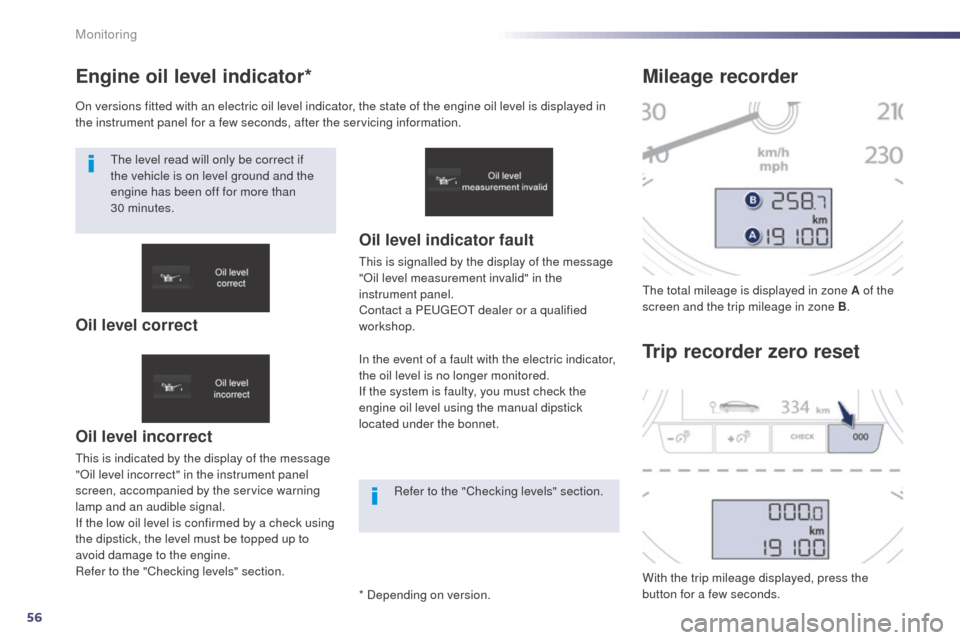
Oil level incorrect
this is indicated by the display of the message
"Oil level incorrect" in the instrument panel
screen, accompanied by the service warning
lamp and an audible signal.
If the low oil level is confirmed by a check using
the dipstick, the level must be topped up to
avoid damage to the engine.
Refer to the "Checking levels" section.
Oil level indicator fault
this is signalled by the display of the message
"Oil level measurement invalid" in the
instrument panel.
Contact a P
e
uge
Ot
dealer or a qualified
workshop.
In the event of a fault with the electric indicator,
the oil level is no longer monitored.
If the system is faulty, you must check the
engine oil level using the manual dipstick
located under the bonnet.
th
e total mileage is displayed in zone A of the
screen and the trip mileage in zone B .
With the trip mileage displayed, press the
button for a few seconds.
Mileage recorder
Trip recorder zero reset
On versions fitted with an electric oil level indicator, the state of the engine oil level is displayed in
the instrument panel for a few seconds, after the servicing information.
th
e level read will only be correct if
the vehicle is on level ground and the
engine has been off for more than
30 minutes.
Oil level correct
Refer to the "Checking levels" section.
* Depending on version.
Monitoring
Page 87 of 338
85
508RXH_en_Chap02_ouvertures_ed01-2014
Low fuel level
When the low fuel level in the tank is
reached, this warning lamp comes on
in the instrument panel, accompanied
by an audible warning and a message
in the instrument panel screen.
Fuel supply cut-off
Your vehicle is equipped with a safety device
which cuts off the fuel supply in the event of a
collision.It is still possible to use a fuel can to fill
the tank but this must be done slowly.
In order to ensure a good flow of fuel,
do not place the nozzle of the fuel can
in direct contact with the flap of the
misfuel prevention device.
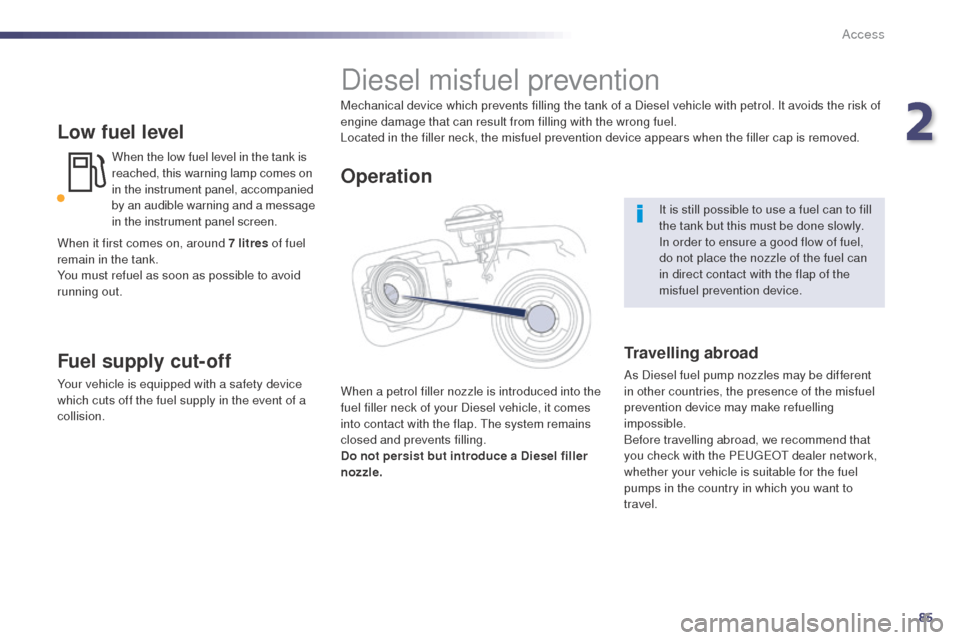
Diesel misfuel prevention
Mechanical device which prevents filling the tank of a Diesel vehicle with petrol. It avoids the risk of
engine damage that can result from filling with the wrong fuel.
Located in the filler neck, the misfuel prevention device appears when the filler cap is removed.
When a petrol filler nozzle is introduced into the
fuel filler neck of your Diesel vehicle, it comes
into contact with the flap.
t
h
e system remains
closed and prevents filling.
Do not persist but introduce a Diesel filler
nozzle.
Operation
Travelling abroad
As Diesel fuel pump nozzles may be different
in other countries, the presence of the misfuel
prevention device may make refuelling
impossible.
Before travelling abroad, we recommend that
you check with the P
e
uge
Ot
dealer network,
whether your vehicle is suitable for the fuel
pumps in the country in which you want to
travel.
When it first comes on, around 7 litres of fuel
remain in the tank.
You must refuel as soon as possible to avoid
running out.
2
Access
Page 107 of 338
105
508RXH_en_Chap03_confort_ed01-2014
In order for these systems to be fully effective, follow the operation and maintenance
guidelines below:
F
I
f the interior temperature remains very high after the vehicle has been parked in the sun
for a considerable time, first ventilate the passenger compartment for a few minutes.
P
lace the air flow control at a sufficient level to provide an adequate renewal of air in
the passenger compartment.
F
t
o o
btain an even air distribution, take care not to obstruct the exterior air intake grilles
located at the base of the windscreen, the nozzles, the vents and the air outlets, as well
as the air extractor located in the boot.
F
u
s
e in preference the intake of exterior air as prolonged use of the air recirculation may
cause misting of the windows and side windows.
F
D
o not cover the sunshine sensor, located on the dashboard; this is used for regulation
of the automatic air conditioning system.
F
O
perate the air conditioning system for 5 to 10 minutes, once or twice a month to keep it
in good working order.
F
e
n
sure that the passenger compartment filter is in good condition and have the filter
elements replaced regularly (refer to the "Checks" section).
W
e recommend the use of a combined passenger compartment filter. t
h
anks to its
second special active filter, it contributes to the purification of the air breathed by the
occupants and the cleanliness of the passenger compartment (reduction of allergic
symptoms, bad odours and greasy deposits).
F
t
h
e air conditioning uses power from the engine while operating. t
h
is results in an
increase in the vehicle's fuel consumption.
W
hen towing at or near maximum capacity or on steep slopes in high ambient
temperatures, switching off the air conditioning saves engine power and so improves
towing capacity.
C
ondensation created by the air conditioning results in a discharge of water under the
vehicle when stationary, which is per fectly normal.
F
t
o e
nsure correct operation of the air conditioning system, you are also advised to have
it checked regularly.
F
I
f the system does not produce cold air, do not use it and contact a P
e
uge
Ot
dealer or
a qualified workshop.
Recommendations for ventilation and air conditioning
the air conditioning system does not
contain chlorine and does not present
any danger to the ozone layer.
3
Comfort
Page 119 of 338
117
508RXH_en_Chap04_conduite_ed01-2014
It is recommended that you do not
apply the parking brake in very cold
conditions (ice) and during towing
(recovery, ...). Deactivate the automatic
functions and release the parking brake
manually. Before leaving the vehicle, check that
parking brake warning lamps in the
instrument panel and the control lever A
are on, not flashing.
th
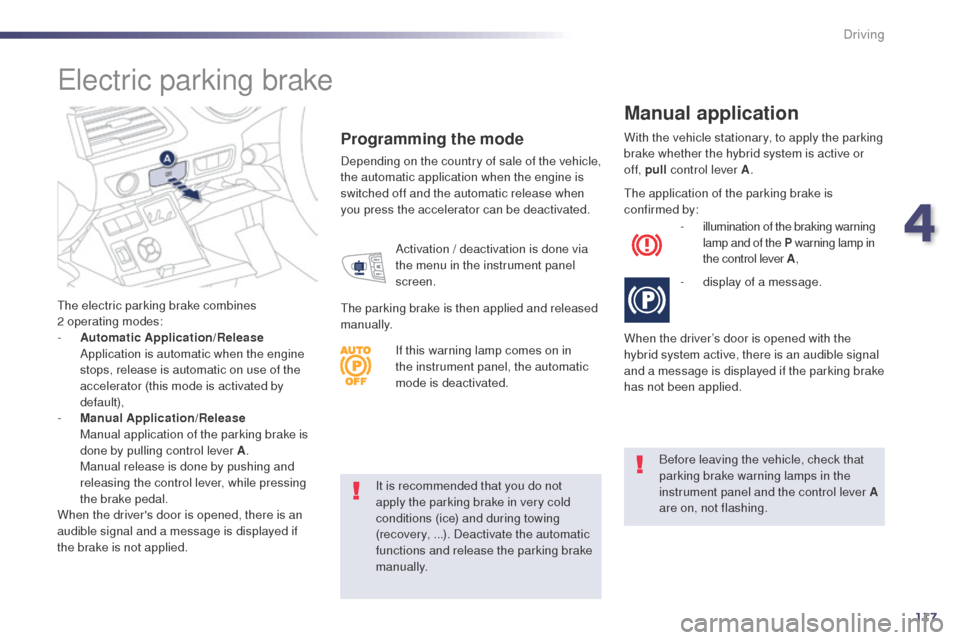
e electric parking brake combines
2 operating modes:
-
A
utomatic Application/Release
A
pplication is automatic when the engine
stops, release is automatic on use of the
accelerator (this mode is activated by
default),
-
M
anual Application/Release
M
anual application of the parking brake is
done by pulling control lever A .
Ma
nual release is done by pushing and
releasing the control lever, while pressing
the brake pedal.
When the driver's door is opened, there is an
audible signal and a message is displayed if
the brake is not applied.
Programming the mode
Depending on the country of sale of the vehicle,
the automatic application when the engine is
switched off and the automatic release when
you press the accelerator can be deactivated. With the vehicle stationary, to apply the parking
brake whether the hybrid system is active or
of f, pull
control lever A .
Manual application
Activation / deactivation is done via
the menu in the instrument panel
screen.
th
e parking brake is then applied and released
manually.
th
e application of the parking brake is
confirmed by:
-
i
llumination of the braking warning
lamp and of the P warning lamp in
the control lever A ,
-
d
isplay of a message.
When the driver’s door is opened with the
hybrid system active, there is an audible signal
and a message is displayed if the parking brake
has not been applied.
electric parking brake
If this warning lamp comes on in
the instrument panel, the automatic
mode is deactivated.
4
Driving
Page 120 of 338
118
508RXH_en_Chap04_conduite_ed01-2014
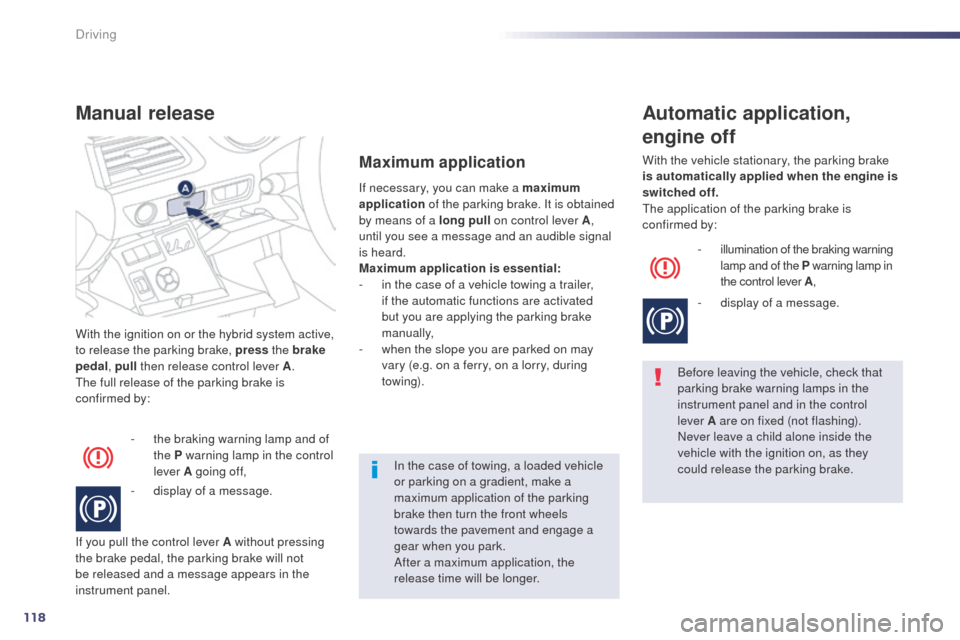
With the ignition on or the hybrid system active,
to release the parking brake, press the brake
pedal , pull then release control lever A .
th
e full release of the parking brake is
confirmed by:
Manual release
- the braking warning lamp and of the P warning lamp in the control
lever A going of f,
-
d
isplay of a message.
If you pull the control lever A without pressing
the brake pedal, the parking brake will not
be released and a message appears in the
instrument panel. If necessary, you can make a maximum
application
of the parking brake. It is obtained
by means of a long pull on control lever A,
until you see a message and an audible signal
is heard.
Maximum application is essential:
-
i
n the case of a vehicle towing a trailer,
if the automatic functions are activated
but you are applying the parking brake
manually,
-
w
hen the slope you are parked on may
vary (e.g. on a ferry, on a lorry, during
towing).
Maximum application
Before leaving the vehicle, check that
parking brake warning lamps in the
instrument panel and in the control
lever
A are on fixed (not flashing).
Never leave a child alone inside the
vehicle with the ignition on, as they
could release the parking brake.
Automatic application,
engine off
- illumination of the braking warning lamp and of the P warning lamp in
the control lever A ,
-
d
isplay of a message.
With the vehicle stationary, the parking brake
is automatically applied when the engine is
switched off.
th
e application of the parking brake is
confirmed by:
In the case of towing, a loaded vehicle
or parking on a gradient, make a
maximum application of the parking
brake then turn the front wheels
towards the pavement and engage a
gear when you park.
After a maximum application, the
release time will be longer.
Driving
Page 121 of 338
119
508RXH_en_Chap04_conduite_ed01-2014
Automatic release
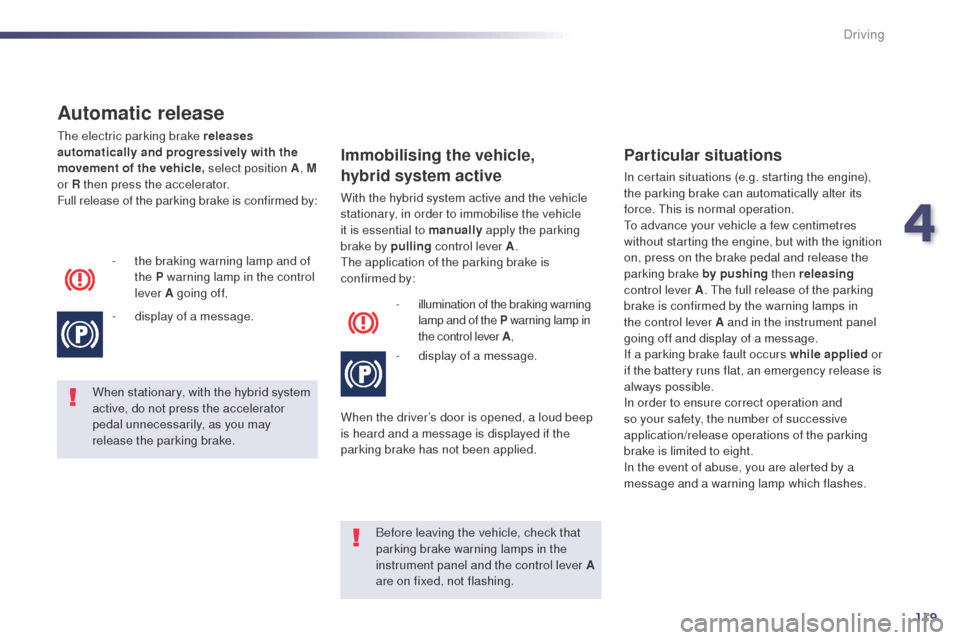
the electric parking brake releases
automatically and progressively with the
movement of the vehicle, select position A, M
or R then press the accelerator.
Full release of the parking brake is confirmed by:
-
t
he braking warning lamp and of
the P warning lamp in the control
lever A going of f,
-
d
isplay of a message.
When stationary, with the hybrid system
active, do not press the accelerator
pedal unnecessarily, as you may
release the parking brake.
Before leaving the vehicle, check that
parking brake warning lamps in the
instrument panel and the control lever A
are on fixed, not flashing.
Immobilising the vehicle,
hybrid system active
With the hybrid system active and the vehicle
stationary, in order to immobilise the vehicle
it is essential to manually apply the parking
brake by pulling control lever A.
th
e application of the parking brake is
confirmed by:
-
i
llumination of the braking warning
lamp and of the P warning lamp in
the control lever A ,
-
d
isplay of a message.
When the driver’s door is opened, a loud beep
is heard and a message is displayed if the
parking brake has not been applied.
Particular situations
In certain situations (e.g. starting the engine),
the parking brake can automatically alter its
force. t
h
is is normal operation.
to a
dvance your vehicle a few centimetres
without starting the engine, but with the ignition
on, press on the brake pedal and release the
parking brake by pushing then releasing
control lever A .
t
h
e full release of the parking
brake is confirmed by the warning lamps in
the control lever A and in the instrument panel
going off and display of a message.
If a parking brake fault occurs while applied or
if the battery runs flat, an emergency release is
always possible.
In order to ensure correct operation and
so your safety, the number of successive
application/release operations of the parking
brake is limited to eight.
In the event of abuse, you are alerted by a
message and a warning lamp which flashes.
4
Driving
Page 124 of 338
122
508RXH_en_Chap04_conduite_ed01-2014
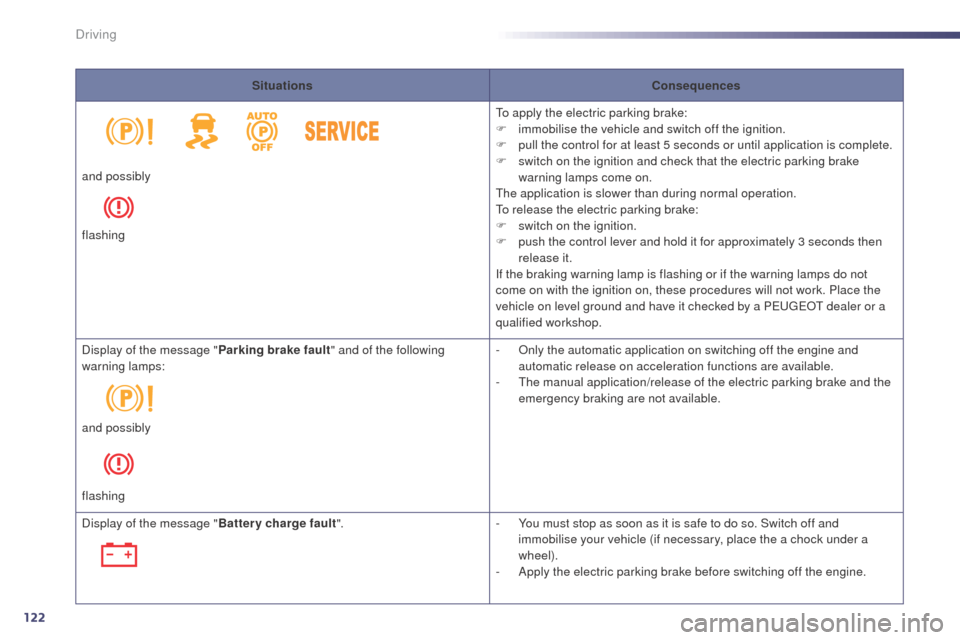
SituationsConsequences
to a
pply the electric parking brake:
F
i
mmobilise the vehicle and switch off the ignition.
F
p
ull the control for at least 5 seconds or until application is complete.
F
s
witch on the ignition and check that the electric parking brake
warning lamps come on.
th
e application is slower than during normal operation.
to r
elease the electric parking brake:
F
s
witch on the ignition.
F
p
ush the control lever and hold it for approximately 3 seconds then
release it.
If the braking warning lamp is flashing or if the warning lamps do not
come on with the ignition on, these procedures will not work. Place the
vehicle on level ground and have it checked by a P
e
uge
Ot
dealer or a
qualified workshop.
and possibly
flashing
Display of the message "
Parking brake fault" and of the following
warning lamps: -
O
nly the automatic application on switching off the engine and
automatic release on acceleration functions are available.
-
t
h
e manual application/release of the electric parking brake and the
emergency braking are not available.
and possibly
flashing
Display of the message " Battery charge fault". -
Y
ou must stop as soon as it is safe to do so. Switch off and
immobilise your vehicle (if necessary, place the a chock under a
wheel).
-
A
pply the electric parking brake before switching off the engine.
Driving
Page 129 of 338
127
508RXH_en_Chap04_conduite_ed01-2014
You must press the brake pedal when
starting the engine.
Whatever the circumstances, you must
manually apply the parking brake when
parking, unless the parking brake is
programmed in automatic mode.
When immobilising the vehicle, with the
hybrid system active, you must place
the gear selector in neutral N
.
Before carrying out any work in the
engine compartment, check that the
gear selector is in neutral N and that the
parking brake is applied.
Stopping the vehicle
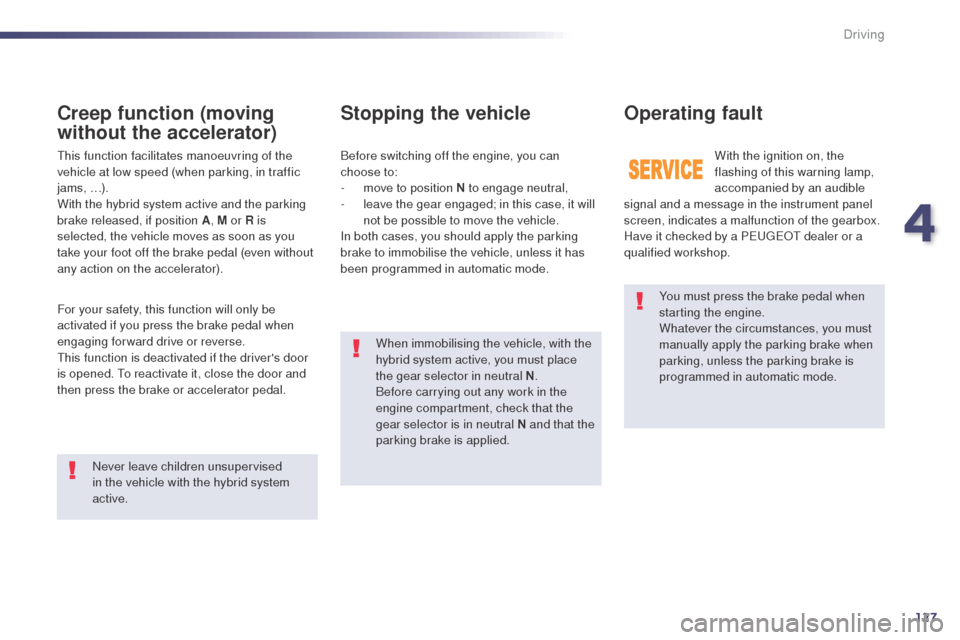
With the ignition on, the
flashing of this warning lamp,
accompanied by an audible
signal and a message in the instrument panel
screen, indicates a malfunction of the gearbox.
Have it checked by a P
e
uge
Ot
dealer or a
qualified workshop.
Before switching off the engine, you can
choose to:
-
m
ove to position N to engage neutral,
-
l
eave the gear engaged; in this case, it will
not be possible to move the vehicle.
In both cases, you should apply the parking
brake to immobilise the vehicle, unless it has
been programmed in automatic mode.
Operating fault
this function facilitates manoeuvring of the
vehicle at low speed (when parking, in traffic
jams, …).
With the hybrid system active and the parking
brake released, if position A , M or R is
selected, the vehicle moves as soon as you
take your foot off the brake pedal (even without
any action on the accelerator).
Creep function (moving
without the accelerator)
Never leave children unsupervised
in the vehicle with the hybrid system
active.
For your safety, this function will only be
activated if you press the brake pedal when
engaging forward drive or reverse.
th
is function is deactivated if the driver's door
is opened. t
o r
eactivate it, close the door and
then press the brake or accelerator pedal.
4
Driving
Page 181 of 338
179
508RXH_en_Chap07_securite_ed01-2014
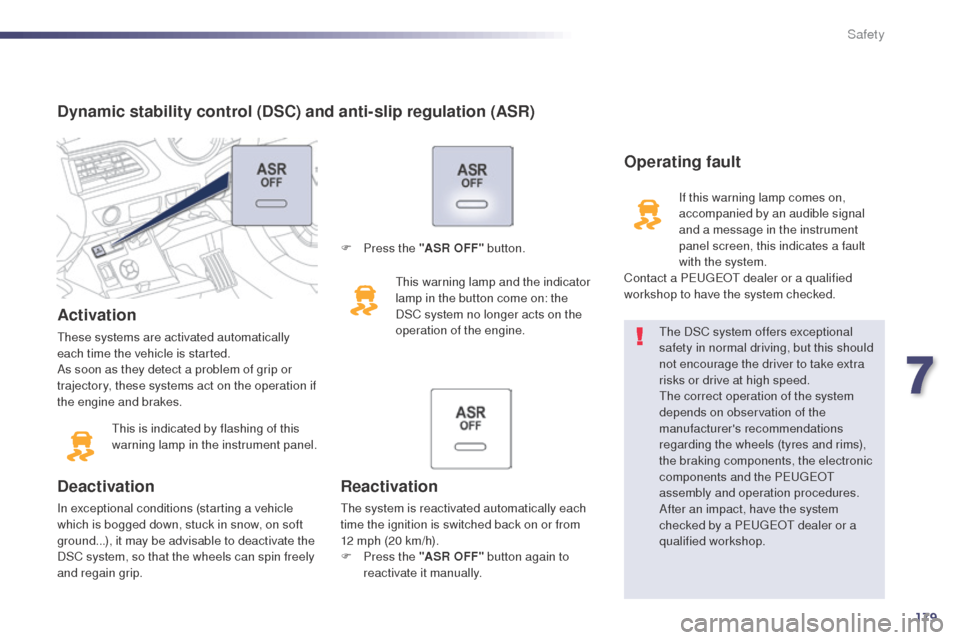
Dynamic stability control (DSC) and anti-slip regulation (ASR)
Activation
these systems are activated automatically
each time the vehicle is started.
As soon as they detect a problem of grip or
trajectory, these systems act on the operation if
the engine and brakes.
th
is is indicated by flashing of this
warning lamp in the instrument panel.
Deactivation
In exceptional conditions (starting a vehicle
which is bogged down, stuck in snow, on soft
ground...), it may be advisable to deactivate the
DSC system, so that the wheels can spin freely
and regain grip.
th
e DSC system offers exceptional
safety in normal driving, but this should
not encourage the driver to take extra
risks or drive at high speed.
th
e correct operation of the system
depends on observation of the
manufacturer's recommendations
regarding the wheels (tyres and rims),
the braking components, the electronic
components and the P
e
uge
Ot
assembly and operation procedures.
After an impact, have the system
checked by a P
e
uge
Ot
dealer or a
qualified workshop.
Operating fault
If this warning lamp comes on,
accompanied by an audible signal
and a message in the instrument
panel screen, this indicates a fault
with the system.
Contact a P
e
uge
Ot
dealer or a qualified
workshop to have the system checked.
Reactivation
the system is reactivated automatically each
time the ignition is switched back on or from
12
mph (20 km/h).
F
P
ress the "AS R O FF " button again to
reactivate it manually.
F
P
ress the "AS R O FF "
button.
th
is warning lamp and the indicator
lamp in the button come on: the
DSC system no longer acts on the
operation of the engine.
7
Safety
Page 194 of 338
192
508RXH_en_Chap08_info-pratiques_ed01-2014
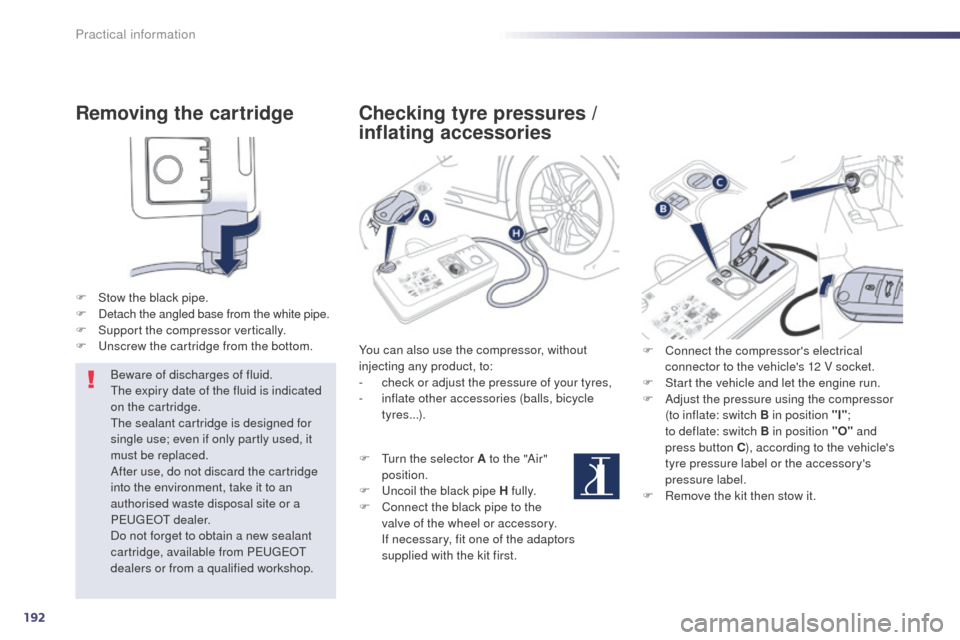
Removing the cartridge
F Stow the black pipe.
F D etach the angled base from the white pipe.
F
S
upport the compressor vertically.
F
u
n
screw the cartridge from the bottom.
Beware of discharges of fluid.
th
e expiry date of the fluid is indicated
on the cartridge.
th
e sealant cartridge is designed for
single use; even if only partly used, it
must be replaced.
After use, do not discard the cartridge
into the environment, take it to an
authorised waste disposal site or a
P
e
uge
Ot d
ealer.
Do not forget to obtain a new sealant
cartridge, available from P
e
uge
Ot
dealers or from a qualified workshop.
Checking tyre pressures /
inflating accessories
You can also use the compressor, without
injecting any product, to:
-
c
heck or adjust the pressure of your tyres,
-
i
nflate other accessories (balls, bicycle
tyres...).
F
t
u
rn the selector A to the "Air"
position.
F
u
n
coil the black pipe H fully.
F
C
onnect the black pipe to the
valve of the wheel or accessory.
I
f necessary, fit one of the adaptors
supplied with the kit first. F
C onnect the compressor's electrical
connector to the vehicle's 12 V socket.
F
S
tart the vehicle and let the engine run.
F
A
djust the pressure using the compressor
(to inflate: switch B in position "I" ;
to
deflate: switch B in position "O" and
press button C ), according to the vehicle's
tyre pressure label or the accessory's
pressure label.
F
R
emove the kit then stow it.
Practical information