brake PEUGEOT PARTNER 2022 Repair Manual
[x] Cancel search | Manufacturer: PEUGEOT, Model Year: 2022, Model line: PARTNER, Model: PEUGEOT PARTNER 2022Pages: 324, PDF Size: 9.42 MB
Page 209 of 324
207
In the event of a breakdown
8► If your vehicle is so equipped, tighten the
security bolt using the wheelbrace 5 equipped
with a security socket
8.
►
T
ighten the other bolts using the
wheelbrace
5
only.
►
Store the tools.
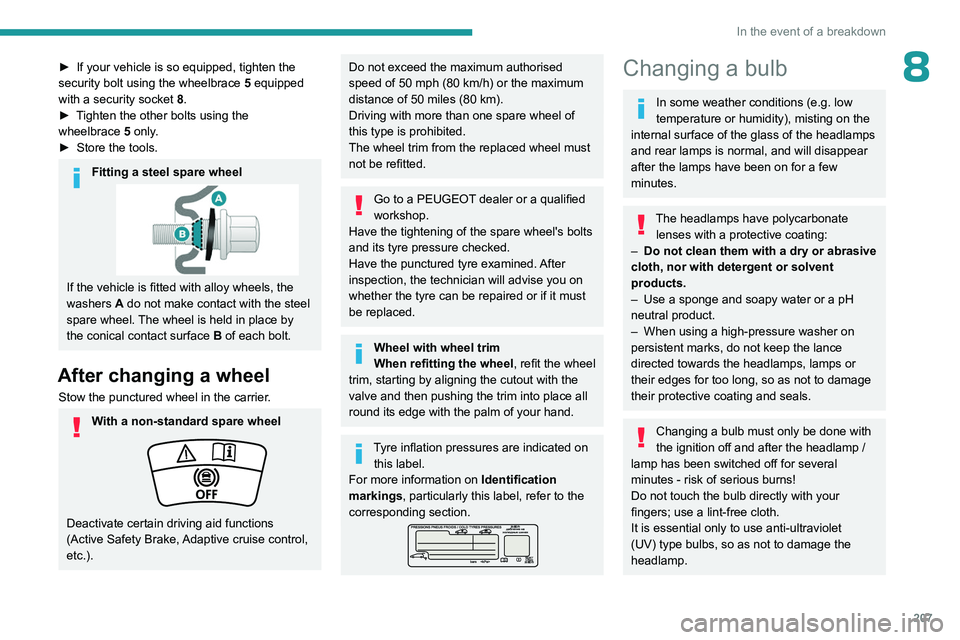
Fitting a steel spare wheel
If the vehicle is fitted with alloy wheels, the
washers A do not make contact with the steel
spare wheel. The wheel is held in place by
the conical contact surface B of each bolt.
After changing a wheel
Stow the punctured wheel in the carrier.
With a non-standard spare wheel
Deactivate certain driving aid functions
(Active Safety Brake, Adaptive cruise control,
etc.).
Do not exceed the maximum authorised
speed of 50 mph (80
km/h) or the maximum
distance of 50 miles (80 km).
Driving with more than one spare wheel of
this type is prohibited.
The wheel trim from the replaced wheel must
not be refitted.
Go to a PEUGEOT dealer or a qualified
workshop.
Have the tightening of the spare wheel's bolts
and its tyre pressure checked.
Have the punctured tyre examined. After
inspection, the technician will advise you on
whether the tyre can be repaired or if it must
be replaced.
Wheel with wheel trim
When refitting the wheel, refit the wheel
trim, starting by aligning the cutout with the
valve and then pushing the trim into place all
round its edge with the palm of your hand.
Tyre inflation pressures are indicated on this label.
For more information on Identification
markings, particularly this label, refer to the
corresponding section.
Changing a bulb
In some weather conditions (e.g. low
temperature or humidity), misting on the
internal surface of the glass of the headlamps
and rear lamps is normal, and will disappear
after the lamps have been on for a few
minutes.
The headlamps have polycarbonate lenses with a protective coating:
–
Do not clean them with a dry or abrasive
cloth, nor with detergent or solvent
products.
–
Use a sponge and soapy water or a pH
neutral product.
–
When using a high-pressure washer on
persistent marks, do not keep the lance
directed towards the headlamps, lamps or
their edges for too long, so as not to damage
their protective coating and seals.
Changing a bulb must only be done with
the ignition off and after the headlamp /
lamp has been switched off for several
minutes - risk of serious burns!
Do not touch the bulb directly with your
fingers; use a lint-free cloth.
It is essential only to use anti-ultraviolet
(UV) type bulbs, so as not to damage the
headlamp.
Page 213 of 324
2 11
In the event of a breakdown
8Rear lamps
For more information on Changing a bulb
and, in particular, the types of bulb, refer to the
corresponding section.
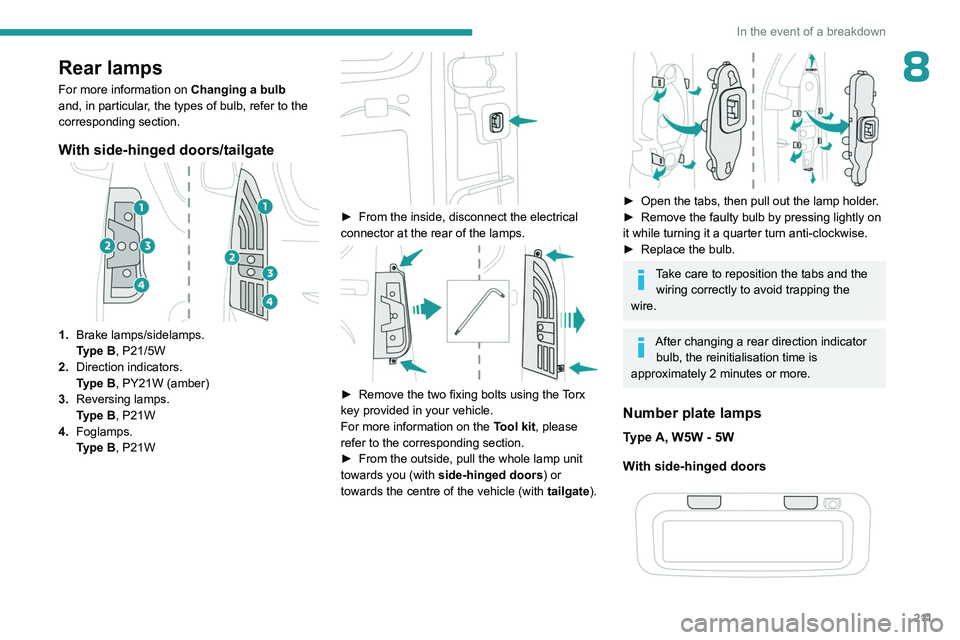
With side-hinged doors/tailgate
1. Brake lamps/sidelamps.
Type
B, P21/5W
2. Direction indicators.
Type
B, PY21W (amber)
3. Reversing lamps.
Type
B, P21W
4. Foglamps.
Type
B, P21W
► From the inside, disconnect the electrical
connector at the rear of the lamps.
► Remove the two fixing bolts using the Torx
key provided in your vehicle.
For more information on the Tool kit, please
refer to the corresponding section.
►
From the outside, pull the whole lamp unit
towards you (with side-hinged doors ) or
towards the centre of the vehicle (with tailgate
).
► Open the tabs, then pull out the lamp holder .
► Remove the faulty bulb by pressing lightly on
it while turning it a quarter turn anti-clockwise.
►
Replace the bulb.
Take care to reposition the tabs and the wiring correctly to avoid trapping the
wire.
After changing a rear direction indicator bulb, the reinitialisation time is
approximately 2 minutes or more.
Number plate lamps
Type A, W5W - 5W
With side-hinged doors
Page 214 of 324
212
In the event of a breakdown
► Unclip the interior trim.
► Disconnect the connector by moving aside
its tab.
►
T
urn the bulb holder a quarter turn
anti-clockwise.
►
Change the bulb.
►
Put the bulb holder back in place and
reconnect the connector
.
►
Put the trim back in place.
With tailgate
► Move aside the plastic lens using a
screwdriver .
►
Change the bulb.
►
Reposition the plastic lens and press it in.
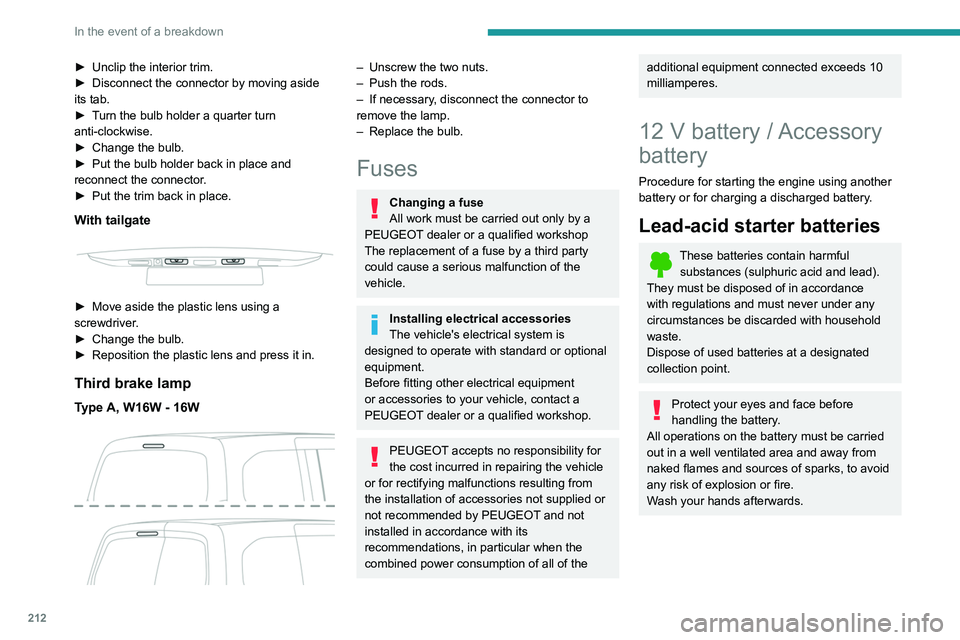
Third brake lamp
Type A, W16W - 16W
– Unscrew the two nuts.
– Push the rods.
–
If necessary
, disconnect the connector to
remove the lamp.
–
Replace the bulb.
Fuses
Changing a fuse
All work must be carried out only by a
PEUGEOT dealer or a qualified workshop
The replacement of a fuse by a third party
could cause a serious malfunction of the
vehicle.
Installing electrical accessories
The vehicle's electrical system is
designed to operate with standard or optional
equipment.
Before fitting other electrical equipment
or accessories to your vehicle, contact a
PEUGEOT dealer or a qualified workshop.
PEUGEOT accepts no responsibility for
the cost incurred in repairing the vehicle
or for rectifying malfunctions resulting from
the installation of accessories not supplied or
not recommended by PEUGEOT and not
installed in accordance with its
recommendations, in particular when the
combined power consumption of all of the
additional equipment connected exceeds 10
milliamperes.
12 V battery / Accessory
battery
Procedure for starting the engine using another
battery or for charging a discharged battery.
Lead-acid starter batteries
These batteries contain harmful
substances (sulphuric acid and lead).
They must be disposed of in accordance
with regulations and must never under any
circumstances be discarded with household
waste.
Dispose of used batteries at a designated
collection point.
Protect your eyes and face before
handling the battery.
All operations on the battery must be carried
out in a well ventilated area and away from
naked flames and sources of sparks, to avoid
any risk of explosion or fire.
Wash your hands afterwards.
Page 218 of 324
216
In the event of a breakdown
Referring to the relevant section, reinitialise
certain equipment:
–
Remote control key or electronic key
(depending on version).
–
Electric windows.
–
Date and time.
–
Preset radio stations.
The Stop & Start system may not be operational during the trip following the
first engine start.
In this case, the system will only be available
again after a continuous period with the
vehicle immobilised, the duration of which
depends on the exterior temperature and the
state of charge of the battery (up to about 8
hours).
Towing
Procedure for having your vehicle towed or for
towing another vehicle using the towing eye.
General recommendations
Observe the legislation in force in the
country where you are driving.
Check that the towing vehicle is heavier than
the towed vehicle.
The driver must remain at the wheel of the
towed vehicle and must have a valid driving
licence.
When towing a vehicle with all four wheels on
the ground, always use an approved towbar;
ropes and straps are prohibited.
The towing vehicle must move off gently.
When the vehicle is towed with its engine
off, there is no longer braking and steering
assistance.
A professional recovery service must
be called in the following cases:
–
broken down on a motorway or main road;
– not possible to put the gearbox into neutral,
unlock the steering, or release the parking
brake;
–
not possible to tow a vehicle with an
automatic gearbox, with the engine running;
–
towing with only two wheels on the ground;
–
four-wheel drive vehicle;
–
no approved towbar available.
Before towing the vehicle, it is essential
to put the vehicle in free-wheeling mode.
For more information on Free-wheeling, refer
to the corresponding section.
Electric motor
An electric vehicle cannot under any
circumstances be used to tow another
vehicle.
However, it may be used, for example, to exit
a rut.
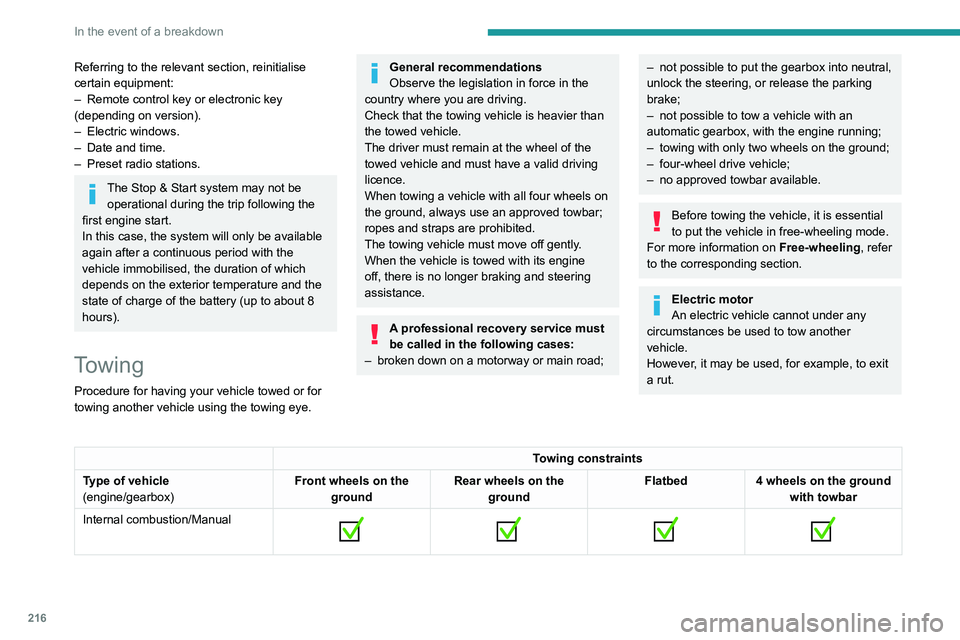
Towing constraints
Type of vehicle
(engine/gearbox) Front wheels on the
ground Rear wheels on the
ground Flatbed
4 wheels on the ground
with towbar
Internal combustion/Manual
Page 219 of 324
217
In the event of a breakdown
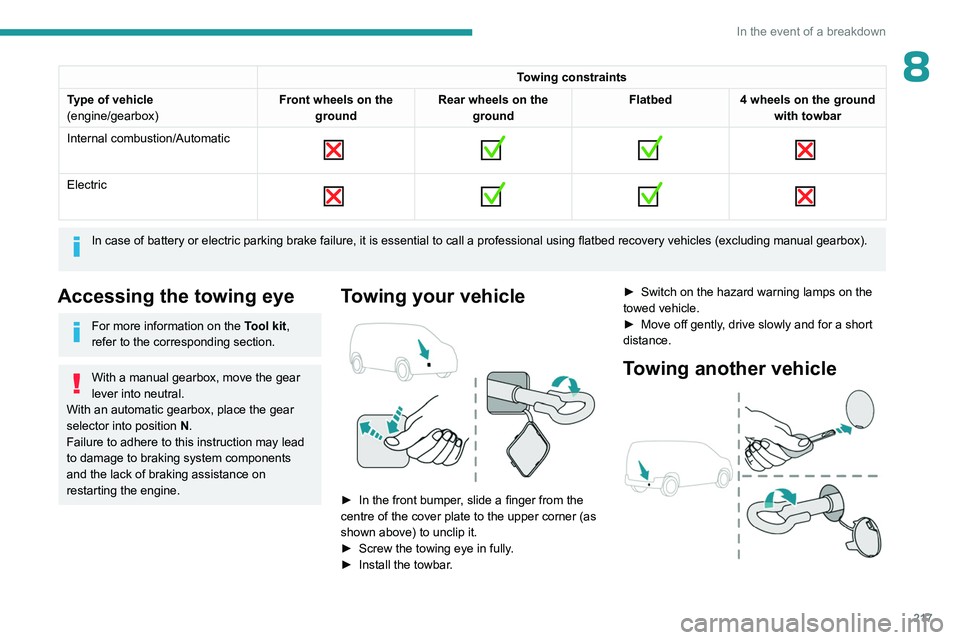
8Towing constraints
Type of vehicle
(engine/gearbox) Front wheels on the
ground Rear wheels on the
ground Flatbed
4 wheels on the ground
with towbar
Internal combustion/Automatic
Electric
In case of battery or electric parking brake failure, it is essential to call a p
rofessional using flatbed recovery vehicles (excluding manual gearbox).
Accessing the towing eye
For more information on the Tool kit,
refer to the corresponding section.
With a manual gearbox, move the gear
lever into neutral.
With an automatic gearbox, place the gear
selector into position N.
Failure to adhere to this instruction may lead
to damage to braking system components
and the lack of braking assistance on
restarting the engine.
Towing your vehicle
► In the front bumper , slide a finger from the
centre of the cover plate to the upper corner (as
shown above) to unclip it.
►
Screw the towing eye in fully
.
►
Install the towbar
. ►
Switch on the hazard warning lamps on the
towed vehicle.
►
Move off gently
, drive slowly and for a short
distance.
Towing another vehicle
Page 228 of 324
226
Technical data
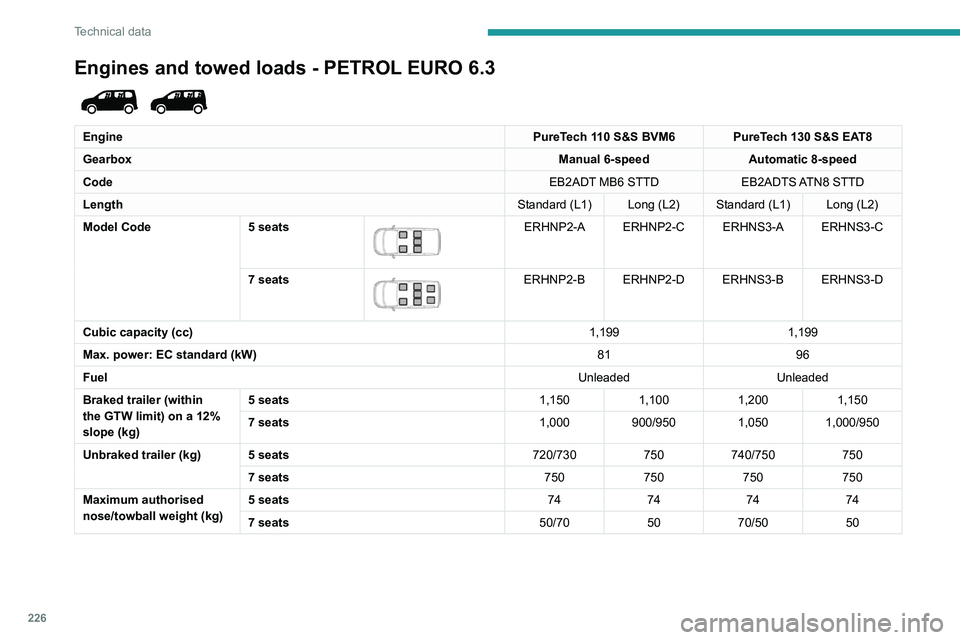
Engines and towed loads - PETROL EURO 6.3
EnginePureTech 110 S&S BVM6 PureTech 130 S&S EAT8
Gearbox Manual 6-speedAutomatic 8-speed
Code EB2ADT MB6 STTDEB2ADTS ATN8 STTD
Length Standard (L1) Long (L2) Standard (L1) Long (L2)
Model Code 5 seats
ERHNP2-A ERHNP2-C ERHNS3-A ERHNS3-C
7 seats
ERHNP2-B ERHNP2-D ERHNS3-B ERHNS3-D
Cubic capacity (cc) 1,1991,199
Max. power: EC standard (kW) 8196
Fuel UnleadedUnleaded
Braked trailer (within
the GTW limit) on a 12%
slope (kg) 5 seats
1,1501,1001,2001,150
7 seats 1,000900/950 1,0501,000/950
Unbraked trailer (kg) 5 seats 720/730750740/750 750
7 seats 750750750750
Maximum authorised
nose/towball weight (kg) 5 seats
74747474
7 seats 50/705070/50 50
Page 229 of 324
227
Technical data
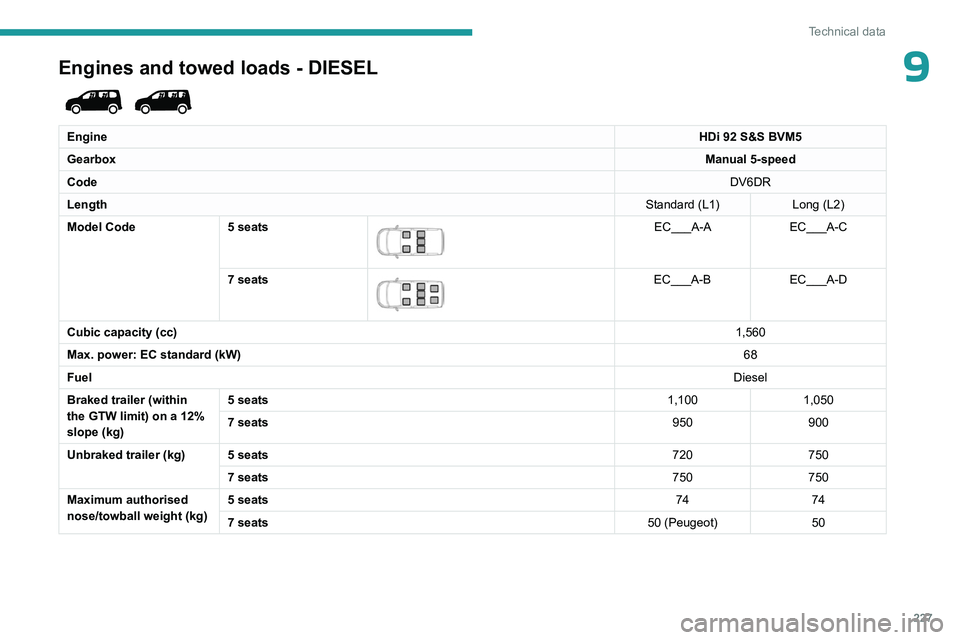
9Engines and towed loads - DIESEL
EngineHDi 92 S&S BVM5
Gearbox Manual 5-speed
Code DV6DR
Length Standard (L1)Long (L2)
Model Code 5 seats
EC___A-AEC___A-C
7 seats
EC___A-B EC___A-D
Cubic capacity (cc) 1,560
Max. power: EC standard (kW) 68
Fuel Diesel
Braked trailer (within
the GTW limit) on a 12%
slope (kg) 5 seats
1,1001,050
7 seats 950900
Unbraked trailer (kg) 5 seats 720750
7 seats 750750
Maximum authorised
nose/towball weight (kg) 5 seats
7474
7 seats 50 (Peugeot)50
Page 230 of 324
228
Technical data
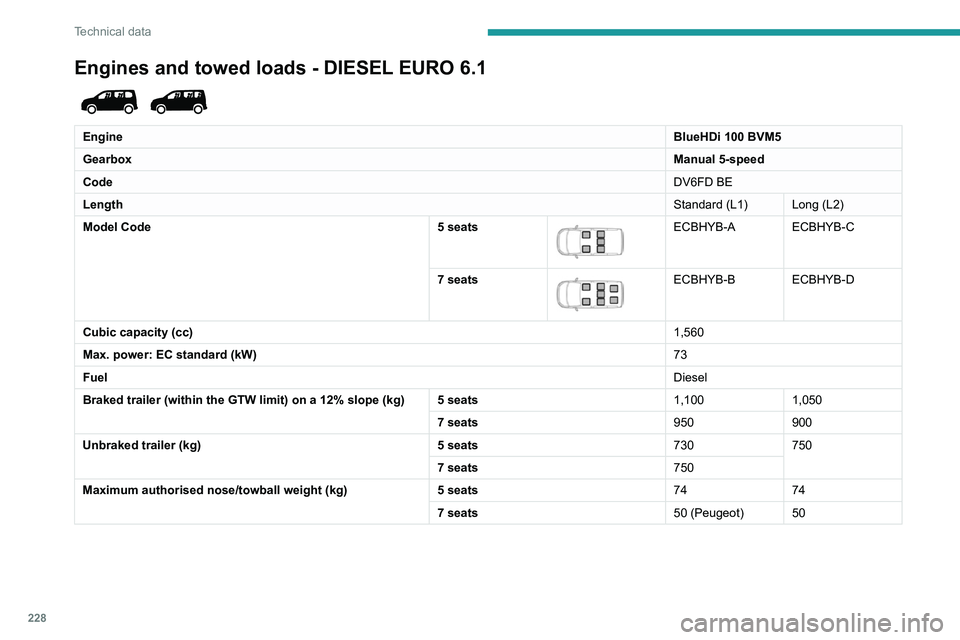
Engines and towed loads - DIESEL EURO 6.1
EngineBlueHDi 100 BVM5
Gearbox Manual 5-speed
Code DV6FD BE
Length Standard (L1) Long (L2)
Model Code 5 seats
ECBHYB-A ECBHYB-C
7 seats
ECBHYB-B ECBHYB-D
Cubic capacity (cc) 1,560
Max. power: EC standard (kW) 73
Fuel Diesel
Braked trailer (within the GTW limit) on a 12% slope (kg) 5 seats 1,1001,050
7 seats 950900
Unbraked trailer (kg) 5 seats730750
7 seats 750
Maximum authorised nose/towball weight (kg) 5 seats7474
7 seats 50 (Peugeot) 50
Page 231 of 324
229
Technical data
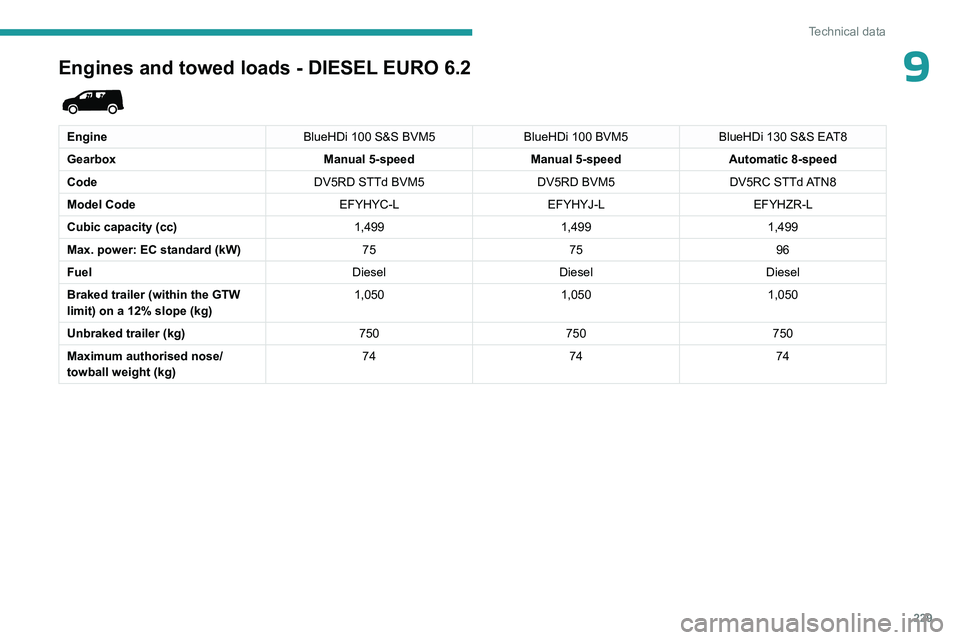
9Engines and towed loads - DIESEL EURO 6.2
EngineBlueHDi 100 S&S BVM5BlueHDi 100 BVM5BlueHDi 130 S&S EAT8
Gearbox Manual 5-speedManual 5-speedAutomatic 8-speed
Code DV5RD STTd BVM5DV5RD BVM5DV5RC STTd ATN8
Model Code EFYHYC-LEFYHYJ-LEFYHZR-L
Cubic capacity (cc) 1,4991,4991,499
Max. power: EC standard (kW) 757596
Fuel DieselDieselDiesel
Braked trailer (within the GTW
limit) on a 12% slope (kg) 1,050
1,0501,050
Unbraked trailer (kg) 750750750
Maximum authorised nose/
towball weight (kg) 74
7474
Page 232 of 324
230
Technical data
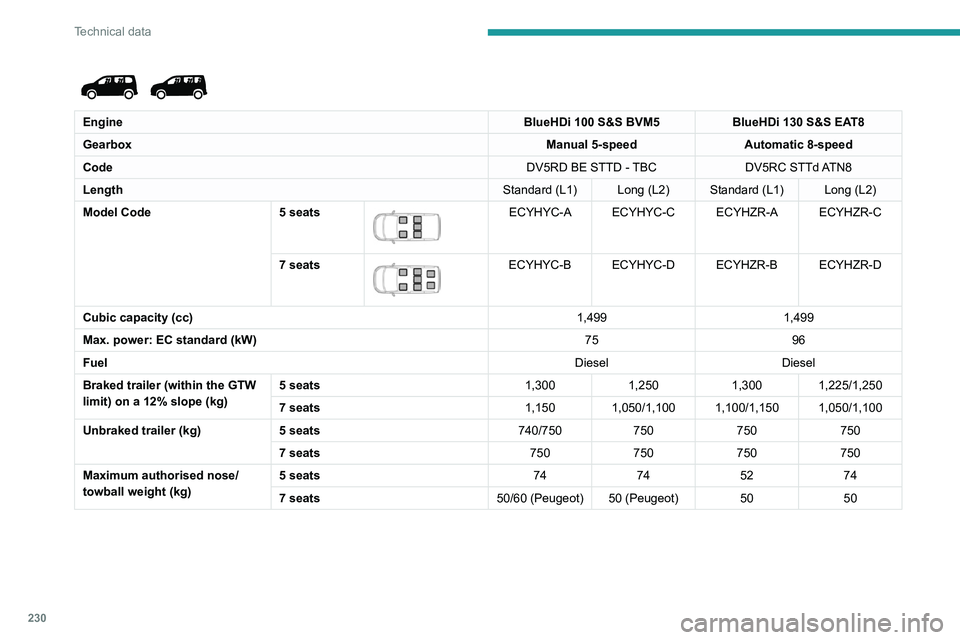
EngineBlueHDi 100 S&S BVM5BlueHDi 130 S&S EAT8
Gearbox Manual 5-speedAutomatic 8-speed
Code DV5RD BE STTD - TBCDV5RC STTd ATN8
Length Standard (L1) Long (L2) Standard (L1) Long (L2)
Model Code 5 seats
ECYHYC-A ECYHYC-C ECYHZR-A ECYHZR-C
7 seats
ECYHYC-B ECYHYC-D ECYHZR-B ECYHZR-D
Cubic capacity (cc) 1,4991,499
Max. power: EC standard (kW) 7596
Fuel DieselDiesel
Braked trailer (within the GTW
limit) on a 12% slope (kg) 5 seats
1,3001,2501,300 1,225/1,250
7 seats 1,150 1,050/1,100 1,100/1,150 1,050/1,100
Unbraked trailer (kg) 5 seats 740/750750750750
7 seats 750750750750
Maximum authorised nose/
towball weight (kg) 5 seats
74745274
7 seats 50/60 (Peugeot) 50 (Peugeot) 5050