charging PEUGEOT PARTNER TEPEE ELECTRIC 2017 User Guide
[x] Cancel search | Manufacturer: PEUGEOT, Model Year: 2017, Model line: PARTNER TEPEE ELECTRIC, Model: PEUGEOT PARTNER TEPEE ELECTRIC 2017Pages: 252, PDF Size: 9.89 MB
Page 23 of 252
21
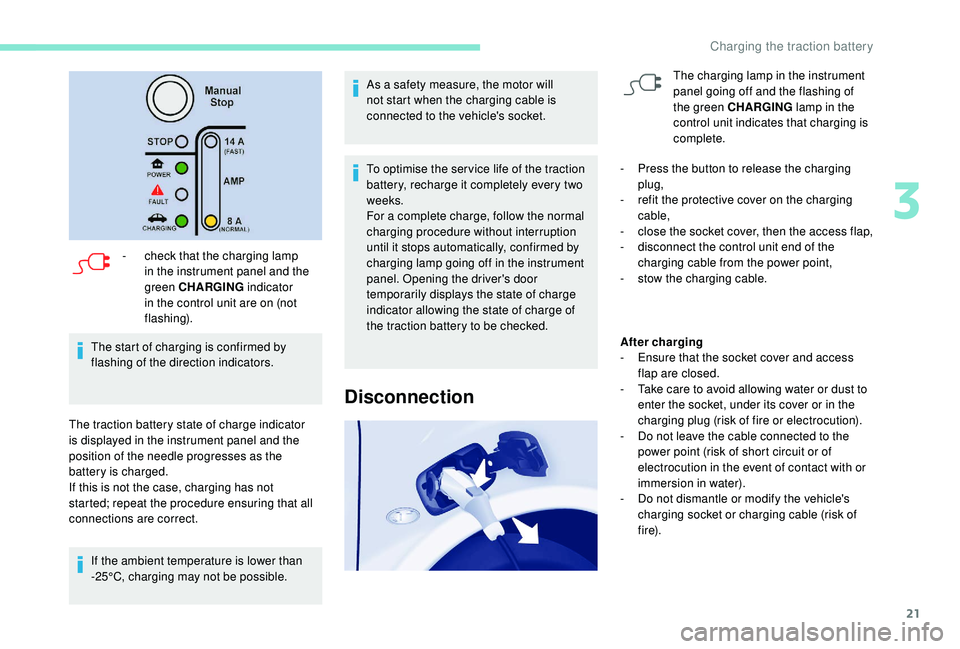
- check that the charging lamp in the instrument panel and the
green CHARGING indicator
in the control unit are on (not
flashing).
The start of charging is confirmed by
flashing of the direction indicators.
The traction battery state of charge indicator
is displayed in the instrument panel and the
position of the needle progresses as the
battery is charged.
If this is not the case, charging has not
started; repeat the procedure ensuring that all
connections are correct. If the ambient temperature is lower than
-25°C, charging may not be possible. As a safety measure, the motor will
not start when the charging cable is
connected to the vehicle's socket.
To optimise the ser vice life of the traction
battery, recharge it completely every two
weeks.
For a complete charge, follow the normal
charging procedure without interruption
until it stops automatically, confirmed by
charging lamp going off in the instrument
panel. Opening the driver's door
temporarily displays the state of charge
indicator allowing the state of charge of
the traction battery to be checked.
Disconnection
The charging lamp in the instrument
panel going off and the flashing of
the green CHARGING
lamp in the
control unit indicates that charging is
complete.
-
P
ress the button to release the charging
plug,
-
r
efit the protective cover on the charging
cable,
-
c
lose the socket cover, then the access flap,
-
d
isconnect the control unit end of the
charging cable from the power point,
-
s
tow the charging cable.
After charging
-
E
nsure that the socket cover and access
flap are closed.
-
T
ake care to avoid allowing water or dust to
enter the socket, under its cover or in the
charging plug (risk of fire or electrocution).
-
D
o not leave the cable connected to the
power point (risk of short circuit or of
electrocution in the event of contact with or
immersion in water).
-
D
o not dismantle or modify the vehicle's
charging socket or charging cable (risk of
f i r e).
3
Charging the traction battery
Page 24 of 252
22
Take care of the cable and its
control unit
- Do not tread on it, submerge it in water, pull on it, or subject it to impacts. If the charging
cable or its control unit is damaged or worn,
do not use it.
-
T
o replace it, contact a franchised dealer or
a qualified workshop.
-
T
he same applies in the event of an impact,
even light, against the charging access flap
or the cover.
When charging has finished but the
cable is still connected, opening the
driver's door restarts charging for around
20
seconds.
Fast charging procedure
If you wear a pacemaker or any
other electrical medical device,
you must not use fast charging.
Do not approach a fast charging
point. However, if this happens,
leave the area as quickly as
possible. If necessary, ask
another person to charge your
vehicle.
Ensure that the charging point and its
cable are compatible with your vehicle.
-
C
heck before charging that the drive
selector is in position P and the ignition is
off, other wise charging is not possible, -
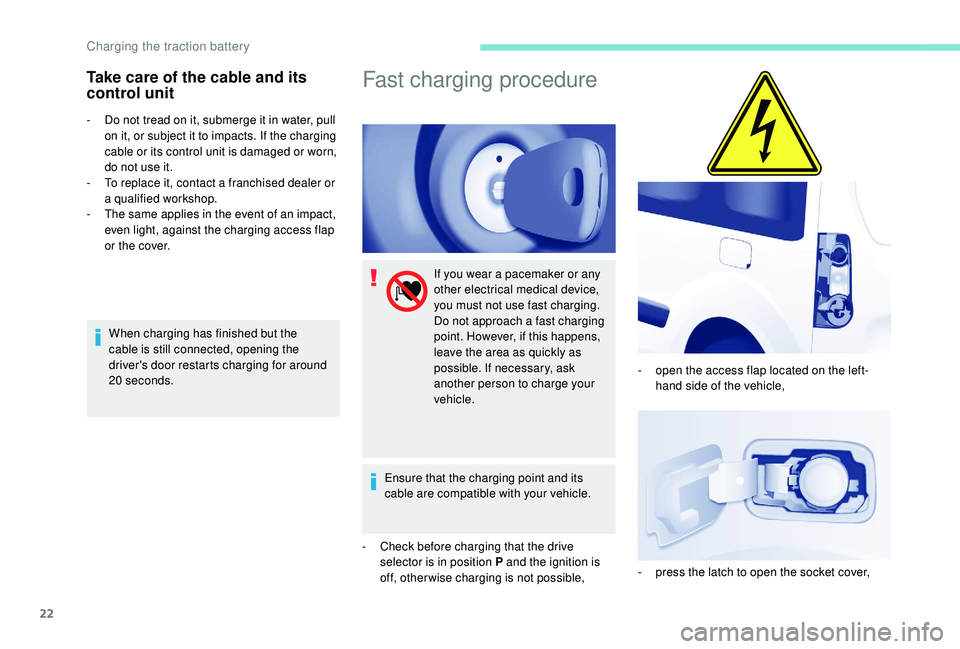
o
pen the access flap located on the left-
hand side of the vehicle,
-
p
ress the latch to open the socket cover,
Charging the traction battery
Page 25 of 252
23
Do not touch the metal end of the fast
charging socket or of the charging cable.
Risk of electrocution and/or malfunctions.The start of charging is confirmed by
flashing of the direction indicators.
Completion of charging is indicated by the
charging point.
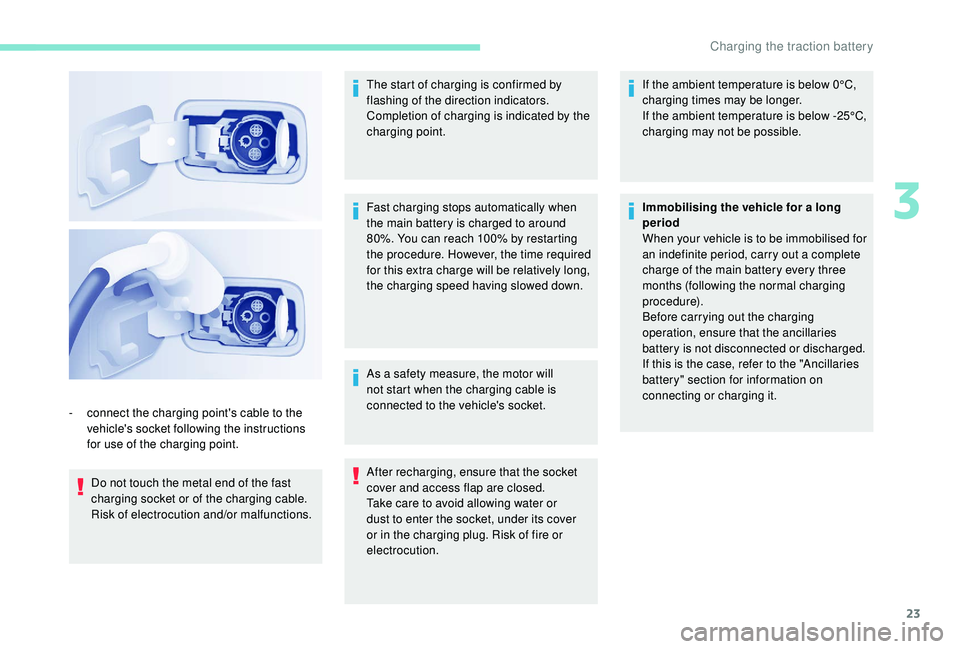
-
c
onnect the charging point's cable to the
vehicle's socket following the instructions
for use of the charging point. Fast charging stops automatically when
the main battery is charged to around
80%. You can reach 100% by restarting
the procedure. However, the time required
for this extra charge will be relatively long,
the charging speed having slowed down.
As a safety measure, the motor will
not start when the charging cable is
connected to the vehicle's socket.
After recharging, ensure that the socket
cover and access flap are closed.
Take care to avoid allowing water or
dust to enter the socket, under its cover
or in the charging plug. Risk of fire or
electrocution.If the ambient temperature is below 0°C,
charging times may be longer.
If the ambient temperature is below -25°C,
charging may not be possible.
Immobilising the vehicle for a long
period
When your vehicle is to be immobilised for
an indefinite period, carry out a complete
charge of the main battery every three
months (following the normal charging
procedure).
Before carrying out the charging
operation, ensure that the ancillaries
battery is not disconnected or discharged.
If this is the case, refer to the "Ancillaries
battery" section for information on
connecting or charging it.
3
Charging the traction battery
Page 26 of 252
24
Other information
Traction battery
Do not make any modification to the
drive train, this could cause a risk of
malfunction.
300 Volt electrical system
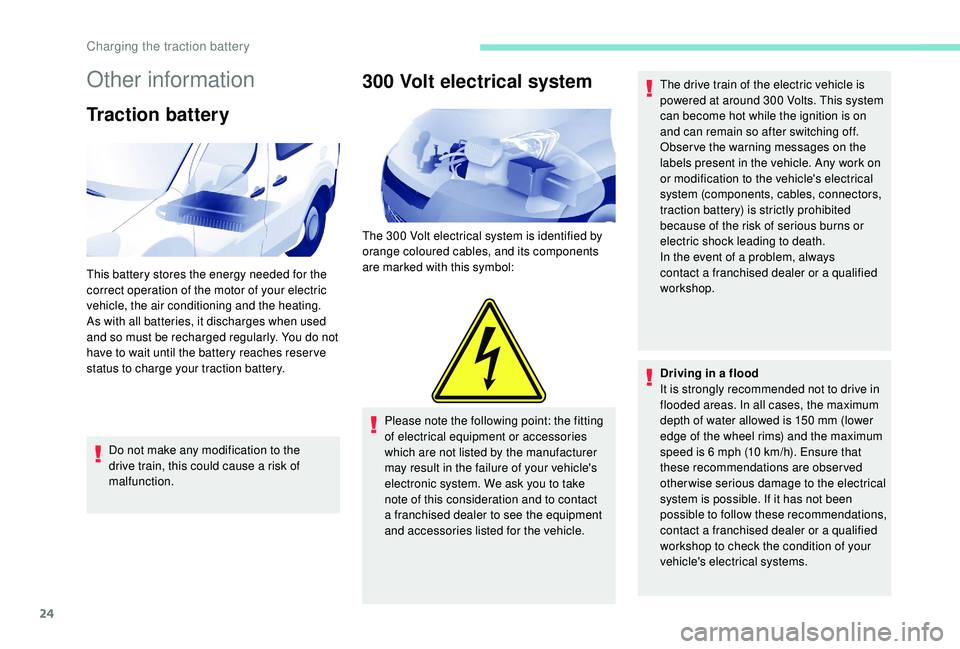
The 300 Volt electrical system is identified by
o range coloured cables, and its components
are marked with this symbol:
Please note the following point: the fitting
of electrical equipment or accessories
which are not listed by the manufacturer
may result in the failure of your vehicle's
electronic system. We ask you to take
note of this consideration and to contact
a franchised dealer to see the equipment
and accessories listed for the vehicle. The drive train of the electric vehicle is
powered at around 300
Volts. This system
can become hot while the ignition is on
and can remain so after switching off.
Obser ve the warning messages on the
labels present in the vehicle. Any work on
or modification to the vehicle's electrical
system (components, cables, connectors,
traction battery) is strictly prohibited
because of the risk of serious burns or
electric shock leading to death.
In the event of a problem, always
contact a franchised dealer or a qualified
workshop.
Driving in a flood
It is strongly recommended not to drive in
flooded areas. In all cases, the maximum
depth of water allowed is 150
mm (lower
edge of the wheel rims) and the maximum
speed is 6
mph (10 km/h). Ensure that
these recommendations are observed
otherwise serious damage to the electrical
system is possible. If it has not been
possible to follow these recommendations,
contact a franchised dealer or a qualified
workshop to check the condition of your
vehicle's electrical systems.
This battery stores the energy needed for the
correct operation of the motor of your electric
vehicle, the air conditioning and the heating.
As with all batteries, it discharges when used
and so must be recharged regularly. You do not
have to wait until the battery reaches reser ve
status to charge your traction battery.
Charging the traction battery
Page 27 of 252
25
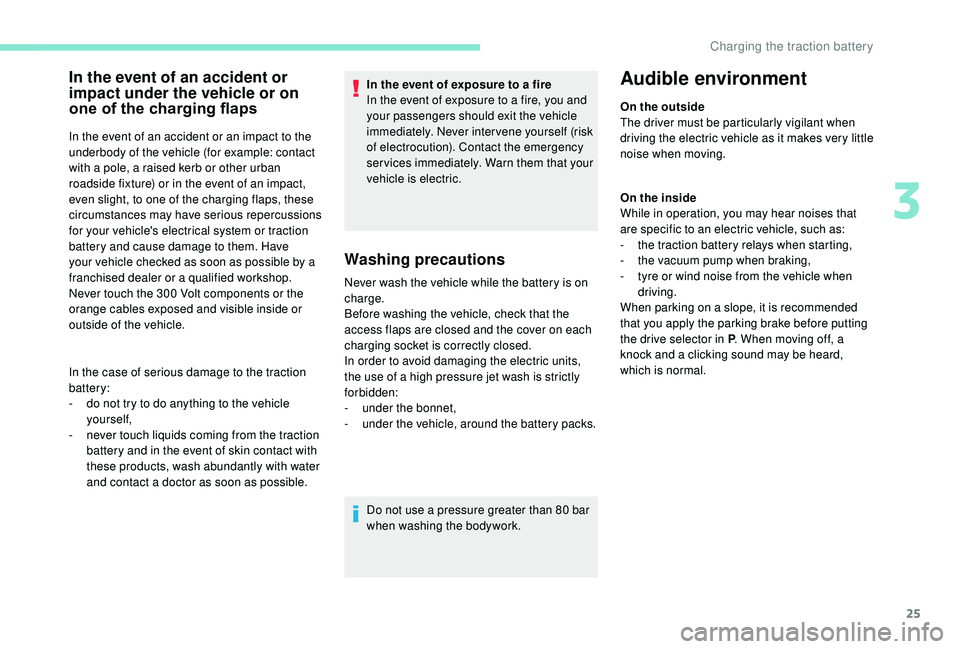
In the event of an accident or
impact under the vehicle or on
one of the charging flaps
In the event of an accident or an impact to the
underbody of the vehicle (for example: contact
with a pole, a raised kerb or other urban
roadside fixture) or in the event of an impact,
even slight, to one of the charging flaps, these
circumstances may have serious repercussions
for your vehicle's electrical system or traction
battery and cause damage to them. Have
your vehicle checked as soon as possible by a
franchised dealer or a qualified workshop.
Never touch the 300 Volt components or the
orange cables exposed and visible inside or
outside of the vehicle.
In the case of serious damage to the traction
battery:
-
d
o not try to do anything to the vehicle
yourself,
-
n
ever touch liquids coming from the traction
battery and in the event of skin contact with
these products, wash abundantly with water
and contact a doctor as soon as possible. In the event of exposure to a fire
In the event of exposure to a fire, you and
your passengers should exit the vehicle
immediately. Never intervene yourself (risk
of electrocution). Contact the emergency
ser vices immediately. Warn them that your
vehicle is electric.
Washing precautions
Never wash the vehicle while the battery is on
charge.
Before washing the vehicle, check that the
access flaps are closed and the cover on each
charging socket is correctly closed.
In order to avoid damaging the electric units,
the use of a high pressure jet wash is strictly
forbidden:
-
u
nder the bonnet,
-
u
nder the vehicle, around the battery packs.
Do not use a pressure greater than 80
bar
when washing the bodywork.
Audible environment
On the outside
The driver must be particularly vigilant when
driving the electric vehicle as it makes very little
noise when moving.
On the inside
While in operation, you may hear noises that
are specific to an electric vehicle, such as:
-
t
he traction battery relays when starting,
-
t
he vacuum pump when braking,
-
t
yre or wind noise from the vehicle when
driving.
When parking on a slope, it is recommended
that you apply the parking brake before putting
the drive selector in P . When moving off, a
knock and a clicking sound may be heard,
which is normal.
3
Charging the traction battery
Page 28 of 252
26
Vehicle immobilisation
Long term
When your vehicle is to be immobilised for an
indefinite period, carry out a complete recharge
of the traction battery every three months
(following the normal charging procedure).
Before carrying out the charging operation,
ensure that the ancillaries battery is not
disconnected or discharged. If this is the case,
refer to the "Ancillaries battery" section for
information on connecting or charging it.Precautions to take when charging the
battery
-
D
o not stay inside or near the vehicle.
This is particularly important if you wear
a pacemaker or other electrical medical
device. For complete information on the
precautions to take, contact your doctor.
-
N
ever do any work under the bonnet as
there is a risk of serious injury.
Risk of cuts as the fan may start turning
at any time. Risk of burns as some areas
remain very hot even one hour after the
end of the charging operation.
Charging the traction battery
Page 29 of 252
27
Ancillaries battery
All other electrical components on your vehicle
are powered by the ancillaries battery.
It is located in the front compartment under the
bonnet and is charged by the traction battery,
during the operation ("Ready" lamp in the
instrument panel) and charging phases.If the ancillaries battery is discharged,
the electric motor cannot be started and
charging of the traction battery is no
longer possible.
It is recommended that the ancillaries
battery be disconnected if the vehicle is
not to be used for more than a month.
Access to the battery Starting using an external battery
Ensure that the backup battery is a 12 volt
b attery.
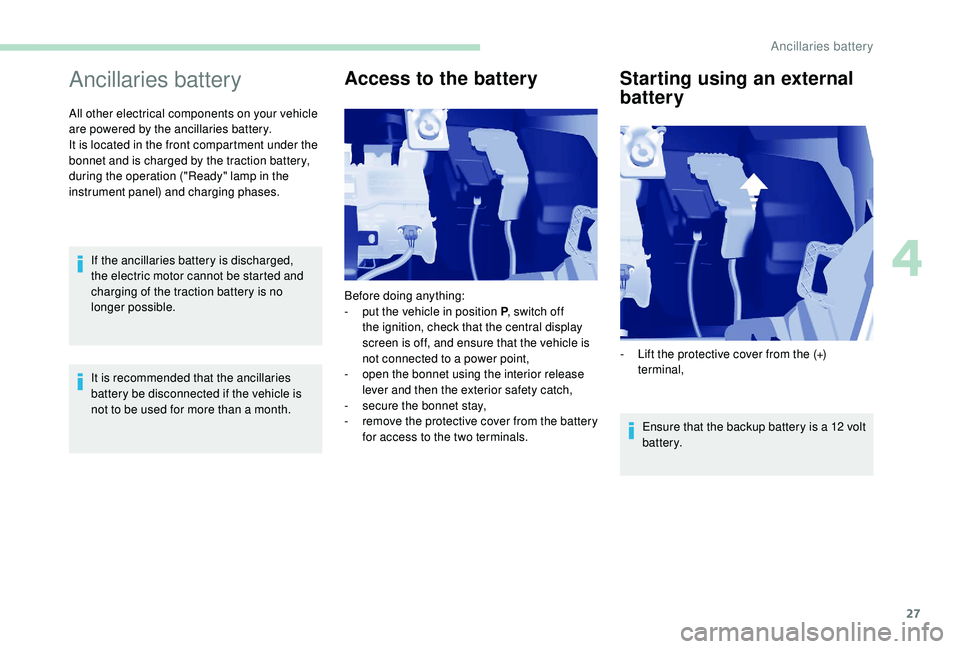
Before doing anything:
-
p
ut the vehicle in position P
, switch off
the ignition, check that the central display
screen is off, and ensure that the vehicle is
not connected to a power point,
-
o
pen the bonnet using the interior release
lever and then the exterior safety catch,
-
s
ecure the bonnet stay,
-
r
emove the protective cover from the battery
for access to the two terminals. -
L
ift the protective cover from the (+)
terminal,
4
Ancillaries battery
Page 30 of 252
28
Charging the battery using
a battery charger
Do not charge the battery without first
disconnecting the terminals and removing the
battery from the front compartment.
Do not disconnect the terminals
when this indicator lamp is on, nor
when the vehicle itself is on charge.Before disconnecting the battery
Wait 2
minutes after switching off the ignition
before disconnecting the battery.
After reconnecting the battery
Following reconnection of the battery, switch
on the ignition and wait 1 minute before
starting to permit initialisation of the electronic
systems. However, if some minor problems
remain after carrying out this operation, contact
a franchised dealer or a qualified workshop.
Remember to enter the radio pre-sets yourself,
referring to the corresponding section in the
handbook.
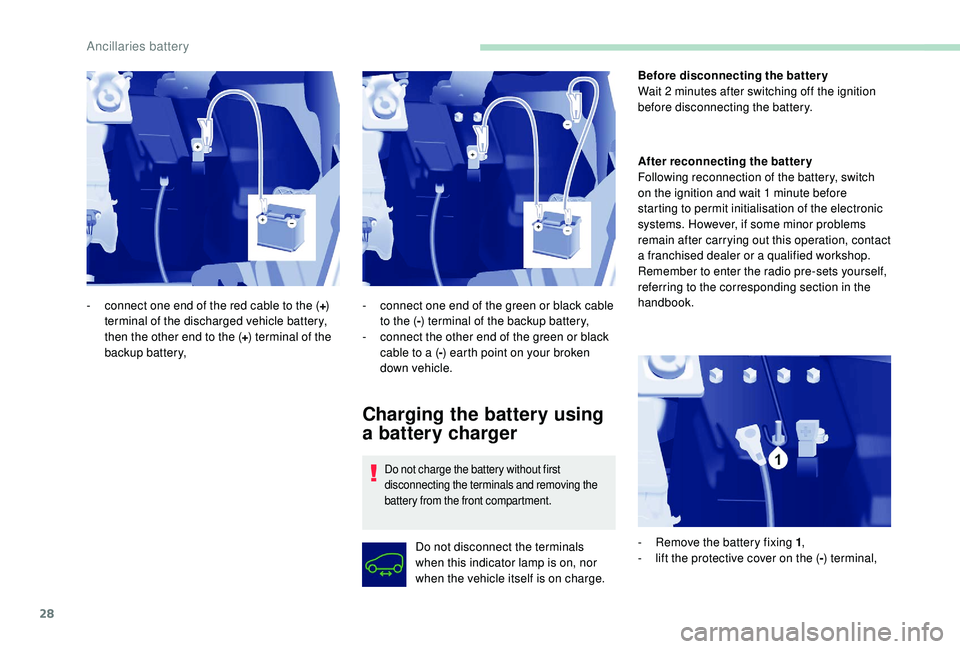
-
c
onnect one end of the red cable to the (
+)
terminal of the discharged vehicle battery,
then the other end to the ( +) terminal of the
backup battery, -
c
onnect one end of the green or black cable
to the ( -) terminal of the backup battery,
-
c
onnect the other end of the green or black
cable to a ( -) earth point on your broken
down vehicle.
- R emove the battery fixing 1
,
- l ift the protective cover on the (-) terminal,
Ancillaries battery
Page 33 of 252
31
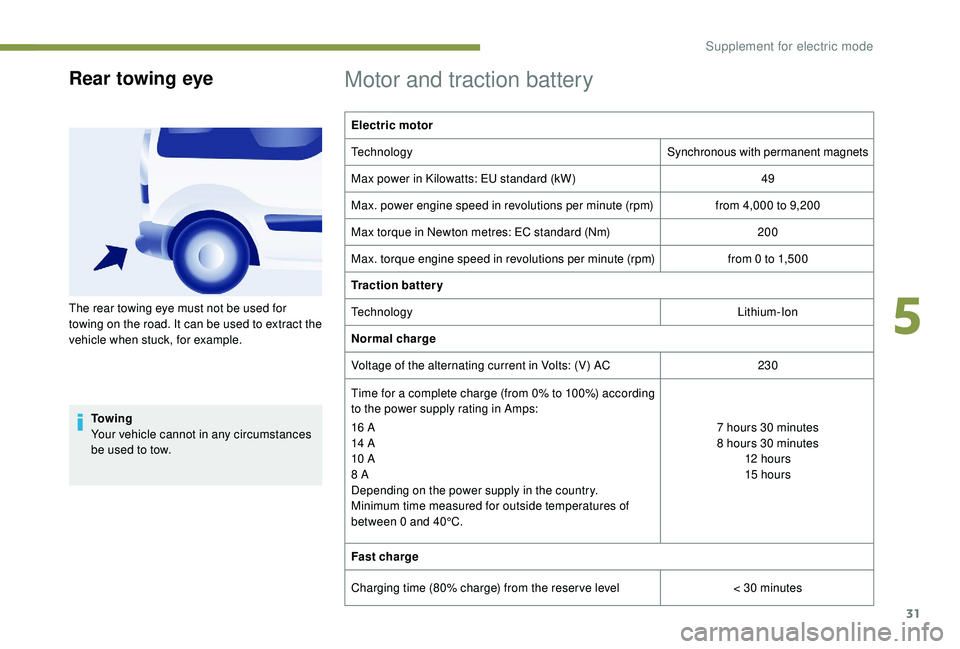
Rear towing eye
To w i n g
Your vehicle cannot in any circumstances
be used to tow.
Motor and traction battery
Electric motor
TechnologySynchronous with permanent magnets
Max power in Kilowatts: EU standard (kW) 49
Max. power engine speed in revolutions per minute (rpm) from 4,000
to 9,200
Max torque in Newton metres: EC standard (Nm) 200
Max. torque engine speed in revolutions per minute (rpm) from 0
to 1,500
Traction battery
Technology Lithium-Ion
Normal charge
Voltage of the alternating current in Volts: (V) AC 230
Time for a complete charge (from 0% to 100%) according
to the power supply rating in Amps:
16
A
14
A
10
A
8
A
Depending on the power supply in the country.
Minimum time measured for outside temperatures of
between 0
and 40°C. 7
hours 30 minutes
8
hours 30 minutes
12
hour s
15
hours
Fast charge
Charging time (80% charge) from the reser ve level < 30
minutes
The rear towing eye must not be used for
towing on the road. It can be used to extract the
vehicle when stuck, for example.
5
Supplement for electric mode
Page 47 of 252

9
Warning/indicator lampStateCause Action/Observations
Red warning/indicator lamps
STOPFixed, associated with
another warning lamp
and accompanied
by a message in the
screen. Major faults linked with the "Brake
fluid level", "Engine oil pressure
and temperature", "Engine
coolant temperature", "Electronic
brake force distribution" and
"Power steering" warning lamps. You must stop as soon as it is safe to do so.
Park, switch off the ignition and call a PEUGEOT
dealer or qualified workshop.
Engine coolant
temperature and
level Fixed, with the needle
in the red zone.
An abnormal increase in
temperature.
Park and switch off the ignition, then allow to cool down.
Check the level visually.
Flashing.
A drop in the engine coolant level. Contact a PEUGEOT dealer or a qualified workshop.
Engine oil pressure
and temperature Fixed while driving. Insufficient pressure or excessive
temperature.
Park and switch off the ignition, then allow to cool down.
Check the level visually. For more information on
Checking levels, refer to the corresponding section.
Fixed, even though the
level is correct. A major fault.
Have it checked by a PEUGEOT dealer or a qualified
workshop.
Battery charge Fixed. A fault in the charging circuit. Check the battery terminals. For more information on
the Battery, refer to the corresponding section.
Flashing. Active functions set to standby
(economy mode). For more information on the Battery
, refer to the
corresponding section.
Fixed, despite the
checks. A fault with the ignition or
injection system. Have it checked by a PEUGEOT dealer or a qualified
workshop.
1
Instruments