ignition PORSCHE CAYNNE S 2006 1.G Owner's Manual
[x] Cancel search | Manufacturer: PORSCHE, Model Year: 2006, Model line: CAYENNE S, Model: PORSCHE CAYENNE S 2006 1.GPages: 420, PDF Size: 3.81 MB
Page 44 of 420
44
Controls, Safety, Instruments
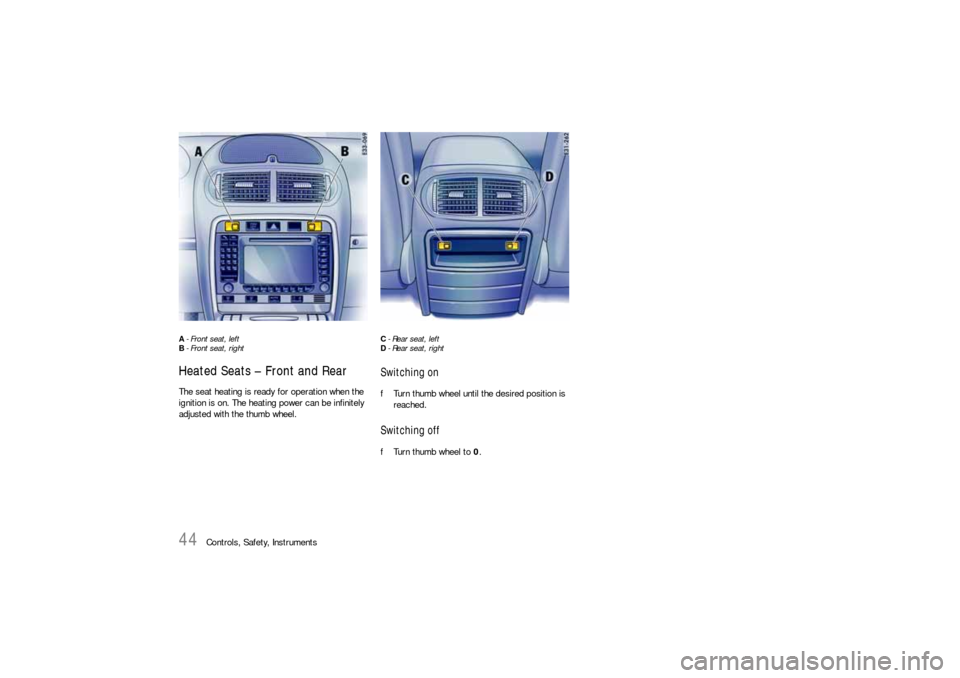
A- Front seat, left
B- Front seat, rightHeated Seats – Front and RearThe seat heating is ready for operation when the
ignition is on. The heating power can be infinitely
adjusted with the thumb wheel.
C-Rear seat, left
D- Rear seat, rightSwitching onfTurn thumb wheel until the desired position is
reached.Switching offfTurn thumb wheel to 0.
Page 47 of 420

Controls, Safety, Instruments
47
Belt tensionerDepending on the force of a collision, fastened
seat belts are automatically tightened in an acci-
dent.
The belt tensioners are triggered in:
– Front and rear impacts
– Side impacts (only belt tensioners of the front
seats are triggered)
Maintenance note
The belt tensioner system can be triggered only
once; the system must be replaced afterwards.
If there is a fault in the belt tensioner system, the
airbag warning light lights up.
Work may be performed on the belt tensioner
system only by an authorized Porsche dealer.
Smoke is released when the belt tensioners are
triggered.
This does not indicate a fire in the vehicle.An audio-visual warning system is interconnect-
ed with the driver’s safety belt.
Every time the ignition is turned on, the gong will
sound for about 6 seconds to remind driver and
passenger to buckle up.
In addition, the gong will sound if vehicle speed
exceeds 6 mph (10 km/h).
The safety belt warning lights in the instrument
panel and multi-purpose display will go off as soon
as the driver has buckled up.
Safety Belt Warning System
Page 52 of 420

52
Controls, Safety, Instruments
Function of the airbag systemThe front airbags are triggered during a frontal col-
lision of sufficient force and direction.
In the event of a side impact of corresponding
force, the side airbag on the impact side is
triggered.
The inflation process generates the amount of gas
required to fill the airbags at the necessary pres-
sure in fractions of a second.
Airbags help to protect the head and upper body,
while simultaneously damping the motion of the
driver and passenger in the impact direction in the
event of a frontal impact or side impact.
Your vehicle is equipped with a crash sensing and
diagnostic module. This module will record the
use of the seat belt restraint system by the driver
and front passenger when the airbags and/or belt
tentioner are triggered.
Precondition for activating the restraint systems:
– Ignition is switched on.Advanced Airbag
Your vehicle is equipped with weight sensing for
the passenger's seat in accordance with U.S. Fed-
eral/Canadian Motor Vehicle Safety Standard
208.
Depending on the weight acting on the passen-
ger's seat, the passenger's airbag will automati-
cally be switched on and off.
Depending on the angle and force of impact, the
passenger's airbag which is switched-on will be
triggered during a collision.
Precondition for switching the passenger's airbag
on and off, depending on weight:
– Ignition is switched on.Seat adjustment for the passenger's seat
If the seat is in an extreme position (e.g., the back-
rest is in contact with the rear seat bench), the
backrest can warp. Warping of the backrest can
lead to malfunctions.
fCorrect the seat adjustment.
The seat is not jammed and is self-supporting.
The backrest is in the upright position.
fDo not transport a load and objects in the rear
footwell or under the passenger's seat.
If the load or objects are under the seat, they
can cause malfunctions.
If the weight on the passenger's seat is reduced
significantly, e.g., by supporting weight on the
armrest, the passenger's airbag can be switched
off.
fSelect an upright seat position, and do not sup-
port weight on the armrests or lean out of the
window.
Always keep feet in the footwell while driving.
Do not put feet on the dashboard or the seat
area. Do not lean against the inside of the door
or outside the window while the vehicle is mov-
ing.
If the passenger's seat is warped significantly, a
message is displayed in the multi-purpose display
in the instrument panel:
fCorrect the seat adjustment.
fPlease observe the chapter “WARNING LIGHTS
AND WARNING MESSAGES” on Page 124.
Page 53 of 420
Controls, Safety, Instruments
53
Automatic deactivation of the passenger
airbags
Danger!
The use of a child restraint system in the
front passenger seat can result in serious
personal injury or death to the child from an
airbag deployment.
To reduce risk of injury from an inflating air-
bag in an accident, Porsche strongly recom-
mends:
fUnder all normal circumstances, the child seat
must be placed in the rear.
Do not use a child restraint system in the front passenger seat.
Before transporting a child on the passenger seat:
fPlease observe the chapter “CHILD RES-
TRAINT SYSTEMS” on Page 55.
– When an up to one-year old child is seated
in the child restraint system, the front airbag is
automatically deactivated on the passenger
side.
– When an adult is seated in the front seat the
front airbag remains active on the passenger‘s
side.
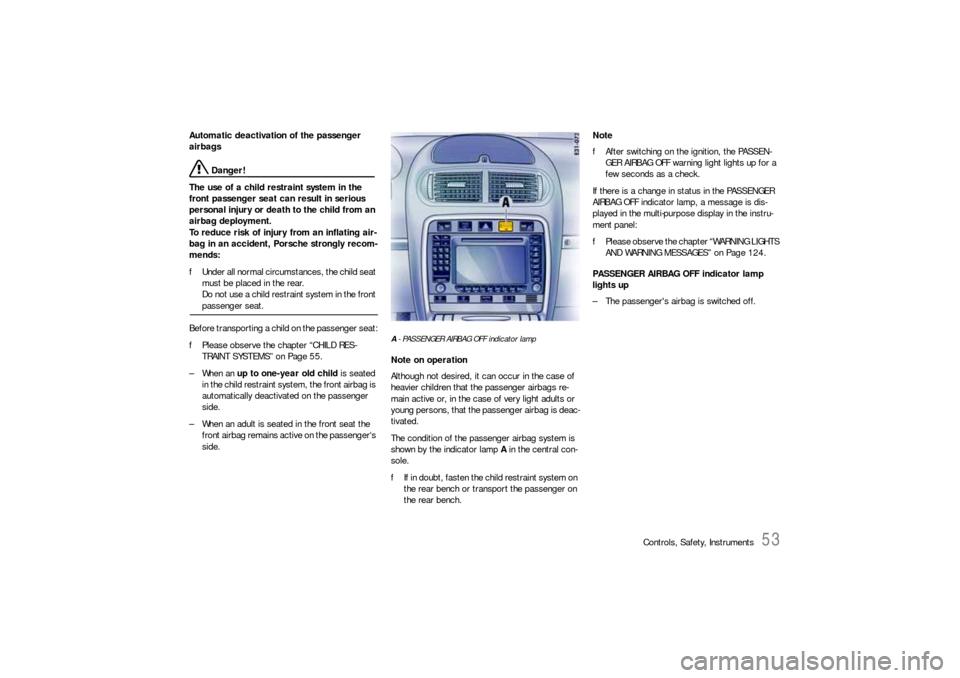
A- PASSENGER AIRBAG OFF indicator lampNote on operation
Although not desired, it can occur in the case of
heavier children that the passenger airbags re-
main active or, in the case of very light adults or
young persons, that the passenger airbag is deac-
tivated.
The condition of the passenger airbag system is
shown by the indicator lamp A in the central con-
sole.
fIf in doubt, fasten the child restraint system on
the rear bench or transport the passenger on
the rear bench.Note
fAfter switching on the ignition, the PASSEN-
GER AIRBAG OFF warning light lights up for a
few seconds as a check.
If there is a change in status in the PASSENGER
AIRBAG OFF indicator lamp, a message is dis-
played in the multi-purpose display in the instru-
ment panel:
fPlease observe the chapter “WARNING LIGHTS
AND WARNING MESSAGES” on Page 124.
PASSENGER AIRBAG OFF indicator lamp
lights up
– The passenger's airbag is switched off.
Page 54 of 420

54
Controls, Safety, Instruments PASSENGER AIRBAG OFF indicator lamp
does not light up
– The passenger's airbag is active and ready for
operation.
– If the passenger's seat is not occupied, the
PASSENGER AIRBAG OFF indicator lamp will
also not light up, even though the passenger's
airbag is switched off. Danger!
Risk of serious or mortal injury due to the
passenger airbag triggering unintentionally.
When the ignition is on and the up to one-
year old child is seated in the child restraint
system on the passenger seat the indicator
lamp „PASSENGER AIRBAG OFF“ must be on.
If the “PASSENGER AIRBAG OFF” indicator
lamp does not light up, it could indicate a
fault in the system.
In this case:
fFasten the child restraint system on the rear
bench immediately.
fHave the fault remedied at your nearest author-ized Porsche dealer.Faults are indicated by a warning light on the ta-
chometer and a message on the instrument
panel’s multi-purpose display.
fPlease observe the chapter “WARNING LIGHTS
AND WARNING MESSAGES” on Page 124.
fIn the following cases you should immedi-
ately consult an authorized Porsche
dealer in order to assure the airbag sys-
tem is functioning properly:
– If the warning light does not light up when the
ignition is switched on or
– If the warning light does not go out once the
engine is running or
– If the warning light appears while driving.
Airbag maintenanceIn order to ensure long-term functioning, the air-
bag system must be inspected by an authorized
Porsche dealer at the intervals recommended in
your Maintenance Booklet.
Important information
If you sell your Porsche, notify the purchaser that
the vehicle is equipped with airbags, and refer
them to the chapter, “Airbag Systems“, in the
owner's manual (safety and disposal rules).
Further information on the airbag system can be
found on stickers attached to the sun visors, as
well as on all airbag components.
For special recommendations on the use of child
restraints:
fPlease observe the chapter “CHILD RES-
TRAINT SYSTEMS” on Page 55.
Warning lights and warning
messages
Page 56 of 420

56
Controls, Safety, Instruments
Using child restraint systems in the front
passenger seat
Danger!
The use of a child restraint system in the
front passenger seat can result in serious
personal injury or death to the child from an
airbag deployment.
To reduce risk of injury from an inflating air-
bag in an accident, Porsche strongly recom-
mends:
fUnder all normal circumstances, the child seat
must be placed in the rear.
Do not use a child restraint system in the front passenger seat.However, there may be serious situations where it
might be necessary to place a child in the front
seat so that he/she can be kept under direct ob-
servation to prevent an immediate risk to the child
(for example, while driving to the doctor or hospi-
tal). The following instructions are provided to you
solely for that purpose.
fSeek appropriate advice from your authorized
Porsche dealer about the possible installation
of a Porsche child restraint system.
fIf a child restraint system must be fastened to
the passenger's seat, adjust the passenger's
seat as far away from the airbag as possible.
fIf emergency or other serious conditions re-
quire a child to be placed in the front seat, ex-
ercise extreme caution and defensive driving
of your vehicle. You must recognize that any
substantial frontal impact could result in the
deployment of the passenger airbag, which
could lead to serious injury or death of the
child.Child restraint system for up to one-year old
children
If the child restraint system must be fastened to
the passenger's seat in exceptional cases:
– make sure that the PASSENGER AIRBAG OFF
indicator lamp lights up.
– adjust the passenger's seat as far away from
the airbag as possible
Danger!
Risk of serious personal injury or death due
to the passenger airbag triggering uninten-
tionally.
When the ignition is on and the up to one-
year old child is seated in the child restraint
system on the passenger seat the indicator
lamp “PASSENGER AIRBAG OFF” must be on.
If the “PASSENGER AIRBAG OFF” indicator
lamp does not light up, it could indicate a
fault in the system.
In this case:
fFasten the child restraint system on the rear
bench immediately.
fHave the fault remedied at your nearest author-ized Porsche dealer.
Page 57 of 420

Controls, Safety, Instruments
57
Child restraint system for children older than
one year
Your vehicle is equipped with weight sensing for
the passenger's seat in accordance with U.S. Fed-
eral Motor Vehicle Safety Standard 208. Depend-
ing on the weight acting on the passenger's seat,
the passenger's airbag will automatically be
switched on or off.
fIn case of doubt, fasten the child restraint sys-
tem on the rear bench.Small adult passengers
fMake sure that the PASSENGER AIRBAG OFF
indicator lamp does not light up.
Danger!
Risk of serious or mortal injury due to the
passenger airbag not triggering.
When the ignition is on and the small adult
passenger is seated on the passenger seat,
the indicator lamp “PASSENGER AIRBAG
OFF” must be off.
If the “PASSENGER AIRBAG OFF” indicator
lamp lights up, it could indicate a fault in the
system.
In this case:
fCarry the passenger on the rear bench.
fHave the fault remedied at your nearest author-ized Porsche dealer.
Page 62 of 420
62
Controls, Safety, Instruments
Steering WheelTiptronic rocker switchesThe Porsche Tiptronic is a six-speed transmission
and features an “automatic” and a “manual” gear-
shift mode.
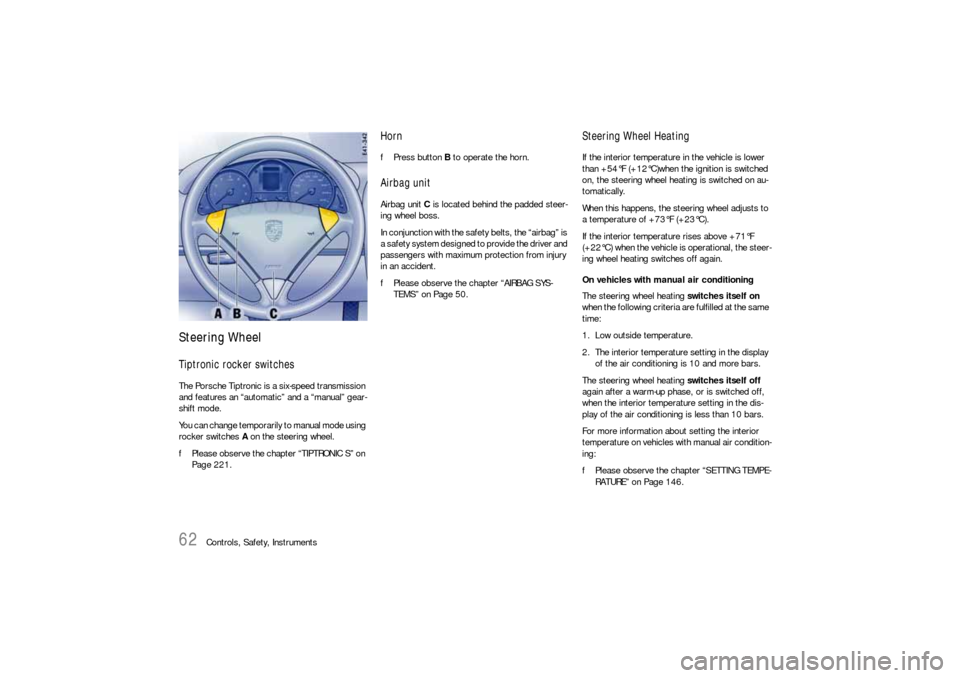
You can change temporarily to manual mode using
rocker switches A on the steering wheel.
fPlease observe the chapter “TIPTRONIC S” on
Page 221.
HornfPress button B to operate the horn.Airbag unitAirbag unit C is located behind the padded steer-
ing wheel boss.
In conjunction with the safety belts, the “airbag” is
a safety system designed to provide the driver and
passengers with maximum protection from injury
in an accident.
fPlease observe the chapter “AIRBAG SYS-
TEMS” on Page 50.
Steering Wheel HeatingIf the interior temperature in the vehicle is lower
than +54°F (+12°C)when the ignition is switched
on, the steering wheel heating is switched on au-
tomatically.
When this happens, the steering wheel adjusts to
a temperature of +73°F (+23°C).
If the interior temperature rises above +71°F
(+22°C) when the vehicle is operational, the steer-
ing wheel heating switches off again.
On vehicles with manual air conditioning
The steering wheel heating switches itself on
when the following criteria are fulfilled at the same
time:
1. Low outside temperature.
2. The interior temperature setting in the display
of the air conditioning is 10 and more bars.
The steering wheel heating switches itself off
again after a warm-up phase, or is switched off,
when the interior temperature setting in the dis-
play of the air conditioning is less than 10 bars.
For more information about setting the interior
temperature on vehicles with manual air condition-
ing:
fPlease observe the chapter “SETTING TEMPE-
RATURE” on Page 146.
Page 64 of 420
64
Controls, Safety, Instruments
Multi-Functional Steering Wheel
Warning!
There is a danger of accident if you set or
operate the on-board computer, radio, navi-
gation system, telephone or other equipment
when driving.
This could distract you from the traffic and
cause you to lose control of the vehicle.
fOperate the components while driving only if
the traffic situation allows you to do so safely.
fCarry out any complicated operating or setting procedures only with the vehicle stationary.
Depending on the equipment in your vehicle, you
can use these function keys to operate the follow-
ing Porsche communication systems:
– Telephone,
– Radio with CD drive,
–CD changer,
– Satelite radio.
Readiness for operation of multi-
functional steering wheel– With ignition switched on and
– With Porsche communication systems
switched on.
fPlease observe the operating instructions sup-
plied for the Porsche communication systems
before operating the function keys.
Note on operation
The Porsche communication systems cannot be
switched on and off using the multi-functional
steering wheel.
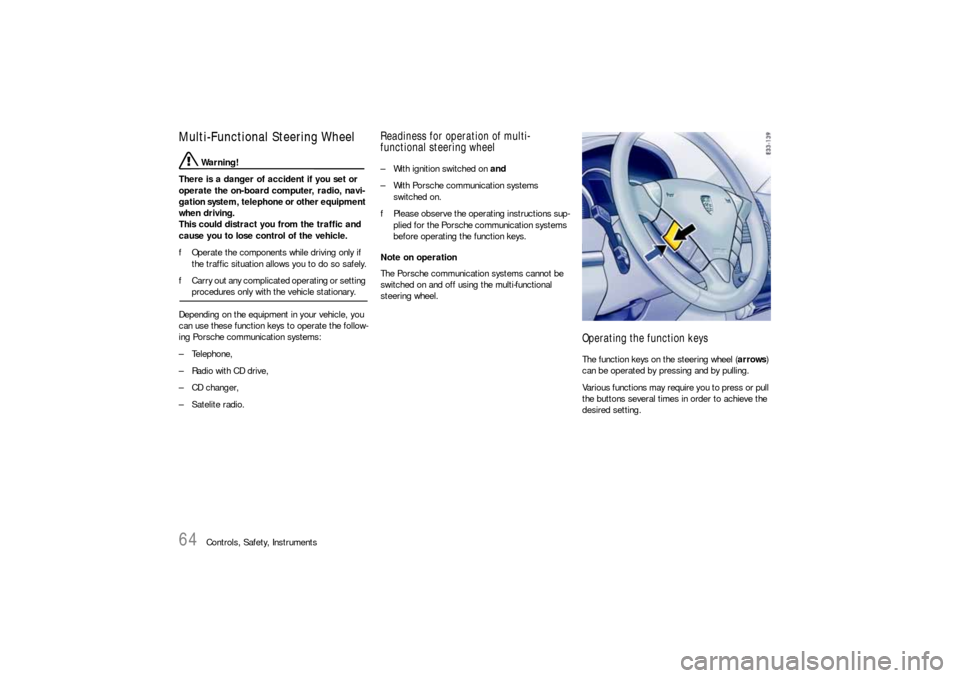
Operating the function keysThe function keys on the steering wheel (arrows)
can be operated by pressing and by pulling.
Various functions may require you to press or pull
the buttons several times in order to achieve the
desired setting.
Page 67 of 420

Controls, Safety, Instruments
67
A- Door mirror setting – driver’s side
B- Heat door mirror
C- Door mirror setting – passenger’s side
D- Fold in door mirrorsDoor MirrorsThe convex mirror glass on the passenger's side
provides a larger field of view.
Warning!
Risk of accident. Vehicles or objects appear
smaller in convex mirrors and further away
than they are in reality.
fBear this distortion in mind when estimating
the distance of vehicles behind you and when
reversing into a parking space.
fAlso make use of the interior mirror for judging
the distance.
Risk of damage to the door mirrors when
washing the vehicle in a car wash.
fFold in door mirrors before using the car wash.Adjusting mirrors1. Switch ignition on.
2. Select A for the driver’s side or C for the
passenger’s side by turning the control switch.
3. Move the door mirrors in the appropriate
direction by tilting the control switch.
If the electrical adjustment facility fails
fAdjust the mirror by pressing on the mirror
face.Adjusting the door mirrors synchronously
In the multi-purpose display of the instrument pan-
el, you have the option of adjusting the door mir-
rors synchronously.
fPlease observe the chapter “MIRRORS” on
Page 121.
Folding in door mirrorfSwitch ignition on.
fTurn control switch to D.
Both door mirrors fold in automatically.
If the electrical adjustment facility fails
fFold in mirror manually.Unfolding door mirrorsfSwitch ignition on.
fTurn control switch to A or C.
Both door mirrors unfold automatically.
If the electrical adjustment facility fails
fUnfold mirrors manually.