ECO mode RENAULT ALASKAN 2017 Workshop Manual
[x] Cancel search | Manufacturer: RENAULT, Model Year: 2017, Model line: ALASKAN, Model: RENAULT ALASKAN 2017Pages: 340, PDF Size: 6.93 MB
Page 226 of 340
NOTE
When the Stop/Start System indicator illumi-
nates, the engine starts running automatically
under at least one of the following conditions:
• The battery voltage becomes low (due to elec-
trical load from other vehicle systems like
headlights, heaters, etc., or auxiliary devices
connected to the 12 volt socket inside the
vehicle).
• The vehicle speed is above about
2km/h (1
MPH).
• The front defogger is operated.
• When the temperature inside the vehicle is
too high or low. (When the air conditioner is
off, the Stop/Start System will operate.)
• When the front defogger is turned on. (The
engine may not start depending on the out-
side temperature.)
• When the battery capacity is low.
• When the power consumption is high.
• When the clutch pedal is depressed.
CAUTION
Only engage gear when the clutch pedal is fully
depressed. NOTE
The following conditions will prevent the Stop/
Start System from automatically restarting the
engine. Starting the engine with the ignition
switch operation is then necessary:
• The driver’s seat belt is unfastened, and driv-
er’s door is open.
• The bonnet is open.
Use this system while waiting at stoplight, etc. When
the vehicle is stopped for long periods of time, turn
off the engine.
When the engine is stopped by the Stop/Start Sys-
tem, heating, cooling and dehumidifying functions
will be deactivated. To avoid the air conditioning
functions from being deactivated, turn off the Idling
Stop mode by pressing the Stop/Start OFF switch.
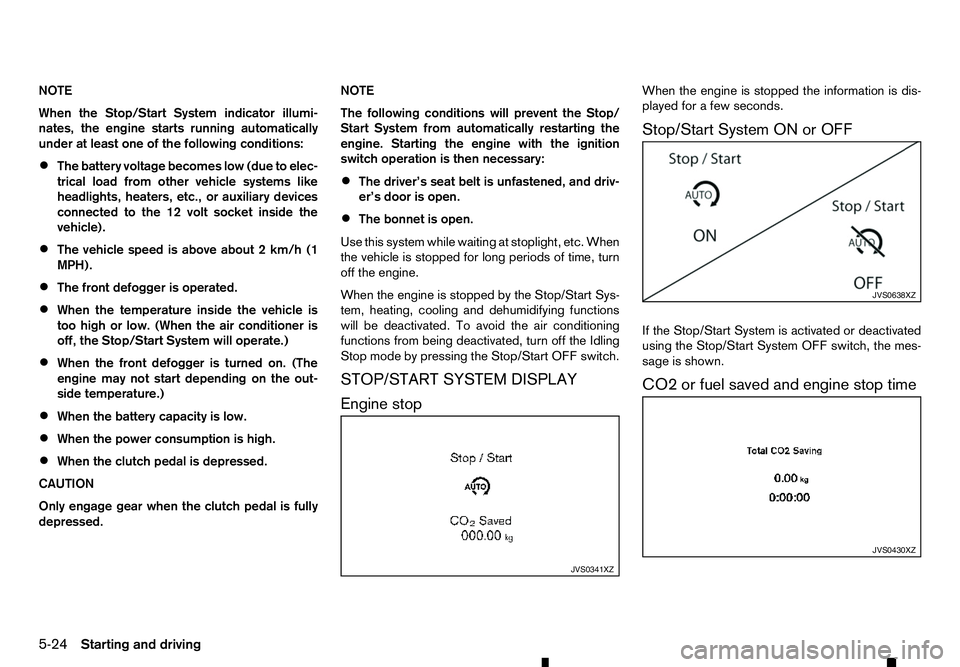
STOP/START SYSTEM DISPLAY
Engine stop When the engine is stopped the information is dis-
played for
afew seconds.
Stop/Start System ON or OFF
If the Stop/Start System is activated or deactivated
using the Stop/Start System OFF switch, the mes-
sage is shown.
CO2 or fuel saved and engine stop time JVS0341XZ JVS0638XZ
JVS0430XZ
5-24 Starting and driving
Page 228 of 340
•
Whenever the Stop/Start System is deactivated
the indicator light ➀on the Stop/Start OFF
switch illuminates. In this condition the Stop/
Start System cannot prevent unnecessary fuel
consumption, exhaust emissions, or noise dur-
ing your journey.
• If the Stop/Start System is malfunctioning, the
indicator light
➀on the Stop/Start OFF switch
illuminates.
NOTE
The Stop/Start System ON or OFF messages dis-
played for afew seconds in the vehicle informa-
tion display when the Stop/Start OFF switch is
pressed. See “Stop/Start System display” earlier
in this section. WARNING
• Do not attempt to raise two wheels off the
ground and shift the transmission to any drive
or reverse position with the engine running.
Doing so may result in drivetrain damage or
unexpected vehicle movement which could
result in serious vehicle damage or personal
injury.
• Do not attempt to test
a4WD equipped ve-
hicle on a2-wheel dynamometer or similar
equipment even if the other two wheels are
raised off the ground. Make sure you inform
test facility personnel that your vehicle is
equipped with 4WD before it is placed on a
dynamometer. Using the wrong test equip-
ment may result in drivetrain damage or unex-
pected vehicle movement which could result
in serious vehicle damage or personal injury.
CAUTION
• Do not drive the vehicle in the <4H> or <4LO>
position on dry hard surface roads. Driving on
dry, hard surfaces in <4H> or <4LO> may
cause unnecessary noise, tyre wear and in-
creased fuel consumption.
If the Four-Wheel Drive (4WD) warning light
turns on when driving on dry hard surface
roads:
–i
nthe <4H> position, shift the 4WD mode
switch to <2WD>. –i
nthe <4LO> position, stop the vehicle and
shift the transmission lever to the N(Neu-
tral) position with the brake pedal
depressed and shift the 4WD mode switch
to <2WD>.
If the 4WD warning light is still on after the
above operation, have your vehicle
checked by an approved dealer or quali-
fied workshop as soon as possible.
• The transfer case may be damaged if you con-
tinue driving with the 4WD warning light blink-
ing.
See “On-road and off-road driving precautions” ear-
lier in this section for other precautions.
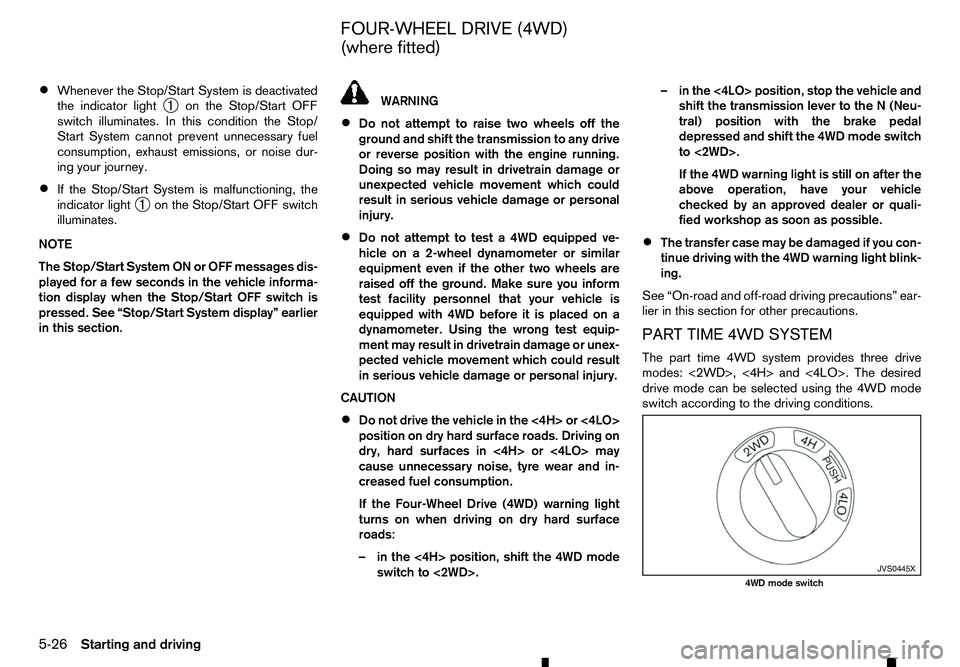
PART TIME 4WD SYSTEM
The part time 4WD system provides three drive
modes: <2WD>, <4H> and <4LO>. The desired
drive mode can be selected using the 4WD mode
switch according to the driving conditions. JVS0445X
4WD mode switch
FOUR-WHEEL DRIVE (4WD)
(where fitted)
5-26 Starting and driving
Page 231 of 340
WARNING
AT model: If the 4WD mode indicator is “OFF” or
the ATP warning light is “ON”, this indicates that
the automatic transmission P(Park) position will
not function and could result in the vehicle mov-
ing unexpectedly, causing serious personal in-
jury or property damage. Always set the parking
brake.
CAUTION
To avoid vehicle damage:
• Do not operate the 4WD mode switch when
cornering, reversing or if the rear wheels are
spinning freely. The vehicle must be moving
straight ahead.
• Do not move the shift lever (AT model) or
release the clutch pedal (MT model) when the
4LO indicator is blinking. Failure to do this
may cause the gears to grind and damaging
the powertrain.
• MT model: Do not accelerate rapidly from a
stopped position when the 4LO indicator is
blinking. Drive straight ahead at
alow speed
until the 4LO indicator is lit. The 4LO indicator
blinks when shifting between <4LO> and
<4H>.
• If the 4WD warning light comes on, perform
the following procedure:
1) Turn off the engine.
2) Start the engine. 3) Check if the 4WD warning light comes on.
If the 4WD warning light is still on after following
the above procedure, have the system checked
and serviced immediately by an approved dealer
or qualified workshop.
The transfer case 4WD mode switch is used to
select either Two-Wheel Drive (2WD) or
Four-Wheel Drive (4WD) depending on the driving
conditions. Turn the 4WD mode switch to select a drive mode (<2WD>, <4H> or <4LO>).
To change into or out of 4LO mode:
1. The vehicle MUST BE standing still.
2. Depress the clutch pedal (MT model) and the brake pedal and move the shift lever to N(Neu-
tral).
3. Depress and turn the 4WD mode switch to change into or out of <4LO>. WARNING
• When parking, apply the parking brake before
stopping the engine and make sure that the
4WD mode indicator is on and that the ATP
warning light or ATP warning message is off,
otherwise, the vehicle could unexpectedly
move even if the automatic transmission is in
the P(Park) position.
• The 4LO indicator must stop blinking and re-
main on or turn off before shifting the trans-
mission into gear. The vehicle may move un- expectedly if the shift lever is shifted from the
N(
Neutral) position to any other gear while
the 4LO indicator is blinking.
CAUTION
• Never turn the 4WD mode switch between
<4LO> and <4H> while driving.
• The <4H> drive mode provides greater power
and traction. Avoid excessive speed as it will
cause increased fuel consumption and higher
oil temperatures, and could damage power
train components. Speeds over 100 km/h (60
MPH) in <4H> are not recommended.
• The <4LO> drive mode provides maximum
power and traction. Avoid raising vehicle
speed excessively. The maximum speed is
approximately 50 km/h (30 MPH).
• The 4WD mode switch can be turned between
<2WD> and <4H> while driving straight ahead.
Do not turn the 4WD mode switch while mak-
ing
aturn or reversing.
• Do not turn the 4WD mode switch between
<2WD> and <4H> while driving on steep
downhill grades. Use the engine brake and
low transmission gears for engine braking.
• Do not turn the 4WD mode switch between
<2WD> and <4H> with the rear wheels spin-
ning.
Starting and driving 5-29
Page 232 of 340
•
Do not drive the vehicle in <4H> or <4LO>
mode on dry, hard surfaced roads. This may
cause unnecessary noise and tyre wear.
RENAULT recommends driving in 2WD under
these conditions.
• It is not possible to shift the 4WD transfer
case between <4H> and <4LO> at low ambi-
ent temperatures when the engine is cold. Do-
ing so may cause the 4LO indicator to blink.
Wait until the 4WD transfer case has reached
operational temperature (after driving for a
while) before using the 4WD mode switch to
change between <4H> and <4LO>.
When driving on rough roads
• Set the 4WD mode switch to <4H> or <4LO>.
• Drive carefully and according to the road surface
conditions.
If the vehicle gets stuck
• Place stones or wooden blocks under the tyres
to free the vehicle.
• Set the 4WD mode switch to <4H> or <4LO>.
• If it is difficult to free the vehicle, drive the vehicle
forwards and backwards to increase the mo-
mentum. If the vehicle is stuck deep in mud, tyre
chains may be effective.
CAUTION
• Do not spin the wheels excessively. The
wheels will sink deep into the mud and it will
be difficult to free the vehicle from the mud. •
Avoid shifting gears with the engine running
at high speeds as this may cause
amalfunc-
tion.
4WD MODE SWITCH OPERATION
• Set the 4WD mode switch to <2WD>, <4H> or
<4LO>, depending on driving conditions.
• You may feel
aslight vehicle movement if the
4WD mode switch is operated while making a
turn, accelerating or decelerating, or if the igni-
tion switch is placed in the “OFF” position while
the 4WD mode switch is set to <4H> or <4LO>.
This is normal.
CAUTION
• The 4WD mode switch can be turned between
<2WD> and <4H> while driving straight ahead.
Do not turn the 4WD mode switch while mak-
ing
aturn or reversing.
• Do not operate the 4WD mode switch while
driving on steep downhill grades. Use the en-
gine brake by setting
alow transmission gear. •
Do not operate the 4WD mode switch with the
rear wheels spinning.
• Before turning the 4WD mode switch to <4H>
from <2WD>, make sure that the vehicle
speed is less than 100 km/h (60 MPH). Fail-
ure to do so can damage the 4WD system.
• Never turn the 4WD mode switch between
<4LO> and <4H> while driving.
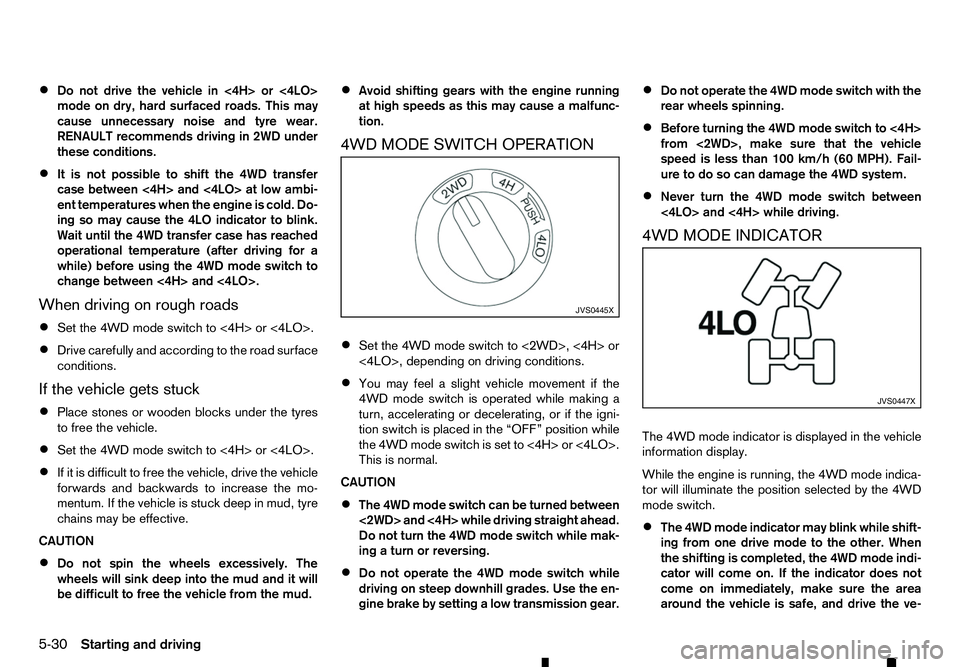
4WD MODE INDICATOR
The 4WD mode indicator is displayed in the vehicle
information display.
While the engine is running, the 4WD mode indica-
tor will illuminate the position selected by the 4WD
mode switch.
• The 4WD mode indicator may blink while shift-
ing from one drive mode to the other. When
the shifting is completed, the 4WD mode indi-
cator will come on. If the indicator does not
come on immediately, make sure the area
around the vehicle is safe, and drive the ve- JVS0445X
JVS0447X
5-30 Starting and driving
Page 234 of 340
TYRE RECOMMENDATION FOR 4WD
CAUTION
• Always use tyres of the same size, brand, con-
struction (bias, bias-belted or radial), and
tread pattern on all four wheels. Failure to do
so may result in acircumference difference
between tyres on the front and rear axles,
which will cause excessive tyre wear and may damage the transmission, transfer case and
differential gears.
• ONLY use spare tyres specified for the Four-
Wheel Drive (4WD) models.
If excessive tyre wear is found, it is recommended
that all four tyres be replaced with tyres of the same
size, brand, construction and tread pattern. The tyre
pressure and wheel alignment should also be
checked and corrected as necessary. Contact an
approved dealer or qualified workshop.
Snow tyres
If you install snow tyres, they must also be of the
same size, brand, construction and tread pattern on
all four wheels.
Tyre inflation pressure
Periodically check the pressures of all tyres, includ-
ing the spare, with agauge while at aservice sta-
tion. If necessary, adjust to the specified pressure.
Tyre pressures are shown on the tyre placard af-
fixed to the driver’s side centre pillar or rear access
door. Tyre rotation
RENAULT recommends that tyres should be rotated
every 5,000 km (3,000 miles).
Snow chains
Snow chains must be installed only on the rear
wheels and not on the front wheels.
Do not drive with snow chains on paved roads that are clear of snow. Driving with chains in such condi-
tions can cause damage to the various mechanisms of the vehicle due to overstress. When driving on
clear paved roads, be sure to change to Two-Wheel
Drive (2WD) mode. The rear differential lock is designed to transmit en-
gine power to the left and right rear wheels equally.
If your vehicle is stuck in sand, snow, mud, etc. or
one wheel is off the ground and the differential lock
is not on, engine power is transmitted to the wheel
with least resistance causing it to spin, leaving insuf-
ficient traction on the other wheel. The rear differen-
tial lock allows the left and right wheels to rotate as
au
nit, enabling your vehicle to free itself.
To lock the rear differential gear:
1) Stop the vehicle completely.
2) Turn the 4WD mode switch to the 4LO position. For operation of the 4WD mode switch, see
“Four-Wheel Drive (4WD) (where fitted)” earlier
in this section.
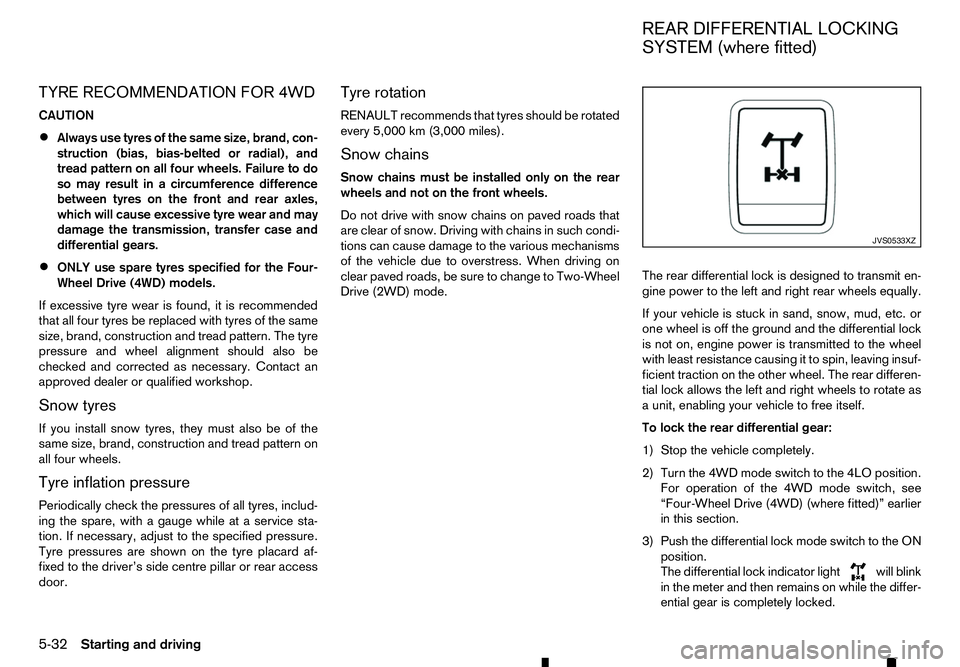
3) Push the differential lock mode switch to the ON position.
The differential lock indicator light will blink
in the meter and then remains on while the differ-
ential gear is completely locked. JVS0533XZ
REAR DIFFERENTIAL LOCKING
SYSTEM (where fitted)
5-32 Starting and driving
Page 235 of 340
After using the rear differential lock, or when resum-
ing normal driving, push the differential lock mode
switch to the OFF position. The differential lock indi-
cator light will turn off after the differential lock is
released.
NOTE
• The rear differential lock-up device operates
only when the engine is running.
• In 4H mode, the rear differential lock-up de-
vice does not operate when the differential
lock mode switch is turned to the “ON” posi-
tion. (The differential lock indicator light will
flash.) WARNING
• Use the rear differential lock only in an emer-
gency when it is not possible to free astuck
vehicle even using the 4LO position.
• When the differential lock is in operation, turn-
ing the vehicle becomes hard and, especially
at high speeds, is dangerous.
• While differential lock is on, the Anti-lock
Braking System (ABS) warning light and the
Electronic Stability Programme (ESP) off indi-
cator light illuminate. This indicates that anti-
lock function may not fully operate.
• Do not operate the differential lock when the
vehicle is turning or when one side wheel is
rotating. Otherwise the power train system
parts could be damaged. •
Avoid quick starts while the differential lock is
in operation. Otherwise the power train sys-
tem parts could be damaged.
Observe the above precautions. Otherwise, loss
of normal steering control may result. WARNING
• The Electronic Stability Programme (ESP) sys-
tem is designed to help the driver maintain
stability but does not prevent accidents due
to abrupt steering operation at high speeds or
by careless or dangerous driving techniques.
Reduce vehicle speed and be especially care-
ful when driving and cornering on slippery sur-
faces and always drive carefully.
• Do not modify the vehicle’s suspension. If
suspension parts such as shock absorbers,
struts, springs, stabiliser bars, bushings and
wheels are not recommended by RENAULT
for your vehicle or are extremely deteriorated,
the ESP system may not operate properly.
This could adversely affect vehicle handling
performance, and the ESP warning light may illuminate.
• If brake related parts such as brake pads, ro-
tors and callipers are not RENAULT-recom-
mended or are extremely deteriorated, the
ESP system may not operate properly and the
ESP warning light may illuminate.
• If engine control related parts are not
RENAULT recommended or are extremely de-
teriorated, the ESP warning light may illu-
minate.
ELECTRONIC STABILITY
PROGRAMME (ESP) SYSTEM
(where fitted)
Starting and driving 5-33
Page 236 of 340
•
When driving on extremely inclined surfaces
such as higher banked corners, the ESP sys-
tem may not operate properly and the ESP
warning light may illuminate. Do not drive
on these types of roads.
• When driving on an unstable surface such as
at urntable, ferry, elevator or ramp, the ESP
warning light may illuminate. This is not a
malfunction. Restart the engine after driving
onto astable surface.
• If wheels or tyres other than the RENAULT
recommended ones are used, the ESP sys-
tem may not operate properly and the ESP
warning light may illuminate.
• The ESP system is not
asubstitute for winter
tyres or tyre chains on asnow covered road.
The Electronic Stability Programme (ESP) system
uses various sensors to monitor driver inputs and
vehicle motion. Under certain driving conditions, the
ESP system performs the following functions:
• Controls brake pressure to reduce wheel slip on
one slipping drive wheel so power is transferred
to
an on slipping drive wheel on the same axle.
• Controls brake pressure and engine output to
reduce drive wheel slip based on vehicle speed
(traction control function). •
Controls brake pressure at individual wheels and
engine output to help the driver maintain control
of the vehicle in the following conditions:
–u
ndersteer (vehicle tends to not follow the
steered path despite increased steering in-
put)
–o versteer (vehicle tends to spin due to cer-
tain road or driving conditions).
The ESP system can help the driver to maintain con-
trol of the vehicle, but it cannot prevent loss of ve-
hicle control in all driving situations.
When the ESP system operates, the ESP warning
light in the instrument panel flashes so note the
following:
• The road may be slippery or the system may
determine some action is required to help the
vehicle on the steered path.
• You may feel
apulsation in the brake pedal and
hear anoise or vibration from under the bonnet.
This is normal and indicates that the ESP system
is working properly.
• Adjust your speed and driving to the road condi-
tions.
If am alfunction occurs in the system, the ESP warn-
ing light illuminates in the instrument panel. The
ESP system automatically turns off.
The ESP OFF switch is used to turn off the ESP
system. The ESP off indicator light illuminates
to indicate the ESP system is off. When the ESP
OFF switch is used to turn off the system, the ESP system still operates to prevent one drive wheel from
slipping by transferring power to
anon slipping drive
wheel. The ESP warning light flashes if this
occurs. All other ESP functions are off and the ESP
warning light will not flash. The ESP system is
automatically reset to on when the ignition switch is
placed in the OFFposition then back to the ONposi-
tion.
When the <4LO> position is selected with the Four-
Wheel Drive (4WD) mode switch, the ESP system
is disabled and the ESP OFF indicator light illumi-
nates.
See “Warning lights, indicator lights and audible
reminders” in the “2. Instruments and controls” sec-
tion and “Four-Wheel Drive (4WD) (where fitted)”
earlier in this section.
The computer has abuilt-in diagnostic feature that
tests the system each time you start the engine and
move the vehicle forward or in reverse at aslow
speed. When the self-test occurs, you may hear a
“clunk” noise and/or feel apulsation in the brake
pedal. This is normal and is not an indication of a
malfunction.
5-34 Starting and driving
Page 240 of 340
WARNING
• Never rely solely on the hill descent control
system to control vehicle speed when driving
on steep downhill grades. Always drive care-
fully when using the hill descent control sys-
tem and decelerate the vehicle speed by de- pressing the brake pedal if necessary. Be
especially careful when driving on frozen,
muddy or extremely steep downhill roads.
Failure to control vehicle speed may result in
al oss of control of the vehicle and possible
serious injury or death.
• The hill descent control system may not con-
trol the vehicle speed on
ahill under all load
or road conditions. Always be prepared to de-
press the brake pedal to control vehicle
speed. Failure to do so may result in acolli-
sion or serious personal injury.
When the hill descent control system is activated, it
automatically applies smooth brakes to control
speed on asteep and slippery descent or off the
road without brake or accelerator operation. The hill
descent control system helps maintain vehicle speed
when driving under 25 km/h (16 MPH) on asteep
descent that engine braking alone in the <4H> or
<4LO> mode cannot control the speed.
NOTE
When the hill descent control system operates
continuously for along time, the temperature of
the Electronic Stability Programme (ESP) system
actuator may increase and the hill descent con- trol system may be temporarily disabled. The hill
descent control system on indicator light will turn
off. The hill descent control system will resume
operating automatically and the indicator light
will illuminate again when the temperature of the
ESP system actuator is reduced. If the indicator
light does not illuminate, turn off the system.
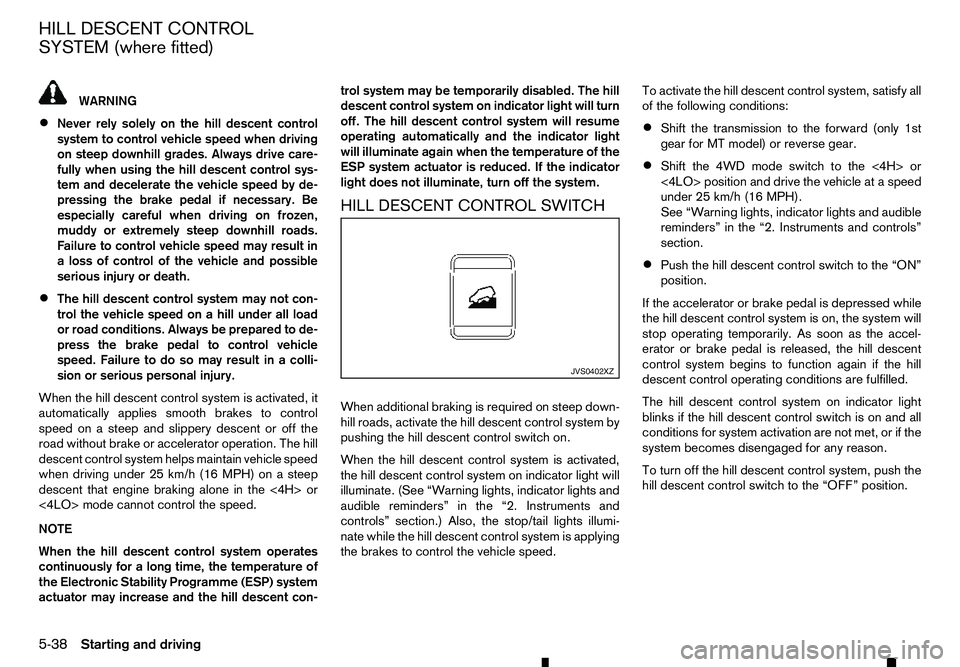
HILL DESCENT CONTROL SWITCH
When additional braking is required on steep down-
hill roads, activate the hill descent control system by
pushing the hill descent control switch on.
When the hill descent control system is activated,
the hill descent control system on indicator light will
illuminate. (See “Warning lights, indicator lights and audible reminders” in the “2. Instruments and
controls” section.) Also, the stop/tail lights illumi-
nate while the hill descent control system is applying
the brakes to control the vehicle speed. To activate the hill descent control system, satisfy all
of the following conditions:
• Shift the transmission to the forward (only 1st
gear for MT model) or reverse gear.
• Shift the 4WD mode switch to the <4H> or
<4LO> position and drive the vehicle at
aspeed
under 25 km/h (16 MPH).
See “Warning lights, indicator lights and audible
reminders” in the “2. Instruments and controls”
section.
• Push the hill descent control switch to the “ON”
position.
If the accelerator or brake pedal is depressed while
the hill descent control system is on, the system will
stop operating temporarily. As soon as the accel- erator or brake pedal is released, the hill descent
control system begins to function again if the hill
descent control operating conditions are fulfilled.
The hill descent control system on indicator light
blinks if the hill descent control switch is on and all
conditions for system activation are not met, or if the
system becomes disengaged for any reason.
To turn off the hill descent control system, push the
hill descent control switch to the “OFF” position. JVS0402XZ
HILL DESCENT CONTROL
SYSTEM (where fitted)
5-38 Starting and driving
Page 241 of 340
WARNING
• Never rely solely on the hill start assist system
to prevent the vehicle from moving backward on ahill. Always drive carefully and attentively.
Depress the brake pedal when the vehicle is
stopped on asteep hill. Be especially careful
when stopped on ahill on frozen or muddy
roads. Failure to prevent the vehicle from roll-
ing backwards may result in aloss of control
of the vehicle and possible serious injury or
death.
• The hill start assist system is not designed to
hold the vehicle at
astandstill on ahill. De-
press the brake pedal when the vehicle is
stopped on asteep hill. Failure to do so may
cause the vehicle to roll backwards and may
result in acollision or serious personal injury.
• The hill start assist system may not prevent
the vehicle from rolling backwards on ahill
under all load or road conditions. Always be
prepared to depress the brake pedal to pre-
vent the vehicle from rolling backwards. Fail-
ure to do so may result in acollision or seri-
ous personal injury.
The hill start assist system automatically keeps the
brakes applied to help prevent the vehicle from roll-
ing backwards in the time it takes the driver to re-
lease the brake pedal and apply the accelerator
when the vehicle is stopped on ahill. The hill start assist system will operate automatically
under the following conditions:
• The transmission is shifted to
aforward or re-
verse gear.
• The vehicle is stopped completely on
ahill by
applying the brake.
The maximum holding time is 2seconds. After 2
seconds the vehicle will begin to roll back and the
hill start assist system will stop operating completely.
The hill start assist system will not operate when the
transmission is shifted to the N(Neutral) or P(Park)
position or on aflat and level road.
When the Electronic Stability Programme (ESP)
warning light illuminates in the meter, the hill start
assist system will not operate. (See “Electronic Sta-
bility Programme (ESP) system (where fitted)” ear-
lier in this section.) The cruise control system allows driving at constant
speeds without keeping your foot on the accelerator
pedal. WARNING
• The cruise control system ONLY maintains a
constant vehicle speed, it does not replace
the driver.
• Always observe the posted speed limits and
do not set the speed over them.
• Do not use the cruise control when driving
under the following conditions. Doing so
could cause
aloss of vehicle control and re-
sult in an accident.
–W hen it is not possible to keep the vehicle
at ac onstant speed
–W hen driving in heavy traffic
–W hen driving in traffic that varies speed
–W hen driving in windy areas
–W hen driving on winding or hilly roads
–W hen driving on slippery (rain, snow, ice,
etc.) roads
CAUTION
On manual Transmission (MT) model, do not shift
to the N(Neutral) position without depressing
the clutch pedal when the cruise control is oper-
HILL START ASSIST SYSTEM
(where fitted)
CRUISE CONTROL (where fitted)
Starting and driving 5-39
Page 246 of 340
When the ignition switch is in the
OFFposition,
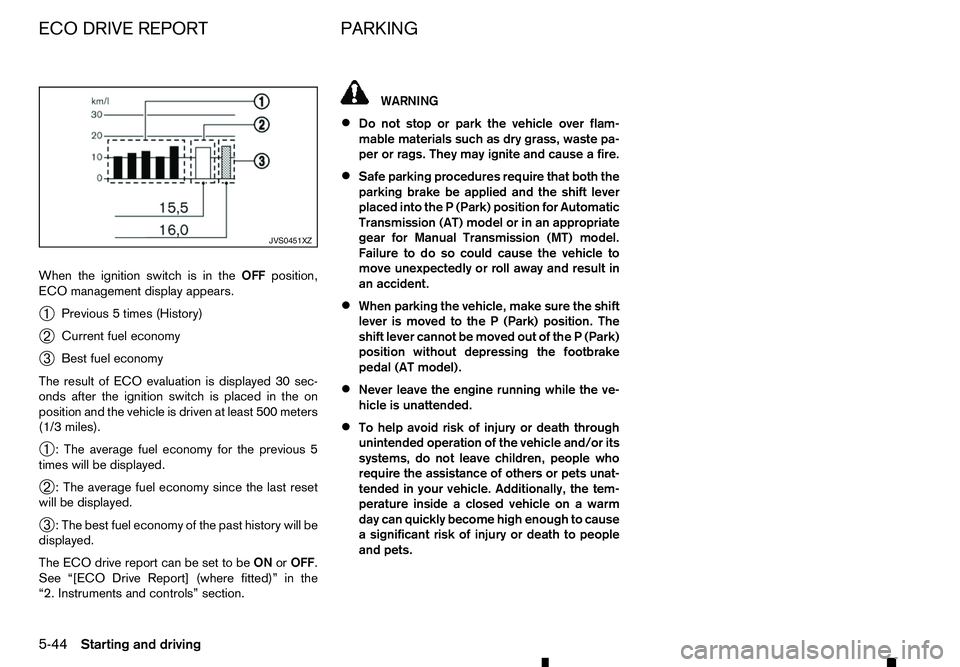
ECO management display appears.
➀ Previous
5times (History)
➁ Current fuel economy
➂ Best fuel economy
The result of ECO evaluation is displayed 30 sec-
onds after the ignition switch is placed in the on
position and the vehicle is driven at least 500 meters
(1/3 miles).
➀ :T
he average fuel economy for the previous 5
times will be displayed.
➁ :T
he average fuel economy since the last reset
will be displayed.
➂ :T
he best fuel economy of the past history will be
displayed.
The ECO drive report can be set to be ONorOFF.
See “[ECO Drive Report] (where fitted)” in the
“2. Instruments and controls” section. WARNING
• Do not stop or park the vehicle over flam-
mable materials such as dry grass, waste pa-
per or rags. They may ignite and cause afire.
• Safe parking procedures require that both the
parking brake be applied and the shift lever
placed into the
P(Park) position for Automatic
Transmission (AT) model or in an appropriate
gear for Manual Transmission (MT) model.
Failure to do so could cause the vehicle to
move unexpectedly or roll away and result in
an accident.
• When parking the vehicle, make sure the shift
lever is moved to the
P(Park) position. The
shift lever cannot be moved out of the P(Park)
position without depressing the footbrake
pedal (AT model).
• Never leave the engine running while the ve-
hicle is unattended.
• To help avoid risk of injury or death through
unintended operation of the vehicle and/or its systems, do not leave children, people who
require the assistance of others or pets unat-
tended in your vehicle. Additionally, the tem-
perature inside aclosed vehicle on awarm
day can quickly become high enough to cause
as ignificant risk of injury or death to people
and pets. JVS0451XZ
ECO DRIVE REPORT
PARKING
5-44 Starting and driving