ECO mode RENAULT ALASKAN 2017 Owners Manual
[x] Cancel search | Manufacturer: RENAULT, Model Year: 2017, Model line: ALASKAN, Model: RENAULT ALASKAN 2017Pages: 340, PDF Size: 6.93 MB
Page 19 of 340

1
Safety —seats, seat belts and supplemental
restraint system Safety
—seats, seat belts and supplemental
restraint system
Seats ....................................................................... 1-2 Front seats ......................................................... 1-2
Rear seats (Double Cab model) .......................... 1-5
Jump seats (where fitted for King Cab models) ... 1-6
Head restraints ........................................................ 1-6 Adjustable head restraint .................................... 1-7
Non-adjustable head restraint.............................. 1-7
Remove .............................................................. 1-7
Install.................................................................. 1-7
Adjust ................................................................. 1-8
Seat belts ................................................................ 1-9 Precautions on seat belt usage ........................... 1-9
Child safety ........................................................ 1-11
Pregnant women ................................................ 1-11
Injured persons................................................... 1-11
Centre mark on seat belts (where fitted) ............. 1-11
Three-point type seat belts .................................. 1-12
Two-point type seat belts (where fitted) ............... 1-13 Seat belt maintenance ........................................ 1-14
Child restraints ........................................................ 1-14
Precautions on child restraint usage.................... 1-14
Universal child restraints for front seat and rear
seats (for Europe) ............................................... 1-15
ISOFIX and i-Size child restraint system (for
second row seats) .............................................. 1-20
Child restraint anchorage (where fitted) .............. 1-21
Child restraint installation using ISOFIX .............. 1-22
Child restraint installation using three-point
type seat belt ...................................................... 1-24
Supplemental Restraint System (SRS) (where
fitted) ....................................................................... 1-29 Precautions on Supplemental Restraint
System (SRS)..................................................... 1-29
Supplemental air bag systems ............................ 1-36
Pre-tensioner seat belt system (where fitted) ....... 1-39
Repair and replacement procedure ..................... 1-40
Page 23 of 340
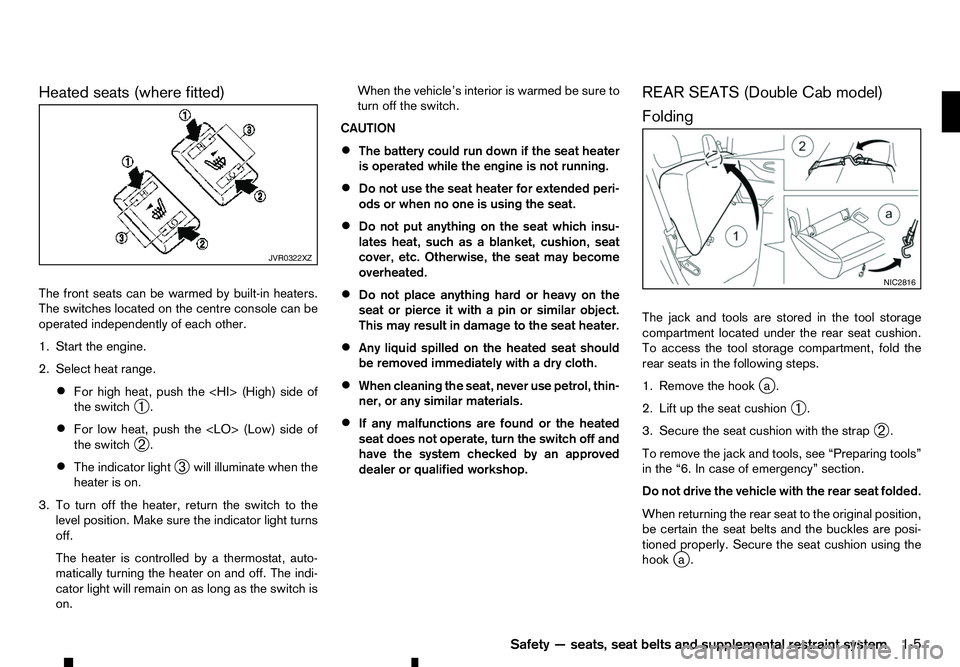
Heated seats (where fitted)
The front seats can be warmed by built-in heaters.
The switches located on the centre console can be
operated independently of each other.
1. Start the engine.
2. Select heat range. • For high heat, push the (High) side of
the switch
➀.
• For low heat, push the
Page 32 of 340
SEAT BELT MAINTENANCE
Periodically check that the seat belt and all the metal
components, such as buckles, tongues, retractors,
flexible wires and anchors, work properly. If loose
parts, deterioration, cuts or other damage on the
seat belt webbing is found, the entire seat belt as-
sembly should be replaced.
If dirt builds up in the shoulder belt guide of the seat
belt anchors, the seat belts may retract slowly. Wipe
the shoulder belt guide with aclean, dry cloth.
To clean the seat belt webbing, apply amild soap
solution or any solution recommended for cleaning
upholstery or carpet. Then wipe with acloth and
allow the seat belts to dry in the shade. Do not allow
the seat belts to retract until they are completely dry. PRECAUTIONS ON CHILD
RESTRAINT USAGE WARNING
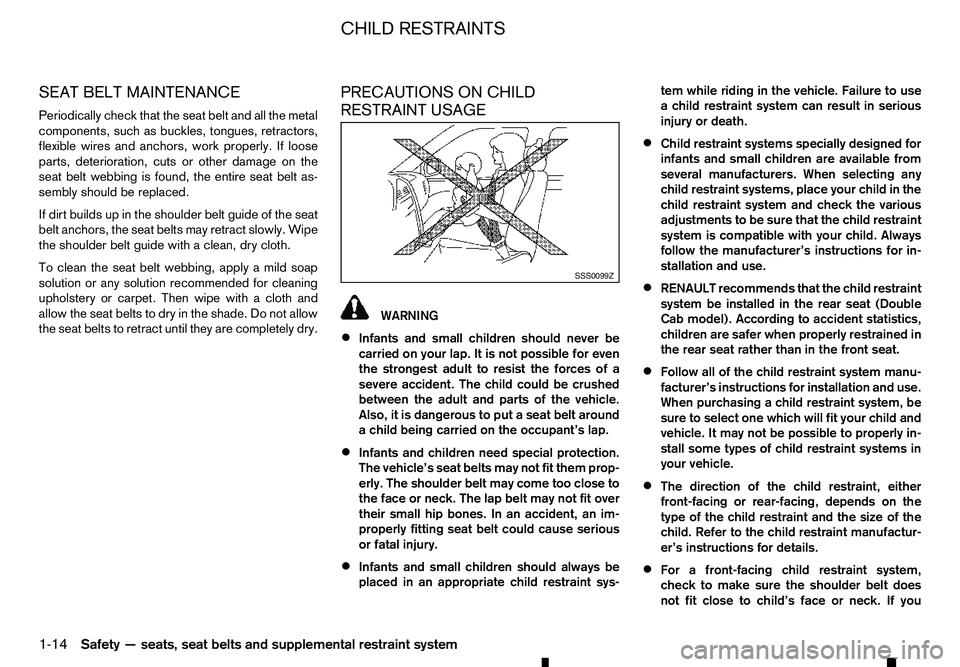
• Infants and small children should never be
carried on your lap. It is not possible for even
the strongest adult to resist the forces of a
severe accident. The child could be crushed
between the adult and parts of the vehicle.
Also, it is dangerous to put aseat belt around
ac hild being carried on the occupant’s lap.
• Infants and children need special protection.
The vehicle’s seat belts may not fit them prop-
erly. The shoulder belt may come too close to
the face or neck. The lap belt may not fit over
their small hip bones. In an accident, an im-
properly fitting seat belt could cause serious
or fatal injury.
• Infants and small children should always be
placed in an appropriate child restraint sys- tem while riding in the vehicle. Failure to use
ac
hild restraint system can result in serious
injury or death.
• Child restraint systems specially designed for
infants and small children are available from
several manufacturers. When selecting any
child restraint systems, place your child in the
child restraint system and check the various
adjustments to be sure that the child restraint
system is compatible with your child. Always
follow the manufacturer’s instructions for in-
stallation and use.
• RENAULT recommends that the child restraint
system be installed in the rear seat (Double
Cab model). According to accident statistics,
children are safer when properly restrained in
the rear seat rather than in the front seat.
• Follow all of the child restraint system manu-
facturer’s instructions for installation and use.
When purchasing
achild restraint system, be
sure to select one which will fit your child and
vehicle. It may not be possible to properly in- stall some types of child restraint systems in
your vehicle.
• The direction of the child restraint, either
front-facing or rear-facing, depends on the
type of the child restraint and the size of the child. Refer to the child restraint manufactur-
er’s instructions for details.
• For
afront-facing child restraint system,
check to make sure the shoulder belt does
not fit close to child’s face or neck. If you SSS0099Z
CHILD RESTRAINTS
1-14 Safety —seats, seat belts and supplemental restraint system
Page 33 of 340
must install
afront-facing child restraint sys-
tem in the front seat, see “Installation on front
passenger’s seat” later in this section.
• Never install
arear-facing child restraint sys-
tem on the front passenger’s seat when the
front passenger’s air bag is active. Supple- mental front-impact air bags inflate with great
force. Arear-facing child restraint system
could be struck by the supplemental front-im-
pact air bags in an accident and could seri-
ously injure or kill your child.
• Do not install
achild restraint in the jump seats
(where fitted for King Cab model). These
seats are not suitable for child restraint instal-
lation.
• Adjustable seatbacks should be positioned to
fit
ac hild restraint system, but as upright as
possible. see “Installation on rear outboard
seats” later in this section and “Child restraint
installation using three-point type seat belt”
later in this section.
• If the seat belt in the position where
achild
restraint system is installed requires alocking
clip and if it is not used, injuries could result
from achild restraint system tipping over dur-
ing normal vehicle braking or cornering.
• After attaching
achild restraint system, test it
before you place the child in it. Tilt it from side
to side. Try to tug it forward and check if it is
held securely in place. The child restraint sys-
tem should not move more than 25 mm (1 in). If the restraint is not secure, tighten the belt
as necessary, or install the restraint in another
seat and test it again.
• Check the child restraint system in your ve-
hicle to be sure that it is compatible with the
vehicle’s seat belt system.
• If
ac hild restraint system is not anchored
properly, the risk of achild being injured in a
collision or asudden stop greatly increases.
• Improper use of
achild restraint system can
increase the risk or severity of injury for both
the child and other occupants in the vehicle.
• Always use an appropriate child restraint sys-
tem. An improperly installed child restraint
system could lead to serious injury or death in
an accident.
• When the child restraint system is not in use,
keep it secured with the ISOFIX and i-Size
child restraint system or
aseat belt to prevent
it from being thrown around in case of asud-
den stop or accident.
RENAULT recommends that infants and small chil-
dren be seated in achild restraint system. You
should choose achild restraint system that fits your
vehicle and always follow the manufacturer’s in-
structions for installation and use. In addition, there
are many types of child restraint systems available
for larger children that should be used for maximum
protection. CAUTION
Remember that
achild restraint system left in a
closed vehicle can become very hot. Check the
seating surface and buckles before placing your
child in achild restraint system.
UNIVERSAL CHILD RESTRAINTS FOR
FRONT SEAT AND REAR SEATS (for
Europe)
NOTE
Child restraints approved to UN Regulation No.
44 or No. 129 are clearly marked with the catego-
ries such as Universal, Semi-universal or ISOFIX.
When selecting any child restraint, keep the follow-
ing points in mind:
• Choose
achild restraint that complies with the
latest European safety standard, UN Regulation
No. 44 or No. 129.
• Place your child in the child restraint and check
the various adjustments to be sure the child re-
straint is compatible with your child. Always fol-
low all of the recommended procedures.
• Check the child restraint in your vehicle to be
sure it is compatible with vehicle’s retention sys-
tem.
• Refer to the tables later in this section for
alist of
the recommended fitment positions and the ap-
proved child restraints for your vehicle.
Safety —seats, seat belts and supplemental restraint system 1-15
Page 44 of 340
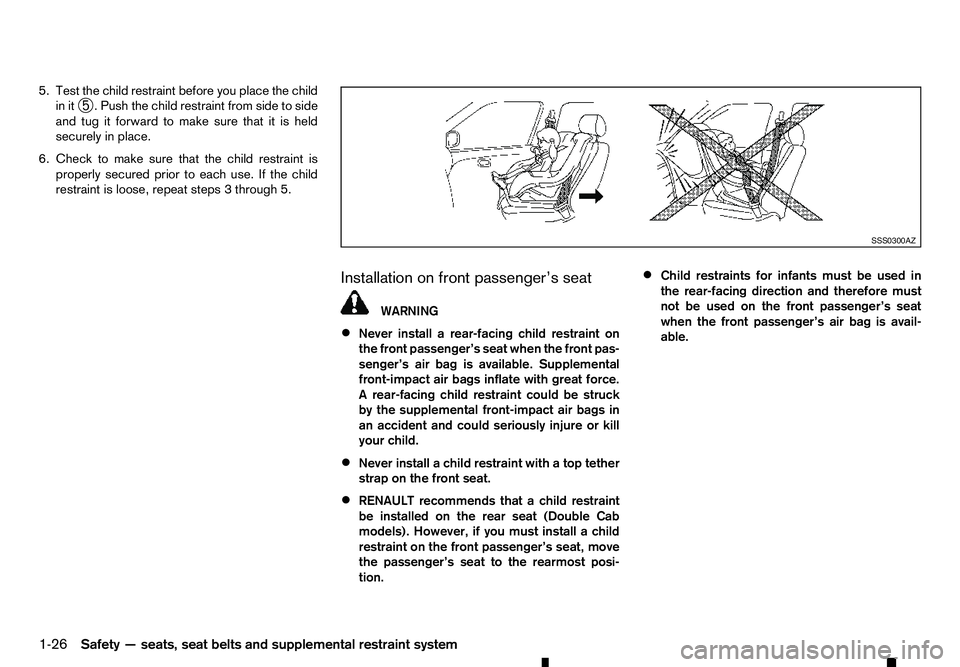
5. Test the child restraint before you place the child
in it ➄.P
ush the child restraint from side to side
and tug it forward to make sure that it is held
securely in place.
6. Check to make sure that the child restraint is properly secured prior to each use. If the child
restraint is loose, repeat steps 3through 5.
Installation on front passenger’s seat WARNING
• Never install
arear-facing child restraint on
the front passenger’s seat when the front pas-
senger’s air bag is available. Supplemental
front-impact air bags inflate with great force.
Ar ear-facing child restraint could be struck
by the supplemental front-impact air bags in
an accident and could seriously injure or kill
your child.
• Never install
achild restraint with atop tether
strap on the front seat.
• RENAULT recommends that
achild restraint
be installed on the rear seat (Double Cab
models). However, if you must install achild
restraint on the front passenger’s seat, move
the passenger’s seat to the rearmost posi-
tion. •
Child restraints for infants must be used in
the rear-facing direction and therefore must
not be used on the front passenger’s seat
when the front passenger’s air bag is avail-
able. SSS0300AZ
1-26 Safety —seats, seat belts and supplemental restraint system
Page 60 of 340
NOTE
For an overview see “Meters and gauges” in the
“0. Illustrated table of contents” section and see
“Instrument panel” in the “0. Illustrated table of
contents” section.
The needle indicators may move slightly after the
ignition switch is placed in the OFF position. This
is not amalfunction.
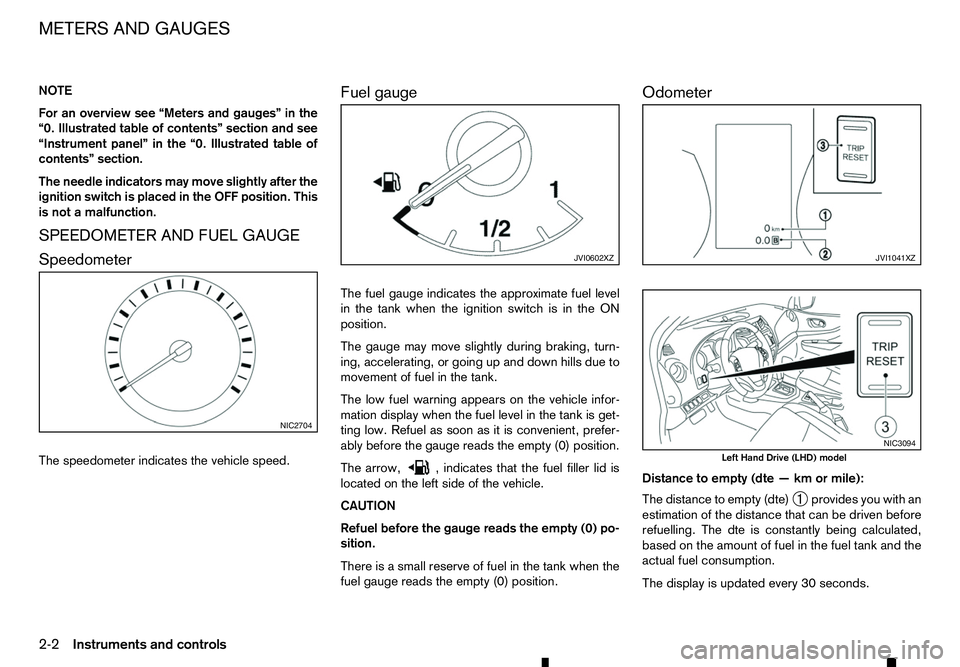
SPEEDOMETER AND FUEL GAUGE
Speedometer
The speedometer indicates the vehicle speed. Fuel gauge
The fuel gauge indicates the approximate fuel level
in the tank when the ignition switch is in the ON
position.
The gauge may move slightly during braking, turn-
ing, accelerating, or going up and down hills due to
movement of fuel in the tank.
The low fuel warning appears on the vehicle infor-
mation display when the fuel level in the tank is get-
ting low. Refuel as soon as it is convenient, prefer-
ably before the gauge reads the empty (0) position.
The arrow, ,i
ndicates that the fuel filler lid is
located on the left side of the vehicle.
CAUTION
Refuel before the gauge reads the empty (0) po-
sition.
There is asmall reserve of fuel in the tank when the
fuel gauge reads the empty (0) position. Odometer
Distance to empty (dte
—kmormile):
The distance to empty (dte) ➀provides you with an
estimation of the distance that can be driven before
refuelling. The dte is constantly being calculated,
based on the amount of fuel in the fuel tank and the
actual fuel consumption.
The display is updated every 30 seconds. NIC2704 JVI0602XZ JVI1041XZ
NIC3094
Left Hand Drive (LHD) model
METERS AND GAUGES
2-2
Instruments and controls
Page 61 of 340
The dte mode includes
alow range warning feature.
If the fuel level is low, the warning is displayed on
the screen.
When the fuel level drops even lower, the dte dis-
play will change to “———”.
• If the amount of fuel added is small, the distance
to empty shown just before the ignition switch is
placed in the “OFF” position may continue to be
displayed.
• When driving uphill or rounding curves, the fuel
in the tank shifts, which may momentarily change
the display.
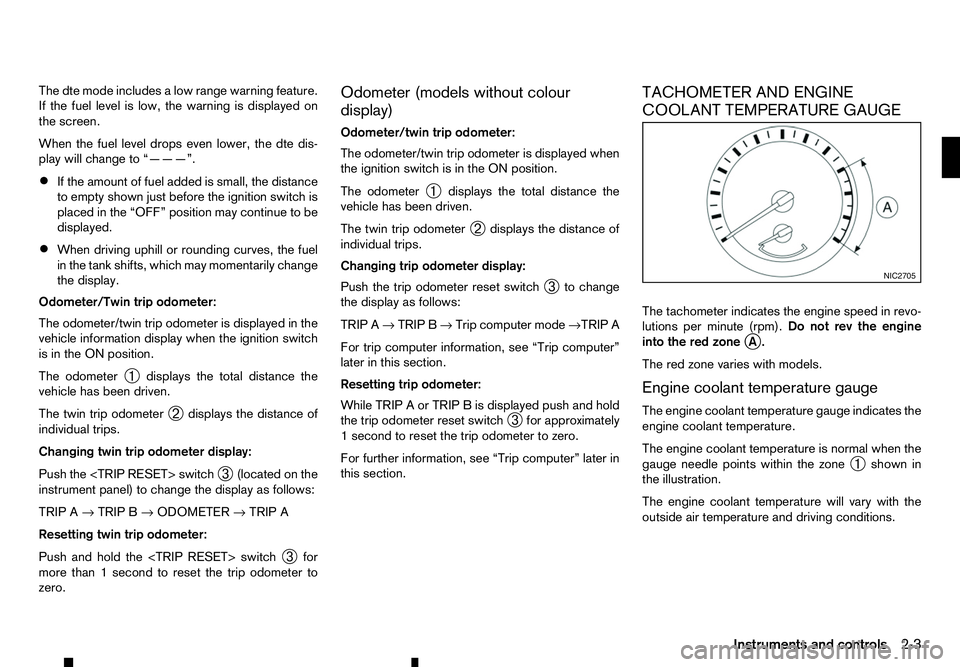
Odometer/Twin trip odometer:
The odometer/twin trip odometer is displayed in the
vehicle information display when the ignition switch
is in the ON position.
The odometer ➀displays the total distance the
vehicle has been driven.
The twin trip odometer ➁displays the distance of
individual trips.
Changing twin trip odometer display:
Push the
instrument panel) to change the display as follows:
TRIP A →TRIP B →ODOMETER →TRIP A
Resetting twin trip odometer:
Push and hold the
more than 1second to reset the trip odometer to
zero. Odometer (models without colour
display)
Odometer/twin trip odometer:
The odometer/twin trip odometer is displayed when
the ignition switch is in the ON position.
The odometer
➀displays the total distance the
vehicle has been driven.
The twin trip odometer ➁displays the distance of
individual trips.
Changing trip odometer display:
Push the trip odometer reset switch ➂to change
the display as follows:
TRIP A →TRIP B →Trip computer mode →TRIP A
For trip computer information, see “Trip computer”
later in this section.
Resetting trip odometer:
While TRIP AorTRIPBisd isplayed push and hold
the trip odometer reset switch ➂for approximately
1s econd to reset the trip odometer to zero.
For further information, see “Trip computer” later in
this section. TACHOMETER AND ENGINE
COOLANT TEMPERATURE GAUGE
The tachometer indicates the engine speed in revo-
lutions per minute (rpm).
Do not rev the engine
into the red zone j
A.
The red zone varies with models.
Engine coolant temperature gauge
The engine coolant temperature gauge indicates the
engine coolant temperature.
The engine coolant temperature is normal when the
gauge needle points within the zone ➀shown in
the illustration.
The engine coolant temperature will vary with the
outside air temperature and driving conditions. NIC2705
Instruments and controls
2-3
Page 62 of 340
INSTRUMENT BRIGHTNESS
CONTROL
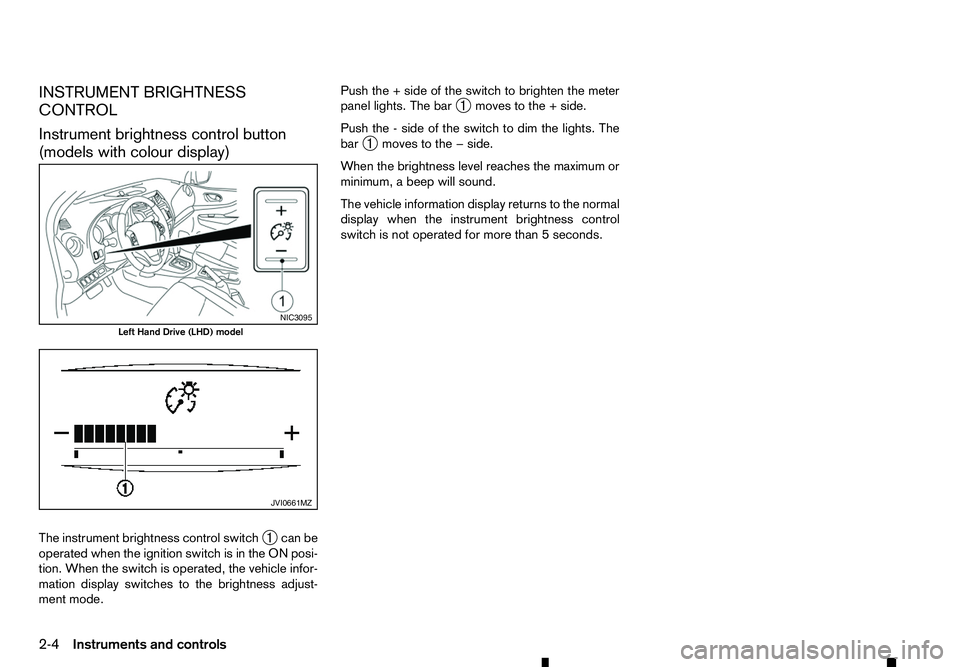
Instrument brightness control button
(models with colour display)
The instrument brightness control switch ➀can be
operated when the ignition switch is in the ON posi-
tion. When the switch is operated, the vehicle infor-
mation display switches to the brightness adjust-
ment mode. Push the
+side of the switch to brighten the meter
panel lights. The bar ➀moves to the
+side.
Push the -side of the switch to dim the lights. The
bar ➀moves to the
−side.
When the brightness level reaches the maximum or
minimum, abeep will sound.
The vehicle information display returns to the normal
display when the instrument brightness control
switch is not operated for more than 5seconds. NIC3095
Left Hand Drive (LHD) model
JVI0661MZ
2-4 Instruments and controls
Page 67 of 340
•
If the engine overheats, continued operation
of the vehicle may seriously damage the en- gine. See “If your vehicle overheats” in the
“6. In case of emergency” section for immedi-
ate required action.
Low temperature indicator light (Blue):
When the ignition switch is placed in the ON posi-
tion, the engine temperature warning light (blue)
comes on. After afew seconds, it should go out and
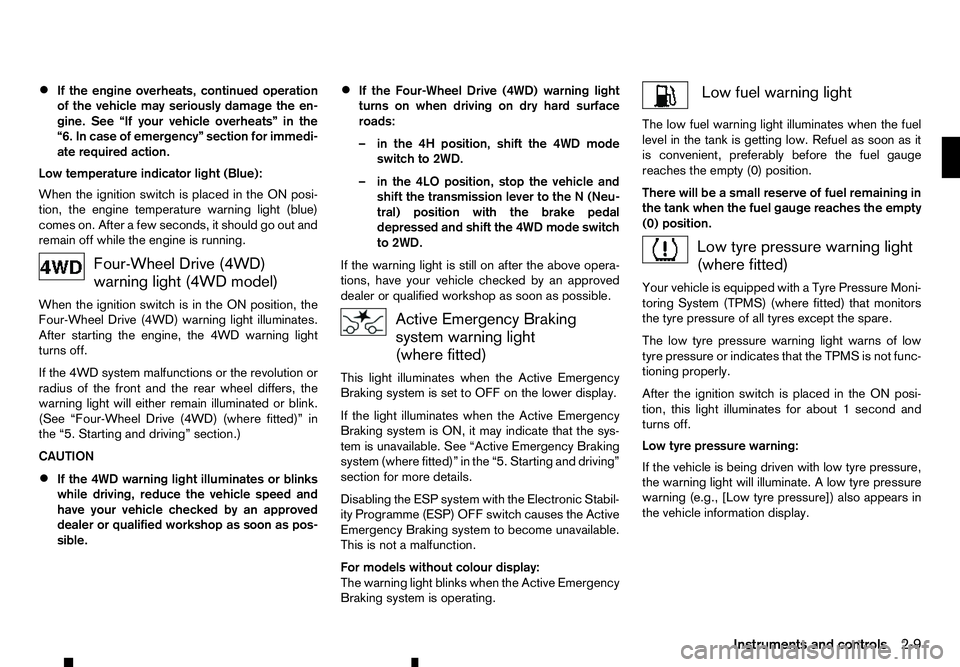
remain off while the engine is running. Four-Wheel Drive (4WD)
warning light (4WD model)
When the ignition switch is in the ON position, the
Four-Wheel Drive (4WD) warning light illuminates.
After starting the engine, the 4WD warning light
turns off.
If the 4WD system malfunctions or the revolution or
radius of the front and the rear wheel differs, the
warning light will either remain illuminated or blink.
(See “Four-Wheel Drive (4WD) (where fitted)” in
the “5. Starting and driving” section.)
CAUTION
• If the 4WD warning light illuminates or blinks
while driving, reduce the vehicle speed and
have your vehicle checked by an approved
dealer or qualified workshop as soon as pos-
sible. •
If the Four-Wheel Drive (4WD) warning light
turns on when driving on dry hard surface
roads:
–i
nthe 4H position, shift the 4WD mode
switch to 2WD.
–i nthe 4LO position, stop the vehicle and
shift the transmission lever to the N(Neu-
tral) position with the brake pedal
depressed and shift the 4WD mode switch
to 2WD.
If the warning light is still on after the above opera-
tions, have your vehicle checked by an approved
dealer or qualified workshop as soon as possible. Active Emergency Braking
system warning light
(where fitted)
This light illuminates when the Active Emergency
Braking system is set to OFF on the lower display.
If the light illuminates when the Active Emergency
Braking system is ON, it may indicate that the sys-
tem is unavailable. See “Active Emergency Braking
system (where fitted)” in the “5. Starting and driving”
section for more details.
Disabling the ESP system with the Electronic Stabil-
ity Programme (ESP) OFF switch causes the Active
Emergency Braking system to become unavailable.
This is not amalfunction.
For models without colour display:
The warning light blinks when the Active Emergency
Braking system is operating. Low fuel warning light
The low fuel warning light illuminates when the fuel
level in the tank is getting low. Refuel as soon as it
is convenient, preferably before the fuel gauge
reaches the empty (0) position.
There will be asmall reserve of fuel remaining in
the tank when the fuel gauge reaches the empty (0) position. Low tyre pressure warning light
(where fitted)
Your vehicle is equipped with aTyre Pressure Moni-
toring System (TPMS) (where fitted) that monitors
the tyre pressure of all tyres except the spare.
The low tyre pressure warning light warns of low
tyre pressure or indicates that the TPMS is not func-
tioning properly.
After the ignition switch is placed in the ON posi-
tion, this light illuminates for about 1second and
turns off.
Low tyre pressure warning:
If the vehicle is being driven with low tyre pressure,
the warning light will illuminate. Alow tyre pressure
warning (e.g., [Low tyre pressure]) also appears in
the vehicle information display.
Instruments and controls 2-9
Page 69 of 340
•
When
aspare tyre is mounted or
awheel is
replaced, the TPMS will not function and the
low tyre pressure warning light will flash for
approximately 1minute. The light will remain
on after 1minute. Contact an approved dealer
or qualified workshop as soon as possible for
tyre replacement and/or system resetting.
• Replacing tyres with those not originally speci-
fied by RENAULT could affect the proper op-
eration of the TPMS.
CAUTION
• The TPMS is not
asubstitute for the regular
tyre pressure check. Be sure to check the tyre
pressure regularly.
• If the vehicle is being driven at speeds of less
than 25 km/h (16 MPH), the TPMS may not
operate correctly.
• Be sure to install the specified size of tyres to
all four wheels correctly. Low washer fluid warning light
(where fitted)
The low washer fluid warning light illuminates when
the washer fluid in the reservoir is at alow level. Add
washer fluid as necessary. (See “Window washer
fluid” in the “8. Maintenance and do-it-yourself” sec-
tion.) Malfunction warning light (red)
(where fitted)
When the ignition switch is placed in the ON posi-
tion, the malfunction warning light illuminates in red.
This means that the system is operational. After
starting the engine, the warning light turns off.
For the orange Malfunction Indicator Light (MIL),
see “Malfunction Indicator Light (MIL)” later in this
section for details.
If the malfunction warning light (red) illuminates con-
tinuously while the engine is running, it may indicate
an engine control system malfunction. Have your
vehicle inspected by an approved dealer or qualified
workshop. You do not need to have your vehicle
towed to the dealer.
CAUTION
Continuing vehicle operation without proper ser-
vicing of the engine control system could lead to
poor driveability, reduced fuel economy, and
damage to the engine control system, which may
affect the vehicle’s warranty coverage. Master warning light (where
fitted)
When the ignition switch is in the ON position, the
master warning light illuminates if any of the follow-
ing are displayed on the vehicle information display.
• No Key Detected warning (where fitted)
• Shift to Park warning (Automatic Transmission
(AT) models) •
Key ID Incorrect warning (where fitted)
• Release Parking Brake warning
• Low fuel warning
• Door open warning
• Low Washer warning (where fitted)
• Key System Error warning (where fitted)
• Low Oil Pressure warning (where fitted)
• AdBlue® warning (where fitted)
• 4WD Error (where fitted)
• Shipping Mode On Push Storage Fuse warning
(where fitted)
• Headlight System Error warning (where fitted)
• Automatic Transmission (AT) Error warning (Au-
tomatic Transmission (AT) models)
• Parking Sensor Error (where fitted)
See “Vehicle information display” later in this sec-
tion. Seat belt warning light
(where fitted)
Front seat belts:
When the ignition switch is in the ON position, the
seat belt warning light illuminates. The light will con-
tinue to illuminate until the driver’s seat belt is fas-
tened.
Instruments and controls 2-11