lock RENAULT KANGOO 1997 KC / 1.G Chassis User Guide
[x] Cancel search | Manufacturer: RENAULT, Model Year: 1997, Model line: KANGOO, Model: RENAULT KANGOO 1997 KC / 1.GPages: 105
Page 54 of 105
STEERING ASSEMBLY
Axial ball joint
36
REFITTING
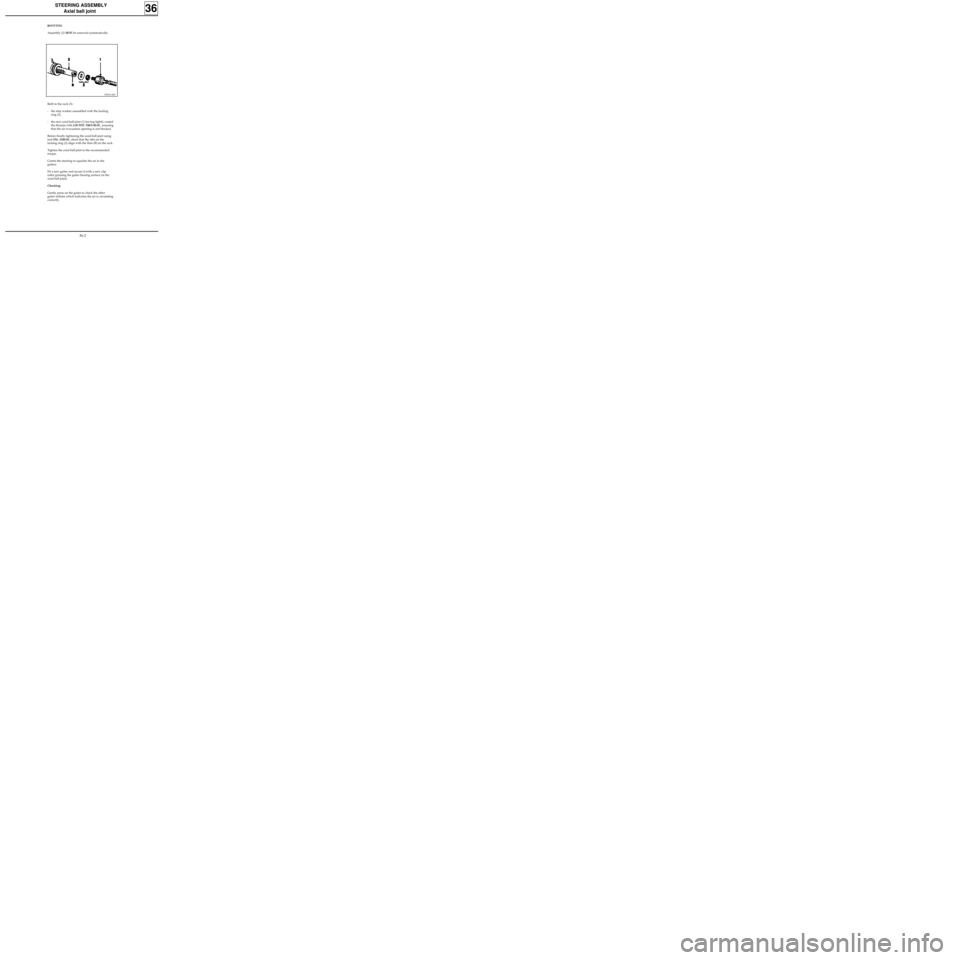
Assembly (2) MUST be renewed systematically.
83510-1R3
Refit to the rack (3) :
- the stop washer assembled with the locking
ring (2),
- the new axial ball joint (1) having lightly coated
the threads with
LOCTITE FREN-BLOC, ensuring
that the air evacuation opening is not blocked.
Before finally tightening the axial ball joint using
tool Dir. 1305-01, check that the tabs on the
locking ring (2) align with the flats (B) on the rack.
Tighten the axial ball joint to the recommended
torque.
Centre the steering to equalise the air in the
gaiters.
Fit a new gaiter and secure it with a new clip
(after greasing the gaiter bearing surface on the
axial ball joint).
Checking
Gently press on the gaiter to check the other
gaiter inflates which indicates the air is circulating
correctly.
36-2
Page 56 of 105
STEERING ASSEMBLY
Power assisted steering rack
36
SPECIAL TOOLING REQUIRED
Mot. 453-01 Hose clamp pliers
T.Av. 476 Ball joint extractor
Wheel bolts 9
Track rod end nut 3.7
Steering rack mounting bolt 5
Universal joint eccentric bolt 2.5
Engine tie bar bolt 6.5
TIGHTENING TORQUES (in daN.m)
Put the vehicle on a two post lift.
REMOVAL
Remove the front wheels.
Fit a clamp Mot. 453-01 to each of the pipes from
the oil reservoir.
NOTE :never clamp the high pressure pipes.
Cut the rubber gaiter retaining clip and push the
gaiter back towards the bulkhead.
Disconnect the ball joints using tool T.Av. 476.
Remove the universal joint eccentric bolt.
Disconnect the oxygen sensor.
Remove the exhaust downpipe.
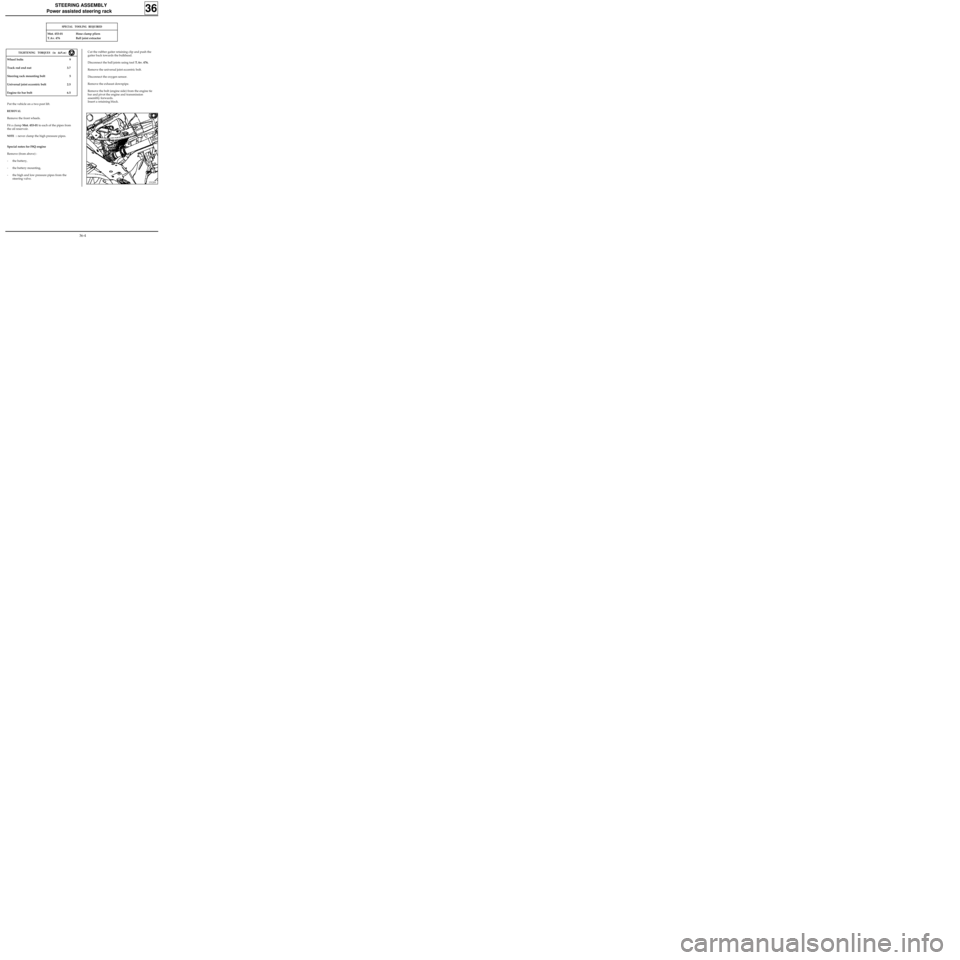
Remove the bolt (engine side) from the engine tie
bar and pivot the engine and transmission
assembly forwards.
Insert a retaining block.
Special notes for F8Q engine
Remove (from above) :
- the battery,
- the battery mounting,
- the high and low pressure pipes from the
steering valve.
13120S
36-4
Page 59 of 105

STEERING ASSEMBLY
Steering pushrod
36
1. Determining the source of the noise
Hold the steering rack on the pinion side and
check for transverse play (up and down).
Movement followed by a click is caused by the
pinion.
2. Adjusting for SMI steering racks
Release the adjusting nut (1) by straightening the
bent over edges (A) on the nut collar.
Check when driving that the steering returns to
the centre point.
Maximum adjustment allowed : 1 notch.
Lock the nut again in the two lugs opposite the
housing by bending over the nut collar.
ADJUSTMENT
If the steering rack pinion is noisy, before considering replacing the steering rack, check that the pinion is
correctly adjusted.
83920R
36-7
Page 61 of 105
STEERING ASSEMBLY
Manual steering assistance pump
36
SPECIAL TOOLING REQUIRED
Mot. 453-01Hose clamp pliers
T. Ar. 1094Extractor
Put the vehicle on a two post lift.
REMOVAL
Remove:
- the PAS pump belt,
- the pulley.
Fit a clamp Mot. 453-01 to the supply pipe.
Disconnect the supply and high pressure pipes.
Take precautions to catch the PAS fluid (protect
the alternator).
Remove the three pump mounting bolts and
remove the pump.
REFITTING
Refitting is the reverse of removal. Observe the
procedure for tensioning the belt (see section 07).
Fill and bleed the circuit, moving the steering
from lock to lock.
D7F engine
without AC
36-9
Page 62 of 105
STEERING ASSEMBLY
Manual steering assistance pump
36
SPECIAL TOOLING REQUIRED
Mot. 453-01Hose clamp pliers
Put the vehicle on a two post lift.
REMOVAL
Remove:
- the right hand wheel,
- the right hand mudguard,
- the bumper (10 bolts).
- the accessories belt,
- the pulley.
Fit a clamp Mot. 453-01 to the supply pipe.
Disconnect the supply and high pressure pipes.
Take precautions to catch the PAS fluid.
Remove the three pump mounting bolts and
remove the pump.
REFITTING
Refitting is the reverse of removal. Observe the
procedure for tensioning the belt (see section 07).
Fill and bleed the circuit, moving the steering
from lock to lock.
F8Q engine
without AC
36-10
Page 63 of 105
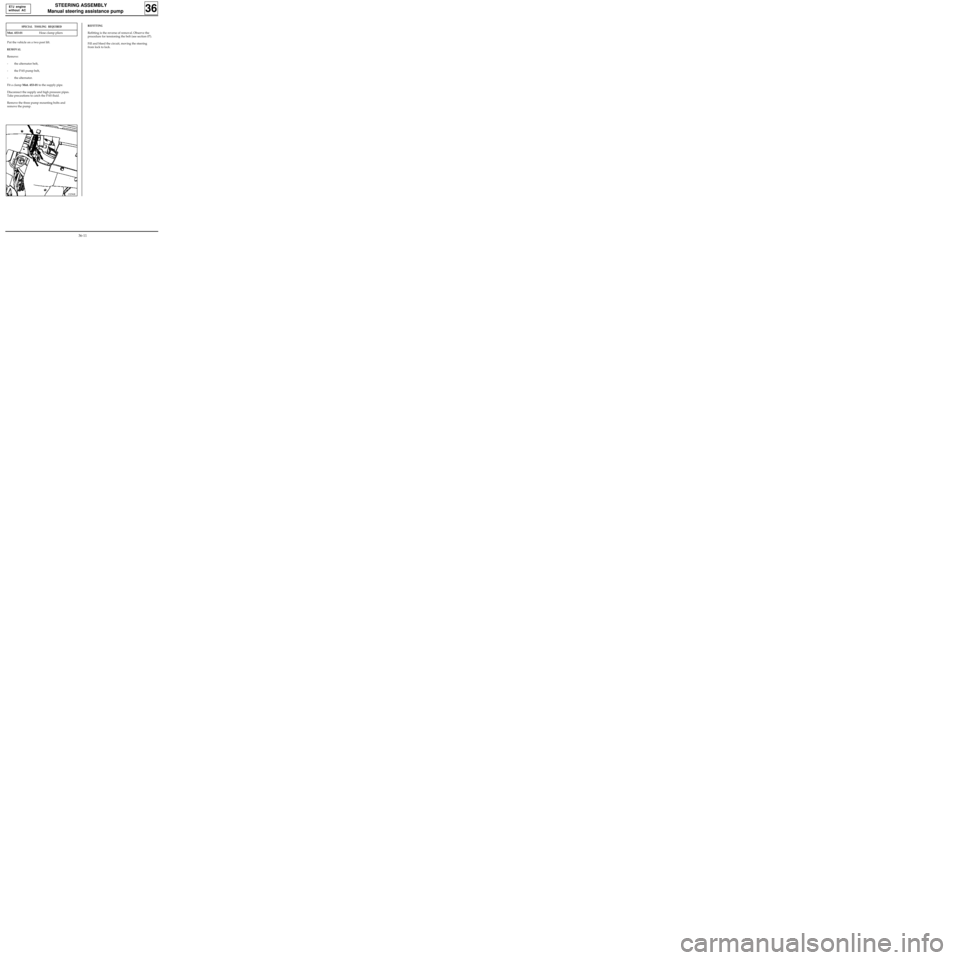
STEERING ASSEMBLY
Manual steering assistance pump
36
SPECIAL TOOLING REQUIRED
Mot. 453-01Hose clamp pliers
Put the vehicle on a two post lift.
REMOVAL
Remove:
- the alternator belt,
- the PAS pump belt,
- the alternator.
Fit a clamp Mot. 453-01 to the supply pipe.
Disconnect the supply and high pressure pipes.
Take precautions to catch the PAS fluid.
Remove the three pump mounting bolts and
remove the pump.
REFITTING
Refitting is the reverse of removal. Observe the
procedure for tensioning the belt (see section 07).
Fill and bleed the circuit, moving the steering
from lock to lock.
13296R
E7J engine
without AC
36-11
Page 77 of 105
MECHANICAL ELEMENT CONTROLS
Handbrake control
37
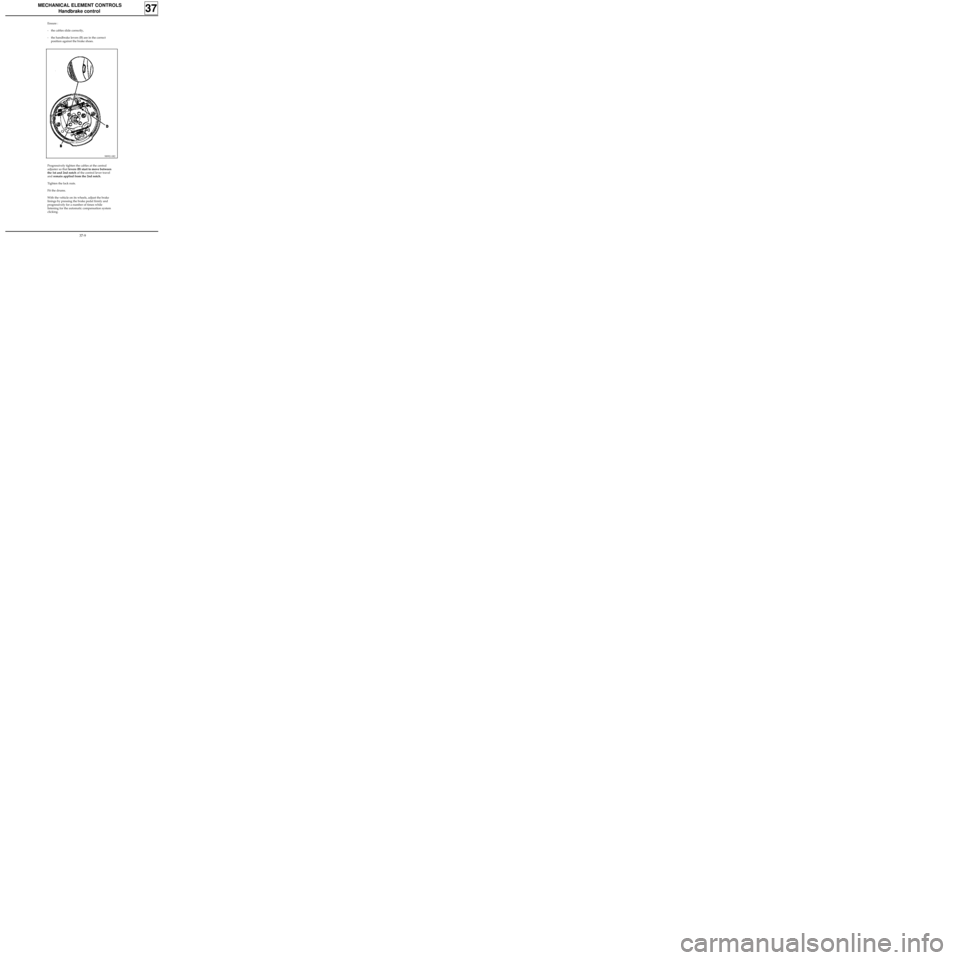
98992-1R2
Ensure :
- the cables slide correctly,
- the handbrake levers (B) are in the correct
position against the brake shoes.
Progressively tighten the cables at the central
adjuster so that levers (B) start to move between
the 1st and 2nd notch of the control lever travel
and remain applied from the 2nd notch.
Tighten the lock nuts.
Fit the drums.
With the vehicle on its wheels, adjust the brake
linings by pressing the brake pedal firmly and
progressively for a number of times while
listening for the automatic compensation system
clicking.
37-9
Page 94 of 105
93856-1S
MECHANICAL ELEMENT CONTROLS
External gear control
37
SPECIAL TOOLING REQUIRED
B.Vi. 1133 Shim for locking the gearbox input lever in 1st
Remove the collector.
Engage 1st gear.
TIGHTENING TORQUES (in daN.m)
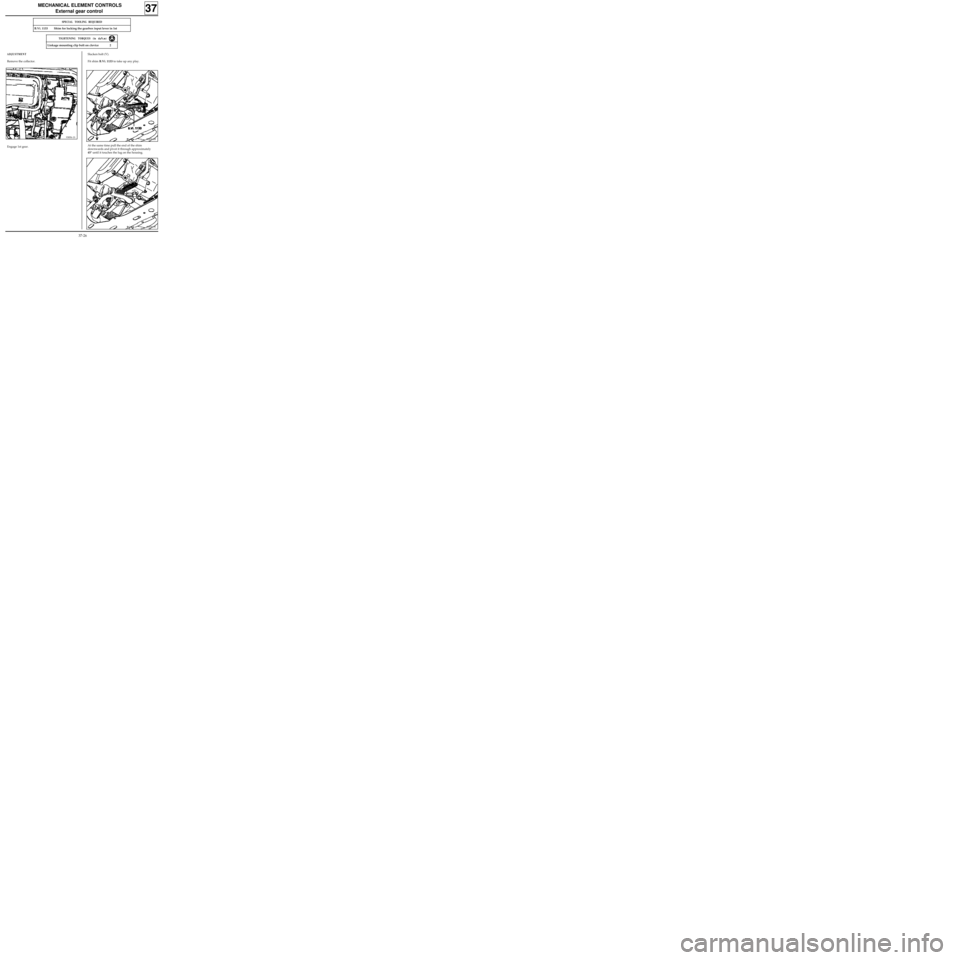
ADJUSTMENT
Linkage mounting clip bolt on clevice 2
Slacken bolt (V).
Fit shim B.Vi. 1133 to take up any play.
92450-2R
At the same time pull the end of the shim
downwards and pivot it through approximately
45° until it touches the lug on the housing.
92450-3S
37-26
Page 96 of 105
ELECTRONICALLY CONTROLLED HYDRAULIC SYSTEMS
BOSCH ABS
38
This vehicle is fitted with BOSCH ABS 5.3 of the four channel additional type; the conventional braking
equipment and the ABS equipment are separate.
SPECIAL NOTES
The system comprises four speed sensors. Each hydraulic braking channel is associated with a sensor at each
wheel. The front wheels are therefore regulated separately. The rear wheels however are regulated at the
same time and in the same way according to the select low principle (the first wheel which tends to lock
causes immediate regulation on the complete axle assembly). The compensator fulfils its normal function.
38-1
Page 104 of 105
ELECTRONICALLY CONTROLLED HYDRAULIC SYSTEMS
BOSCH ABS
38
HYDRAULIC BRAKING TEST
This section describes the test to be carried out using the XR25, to check the mounting of the ABS system in
the vehicle and, in particular, the hydraulic circuit.
NOTE: for this test, two persons are required and the vehicle must be on a two post lift, if possible.
Principle of the test
Put the vehicle on the lift with the wheel to be tested raised. One of the operators must be in the passenger
compartment in the driver’s position with the XR25. Switch the ignition on, vehicle in neutral, in fault finding
mode and press the brake pedal. The second operator must apply a torque to the wheel to try and rotate it.
The operator generates an appropriate command on the XR25 which carries out the following cycle ten
times: alternate decrease then increase in pressure at the wheel to be checked. These actions in the ABS will
be noted at the wheel as ten alternate locking and releasing operations. The jerky movement of the wheel,
noted qualitatively by the operator, signify that the hydraulic circuit for this wheel is correctly connected.
The programme for the XR25 for this sequence is as follows:
- Cycle on the wheel to be tested:
- a drop in pressure for 200 ms where the pump starts at the same time,
- an increase in pressure for 300 ms where the pump starts at the same time (ten cycles are carried out
for the wheel in question).
- The pressure increases to master cylinder pressure for all four wheels.
- The hydraulic pump motor stops.
- The operator releases the brake pedal.
The hydraulic test for the wheel in question is complete - begin the test for the three other wheels.
BLEEDING PROCEDURE
NOTE :
the hydraulic assembly is pre-filled.
This bleeding procedure must be used when one of the following components has been removed:
- the hydraulic assembly,
- the master cylinder,
- the pipework (between the hydraulic assembly and the master cylinder).
1)Bleed the braking system conventionally using the pedal.
NOTE : if, after a road test with ABS regulation, the pedal travel is not correct, bleed the hydraulic assembly.
38-9