Automatic SAAB 9-3 2009 Repair Manual
[x] Cancel search | Manufacturer: SAAB, Model Year: 2009, Model line: 9-3, Model: SAAB 9-3 2009Pages: 304, PDF Size: 44.31 MB
Page 216 of 304
216 Car careWipers and washersWiper bladesCheck and clean all wiper blades regularly.
If poor wiper performance is experienced,
clean the windshield with washer fluid. This
is particularly important if the car has been
through an automatic car wash, as these
sometimes leave a wax coating on the wind-
shield.
If wiper performance is still unsatisfactory,
fit new blades.
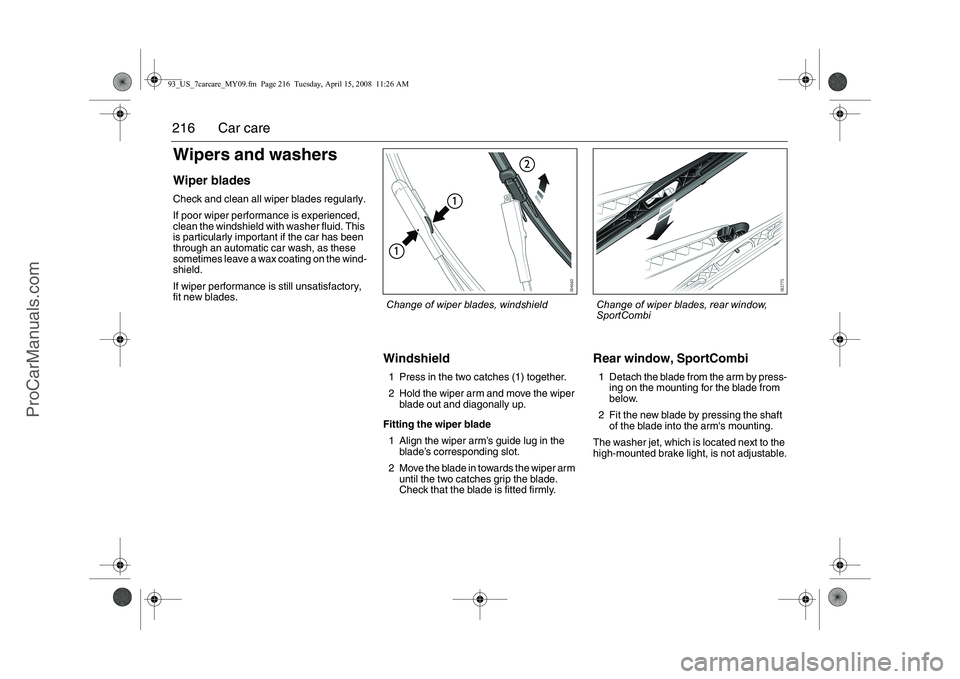
Windshield1 Press in the two catches (1) together.
2 Hold the wiper arm and move the wiper blade out and diagonally up.
Fitting the wiper blade 1 Align the wiper arm’s guide lug in the blade’s corresponding slot.
2 Move the blade in towards the wiper arm until the two catches grip the blade.
Check that the blade is fitted firmly.
Rear window, SportCombi1 Detach the blade from the arm by press-ing on the mounting for the blade from
below.
2 Fit the new blade by pressing the shaft of the blade into the arm's mounting.
The washer jet, which is located next to the
high-mounted brake light, is not adjustable.
Change of wiper blades, windshield
Change of wiper blades, rear window,
SportCombi
93_US_7carcare_MY09.fm Page 216 Tuesday, April 15, 2008 11:26 AM
ProCarManuals.com
Page 219 of 304
219
Car care
Wrong bulb fitted
If a low or main beam bulb of too high a
rating is fitted, a bulb failure message will be
shown on the SID (a too high wattage bulb
can damage the reflector).
If the following message is displayed but the
bulb shines, it is most likely that an incorrect
bulb has been fitted.
Note
When changing bulbs, fit the same type of
bulb (e.g. Long-Life) as that removed.
Headlight aiming , page 274.
Xenon headlights 3Xenon headlights produce roughly two
times as much light as halogen bulbs and
have a significantly longer service life.
The lamp units consist of a gas discharge
lamp containing xenon. When the lights are
switched on a very hi gh voltage activates
the xenon gas. The lamps soon reach full
intensity.
Cars with xenon headlights have automatic
levelling. The levelling system is comprised
of two sensors, one on the front suspension
and one on the rear suspension, and a con-
trol unit by the engine bay fuse box. Head-
light alignment is adjus ted automatically to
the car’s load to prevent dazzling drivers in
oncoming traffic.
If a fault is detected in the system, the fol-
lowing message will be displayed on the
SID:
Right high beam failure.
WARNING
Xenon headlights are high tension. All
work on xenon headlights, including
changing bulbs, must be carried out by
dealer personnel.
Headlight levelling
malfunction.
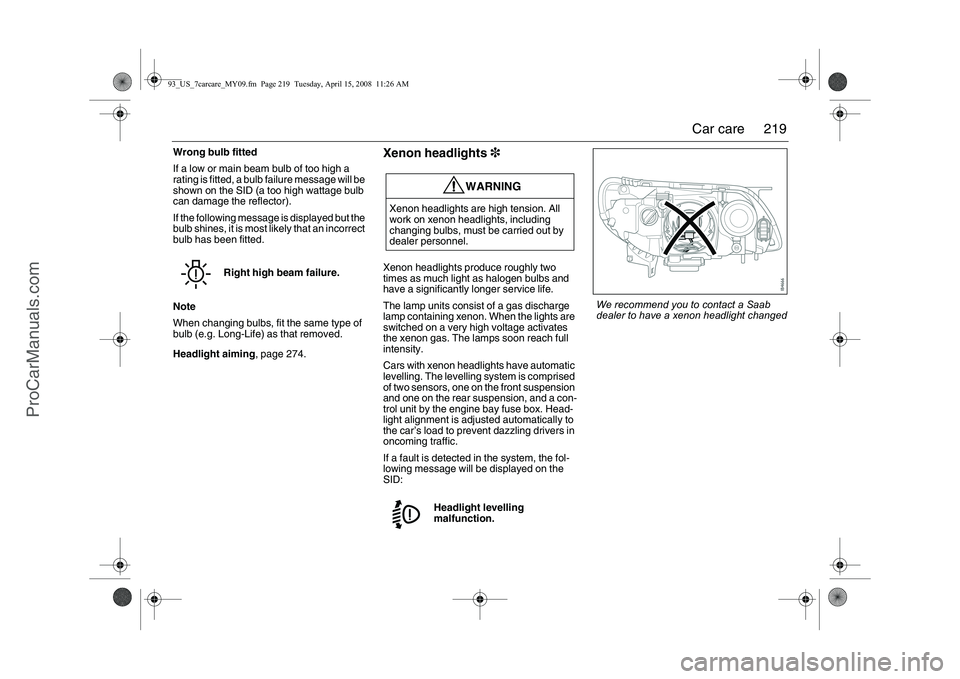
We recommend you to contact a Saab
dealer to have a xenon headlight changed
93_US_7carcare_MY09.fm Page 219 Tuesday, April 15, 2008 11:26 AM
ProCarManuals.com
Page 235 of 304
235
Car care
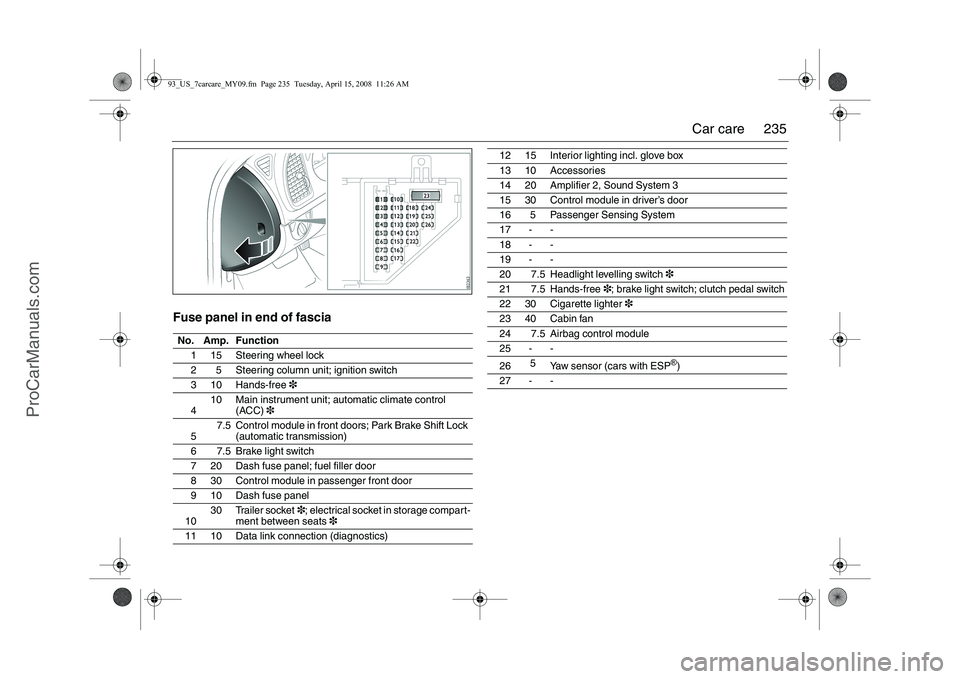
Fuse panel in end of fasciaNo. Amp. Function
1 15 Steering wheel lock
2 5 Steering column unit; ignition switch
3 10 Hands-free 3
4 10 Main instrument unit;
automatic climate control
(ACC) 3
5 7.5 Control module in front doors; Park Brake Shift Lock
(automatic transmission)
6 7.5 Brake light switch
7 20 Dash fuse panel; fuel filler door
8 30 Control module in passenger front door
9 10 Dash fuse panel
10 30 Trailer socket
3; electrical socket in storage compart-
ment between seats 3
11 10 Data link connection (diagnostics)
12 15 Interior lighting incl. glove box
13 10 Accessories
14 20 Amplifier 2, Sound System 3
15 30 Control module in driver’s door
16 5 Passenger Sensing System
17 - -
18 - -
19 - -
20 7.5 Headlight levelling switch 3
21 7.5 Hands-free 3; brake light switch; clutch pedal switch
22 30 Cigarette lighter 3
23 40 Cabin fan
24 7.5 Airbag control module
25 - -
26 5
Yaw sensor (cars with ESP
®)
27 - -
93_US_7carcare_MY09.fm Page 235 Tuesday, April 15, 2008 11:26 AM
ProCarManuals.com
Page 236 of 304
236 Car care
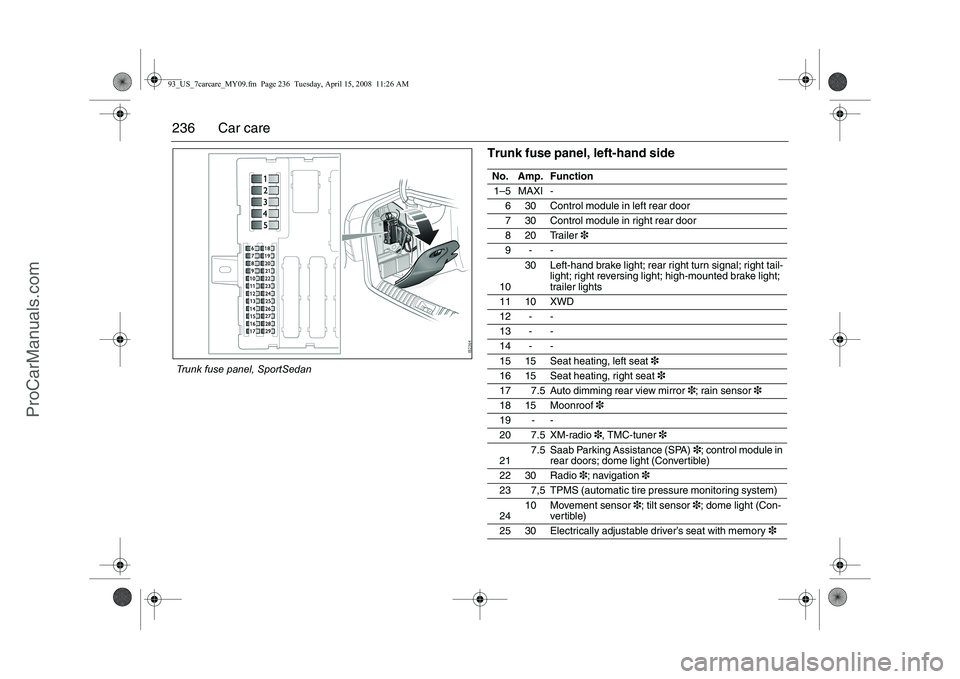
Trunk fuse panel, left-hand sideNo. Amp. Function1–5 MAXI -
6 30 Control module in left rear door
7 30 Control module in right rear door
820Trailer 3
9--
10 30 Left-hand brake light; rear right turn signal; right tail-
light; right reversing light; high-mounted brake light;
trailer lights
11 10 XWD
12 - -
13 - -
14 - -
15 15 Seat heating, left seat 3
16 15 Seat heating, right seat 3
17 7.5 Auto dimming rear view mirror 3; rain sensor 3
18 15 Moonroof 3
19 - -
20 7.5 XM-radio 3, TMC-tuner 3
21 7.5 Saab Parking Assistance (SPA)
3; control module in
rear doors; dome light (Convertible)
22 30 Radio 3; navigation 3
23 7,5 TPMS (automatic tire pressure monitoring system)
24 10 Movement sensor
3; tilt sensor 3; dome light (Con-
vertible)
25 30 Electrically adjustable driver’s seat with memory 3
Trunk fuse panel, SportSedan93_US_7carcare_MY09.fm Page 236 Tuesday, April 15, 2008 11:26 AM
ProCarManuals.com
Page 238 of 304
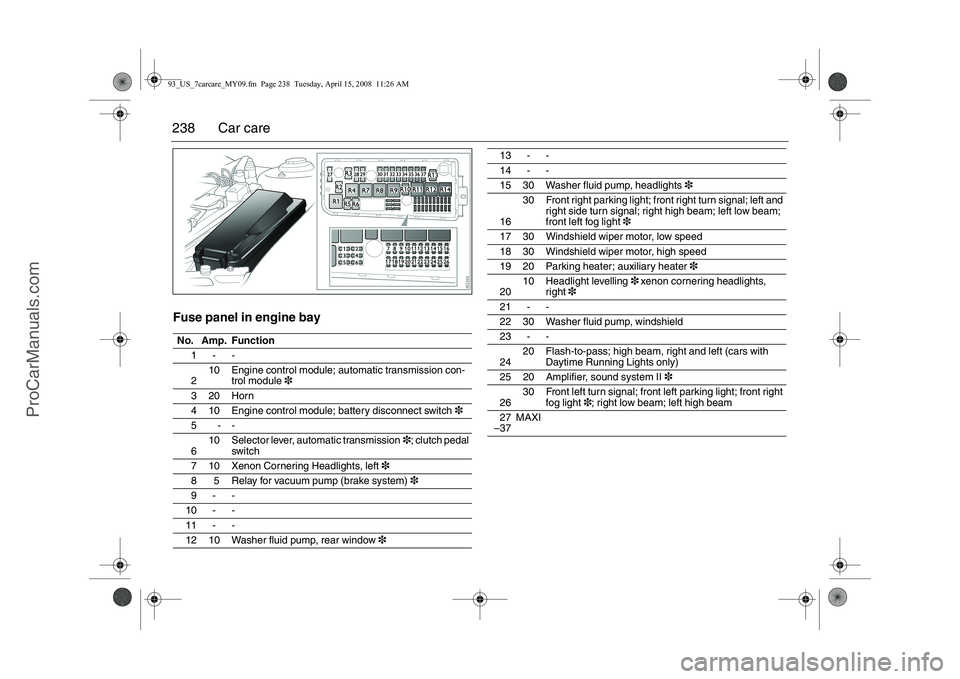
238 Car careFuse panel in engine bayNo. Amp. Function1--
2 10 Engine control module; au
tomatic transmission con-
trol module 3
320Horn
4 10 Engine control module; ba ttery disconnect switch3
5--
6 10 Selector lever, automatic transmission
3; clutch pedal
switch
7 10 Xenon Cornering Headlights, left 3
8 5 Relay for vacuum pump (brake system) 3
9--
10 - -
11 - -
12 10 Washer fluid pump, rear window 3
13 - -
14 - -
15 30 Washer fluid pump, headlights3
16 30 Front right parking light; fr
ont right turn signal; left and
right side turn signal; right high beam; left low beam;
front left fog light 3
17 30 Windshield wiper motor, low speed
18 30 Windshield wiper motor, high speed
19 20 Parking heater; auxiliary heater 3
20 10 Headlight levelling
3 xenon cornering headlights,
right 3
21 - -
22 30 Washer fluid pump, windshield
23 - -
24 20 Flash-to-pass; high beam, right and left (cars with
Daytime Running Lights only)
25 20 Amplifier, sound system II 3
26 30 Front left turn signal; front left parking light; front right
fog light 3; right low beam; left high beam
27
–37 MAXI
93_US_7carcare_MY09.fm
Page 238 Tuesday, April 15, 2008 11:26 AM
ProCarManuals.com
Page 250 of 304
250 Car care
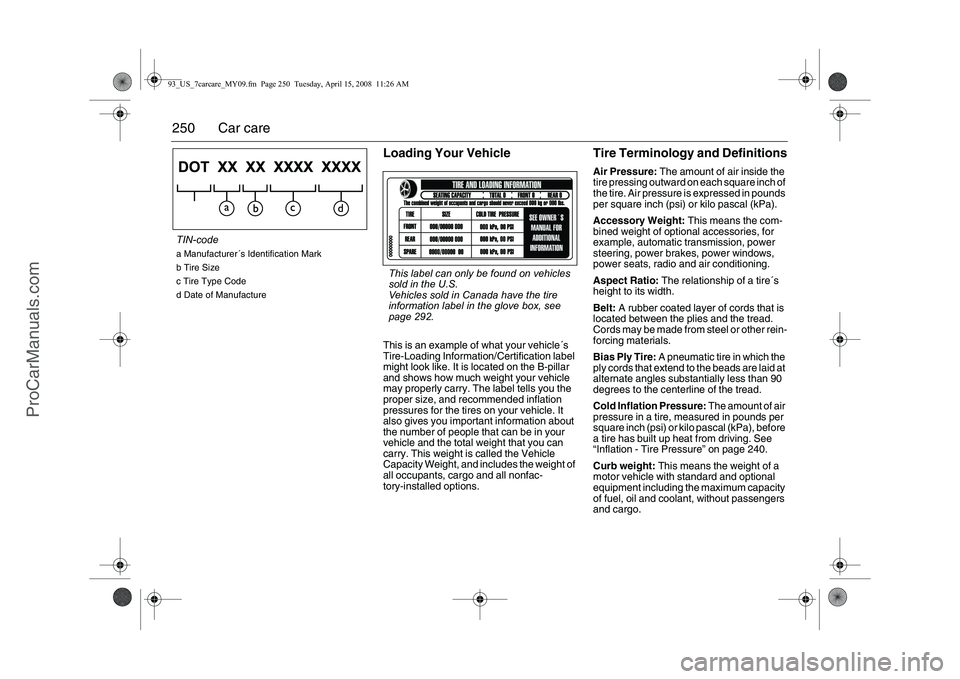
Loading Your VehicleThis is an example of what your vehicle´s
Tire-Loading Information/Certification label
might look like. It is located on the B-pillar
and shows how much weight your vehicle
may properly carry. The label tells you the
proper size, and recommended inflation
pressures for the tires on your vehicle. It
also gives you important information about
the number of people that can be in your
vehicle and the total weight that you can
carry. This weight is called the Vehicle
Capacity Weight, and includes the weight of
all occupants, cargo and all nonfac-
tory-installed options.
Tire Terminology and DefinitionsAir Pressure: The amount of air inside the
tire pressing outward on each square inch of
the tire. Air pressure is expressed in pounds
per square inch (psi) or kilo pascal (kPa).
Accessory Weight: This means the com-
bined weight of optional accessories, for
example, automatic transmission, power
steering, power brakes, power windows,
power seats, radio and air conditioning.
Aspect Ratio: The relationship of a tire´s
height to its width.
Belt: A rubber coated layer of cords that is
located between the plies and the tread.
Cords may be made from steel or other rein-
forcing materials.
Bias Ply Tire: A pneumatic tire in which the
ply cords that extend to the beads are laid at
alternate angles substantially less than 90
degrees to the centerline of the tread.
Cold Inflation Pressure: The amount of air
pressure in a tire, measured in pounds per
square inch (psi) or ki lo pascal (kPa), before
a tire has built up heat from driving. See
“Inflation - Tire Pressure” on page 240.
Curb weight: This means the weight of a
motor vehicle with standard and optional
equipment including the maximum capacity
of fuel, oil and coolant, without passengers
and cargo.
This label can only be found on vehicles
sold in the U.S.
Vehicles sold in Canada have the tire
information label in the glove box, see
page 292.
TIN-codea Manufacturer´s Identification Mark
b Tire Size
c Tire Type Code
d Date of Manufacture93_US_7carcare_MY09.fm
Page 250 Tuesday, April 15, 2008 11:26 AM
ProCarManuals.com
Page 253 of 304
253
Car care
Winter tiresWinter (snow) tires are recommended for
winter climates where the majority of your
driving will be done on snow and ice. Winter
tires should be fitted to all four wheels to
maintain a proper balance. Your Saab
dealer can advise you of to the correct size
tire for your car (if different from the original
size) and also supply Saab approved winter
tires pre-mounted on steel or alloy rims.
Winter tires normally use a different speed
rating compared to summer/all season tires.
Make sure not to exce ed the stated speed
rating on the tires you use.
Make sure that wheels with sensors for tire
pressure monitoring are fitted during
replacement if the car has automatic tire
pressure monitoring.Tire date codeTires should be regarded as perishable
goods. As the tires age, the rubber becomes
progressively harder, and the road holding
ability of the tires diminishes. This is partic-
ularly true on winter tires.
Tires have a code that specifies their date of
manufacture. The first two digits denote the
week number and the last two digits the year
followed by a filled triangle.
Automatic tire pressure
monitoring systemThe system consists of a sensor in each
wheel and a common receiver. The sensors
are located inside the tire in direct connec-
tion with the air pressure valves.
Make sure that wheels with sensors for tire
pressure monitoring are fitted during
replacement if the car has automatic tire
pressure monitoring.
The system will trigger a warning/alarm if
the spare wheel is fitted because it has no
sensor. Tire pressure informa
tion is transmitted
wireless to the receiver.
The system checks the tire pressures when
speed exceeds 19 mph (30 km/h).
The system is self-programming which
means that the wheels can be shifted
around without any need for adjustment.
The sensor batteries last for 10 years or
around 160 000 km. The battery cannot be
replaced. The whole sensor must be
replaced.
WARNING
The system is an aid to the driver. The
driver always has the responsibility that
the tires have the correct air pressure.
For optimum safety, economy and com-
fort tire pressures should be checked reg-
ularly even if the automatic tire pressure
monitoring has not alarmed.
NOTICETire replacement must take place with
great care to avoid damaging the sensors
that are built together with the valves.
Remove the rear side first, see page 255.
Start to remove the tire opposite the valve.
During removal the tire machine must not come closer than ±10° from the
valve.
During fitting, start 20° after the valve and finish 20° before the valve.
Do not inflate the tire with pressure higher than 102 psi (700 kPa).
93_US_7carcare_MY09.fm Page 253 Tuesday, April 15, 2008 11:26 AM
ProCarManuals.com
Page 258 of 304
258 Car careDriving with a compact wheel
fittedObserve the following when the compact
spare tire is fitted:
The compact spare is light and easy to handle when changing a tire.
Do not drive further than necessary with the compact spare fitted - the maximum
life of the tire is only just over 2,000 miles
(approx. 3,500 km).
Refit the standard tire as soon as possi- ble.
Fitting a spare tire/wheel without pressure sensor will trigger a malfunction
message, see page 255.
Important considerations when driving with
a compact spare tire:
The car’s ground clearance is reduced. The car must not be driven with more than
one compact spare tire at a time.
Avoid driving against the curb.
Do not use snow chains.
Do not fit the wheel cover - this would conceal the warning text.
Changing a tire
WARNING
Do not exceed 50 mph (80 km/h). The
tire can overheat affecting the car’s
road holding.
Tire pressure: refer to page 291.
The spare tire or punctured tire must be stowed under the trunk floor, and
secured in place with the retaining nut.
WARNING
Lifting a vehicle and getting under it to do
maintenance or repairs is dangerous
without the appropriate safety equipment
and training. The jack provided with your
vehicle is designed only for changing a
flat tire. If it is used for anything else, you
or others could be badly injured or killed if
the vehicle slips off the jack. Use the jack
provided with your vehicle only for chang-
ing a flat tire.
Changing a tire can be dangerous. The
vehicle can slip off the jack and roll over
or fall on you or other people. You and
they could be badly injured or even killed.
Find a level place to change your tire. To
help prevent the vehicle from moving:
1 Set the parking brake firmly.
2 If you have an automatic transmis- sion, put the shift lever in PARK (P).
For a manual transmission, leave the
car in gear (1st or REVERSE (R)).
3 Turn off the engine and do not restart while the vehicle is raised.
4 Do not allow passengers to remain in the vehicle.
93_US_7carcare_MY09.fm Page 258 Tuesday, April 15, 2008 11:26 AM
ProCarManuals.com
Page 267 of 304
267
Car care
Textile carpetingTextile carpeting should be vacuum
cleaned regularly. Carpeting can also be
cleaned using a brush or sponge and carpet
shampoo.
For safety reasons, vacuum cleaners that
are not earthed (grounded) must not be
used out of doors.Engine bayThe engine bay should be cleaned with an
engine decreasing and rinsed with hot
water. The headlights must be covered
over. Do not use a pressure washer. Avoid
spraying electrical components and con-
nectors.
Do not use petrol as a cleaning agent or sol-
vent when carrying out repairs or mainte-
nance. Saab recommends the use of envi-
ronmentally-friendly cleaning solutions.
WashingThe bodywork must be washed frequently.
When the car is new, the body should be
washed by hand using plain cold water and
a clean, soft brush through which the water
flows. Automatic carwashes should be
avoided when the car is new.
After 5–6 months the paintwork will have
hardened. To facilitate cleaning, a suitable
detergent can be added to the water, which
should be lukewarm.
Remove any bird droppings without delay,
as these can discolor the paintwork and
prove difficult to polish out. Lay a wad of wet
paper on the patch of dirt and leave it for a
minute or so. It will then be easy to wash off
the dirt.
Use a soft cloth moistened with white spirit
to remove splashes of tar or asphalt. Do not
use strong cleaners, as these can dry out
the paintwork.
NOTICEOnly use liquid detergent when cleaning
the plastic lenses of the front and rear
lights. Do not use mechanical cleaning.
Rinse off the detergent immediately, oth-
erwise cracks may form in the plastic
lenses.
The door mirrors should be folded in
before the car enters an automatic car
wash.
SportCombi: To avoid the wiper arm to
break tape it down to the window when
using a drive-through car wash.
Try your brakes on leaving a car wash.
Wet brake discs reduce the performance
of the brakes.
Fixed antennae, such as for a mobile
phone, must be removed if the car goes
through an automatic car wash.
Cars with Saab Parking Assistance: Do
not spray the sensors or closer than 8 in.
(20 cm) to the sensors with a pressure
washer, as this can damage them.
93_US_7carcare_MY09.fm Page 267 Tuesday, April 15, 2008 11:26 AM
ProCarManuals.com
Page 268 of 304
268 Car careThe underside of the car also needs wash-
ing regularly, and this should be done extra
thoroughly at the end of winter. Clean the
underside of the car by hand if the car is
usually washed in an automatic car wash
without special facilities for underbody
cleaning.
Never wash or leave the car to dry in the
sun, but wipe it dry with a chamois leather
immediately after washing to avoid smears
and streaks.
Clean the inside of window glass using a
proprietary window cleaner. This is particu-
larly important when the car is new, as
upholstery and trim have a tendency to
sweat a little at first.
Keep the glass well polished, as this helps
to prevent misting.
Clean the outside of the windows with Saab
washer fluid. This is especially important if
the car has been washed in an automatic
car wash, as sometimes a wax treatment is
used that can contaminate the windshield
and impair the performance of the wipers.
Saab offers a full co mplement of car care
products. See your dealer or visit us at our
website. Convertible
If a pressure washer is used be heedful of
the following recommendations:
On the lower part of the car (not higher than the door handles): max pressure
of 100 bar and not closer than 8 in.
(20 cm).
On the upper part of the car: tax pres- sure of 100 bar and not closer than
32 in. (80 cm).
Do not use any drying chemicals or water- proofing agents.
Avoid automatic car washes.
WARNING
Read and follow the instructions on the packaging of the recommended
cleaning agents and waterproofing
agents. We recommend that you con-
tact an authorized Saab dealer
regarding recommended cleaning
agents and waterproofing agents.
Never treat the soft top with hot wax or similar.
Never use petrochemical based sol-
vents for cleaning. Only use water with
a recommended cleaning agent. Pet-
rochemical based solvents can cause
irreparable damage to the soft top.
Never use a pressure washer to clean the soft top. Only use normal house-
hold water pressure.NOTICE Only operate the soft top when it is clean and dry.
Do not lower the so ft top when it is
damp. This can cause folds and pres-
sure marks. If the soft top is heavily
soiled, the dirt may cause irreparable
visible chafe marks.
Only use water, recommended clean- ing agents and a microfibre cloth if the
soft top is already damaged, other-
wise the damage can become worse.
At creases, seams and window edges the cleaning motion should be away
from the crease, seam or window
edge in to the soft top.
93_US_7carcare_MY09.fm Page 268 Tuesday, April 15, 2008 11:26 AM
ProCarManuals.com