ignition Seat Alhambra 2011 Manual PDF
[x] Cancel search | Manufacturer: SEAT, Model Year: 2011, Model line: Alhambra, Model: Seat Alhambra 2011Pages: 385, PDF Size: 7.92 MB
Page 198 of 385
196
Driving
Start-Stop Function* Fig. 139 Detailed view of
the centr
e c
onsole: Start-
Stop function button.
In Start-Stop mode, the engine is automatically switched off when the vehi-
cle i
s at a standstill. The engine restarts automatically when required.
The function is enabled automatically whenever the ignition is switched on.
The instrument panel displays information on the current status.
Vehicles with a manual gearbox
● When the vehicle is at a standstill, leave it in neutral and take your foot
off the clut
ch. The engine switches off.
● Simply depress the clutch pedal to move off again.
Vehicl
es with an automatic gearbox
● When the vehicle is at a standstill, depress the brake or keep it pressed
down. The en
gine switches off.
● The engine will start again as soon as you release the brake pedal.
● With the gear lever set to P, the engine wi
ll not start until a range of
gears is selected or the accelerator pedal is depressed. Important conditions for the engine to automatically switch off
●
The driver seat belt must be buckled.
● The driver door must be closed.
● The bonnet must be closed.
● The factory-fitted towing bracket must not be electrically connected to a
trail
er.
● A minimum engine temperature has been reached.
● The vehicle has moved since the last stop.
● In vehicles with Climatronic: The temperature inside the vehicle is within
the preset
temperature range.
● The temperature set is neither very high nor very low.
● The air conditioning defrost function is not switched on.
● In vehicles with Climatronic: the blower has not been manually set to a
high speed.
● The pow
er level of the vehicle's battery is sufficient.
● The vehicle's battery temperature is neither too high nor too low.
● The vehicle is not on a steep gradient or slope.
● The front wheels are not overly turned.
● The heated windscreen is not switched on.
● Reverse gear is not engaged.
● The park assist system is not switched on.
Conditions
for automatically restarting the engine
The engine may automatically restart under the following conditions:
● If the vehicle interior is too hot or too cold.
● If the vehicle moves.
● If the vehicle's battery voltage drops.
Conditions
requiring the key to restart the engine
The engine must be started using the key under the following conditions:
Page 201 of 385
199
Driving
Parking sensor system* Fig. 140 Detailed view of
the centr
e c
onsole: but-
ton for switching the
parking sensor system
on and off. Fig. 141 Parking sensor
sys
t
em sensors on the
front bumper.
The parking sensor system assists the driver when parking. If the vehicle is
appro
aching an obstacle, an intermittent sound signal is emitted. The short-
er the distance, the shorter the intervals between tones. If the vehicle is too
close to the obstacle, the sound signal becomes constant. Switching the parking sensor system on and off
●
Press the button ⇒
fig. 140 when the ignition i
s switched on.
● Automatic on: select r
everse gear.
● Automatic off: drive fa
ster than 15 km/h.
The button lights up when the function is switched on.
Things to note regarding the parking sensor system
● The parking sensor system sometimes registers water on the sensors as
an obs
tacle.
● If the distance does not change, the warning signal will sound less loud-
ly aft
er a few seconds. If the continuous signal sounds, the volume will re-
main constant.
● When the vehicle moves away from the obstacle, the beeping sound au-
tomatic
ally switches off. On approaching the obstacle again, the beeping
sound will automatically switch back on.
● If the electronic parking brake is engaged or the gear lever is set to P, no
sound wi
ll be emitted.
● Your Authorised Service Centre can adjust the volume of the warning
signal
s. Note
If the parking sensor system is faulty, a constant acoustic signal will be
emitted the fir s
t time it is switched on and the button will flash. Switch the
parking sensor system off using the button and take the vehicle to a spe-
cialist workshop to have the system checked as soon as possible. Safety First Operating instructions Practical tips Technical Data
Page 210 of 385
208
Driving
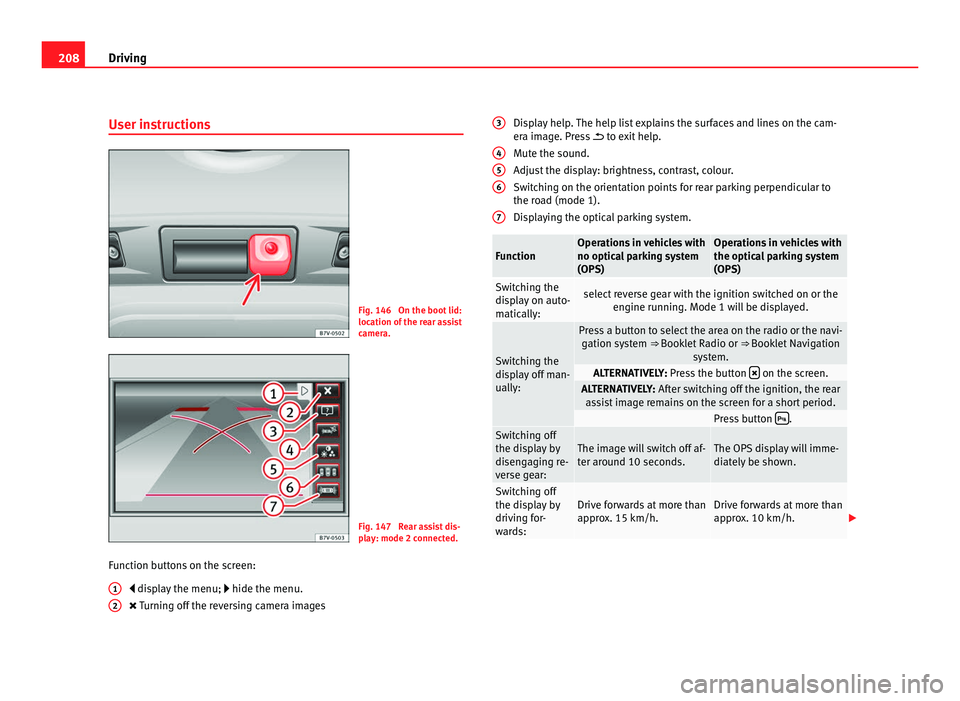
User instructions Fig. 146 On the boot lid:
location of
the r
ear assist
camera. Fig. 147 Rear assist dis-
pl
a
y: mode 2 connected.
Function buttons on the screen: disp
lay the menu; hide the menu.
Turning off the reversing camera images
1 2 Display help. The help list explains the surfaces and lines on the cam-
era im
ag
e. Press to exit help.
Mute the sound.
Adjust the display: brightness, contrast, colour.
Switching on the orientation points for rear parking perpendicular to
the road (mode 1).
Displaying the optical parking system. Function Operations in vehicles with
no optica
l
parking system
(OPS) Operations in vehicles with
the optica
l
parking system
(OPS) Switching the
dis
p
lay on auto-
matically: select reverse gear with the ignition switched on or the
engine ru nnin
g. Mode 1 will be displayed. Switching the
dis
p
lay off man-
ually: Press a button to select the area on the radio or the navi-
gation sy s
tem ⇒ Booklet Radio or ⇒ Booklet Navigation
system. ALTERNATIVELY: Pre
s
s the button on the screen.
ALTERNATIVELY: Aft
er sw
itching off the ignition, the rear
assist image remains on the screen for a short period. Press button
.
Switching off
the dis
p
lay by
disengaging re-
verse gear: The image will switch off af-
ter ar
ou
nd 10 seconds. The OPS display will imme-
diat
ely
be shown. Switching off
the dis
p
lay by
driving for-
wards: Drive forwards at more than
appr
o
x. 15 km/h. Drive forwards at more than
appr
o
x. 10 km/h. 3
4
5
6
7
Page 214 of 385
212
Driving
Cruise control system*
Introduction The cruise control system (CCS) is able to maintain the set speed when driv-
ing f
or
wards from approx. 20 km/h (12 mph).
The CCS only slows down by reducing the accelerator but not by braking.
⇒ .
Addition a
l information and warnings:
● Changing gear ⇒ page 174
● A
ccessories, parts replacement, repairs and modifications ⇒ page 257WARNING
Use of the cruise control could cause accidents and severe injuries if it is
not po s
sible to drive at a constant speed maintaining the safety distance.
● Do not use the CCS in heavy traffic, if the distance from the vehicle in
front i
s insufficient, on steep roads, with several bends or in slippery cir-
cumstances (snow, ice, rain or loose gravel), or on flooded roads.
● Never use the CCS when driving off-road or on unpaved roads.
● Always adapt your speed and the distance to the vehicles ahead in
line with v
isibility, weather conditions, the condition of the road and the
traffic situation.
● To avoid unexpected operation of the cruise control system, turn it off
every
time you finish using it.
● It is dangerous to use a set speed which is too high for the prevailing
roa
d, traffic or weather conditions.
● When travelling down hills, the CCS cannot maintain a constant
speed. The
vehicle tends to accelerate under its own weight. Select a
lower gear or use the foot brake to slow the vehicle. Warning and control lamp
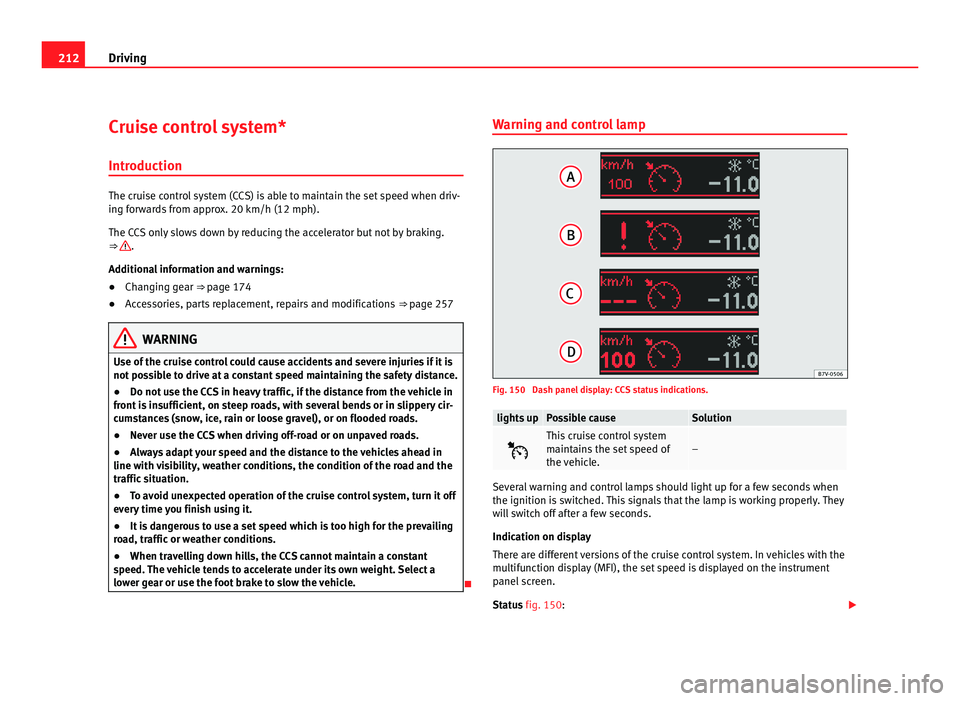
Fig. 150 Dash panel display: CCS status indications.
lights up Possible cause Solution
This cruise control system
maint
ain
s the set speed of
the vehicle. –
Several warning and control lamps should light up for a few seconds when
the ignition is
sw
itched. This signals that the lamp is working properly. They
will switch off after a few seconds.
Indication on display
There are different versions of the cruise control system. In vehicles with the
multifunction display (MFI), the set speed is displayed on the instrument
panel screen.
Status fig. 150:
Page 218 of 385
216
Driving
Control lamps Blinks or lights
up Possible cause Solution
(yellow) Lane assist system con-
nected b
ut
inactive. The system cannot clearly
detect
the l
ane. See and
page 217, The lane assist
system is inactive (control
lamp lit in yellow). (green) Lane assist system con-
nected and activ
e. –
Several warning and control lamps should light up for a few seconds when
the ignition is
sw
itched. This signals that the lamp is working properly. They
will switch off after a few seconds. WARNING
If the warning lamps and messages are ignored, the vehicle may stall in
traffic, or m a
y cause accidents and severe injuries.
● Never ignore the warning lamps or text messages.
● Stop the vehicle safely as soon as possible. CAUTION
Failure to heed the warning lamps and text messages when they appear
ma y
result in faults in the vehicle. Operation mode
Fig. 152 In the sun visor:
Field of
vision of the lane
assist system camera.
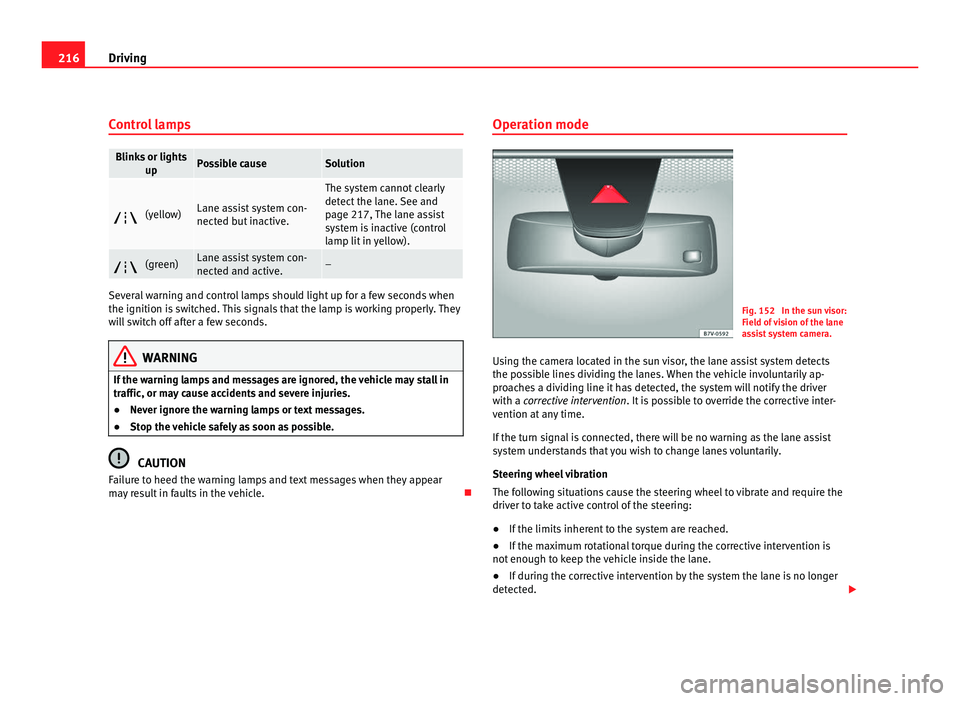
Using the camera located in the sun visor, the lane assist system detects
the poss
ible lines dividing the lanes. When the vehicle involuntarily ap-
proaches a dividing line it has detected, the system will notify the driver
with a corrective intervention. It is possible to override the corrective inter-
vention at any time.
If the turn signal is connected, there will be no warning as the lane assist
system understands that you wish to change lanes voluntarily.
Steering wheel vibration
The following situations cause the steering wheel to vibrate and require the
driver to take active control of the steering:
● If the limits inherent to the system are reached.
● If the maximum rotational torque during the corrective intervention is
not enough to k
eep the vehicle inside the lane.
● If during the corrective intervention by the system the lane is no longer
detected.
Page 224 of 385
222
Driving Note
● Do not only rely on the tyre monitoring system. Regularly check your
ty r
es to ensure that the tyre pressure is correct and that the tyres are not
damaged due to puncture, cuts, tears and impacts/dents. Remove objects
from the tyres only when the tyres have not been pierced by these.
● The tyre monitoring system is set to the tyre pressure recommended by
the manufact
urer and indicated on the label ⇒ fig. 176.
Elements of the tyre monitoring indicator Tyre monitoring indicator with button.
See ⇒ page 223.
Warning lamp on the in
strument panel.
S
ET button on the centre console.
Monitoring the tread of all tyres using ABS sensors (indirect measure-
ment).
Adjustable medium and full-load tyre pressures.
Button to update the system when the tyre pressure is changed. Control lamp Lights
up or
fla she
s Possible cause ⇒ Solution
The tyre pressure of a wheel
ha
s
dropped considerably in
relation to the pressure set by
the driver ⇒ page 223.
Stop the vehicle! Reduc
e your
speed immediately! Stop the ve-
hicle safely as soon as possible.
Avoid sudden manoeuvres and
braking!
Check all tyres and pressures.
Replace any damaged tyres. System malfunction. Consult a specialist workshop if
the tyr
e pr
essure is correct and
the lamp remains lit after
switching the ignition off and
back on again. Have the system
checked there. Several warning and control lamps should light up for a few seconds when
the ignition is
sw
itched. This signals that the lamp is working properly. They
will switch off after a few seconds. WARNING
When the tyres are inflated at different pressures or at a pressure that is
too lo w then a ty
re may the damaged resulting in a loss of control of the
vehicle and a serious or mortal accident.
● If the indicator lights, st
op immediately and check the tyres.
● If the tyres are inflated at different pressures or if a tyre pressure is
too low
, this will increase tyre wear, negatively affecting vehicle stability
and increasing braking distances.
Page 226 of 385
224
Driving
● The vehicle is fitted with snow chains.
● The wheel on one ax
le is changed.
There ma
y be a delay in the reaction of the tyre monitoring indicator or it
may not indicate anything under certain circumstances (e.g. sports driving,
snow-covered or unpaved roads).
Adaptation of the tyre monitoring indicator
On adjusting tyre pressure or changing one or more wheels, the ⇒ fig. 154
button on the tyre monitoring indicator must be kept pressed down, with
the ignition on, until a signal is heard. Do the same, for example, when the
front and rear wheels are swapped ⇒ fig. 175.
If the wheels are subjected to an excessive load (towing a trailer, heavy
load), the tyre pressure must be increased to the maximum recommended
pressure ⇒ page 293. Press the tyre monitoring indicator button to confirm
the new pressure value. Note
An erroneous indication may be given when snow chains are in use because
the ch ain
s increase the tread of the wheel.
Page 231 of 385
229
Driving and the environment flashes Possible cause Solution
Fault in the engine manage-
ment (die
sel
engines). Take the vehicle to a Technical
Serv
ic
e as soon as possible and
have the engine checked. Combustion fault which could
dam
ag
e the catalytic convert-
er. You should reduce speed ac-
cor
din
gly. Drive carefully until
you reach the next qualified
workshop. Have the engine
checked there. Several warning and control lamps should light up for a few seconds when
the ignition is
sw
itched. This signals that the lamp is working properly. They
will switch off after a few seconds. WARNING
Observe traffic regulations when cleaning the diesel particulate filter
whil e driv
ing.
● Only carry on driving if visibility, weather, road and traffic conditions
so permit.
● Never end
anger your safety or that of other road users. CAUTION
Always pay attention to any lit lamps and to the corresponding descriptions
and ins truction
s to avoid damage to the vehicle. Note
While the control lamps , or r
emain lit, there may be engine prob-
lems, fuel consumption may be greater and the engine may lose power. Catalytic converter The catalytic converter permits the subsequent treatment of the exhaust
ga
se
s thus reducing contaminating gas emissions. To ensure a longer work-
ing life for the exhaust system and catalytic converter in a petrol engine:
● Always use unleaded petrol.
● Never run the tank completely dry.
● Do not top up with too much engine oil ⇒ page 279.
● Do not
tow-start the vehicle; use the starter cables ⇒ page 337.
If
you should notice misfiring, uneven running or loss of power when the car
is moving, reduce speed immediately. Have the car inspected by a Technical
Service. If this happens, unburnt fuel can enter the exhaust system and es-
cape into the atmosphere. The catalytic converter can also be damaged by
overheating. For the sake of the environment
Even when the emission control system is working perfectly, there may be a
smell of
sulphur from the exhaust gas under some conditions. This depends
on the sulphur content of the fuel being used.
Diesel particulate filter The diesel particulate filter removes soot particulates from the exhaust gas.
The filt
er r
etains these particulates and burns them. To assist the combus-
tion process, SEAT recommends you avoid frequent short trips.
● Always use diesel with a low sulphur content ⇒ page 267.
● Nev
er use petrol or fuel oil.
● Never use biodiesel. However, a blend prepared by the diesel manufac-
turer c
ontaining biodiesel within the limits established by the EN 590
standard may be used ⇒ page 267. Safety First Operating instructions Practical tips Technical Data
Page 257 of 385
255
Vehicle maintenance and cleaning
Notes for the user Labels and p
latesSome parts in the engine compartment come from the factory with certifi-
cat
e
s of safety, labels or plates containing important information regarding
the operation of the vehicle, for example, on the petrol cap, on the passeng-
er's sun visor, on the driver's door strut, or on the floor of the luggage com-
partment.
● Never remove these certificates of safety, labels or plates, and ensure
they are k
ept in good condition and are legible.
● If a vehicle part, bearing a certificate of safety, label or plate, is re-
plac
ed, the qualified workshop should attach the information back in the
same place.
Certificate of safety
A certificate of safety on the door strut states that all the safety standards
and regulations established by the national traffic authorities responsible
for road safety were met at the time of manufacture. It may also give the
month and year of manufacture, together with the chassis number.
Warning of high voltage label*
There is a label close to the bonnet lock which warns of high voltage in the
vehicle electrical installation. The vehicle ignition system complies with sev-
eral standards, including the Canadian standard, ICES-002.
Using your vehicle in other countries and continents The vehicle is manufactured at the factory for use in a particular country in
acc
or
dance with the national legislation in force at the time of manufacture. If the vehicle is sold in another country or used in another country for an ex-
tended period of time, the ap
plicable legislation of that country should be
observed.
It may be necessary to fit or remove certain pieces of equipment or to deac-
tivate certain functions. Service work may also be affected. This is particu-
larly true if the vehicle is used in a different climate for an extended period
of time.
As there are different types of frequency bands around the world, you may
find that the radio or navigation system supplied at the factory does not
work in another country. CAUTION
● SEAT does not accept liability for any damage to the vehicle due to the
u se of
a lower quality fuel, an inadequate service or the non-availability of
genuine spare parts.
● SEAT does not accept liability if the vehicle does not comply in part or in
ful
l with the legal requirements of other countries or continents.
Radio reception and the aerial The aerial of radio and navigation systems fitted at the factory may be
mount
ed in diff
erent parts of the vehicle:
● On the inside of the rear window, next to the rear window heating,
● on the inside of the rear side windows,
● on the inside of the windscreen,
● on the roof of the car.
Aerials
mounted on the inside of a window can be recognised by the fine
wires. Safety First Operating instructions Practical tips Technical Data
Page 266 of 385
264
Checking and refilling levels
Checking and refilling levels
Filling the tank
Introduction The fuel tank flap is on the rear right of the vehicle.
Addition
a
l information and warnings:
● Fuel ⇒ page 267
● Selectiv
e Catalytic Reduction (AdBlue) ⇒ page 271
● W
orking in the engine compartment ⇒ page 275WARNING
Refuelling or handling fuel carelessly can cause an explosion or fire re-
su ltin
g in serious burns and injuries.
● Always make sure that you correctly close the fuel cap to avoid evap-
oration and fuel
spillage.
● Fuels are highly explosive and inflammable substances that can
cause seriou
s burns and injuries.
● Fuel could leak out or be spilt if the engine is not switched off or if the
fill
er fuel nozzle is not fully inserted into the tank filler neck when refuel-
ling. This could lead to a fire, explosion and severe injuries.
● When refuelling, turn off the engine, the auxiliary heating
(⇒ page 163) and t
urn off the ignition for safety reasons.
● Always turn off mobile telephones, radio apparatus and other radio
wave emittin
g equipment before refuelling. Electromagnetic waves could
cause sparks and lead to a fire. WARNING (Continued)
● Nev er enter the vehicle while refuelling. If it is absolutely necessary
t o ent
er the vehicle, close the door and touch a metal surface before
touching the filler nozzle again. This will prevent the generation of static
electricity. Sparks could cause a fire when refuelling.
● Never handle fuel close to open flames, sparks or objects with slow
combu
stion (e.g. cigarettes).
● Avoid static electricity and electro-magnetic radiation when refuel-
ling.
● Ob
serve the safety regulations of the service station.
● Never spill fuel on the vehicle or in the luggage compartment. WARNING
For safety reasons, SEAT does not recommend carrying a spare fuel canis-
ter in the v
ehicle. Fuel could be spilled and catch fire, above all in case of
an accident and this applies to a full container as well as empty contain-
ers. This could lead to explosions, fires and injuries.
● Observe the following if you exceptionally have to carry fuel in a can-
ist
er:
– Never place a fuel container to fill it inside the vehicle or on the ve-
hicle, f
or example, in the luggage compartment or on the tailgate.
Filling in these circumstances could create an electrostatic charge
and spark that could ignite fuel fumes.
– Always place the canister on the ground to fill it.
– Insert the fuel nozzle into the mouth of the canister as far as possi-
ble.