ignition Seat Alhambra 2011 Owner's Guide
[x] Cancel search | Manufacturer: SEAT, Model Year: 2011, Model line: Alhambra, Model: Seat Alhambra 2011Pages: 385, PDF Size: 7.92 MB
Page 94 of 385
92
Unlocking and locking
Panorama sliding sunroof*
Introduction Additional information and warnings:
●
SEAT information system ⇒ pag e 62
● C
entral locking and locking system ⇒ page 74
● Emer
gency locking and unlocking ⇒ page 314WARNING
Careless use of the panorama sliding sunroof can cause serious injury.
● Only close the panorama sliding sunroof and the sunshade when no-
body i s
in the way.
● Always take all the keys with you whenever you leave the vehicle.
● Never leave children or disabled persons in the vehicle, particularly if
they hav
e access to the keys. Uncontrolled use of the key could lock the
vehicle, start the engine, turn on the ignition and operate the sliding
sunroof.
● The sliding sunroof can be operated for up to about ten minutes after
the ignition has
been switched off, provided the driver door and the front
passenger door are not opened. Note
In case of a fault in the operation of the sliding sunroof, the anti-trap func-
tion wi l
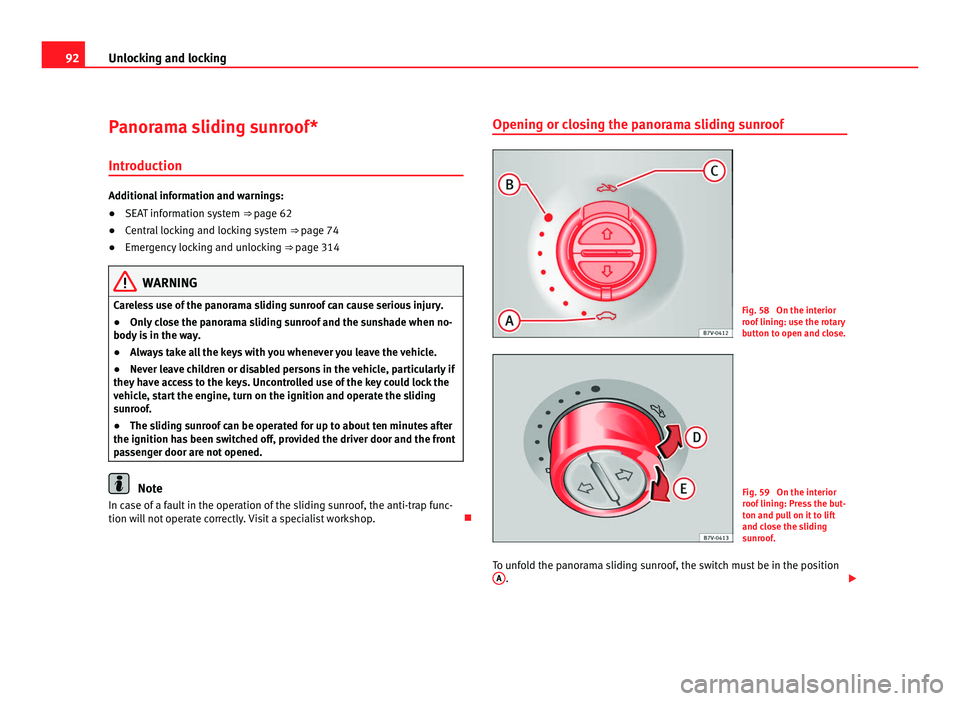
l not operate correctly. Visit a specialist workshop. Opening or closing the panorama sliding sunroof
Fig. 58 On the interior
roof
linin
g: use the rotary
button to open and close. Fig. 59 On the interior
roof
linin
g: Press the but-
ton and pull on it to lift
and close the sliding
sunroof.
To unfold the panorama sliding sunroof, the switch must be in the position A .
Page 95 of 385
93
Unlocking and locking Function Switch setting Necessary operations
⇒ fig. 58
To open the sliding
su nr
oof completely: C
Rotate the switch to the re-
quired po
s
ition. To choose the con-
venienc e po
sition
for the sliding sun- roof: B
To close the sliding
su nr
oof completely: A
⇒ fig. 59
To completely de-
plo y
the roof deflec- tor: D Briefly push the switch up
(arro
w). To stop automatic
operation: D
or
E Briefly push the button
again b
ac
k or pull on it. To completely close
the roof defl
ector: E Briefly push the switch up
(arro
w). To set the inter-
mediat e po
sition: D
or
E Holding the button or hold
it b
ac
k until the roof is in
the required position. The panorama sliding sunroof will only work with the ignition on. The slid-
ing s
u
nroof can be operated for up to about ten minutes after the ignition
has been switched off, provided the driver door and the front passenger
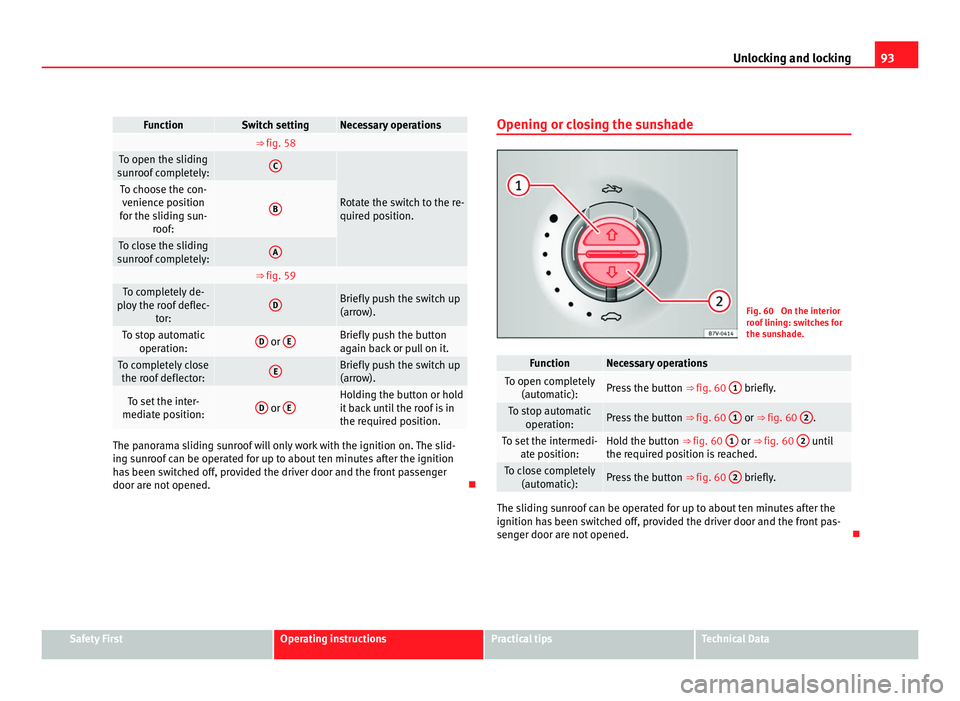
door are not opened. Opening or closing the sunshade
Fig. 60 On the interior
roof
linin
g: switches for
the sunshade. Function Necessary operations
To open completely
(autom atic): Press the button
⇒ fig. 60 1 briefly.
To stop automatic
operation: Press the button
⇒ fig. 60 1 or ⇒ fig. 60
2 .
To set the intermedi-
ate po s
ition: Hold the button ⇒ fig. 60
1 or ⇒ fig. 60
2 until
the requir ed po
sition is reached. To close completely
(autom atic): Press the button
⇒ fig. 60 2 briefly.
The sliding sunroof can be operated for up to about ten minutes after the
ignition ha
s
been switched off, provided the driver door and the front pas-
senger door are not opened. Safety First Operating instructions Practical tips Technical Data
Page 96 of 385
94
Unlocking and locking
Panorama sliding sunroof: operation Convenience open/close function
The panor
am
a sliding sunroof can be opened or closed from outside the ve-
hicle using the vehicle key:
● Hold in the unlocking for locking button for the vehicle. The panorama
sliding s
unroof is adjusted or closes.
● Release the unlock or lock button to stop the function.
During c
onvenience closing, first the windows and then the sliding sunroof
will be closed. Note
The sliding sunroof rotary button remains in the last position selected if the
roof i
s closed using convenience closing from outside the vehicle and will
have to be re-positioned the next time you drive.
Anti-trap function of the panorama sliding sunroof and the
sun
shade The anti-trap function reduces the risk of injury when opening and closing
the panor
am
a sliding sunroof and sunshade ⇒ . When the panorama
slidin g s
unroof or the sunshade encounter difficulty or an obstacle when
closing, they will stop and reopen.
● Check why the panorama sliding sunroof or the sunshade did not close.
● Attempt to close the panorama sliding sunroof or sunshade once again.
● If the panorama sliding sunroof or sunshade is still obstructed, it will
stop at
the corresponding position. Now close the panorama sliding sun-
roof or sunshade without the anti-trap function. Closing without the roll-back function
●
The ⇒ fig. 58 1 switch should be in the “closed” position
A .
● Panorama sliding sunroof: Within five sec
onds of triggering the anti-trap
function, pull the control all the way back ⇒ fig. 59 (arrow E) until the panor-
ama sliding sunroof closes fully.
● Sunshade: Within five sec
onds of triggering the anti-trap function, push
the ⇒ fig. 60 2 button until the sunshade closes completely.
● The panorama sliding sunroof or sunshade close without the anti-trap
fu nction.
● If
the panorama sliding sunroof still cannot be closed, visited a special-
ised work
shop. WARNING
Closing the panorama sliding sunroof or sunshade without the anti-trap
fu nction c
an cause serious injuries.
● Always close the panorama sliding sunroof carefully.
● Nobody should be in the way of the panorama sliding sunroof or sun-
shade, e
specially when they are closed without the anti-trap function.
● The anti-trap function does not prevent fingers or other parts of the
body gettin
g pinched against the window frame and causing injury. Note
The anti-trap function is activated if the windows and the panorama sliding
su nr
oof are closed from the outside of the vehicle using the ignition key for
convenience closing ⇒ page 90.
Page 97 of 385
95
Lights and visibility
Lights and visibility
Lights Introduction The legal requirements regarding the use of vehicle lights in each country
mus
t
be observed.
The driver is personally responsible for the correct use and adjustment of
the lights in all situations.
Additional information and warnings:
● SEAT information system ⇒ page 62
● Ch
anging bulbs ⇒ page 326 WARNING
If the headlights are set too high and the main beam is not used correct-
ly, ther e i
s a risk of dazzling or distracting other road users. This could
result in serious accident.
● Always make sure that the headlamps are correctly adjusted.
● Never use the main beam or flashed headlamps as this could dazzle
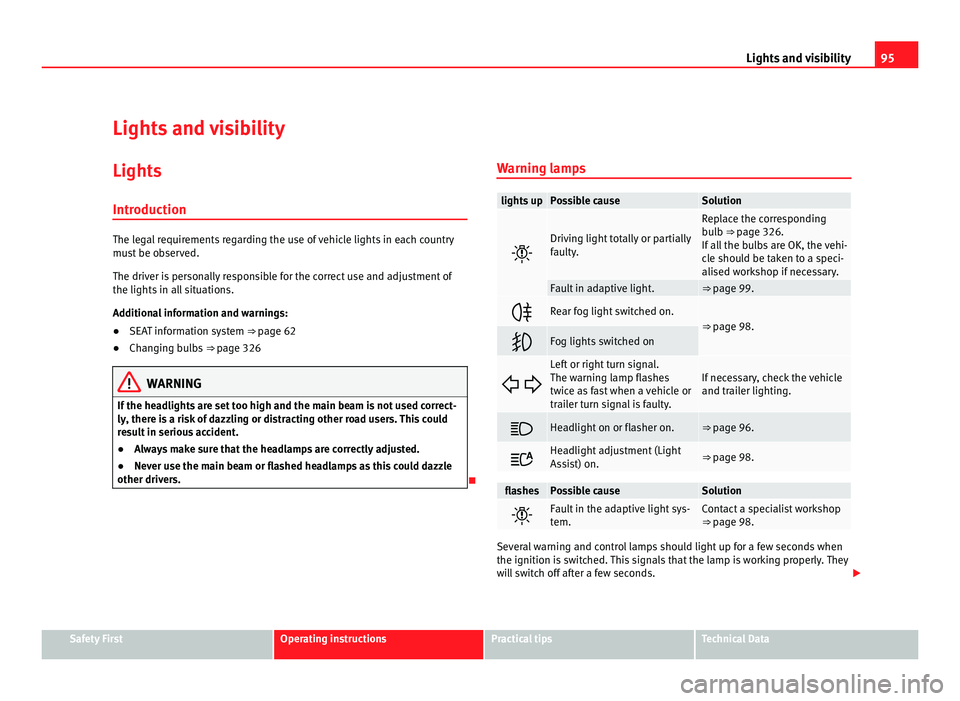
other drivers. Warning lamps lights up Possible cause Solution
Driving light totally or partially
fau
lty
. Replace the corresponding
bu
l
b ⇒ page 326.
If all the bulbs are OK, the vehi-
cle should be taken to a speci-
alised workshop if necessary. Fault in adaptive light. ⇒ page 99.
Rear fog light switched on.
⇒ page 98.
Fog lights switched on
Left or right turn signal.
The warnin
g l
amp flashes
twice as fast when a vehicle or
trailer turn signal is faulty. If necessary, check the vehicle
and trai
l
er lighting. Headlight on or flasher on. ⇒ page 96.
Headlight adjustment (Light
Ass
i
st) on. ⇒ page 98.
flashes Possible cause Solution
Fault in the adaptive light sys-
tem. Contact a specialist workshop
⇒ pag
e 98. Several warning and control lamps should light up for a few seconds when
the ignition is
sw
itched. This signals that the lamp is working properly. They
will switch off after a few seconds. Safety First Operating instructions Practical tips Technical Data
Page 98 of 385
96
Lights and visibility WARNING
If the warning lamps and messages are ignored, the vehicle may stall in
traffic, or m a
y cause accidents and severe injuries.
● Never ignore the warning lamps or text messages.
● Stop the vehicle safely as soon as possible.
● Park the vehicle at a suitable distance away from the traffic ensuring
that the e
xhaust system is not in contact with inflammable material, for
example, dry grass, fuel, oil, etc.
● A faulty vehicle represents a risk of accident for the driver and for oth-
er roa
d users. If necessary, switch on the hazard warning lamps and put
out the warning triangle to advise other drivers. CAUTION
Failure to heed the warning lamps and text messages when they appear
ma y
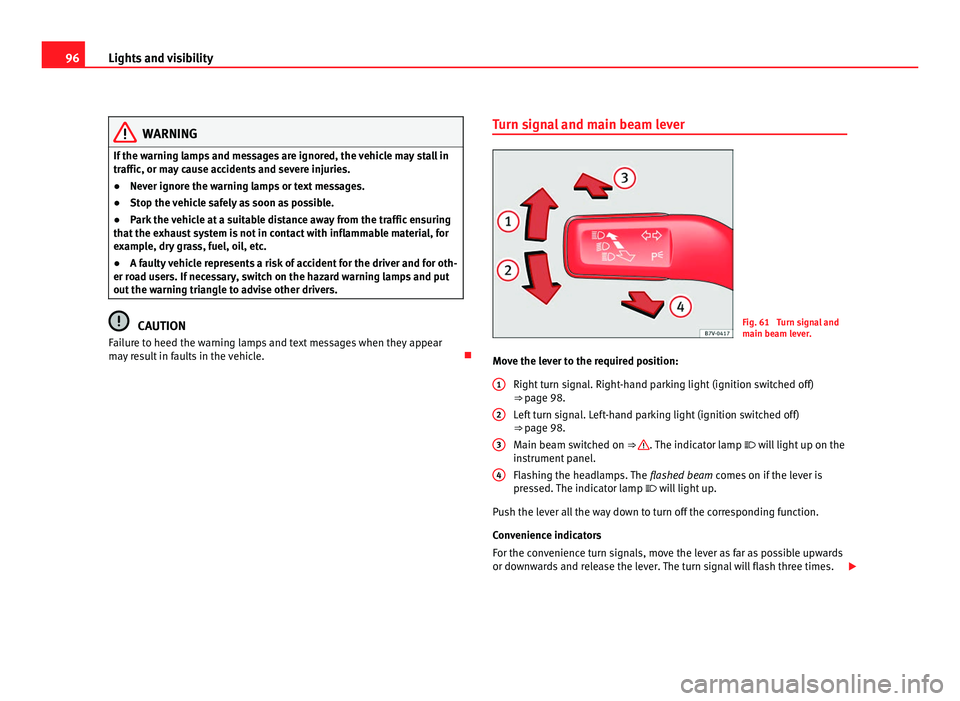
result in faults in the vehicle. Turn signal and main beam lever Fig. 61 Turn signal and
main be
am l
ever.
Move the lever to the required position: Right turn s
ignal. Right-hand parking light (ignition switched off)
⇒ page 98.
Left turn signal. Left-hand parking light (ignition switched off)
⇒ page 98.
Main beam switched on ⇒ . The indicator lamp
wil
l light up on the
instrument panel.
Flashing the headlamps. The flashed beam comes on if the lever is
pressed. The indicator lamp will light up.
Push the lever all the way down to turn off the corresponding function.
Convenience indicators
For the convenience turn signals, move the lever as far as possible upwards
or downwards and release the lever. The turn signal will flash three times.
1 2
3
4
Page 99 of 385
97
Lights and visibility
The control turn signals are switched on and off from the menu Lights & Visi-
bility on the instrument panel display ⇒ page 62. This function can be dis-
connected at a specialised workshop for those vehicles which do not have
the menu Lights & Visibility .WARNING
Incorrect use of the headlamps may cause accidents and serious injury,
as the m
ain beam may distract or dazzle other drivers. Note
● The turn signal only works when the ignition is switched on. The hazard
w arnin
g lights also work when the ignition is switched off ⇒ page 312.
● If a turn signal on the vehicle or trailer is faulty, the warning lamp flash-
es tw
ice as fast as usual.
● The main beam headligh
ts can only be switched on if the dipped beam
headlights are already on.
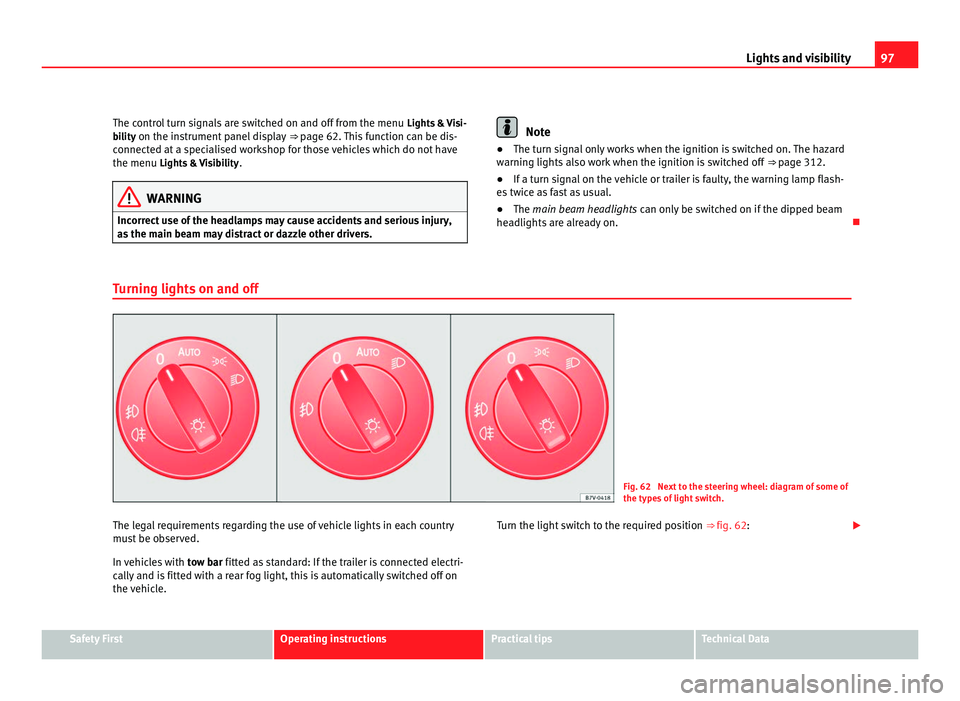
Turning lights on and off Fig. 62 Next to the steering wheel: diagram of some of
the type
s
of light switch.
The legal requirements regarding the use of vehicle lights in each country
mus t
be observed.
In vehicles with tow bar fitted as standard: If the trailer is connected electri-
cally and is fitted with a rear fog light, this is automatically switched off on
the vehicle. Turn the light switch to the required position
⇒ fig. 62:Safety First Operating instructions Practical tips Technical Data
Page 100 of 385
98
Lights and visibility when the ignition is turned
off
when the ignition is on
Fog lights, dipped beam and
side lights
off
. Lights off or daytime driving light
on.
The guidance lights may be
swit
c
hed on. Automatic dipped beam control
or da
ytime driv
ing light on. Side light on. Side light on.
Dipped beam off; if necessa-
ry
, the s
ide light comes on for
a time. Dipped beam switched on.
Fog lights
The warnin
g l
amps or on the light switch also indicate that the fog
lights are switched on.
● Switching on the fog lights : Turn the sw
itch to position or pull out
to the first stop.
● Switching on the rear fog light : turn the light sw
itch to position o
pull out to the maximum.
● To switch off the fog lights, press the light switch or turn it to position .
Audible w
arnings to advise the driver that the lights have not been
switched off
If the key is not in the ignition and the driver's door is open, an audible
warning signal is heard in the following cases: This is a reminder to turn off
the lights.
● When the parking light is on ⇒ page 96.
● When the light
switch is in position . WARNING
The side lights or daytime driving lights are not bright enough to illumi-
nat e the r
oad ahead and to ensure that other road users are able to see
you.
● Always use your dipped beam head lights if it is raining or if visibility
is poor
.
Lights and visibility: functions Parking light
When the park
in
g light is switched on,(right or left turn signal), the front
side light and the rear light on the corresponding side of the vehicle stay lit.
The parking lights will only work with the ignition off.
Daytime driving light
The daytime driving light consists of individual lights in the front head-
lamps.
When the daytime driving light is switched on, only the individual lights
come on ⇒ .
The da ytime lights
are switched on each time the ignition is turned on if the
light switch is in position .
When the light switch is in position , a photo sensor automatically turns
the instrument and switch lighting on and off. Activating the daytime lights Deactivating the daytime lights
Press and hold the turn signal and
main be
am l
ever upwards and back-
wards (right turn signal and light
flasher). Press and hold the turn signal and
main be
am l
ever downwards and
backwards (left turn signal and light
flasher). Switch the ignition on and off for approximately 3 seconds.
Page 102 of 385
100
Lights and visibility
The automatic headlight adjustment automatically switches on the main
beam dependin g on the
vehicles travelling in front and in the opposite di-
rection, and of other environmental and traffic conditions from an approxi-
mate speed of 60 km/h (37 mph) and turns them off again at speeds below
approximately 30 km/h (18 mph).
When the dynamic adaptive light system is deactivated ⇒ page 99 or the
headlight adjustment is activated, only the main beam is turned on and off
automatically. This happens depending on the vehicles travelling in front
and in the opposite direction, and on the road lighting.
Switching on and off How it works
Switching
on: – With the ignition on, turn the lights control to the position
and p
ut the turn signal and main beam lever in the
main beam position ⇒ page 96. When the headlight adjust-
ment (automatic also) is activated, the warning lamp lights
up in the instrument panel display .Switching
off: – Switch the ignition off.
– ALTERNA
TIVEL
Y: Turn the light switch to a position other
than ⇒ page 97.
– ALTERNATIVELY: place the turn signal and main beam lev-
er in the headlight flasher or main beam position
⇒ page 96. The following conditions can cause the headlight adjustment to fail to turn
off the m
ain be
am or fail to do so in time:
● On roads with insufficient lighting with very reflective signs
● If road users are insufficiently lit up, e.g. pedestrians or cyclists
● On closed curves, when the traffic in the opposite direction is partially
hidden, on pronou
nced slopes
● On roads with traffic in the opposite direction and with a central reserva-
tion barrier when the driver c
an see through gaps or over it e.g. lorry drivers
● If the camera is damaged or if the power supply has been cut off
● In the event of fog, snow or heavy rain ●
In the event of
dust or sand storms
● If the windscreen is damaged by the impact from a stone in the camera's
field of
vision
● If the camera's field of vision is misted up, dirty or covered by a sticker,
snow or ic
e. WARNING
The greater comfort that the headlight adjustment provides (automatic
al so) mu
st not cause you to take risks. The system is not a replacement
for driver awareness.
● Always monitor the lights yourself and adjust them depending on the
light, vi
sibility and traffic conditions.
● The headlight adjustment (automatic also) may not correctly detect
all
situations and in certain situations may only provide limited function.
● If the windscreen is damaged or modifications are made to the vehi-
cle lightin
g, this may harm the functioning of the headlight adjustment
(automatic also), for example, if additional headlight are fitted. Note
Main beam and flashed headlights can be turned on and off manually at
any time w
ith the turn signal and main beam lever ⇒ page 96.
Adhesive strips for headlights or adjusting headlights In those countries where vehicles drive on the other side of the road to the
home cou
ntr
y, the asymmetric dipped beam may dazzle drivers of oncom-
ing vehicles. Therefore, when driving abroad, adhesive strips should be at-
tached to the headlights or the headlights should be adjusted accordingly.
The direction of the headlights can be adjusted from the instrument panel,
in the Tourist light submenu of the Settings menu
⇒ page 67.
Page 103 of 385
101
Lights and visibility
For those vehicles in which it is not possible to adjust the headlights from
the menu, adhe s
ive strips are used to cover certain parts of the headlamp
cover or the headlights may be adjusted at a specialised workshop. For fur-
ther information, please refer to a specialised workshop. SEAT recommends
visiting a Technical Service. Note
Use of the Touris
t light option and the adhesives on the headlights is only
allowed if they are to be used for a short period of time. To modify the direc-
tion of the headlights permanently, please take the vehicle to a specialised
workshop. SEAT recommends visiting a Technical Service.
“Coming home” and “Leaving home” function (guidance
lights)C omin
g HomeThe “Coming home” function should be switched on manually. However the
“Le
av
ing home” function is automatically controlled by a photo sensor. “Coming Home” Necessary operations
To switch sys-
tem on: – Switch off the ignition.
– Briefly fl
a
sh the headlights for approximately one sec-
ond ⇒ page 96.
The “Coming home” lighting comes on when the driver's
door is opened. The delay in switching off the headlights
is counted from when the last door or tailgate is closed. The system
swit
c
hes off: – Automatically at the end of the delay period.
– Autom
atic
ally, if 30 seconds after coming on, a vehicle
door or tailgate remains open.
– If the light switch is turned to position .
– If the ignition is switched on. “Leaving home” Necessary operations
To switch sys-
tem on: – Unlock the vehicle when the light switch is in position
and the phot
o sensor detects darkness. The system
swit
c
hes off: – Automatically, at the end of the delay period.
– When the
v
ehicle is locked.
– When the light switch is turned to position .
– When the ignition is switched on. Lighting around the exterior mirrors
The lighting ar
ou
nd the exterior mirrors illuminates the door area on enter-
ing and leaving the vehicles. It comes on when the vehicle is unlocked,
when the vehicle door is opened and when the “Coming home” or “Leaving
home” function is switched on. If the equipment includes the light sensor,
the lighting around the exterior mirrors only comes when it is dark. Note
● The time tak en f
or the headlights to go off can be changed in the Lights
& Visibility menu and the function can be switched on or off ⇒ page 62.
● When the “Coming home” function is on, if the vehicle door is opened
there is
no audible warning signal to advise that the light is still on. Safety First Operating instructions Practical tips Technical Data
Page 105 of 385
103
Lights and visibility Button /
Swit c
h Function
Switches door contact control on (central position).
The interior lights
c
ome on automatically when the vehicle is
unlocked, a door is opened or the key is removed from the ig-
nition.
The lights go off a few seconds after all the doors are closed,
the vehicle is locked or the ignition is switched on. Turning the reading light on and off
Storage and luggage compartment lighting
When the glov
e bo
x and the tailgate are opened and closed, a light auto-
matically switches on or off.
Background lighting
The background lighting in the front covering of the ceiling lights up the
controls on the central console from above when the side or dipped lights
are on.
In addition, the lever on the door moulding can also be illuminated. Note
The reading lights go out when the vehicle is locked, or a few minutes after
the key i
s removed from the ignition. This prevents the battery from dis-
charging. Sun blind
Introduction WARNING
Sun visors and sun blinds may reduce visibility when open.
● Always roll or fold sun blinds and visors away when not in use.
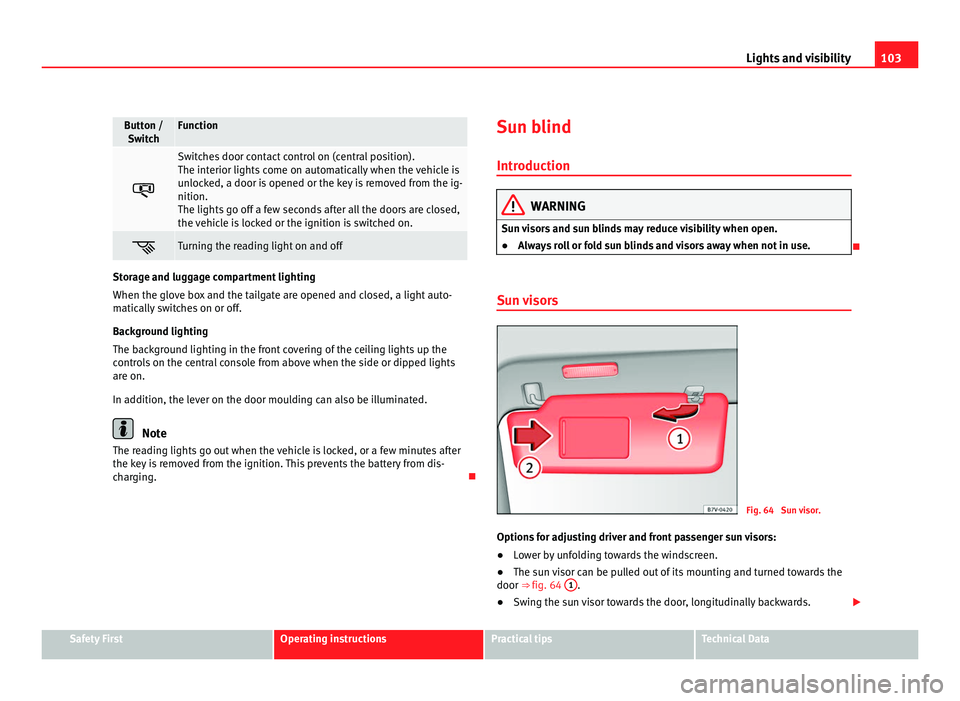
Sun visors Fig. 64 Sun visor.
Options for adjusting driver and front passenger sun visors:
● Lower by unfolding towards the windscreen.
● The sun visor can be pulled out of its mounting and turned towards the
door ⇒ fig. 64 1 .
● Swing the sun visor towards the door, longitudinally backwards. Safety First Operating instructions Practical tips Technical Data