ignition Seat Alhambra 2011 Service Manual
[x] Cancel search | Manufacturer: SEAT, Model Year: 2011, Model line: Alhambra, Model: Seat Alhambra 2011Pages: 385, PDF Size: 7.92 MB
Page 107 of 385
105
Lights and visibility
Windscreen wiper and washer
Introduction Additional information and warnings:
●
Recirculation of air conditioning air ⇒ p age 155
● Working in the engine compartment ⇒ page 275
● C
aring for and cleaning the vehicle exterior ⇒ page 242WARNING
Water from the windscreen washer water bottle may freeze on the wind-
sc r
een if it does not contain enough anti-freeze, reducing forward visibili-
ty.
● In winter, ensure the windscreen washer contains enough anti-freeze.
● In cold conditions, you should not use the wash / wipe system unless
you hav
e warmed the windscreen with the ventilation system. The anti-
freeze could freeze on the windscreen and reduce visibility. WARNING
Worn or dirty wiper blades reduce visibility and increase the risk of acci-
dent and seriou s
injury.
● Always replace damaged or worn blades or blades which do not clean
the winds
creen correctly. CAUTION
In icy conditions, always check that the wiper blades are not frozen to the
gla s
s before using the wipers for the first time. In cold weather, it may help
to leave the vehicle parked with the wipers in service position ⇒ page 107. Control lamp lights up Possible cause Solution
Windscreen wiper fluid level
too lo
w Top up the windscreen wiper
bottle a
s
soon as possible
⇒ page 109. Several warning and control lamps should light up for a few seconds when
the ignition is
sw
itched. This signals that the lamp is working properly. They
will switch off after a few seconds. CAUTION
Failure to heed the warning lamps and text messages when they appear
ma y
result in faults in the vehicle. Safety First Operating instructions Practical tips Technical Data
Page 108 of 385
106
Lights and visibility
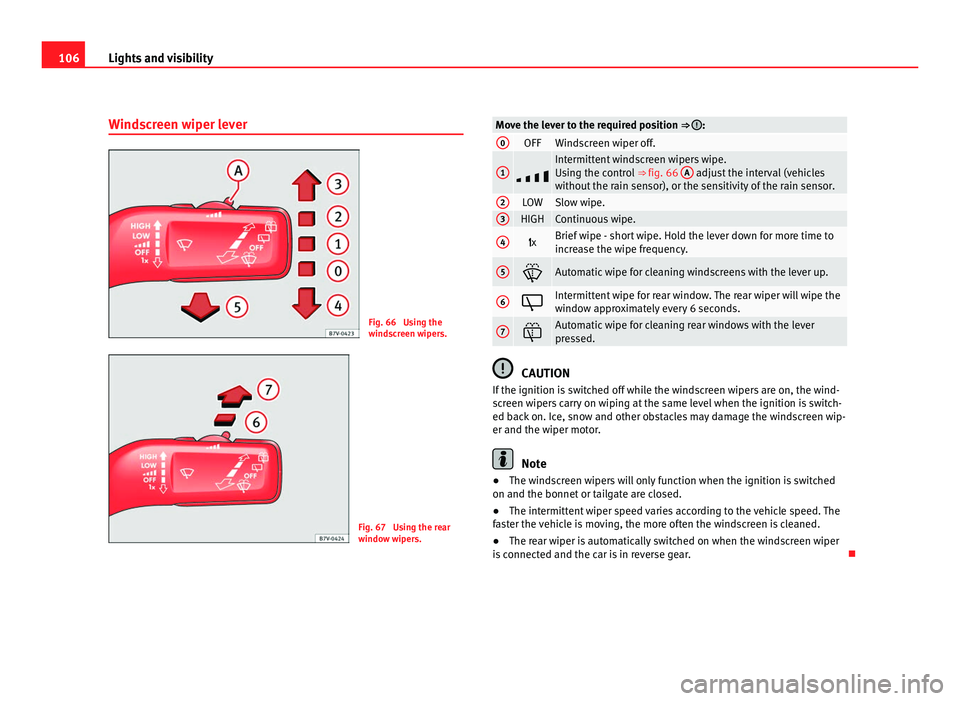
Windscreen wiper lever Fig. 66 Using the
wind
s
creen wipers. Fig. 67 Using the rear
windo
w w
ipers. Move the lever to the required position ⇒ :
0
OFF Windscreen wiper off.
1
Intermittent windscreen wipers wipe.
Us
in
g the control ⇒ fig. 66 A adjust the interval (vehicles
without the r
ain sensor), or the sensitivity of the rain sensor. 2
LOW Slow wipe.
3
HIGH Continuous wipe.
4
x Brief wipe - short wipe. Hold the lever down for more time to
incr
e
ase the wipe frequency. 5
Automatic wipe for cleaning windscreens with the lever up.
6
Intermittent wipe for rear window. The rear wiper will wipe the
windo
w ap
proximately every 6 seconds. 7
Automatic wipe for cleaning rear windows with the lever
pre
s
sed. CAUTION
If the ignition is switched off while the windscreen wipers are on, the wind-
sc r
een wipers carry on wiping at the same level when the ignition is switch-
ed back on. Ice, snow and other obstacles may damage the windscreen wip-
er and the wiper motor. Note
● The windscreen wipers will only function when the ignition is switched
on and the bonnet or t
ailgate are closed.
● The intermittent wiper speed varies according to the vehicle speed. The
fas
ter the vehicle is moving, the more often the windscreen is cleaned.
● The rear wiper is automatically switched on when the windscreen wiper
is c
onnected and the car is in reverse gear.
Page 109 of 385
107
Lights and visibility
Windscreen wiper functions Windscreen wiper performance in different situations:
If the vehicle is at a stand-
sti
l
l: The activated position provisionally changes
to the pr
ev
ious position. During the automatic wipe: The air conditioning comes on for approxi-
mat
ely
30 seconds in air recirculation mode
to prevent the smell of the windscreen wash-
er fluid entering the inside of the vehicle. For the intermittent wipe: The intervals between wipes vary according
to the s
peed of
the vehicle. The higher the
vehicle speed the shorter the intervals. Heated windscreen washer jets
The heatin
g on
ly thaws the frozen jets, it does not thaw the water in the
washer hoses. The heated windscreen washer jets automatically adjust the
heat depending on the ambient temperature, when the ignition is switched
on.
Headlight wash /wipe system
The headlight washers/wipers clean the headlight lenses.
After the ignition is switched on, the first and every fifth time the wind-
screen washer is switched on, the headlights are also washed. Therefore,
the windscreen wiper lever should be pulled towards the steering wheel
when the dipped beam or main beam are on. Any incrusted dirt (such as in-
sects) should be cleaned regularly (e.g. when refuelling).
To ensure the headlight washers work correctly in winter, any snow which
has got into the bumper jet supports should be cleaned away. If necessary,
remove snow with an anti-icing spray. Note
The wiper will try to wipe away any obstacles that are on the windscreen.
The wiper w i
ll stop moving if the obstacle blocks its path. Remove the ob-
stacle and switch the wiper back on again.
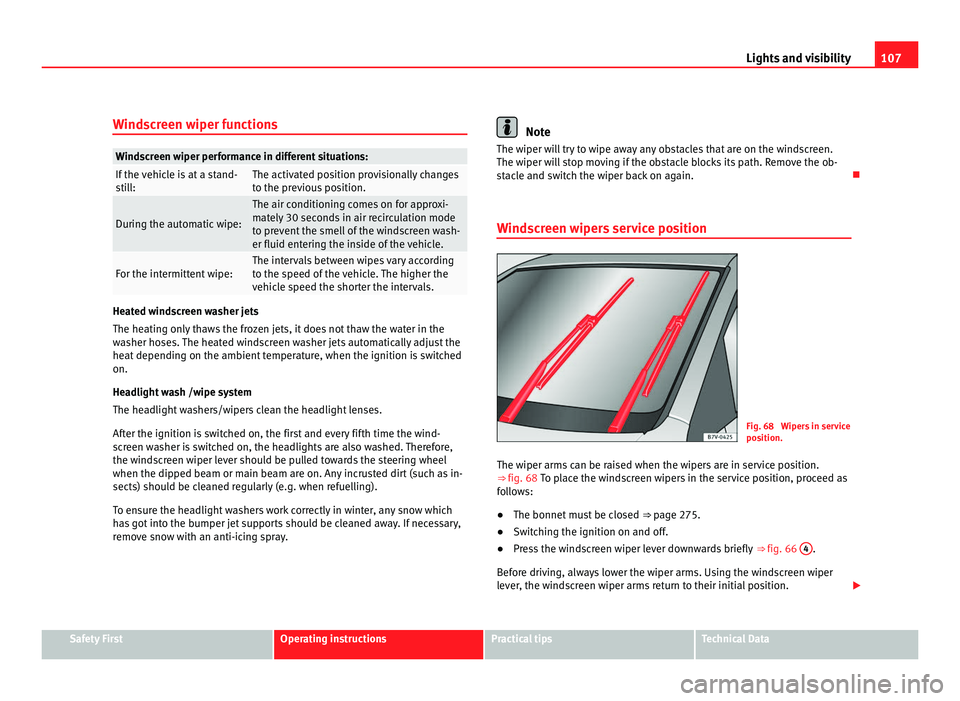
Windscreen wipers service position Fig. 68 Wipers in service
pos
ition.
The w
iper arms can be raised when the wipers are in service position.
⇒ fig. 68 To p l
ace the windscreen wipers in the service position, proceed as
follows:
● The bonnet must be closed ⇒ page 275.
● Sw
itching the ignition on and off.
● Press the windscreen wiper lever downwards briefly ⇒ fig. 66 4 .
Bef or
e driving, always lower the wiper arms. Using the windscreen wiper
lever, the windscreen wiper arms return to their initial position. Safety First Operating instructions Practical tips Technical Data
Page 110 of 385
108
Lights and visibility
Lifting and returning windscreen wiper arms
● Place the wiper arms in the service position ⇒ .
● Only hold the wiper arms at the point where the blade is fixed. CAUTION
● To prevent damage to the bonnet and the wiper arms, only leave them in
the ser v
ice position.
● Before driving, always lower the wiper arms.
Rain sensor* Fig. 69 Windscreen wip-
er lev
er: a
djusting the
rain sensor A . Fig. 70 Rain sensor sen-
sitiv
e s
urface.
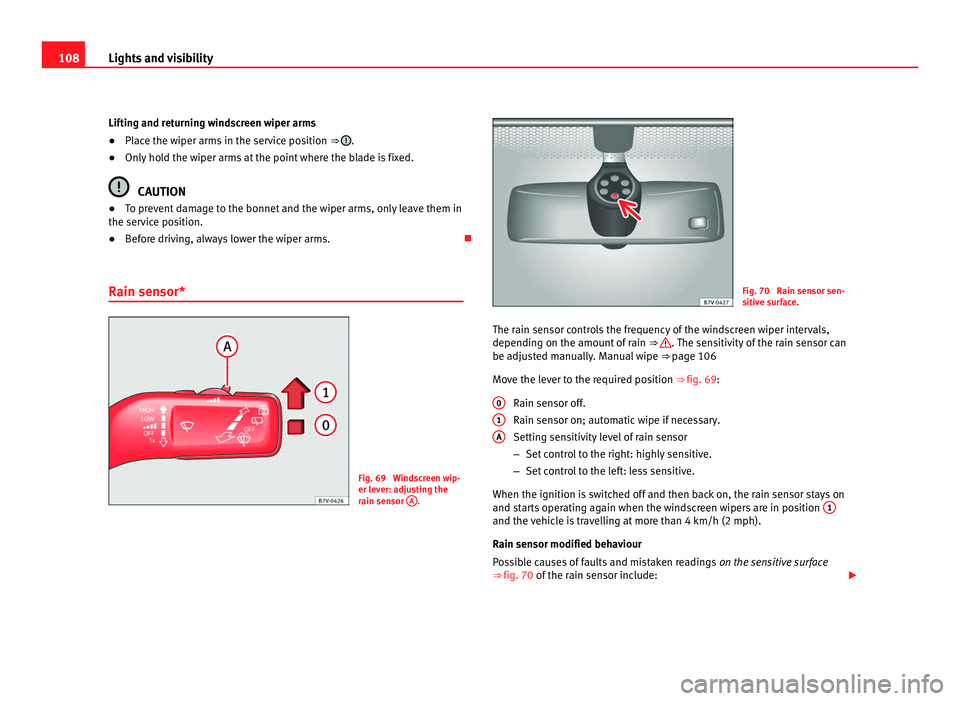
The rain sensor controls the frequency of the windscreen wiper intervals,
depending on the amount
of rain ⇒ . The sensitivity of the rain sensor can
be adju s
ted manually. Manual wipe ⇒ page 106
Move the lever to the required position ⇒ fig. 69: Rain sensor off.
Rain sensor on; automatic wipe if necessary.
Setting sensitivity level of rain sensor
–Set control to the right: highly sensitive.
– Set control to the left: less sensitive.
When the ignition is switched off and then back on, the rain sensor stays on
and starts operating again when the windscreen wipers are in position 1 and the vehicle is travelling at more than 4 km/h (2 mph).
Rain sen
sor modified beh
aviour
Possible causes of faults and mistaken readings on the sensitive surface
⇒ fig. 70 of the rain sensor include:
0 1
A
Page 113 of 385
111
Lights and visibility
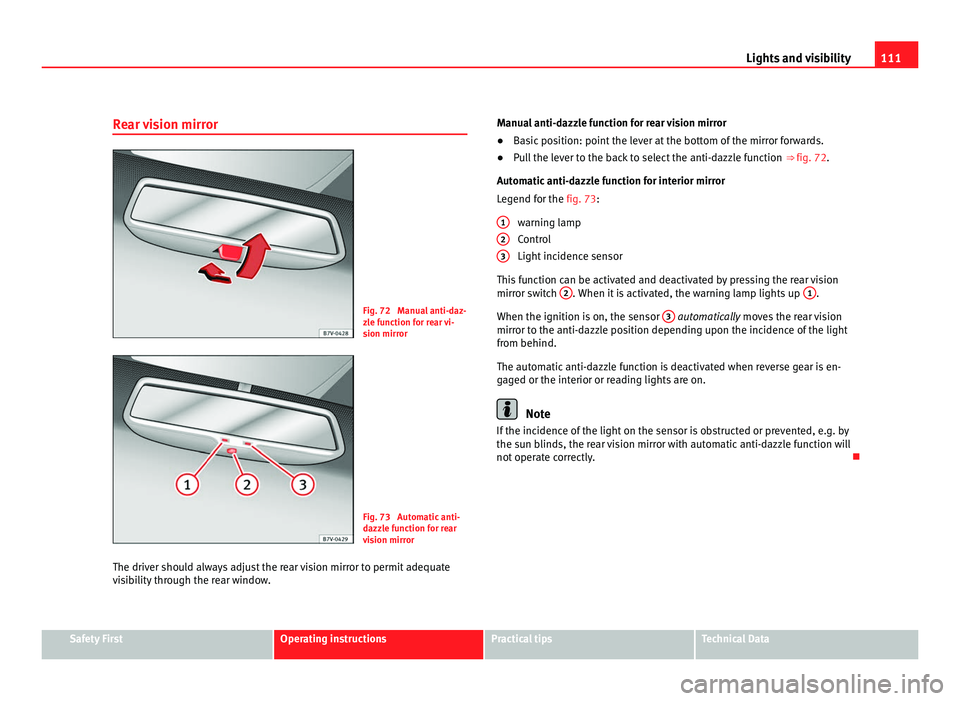
Rear vision mirror Fig. 72 Manual anti-daz-
zl
e f
unction for rear vi-
sion mirror Fig. 73 Automatic anti-
dazz
l
e function for rear
vision mirror
The driver should always adjust the rear vision mirror to permit adequate
vis
ibility through the rear window. Manual anti-dazzle function for rear vision mirror
●
Basic position: point the lever at the bottom of the mirror forwards.
● Pull the lever to the back to select the anti-dazzle function ⇒ fig. 72.
Automatic
anti-dazzle function for interior mirror
Legend for the fig. 73:
warning lamp
Control
Light incidence sensor
This function can be activated and deactivated by pressing the rear vision
mirror switch 2 . When it is activated, the warning lamp lights up
1 .
When the ignition is on, the sen
sor 3 automatically moves the rear vision
mirr or t
o the anti-dazzle position depending upon the incidence of the light
from behind.
The automatic anti-dazzle function is deactivated when reverse gear is en-
gaged or the interior or reading lights are on. Note
If the incidence of the light on the sensor is obstructed or prevented, e.g. by
the su n b
linds, the rear vision mirror with automatic anti-dazzle function will
not operate correctly.
1 2
3
Safety First Operating instructions Practical tips Technical Data
Page 114 of 385
112
Lights and visibility
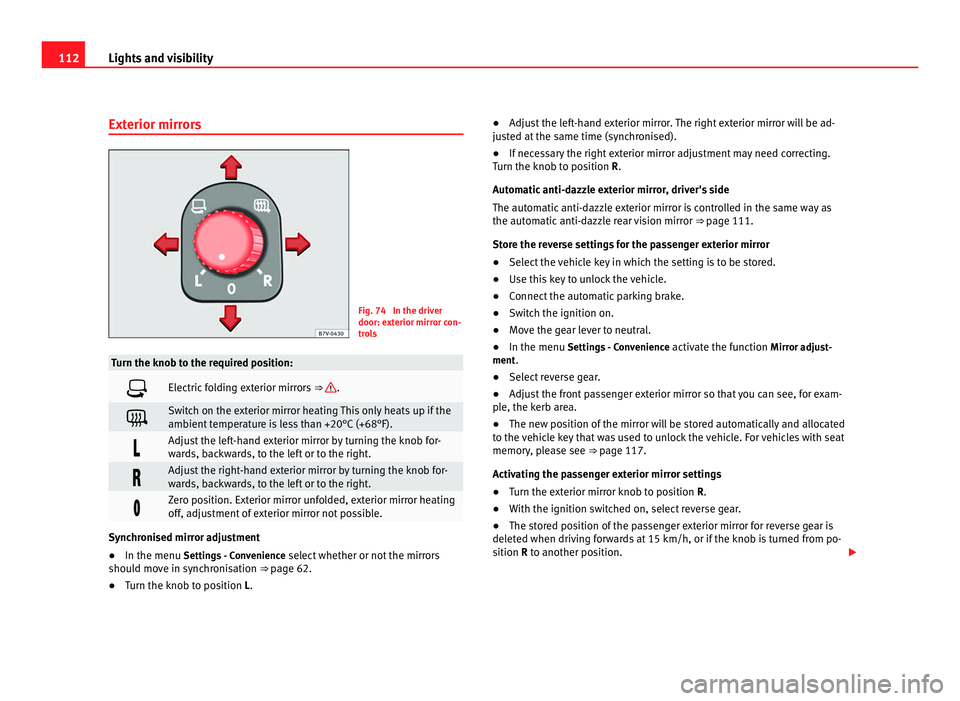
Exterior mirrors Fig. 74 In the driver
door: ext
erior mirr
or con-
trols Turn the knob to the required position:
Electric folding exterior mirrors
⇒ .
Switch on the exterior mirror heating This only heats up if the
ambient
t
emperature is less than +20°C (+68°F). Adjust the left-hand exterior mirror by turning the knob for-
war
d
s, backwards, to the left or to the right. Adjust the right-hand exterior mirror by turning the knob for-
war
d
s, backwards, to the left or to the right. Zero position. Exterior mirror unfolded, exterior mirror heating
off, a
dju
stment of exterior mirror not possible. Synchronised mirror adjustment
●
In the menu Setting s
- Convenience select whether or not the mirrors
should move in synchronisation ⇒ page 62.
● Turn the knob to position L. ●
Adjust the left-hand exterior mirror. The right exterior mirror will be ad-
jus
ted at the same time (synchronised).
● If necessary the right exterior mirror adjustment may need correcting.
Turn the knob t
o position R.
Automatic anti-dazzle exterior mirror, driver's side
The automatic anti-dazzle exterior mirror is controlled in the same way as
the automatic anti-dazzle rear vision mirror ⇒ page 111.
Store the reverse settings for the passenger exterior mirror
● Select the vehicle key in which the setting is to be stored.
● Use this key to unlock the vehicle.
● Connect the automatic parking brake.
● Switch the ignition on.
● Move the gear lever to neutral.
● In the menu Settings
- Convenience activate the function Mirror adjust-
ment.
● Select reverse gear.
● Adjust the front passenger exterior mirror so that you can see, for exam-
ple, the k
erb area.
● The new position of the mirror will be stored automatically and allocated
to the v
ehicle key that was used to unlock the vehicle. For vehicles with seat
memory, please see ⇒ page 117.
Activating the passenger exterior mirror settings
● Turn the exterior mirror knob to position R.
● With the ignition switched on, select reverse gear.
● The stored position of the passenger exterior mirror for reverse gear is
deleted when driv
ing forwards at 15 km/h, or if the knob is turned from po-
sition R to another position.
Page 117 of 385
115
Seats and storage compartments
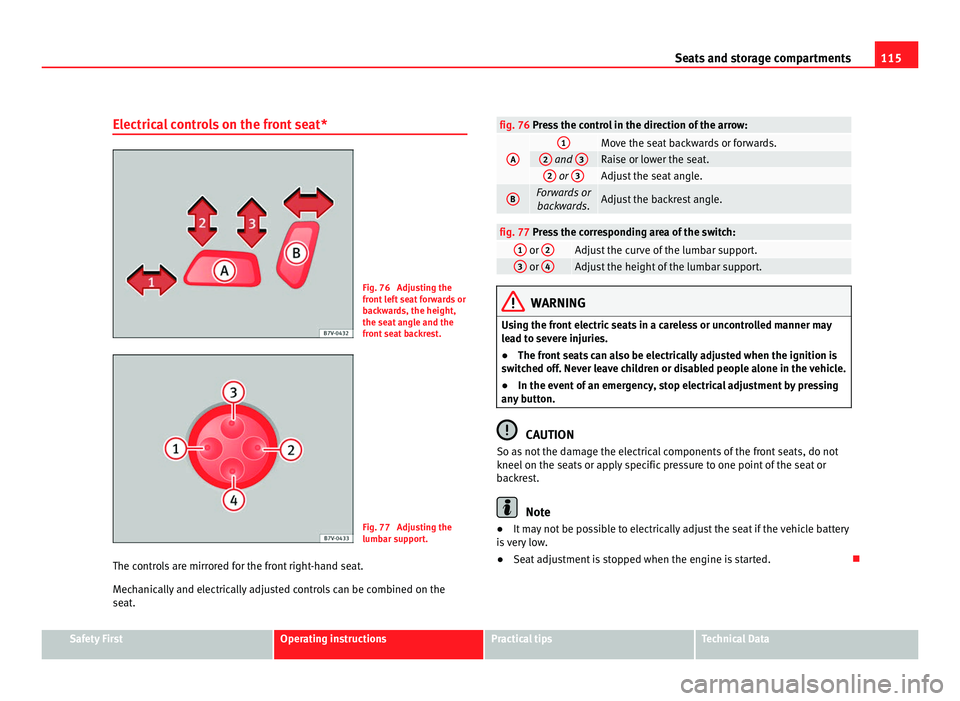
Electrical controls on the front seat* Fig. 76 Adjusting the
front
l
eft seat forwards or
backwards, the height,
the seat angle and the
front seat backrest. Fig. 77 Adjusting the
lumbar s
up
port.
The controls are mirrored for the front right-hand seat.
Mech
anically and electrically adjusted controls can be combined on the
seat. fig. 76 Press the control in the direction of the arrow:
A 1
Move the seat backwards or forwards.
2
and
3 Raise or lower the seat.
2
or
3 Adjust the seat angle.
B Forwards or
backwar ds. Adjust the backrest angle.
fig. 77 Press the corresponding area of the switch:
1
or
2 Adjust the curve of the lumbar support.
3
or
4 Adjust the height of the lumbar support.
WARNING
Using the front electric seats in a careless or uncontrolled manner may
le a
d to severe injuries.
● The front seats can also be electrically adjusted when the ignition is
switc
hed off. Never leave children or disabled people alone in the vehicle.
● In the event of an emergency, stop electrical adjustment by pressing
any b
utton. CAUTION
So as not the damage the electrical components of the front seats, do not
kneel on the se ats
or apply specific pressure to one point of the seat or
backrest. Note
● It may not be possible to electrically adjust the seat if the vehicle battery
i s
very low.
● Seat adjustment is stopped when the engine is started. Safety First Operating instructions Practical tips Technical Data
Page 119 of 385
117
Seats and storage compartments
Seat functions Introduction Additional information and warnings
●
Adjust the seat position ⇒ page 10
● Se
at belts ⇒ page 21
● Airb
ag system ⇒ page 31
● Chi
ld seats (accessories) ⇒ page 39
● Int
egrated child seats ⇒ page 46
● Ext
erior mirrors ⇒ page 110
● L
uggage compartment ⇒ page 125 WARNING
Inappropriate use of the seat functions can cause severe injuries.
● Assume the proper sitting position before your trip and remain in it
throughout .
This also applies to the other occupants.
● Only adjust the seat position memory when the vehicle is stationary.
● Only switch the lumbar massage function on and off when the vehicle
is s
tationary.
● Keep hands, fingers, feet and other limbs away from the seat operat-
ing and adju
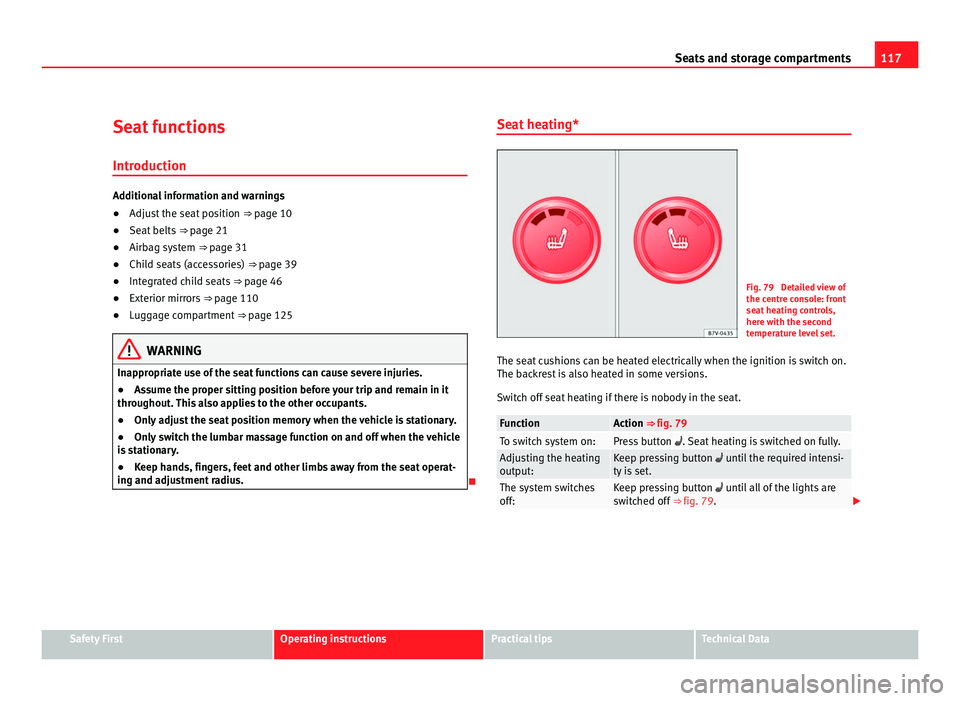
stment radius. Seat heating* Fig. 79 Detailed view of
the centr
e c
onsole: front
seat heating controls,
here with the second
temperature level set.
The seat cushions can be heated electrically when the ignition is switch on.
The back
rest is also heated in some versions.
Switch off seat heating if there is nobody in the seat. Function Action ⇒ fig. 79
To switch system on: Press button
. Seat
heating is switched on fully. Adjusting the heating
output: Keep pressing button unti
l
the required intensi-
ty is set. The system switches
off: Keep pressing button unti
l
all of the lights are
switched off ⇒ fig. 79. Safety First Operating instructions Practical tips Technical Data
Page 120 of 385
118
Seats and storage compartments WARNING
People whose pain and temperature threshold has been affected by some
kind of medic
ine, paraplegia or chronic illness (e.g. diabetes) may sus-
tain burns to the back, buttocks and legs from use of the seat heating
that may lead to a long healing process or that may never completely
heal. Seek medical advice if you have doubts regarding your health.
● People with a limit pain and temperature threshold must never use
seat he
ating. CAUTION
● To avoid damaging the heating elements of the seat heating, please do
not kneel
on the seat or apply sharp pressure at a single point to the seat
cushion and backrest.
● Liquids, sharp objects and insulating materials on the seat could dam-
age the seat
heating.
● In the event of smells, switch off the seat heating immediately and have
the unit in
spected by a Technical Service. For the sake of the environment
The seat heating should remain on only when needed. Otherwise, it is an
unnec e
ssary fuel waste. Seat with position memory* Fig. 80 Memory buttons
on the outs
ide of
the
driver seat
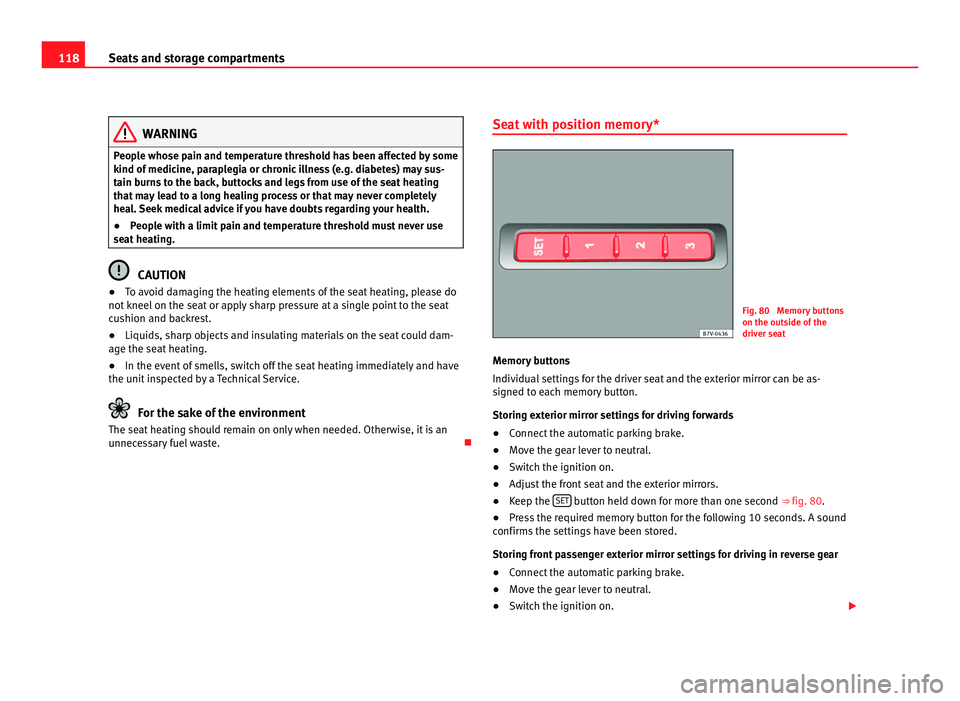
Memory buttons
Individual settin
gs for the driver seat and the exterior mirror can be as-
signed to each memory button.
Storing exterior mirror settings for driving forwards
● Connect the automatic parking brake.
● Move the gear lever to neutral.
● Switch the ignition on.
● Adjust the front seat and the exterior mirrors.
● Keep the SET button held down for more than one second ⇒ fig. 80.
● Press the required memory button for the following 10 seconds. A sound
confirms the settin
gs have been stored.
Storing front passenger exterior mirror settings for driving in reverse gear
● Connect the automatic parking brake.
● Move the gear lever to neutral.
● Switch the ignition on.
Page 121 of 385
119
Seats and storage compartments
● Press the required memory button.
● Select
reverse gear.
● Adjust the front passenger exterior mirror so that you can see, for exam-
ple, the k
erb area.
● The new position of the mirror will be stored automatically and allocated
to the v
ehicle key that was used to unlock the vehicle.
Activating exterior mirror settings
● With the driver's door open and the ignition turned off, push the memo-
ry b
utton of the corresponding door briefly.
● ALTERNATIVELY: With the ignition swit
ched on, hold in the correspond-
ing memory button until the memorised position is reached.
To activate the memory function of the vehicle key
Important: a position must be memorised in the memory.
● Open the driver-side door.
● Press and hold any memory button.
● Within the following three seconds, push the button to open the vehi-
cl e on the
vehicle key. A sound confirms the settings have been activated.
Adjusting the wing mirrors for driving and assigning driver seat settings to
a vehicle key
● Activate the memory function of the vehicle key
● Adjust the front seat and the exterior mirrors.
● Lock the vehicle. The settings are assigned to the vehicle key.
To deactiv
ate the memory function of the vehicle key
Important: a position must be memorised in the memory.
● Press and hold the SET button.
● Within the following ten seconds, push the button to open the vehi-
cl e on the
vehicle key. A sound confirms the settings have been deactiva-
ted. Initialising the seat position memory
The position memor
y system must be initialised if, for example, the driver's
seat has been changed.
Initialisation deletes all memories and assignments for the seat with posi-
tion memory. The memory buttons can then be reprogrammed and the vehi-
cle keys re-assigned.
● Open the driver's door and do not get into the vehicle.
● Operating the seat settings from outside the vehicle.
● Move the angle of the backrest completely forwards.
● Release the control to set the angle and then press again until a sound
is he
ard. Note
The front passenger side wing mirror automatically changes from the posi-
tion st or
ed for reversing as soon as the vehicle moves forward at a speed of
at least 15 km/h or when the gear selection lever is changed to a position
other than R. Safety First Operating instructions Practical tips Technical Data