tow Seat Alhambra 2015 Service Manual
[x] Cancel search | Manufacturer: SEAT, Model Year: 2015, Model line: Alhambra, Model: Seat Alhambra 2015Pages: 305, PDF Size: 5.46 MB
Page 245 of 305
Emergencies
First-aid kit
There is a first aid kit ››› page 112 in the rear
left-hand side storage compartment of the
luggage compartment.
The first aid kit must comply with legal re-
quirements. Check the expiry date of the con-
tents of the first aid kit.
Fire extinguisher
There is a Fire extinguisher underneath the
fr ont
passenger seat.
The fire extinguisher must conform to legal
requirements, be ready for use and be
checked regularly. Check the certification
seal on the extinguisher. WARNING
Loose objects in the vehicle interior can be vi-
olently thrown in case of a sudden manoeu-
vre or braking and especially in accidents
causing serious injury.
● Secure fire extinguishers, first aid kit, re-
flective vests and warning triangle securely
to their respective supports. Protecting yourself and securing the
vehicle
Fig. 179
In the centre of the dash panel: push
button for hazard warning lights. Always fulfil legal requirements for securing a
broken down vehicle. In a number of coun-
tries it is now obligatory, for example, to turn
on the hazard warning lights and use a re-
flective safety vest
››› page 242.
When being towed with the hazard warning
lights on, a change in direction or traffic lane
can be indicated as usual using the turn sig-
nal lever. The hazard lights will be interrup-
ted temporarily.
For your own safety and that of other passen-
gers, the following points should be ob-
served in the order given:
Park the vehicle a safe distance from
traffic and on suitable ground ››› .
1. Turn on the hazard warning lights with
the button
››› Fig. 179.
Connect the electronic parking brake
››› page 137 .
Mo v
e the selector lever to its intermedi-
ate position or to
P ››› page 143.
Stop the engine and remove the key
from the ignition ››› page 133.
Have all occupants leave the vehicle and
move to safety, for example behind a
guard rail.
When leaving the vehicle, take all keys
with you.
Place an emergency warning triangle to
indicate the position of your vehicle to
other road users.
Allow the engine to cool and check if a
specialist is required.
Examples of when to use the hazard warning
lights:
● If the vehicles ahead suddenly slow down
or reach the end of a traffic jam, to warn the
vehicles behind.
● In case of an emergency.
● If the vehicle breaks down.
● When being towed.
Always comply with the applicable laws re-
garding the use of hazard warning lights. »
2.
3.
4.
5.
6.
7.
8.
9.
243Technical specifications
Advice
Operation
Safety
Page 247 of 305
Emergencies
Note
After use, return the jack to its initial position
using the handle in order to securely store it
in the vehicle. Components
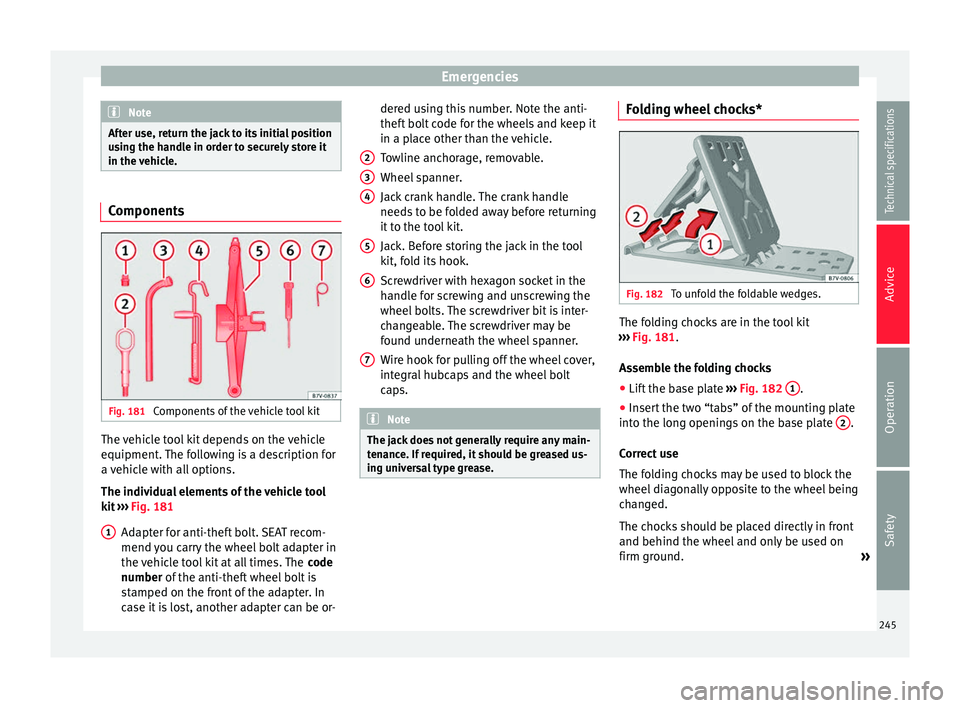
Fig. 181
Components of the vehicle tool kit The vehicle tool kit depends on the vehicle
equipment. The following is a description for
a vehicle with all options.
The individual elements of the vehicle tool
kit
›
›› Fig. 181
Ad apter for anti-theft bolt. SEAT recom-
mend you carry the wheel bolt adapter in
the vehicle tool kit at all times. The code
number
of the anti-theft wheel bolt is
stamped on the front of the adapter. In
case it is lost, another adapter can be or-
1 dered using this number. Note the anti-
theft bolt code for the wheels and keep it
in a place other than the vehicle.
Towline anchorage, removable.
Wheel spanner.
Jack crank handle. The crank handle
needs to be folded away before returning
it to the tool kit.
Jack. Before storing the jack in the tool
kit, fold its hook.
Screwdriver with hexagon socket in the
handle for screwing and unscrewing the
wheel bolts. The screwdriver bit is inter-
changeable. The screwdriver may be
found underneath the wheel spanner.
Wire hook for pulling off the wheel cover,
integral hubcaps and the wheel bolt
caps.
Note
The jack does not generally require any main-
tenance. If required, it should be greased us-
ing universal type grease. 2
3
4
5
6
7 Folding wheel chocks*
Fig. 182
To unfold the foldable wedges. The folding chocks are in the tool kit
››› Fig. 181 .
As semb
le the folding chocks
● Lift the base plate ››› Fig. 182 1 .
● Insert the two “tabs” of the mounting plate
into the long openings on the base plate 2 .
Correct use
The folding chocks may be used to block the
wheel diagonally opposite to the wheel being
changed.
The chocks should be placed directly in front
and behind the wheel and only be used on
firm ground. »
245
Technical specifications
Advice
Operation
Safety
Page 251 of 305
Emergencies
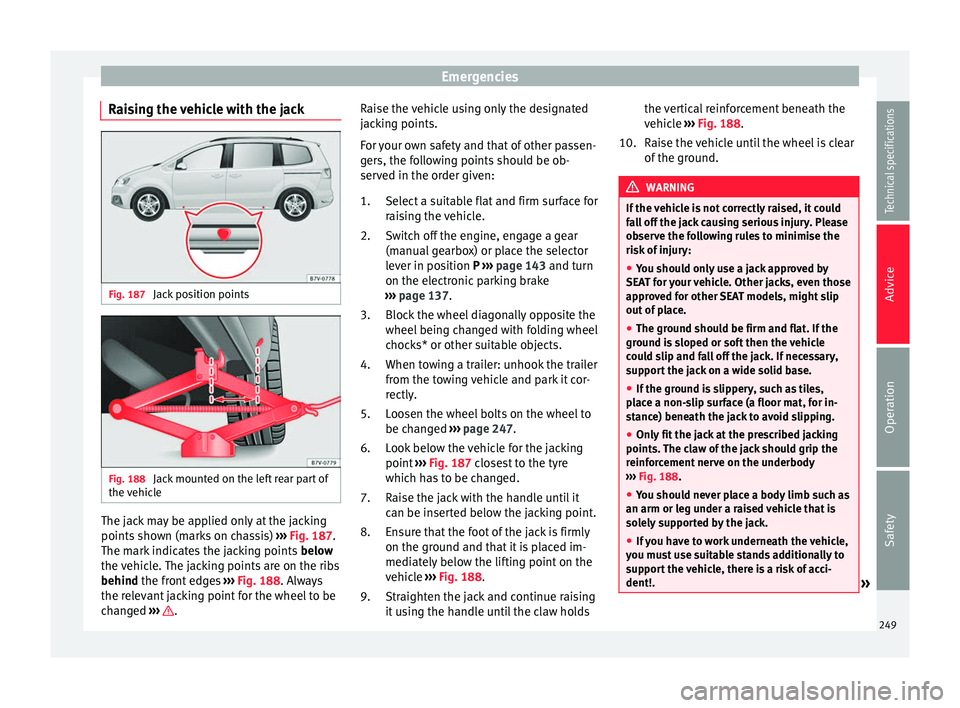
Raising the vehicle with the jack Fig. 187
Jack position points Fig. 188
Jack mounted on the left rear part of
the vehicle The jack may be applied only at the jacking
points shown (marks on chassis)
››› Fig. 187 .
The m ark
indicates the jacking points below
the vehicle. The jacking points are on the ribs
behind
the front edges ››› Fig. 188. Always
the rel
evant jacking point for the wheel to be
changed ››› . Raise the vehicle using only the designated
jacking points.
For your own safety and that of other passen-
gers, the following points should be ob-
served in the order given:
Select a suitable flat and firm surface for
raising the vehicle.
Switch off the engine, engage a gear
(manual gearbox) or place the selector
lever in position P
›
›› p
age 143 and turn
on the electronic parking brake
››› page 137.
Block
the wheel diagonally opposite the
wheel being changed with folding wheel
chocks* or other suitable objects.
When towing a trailer: unhook the trailer
from the towing vehicle and park it cor-
rectly.
Loosen the wheel bolts on the wheel to
be changed ››› page 247.
Look below the vehicle for the jacking
point ››› Fig. 187 closest to the tyre
which h
as to be changed.
Raise the jack with the handle until it
can be inserted below the jacking point.
Ensure that the foot of the jack is firmly
on the ground and that it is placed im-
mediately below the lifting point on the
vehicle ››› Fig. 188
.
Straighten the jack and continue raising
it using the handle until the claw holds
1.
2.
3.
4.
5.
6.
7.
8.
9. the vertical reinforcement beneath the
vehicle
››› Fig. 188
.
Raise the vehicle until the wheel is clear
of the ground. WARNING
If the vehicle is not correctly raised, it could
fall off the jack causing serious injury. Please
observe the following rules to minimise the
risk of injury:
● You should only use a jack approved by
SEAT for your vehicle. Other jacks, even those
approved for other SEAT models, might slip
out of place.
● The ground should be firm and flat. If the
ground is sloped or soft then the vehicle
could slip and fall off the jack. If necessary,
support the jack on a wide solid base.
● If the ground is slippery, such as tiles,
place a non-slip surface (a floor mat, for in-
stance) beneath the jack to avoid slipping.
● Only fit the jack at the prescribed jacking
points. The claw of the jack should grip the
reinforcement nerve on the underbody
››› Fig. 188.
● You shou
ld never place a body limb such as
an arm or leg under a raised vehicle that is
solely supported by the jack.
● If you have to work underneath the vehicle,
you must use suitable stands additionally to
support the vehicle, there is a risk of acci-
dent!. » 10.
249
Technical specifications
Advice
Operation
Safety
Page 257 of 305
Emergencies
Starting
7. Start the engine of the vehicle with the boosting battery and let it run at idling
speed.
8. Start the engine of the vehicle with the flat battery and wait 2 or 3 minutes until the
engine is “running”.
Removing the jump leads
9. Before you remove the jump leads, switch off the dipped beam headlights (if they
are switched on).
10. Turn on the heater blower and heated rear
w indo
w in the vehicle with the flat battery.
This helps minimise voltage peaks which
are generated when the leads are discon-
nected.
11.When the engine is running, disconnect the leads in reverse order to the details
given above.
Connect the battery clamps so they have
good metal-to-metal contact with the battery
terminals.
If the engine fails to start, switch off the start-
er after about 10 seconds and try again after
about 1 minute. WARNING
● Please note the safety warnings referring to
working in the engine compartment
››› page 214.
● The b att
ery providing assistance must have
the same voltage as the flat battery (12V) and
approximately the same capacity (see imprint
on battery). Failure to comply could result in
an explosion.
● Never use jump leads when one of the bat-
teries is frozen. Danger of explosion! Even af-
ter the battery has thawed, battery acid could
leak and cause chemical burns. If a battery
freezes, it should be replaced.
● Keep sparks, flames and lighted cigarettes
away from batteries, danger of explosion.
Failure to comply could result in an explo-
sion.
● Observe the instructions provided by the
manufacturer of the jump leads.
● Do not connect the negative cable from the
other vehicle directly to the negative terminal
of the flat battery. The gas emitted from the
battery could be ignited by sparks. Danger of
explosion.
● Do not attach the negative cable from the
other vehicle to parts of the fuel system or to
the brake line.
● The non-insulated parts of the battery
clamps must not be allowed to touch. The
jump lead attached to the positive battery
terminal must not touch metal parts of the ve-
hicle, this can cause a short circuit. ●
Position the leads in such a way that they
cannot come into contact with any moving
parts in the engine compartment.
● Do not lean on the batteries. This could re-
sult in chemical burns. Note
The vehicles must not touch each other, oth-
erwise electricity could flow as soon as the
positive terminals are connected. Towing and tow starting
Introduction When towing, always respect legal require-
ments.
For technical reasons, it is not possible to
tow a vehicle if the battery is flat.
If the vehicle comes with the Keyless Access
system, towing is only allowed with the igni-
tion on!
The vehicle battery drains if the vehicle is
towed with the engine switched off and the
ignition connected. Depending on the battery
charge status, the drop in voltage may be so
large, even after just a few minutes, that no
electrical device in the vehicle may work e.g.
the hazard warning lights. In vehicles with
»
255
Technical specifications
Advice
Operation
Safety
Page 258 of 305
Advice
the Keyless Access system, the steering
wheel could lock ››› .
WARNING
A vehicle with a flat battery should never be
towed.
● Never remove the key from the ignition
lock. Otherwise, the steering wheel lock
could suddenly lock. The vehicle would not
be controlled and a serious accident could
ensue. WARNING
When towing the vehicle, the handling and
braking efficiency change considerably.
Please observe the following instructions to
minimise the risk of serious accidents and in-
jury:
● As the driver of the vehicle being towed:
– The brake must be depressed must hard-
er as the brake servo does not operate.
Always remain aware to avoid collision
with the towing vehicle.
– More strength is required at the steering
wheel as the power steering does not op-
erate when the engine is switched off.
● As the driver of the towing vehicle:
– Accelerate gently and carefully.
– Avoid sudden braking and manoeuvres.
– Brake well in advance than usual and
brake gently. CAUTION
● Carefully fit and remove the towline anchor-
age and its cover to avoid damage to the ve-
hicle (e.g. paintwork).
● When towing, fuel could enter the catalytic
converter and cause damage! Instructions for tow starting
In general, the vehicle should not be started
by towing. Jump-starting is much more pref-
erable
› › ›
page 253.
For technical reasons, the following vehicles
can
not be tow started:
● Vehicles with an automatic gearbox.
● Vehicles with the Keyless Access locking
and ignition system, since the electronic
steering lock may not unlock.
● Vehicles with an electronic parking brake,
given that it is possible that the brake will
not be disengaged.
● If the vehicle battery is flat, it is possible
that the engine control units do not operate
correctly.
However, if your vehicle must absolutely be
tow-started (manual gearbox):
● Put it into second or third gear.
● Keep the clutch pressed down. ●
Switch on the ignition and the hazard warn-
ing lights.
● Release the clutch when both vehicles are
moving.
● As soon as the engine starts, press the
clutch and move the gear lever into neutral.
This helps to prevent a collision with the tow-
ing vehicle. CAUTION
When tow-starting, fuel could enter the cata-
lytic converter and damage it. Towing instructions
Tow rope or tow bar
When towing, the tow bar is the safest and
vehicle friendly way. You should only use a
tow rope if you do not have a tow bar.
A tow rope should be slightly elastic to avoid
damage to both vehicles. It is advisable to
use a tow rope made of synthetic fibre or sim-
ilarly elastic material.
Only secure the tow rope or tow bar to the
towline anchorage or specially designed fit-
ting.
Vehicles with a
factory fitted towing device ,
can only
be used for towing with a tow bar,
s
pecially designed to fit on a tow hitch ball
››› page 179.
256
Page 259 of 305
Emergencies
Towing vehicles with an automatic gearbox
Note the following for a towed vehicle:
● Make sure the gear selector lever is in the N
position.
● Do not drive faster than 50 km/h (30 mph).
● Do not tow further than 50 km (30 miles).
● If a breakdown truck is used, the vehicle
must be towed with the front wheels raised.
Note the following instructions for towing
four all-wheel drive vehicles.
Instructions for towing all-wheel drive
vehicles
All-wheel drive vehicles can be towed using a
toolbar or tow rope. If the vehicle is towed
with the front or rear axle raised, the engine
must be turned off to avoid transmission
damage.
For vehicles with a double clutched DSG ®
(di-
rect shift gearbox) the instructions for towing
vehicles with an automatic gearbox apply
››› page 257 .
Sit uation
s in which the vehicle should not be
towed
In the following cases, the vehicle should not
be towed but transported on a trailer or spe-
cial vehicle:
● If the vehicle gearbox does not contain lu-
bricant due to a fault. ●
If the vehicle battery is flat and, as a result,
the electronic steering lock and electronic
parking brake cannot be disengaged if ap-
plied.
● If the vehicle to be towed has an automatic
gearbox and the distance to be covered is
greater than 50 km (30 miles). Note
● The vehicle can only be towed if the elec-
tronic parking brake and steering lock are de-
activated. If the vehicle has no power supply
or there is an electric system fault, the en-
gine must be started using jump leads to de-
activate the electronic parking brake and
electronic steering lock.
● Vehicles with the Keyless Access locking
and ignition system should only be towed
with the ignition connected since, otherwise,
the electronic steering lock will not unlock. Fitting the front towline anchorage
Fig. 194
On the right-hand side of the front
bumper: Screw in the towline anchorage. The location for the removable towline an-
chorage is on the right-hand side of the front
bumper
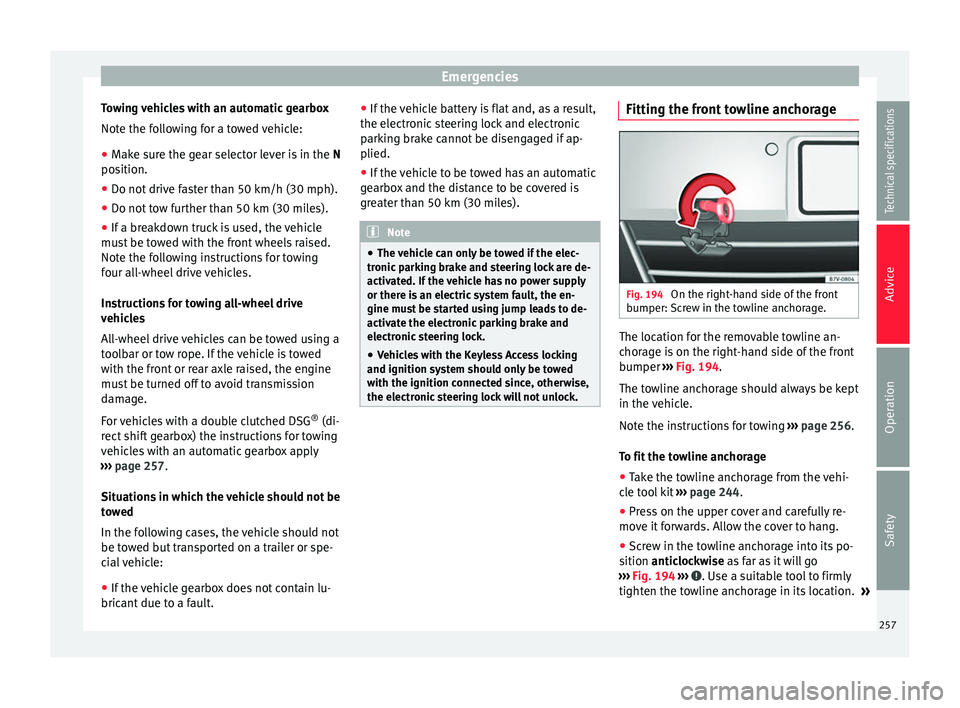
››› Fig. 194 .
The t o
wline anchorage should always be kept
in the vehicle.
Note the instructions for towing ››› page 256.
To fit the towline anchorage
● Take the towline anchorage from the vehi-
cle tool kit ››› page 244.
● Pre
ss on the upper cover and carefully re-
move it forwards. Allow the cover to hang.
● Screw in the towline anchorage into its po-
sition anticlockwise as far as it will go
›
›› Fig. 194 ››› . Use a suitable tool to firmly
tighten the towline anchorage in its location. »
257
Technical specifications
Advice
Operation
Safety
Page 260 of 305
Advice
● After towing, remove the towline anchorage
by turning it clockwise and put the cover
b ac
k in place. CAUTION
The towline anchorage must always be com-
pletely and firmly tightened. Otherwise, it
could be released while towing and tow-start-
ing. Fitting the rear towline anchorage
Fig. 195
On the rear bumper, to the right
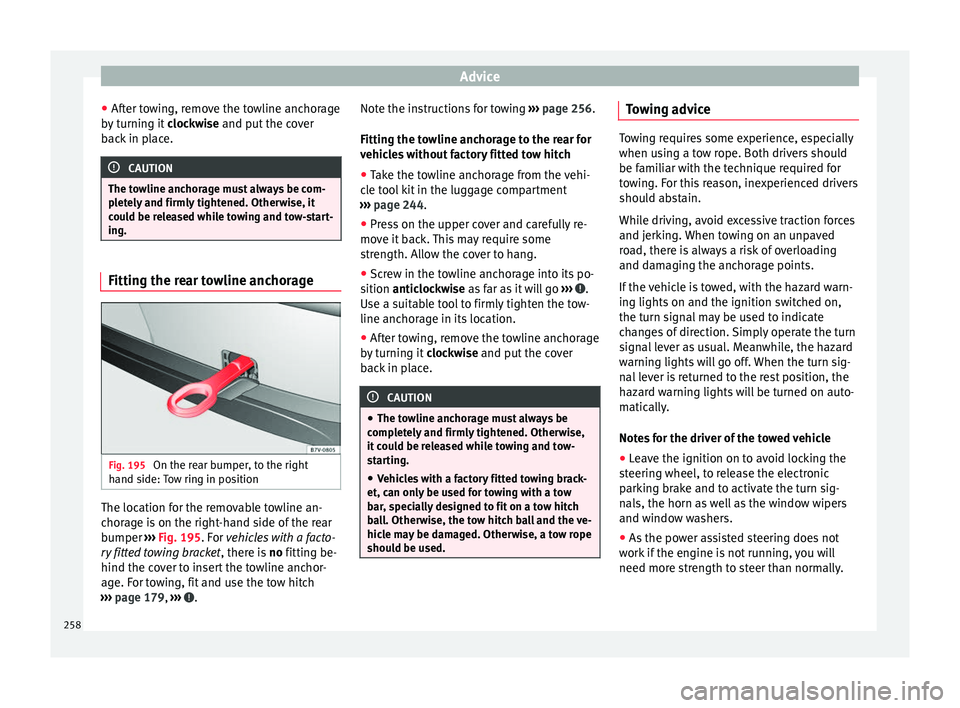
hand side: Tow ring in position The location for the removable towline an-
chorage is on the right-hand side of the rear
bumper
››› Fig. 195 . For
vehicles with a facto-
ry
fitted towing bracket , there is no fitting be-
hind the cover to insert the towline anchor-
age. For towing, fit and use the tow hitch
››› page 179, ››› . Note the instructions for towing
››› page 256.
Fitting the towline anchorage to the rear for
vehicles without factory fitted tow hitch ● Take the towline anchorage from the vehi-
cle tool kit in the luggage compartment
››› page 244 .
● Pr e
ss on the upper cover and carefully re-
move it back. This may require some
strength. Allow the cover to hang.
● Screw in the towline anchorage into its po-
sition anticlockwise as far as it will go ›
›› .
Use a suitable tool to firmly tighten the tow-
line anchorage in its location.
● After towing, remove the towline anchorage
by turning it clockwise and put the cover
b ac
k in place. CAUTION
● The towline anchorage must always be
completely and firmly tightened. Otherwise,
it could be released while towing and tow-
starting.
● Vehicles with a factory fitted towing brack-
et, can only be used for towing with a tow
bar, specially designed to fit on a tow hitch
ball. Otherwise, the tow hitch ball and the ve-
hicle may be damaged. Otherwise, a tow rope
should be used. Towing advice
Towing requires some experience, especially
when using a tow rope. Both drivers should
be familiar with the technique required for
towing. For this reason, inexperienced drivers
should abstain.
While driving, avoid excessive traction forces
and jerking. When towing on an unpaved
road, there is always a risk of overloading
and damaging the anchorage points.
If the vehicle is towed, with the hazard warn-
ing lights on and the ignition switched on,
the turn signal may be used to indicate
changes of direction. Simply operate the turn
signal lever as usual. Meanwhile, the hazard
warning lights will go off. When the turn sig-
nal lever is returned to the rest position, the
hazard warning lights will be turned on auto-
matically.
Notes for the driver of the towed vehicle
●
Leave the ignition on to avoid locking the
steering wheel, to release the electronic
parking brake and to activate the turn sig-
nals, the horn as well as the window wipers
and window washers.
● As the power assisted steering does not
work if the engine is not running, you will
need more strength to steer than normally.
258
Page 261 of 305
Emergencies
● The brake must be depressed must harder
as the brake servo does not operate. Avoid
hitting the towing vehicle.
● Note the instructions and information con-
tained in the Instruction Manual for the vehi-
cle to be towed.
Notes for the driver of the towing vehicle
● Accelerate gently and carefully. Avoid sud-
den manoeuvres.
● Brake well in advance than usual and brake
gently.
● Note the instructions and information con-
tained in the Instruction Manual for the vehi-
cle to be towed.
Emergency locking and
unlocking
Introduction The doors, rear lid and panoramic sliding
sunroof can be locked manually and partially
opened, for example if the key or the central
locking is damaged.
WARNING
Opening and closing doors carelessly can
cause serious injury. ●
If the vehicle is locked from outside, the
doors and windows cannot be opened from
the inside.
● Never leave children or disabled people
alone in the car. They could be trapped in the
car in an emergency and will not be able to
get themselves to safety.
● Depending on the time of the year, temper-
atures inside a locked and closed vehicle can
be extremely high or extremely low resulting
in serious injuries and illness or even death,
particularly for young children. WARNING
Getting in the way of the doors and the pan-
oramic sliding sunroof is dangerous and can
lead to serious injury.
● Open and close the doors and the panor-
amic sliding sunroof only when nobody is in
the way. CAUTION
When opening and closing in an emergency,
carefully disassemble components and then
reassemble them carefully to avoid damage
to the vehicle. Manually locking and unlocking the
driver door
Fig. 196
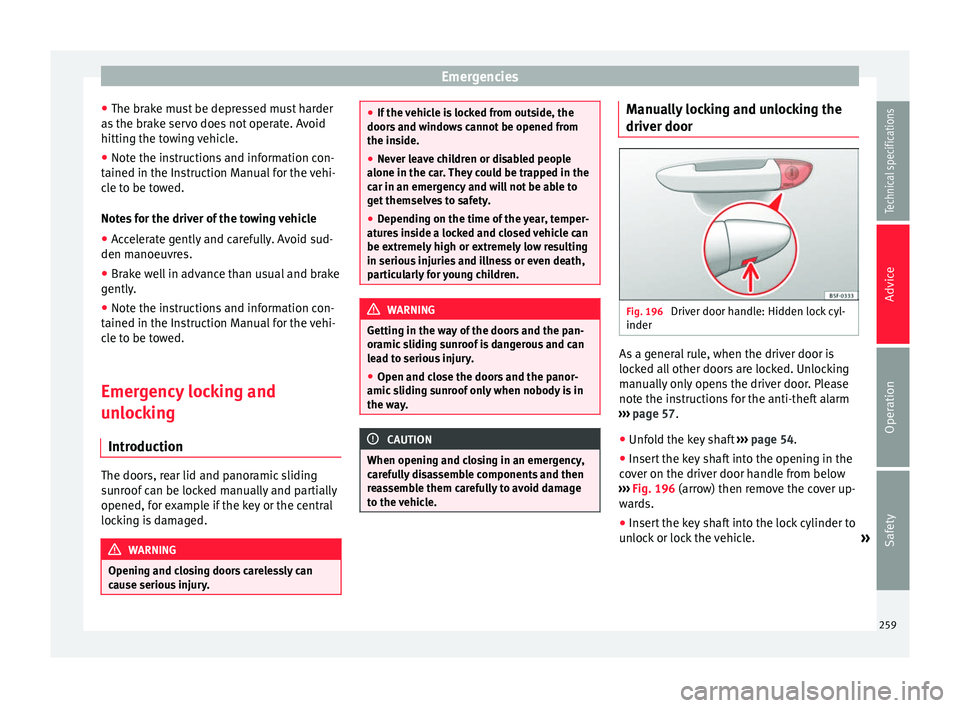
Driver door handle: Hidden lock cyl-
inder As a general rule, when the driver door is
locked all other doors are locked. Unlocking
manually only opens the driver door. Please
note the instructions for the anti-theft alarm
››› page 57 .
● Unf o
ld the key shaft ››› page 54.
● Insert the key shaft into the opening in the
cover on the driver door handle from below
››› Fig. 196 (arrow) then remove the cover up-
war
ds.
● Insert the key shaft into the lock cylinder to
unlock or lock the vehicle. »
259
Technical specifications
Advice
Operation
Safety
Page 264 of 305
Advice
Manually unlocking the gear selector
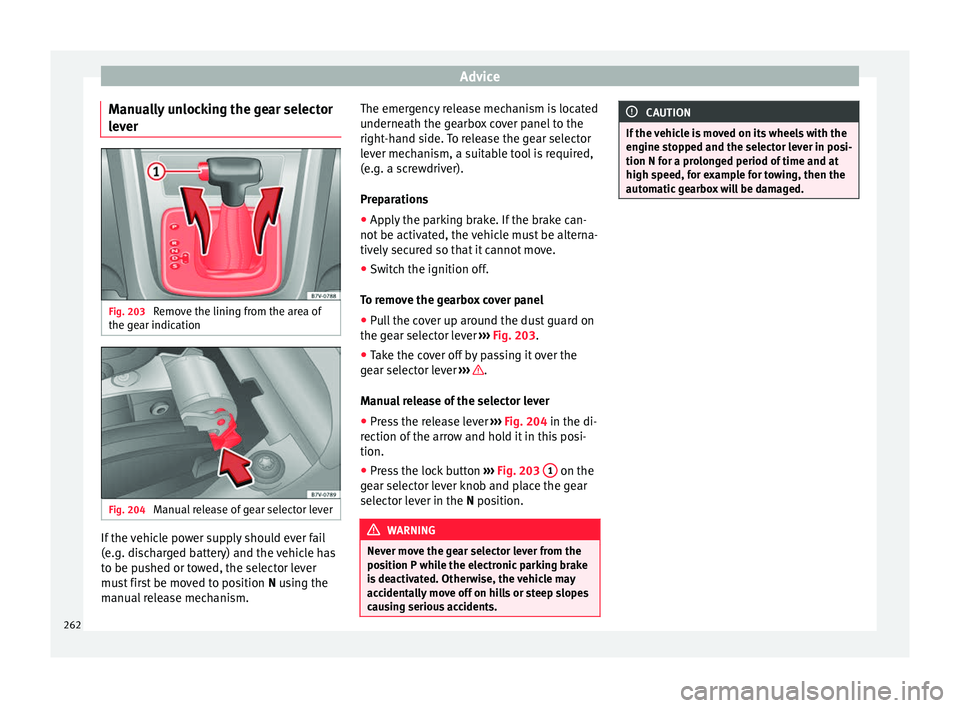
lever Fig. 203
Remove the lining from the area of
the gear indication Fig. 204
Manual release of gear selector lever If the vehicle power supply should ever fail
(e.g. discharged battery) and the vehicle has
to be pushed or towed, the selector lever
must first be moved to position
N using the
m anual
release mechanism. The emergency release mechanism is located
underneath the gearbox cover panel to the
right-hand side. To release the gear selector
lever mechanism, a suitable tool is required,
(e.g. a screwdriver).
Preparations
●
Apply the parking brake. If the brake can-
not be activated, the vehicle must be alterna-
tively secured so that it cannot move.
● Switch the ignition off.
To remove the gearbox cover panel
● Pull the cover up around the dust guard on
the gear selector lever ››› Fig. 203.
● Tak
e the cover off by passing it over the
gear selector lever ››› .
Manual release of the selector lever
● Press the release lever ››› Fig. 204 in the di-
r ection of
the arrow and hold it in this posi-
tion.
● Press the lock button ››› Fig. 203
1 on the
gear selector lever knob and place the gear
selector lever in the N
position. WARNING
Never move the gear selector lever from the
position P while the electronic parking brake
is deactivated. Otherwise, the vehicle may
accidentally move off on hills or steep slopes
causing serious accidents. CAUTION
If the vehicle is moved on its wheels with the
engine stopped and the selector lever in posi-
tion N for a prolonged period of time and at
high speed, for example for towing, then the
automatic gearbox will be damaged. 262
Page 269 of 305
Fuses and bulbs
WARNING
Failure to replace bulbs correctly may cause
serious accidents.
● Before carrying out any work in the engine
compartment please read and observe the
warnings ››› page 214. In any vehicle, the en-
gine c omp
artment is a hazardous area and
could cause severe injury.
● Discharge lamps work with high-voltage
and can cause serious or fatal injury if han-
dled incorrectly.
● H7 and discharge lamps are highly pressur-
ised and could explode when being changed.
● Only replace the bulbs concerned when
they have cooled.
● Never replace bulbs alone if you are not fa-
miliar with the operations necessary. If you
are not sure about procedures then visit a
specialised workshop to carry out the neces-
sary work.
● Never touch the bulb glass directly. Finger-
prints will be evaporated by the heat of the
operating bulb thus “fogging” up the reflec-
tor.
● The headlamp frameworks in the engine
compartment and the tail lamps contain sharp elements. Always protect your hands
when changing bulbs.
CAUTION
● After changing a bulb, if the rubber covers
are not replaced correctly on the headlamp
framework, the electrical installation may be
damaged, especially if water is allowed to en-
ter.
● Remove the ignition key before working on
the electric system. Otherwise, a short circuit
could occur.
● Switch off the lights and the parking light
before changing a bulb.
● Take good care to avoid damaging any com-
ponents. Control lamp
It
lights upPossible causeSolution
A vehicle exterior
lighting bulb is not
working.Replace the faulty
bulb. Several warning and control lamps light up
for a few seconds when the ignition is switch-
ed on, signalling that the function is being
verified. They will switch off after a few sec-
onds.
Checking the bulbs of a trailer
For vehicles with the factory fitted towing
bracket, certain trailer lights are also control-
led if the power socket is correctly connected.
A fault on a trailer turn signal is indicated on
the instrument panel by the turn signal blink-
ing twice as fast (
or ) ››› page 74.
● General fault of all turn signals on one side.
● Fault in one tail light (on some models, al-
so the registration light).
● Fault in two brake lights. WARNING
Observe the safety warnings ››› in Control
and warning lamps on page 47. Note
A fault in the LED on the tail lights will not be
indicated. However, if the fault affects all the
LEDs then this will be indicated by the control
lamp . 267
Technical specifications
Advice
Operation
Safety