service Seat Alhambra 2015 Repair Manual
[x] Cancel search | Manufacturer: SEAT, Model Year: 2015, Model line: Alhambra, Model: Seat Alhambra 2015Pages: 305, PDF Size: 5.46 MB
Page 236 of 305
Advice
good performance, a better seal, improved
safety and wheel run out. Therefore, worn
rims should always be replaced and must on-
ly be repaired in a specialised workshop.
SEAT recommends visiting a technical service
››› .
Wheel rims with bolted trims
Wheel rims may be fitted with interchangea-
ble trim parts which are attached to the rim
using self-locking bolts. Worn trims should
only be replaced at a specialised workshop.
SEAT recommends visiting a technical service
››› .
WARNING
The use of worn or damaged wheel rims could
make driving more dangerous and result in
serious accidents and damage.
● Only wheel rims which have been approved
for use with your vehicle should be used.
● Inspect wheel rims regularly for damage
and replace as required. WARNING
If the bolted joints of wheel rims with bolted
ring trims are not correctly tightened or loos-
ened, this could result in serious accident.
● Never loosen the bolted joints of wheel
rims with bolted ring trims.
● Any work relating to wheel rims with bolted
rims should be carried out at specialised workshop. SEAT recommends taking your car
in for technical service.
Replacement of wheel rims and new
tyres
New tyres
● When tyres are new, drive with extreme
caution for the first 500 km, as all tyres need
to be run-in . Tyres which have not been run-
in do not
have such good grip ››› or brak-
ing capacity ››› .
● All four wheels must be fitted with radial
tyres of the same type, size (rolling circumfer-
ence) and the same tread pattern.
● The tread depth of new tyres may vary, ac-
cording to the type and make of tyre and the
tread pattern.
Replacing tyres
● Where possible, always replace both
wheels on an axle (both wheels on the front
axle or both wheels on the rear axle) ››› .
● Old tyres should only be replaced by SEAT
approved tyres for the vehicle in question,
and in accordance with the maximum permit-
ted size, diameter, load and speed capacity.
● If replacing tyres, make sure the new ones
have an emergency ride system (Conti-
Seal/Run flat). Otherwise, we recommend
carrying a tyre mobility system. ●
Never use tyres which are larger than SEAT
approved tyres. If the tyres are too big, they
may knock or rub against the chassis or other
components, resulting in damage. WARNING
New tyres do not give maximum grip and will
not have reached their maximum braking ca-
pacity to start with, and therefore need run-
ning in.
● To prevent accidents and major damage,
extreme caution should be taken for the first
600 km. WARNING
There should be adequate space between the
tyres and the vehicle in accordance with the
vehicle design. If this is not the case, the
tyres may rub against parts of the running
gear, chassis or brake lines, leading to faults
in the brake system or to tread detachment,
and the risk of burst tyres.
● The true tyre dimension should not be
greater than the dimensions of tyres manu-
factured and approved by SEAT and should
not rub against parts of the vehicle. Note
● Although tyres may be shown as being the
same size, the true dimensions of different
types of tyre may vary with respect to the
nominal size, or tread patterns may be differ-
ent. 234
Page 238 of 305
Advice
● Adjust tyre pressures to the loads carried in
the vehicle.
● After checking the pressure, always replace
the valve caps, and where applicable, ob-
serve the instructions given for adjusting the
tyre control system ››› page 177. WARNING
If tyre pressures are too high or too low, the
tyre may deflate or burst suddenly while driv-
ing. This could result in a serious accident.
● If the tyre pressure is too low, they could
overheat, resulting in tread detachment or
even burst tyres.
● When driving at high speeds and/or fully
loaded, the tyre could suddenly overheat,
burst or be subject to tread detachment, with
the resultant loss of control of the vehicle.
● Tyre pressures which are too high or too
low reduce the service life of the tyre, affect-
ing the vehicle's performance.
● Tyre pressures should be checked regularly,
at least once a month and before long jour-
neys.
● Adjust the pressures of all the tyres to the
vehicle load.
● Never deflate excess pressure from hot
tyres. CAUTION
● Take care not to tilt the manometer when
placing it on the valve. Otherwise, the valve
may be damaged.
● If tyre valves are not protected by caps, or if
the caps are not screwed on correctly, they
may become damaged. Check that the caps
are identical to the standard caps and have
been correctly tightened. For the sake of the environment
Under-inflated tyres will increase fuel con-
sumption. Note
When checking tyre pressures, please ob-
serve the instructions for the tyre control sys-
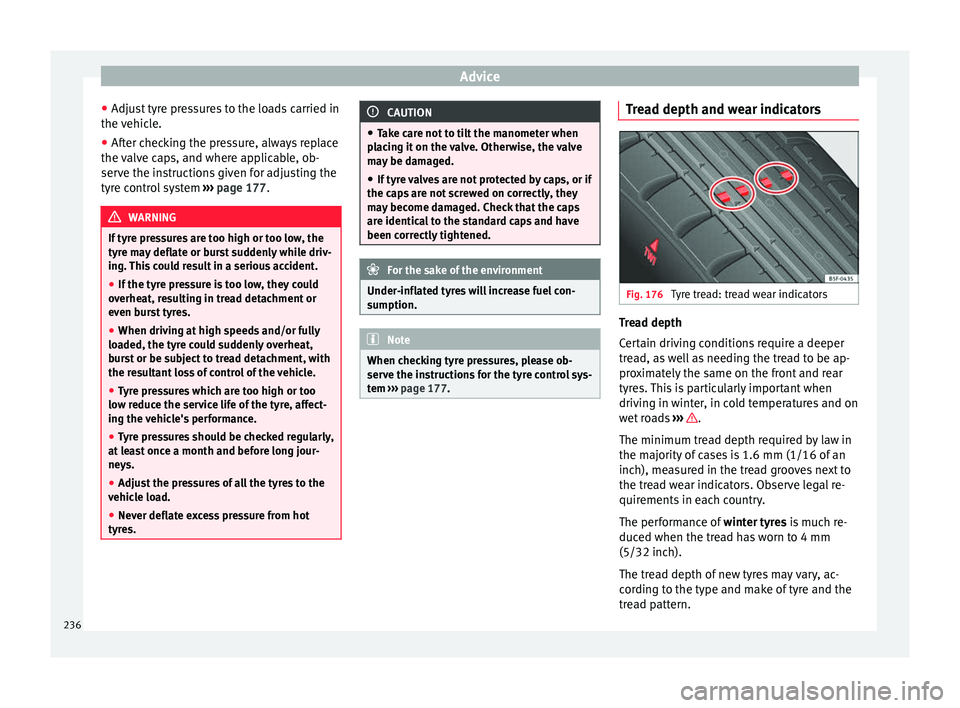
tem ››› page 177. Tread depth and wear indicators
Fig. 176
Tyre tread: tread wear indicators Tread depth
Certain driving conditions require a deeper
tread, as well as needing the tread to be ap-
proximately the same on the front and rear
tyres. This is particularly important when
driving in winter, in cold temperatures and on
wet roads
››› .
The minimum tread depth required by law in
the majority of cases is 1.6 mm (1/16 of an
inch), measured in the tread grooves next to
the tread wear indicators. Observe legal re-
quirements in each country.
The performance of winter tyres is much re-
duced when the tread has worn to 4 mm
(5/32 inch).
The tread depth of new tyres may vary, ac-
cording to the type and make of tyre and the
tread pattern.
236
Page 242 of 305
AdviceTyre code (example)Meaning
MAX LOAD 615 KG (1356 LBS)US load rating, indicating maximum permitted load per tyre.
MAX INFLATION 350 KPA (51 PSI)US limit, indicating maximum permitted tyre pressure.
SIDEWALL 1 PLY RAYONInformation about tyre wall components:
1 layer of rayon (artificial silk).
TREAD 4 PLIES
1 RAYON + 2 STEEL + 1 NYLONInformation about tread components:
In the example, there are 4 layers below the tread: 1 layer of rayon (artificial silk), 2 layers of steel reinforcement and 1
layer of nylon.
Information for the end consumer concerning the comparative values of the established base tyres (standardised test procedures)
:
TREADWEAR 280Relative service life of the tyre, with respect to specific US standard test.
TRACTION AABraking capacity of tyre on wet surface (AA, A, B or C).
TEMPERATURE ATyre temperature resistance at higher test speeds (A, B or C).
If there are different letters, they are specific codes of the tyre manufacturer or specific national codes.
a)
The letters TIN refer to the tyre serial number.
Tyres with directional tread pattern
Tyres with directional tread pattern have
been designed to operate best when rotating
in only one direction. An arrow on the tyre
sidewall indicates the direction of rotation on
tyres with directional tread. Always observe
the direction of rotation indicated when
mounting the wheel. This guarantees opti-
mum grip and helps to avoid aquaplaning,
grip, noise and wear. Tyre load rating
The load rating code indicates the maximum
load in kilogrammes each wheel can carry
(load capacity).
615 kg (1,356 pounds)
650 kg (1,433 pounds)
690 kg (1,521 pounds)
730 kg (1,609 pounds)
775 kg (1,709 pounds)
91
93
95
97
99 Speed rating
The speed rating indicates the maximum
speed permitted for the tyres.
max. 150 km/h (93 mph)
max. 160 km/h (99 mph)
max. 170 km/h (106 mph)
max. 180 km/h (112 mph)
max. 190 km/h (118 mph)
max. 200 km/h (124 mph)
max. 210 km/h (130 mph)
max. 240 km/h (149 mph)
P
Q
R
S
T
U
H
V
240
Page 243 of 305
Wheels and tyres
max. 240 km/h (149 mph)
max. 270 km/h (168 mph)
max. 300 km/h (186 mph)
Some manufacturers use the letters “ZR” for
tyres with a maximum authorised speed
above 240 km/h (149 mph).
Winter service
Winter tyres* In winter conditions winter tyres will consid-
erably improve the vehicle's handling. The
design of summer tyres (width, rubber com-
pound, tread pattern) gives less grip on ice
and snow. Winter tyres also improve the vehi-
cle braking performance, reducing the brak-
ing distance in winter weather. SEAT recom-
mend that winter tyres be fitted to the vehicle
at temperatures below +7 °C (+45 °F).
The performance of winter tyres is much re-
duced if the
tyre tread is worn below 4 mm
(1/16 inc h).
The age of the tyre is another
factor affecting performance, regardless of
the depth of the tyre tread.
Please observe the following when using
winter tyres:
● Observe legal requirements in each coun-
try. Z
W
Y ●
Winter tyres must be fitted on all four
wheels.
● Only use winter tyres in wintery weather
conditions.
● Only use winter tyres of the size authorised
for the vehicle.
● Only use radial winter tyres of the same
type, size (rolling circumference) and tread
pattern.
● Adjust speeds to within the limits indicated
(code letter on tyre) ››› .
Speed limit
A code letter indicating the speed limit is
stamped on all winter tyres ››› page 240.
In some vehicles, it is possible to set a speed
warning in the MFA (multifunction display)
menu on the instrument panel ››› page 47.
If you use V-rated tyres the speed limits and
ty r
e pressure will be determined by engine
size. Please ask your technical service centre
for further information on the maximum per-
mitted speed and the required pressures for
the tyres.
All-wheel drive*
Thanks to its all-wheel drive, your car will
have plenty of traction in winter conditions,
even with the standard tyres. Nevertheless,
SEAT still recommend that winter tyres or all-
season tyres should be fitted on all fourwheels when winter road conditions are ex-
pected, mainly because this will give a better
braking response
.
Please observe all instructions and warnings
when using
snow chains ››› page 242. WARNING
Although winter tyres help to make driving
safer in the winter, you should not take un-
necessary risks.
● Adjust your speed and driving style to visi-
bility, road, traffic and weather conditions.
● Never exceed the maximum permitted
speed or loads specified for the type of winter
tyre fitted on your vehicle. For the sake of the environment
When winter is over, change back to summer
tyres. In temperatures above +7 °C (+45 °F),
performance will be improved if summer tyres
are used. Fuel consumption, wear and noises
while driving will all be reduced. Note
● If the vehicle is fitted with a tyre control
system, this should be “reprogrammed”
whenever a tyre is changed ››› page 179.
● Please ask at a technical service centre for
information about the permitted sizes for
winter tyres. 241
Technical specifications
Advice
Operation
Safety
Page 265 of 305
Emergencies
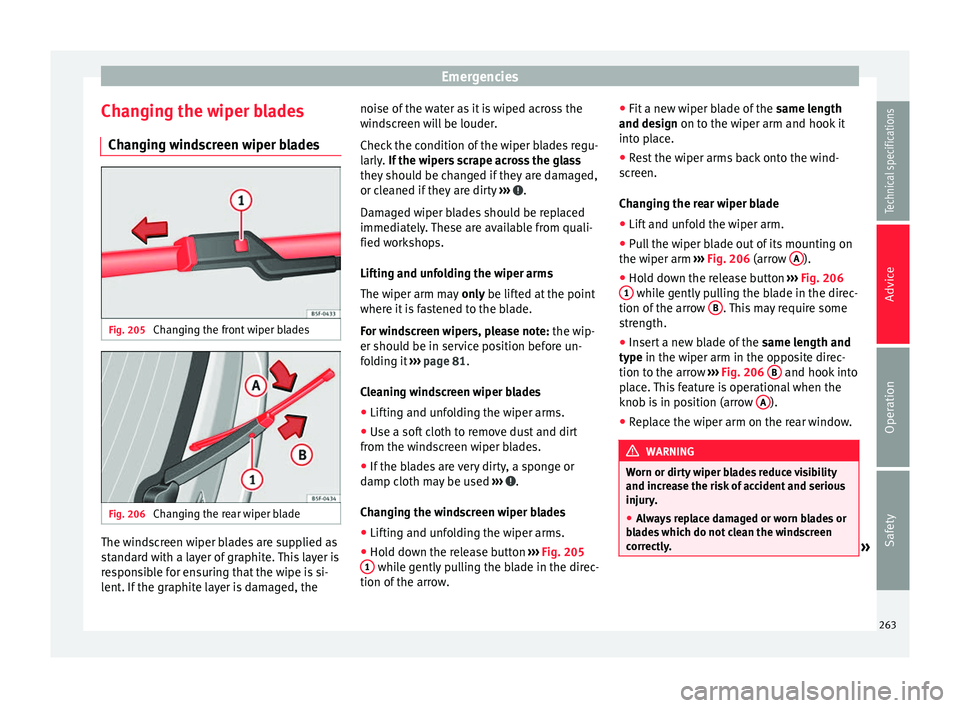
Changing the wiper blades Changing windscreen wiper blades Fig. 205
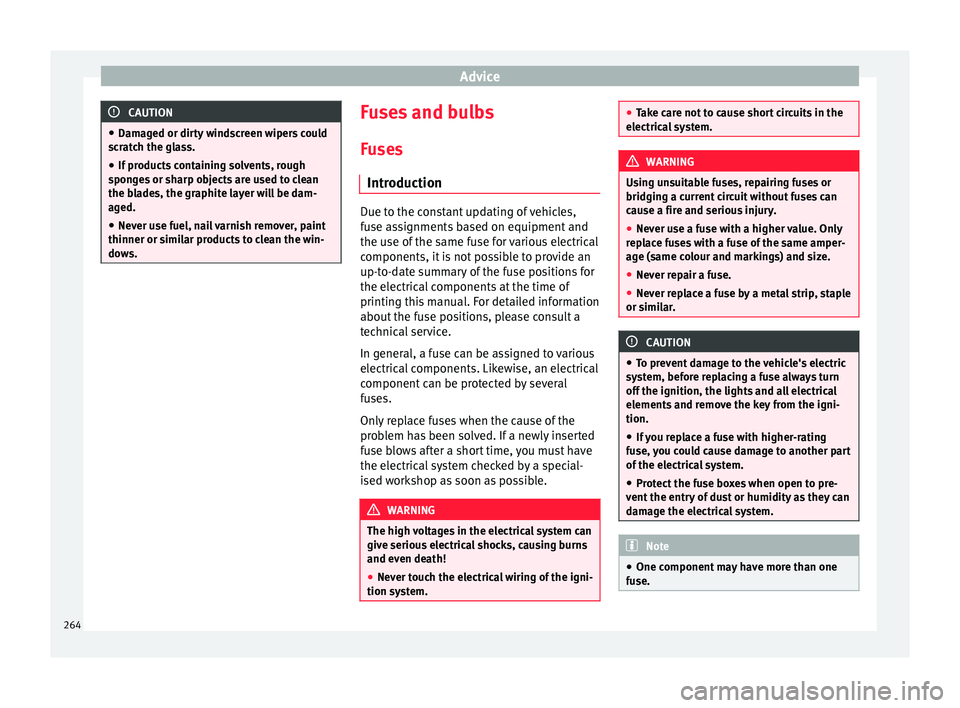
Changing the front wiper blades Fig. 206
Changing the rear wiper blade The windscreen wiper blades are supplied as
standard with a layer of graphite. This layer is
responsible for ensuring that the wipe is si-
lent. If the graphite layer is damaged, the noise of the water as it is wiped across the
windscreen will be louder.
Check the condition of the wiper blades regu-
larly.
If the wipers scrape across the glass
they shou
ld be changed if they are damaged,
or cleaned if they are dirty ››› .
Damaged wiper blades should be replaced
immediately. These are available from quali-
fied workshops.
Lifting and unfolding the wiper arms
The wiper arm may only be lifted at the point
wher e it
is fastened to the blade.
For windscreen wipers, please note: the wip-
er should be in service position before un-
folding it ››› page 81.
Cl
eaning windscreen wiper blades
● Lifting and unfolding the wiper arms.
● Use a soft cloth to remove dust and dirt
from the windscreen wiper blades.
● If the blades are very dirty, a sponge or
damp cloth may be used ››› .
Changing the windscreen wiper blades
● Lifting and unfolding the wiper arms.
● Hold down the release button ››› Fig. 205
1 while gently pulling the blade in the direc-
tion of the arrow. ●
Fit a new wiper blade of the same length
and design on to the wiper arm and hook it
int o p
lace.
● Rest the wiper arms back onto the wind-
screen.
Changing the rear wiper blade
● Lift and unfold the wiper arm.
● Pull the wiper blade out of its mounting on
the wiper arm ››› Fig. 206 (arrow A ).
● Hold down the release button ››› Fig. 206
1 while gently pulling the blade in the direc-
tion of the arrow B . This may require some
strength.
● Insert a new blade of the same length and
type in the wiper arm in the opposite direc-
tion t o the arr
ow ››› Fig. 206 B and hook into
place. This feature is operational when the
knob is in position (arrow A ).
● Replace the wiper arm on the rear window. WARNING
Worn or dirty wiper blades reduce visibility
and increase the risk of accident and serious
injury.
● Always replace damaged or worn blades or
blades which do not clean the windscreen
correctly. » 263
Technical specifications
Advice
Operation
Safety
Page 266 of 305
Advice
CAUTION
● Damaged or dirty windscreen wipers could
scratch the glass.
● If products containing solvents, rough
sponges or sharp objects are used to clean
the blades, the graphite layer will be dam-
aged.
● Never use fuel, nail varnish remover, paint
thinner or similar products to clean the win-
dows. Fuses and bulbs
Fuses Introduction Due to the constant updating of vehicles,
fuse assignments based on equipment and
the use of the same fuse for various electrical
components, it is not possible to provide an
up-to-date summary of the fuse positions for
the electrical components at the time of
printing this manual. For detailed information
about the fuse positions, please consult a
technical service.
In general, a fuse can be assigned to various
electrical components. Likewise, an electrical
component can be protected by several
fuses.
Only replace fuses when the cause of the
problem has been solved. If a newly inserted
fuse blows after a short time, you must have
the electrical system checked by a special-
ised workshop as soon as possible.
WARNING
The high voltages in the electrical system can
give serious electrical shocks, causing burns
and even death!
● Never touch the electrical wiring of the igni-
tion system. ●
Take care not to cause short circuits in the
electrical system. WARNING
Using unsuitable fuses, repairing fuses or
bridging a current circuit without fuses can
cause a fire and serious injury.
● Never use a fuse with a higher value. Only
replace fuses with a fuse of the same amper-
age (same colour and markings) and size.
● Never repair a fuse.
● Never replace a fuse by a metal strip, staple
or similar. CAUTION
● To prevent damage to the vehicle's electric
system, before replacing a fuse always turn
off the ignition, the lights and all electrical
elements and remove the key from the igni-
tion.
● If you replace a fuse with higher-rating
fuse, you could cause damage to another part
of the electrical system.
● Protect the fuse boxes when open to pre-
vent the entry of dust or humidity as they can
damage the electrical system. Note
● One component may have more than one
fuse. 264
Page 268 of 305
Advice
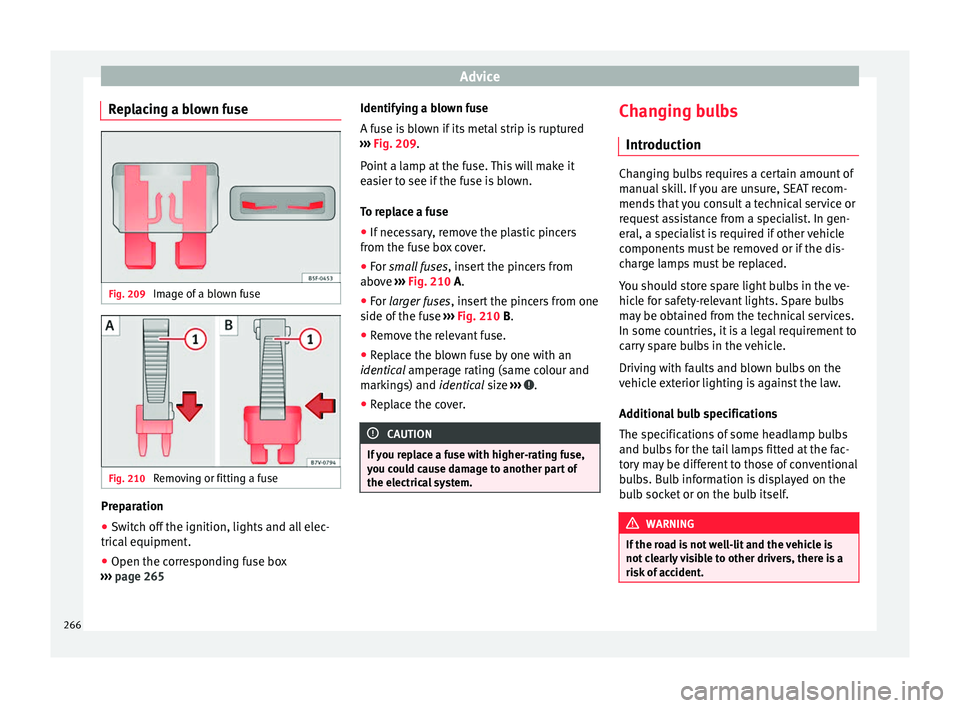
Replacing a blown fuse Fig. 209
Image of a blown fuse Fig. 210
Removing or fitting a fuse Preparation
● Switch off the ignition, lights and all elec-
trical equipment.
● Open the corresponding fuse box
››› page 265 Identifying a blown fuse
A fuse is blown if its metal strip is ruptured
››› Fig. 209 .
P oint
a lamp at the fuse. This will make it
easier to see if the fuse is blown.
To replace a fuse
● If necessary, remove the plastic pincers
from the fuse box cover.
● For
small fuses, insert the pincers from
above ››› Fig. 210 A.
● For
larger fuses , insert the pincers from one
side of the fuse ››› Fig. 210 B.
● Remove the relevant fuse.
● Replace the blown fuse by one with an
identical amperage rating (same colour and
mark
ings) and identical size ››› .
● Replace the cover. CAUTION
If you replace a fuse with higher-rating fuse,
you could cause damage to another part of
the electrical system. Changing bulbs
Introduction Changing bulbs requires a certain amount of
manual skill. If you are unsure, SEAT recom-
mends that you consult a technical service or
request assistance from a specialist. In gen-
eral, a specialist is required if other vehicle
components must be removed or if the dis-
charge lamps must be replaced.
You should store spare light bulbs in the ve-
hicle for safety-relevant lights. Spare bulbs
may be obtained from the technical services.
In some countries, it is a legal requirement to
carry spare bulbs in the vehicle.
Driving with faults and blown bulbs on the
vehicle exterior lighting is against the law.
Additional bulb specifications
The specifications of some headlamp bulbs
and bulbs for the tail lamps fitted at the fac-
tory may be different to those of conventional
bulbs. Bulb information is displayed on the
bulb socket or on the bulb itself.
WARNING
If the road is not well-lit and the vehicle is
not clearly visible to other drivers, there is a
risk of accident. 266
Page 278 of 305
Technical specifications
Towing a trailer Trailer weights Trailer weight
The trailer weights and drawbar loads ap-
proved are selected in intensive trials accord-
ing to precisely defined criteria. The ap-
proved trailer weights are valid for vehicles in
the EU
for maximum speeds of 80 km/h (50
mph) (in c ertain circumstances up to 100
km/h (62 mph)). The figures may be different
in other countries. All data in the official vehi-
cle documentation takes precedence over
these data at all times ››› .
Drawbar loads
The maximum
permitted drawbar load on the
b
all joint of the towing bracket must not ex-
ceed
100 kg.
In the interest of road safety, we recommend
that you always tow approaching the maxi-
mum drawbar load. The response of the trail-
er on the road will be poor, if the drawbar
load is too small.
If the maximum permissible drawbar load
cannot be met (e.g. with small, empty and
light-weight single axle trailers or tandem
axle trailers with a wheelbase of less than 1
metre), a minimum of 4% of the actual trailer
weight is legally required for the drawbar
load. WARNING
● For safety reasons, do not exceed the 80
km/h (50 mph) limit. This is also valid in
countries where higher speeds are permitted.
● Never exceed the maximum trailer weights
or the drawbar load. If the permissible axle
load or the permissible total weight is excee-
ded, the driving characteristics of the vehicle
may change, leading to accidents, injuries
and damage to the vehicle. Wheels
Tyre pressure, snow chains, wheel
bolts Tyre pressures
The sticker with the tyre pressure values can
be found on the inside of the fuel tank flap.
The tyre pressure values given there are for
cold
tyres. The slightly raised pressures of
w arm ty
res must not be reduced. ››› Snow chains
Snow chains may be fitted only to the
front
wheels .
C on
sult the section “wheels” of this manual. Wheel bolts
After the wheels have been changed, the
tightening torque
of the wheel bolts should
be checked as soon as possible with a torque
wrench ››› . The tightening torque for steel
and alloy wheels is 140 Nm. WARNING
● Check the tyre pressure at least once per
month. Checking the tyre pressure is very im-
portant. If the tyre pressure is too high or too
low, there is an increased danger of accidents
- particularly at high speeds.
● If the tightening torque of the wheel bolts
is too low, they could loosen while the vehi-
cle is in motion. Risk of accident! If the tight-
ening torque is too high, the wheel bolts and
threads can be damaged. Note
We recommend that you ask your Technical
Service for information about appropriate
wheel, tyre and snow chain size. 276
Page 290 of 305
Index
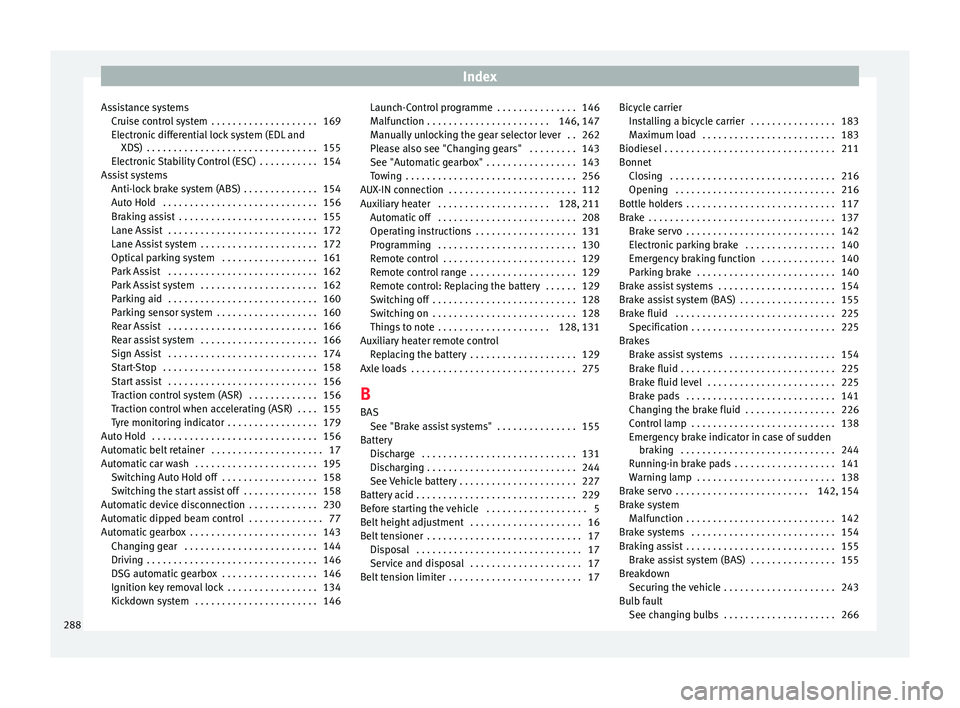
Assistance systems Cruise control system . . . . . . . . . . . . . . . . . . . . 169
Electronic differential lock system (EDL andXDS) . . . . . . . . . . . . . . . . . . . . . . . . . . . . . . . . 155
Electronic Stability Control (ESC) . . . . . . . . . . . 154
Assist systems Anti-lock brake system (ABS) . . . . . . . . . . . . . . 154
Auto Hold . . . . . . . . . . . . . . . . . . . . . . . . . . . . . 156
Braking assist . . . . . . . . . . . . . . . . . . . . . . . . . . 155
Lane Assist . . . . . . . . . . . . . . . . . . . . . . . . . . . . 172
Lane Assist system . . . . . . . . . . . . . . . . . . . . . . 172
Optical parking system . . . . . . . . . . . . . . . . . . 161
Park Assist . . . . . . . . . . . . . . . . . . . . . . . . . . . . 162
Park Assist system . . . . . . . . . . . . . . . . . . . . . . 162
Parking aid . . . . . . . . . . . . . . . . . . . . . . . . . . . . 160
Parking sensor system . . . . . . . . . . . . . . . . . . . 160
Rear Assist . . . . . . . . . . . . . . . . . . . . . . . . . . . . 166
Rear assist system . . . . . . . . . . . . . . . . . . . . . . 166
Sign Assist . . . . . . . . . . . . . . . . . . . . . . . . . . . . 174
Start-Stop . . . . . . . . . . . . . . . . . . . . . . . . . . . . . 158
Start assist . . . . . . . . . . . . . . . . . . . . . . . . . . . . 156
Traction control system (ASR) . . . . . . . . . . . . . 156
Traction control when accelerating (ASR) . . . . 155
Tyre monitoring indicator . . . . . . . . . . . . . . . . . 179
Auto Hold . . . . . . . . . . . . . . . . . . . . . . . . . . . . . . . 156
Automatic belt retainer . . . . . . . . . . . . . . . . . . . . . 17
Automatic car wash . . . . . . . . . . . . . . . . . . . . . . . 195 Switching Auto Hold off . . . . . . . . . . . . . . . . . . 158
Switching the start assist off . . . . . . . . . . . . . . 158
Automatic device disconnection . . . . . . . . . . . . . 230
Automatic dipped beam control . . . . . . . . . . . . . . 77
Automatic gearbox . . . . . . . . . . . . . . . . . . . . . . . . 143 Changing gear . . . . . . . . . . . . . . . . . . . . . . . . . 144
Driving . . . . . . . . . . . . . . . . . . . . . . . . . . . . . . . . 146
DSG automatic gearbox . . . . . . . . . . . . . . . . . . 146
Ignition key removal lock . . . . . . . . . . . . . . . . . 134
Kickdown system . . . . . . . . . . . . . . . . . . . . . . . 146 Launch-Control programme . . . . . . . . . . . . . . . 146
Malfunction . . . . . . . . . . . . . . . . . . . . . . . 146, 147
Manually unlocking the gear selector lever . . 262
Please also see "Changing gears" . . . . . . . . . 143
See "Automatic gearbox" . . . . . . . . . . . . . . . . . 143
Towing . . . . . . . . . . . . . . . . . . . . . . . . . . . . . . . . 256
AUX-IN connection . . . . . . . . . . . . . . . . . . . . . . . . 112
Auxiliary heater . . . . . . . . . . . . . . . . . . . . . 128, 211 Automatic off . . . . . . . . . . . . . . . . . . . . . . . . . . 208
Operating instructions . . . . . . . . . . . . . . . . . . . 131
Programming . . . . . . . . . . . . . . . . . . . . . . . . . . 130
Remote control . . . . . . . . . . . . . . . . . . . . . . . . . 129
Remote control range . . . . . . . . . . . . . . . . . . . . 129
Remote control: Replacing the battery . . . . . . 129
Switching off . . . . . . . . . . . . . . . . . . . . . . . . . . . 128
Switching on . . . . . . . . . . . . . . . . . . . . . . . . . . . 128
Things to note . . . . . . . . . . . . . . . . . . . . . 128, 131
Auxiliary heater remote control Replacing the battery . . . . . . . . . . . . . . . . . . . . 129
Axle loads . . . . . . . . . . . . . . . . . . . . . . . . . . . . . . . 275
B BAS See "Brake assist systems" . . . . . . . . . . . . . . . 155
Battery Discharge . . . . . . . . . . . . . . . . . . . . . . . . . . . . . 131
Discharging . . . . . . . . . . . . . . . . . . . . . . . . . . . . 244
See Vehicle battery . . . . . . . . . . . . . . . . . . . . . . 227
Battery acid . . . . . . . . . . . . . . . . . . . . . . . . . . . . . . 229
Before starting the vehicle . . . . . . . . . . . . . . . . . . . 5
Belt height adjustment . . . . . . . . . . . . . . . . . . . . . 16
Belt tensioner . . . . . . . . . . . . . . . . . . . . . . . . . . . . . 17 Disposal . . . . . . . . . . . . . . . . . . . . . . . . . . . . . . . 17
Service and disposal . . . . . . . . . . . . . . . . . . . . . 17
Belt tension limiter . . . . . . . . . . . . . . . . . . . . . . . . . 17 Bicycle carrier
Installing a bicycle carrier . . . . . . . . . . . . . . . . 183
Maximum load . . . . . . . . . . . . . . . . . . . . . . . . . 183
Biodiesel . . . . . . . . . . . . . . . . . . . . . . . . . . . . . . . . 211
Bonnet Closing . . . . . . . . . . . . . . . . . . . . . . . . . . . . . . . 216
Opening . . . . . . . . . . . . . . . . . . . . . . . . . . . . . . 216
Bottle holders . . . . . . . . . . . . . . . . . . . . . . . . . . . . 117
Brake . . . . . . . . . . . . . . . . . . . . . . . . . . . . . . . . . . . 137 Brake servo . . . . . . . . . . . . . . . . . . . . . . . . . . . . 142
Electronic parking brake . . . . . . . . . . . . . . . . . 140
Emergency braking function . . . . . . . . . . . . . . 140
Parking brake . . . . . . . . . . . . . . . . . . . . . . . . . . 140
Brake assist systems . . . . . . . . . . . . . . . . . . . . . . 154
Brake assist system (BAS) . . . . . . . . . . . . . . . . . . 155
Brake fluid . . . . . . . . . . . . . . . . . . . . . . . . . . . . . . 225 Specification . . . . . . . . . . . . . . . . . . . . . . . . . . . 225
Brakes Brake assist systems . . . . . . . . . . . . . . . . . . . . 154
Brake fluid . . . . . . . . . . . . . . . . . . . . . . . . . . . . . 225
Brake fluid level . . . . . . . . . . . . . . . . . . . . . . . . 225
Brake pads . . . . . . . . . . . . . . . . . . . . . . . . . . . . 141
Changing the brake fluid . . . . . . . . . . . . . . . . . 226
Control lamp . . . . . . . . . . . . . . . . . . . . . . . . . . . 138
Emergency brake indicator in case of suddenbraking . . . . . . . . . . . . . . . . . . . . . . . . . . . . . 244
Running-in brake pads . . . . . . . . . . . . . . . . . . . 141
Warning lamp . . . . . . . . . . . . . . . . . . . . . . . . . . 138
Brake servo . . . . . . . . . . . . . . . . . . . . . . . . . 142, 154
Brake system Malfunction . . . . . . . . . . . . . . . . . . . . . . . . . . . . 142
Brake systems . . . . . . . . . . . . . . . . . . . . . . . . . . . 154
Braking assist . . . . . . . . . . . . . . . . . . . . . . . . . . . . 155 Brake assist system (BAS) . . . . . . . . . . . . . . . . 155
Breakdown Securing the vehicle . . . . . . . . . . . . . . . . . . . . . 243
Bulb fault See changing bulbs . . . . . . . . . . . . . . . . . . . . . 266
288
Page 295 of 305
Index
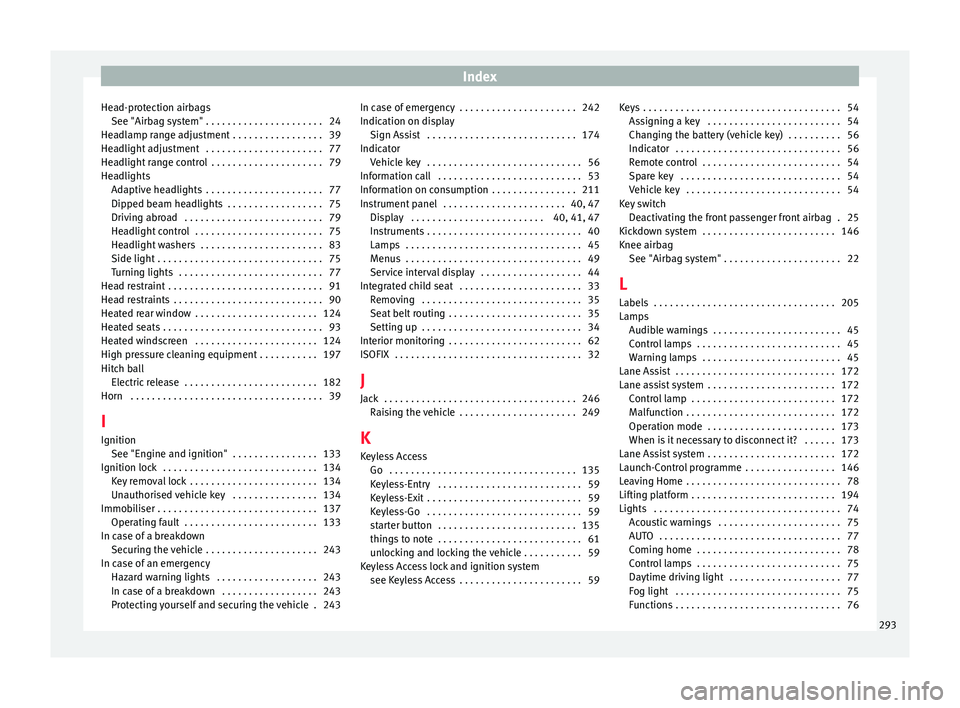
Head-protection airbags See "Airbag system" . . . . . . . . . . . . . . . . . . . . . . 24
Headlamp range adjustment . . . . . . . . . . . . . . . . . 39
Headlight adjustment . . . . . . . . . . . . . . . . . . . . . . 77
Headlight range control . . . . . . . . . . . . . . . . . . . . . 79
Headlights Adaptive headlights . . . . . . . . . . . . . . . . . . . . . . 77
Dipped beam headlights . . . . . . . . . . . . . . . . . . 75
Driving abroad . . . . . . . . . . . . . . . . . . . . . . . . . . 79
Headlight control . . . . . . . . . . . . . . . . . . . . . . . . 75
Headlight washers . . . . . . . . . . . . . . . . . . . . . . . 83
Side light . . . . . . . . . . . . . . . . . . . . . . . . . . . . . . . 75
Turning lights . . . . . . . . . . . . . . . . . . . . . . . . . . . 77
Head restraint . . . . . . . . . . . . . . . . . . . . . . . . . . . . . 91
Head restraints . . . . . . . . . . . . . . . . . . . . . . . . . . . . 90
Heated rear window . . . . . . . . . . . . . . . . . . . . . . . 124
Heated seats . . . . . . . . . . . . . . . . . . . . . . . . . . . . . . 93
Heated windscreen . . . . . . . . . . . . . . . . . . . . . . . 124
High pressure cleaning equipment . . . . . . . . . . . 197
Hitch ball Electric release . . . . . . . . . . . . . . . . . . . . . . . . . 182
Horn . . . . . . . . . . . . . . . . . . . . . . . . . . . . . . . . . . . . 39
I Ignition See "Engine and ignition" . . . . . . . . . . . . . . . . 133
Ignition lock . . . . . . . . . . . . . . . . . . . . . . . . . . . . . 134 Key removal lock . . . . . . . . . . . . . . . . . . . . . . . . 134
Unauthorised vehicle key . . . . . . . . . . . . . . . . 134
Immobiliser . . . . . . . . . . . . . . . . . . . . . . . . . . . . . . 137 Operating fault . . . . . . . . . . . . . . . . . . . . . . . . . 133
In case of a breakdown Securing the vehicle . . . . . . . . . . . . . . . . . . . . . 243
In case of an emergency Hazard warning lights . . . . . . . . . . . . . . . . . . . 243
In case of a breakdown . . . . . . . . . . . . . . . . . . 243
Protecting yourself and securing the vehicle . 243 In case of emergency . . . . . . . . . . . . . . . . . . . . . . 242
Indication on display
Sign Assist . . . . . . . . . . . . . . . . . . . . . . . . . . . . 174
Indicator Vehicle key . . . . . . . . . . . . . . . . . . . . . . . . . . . . . 56
Information call . . . . . . . . . . . . . . . . . . . . . . . . . . . 53
Information on consumption . . . . . . . . . . . . . . . . 211
Instrument panel . . . . . . . . . . . . . . . . . . . . . . . 40, 47 Display . . . . . . . . . . . . . . . . . . . . . . . . . 40, 41, 47
Instruments . . . . . . . . . . . . . . . . . . . . . . . . . . . . . 40
Lamps . . . . . . . . . . . . . . . . . . . . . . . . . . . . . . . . . 45
Menus . . . . . . . . . . . . . . . . . . . . . . . . . . . . . . . . . 49
Service interval display . . . . . . . . . . . . . . . . . . . 44
Integrated child seat . . . . . . . . . . . . . . . . . . . . . . . 33 Removing . . . . . . . . . . . . . . . . . . . . . . . . . . . . . . 35
Seat belt routing . . . . . . . . . . . . . . . . . . . . . . . . . 35
Setting up . . . . . . . . . . . . . . . . . . . . . . . . . . . . . . 34
Interior monitoring . . . . . . . . . . . . . . . . . . . . . . . . . 62
ISOFIX . . . . . . . . . . . . . . . . . . . . . . . . . . . . . . . . . . . 32
J Jack . . . . . . . . . . . . . . . . . . . . . . . . . . . . . . . . . . . . 246 Raising the vehicle . . . . . . . . . . . . . . . . . . . . . . 249
K
Keyless Access Go . . . . . . . . . . . . . . . . . . . . . . . . . . . . . . . . . . . 135
Keyless-Entry . . . . . . . . . . . . . . . . . . . . . . . . . . . 59
Keyless-Exit . . . . . . . . . . . . . . . . . . . . . . . . . . . . . 59
Keyless-Go . . . . . . . . . . . . . . . . . . . . . . . . . . . . . 59
starter button . . . . . . . . . . . . . . . . . . . . . . . . . . 135
things to note . . . . . . . . . . . . . . . . . . . . . . . . . . . 61
unlocking and locking the vehicle . . . . . . . . . . . 59
Keyless Access lock and ignition system see Keyless Access . . . . . . . . . . . . . . . . . . . . . . . 59 Keys . . . . . . . . . . . . . . . . . . . . . . . . . . . . . . . . . . . . . 54
Assigning a key . . . . . . . . . . . . . . . . . . . . . . . . . 54
Changing the battery (vehicle key) . . . . . . . . . . 56
Indicator . . . . . . . . . . . . . . . . . . . . . . . . . . . . . . . 56
Remote control . . . . . . . . . . . . . . . . . . . . . . . . . . 54
Spare key . . . . . . . . . . . . . . . . . . . . . . . . . . . . . . 54
Vehicle key . . . . . . . . . . . . . . . . . . . . . . . . . . . . . 54
Key switch Deactivating the front passenger front airbag . 25
Kickdown system . . . . . . . . . . . . . . . . . . . . . . . . . 146
Knee airbag See "Airbag system" . . . . . . . . . . . . . . . . . . . . . . 22
L
Labels . . . . . . . . . . . . . . . . . . . . . . . . . . . . . . . . . . 205
Lamps Audible warnings . . . . . . . . . . . . . . . . . . . . . . . . 45
Control lamps . . . . . . . . . . . . . . . . . . . . . . . . . . . 45
Warning lamps . . . . . . . . . . . . . . . . . . . . . . . . . . 45
Lane Assist . . . . . . . . . . . . . . . . . . . . . . . . . . . . . . 172
Lane assist system . . . . . . . . . . . . . . . . . . . . . . . . 172 Control lamp . . . . . . . . . . . . . . . . . . . . . . . . . . . 172
Malfunction . . . . . . . . . . . . . . . . . . . . . . . . . . . . 172
Operation mode . . . . . . . . . . . . . . . . . . . . . . . . 173
When is it necessary to disconnect it? . . . . . . 173
Lane Assist system . . . . . . . . . . . . . . . . . . . . . . . . 172
Launch-Control programme . . . . . . . . . . . . . . . . . 146
Leaving Home . . . . . . . . . . . . . . . . . . . . . . . . . . . . . 78
Lifting platform . . . . . . . . . . . . . . . . . . . . . . . . . . . 194
Lights . . . . . . . . . . . . . . . . . . . . . . . . . . . . . . . . . . . 74 Acoustic warnings . . . . . . . . . . . . . . . . . . . . . . . 75
AUTO . . . . . . . . . . . . . . . . . . . . . . . . . . . . . . . . . . 77
Coming home . . . . . . . . . . . . . . . . . . . . . . . . . . . 78
Control lamps . . . . . . . . . . . . . . . . . . . . . . . . . . . 75
Daytime driving light . . . . . . . . . . . . . . . . . . . . . 77
Fog light . . . . . . . . . . . . . . . . . . . . . . . . . . . . . . . 75
Functions . . . . . . . . . . . . . . . . . . . . . . . . . . . . . . . 76
293