brake light Seat Leon 5D 2012 Owner's Guide
[x] Cancel search | Manufacturer: SEAT, Model Year: 2012, Model line: Leon 5D, Model: Seat Leon 5D 2012Pages: 289, PDF Size: 3.81 MB
Page 196 of 289

195
Trailer
Note
● Towing a trailer places additional demands on the vehicle. We recom-
mend additional services between the normal inspection intervals if the ve-
hicle is used frequently for towing a trailer.
● Find out whether special regulations apply to towing a trailer in your
country.
Ball coupling of towing bracket*
The ball coupling is provided with instructions on fitting and removing the
ball coupling of the towing bracket.
WARNING
The towing bracket ball coupling must be stored securely in the luggage
compartment to prevent them being flung through the vehicle and caus-
ing injury.
Note
● By law, the ball coupling must be removed if a trailer is not being towed
if it obscures the number plate.
Driving tips
Driving with a trailer always requires extra care. Weight distribution
The weight distribution of a loaded trailer with an unladen vehicle is very
unfavourable. However, if this cannot be avoided, drive extra slowly to allow
for the unbalanced weight distribution. Speed
The stability of the vehicle and trailer is reduced with increasing speed. For
this reason, it is advisable not to drive at the maximum permissible speed
in an unfavourable road, weather or wind conditions. This applies especially
when driving downhill.
You should always reduce speed immediately if the trailer shows the slight-
est sign of
snaking. Never try to stop the “snaking” by increasing speed.
Always brake in due course. If the trailer has an overrun brake, apply the
brakes gently at first and then, firmly. This will prevent the jerking that can
be caused by locking of trailer wheels. Select a low gear in due course be-
fore going down a steep downhill. This enables you to use the engine brak-
ing to slow down the vehicle.
Reheating
At very high temperatures and during prolonged slopes, driving in a low
gear and high engine speed, always monitor the coolant temperature gauge
⇒ page 69.
Electronic Stability Control*
The ESC* system helps to stabilise the trailer in case of skidding or rocking.
Safety FirstOperating instructionsPractical TipsTechnical specifications
Page 200 of 289

199
Care and cleaning
Washing the car by hand
When washing the car by hand, use plenty of water to soften the dirt first,
and rinse off as well as possible.
Then clean the vehicle with a soft sponge, glove or brush using only slight
pressure. You should start on the roof and work down. Special car shampoo
should only be used for very persistent dirt.
Rinse the sponge or glove thoroughly and often.
Wheels, sills and similar should be cleaned last. Use a second sponge for
this.
WARNING
● The vehicle should only be washed with the ignition switched off.
Failure to do so could result in an accident.
● Do not clean the underside of chassis, the inside of wheel arches or
wheel trims without protecting your hands and arms. You may cut your-
self on sharp-edged metal parts. Otherwise, there is a risk of sustaining
cuts.
● When washing the car during the winter season: water and ice in the
brake system can reduce braking effectiveness: risk of accident!
CAUTION
● Do not wash the vehicle in direct sunlight – otherwise the paint can be
damaged.
● Do not use sponges, abrasive household sponges or similar to clean in-
sect remains. This could damage the surface.
● Clean off stubborn dirt (insects, etc.) from the headlights at regular in-
tervals, for instance when filling the fuel tank. The headlights should only
be washed with water, do not wipe them with a dry cloth or sponge. It is
best to use soapy water. ●
Never wash tyres with a jet that sprays the water out in a direct stream.
This could damage the tyres even if the spray is kept at a distance and only
used for a very short time.
● Before washing the vehicle in an automatic car wash, please make sure
to retract the exterior mirrors to prevent them from being damaged. Electri-
cally retractable exterior mirrors must not be folded in or out by hand. Al-
ways use the electrical power control.
For the sake of the environment
The car should only be washed in special wash bays. This prevents oily wa-
ter from getting into the public drains. In some places, washing vehicles
anywhere else may be prohibited.
Sensors and camera lenses
● Use a small brush to remove snow and a de-icer spray to remove ice.
● Clean the sensors with a solvent-free product and a soft, dry cloth.
● Moisten the camera lens using a standard alcohol-based glass cleaning
agent and clean the lens with a dry cloth. The area in front of the active
Lane Assist* lens area is normally cleaned with the windscreen washer.
CAUTION
● When you clean the vehicle with a pressure washer,
– stay a suitable distance from the sensors on the front and rear bump-
ers.
– Do not clean the camera lenses or surrounding area with the pressure
washer.
● Never use warm or hot water to remove snow and ice from the reverse
camera lens, as it could crack the lens.
● Never use abrasive cleaning agents on the lens.
Safety FirstOperating instructionsPractical TipsTechnical specifications
Page 218 of 289
217
Checking and refilling levels
Brake fluid
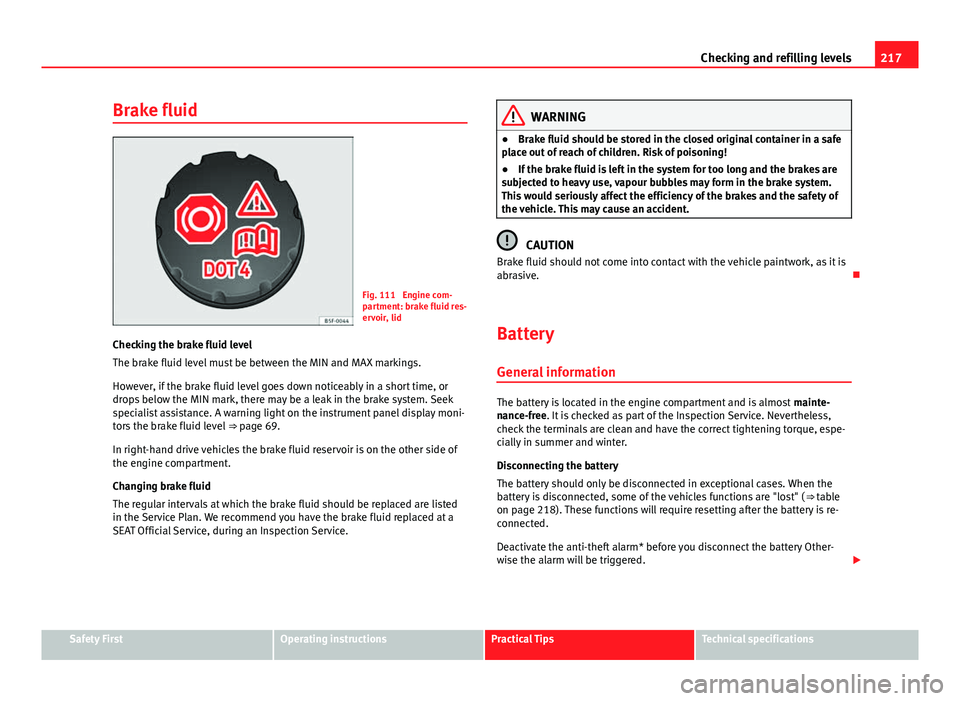
Fig. 111 Engine com-
partment: brake fluid res-
ervoir, lid
Checking the brake fluid level
The brake fluid level must be between the MIN and MAX markings.
However, if the brake fluid level goes down noticeably in a short time, or
drops below the MIN mark, there may be a leak in the brake system. Seek
specialist assistance. A warning light on the instrument panel display moni-
tors the brake fluid level ⇒ page 69.
In right-hand drive vehicles the brake fluid reservoir is on the other side of
the engine compartment.
Changing brake fluid
The regular intervals at which the brake fluid should be replaced are listed
in the Service Plan. We recommend you have the brake fluid replaced at a
SEAT Official Service, during an Inspection Service.
WARNING
● Brake fluid should be stored in the closed original container in a safe
place out of reach of children. Risk of poisoning!
● If the brake fluid is left in the system for too long and the brakes are
subjected to heavy use, vapour bubbles may form in the brake system.
This would seriously affect the efficiency of the brakes and the safety of
the vehicle. This may cause an accident.
CAUTION
Brake fluid should not come into contact with the vehicle paintwork, as it is
abrasive.
Battery General information
The battery is located in the engine compartment and is almost mainte-
nance-free. It is checked as part of the Inspection Service. Nevertheless,
check the terminals are clean and have the correct tightening torque, espe-
cially in summer and winter.
Disconnecting the battery
The battery should only be disconnected in exceptional cases. When the
battery is disconnected, some of the vehicles functions are "lost" ( ⇒ table
on page 218). These functions will require resetting after the battery is re-
connected.
Deactivate the anti-theft alarm* before you disconnect the battery Other-
wise the alarm will be triggered.
Safety FirstOperating instructionsPractical TipsTechnical specifications
Page 233 of 289
232Emergencies
Emergencies
General information
– If you have a flat tyre or puncture, park the car as far away from
the flow of traffic as possible in a safe place. If you have a punc-
ture, stop the vehicle on a horizontal surface. If you are on a
slope, take extra care.
– Apply the handbrake.
– Switch on the hazard warning lights.
– Always wear a reflective vest ⇒ page 232.
– Set up the warning triangle.
– All vehicle occupants should leave the car. They should wait in
a safe place (for instance behind the roadside crash barrier).
WARNING
Always observe the above steps and protect yourself and other road
users.
Equipment
Reflective vests
Wearing a reflective vest makes you more visible to other road
users.
Note
● Always wear a reflective vest when you get out of the vehicle in moving
traffic (for example, in the event of breakdown or to load/unload the vehi-
cle).
● Observe the applicable legislation for each country.
Vehicle tools/Tyre repair kit/Compressor*
The vehicle tools, the tyre repair kit and the compressor* are stor-
ed under the floor panel in the luggage compartment.
To access the vehicle tools:
– Lift up the floor panel by the plastic handle until it is fastened to
the tabs on both sides.
Depending on the vehicle equipment, you will find the tyre repair set and
the compressor* under the floor panel cover.
Page 244 of 289

243
Emergencies
Starting
5. Start the engine of the vehicle with the boosting battery and let it run at idling speed.
6. Start the engine of the vehicle with the flat battery and wait two or three minutes until the engine is “running”.
Removing the jump leads
7. Before you remove the jump leads, switch off the dipped beam headlights (if they are switched on).
8. Turn on the heater blower and heated rear window in the vehi- cle with the flat battery. This helps minimise voltage peaks
which are generated when the leads are disconnected.
9. When the engine is running, disconnect the leads in reverse or- der to the details given above.
Connect the battery clamps so they have good metal-to-metal contact with
the battery terminals.
If the engine fails to start, switch off the starter after about 10 seconds and
try again after about half a minute.
WARNING
● Please note the safety warnings referring to working in the engine
compartment ⇒ page 209.
● The battery providing assistance must have the same voltage as the
flat battery (12V) and approximately the same capacity (see imprint on
battery). Failure to comply could result in an explosion.
WARNING (Continued)
● Never use jump leads when one of the batteries is frozen. Danger of
explosion! Even after the battery has thawed, battery acid could leak and
cause chemical burns. If a battery freezes, it should be replaced.
● Keep sparks, flames and lighted cigarettes away from batteries, dan-
ger of explosion. Failure to comply could result in an explosion.
● Observe the instructions provided by the manufacturer of the jump
leads.
● Do not connect the negative cable from the other vehicle directly to
the negative terminal of the flat battery. The gas emitted from the battery
could be ignited by sparks. Danger of explosion.
● Do not attach the negative cable from the other vehicle to parts of the
fuel system or to the brake line.
● The non-insulated parts of the battery clamps must not be allowed to
touch. The jump lead attached to the positive battery terminal must not
touch metal parts of the vehicle, this can cause a short circuit.
● Position the leads in such a way that they cannot come into contact
with any moving parts in the engine compartment.
● Do not lean on the batteries. This could result in chemical burns.
Note
The vehicles must not touch each other, otherwise electricity could flow as
soon as the positive terminals are connected.
Safety FirstOperating instructionsPractical TipsTechnical specifications
Page 245 of 289
244Emergencies
Towing and tow-starting the vehicle
General information
Points to observe when tow-starting or towing away If you use a tow rope:
Notes for the driver of the towing vehicle
– The tow rope must be taut before you drive off.
– Release the clutch very carefully when starting the vehicle
(manual gearbox), or accelerate gently (automatic gearbox).
Notes for the driver of the towed vehicle
– The ignition should be switched on so that the turn signals,
horn, windscreen wipers and washers can be used. Please en-
sure that the steering wheel is unlocked when you switch on the
ignition, and that it moves freely.
– Put the gearbox lever in neutral (manual gearbox) or move the
selector lever to position N (automatic gearbox).
– The brake servo only works when the engine is running. Consid-
erably more effort is required on the brake pedal when the en-
gine is switched off.
– Remember that the brake servo only works when the ignition is
switched on and the vehicle is moving 1)
. Otherwise, considera-
bly more strength than usual will be required when steering. –
Ensure that the tow rope remains taut at all times.
Tow rope or tow bar
It is easier and safer to tow a vehicle with a tow bar. You should only use a
tow rope if you do not have a tow bar.
A tow rope should be slightly elastic to avoid damage to both vehicles. It is
advisable to use a tow rope made of synthetic fibre or similarly elastic mate-
rial.
Only attach the tow rope or the tow bar to the towing rings ⇒ page 245.
Driving style
Towing requires some experience, especially when using a tow rope. Both
drivers should be familiar with the technique required for towing. Inexper-
ienced drivers should not attempt to tow.
Do not pull too hard with the towing vehicle and take care to avoid jerking
the tow rope. When towing on an unpaved road, there is always a risk of
overloading and damaging the anchorage points.
WARNING
If the vehicle has no electrical power, the brake lights, turn signals and
all other lights will no longer function. Do not have the vehicle towed
away. Failure to do so could result in an accident.
CAUTION
If there is no oil in the gearbox or no lubricant in the automatic transmission
the car may only be towed with the driven wheels lifted clear of the road, or
transported on a special car transporter or trailer.
1)
Important: the battery must be correctly charged.
Page 251 of 289

250Fuses and bulbs
–Unlock the fuse cover ⇒ Fig. 132.
– Remove the clips from the fuse cover.
– Use the plastic clip to pull out the fuse and replace the blown
fuse with a fuse of the same rating.
The individual electrical circuits are protected by fuses. Fuses are located
under a cover below the steering wheel on the left side of the engine com-
partment.
WARNING
Do not repair fuses, and never replace a blown fuse with a higher amper-
age fuse. The electrical system could be damaged, with risk of fire.
CAUTION
● Multiple fuse values on the same line (for example, 5/10/20) in the fol-
lowing tables indicate equipment-related differences. Replace the blown
fuse with a fuse of the same amperage.
● If a newly replaced fuse blows again after a short time, the electrical sys-
tem must be checked by a specialised workshop as soon as possible.
Note
● Positions are not occupied by a fuse do not appear in the following ta-
bles.
● Some of the equipment listed in the tables below pertain only to certain
versions of the model or are an optional extra. Fuses in the vehicle interior
No.Electrical consumerAmpsF2Vacant-F4Alarm10F5Gateway5F6Anti-theft alarm system5
F7Air conditioner/heating control panel, selector
lever (automatic gearbox), relay coil, rear win-
dow heating, additional heating10
F8Diagnosis, handbrake switch, light switch, re-
verse light, interior lighting10
F9Vacant-F10Radio display10F11Vacant-F12Radio20F13Vacant-F14Air conditioner fan40F15Vacant-F16Vacant-F17Instrument panel5F18Vacant-F19Vacant-F20Vacant-F23Right lights40F24Sunroof30F25Left door30F26Heated seats30F27Vacant-F28Vacant-
Page 252 of 289

251
Fuses and bulbs
No.Electrical consumerAmpsF29Vacant-F30Vacant-F31Left lights40F32Parking aid control unit7,5F33Airbag5
F34Reverse switch, clima sensor, electrochromic
mirror7,5
F35Diagnosis, headlight control unit, headlight ad-
juster10
F36Front camera10F37Vacant-F38Vacant-F39Right door30F4012V socket20F41Steering column20F42Central locking40F43Interior light30F44Vacant-F45Vacant-F47Rear window wiper15F49Starter motor; clutch sensor5F51Vacant-F53Heated rear window30
The electric windows and electric seats* are protected by circuit breakers.
These switch on again automatically after a few seconds when the overload
(caused for example by frozen windows) has been corrected.
Note
Please note that the above list, while correct at the time of printing, is sub-
ject to alterations.
Fuses on left side of engine compartment
No.Electrical consumerAmpsF1Vacant-F2ESC control unit40F3Engine control unit (diesel/petrol)15/30F4Engine sensors5/10F5Engine sensors7,5/10F6Brake light sensor5F7Engine power supply5/10F8Lambda probe10F9Engine5/10/20F10Fuel pump control unit15/20F11PTC40F12PTC40F13Automatic gearbox control unit15/30F15Horn15F16Fuel pump control unit20F17Engine control unit7,5F18Terminal 30 (positive reference)5F19Front windscreen washer30F20Alarm horn10F22Engine control unit5F23Starter motor30
Safety FirstOperating instructionsPractical TipsTechnical specifications
Page 253 of 289

252Fuses and bulbs
No.Electrical consumerAmpsF24PTC40F31Vacant-F32Vacant-F37Vacant-
Note
Please note that the above list, while correct at the time of printing, is sub-
ject to alterations.
Bulbs
Changing a bulb
Changing bulbs requires a certain degree of practical skill. If you choose to change engine compartment lamps yourself, remember
that it is a dangerous area ⇒
in Working on components in the engine
compartment on page 209.
Always use identical bulbs with the same designation. The name can be
found on the base of the bulb holder.
Depending on how equipped the vehicle is, there are different sets of head-
lights and tail lights:
● Halogen headlights
● Full-LED main headlights*
● Rear bulb light
● LED rear light* Full-LED headlight system*
Full-LED headlights handle all light functions (daylight, side light, turn sig-
nal, dipped beam and route light) with light emitting diodes (LEDs) as a
light source.
Full-LED headlights are designed to last the lifetime of the car and light
bulbs cannot be replaced. In case of headlight failure, go to an authorised
workshop to have it replaced.
Bulbs (12 V)
Halogen headlightsTypeDaytime driving light/side lightP21W SLLDipped beam headlightsH7 LLMain beam headlightsH7 LLTurn signalPY21W LL
Full-LED main headlightsTypeNo bulbs may be replaced. All functions are
with LEDs
Front fog lightTypeFog light/cornering*H8
Rear bulb lightTypeBrake lights/tail lightsP21W LLSide lights2x W5W LLTurn signalPY21W LLRear fog lightH21WReverse lightsP21W LL
LED rear lightTypeTurn signalPY21W LLRear fog lightH21W
Page 258 of 289

257
Fuses and bulbs
Remove the bulb holder
Fig. 142 Front fog light
– Remove connector ⇒ Fig. 142 A
from the bulb.
– Turn bulb holder ⇒ Fig. 142 B
to the left and pull.
– Remove the bulb by pressing on the bulb holder and turning it
anti-clockwise at the same time.
– Installation involves all of the above steps in reverse sequence.
– Check that the bulb works properly. Changing tail light bulbs (on side panel)
Overview of tail lights
Rear lights on the side panel
Turn signalPY21W NA LLSide light and brake lightP21W LL
Safety FirstOperating instructionsPractical TipsTechnical specifications