service Seat Toledo 2014 Owner's manual
[x] Cancel search | Manufacturer: SEAT, Model Year: 2014, Model line: Toledo, Model: Seat Toledo 2014Pages: 200, PDF Size: 4.37 MB
Page 5 of 200
Table of Contents
Table of Contents
Safety . . . . . . . . . . . . . . . . . . . . . . . . . . . . . . . . 5
Safe driving . . . . . . . . . . . . . . . . . . . . . . . . . . . . 5
Safety first! . . . . . . . . . . . . . . . . . . . . . . . . . . . . . 5
Advice about driving . . . . . . . . . . . . . . . . . . . . . 5
Sitting position for vehicle occupants . . . . . . . 6
Pedal area . . . . . . . . . . . . . . . . . . . . . . . . . . . . . . 10
Seat belts . . . . . . . . . . . . . . . . . . . . . . . . . . . . . . 11
The reasons why we should wear seat belts . . 11
How to properly adjust your seatbelt . . . . . . . . 14
Seat belt tensioners . . . . . . . . . . . . . . . . . . . . . . 15
Airbag system . . . . . . . . . . . . . . . . . . . . . . . . . . 16
Brief introduction . . . . . . . . . . . . . . . . . . . . . . . . 16
Airbag overview . . . . . . . . . . . . . . . . . . . . . . . . . 19
Deactivating airbags . . . . . . . . . . . . . . . . . . . . . 22
Transporting children safety . . . . . . . . . . . . . . . 24
Safety for children . . . . . . . . . . . . . . . . . . . . . . . 24
Child seats . . . . . . . . . . . . . . . . . . . . . . . . . . . . . 26
Operation . . . . . . . . . . . . . . . . . . . . . . . . . . . . . 29
Controls and displays . . . . . . . . . . . . . . . . . . . . 29
Overview . . . . . . . . . . . . . . . . . . . . . . . . . . . . . . . 28
Instruments and warning lamps . . . . . . . . . . . . 30
Dash . . . . . . . . . . . . . . . . . . . . . . . . . . . . . . . . . . 30
Control lamps . . . . . . . . . . . . . . . . . . . . . . . . . . . 32
Information system . . . . . . . . . . . . . . . . . . . . . . 39
Multi-function display* (on board computer) . . 39
MAXI DOT* (Informative display) . . . . . . . . . . . . 43
Maintenance interval display* . . . . . . . . . . . . . 45
Communication . . . . . . . . . . . . . . . . . . . . . . . . . 46
Steering wheel controls* . . . . . . . . . . . . . . . . . . 46
Multimedia . . . . . . . . . . . . . . . . . . . . . . . . . . . . . 51
Opening and closing . . . . . . . . . . . . . . . . . . . . . 51
Remote control . . . . . . . . . . . . . . . . . . . . . . . . . . 51
Keys . . . . . . . . . . . . . . . . . . . . . . . . . . . . . . . . . . . 53
Central locking system . . . . . . . . . . . . . . . . . . . . 54 Anti-theft alarm system* . . . . . . . . . . . . . . . . . . 57
Rear lid . . . . . . . . . . . . . . . . . . . . . . . . . . . . . . . . 58
Electric window opening and closing . . . . . . . . 60
Lights and visibility
. . . . . . . . . . . . . . . . . . . . . . 61
Lights . . . . . . . . . . . . . . . . . . . . . . . . . . . . . . . . . 61
Interior lights . . . . . . . . . . . . . . . . . . . . . . . . . . . 66
Visibility . . . . . . . . . . . . . . . . . . . . . . . . . . . . . . . 67
Windscreen wipers and windscreen washers . . 68
Rear vision mirrors . . . . . . . . . . . . . . . . . . . . . . . 70
Seats and head restraints . . . . . . . . . . . . . . . . . 71
Adjusting seats and head restraints . . . . . . . . . 71
Seat functions . . . . . . . . . . . . . . . . . . . . . . . . . . 73
Transport and practical equipment . . . . . . . . . 76
Practical equipment . . . . . . . . . . . . . . . . . . . . . . 76
Storing objects . . . . . . . . . . . . . . . . . . . . . . . . . . 81
Luggage compartment . . . . . . . . . . . . . . . . . . . . 82
Roof rack* . . . . . . . . . . . . . . . . . . . . . . . . . . . . . . 85
Heating and air conditioning . . . . . . . . . . . . . . 87
Heating and air conditioning . . . . . . . . . . . . . . . 87
Heating . . . . . . . . . . . . . . . . . . . . . . . . . . . . . . . . 88
Air conditioning (manual)* . . . . . . . . . . . . . . . . 90
Climatronic* (automatic air conditioning) . . . . 93
Driving . . . . . . . . . . . . . . . . . . . . . . . . . . . . . . . . 96
Starting and stopping the engine . . . . . . . . . . . 96
Brakes and brake servo systems . . . . . . . . . . . . 98
Manual gearbox . . . . . . . . . . . . . . . . . . . . . . . . . 100
Automatic gearbox . . . . . . . . . . . . . . . . . . . . . . . 100
Run-in and economical driving . . . . . . . . . . . . . 104
Wading and driving off-road . . . . . . . . . . . . . . . 107
Driver assistance systems . . . . . . . . . . . . . . . . . 108
Braking and stability systems . . . . . . . . . . . . . . 108
Parking aid* . . . . . . . . . . . . . . . . . . . . . . . . . . . . 110
Cruise control* . . . . . . . . . . . . . . . . . . . . . . . . . . 111
Start-Stop* System . . . . . . . . . . . . . . . . . . . . . . . 112
Towing bracket device . . . . . . . . . . . . . . . . . . . . 114
Driving the vehicle with a trailer . . . . . . . . . . . . 114
Towing bracket device . . . . . . . . . . . . . . . . . . . . 116 Advice
. . . . . . . . . . . . . . . . . . . . . . . . . . . . . . . . 122
Care and maintenance . . . . . . . . . . . . . . . . . . . . 122
Accessories and modifications to the vehicle . 122
Care and cleaning . . . . . . . . . . . . . . . . . . . . . . . 123
Checking and refilling levels . . . . . . . . . . . . . . . 129
Fuel . . . . . . . . . . . . . . . . . . . . . . . . . . . . . . . . . . . 129
Engine compartment . . . . . . . . . . . . . . . . . . . . . 132
Engine oil . . . . . . . . . . . . . . . . . . . . . . . . . . . . . . 135
Coolant . . . . . . . . . . . . . . . . . . . . . . . . . . . . . . . . 137
Brake fluid . . . . . . . . . . . . . . . . . . . . . . . . . . . . . 139
Windscreen washer . . . . . . . . . . . . . . . . . . . . . . 139
Battery . . . . . . . . . . . . . . . . . . . . . . . . . . . . . . . . . 140
Wheels and tyres . . . . . . . . . . . . . . . . . . . . . . . . 144
Wheels . . . . . . . . . . . . . . . . . . . . . . . . . . . . . . . . 144
Spare wheel . . . . . . . . . . . . . . . . . . . . . . . . . . . . 146
Tyre control systems . . . . . . . . . . . . . . . . . . . . . . 147
Winter service . . . . . . . . . . . . . . . . . . . . . . . . . . . 148
Emergencies . . . . . . . . . . . . . . . . . . . . . . . . . . . . 149
Emergency equipment . . . . . . . . . . . . . . . . . . . . 149
Changing a wheel . . . . . . . . . . . . . . . . . . . . . . . 150
Tyre repairs . . . . . . . . . . . . . . . . . . . . . . . . . . . . . 154
Jump-starting . . . . . . . . . . . . . . . . . . . . . . . . . . . 157
Towing the vehicle . . . . . . . . . . . . . . . . . . . . . . . 159
Emergency locking and unlocking . . . . . . . . . . 161
Changing the wiper blades . . . . . . . . . . . . . . . . 162
Fuses and bulbs . . . . . . . . . . . . . . . . . . . . . . . . . 163
Fuses . . . . . . . . . . . . . . . . . . . . . . . . . . . . . . . . . . 163
Changing bulbs . . . . . . . . . . . . . . . . . . . . . . . . . 166
Changing front fog light bulbs . . . . . . . . . . . . . 169
Changing bulbs for rear lights (in side panel) . 169
Changing rear lights (in rear lid) . . . . . . . . . . . . 171
Changing bulb for the number plate light . . . . 173
Technical specifications . . . . . . . . . . . . . . . 174
Technical specifications . . . . . . . . . . . . . . . . . . 174
Important information . . . . . . . . . . . . . . . . . . . . 174
Information on fuel consumption . . . . . . . . . . . 175
Towing a trailer . . . . . . . . . . . . . . . . . . . . . . . . . . 176 3
Page 18 of 200
Safety
Service and disposal of belt
tensioners The belt tensioners are components of the
seat belts that are installed in the seats of
your vehicle. If you work on the belt tension-
ers or remove and install parts of the system
when performing other repair work, the seat
belt may be damaged. The consequence may
be that, in the event of an accident, the belt
tensioners function incorrectly or may not
function at all.
So that the effectiveness of the seat belt ten-
sioner is not reduced and that removed parts
do not cause any injuries or environmental
pollution, regulations, which are known to
the specialised workshops, must be ob-
served.
WARNING
● Improper use or repairs not carried out by
qualified mechanics increase the risk of se-
vere or fatal injuries. The belt tensioners may
fail to trigger or may trigger in the wrong cir-
cumstances.
● Never attempt to repair, adjust, remove or
install parts of the belt tensioners or seat
belts.
● The seat belt tensioner, seat belt and auto-
matic retractor cannot be repaired.
● Any work on the belt tensioners and seat
belts, including the removal and refitting of
system parts in conjunction with other repair work, must be performed by a specialised
workshop only.
●
The belt tensioners will only provide pro-
tection for one accident and must be changed
if they have been activated. Airbag system
Brief introduction Why wear a seat belt and assume the
correct sitting position? For the inflating airbags to achieve the best
protection, the seat belt must always be worn
properly and the correct sitting position must
be assumed.
The airbag system is not a substitute for seat
belts, but it is an integral part of the vehicle's
overall passive safety system. Please bear in
mind that the airbag system can only work ef-
fectively when the vehicle occupants are
wearing their seat belts correctly and have
adjusted the head restraints properly. There-
fore, it is most important to wear the seat
belts at all times, not only because this is re-
quired by law in most countries, but also for
your safety
›››
page 11, The reasons why we
should wear seat belts .
The airbag inflates in a matter of seconds, so
if you are not properly seated when the air-
bag is triggered, you may sustain fatal inju-
ries. Therefore, it is essential that all vehicle
occupants assume a correct sitting position
while travelling.
Sharp braking before an accident may cause
a passenger not wearing a seat belt to be
thrown forward into the area of the deploying
16
Page 21 of 200
Airbag system
should have a specialised workshop check
the system immediately.
If any of the airbags are disabled by a Techni-
cal Service, the warning lamp flashes for sev-
eral more seconds after verification and will
turn off if there is no fault. WARNING
● If there is a malfunction, the airbag and
belt tensioner system cannot properly per-
form its protective function.
● If a malfunction occurs, have the system
checked immediately by a specialised work-
shop. Otherwise, in the event of an accident,
the airbag system and belt tensioners may
not be triggered, or may not be triggered cor-
rectly. Airbag overview
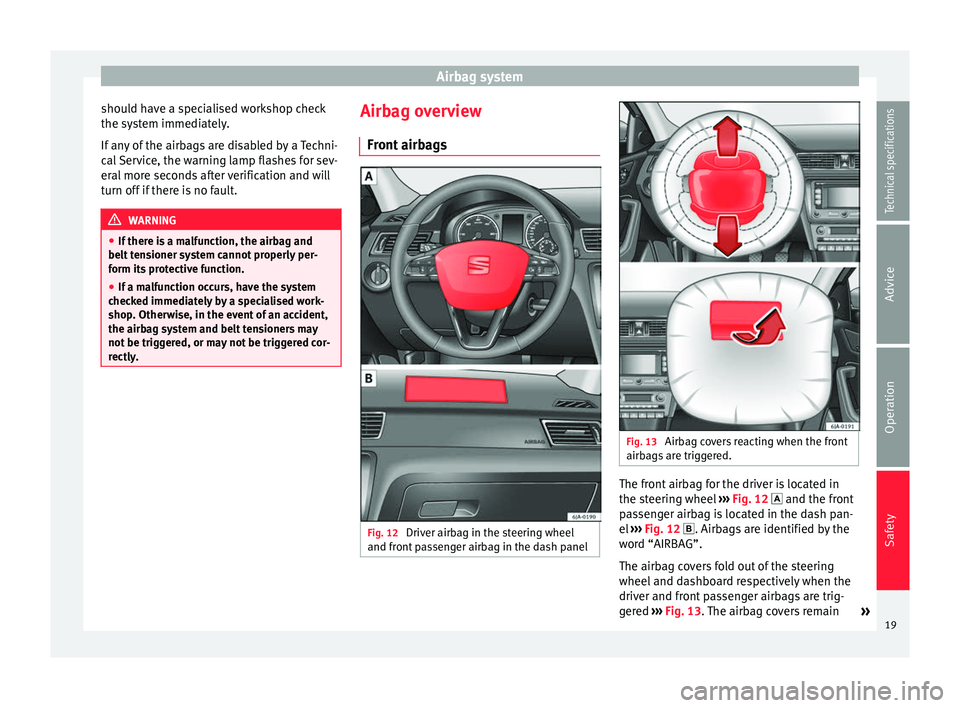
Front airbags Fig. 12
Driver airbag in the steering wheel
and front passenger airbag in the dash panel Fig. 13
Airbag covers reacting when the front
airbags are triggered. The front airbag for the driver is located in
the steering wheel
›››
Fig. 12
and the fr
ont
p
assenger airbag is located in the dash pan-
el ›››
Fig. 12 . Airbags are identified by the
w
ord “AIRBAG”.
The airbag covers fold out of the steering
wheel and dashboard respectively when the
driver and front passenger airbags are trig-
gered ›››
Fig. 13
. The airbag covers remain
»
19
Technical specifications
Advice
Operation
Safety
Page 24 of 200
Safety
and upper body in the event of a severe side
collision ››› page 20 . WARNING
● In order for the head-protection airbags to
provide their maximum protection, the pre-
scribed sitting position must always be main-
tained with seat belts fastened while travel-
ling.
● For safety reasons, the curtain airbag must
be disabled in those vehicles fitted with a
screen dividing the interior of the vehicle.
See your technical service to make this ad-
justment.
● There must be no other persons, animals or
objects between the occupants of the rear
seats and the deployment space of the head-
protection airbags so that the head-protec-
tion airbag can deploy without restriction and
provide the greatest possible protection.
Therefore, sun blinds which have not been
expressly approved for use in your vehicle
may not be attached to the side windows
● The built-in coat hooks should be used only
for lightweight clothing. Do not leave any
heavy or sharp-edged objects in the pockets.
Please, do not hang the clothes on coat hang-
ers.
● The airbags provide protection for just one
accident; replace them once they have de-
ployed.
● Any work on the head-protection airbag
system or removal and installation of the air-
bag components for other repairs (such as re- moval of the roof lining) should only be per-
formed by a specialised workshop. Other-
wise, faults may occur during the airbag sys-
tem operation.
●
Do not attempt to modify components of
the airbag system in any way.
● The side and head airbags are managed
through sensors located in the interior of the
front doors. To ensure the correct operation of
the side and curtain airbags neither the
doors nor the door panels should be modified
in any way (e.g. fitting loudspeakers). If the
front door is damaged, the airbag system
may not work correctly. All work carried out
on the front door must be done in a special-
ised workshop. Deactivating airbags
Disabling the front airbag The disabling of airbags is only carried out in
certain cases, i.e. if:
● a child seat is required in the front passen-
ger seat with the child facing in the opposite
direction to the direction of travel (in some
countries, due to divergent legal require-
ments, facing in the direction of travel)
››› page 26 ;
● de s
pite the driver seat being in the correct
position, a minimum distance of 25 cm can- not be maintained between the centre of the
steering wheel and the driver's torso,
●
installation of special devices is required in
the steering wheel area due to a physical dis-
ability,
● if you have special seats installed (e.g. an
orthopaedic seat without side airbags).
The front passenger front airbag can be disa-
bled using the switch ››› page 23.
We recommend that you contact an author-
ised SEAT dealer for the disabling of other air-
bags.
Airbag system control
The airbag system availability is controlled
electronically, regardless of whether an air-
bag is disabled.
If an airbag was disabled using a diagnostics
system:
● the airbag system warning lamp illumi-
nates after switching on the ignition for
about 4 seconds, and then flashes for about
12 seconds.
If the airbag has been disabled with the air-
bag switch on the side of the dash panel:
● the airbag control lamp will illuminate
for about 4 seconds after the ignition is
switched on,
22
Page 26 of 200
Safety
Control lamp with the word
(front passenger airbag disabled)
If the front passenger front airbag is disa-
bled
, after switching on the ignition, the con-
trol lamp will illuminate for several seconds,
then it will switch off for about 1 s and then
switch on again.
If the control lamp is flashing, there is a fault
in the disabling of the airbag system ››› .
Please go immediately to an Official Service. WARNING
● The driver of the vehicle is responsible for
disabling or switching on the airbag.
● Always switch off the ignition before disa-
bling the front passenger airbag! Failure to do
so could result in a fault in the airbag disa-
bling system.
● Never leave the key in the airbag disabling
switch as it could get damaged or enable or
disable the airbag during driving.
● If the (airbag disabled) control lamp
fl a
shes, the front passenger front airbag will
not trigger in the event of an accident! Have
the system immediately checked by an Offi-
cial Service. Transporting children safety
Safety for children Introduction For safety reasons, as we have learned from
accident statistics, we recommend that chil-
dren under 12 years of age travel in the rear
seats. Depending on their age, height and
weight, children travelling in rear seats must
use a child seat or a seat belt. For safety rea-
sons, the child seat should be installed in the
rear seat, behind the front passenger seat or
in the centre back seat.
The physical laws involved and the forces
acting in a collision apply also to children
››› page 13 . But unlike adults, children do not
h av
e fully developed muscle and bone struc-
tures. This means that children are subject to
a greater risk of injury.
To reduce the risk of injuries, children must
always use special child restraint systems
when travelling in the vehicle.
We recommend the use of child safety prod-
ucts from the SEAT Original Accessories Pro-
gramme, which includes systems for all ages
made by “Peke” (not for all countries).
These systems have been especially de-
signed and approved, complying with the
ECE-R44. regulation. Follow the manufacturer's instructions and
observe any statutory requirements when in-
stalling and using child seats. Always read
and note
››› page 25.
We r
ecommend you always carry the manu-
facturer's Child Seat Instruction Manual to-
gether with the on-board documentation.
24
Page 27 of 200

Transporting children safety
Important information regarding the
front passenger's airbag Fig. 19
Passenger's side sun visor: airbag
sticker. Fig. 20
On the rear frame of the passenger
side door: airbag sticker. A sticker with important information about
the passenger airbag is located on the pas-
senger's sun visor and/or on the passenger
side door frame. Read and always observe the safety information included in the follow-
ing chapters:
● Safety distance with respect to the passen-
ger airbag ››› page 16, Why wear a seat belt
and assume the correct sitting position? .
● Objects between the passenger and the
passenger side airbag ››› in Front airbags
on page 20 .
The p a
ssenger side front airbag, when ena-
bled, is a serious risk for a child that is facing
backward since the airbag can strike the seat
with such force that it can cause serious or
fatal injuries. Children up to 12 years old
should always travel on the rear seat.
Therefore we strongly recommend you to
transport children on the rear seats. This is
the safest location in the vehicle. Alternative-
ly, the front passenger airbag can be disa-
bled with a key-operated switch ››› page 22.
When transporting children, use a child seat
suitable for the age and size of each child
››› page 24. WARNING
● If a child seat is secured to the front pas-
senger seat, the risk to the child of sustain-
ing critical or fatal injuries in the event of an
accident increases.
● An inflating front passenger airbag can
strike the rear-facing child seat and project it with great force against the door, the roof or
the backrest.
●
Never install a child seat facing backwards
on the front passenger seat unless the front
passenger front airbag has been disabled.
Risk of potentially fatal injuries to the child!
However, if it is necessary, in exceptional ca-
ses, to transport a child in the front passen-
ger seat, the front passenger front airbag
must always be disabled ››› page 22. If the
front passenger seat has a height adjustment
option, move it to the highest position.
● For those vehicles that do not include a key
lock switch to deactivate the airbag, the vehi-
cle must be taken to a technical service.
● All vehicle occupants, especially children,
must assume the proper sitting position and
be properly belted in while travelling.
● Never hold children or babies on your lap,
this can result in potentially fatal injuries to
the child!
● Never allow a child to be transported in a
vehicle without being properly secured, or to
stand up or kneel on a seat while travelling.
In an accident, the child could be flung
through the vehicle, causing possibly fatal in-
juries to themselves and to the other vehicle
occupants.
● If children assume an improper sitting posi-
tion when the vehicle is moving, they expose
themselves to greater risk of injury in the
event of a sudden braking manoeuvre or in an
accident. This is particularly important if the
child is travelling on the front passenger seat » 25
Technical specifications
Advice
Operation
Safety
Page 29 of 200
Transporting children safety
Suitable for universal approved restrain-
ing systems for use in this age category
(universal retention systems are those
fitted using the adult seat belt).
Move the front passenger seat as far
back as possible, as high as possible
and always disable the airbag.
Suitable for retention systems using the
“ISOFIX” and Top Tether* anchors. WARNING
● When travelling, children must be secured
in the vehicle with a restraint system suitable
for age, weight and size.
● Read and always observe information and
warnings concerning the use of child seats
››› page 25. Child seats fastened with the
“ISOFIX” and Top Tether* system
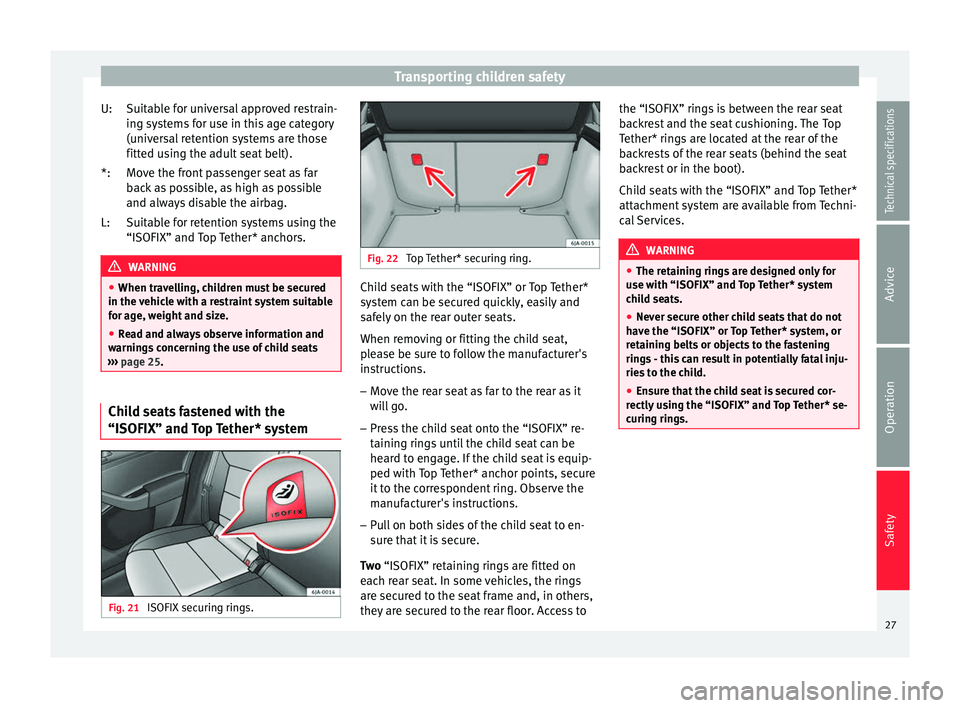
Fig. 21
ISOFIX securing rings. U:
*:
L:
Fig. 22
Top Tether* securing ring. Child seats with the “ISOFIX” or Top Tether*
system can be secured quickly, easily and
safely on the rear outer seats.
When removing or fitting the child seat,
please be sure to follow the manufacturer's
instructions.
– Move the rear seat as far to the rear as it
will go.
– Press the child seat onto the “ISOFIX” re-
taining rings until the child seat can be
heard to engage. If the child seat is equip-
ped with Top Tether* anchor points, secure
it to the correspondent ring. Observe the
manufacturer's instructions.
– Pull on both sides of the child seat to en-
sure that it is secure.
Two “ISOFIX” retaining rings are fitted on
e ac
h rear seat. In some vehicles, the rings
are secured to the seat frame and, in others,
they are secured to the rear floor. Access to the “ISOFIX” rings is between the rear seat
backrest and the seat cushioning. The Top
Tether* rings are located at the rear of the
backrests of the rear seats (behind the seat
backrest or in the boot).
Child seats with the “ISOFIX” and Top Tether*
attachment system are available from Techni-
cal Services.
WARNING
● The retaining rings are designed only for
use with “ISOFIX” and Top Tether* system
child seats.
● Never secure other child seats that do not
have the “ISOFIX” or Top Tether* system, or
retaining belts or objects to the fastening
rings - this can result in potentially fatal inju-
ries to the child.
● Ensure that the child seat is secured cor-
rectly using the “ISOFIX” and Top Tether* se-
curing rings. 27
Technical specifications
Advice
Operation
Safety
Page 32 of 200
Operation
Instruments and warning lamps
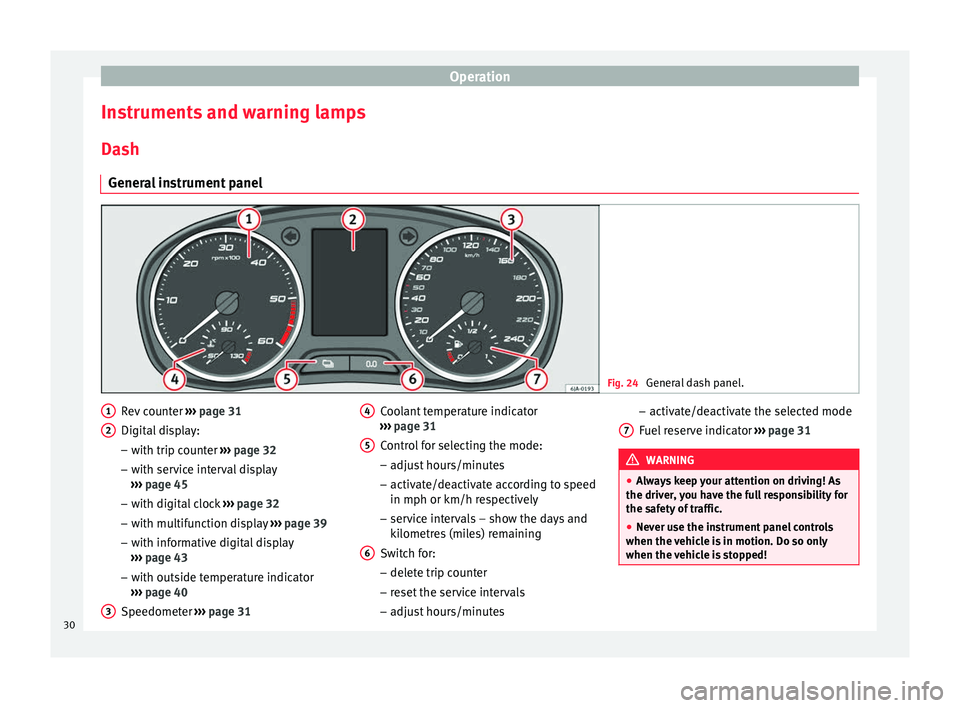
Dash General instrument panel Fig. 24
General dash panel. Rev counter
››› page 31
Digital display:
– with trip counter ››› page 32
– with service interval display
››› page 45
– with digital clock ››› page 32
– with multifunction display ››› page 39
– with informative digital display
››› page 43
– with outside temperature indicator
››› page 40
Speedometer ››› page 31
1 2
3 Coolant temperature indicator
››› page 31
Control for selecting the mode:
– adjust hours/minutes
– activate/deactivate according to speed
in mph or km/h respectively
– service intervals – show the days and
kilometres (miles) remaining
Switch for:
– delete trip counter
– reset the service intervals
– adjust hours/minutes
4 5
6 –
activate/deactivate the selected mode
Fuel reserve indicator ››› page 31 WARNING
● Always keep your attention on driving! As
the driver, you have the full responsibility for
the safety of traffic.
● Never use the instrument panel controls
when the vehicle is in motion. Do so only
when the vehicle is stopped! 7
30
Page 34 of 200
Operation
Trip counter* Daily trip counter (trip)
The daily trip counter indicates the distance
that has been covered since the last time the
function was reset in 100 metre sections.
In order to reset the daily distance covered
keep the button
6
››› Fig. 24 ››› page 30
pressed down.
Odometer
The odometer indicates the total number of
kilometres (or mileage) that the vehicle has
covered until now.
Fault indication
In the event of a fault the word Error
will be
permanently displayed on the informative
display. Please take the vehicle to a special-
ised Technical Service to solve this fault. Note
In vehicles equipped with an informative dis-
play, if the indicator of the second speed in
mph or in kph are activated respectively, this
speed will be displayed in place of the odom-
eter. Digital clock
The clock is set using the buttons
5 to
6 ›››
Fig. 24 ››› p
age 30.
Select the indication you want to change with
button 5 and make the adjustment with but-
ton 6 .
In vehicles equipped with an informative dis-
play this can be reset from the menu, Time
››› page 44.
R ec
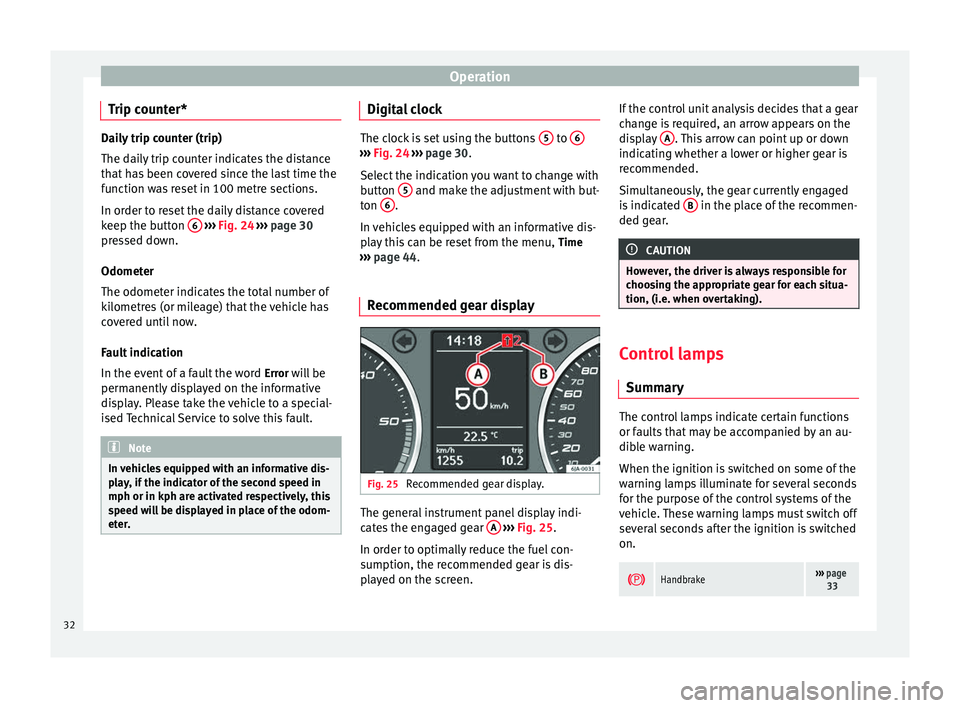
ommended gear display Fig. 25
Recommended gear display. The general instrument panel display indi-
cates the engaged gear
A
›››
Fig. 25 .
In or der t
o optimally reduce the fuel con-
sumption, the recommended gear is dis-
played on the screen. If the control unit analysis decides that a gear
change is required, an arrow appears on the
display
A . This arrow can point up or down
indicating whether a lower or higher gear is
recommended.
Simultaneously, the gear currently engaged
is indicated B in the place of the recommen-
ded gear. CAUTION
However, the driver is always responsible for
choosing the appropriate gear for each situa-
tion, (i.e. when overtaking). Control lamps
Summary The control lamps indicate certain functions
or faults that may be accompanied by an au-
dible warning.
When the ignition is switched on some of the
warning lamps illuminate for several seconds
for the purpose of the control systems of the
vehicle. These warning lamps must switch off
several seconds after the ignition is switched
on.
Handbrake›››
page
33 32
Page 35 of 200
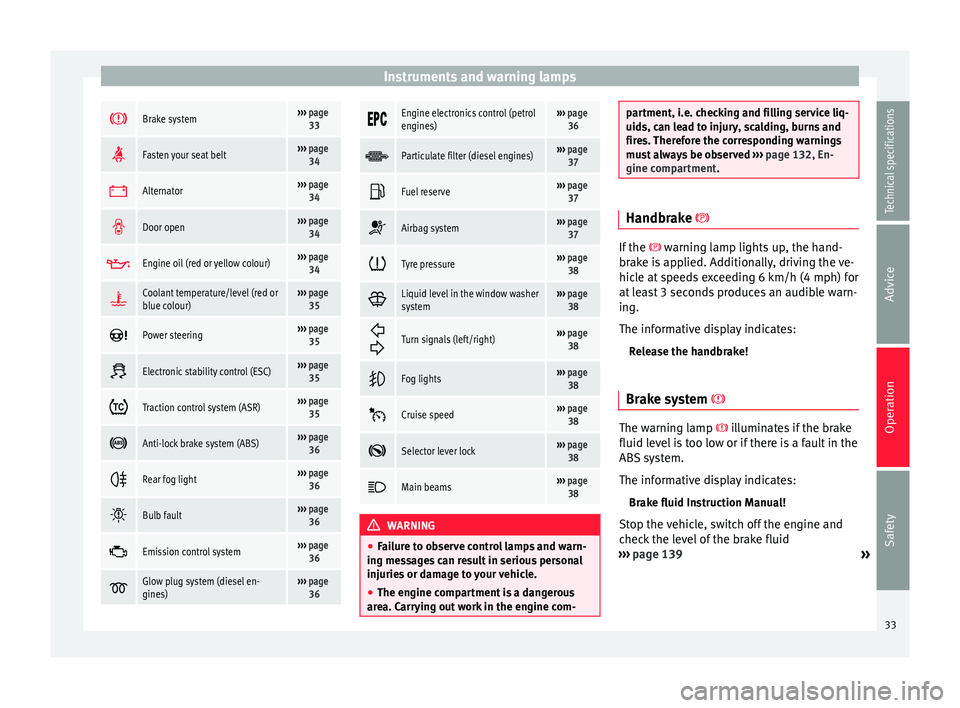
Instruments and warning lamps
Brake system›››
page
33
Fasten your seat belt›››
page
34
Alternator›››
page
34
Door open›››
page
34
Engine oil (red or yellow colour)›››
page
34
Coolant temperature/level (red or
blue colour)›››
page
35
Power steering›››
page
35
Electronic stability control (ESC)›››
page
35
Traction control system (ASR)›››
page
35
Anti-lock brake system (ABS)›››
page
36
Rear fog light›››
page
36
Bulb fault›››
page
36
Emission control system›››
page
36
Glow plug system (diesel en-
gines)›››
page
36
Engine electronics control (petrol
engines)›››
page
36
Particulate filter (diesel engines)›››
page
37
Fuel reserve›››
page
37
Airbag system›››
page
37
Tyre pressure›››
page
38
Liquid level in the window washer
system›››
page
38
Turn signals (left/right)››› page
38
Fog lights›››
page
38
Cruise speed›››
page
38
Selector lever lock›››
page
38
Main beams›››
page
38 WARNING
● Failure to observe control lamps and warn-
ing messages can result in serious personal
injuries or damage to your vehicle.
● The engine compartment is a dangerous
area. Carrying out work in the engine com- partment, i.e. checking and filling service liq-
uids, can lead to injury, scalding, burns and
fires. Therefore the corresponding warnings
must always be observed
››› page 132, En-
gine compartment. Handbrake
If the
warning lamp lights up, the hand-
br ak
e is applied. Additionally, driving the ve-
hicle at speeds exceeding 6 km/h (4 mph) for
at least 3 seconds produces an audible warn-
ing.
The informative display indicates:
Release the handbrake!
Brake system The warning lamp
illuminates if the brake
fluid level is too low or if there is a fault in the
ABS system.
The informative display indicates:
Brake fluid Instruction Manual!
Stop the vehicle, switch off the engine and
check the level of the brake fluid
››› page 139
»
33
Technical specifications
Advice
Operation
Safety