ESP SKODA OCTAVIA 2013 3.G / (5E) Workshop Manual
[x] Cancel search | Manufacturer: SKODA, Model Year: 2013, Model line: OCTAVIA, Model: SKODA OCTAVIA 2013 3.G / (5E)Pages: 287, PDF Size: 18.55 MB
Page 230 of 287
WARNING“Quick-charging” the vehicle battery is dangerous and requires a special
charger and specialist knowledge.
CAUTION
On vehicles with the START/STOP system, the pole terminal of the charger must
not be connected directly to the negative terminal of the vehicle battery, but only
to the engine earth » page 244, Jump-starting in vehicles with the START-STOP
system .
Note
We therefore recommend that vehicle batteries be rapid charged by a specialist
garage.
Replacing
First read and observe the introductory information and safety warn-
ings
on page 224.
When replacing a battery, the new vehicle battery must have the same capacity,
voltage, amperage and be the same size. Suitable vehicle battery types can be
purchased from a specialist garage.
We recommend having the battery replaced by a specialist garage, where the
new vehicle battery will be installed properly and the original battery will be dis-
posed of in accordance with national regulations.
Disconnecting and reconnecting
First read and observe the introductory information and safety warn-
ings
on page 224.
On disconnecting and reconnecting the vehicle battery, the following functions
are initially deactivated or are no longer able to operate fault-free:
OperationOperating measureElectrical power window (operational faults)» page 49Enter the radio/navigation system code num-
ber» Operating instructions for Info-
tainment Radio or » Operating
instructions for Infotainment
NavigationSetting the clock» page 14Data in the multifunction display are deleted» page 29
Note
We recommend having the vehicle checked by a specialist garage in order to en-
sure full functionality of all electrical systems.
Automatic load deactivation
First read and observe the introductory information and safety warn-ings
on page 224.
The vehicle voltage control unit automatically prevents the battery from discharg-
ing when the bettery is subjected to heavy loads. This manifests itself by the fol-
lowing.
› The idling speed is raised to allow the generator to deliver more electricity to
the electrical system.
› Where appropriate large convenience consumers, e.g. seat heaters, rear win-
dow heaters, have their power limited or in case of emergency shut off com-
pletely.
CAUTION
■ Despite such intervention by the vehicle electric system management, the vehi-
cle battery may be drained. For example, when the ignition is switched on a long
time with the engine turned off or the side or parking lights are turned on during longer parking.■
Consumers which are supplied via a 12 V socket can cause the vehicle battery to
discharge when the ignition is switched off.
Note
Driving comfort is not disrupted by any shutting off of consumers. Often the driv-
er is not aware of it having taken place.
227Inspecting and replenishing
Page 231 of 287
Wheels
Tyres and wheel rims
Introduction
This chapter contains information on the following subjects:
Service life of tyres
229
New tyres
230
Unidirectional tyres
231
Tyre control display
231
Spare wheel
232
Full wheel trim
233
Wheel bolts
233
Wheel bolts
233WARNING■ The national legal requirements must be observed for the use of tyres.■Observe the national legal regulations relating to the use of snow chains
and the maximum vehicle speed with snow chains.WARNINGThe following instructions for the use of tyres must be observed.■During the first 500 km, new tyres do not offer optimum grip and appropri-
ate care should therefore be taken when driving – risk of accident!■
On all four wheels, use only radial tyres of the same type, size (rolling cir-
cumference) and the same tread pattern.
■
For safety reasons, do no replace tyres individually.
■
Never exceed the maximum permissible load bearing capacity for fitted
tyres – risk of accident!
■
Never exceed the maximum permissible speed for fitted tyres – risk of acci-
dent!
■
An incorrect wheel alignment at the front or rear impairs handling – risk of
accident!
WARNING (Continued)■ Unusual vibrations or pulling of the vehicle to one side could be a sign of
tyre damage. If there is any doubt that a wheel is damaged, immediately re-
duce your speed and stop! If no external damage is evident, drive slowly and
carefully to the nearest specialist garage to have the vehicle checked.■
Only use those tyres or wheel rims which have been approved by ŠKODA for
your model of vehicle. Failure to observe this instruction will adversely affect
the road safety of your vehicle – risk of accident!
WARNINGObserve the following information regarding damage and wear of tyres.■Never use tyres if you do not know anything about the condition and age.■
Never drive with damaged tyres – risk of accident!
■
Immediately replace damaged wheel rims or tyres.
■
You must have your tyres replaced with new ones at the latest when the
wear indicators have been worn down.
■
Worn tyres do not provide the necessary adhesion to the road surface par-
ticularly at high speeds on wet roads. One could experience “aquaplaning” (uncontrolled movements of the vehicle – “swimming” on a wet road surface).
WARNINGObserve the following information regarding the tyre inflation pressure.■The tyre control display does not absolve the driver of the responsibility to
ensure the correct tyre inflation pressure. Check the tyre inflation pressure at
regular intervals.■
Too low or too high inflation pressure impairs handling – risk of an accident!
■
If the inflation pressure is too low, the tyre must perform a greater rolling
resistance. At higher speeds the tyre will warm up as a result of this. This can
result in tread separation and a tyre blowout.
WARNINGObserve the following information regarding the wheel bolts.■The wheel bolts must be clean and must turn easily. Never treat them with
grease or oil. 228General Maintenance
Page 233 of 287
Always check the inflation pressure when the tyres are cold. Do not reduce the
higher pressure of warm tyres.
With greater payload, adjust the tyre inflation pressure accordingly.
Driving style
Fast cornering, sharp acceleration and braking increase the wear of your tyres.
Balancing wheels
The wheels of a new vehicle are balanced. When driving, there are a wide range
of influences which may result in an imbalance. This may become apparent by a
“vibration” in the steering.
Have the wheels rebalanced after replacing the tyres.
Wheel alignment errors
An incorrect wheel alignment at the front or rear leads to excess wear on the tyres.
Tyre damage
Drive over kerbs and other such obstacles slowly and perpendicularly wherever possible in order to avoid damage to tyres and wheel trims.
We recommend checking your tyres and wheel rims for damage (punctures, cuts,
splits and bulges, etc.) on a regular basis. Remove foreign bodies (e.g. small
stones) from the tyre profile immediately.
Changing wheels around
If significantly greater wear is present on the front tyres, we recommend replac-
ing the front wheels with the rear wheels as shown in the diagram » Fig. 190 .
You will then obtain approximately the same life for all the tyres.
We recommend that you change the tyres around every 10000 km in order to
achieve even wear on all tyres and to obtain optimal tyre life.
Storing tyres
Mark them previously used tyres so that you are able to fit them on again to run in the same direction.
Always store wheels or tyres in a cool, dry and, where possible, dark place. Tyres which are not fixed to a wheel trim should be stored upright.
Wear indicators
The base of the tread of the tyres has 1.6 mm high wear indicators installed.
These wear indicators are evenly spaced around the circumference of the tyre,
depending on the make » Fig. 189 -
. Markings on the walls of the tyres through
the letters “TWI”, triangular symbols or other symbols identify the position of the
wear indicators.Tyre age
Tyres age losing their original characteristics, even if they are not used. There-
fore, we recommend not to use summer or winter tyres that are older than 6 years or 4 years respectively.
New tyres
First read and observe the introductory information and safety warn-
ings
on page 228.
Only fit radial tyres of the same type, size (rolling circumference) and the same
tread pattern on one axle on all 4 wheels.
The tyre/wheel combinations which are approved for your vehicle are indicated in
your vehicle documents.
Where possible replace tyres by axle. Always fit the tyres with the deeper tread
depth to the front wheels.
Explanation of tyre markings
195/65 R 15 91 T
What this means is:
195Tyre width in mm » Fig. 189 on page 229 - 65Height/width ratio in % » Fig. 189 on page 229 - RCode letter for the type of tyre – Radial » Fig. 189 on page 229 - 15Diameter of wheel in inches » Fig. 189 on page 229 - 91Load index » TSpeed symbol »
The date of manufacture is stated on the tyre wall (possibly on the inside). e.g.
DOT ... 10 13...
means, for example, that the tyre was manufactured in the 10th week of 2013.
Load index
This indicates the maximum permisible load on each indvidua tyre. 615 kg
630 kg
650 kg
670 kg
91929394230General Maintenance
Page 234 of 287
690 kg
730 kg
775 kg
Speed symbol
This indicates the maximum permissible vehicle speed with mounted tyres for the respective category.
130 km/h
160 km/h
170 km/h
180 km/h
190 km/h
200 km/h
210 km/h
240 km/h
270 km/h
300 km/h
CAUTION
The information about the load index and the speed symbol for your vehicle are
listed in your vehicle documents.
Unidirectional tyres
First read and observe the introductory information and safety warn-
ings
on page 228.
The direction of rotation of the tyres is marked by arrows on the wall of the tyre.
The indicated direction of rotation must be adhered to in order to obtain the best
benefits from the characteristics of these tyres.
These characteristics are mainly. › Increased driving stability.
› Reduced risk of aquaplaning.
› Reduced tyre noise and reduced tyre wear.
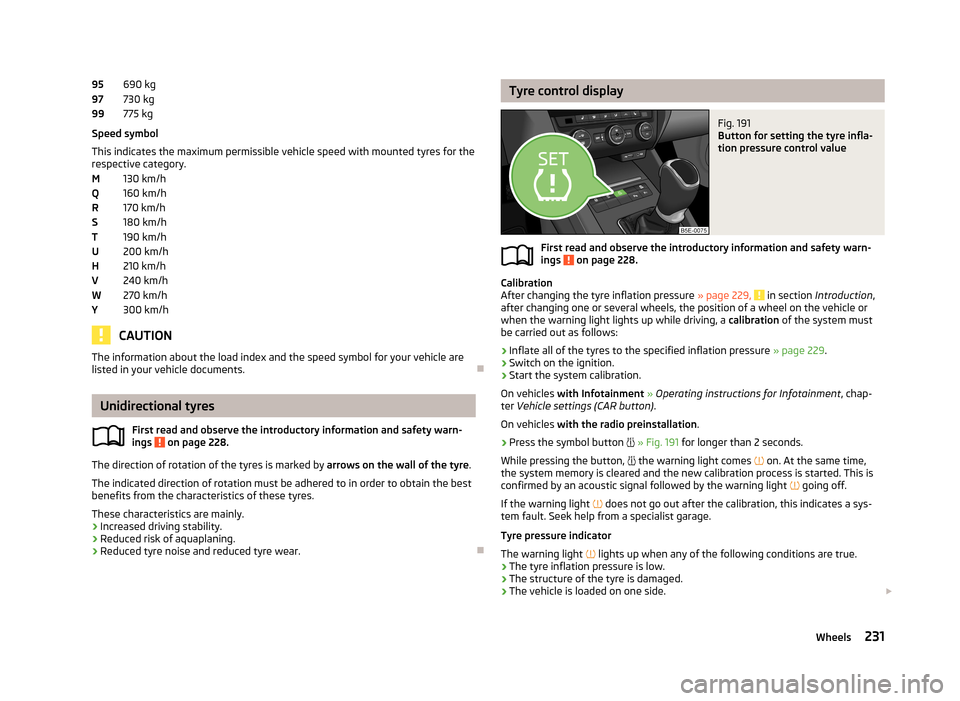
959799MQRSTUHVWYTyre control displayFig. 191
Button for setting the tyre infla-
tion pressure control value
First read and observe the introductory information and safety warn-
ings on page 228.
Calibration
After changing the tyre inflation pressure » page 229, in section Introduction ,
after changing one or several wheels, the position of a wheel on the vehicle or
when the warning light lights up while driving, a calibration of the system must
be carried out as follows:
›
Inflate all of the tyres to the specified inflation pressure » page 229.
›
Switch on the ignition.
›
Start the system calibration.
On vehicles with Infotainment » Operating instructions for Infotainment , chap-
ter Vehicle settings (CAR button) .
On vehicles with the radio preinstallation .
›
Press the symbol button
» Fig. 191 for longer than 2 seconds.
While pressing the button,
the warning light comes
on. At the same time,
the system memory is cleared and the new calibration process is started. This is
confirmed by an acoustic signal followed by the warning light
going off.
If the warning light
does not go out after the calibration, this indicates a sys-
tem fault. Seek help from a specialist garage.
Tyre pressure indicator
The warning light
lights up when any of the following conditions are true.
› The tyre inflation pressure is low.
› The structure of the tyre is damaged.
› The vehicle is loaded on one side.
231Wheels
Page 237 of 287
Winter operation
Introduction
This chapter contains information on the following subjects:
Winter tyres
234
Snow chains
234
Winter tyres
First read and observe the introductory information given on page 234.
The handling of your vehicle will be significantly improved when driving on wintry
roads if you fit winter tyres. Summer tyres on ice, snee and at temperatures be-
low 7 °C have less grip. This is especially true of low-profile tyres or high-speed
tyres .
To achieve the best possible handling properties, winter tyres must be fitted on
all 4 wheels, the minimum tread depth must be 4 mm and tyres must be no older than 4 years.
Winter tyres of a lower speed category can be used provided that the permissible
maximum speed of these tyres is not exceeded even if the possible maximum
speed of the vehicle is higher.
The winter tyre speed limit is set in the Infotainment system » Operating instruc-
tions for Infotainment , chapter Vehicle settings (CAR button) .
For the sake of the environment
Fit the summer tyres on again in good time as they provide better handling prop-
erties, a shorter braking distance, less tyre noise, and reduced tyre wear on roadswhich are free of snow and ice as well as at temperatures above 7 °C. The fuelconsumption is also lower.
Snow chains
First read and observe the introductory information given on page 234.
When driving on wintry roads, snow chains improve not only traction, but also the
braking performance.
Snow chains must only be mounted on the front wheels.
For technical reasons, it is only permissible to fit snow chains with the following wheel/tyre combinations.
Wheel sizeDepth (D)Tyre size6J x 15 a)43 mm195/65 R156J x 16 b)48 mm205/55 R166J x 17b)48 mm205/50 R17a)
Only fit snow chains with links and locks not larger than 13 mm.
b)
Only fit snow chains with links and locks not larger than 12 mm.
CAUTION
■
The chains must be removed when driving on roads which are free of snow.
They adversely affect the handling of your vehicle, damage the tyres and are rap-
idly destroyed.■
Remove the full wheel trims before installing the snow chains.
234General Maintenance
Page 248 of 287
■While towing, take care to avoid impermissibly high tensile forces or jerky loads.
There is always a risk of excessive stresses and damage resulting at the points to which you attach the tow rope or tow bar when you attempt to tow a vehicle
which is not standing on a paved road.■
Attach the tow rope or the tow bar to the towing eyes » page 245 , Front tow-
ing eye or » page 245 , Rear towing eye to the detachable ball head of the tow-
ing device » page 169 .
Note
■
We recommend using a tow rope from ŠKODA Original Accessories available
from a ŠKODA Partner.■
Towing another vehicle requires a certain amount of practice. Both drivers
should be familiar with the particular points about towing a vehicle. Unskilled
drivers should not attempt to tow in another vehicle or to be towed in.
■
When towing, respect the national legal provisions, especially those which re-
late to the identification of the towing vehicle and the vehicle being towed.
■
The tow rope must not be twisted as it may in certain circumstances result in
the front towing eye being unscrewed out of your vehicle.
Front towing eye
Fig. 205
Front bumper: Removing the cap/installing the towing eye
First read and observe the introductory information and safety warn- ings
on page 244.
Removing/installing the cap
›
Press on the cap in the area
A
» Fig. 205 .
›
Remove the cap in the direction of the arrow
1
.
›After unscrewing the towing eye, insert the area B of the cap under the right-
hand side of the hole in the front bumper and then press on the opposite side
of the cap.
The cap must engage firmly.
Removing/installing the towing eye›
Manually screw the towing eye as far as it will go in the direction of the arrow
2
» Fig. 205 » .
For tightening purposes, we recommend, for example, using the wheel wrench,
towing eye from another vehicle or a similar object that can be pushed through
the eye.
›
Unscrew the towing eye against the direction of the arrow
2
.
CAUTION
The towing eye must always be screwed in fully and firmly tightened, otherwise
the towing eye can tear when towing in or tow-starting.
Rear towing eye
Fig. 206
Rear bumper: Removing the cap/installing the towing eye
First read and observe the introductory information and safety warn- ings
on page 244.
Removing/installing the cap
›
Press on the cover in area
A
» Fig. 206 (for vehicles Octavia RS, Octavia Estate
RS on the right edge of the cap press).
›
Remove the cap in the direction of the arrow
1
.
245Emergency equipment, and self-help
Page 254 of 287
Fuses and light bulbs
Fuses
Introduction
This chapter contains information on the following subjects:
Fuses in the dash panel – LHD
252
Fuses in the dash panel – RHD
252
Assignment of the fuses in the dash panel
253
Fuses in the engine compartment
254
Assignment of fuses in the engine compartment
254
Individual electrical circuits are protected by fuses.
Switch off the ignition and the corresponding power consuming device before re-
placing a fuse.
Find out which fuse belongs to the component that is not operating » page 253,
Assignment of the fuses in the dash panel or » page 254 , Assignment of fuses in
the engine compartment .
Electrically adjustable seats are protected by automatic circuit breakers, which
switch on again automatically after a few seconds after the overload has been
eliminated.
Fuse colourMaximum amperagelight brown5dark brown7.5red10blue15yellow/blue20white25green/pink30orange/green40red50WARNINGAlways read and observe the warnings before completing any work in the en-
gine compartment » page 215.
CAUTION
■
“Never repair” fuses, and do not replace them with fuses of a higher amperage –
risk of fire! This may also cause damage at other points in the electrical system.■
If a newly inserted fuse blows again after a short time, have the electrical sys-
tem checked as quickly as possible by a specialist garage.
■
A blown fuses is recognisable by the molten metal strip. Replace the faulty fuse
with a new one of the same amperage.
■
The cover for the fuse box in the engine compartment must always be applied
correctly. Water may get into the fuse box if the cover is not replaced properly -
there is a risk of damage to the vehicle.
Note
■ We recommend always carrying replacement fuses in the vehicle. A box of re-
placement fuses can be purchased from ŠKODA Original Accessories.■
There can be several power consuming devices for one fuse.
■
There can be several consumer devices for one fuse, depending on the vehicle's
equipment.
■
Multiple fuses may exist for a single power consuming device.
■
Multiple power consuming devices can share a single fuse.
251Fuses and light bulbs
Page 255 of 287
Fuses in the dash panel – LHDFig. 215
Storage compartment on the
driver's side: LHD
First read and observe the introductory information and safety warn-
ings on page 251.
On left-hand drive vehicles, the fuse box is located behind the storage compart-
ment in the left-hand section of the dash panel.
Replacing fuses
›
Open the storage compartment » page 80.
›
Grab hold of the storage compartment in the area of the arrows » Fig. 215.
›
Fold out the storage compartment by pulling in the direction of arrow
1
.
›
Remove the plastic clip under the cover of the fuse box in the engine
room » Fig. 219 on page 254 .
›
Place the clip on the respective fuse and pull this fuse out » page 253.
›
Insert a new fuse.
›
Replace the bracket at the original position.
›
Fold back the storage compartment by pressing into the secured position in the
dash panel in the direction of the arrow
2
.
›
Close the storage compartment.
Fuses in the dash panel – RHDFig. 216
Storage compartment on the front passenger's side: RHD
First read and observe the introductory information and safety warn- ings
on page 251.
On right-hand drive vehicles, the fuse box is located on the front passenger's side behind the storage compartment in the left-hand section of the dash panel.
Removing the storage compartment and replacing the fuse
›
Insert a screwdriver under the side cover » Fig. 216.
›
Unlock the cover in the direction of the arrow
1
.
›
Push the cover out in the direction of the arrow
2
.
›
Open the storage compartment.
›
Unlock the brake rod of the storage compartment in the direction of the arrow
3
with the screwdriver.
›
Remove the storage compartment in the direction of the arrow
4
.
›
Remove the plastic clip under the cover of the fuse box in the engine
room » Fig. 219 on page 254 .
›
Place the clip on the respective fuse and pull this fuse out » page 253
.
›
Insert a new fuse.
›
Replace the bracket at the original position.
Installing the storage compartment
›
Pull in the storage compartment behind the brackets
A
» Fig. 216 .
›
Push in the storage compartment in the opposite direction of the arrow
4
.
›
Insert the brake rod and lock it against the arrow
3
with a screwdriver.
›
Push in the side cover against the direction of the arrow
2
.
›
Press the side cover fully against the direction of the arrow
1
.
›
Close the storage compartment.
252Do-it-yourself
Page 263 of 287
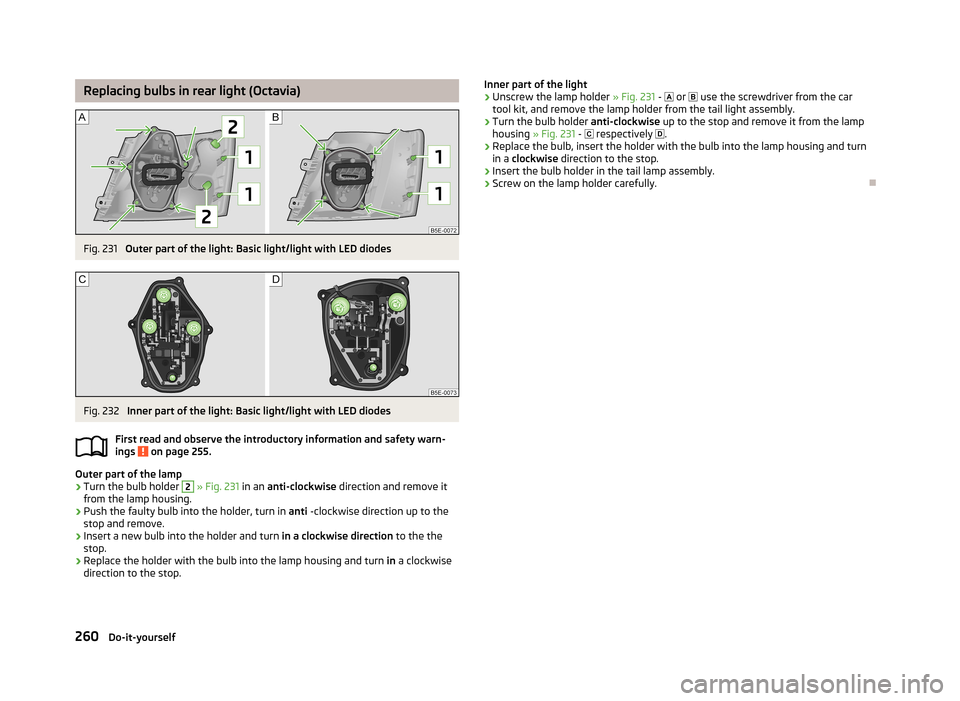
Replacing bulbs in rear light (Octavia)Fig. 231
Outer part of the light: Basic light/light with LED diodes
Fig. 232
Inner part of the light: Basic light/light with LED diodes
First read and observe the introductory information and safety warn-
ings
on page 255.
Outer part of the lamp
›
Turn the bulb holder
2
» Fig. 231 in an anti-clockwise direction and remove it
from the lamp housing.
›
Push the faulty bulb into the holder, turn in anti -clockwise direction up to the
stop and remove.
›
Insert a new bulb into the holder and turn in a clockwise direction to the the
stop.
›
Replace the holder with the bulb into the lamp housing and turn in a clockwise
direction to the stop.
Inner part of the light›Unscrew the lamp holder » Fig. 231 - or use the screwdriver from the car
tool kit, and remove the lamp holder from the tail light assembly.›
Turn the bulb holder anti-clockwise up to the stop and remove it from the lamp
housing » Fig. 231 - respectively .
›
Replace the bulb, insert the holder with the bulb into the lamp housing and turn
in a clockwise direction to the stop.
›
Insert the bulb holder in the tail lamp assembly.
›
Screw on the lamp holder carefully.
260Do-it-yourself
Page 267 of 287
Operating weight
The specified operating weight is for orientation purposes only. This value repre- sents the minimum operating weight without additional weight-increasing equip-ment such as air conditioning system, spare wheel, or trailer hitch.
The operating weight also contains the weight of the driver (75 kg), the weight of
the operating fluids, the tool kit, and a fuel tank filled to 90 % capacity.
It is possible to calculate the approximate loading capacity from the difference
between the permissible total weight and the operating weight »
.
The payload consists of the following components: › Passengers
› All items of luggage and other loads
› Roof load including roof rack system
› Equipment not included in the operating weight
› Trailer hook weight when towing (up to 75 kg and 80 kg for the Octavia Combi
4x4 vehicles).
Fuel consumption and CO 2 emissions according to ECE regulations and EU
directives
The measurement of the intra-urban cycle begins with a cold start of the engine. Afterwards standard urban driving is simulated.
In the extra-urban driving cycle, the vehicle is accelerated and decelerated in all
gears, corresponding to daily routine driving conditions. The driving speed varies
between 0 and -120 km/h.
The calculation of the combined fuel consumption considers a weighting of about 37 % for the intra-urban cycle and 63 % for the extra-urban cycle.
WARNINGDo not exceed the specified maximum permissible weights – risk of accident
and damage!Note■ If required, you can find out the precise weight of your vehicle at a specialist ga-
rage.■
The fuel consumption and emission values have been determined in accordance
with rules and under conditions set out by legal or technical requirements for de-
termining operational and technical data for motor vehicles.
■
Depending on the range of equipment, style of driving, traffic situation, weather
influences and vehicle condition, consumption values may deviate from the indi-
cated values.
264Technical data