boot SKODA ROOMSTER 2012 1.G User Guide
[x] Cancel search | Manufacturer: SKODA, Model Year: 2012, Model line: ROOMSTER, Model: SKODA ROOMSTER 2012 1.GPages: 194, PDF Size: 4.8 MB
Page 35 of 194
The delayed automatic locking function of the boot lid can be activated on your
vehicle. The following applies following activation of this function: If the boot lid
was locked with the button
on the remote control key 2
» page 29, then it is
possible to open the lid within a limited period of it being closed.
If you wish, a
ŠKODA Service Partner can activate or deactivate the delayed auto-
matic locking of the boot lid. The Service Partner will also provide any further in-
formation that is required.
There is a risk of unwanted entry into the vehicle before the boot lid is locked au-
tomatically. Always lock the vehicle using the button on the remote control or
with the key if no remote control is available » page 28 .ÐEmergency unlocking
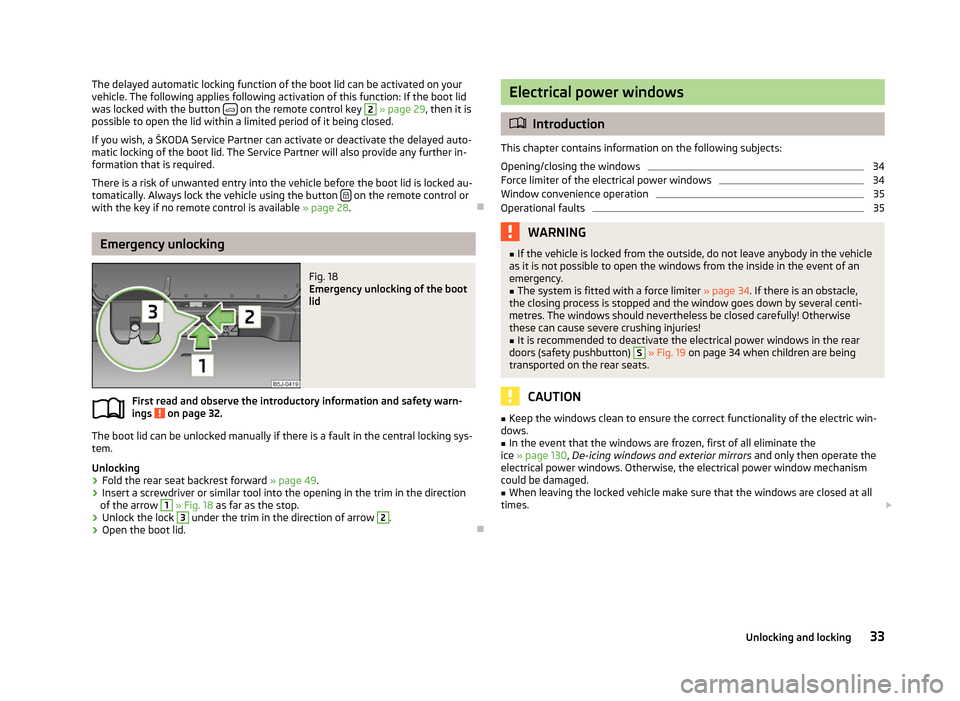
Fig. 18
Emergency unlocking of the boot
lid
First read and observe the introductory information and safety warn-
ings on page 32.
The boot lid can be unlocked manually if there is a fault in the central locking sys-
tem.
Unlocking
›
Fold the rear seat backrest forward
» page 49.
› Insert a screwdriver or similar tool into the opening in the trim in the direction
of the arrow 1
» Fig. 18 as far as the stop.
› Unlock the lock 3
under the trim in the direction of arrow 2
.
› Open the boot lid. Ð
ä Electrical power windows
ä
Introduction
This chapter contains information on the following subjects:
Opening/closing the windows 34
Force limiter of the electrical power windows 34
Window convenience operation 35
Operational faults 35
WARNING
■ If the vehicle is locked from the outside, do not leave anybody in the vehicle
as it is not possible to open the windows from the inside in the event of an
emergency.
■ The system is fitted with a force limiter » page 34. If there is an obstacle,
the closing process is stopped and the window goes down by several centi-
metres. The windows should nevertheless be closed carefully! Otherwise
these can cause severe crushing injuries!
■ It is recommended to deactivate the electrical power windows in the rear
doors (safety pushbutton) S
» Fig. 19 on page 34 when children are being
transported on the rear seats. CAUTION
■ Keep the windows clean to ensure the correct functionality of the electric win-
dows. ■ In the event that the windows are frozen, first of all eliminate the
ice » page 130, De-icing windows and exterior mirrors and only then operate the
electrical power windows. Otherwise, the electrical power window mechanism
could be damaged. ■ When leaving the locked vehicle make sure that the windows are closed at all
times. £
33
Unlocking and locking
Page 41 of 194
The fog lights with the function CORNER are adjusted according to the steering
angle or after switching on the turn signal light
1)
in the following circumstances:
› the vehicle is stationary and the engine is running or it moves with a speed of
maximum 40 km/h;
› the daytime running lights are not switched on;
› the low beam is switched on;
› the fog lights are not switched on;
› no reverse gear is engaged. ÐRear fog light
First read and observe the introductory information and safety warn-
ings on page 36.
Switching on
› First of all, turn the light switch
» Fig. 22 on page 38 » page 38 to position or
.
› Pull the light switch to position 2
.
If the vehicle is not fitted with fog lights » page 38, the rear fog light is switched
on by turning the light switch to the position or and is pulled out directly to
the position 2
. This switch does not have two positions, but only one position.
The warning light
lights up in the instrument cluster when the rear fog light is
switched on » page 17.
Only the rear fog light on the trailer lights up if the vehicle has a factory-fitted
towing device or a towing device from ŠKODA original accessories and it is driven
with a trailer and the rear fog light switched on. Ð
ä Headlight beam adjustment
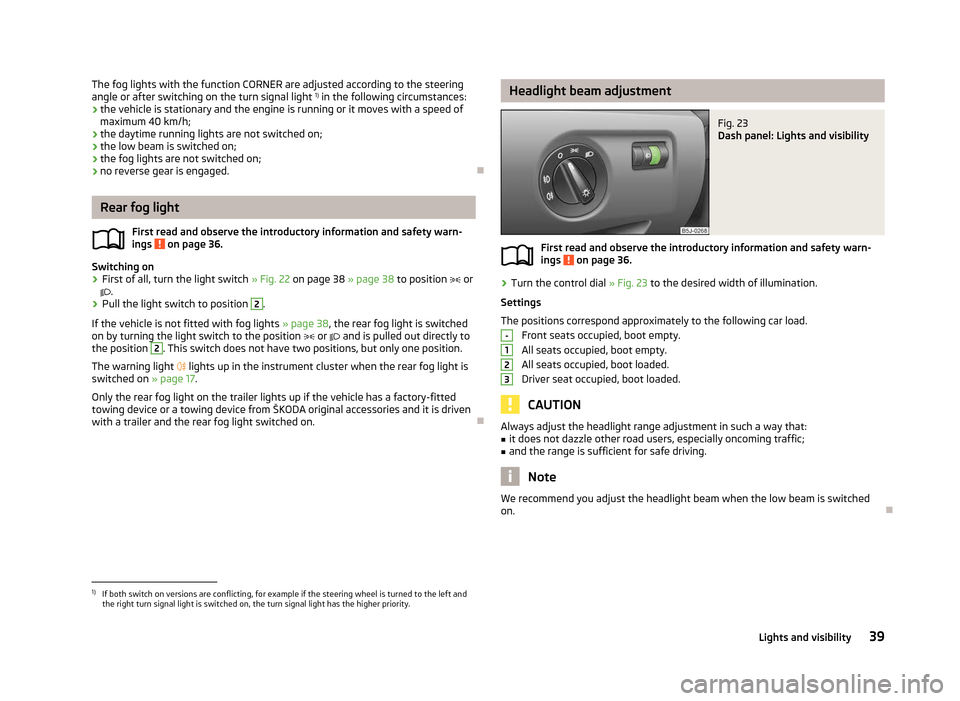
Fig. 23
Dash panel: Lights and visibility
First read and observe the introductory information and safety warn-
ings on page 36.
›
Turn the control dial
» Fig. 23 to the desired width of illumination.
Settings
The positions correspond approximately to the following car load. Front seats occupied, boot empty.
All seats occupied, boot empty.
All seats occupied, boot loaded.
Driver seat occupied, boot loaded. CAUTION
Always adjust the headlight range adjustment in such a way that:
■ it does not dazzle other road users, especially oncoming traffic;
■ and the range is sufficient for safe driving. Note
We recommend you adjust the headlight beam when the low beam is switched
on. Ð
ä -
1
2
3
1)
If both switch on versions are conflicting, for example if the steering wheel is turned to the left and
the right turn signal light is switched on, the turn signal light has the higher priority.
39
Lights and visibility
Page 43 of 194
Note
■ The turn signal system only operates when the ignition is switched on. The cor-
responding warning light or in the instrument cluster also flashes.
■ The turn signal is automatically cancelled after negotiating a curve.
■ The warning light flashes at twice its normal rate if a bulb for the turn signal
light fails. ÐInterior light
Interior lights at the front
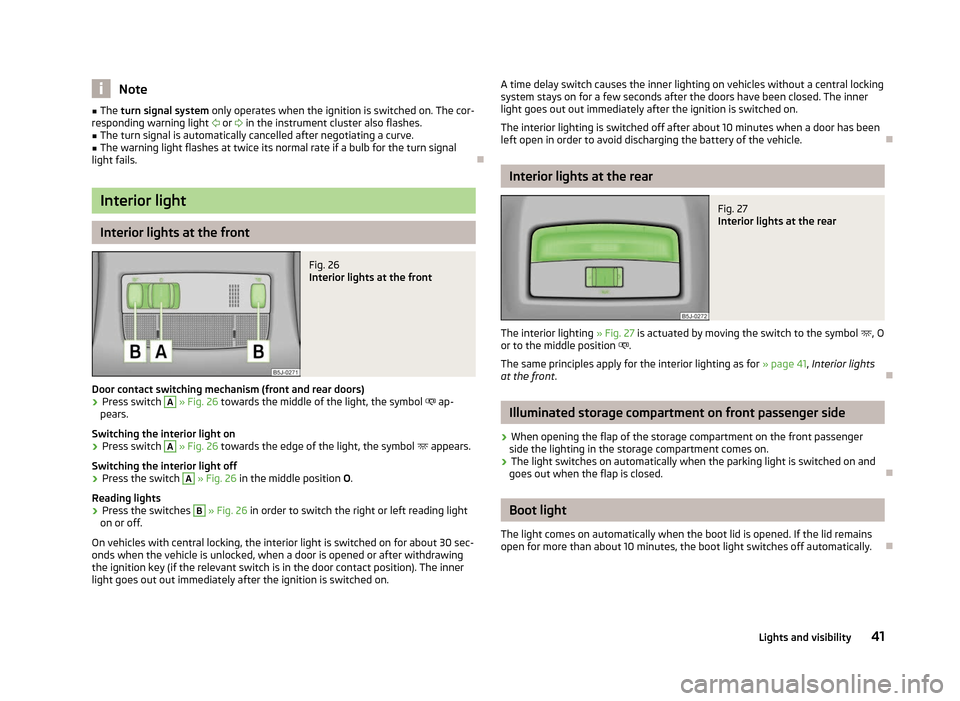
Fig. 26
Interior lights at the front
Door contact switching mechanism (front and rear doors) › Press switch A
» Fig. 26 towards the middle of the light, the symbol
ap-
pears.
Switching the interior light on
› Press switch A
» Fig. 26 towards the edge of the light, the symbol
appears.
Switching the interior light off
› Press the switch A
» Fig. 26
in the middle position O.
Reading lights
› Press the switches B
» Fig. 26
in order to switch the right or left reading light
on or off.
On vehicles with central locking, the interior light is switched on for about 30 sec-
onds when the vehicle is unlocked, when a door is opened or after withdrawing
the ignition key (if the relevant switch is in the door contact position). The inner
light goes out out immediately after the ignition is switched on. A time delay switch causes the inner lighting on vehicles without a central locking
system stays on for a few seconds after the doors have been closed. The inner
light goes out out immediately after the ignition is switched on.
The interior lighting is switched off after about 10 minutes when a door has been
left open in order to avoid discharging the battery of the vehicle. Ð Interior lights at the rear
Fig. 27
Interior lights at the rear
The interior lighting » Fig. 27 is actuated by moving the switch to the symbol , O
or to the middle position .
The same principles apply for the interior lighting as for » page 41, Interior lights
at the front . Ð Illuminated storage compartment on front passenger side
› When opening the flap of the storage compartment on the front passenger
side the lighting in the storage compartment comes on.
› The light switches on automatically when the parking light is switched on and
goes out when the flap is closed. Ð Boot light
The light comes on automatically when the boot lid is opened. If the lid remains
open for more than about 10
minutes, the boot light switches off automatically. Ð
41
Lights and visibility
Page 53 of 194
Adjusting seats in crosswise direction
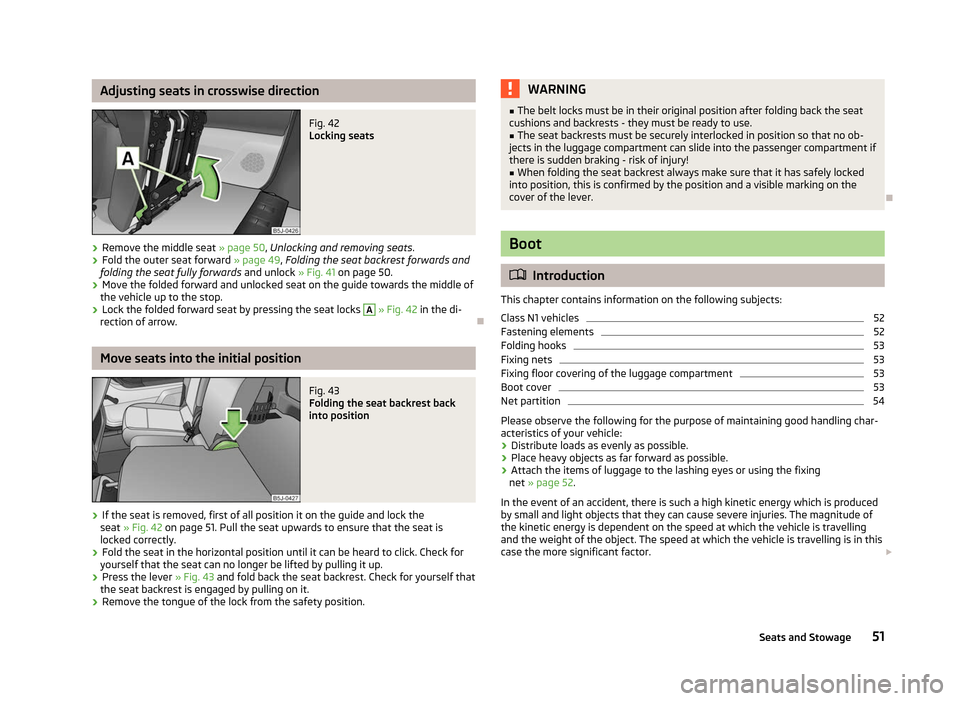
Fig. 42
Locking seats
› Remove the middle seat
» page 50, Unlocking and removing seats .
› Fold the outer seat forward
» page 49, Folding the seat backrest forwards and
folding the seat fully forwards and unlock » Fig. 41 on page 50.
› Move the folded forward and unlocked seat on the guide towards the middle of
the vehicle up to the stop.
› Lock the folded forward seat by pressing the seat locks A
» Fig. 42 in the di-
rection of arrow. ÐMove seats into the initial position
Fig. 43
Folding the seat backrest back
into position
› If the seat is removed, first of all position it on the guide and lock the
seat » Fig. 42 on page 51. Pull the seat upwards to ensure that the seat is
locked correctly.
› Fold the seat in the horizontal position until it can be heard to click. Check for
yourself that the seat can no longer be lifted by pulling it up.
› Press the lever
» Fig. 43 and fold back the seat backrest. Check for yourself that
the seat backrest is engaged by pulling on it.
› Remove the tongue of the lock from the safety position. WARNING
■ The belt locks must be in their original position after folding back the seat
cushions and backrests - they must be ready to use.
■ The seat backrests must be securely interlocked in position so that no ob-
jects in the luggage compartment can slide into the passenger compartment if
there is sudden braking - risk of injury! ■ When folding the seat backrest always make sure that it has safely locked
into position, this is confirmed by the position and a visible marking on the
cover of the lever. Ð Boot
ä
Introduction
This chapter contains information on the following subjects:
Class
N1 vehicles 52
Fastening elements 52
Folding hooks 53
Fixing nets 53
Fixing floor covering of the luggage compartment 53
Boot cover 53
Net partition 54
Please observe the following for the purpose of maintaining good handling char-
acteristics of your vehicle:
› Distribute loads as evenly as possible.
› Place heavy objects as far forward as possible.
› Attach the items of luggage to the lashing eyes or using the fixing
net »
page 52 .
In the event of an accident, there is such a high kinetic energy which is produced
by small and light objects that they can cause severe injuries. The magnitude of
the kinetic energy is dependent on the speed at which the vehicle is travelling
and the weight of the object. The speed at which the vehicle is travelling is in this
case the more significant factor. £
51
Seats and Stowage
Page 54 of 194

Example: In the event of a frontal collision at a speed of 50 km/h, an unsecured
object with a weight of 4.5 kg produces an energy, which corresponds to 20 times
its own weight. This means that it results in a weight of approx. 90 kg
“ ”. You can
imagine the injuries that can occur, if this “object” flies through the interior com-
partment and hits an occupant. WARNING
■ Store the objects in the boot and attach them to the lashing eyes.
■ Loose objects in the passenger compartment can be thrown forward during
a sudden manoeuvre or in case of an accident and can injure the occupants or
other oncoming traffic. This risk is still increased, if the objects which are fly-
ing around are hit by a deployed airbag. In this case, the objects which are
thrown back can injure the occupants - hazard. ■ Please note that the handling properties of the vehicle may be affected
when transporting heavy objects as the centre of gravity can be displaced -
risk of accident! The speed and style of driving must be adjusted accordingly.
■ If the items of luggage or objects are attached to the lashing eyes with un-
suitable or damaged lashing straps, injuries can occur in the event of braking
manoeuvres or accidents. To prevent items of luggage from being thrown for-
ward, always use suitable lashing straps which must be firmly attached to the
lashing eyes. ■ The items carried in the boot must be stored in such a way that no objects
are able to slip forward if any sudden driving or braking manoeuvres are un-
dertaken - risk of injury!
■ When transporting fastened objects which are sharp and dangerous in the
boot that has been enlarged by folding the rear seats forward, ensure the
safety of the passengers transported on the other rear seats » page 102, Cor-
rect seated position for the occupants on the rear seats .
■ If the rear seat next to the folded forward seat is occupied, ensure maxi-
mum safety, e.g. by placing the goods to be transported in such a way that the
seat is prevented from folding back in case of a rear collision.
■ Never drive with the boot lid fully opened or slightly ajar otherwise exhaust
gases may get into the interior of the vehicle - risk of poisoning!
■ Under no circumstances, should the permissible axle loads and permissible
gross weight of the vehicle be exceeded - risk of accident!
■ Never transport people in the boot! CAUTION
Please ensure that the heating elements for the rear window heater are not dam-
aged as a result of abrasive objects. Note
Tyre pressure must be adjusted to the load »
page 149, Service life of tyres. Ð Class N1 vehicles
First read and observe the introductory information and safety warn-
ings on page 51.
On class N1 vehicles, which are not fitted with a protective grille, a lashing set
which complies with the standard EN
12195 (1 - 4) must be used for fastening the
load. Ð Fastening elements
Fig. 44
Boot: Lashing eyes and fasten-
ing elements
First read and observe the introductory information and safety warn-
ings on page 51.
The boot provides the following fastening elements
»
Fig. 44.
Lashing eyes for fastening items of luggage and fixing nets.
Fastening elements for fastening fixing nets. CAUTION
The maximum permissible load of the lashing eyes is 3.5 kN (350 kg). Ð
ä
ä
A
B
52
Using the system
Page 55 of 194
Folding hooks
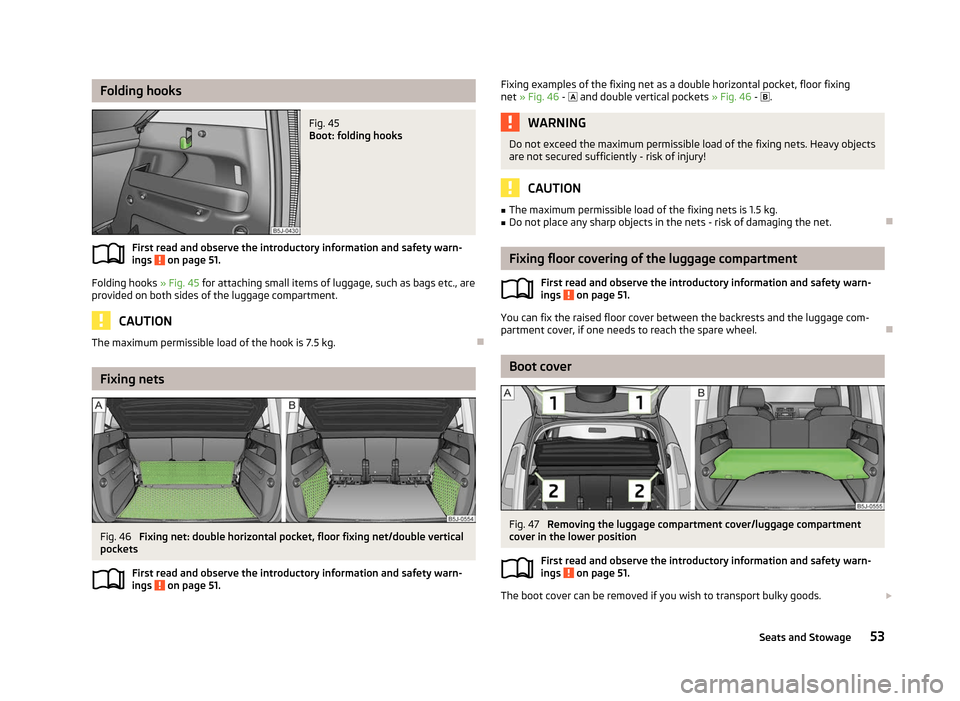
Fig. 45
Boot: folding hooks
First read and observe the introductory information and safety warn-
ings on page 51.
Folding hooks
» Fig. 45 for attaching small items of luggage, such as bags etc., are
provided on both sides of the luggage compartment. CAUTION
The maximum permissible load of the hook is 7.5 kg. ÐFixing nets
Fig. 46
Fixing net: double horizontal pocket, floor fixing net/double vertical
pockets
First read and observe the introductory information and safety warn-
ings on page 51.ä
ä Fixing examples of the fixing net as a double horizontal pocket, floor fixing
net
» Fig. 46 - and double vertical pockets » Fig. 46 - . WARNING
Do not exceed the maximum permissible load of the fixing nets. Heavy objects
are not secured sufficiently - risk of injury! CAUTION
■ The maximum permissible load of the fixing nets is 1.5 kg.
■ Do not place any sharp objects in the nets - risk of damaging the net. Ð Fixing floor covering of the luggage compartment
First read and observe the introductory information and safety warn-
ings on page 51.
You can fix the raised floor cover between the backrests and the luggage com-
partment cover, if one needs to reach the spare wheel. Ð Boot cover
Fig. 47
Removing the luggage compartment cover/luggage compartment
cover in the lower position
First read and observe the introductory information and safety warn-
ings on page 51.
The boot cover can be removed if you wish to transport bulky goods.
£
ä
ä
53
Seats and Stowage
Page 56 of 194
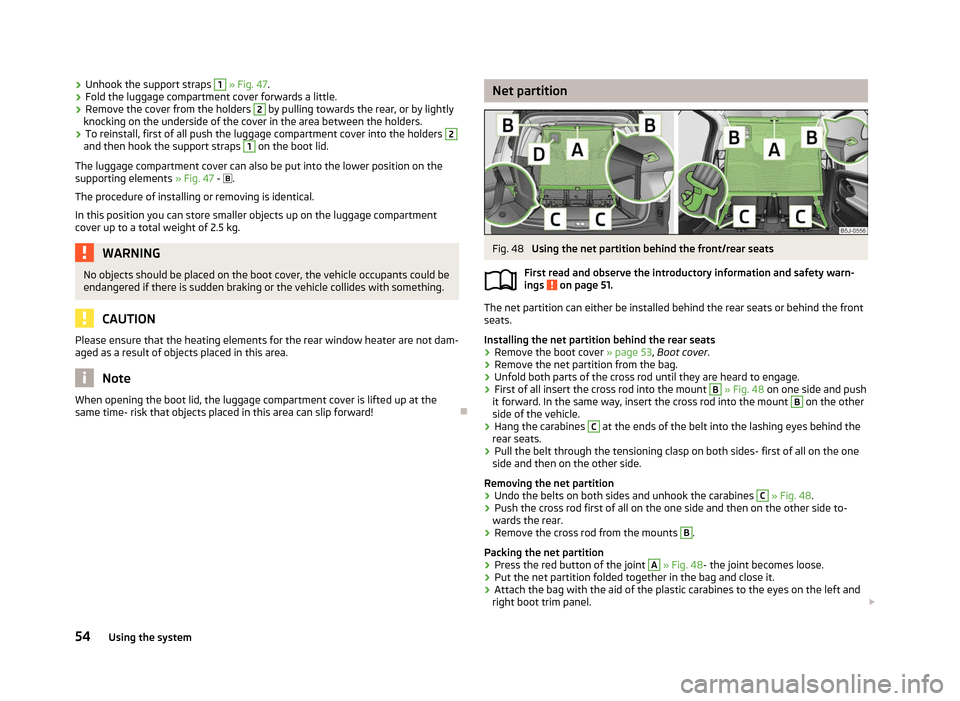
›
Unhook the support straps 1
» Fig. 47.
› Fold the luggage compartment cover forwards a little.
› Remove the cover from the holders 2
by pulling towards the rear, or by lightly
knocking on the underside of the cover in the area between the holders.
› To reinstall, first of all push the luggage compartment cover into the holders 2
and then hook the support straps 1
on the boot lid.
The luggage compartment cover can also be put into the lower position on the
supporting elements » Fig. 47 - .
The procedure of installing or removing is identical.
In this position you can store smaller objects up on the luggage compartment
cover up to a total weight of 2.5 kg. WARNING
No objects should be placed on the boot cover, the vehicle occupants could be
endangered if there is sudden braking or the vehicle collides with something. CAUTION
Please ensure that the heating elements for the rear window heater are not dam-
aged as a result of objects placed in this area. Note
When opening the boot lid, the luggage compartment cover is lifted up at the
same time- risk that objects placed in this area can slip forward! Ð Net partition
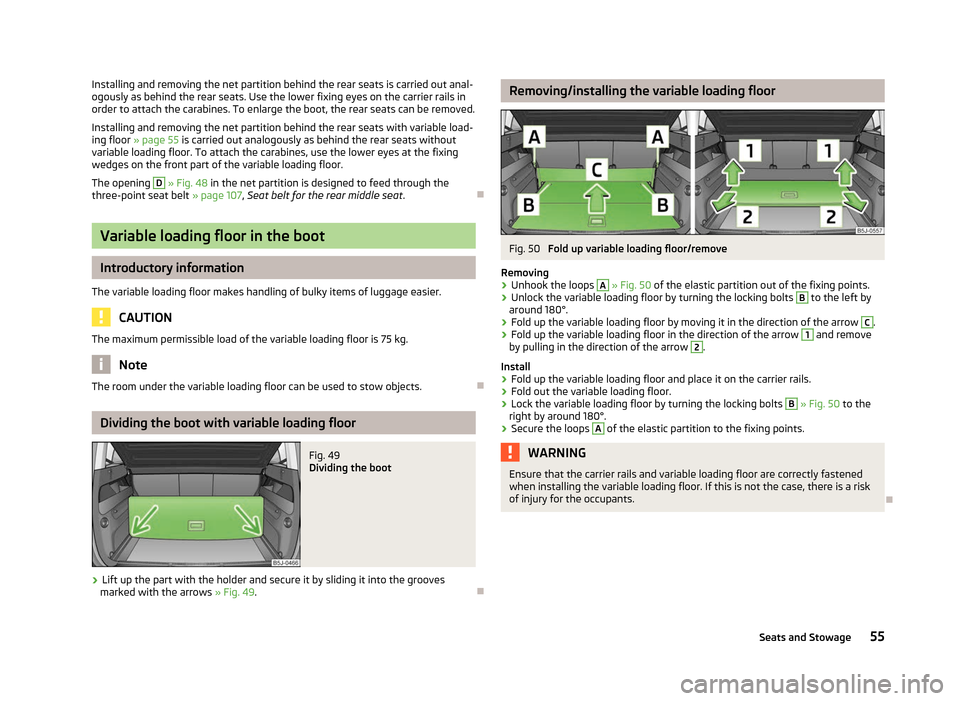
Fig. 48
Using the net partition behind the front/rear seats
First read and observe the introductory information and safety warn-
ings on page 51.
The net partition can either be installed behind the rear seats or behind the front
seats.
Installing the net partition behind the rear seats
›
Remove the boot cover » page 53, Boot cover.
› Remove the net partition from the bag.
› Unfold both parts of the cross rod until they are heard to engage.
› First of all insert the cross rod into the mount B
» Fig. 48
on one side and push
it forward. In the same way, insert the cross rod into the mount B
on the other
side of the vehicle.
› Hang the carabines C
at the ends of the belt into the lashing eyes behind the
rear seats.
› Pull the belt through the tensioning clasp on both sides- first of all on the one
side and then on the other side.
Removing the net partition
› Undo the belts on both sides and unhook the carabines C
» Fig. 48.
› Push the cross rod first of all on the one side and then on the other side to-
wards the rear.
› Remove the cross rod from the mounts B
.
Packing the net partition
› Press the red button of the joint A
» Fig. 48
- the joint becomes loose.
› Put the net partition folded together in the bag and close it.
› Attach the bag with the aid of the plastic carabines to the eyes on the left and
right boot trim panel. £
ä
54 Using the system
Page 57 of 194
Installing and removing the net partition behind the rear seats is carried out anal-
ogously as behind the rear seats. Use the lower fixing eyes on the carrier rails in
order to attach the carabines. To enlarge the boot, the rear seats can be removed.
Installing and removing the net partition behind the rear seats with variable load-
ing floor » page 55 is carried out analogously as behind the rear seats without
variable loading floor. To attach the carabines, use the lower eyes at the fixing
wedges on the front part of the variable loading floor.
The opening D
» Fig. 48
in the net partition is designed to feed through the
three-point seat belt » page 107, Seat belt for the rear middle seat .ÐVariable loading floor in the boot
Introductory information
The variable loading floor makes handling of bulky items of luggage easier. CAUTION
The maximum permissible load of the variable loading floor is 75 kg.Note
The room under the variable loading floor can be used to stow objects. ÐDividing the boot with variable loading floor
Fig. 49
Dividing the boot
› Lift up the part with the holder and secure it by sliding it into the grooves
marked with the arrows »
Fig. 49. Ð Removing/installing the variable loading floor
Fig. 50
Fold up variable loading floor/remove
Removing › Unhook the loops A
» Fig. 50 of the elastic partition out of the fixing points.
› Unlock the variable loading floor by turning the locking bolts B
to the left by
around 180°.
› Fold up the variable loading floor by moving it in the direction of the arrow C
.
› Fold up the variable loading floor in the direction of the arrow 1
and remove
by pulling in the direction of the arrow 2
.
Install
› Fold up the variable loading floor and place it on the carrier rails.
› Fold out the variable loading floor.
› Lock the variable loading floor by turning the locking bolts B
» Fig. 50 to the
right by around 180°.
› Secure the loops A
of the elastic partition to the fixing points.
WARNING
Ensure that the carrier rails and variable loading floor are correctly fastened
when installing the variable loading floor. If this is not the case, there is a risk
of injury for the occupants. Ð
55
Seats and Stowage
Page 58 of 194
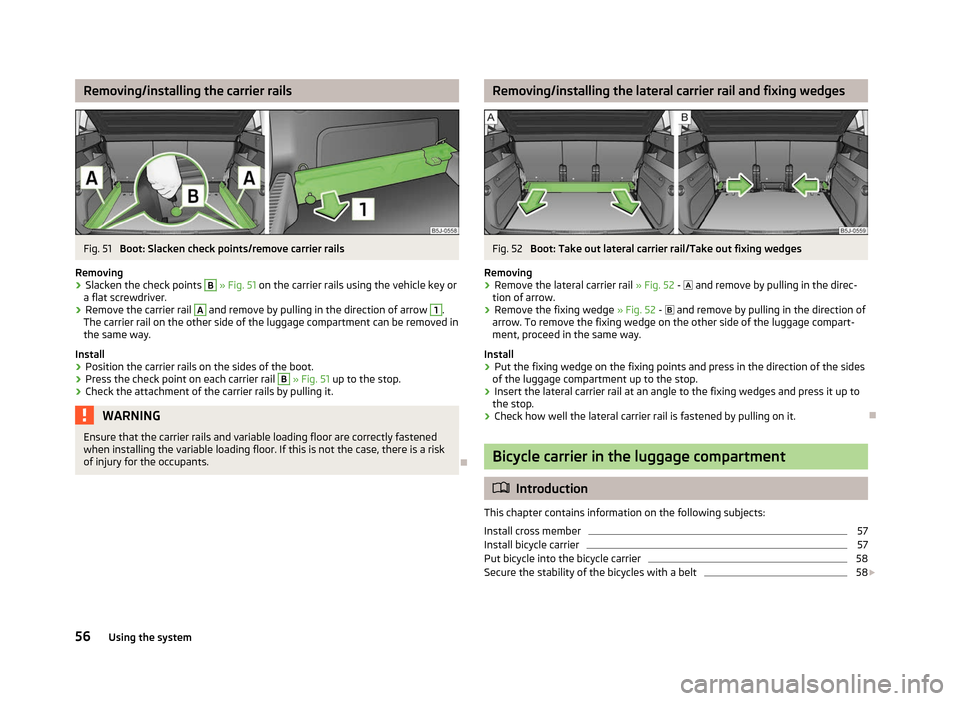
Removing/installing the carrier rails
Fig. 51
Boot: Slacken check points/remove carrier rails
Removing
› Slacken the check points B
» Fig. 51
on the carrier rails using the vehicle key or
a flat screwdriver.
› Remove the carrier rail A
and remove by pulling in the direction of arrow 1
.
The carrier rail on the other side of the luggage compartment can be removed in
the same way.
Install
› Position the carrier rails on the sides of the boot.
› Press the check point on each carrier rail B
» Fig. 51
up to the stop.
› Check the attachment of the carrier rails by pulling it. WARNING
Ensure that the carrier rails and variable loading floor are correctly fastened
when installing the variable loading floor. If this is not the case, there is a risk
of injury for the occupants. Ð Removing/installing the lateral carrier rail and fixing wedges
Fig. 52
Boot: Take out lateral carrier rail/Take out fixing wedges
Removing
› Remove the lateral carrier rail
»
Fig. 52 - and remove by pulling in the direc-
tion of arrow.
› Remove the fixing wedge
» Fig. 52 - and remove by pulling in the direction of
arrow. To remove the fixing wedge on the other side of the luggage compart-
ment, proceed in the same way.
Install
› Put the fixing wedge on the fixing points and press in the direction of the sides
of the luggage compartment up to the stop.
› Insert the lateral carrier rail at an angle to the fixing wedges and press it up to
the stop.
› Check how well the lateral carrier rail is fastened by pulling on it. Ð Bicycle carrier in the luggage compartment
ä
Introduction
This chapter contains information on the following subjects:
Install cross member 57
Install bicycle carrier 57
Put bicycle into the bicycle carrier 58
Secure the stability of the bicycles with a belt 58
£
56 Using the system
Page 59 of 194
WARNING
When transporting bicycles, ensuring the safety of the passengers is para-
mount. CAUTION
Be careful when maneuvering the bicycle - risk of damage to the vehicle. ÐInstall cross member
Fig. 53
Install cross member
First read and observe the introductory information and safety warn-
ings on page 56.
›
Remove the luggage compartment cover
» page 53.
› Fold the rear seats forward, remove
» page 50.
› Undo the securing screws C
» Fig. 53 and remove a little to unlock the holders B
.
› Place the cross member A
with the fixed part onto the right lashing eye and
then place it on the left lashing eye with the removable part of the cross mem-
ber A
.
› Press the holders B
until they latch. Tighten the securing screws C
.
› Check how well the cross member is fastened by pulling on it. Ð
ä Install bicycle carrier
Fig. 54
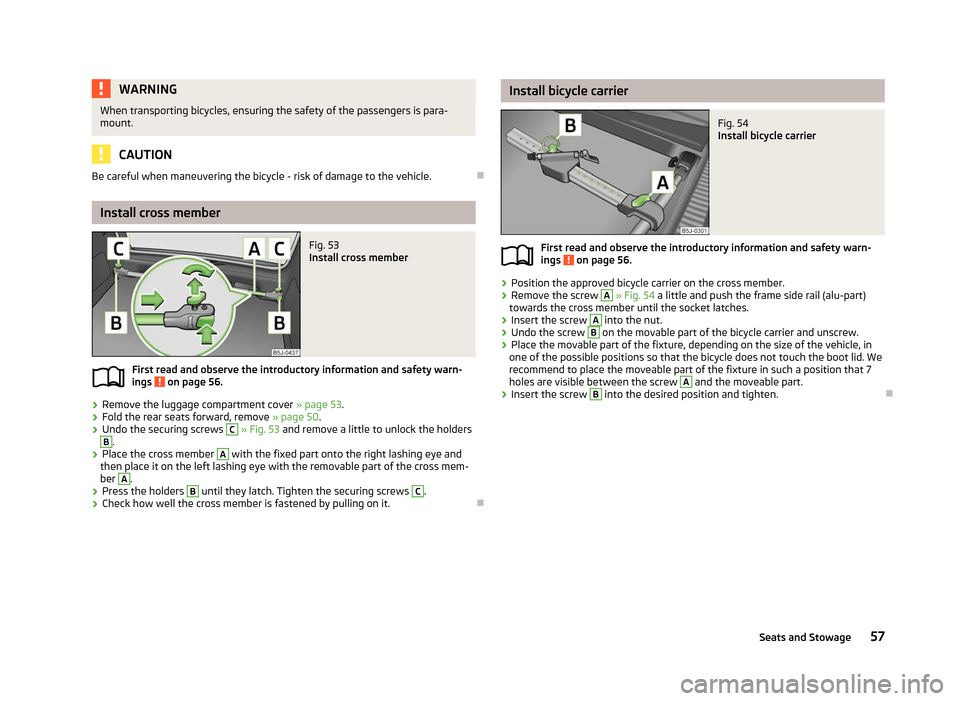
Install bicycle carrier
First read and observe the introductory information and safety warn-
ings on page 56.
›
Position the approved bicycle carrier on the cross member.
› Remove the screw A
» Fig. 54 a little and push the frame side rail (alu-part)
towards the cross member until the socket latches.
› Insert the screw A
into the nut.
› Undo the screw B
on the movable part of the bicycle carrier and unscrew.
› Place the movable part of the fixture, depending on the size of the vehicle, in
one of the possible positions so that the bicycle does not touch the boot lid. We
recommend to place the moveable part of the fixture in such a position that 7
holes are visible between the screw A
and the moveable part.
› Insert the screw B
into the desired position and tighten.
Ð
ä
57
Seats and Stowage