ABS SUBARU FORESTER 2004 Service Repair Manual
[x] Cancel search | Manufacturer: SUBARU, Model Year: 2004, Model line: FORESTER, Model: SUBARU FORESTER 2004Pages: 2870, PDF Size: 38.67 MB
Page 2638 of 2870

4AT(H4DOTC)-62
AUTOMATIC TRANSMISSION (DIAGNOSTIC)
Diagnostic Procedure with Diagnostic Trouble Code (DTC)
M: DTC P0736 REVERSE INCORRECT RATIO
DTC DETECTING CONDITION:
Vehicle speed sensor malfunction and torque converter turbine speed sensor malfunction, etc. or control
valve malfunction.
TROUBLE SYMPTOM:
Shift point is too high or too low.
Excessive shift shock.
Tight corner “braking” phenomenon.
Gear is not shifted to reverse.
Gear position is held by fail safe function.
Step Check Yes No
1 PREPARE SUBARU SELECT MONITOR.Do you have a Subaru Select
Monitor?Go to step 2.Go to step 5.
2 CHECK ACCELERATOR PEDAL POSITION
SENSOR.
1) Connect the Subaru Select Monitor to data
link connector.
2) Turn the ignition switch to ON.
3) Read the value of accelerator pedal posi-
tion sensor on Subaru Select Monitor.Does the value of accelerator
pedal position sensor change
from 0% to 100% smoothly
when throttle was operated from
fully closing to fully opening?Go to step 3.Check accelerator
pedal position sen-
sor.
DTC P1708
THROTTLE POSI-
TION SENSOR
CIRCUIT LOW
INPUT, Diagnostic
Procedure with
Diagnostic Trou-
ble Code (DTC).>
3 CHECK FRONT VEHICLE SPEED SENSOR.
1) Lift-up the vehicle and place rigid racks.
2) Start the engine.
3) Move the select lever “D” range and slowly
increase vehicle speed.
NOTE:
The speed difference between front and rear
wheels may light ABS warning light, but this indi-
cates no malfunction. When AT control diagnosis
is finished, perform the ABS memory clearance
procedure of on-board diagnostics system.Does the vehicle speed dis-
played by Subaru Select Moni-
tor almost correspond with
vehicle speed indicated by
combination meter?Go to step 4.Check the front
vehicle speed sen-
sor.
4 CHECK TORQUE CONVERTER TURBINE
SPEED SENSOR.
1) Move the select lever to “P” or “N” range.
2) Idle the engine.Does the turbine speed sen-
sor revolution displayed by
Subaru Select Monitor almost
correspond with engine revolu-
tion indicated by tachometer?There are mal-
functions in TCM,
TCM connector
poor contact or
transmission
assembly mechan-
ical malfunction.Check the torque
converter turbine
speed sensor cir-
cuit.
5 CHECK ACCELERATOR PEDAL POSITION
SENSOR.
1) Turn the ignition switch to ON.
2) Fully close the throttle.
3) Measure the voltage between TCM and
chassis ground.
Connector & terminal
(B55) No. 19 (+) — Chassis ground (
−):Is the voltage 0.8 — 1.2 V? Go to step 6.Check the acceler-
ator pedal position
sensor circuit.
DTC P1708
THROTTLE POSI-
TION SENSOR
CIRCUIT LOW
INPUT, Diagnostic
Procedure with
Diagnostic Trou-
ble Code (DTC).>
Page 2642 of 2870

4AT(H4DOTC)-66
AUTOMATIC TRANSMISSION (DIAGNOSTIC)
Diagnostic Procedure with Diagnostic Trouble Code (DTC)
3 CHECK HARNESS CONNECTOR BETWEEN
TCM AND TRANSMISSION.
Measure the resistance of harness connector
between TCM connector and chassis ground.
Connector & terminal
(B56) No. 5 — Chassis ground:Is the resistance more than 1
MΩ?Go to step 4.Repair the short
circuit in harness
between TCM and
transmission con-
nector.
4 CHECK LOCK-UP DUTY SOLENOID.
Measure the resistance between transmission
connector receptacle’s terminals.
Connector & terminal
(T4) No. 12 — No. 19:Is the resistance 2.0 — 4.5 Ω? Go to step 5.Go to step 11.
5 PREPARE SUBARU SELECT MONITOR.Do you have a Subaru Select
Monitor?Go to step 8.Go to step 6.
6 CHECK OUTPUT SIGNAL EMITTED FROM
TCM.
1) Connect the connectors to TCM and trans-
mission.
2) Lift-up the vehicle and place rigid racks.
NOTE:
Raise all wheels off ground.
3) Start the engine and warm-up the engine
until ATF temperature is above 80°C (176°F).
NOTE:
If ambient temperature is below 0°C (32°F),
drive the vehicle until ATF reaches its operating
temperature.
4) Shift the select lever to “D” range and
slowly increase vehicle speed to 60 km/h
(37 MPH).
NOTE:
The speed difference between front and rear
wheels may light the ABS warning light, but this
indicates no malfunction. When AT control diag-
nosis is finished, perform the ABS memory
clearance procedure of on-board diagnostics
system.
5) Measure the voltage between TCM con-
nector and chassis ground.
Connector & terminal
(B56) No. 5 (+) — Chassis ground (
−):Is the voltage more than 10.5
V?Go to step 7.Go to step 10.
7 CHECK OUTPUT SIGNAL FROM TCM.
1) Return the engine to idling speed and shift
select lever to “N” range.
2) Measure the voltage between TCM con-
nector and chassis ground.
Connector & terminal
(B56) No. 5 (+) — Chassis ground (
−):Is the voltage less than 1 V? Even if the POWER
indicator light was
blinking, the circuit
has returned to a
normal condition at
this time. A tempo-
rary poor contact of
the connector or
harness may be the
cause. Repair the
harness or connec-
tor in TCM and
transmission.Go to step 10. Step Check Yes No
Page 2643 of 2870

4AT(H4DOTC)-67
AUTOMATIC TRANSMISSION (DIAGNOSTIC)
Diagnostic Procedure with Diagnostic Trouble Code (DTC)
8 CHECK OUTPUT SIGNAL FROM TCM US-
ING SUBARU SELECT MONITOR.
1) Connect the connectors to TCM and trans-
mission.
2) Lift-up the vehicle and place rigid racks.
N
OTE:
Raise all wheels off ground.
3) Connect the Subaru Select Monitor to data
link connector.
4) Start the engine and turn Subaru Select
Monitor switch to ON.
5) Start the engine and warm-up the engine
until ATF temperature is above 80°C (176°F).
N
OTE:
If ambient temperature is below 0°C (32°F),
drive the vehicle until ATF reaches its operating
temperature.
6) Read the data of lock-up duty solenoid
using Subaru Select Monitor.
Lock-up duty solenoid is indicated in “%”.
7) Shift the select lever to “D” range and
slowly increase vehicle speed to 60 km/h
(37 MPH). Wheels will lock-up.
NOTE:
The speed difference between front and rear
wheels may light the ABS warning light, but this
indicates no malfunction. When AT control diag-
nosis is finished, perform the ABS memory
clearance procedure of on-board diagnostics
system.
9 CHECK OUTPUT SIGNAL FROM TCM US-
ING SUBARU SELECT MONITOR.
Return the engine to idling speed and shift
select lever to “N” range, read the data.
N
OTE:
The speed difference between front and rear
wheels may light the ABS warning light, but this
indicates no malfunction. When AT control diag-
nosis is finished, perform the ABS memory
clearance procedure of on-board diagnostics
system.
indicator light was
blinking, the circuit
has returned to a
normal condition at
this time. A tempo-
rary poor contact of
the connector or
harness may be the
cause. Repair the
harness or connec-
tor in TCM and
transmission.Go to step 10.
10 CHECK POOR CONTACT.Is there poor contact in lock-up
duty solenoid circuit?Repair poor con-
tact.Replace the TCM.
trol Module
(TCM).> Step Check Yes No
Page 2656 of 2870

4AT(H4DOTC)-80
AUTOMATIC TRANSMISSION (DIAGNOSTIC)
Diagnostic Procedure with Diagnostic Trouble Code (DTC)
5 CHECK OUTPUT SIGNAL FROM TCM.
1) Connect the connectors to TCM and trans-
mission.
2) Lift-up the vehicle and place rigid racks.
N
OTE:
Raise all wheels off ground.
3) Start the engine and warm-up the engine
until ATF temperature is above 80°C (176°F).
N
OTE:
If ambient temperature is below 0°C (32°F),
drive the vehicle until ATF reaches its operating
temperature.
4) Shift the select lever to “D” range and
slowly increase vehicle speed and measure at
3rd or 4th gear.
N
OTE:
The speed difference between front and rear
wheels may light the ABS warning light, but this
indicates no malfunction. When AT control diag-
nosis is finished, perform the ABS memory
clearance procedure of on-board diagnostics
system.
5) Measure the voltage between TCM con-
nector and chassis ground.
Connector & terminal
(B56) No. 8 (+) — Chassis ground (
−):Is the voltage less than 1 V? Go to step 6.Go to step 9.
6 CHECK OUTPUT SIGNAL FROM TCM.
1) Return the engine to idling speed and shift
select lever to “N” range.
2) Measure the voltage between TCM con-
nector and chassis ground.
Connector & terminal
(B56) No. 8 (+) — Chassis ground (
−):Is the voltage more than 10.5
V?Even if the POWER
indicator light was
blinking, the circuit
has returned to a
normal condition at
this time. A tempo-
rary poor contact of
the connector or
harness may be the
cause. Repair the
harness or connec-
tor in TCM and
transmission.Go to step 9. Step Check Yes No
Page 2657 of 2870

4AT(H4DOTC)-81
AUTOMATIC TRANSMISSION (DIAGNOSTIC)
Diagnostic Procedure with Diagnostic Trouble Code (DTC)
7 CHECK OUTPUT SIGNAL FROM TCM US-
ING SUBARU SELECT MONITOR.
1) Connect the connectors to TCM and trans-
mission.
2) Lift-up the vehicle and place rigid racks.
N
OTE:
Raise all wheels off ground.
3) Connect the Subaru Select Monitor to data
link connector.
4) Start the engine and turn Subaru Select
Monitor switch to ON.
5) Start the engine and warm-up the engine
until ATF temperature is above 80°C (176°F).
N
OTE:
If ambient temperature is below 0°C (32°F),
drive the vehicle until ATF reaches its operating
temperature.
6) Read the data of high clutch duty solenoid
using Subaru Select Monitor.
High clutch duty solenoid is indicated in “%”.
7) Shift the select lever to “D” range and
slowly increase vehicle speed and measure at
3rd or 4th gear.
NOTE:
The speed difference between front and rear
wheels may light the ABS warning light, but this
indicates no malfunction. When AT control diag-
nosis is finished, perform the ABS memory
clearance procedure of on-board diagnostics
system.
8 CHECK OUTPUT SIGNAL FROM TCM US-
ING SUBARU SELECT MONITOR.
Return the engine to idling speed and shift
select lever to “N” range.
N
OTE:
The speed difference between front and rear
wheels may light the ABS warning light, but this
indicates no malfunction. When AT control diag-
nosis is finished, perform the ABS memory
clearance procedure of on-board diagnostics
system.
indicator light was
blinking, the circuit
has returned to a
normal condition at
this time. A tempo-
rary poor contact of
the connector or
harness may be the
cause. Repair the
harness or connec-
tor in TCM and
transmission.Go to step 9.
9 CHECK POOR CONTACT.Is there poor contact in high
clutch duty circuit?Repair poor con-
tact.Replace the TCM.
trol Module
(TCM).> Step Check Yes No
Page 2663 of 2870

4AT(H4DOTC)-87
AUTOMATIC TRANSMISSION (DIAGNOSTIC)
Diagnostic Procedure with Diagnostic Trouble Code (DTC)
2 CHECK HARNESS CONNECTOR BETWEEN
TCM AND N–R LOCK SOLENOID.
Measure the resistance of harness between
TCM and chassis ground.
Connector & terminal
(B56) No. 18 — Chassis ground:Is the resistance more than 1
MΩ?Go to step 3.Repair the short
circuit in harness
between TCM and
N–R lock solenoid
connector.
3 CHECK HARNESS CONNECTOR BETWEEN
N–R LOCK SOLENOID AND CHASSIS
GROUND.
Measure the resistance of harness between
N–R lock solenoid and chassis ground.
Connector & terminal
(B117) No. 5 — Chassis ground:Is the resistance less than 1
Ω?Go to step 4.Repair the open
circuit in harness
between chassis
ground terminal
and N–R lock sole-
noid connector.
4 CHECK N–R LOCK SOLENOID.
Measure the resistance between N–R lock
solenoid.
Connector & terminal
(B117) No. 5 — No. 4:Is the resistance 20 — 40 Ω? Go to step 5.Replace the N–R
lock solenoid.
5 CHECK TCM OUTPUT SIGNAL.
1) Connect all connectors.
2) Turn the ignition switch to ON.
3) Shift the select lever to “D” range.
4) Measure the voltage between TCM and
chassis ground.
Connector & terminal
(B56) No. 18 (+) — Chassis ground (
−):Is the voltage more than 10.5
V?Go to step 6.Go to step 7.
6 CHECK OUTPUT SIGNAL FROM TCM.
1) Lift-up the vehicle and place rigid racks.
N
OTE:
Raise all wheels off ground.
2) Start the engine.
3) Shift the select lever “D” range and slowly
increase vehicle speed to 20 km/h (12 MPH).
NOTE:
The speed difference between front and rear
wheels may light ABS warning light, but this indi-
cates no malfunction. When AT control diagnosis
is finished, perform the ABS memory clearance
procedure of on-board diagnostics system.
4) Measure the voltage between TCM and
chassis ground.
Connector & terminal
(B56) No. 18 (+) — Chassis ground (
−):Is the voltage less than 1 V? Even if the POWER
indicator light was
blinking, the circuit
has returned to a
normal condition at
this time. A tempo-
rary poor contact of
the connector or
harness may be
cause. Repair the
harness or connec-
tor in reverse inhibi-
tor control circuit.Go to step 7.
7 CHECK POOR CONTACT.Is there poor contact in the
reverse inhibitor control circuit?Repair the poor
contact.Replace the TCM.
trol Module
(TCM).> Step Check Yes No
Page 2666 of 2870

4AT(H4DOTC)-90
AUTOMATIC TRANSMISSION (DIAGNOSTIC)
Diagnostic Procedure with Diagnostic Trouble Code (DTC)
8 CHECK INPUT SIGNAL FOR TCM.
1) Connect the connectors to TCM and trans-
mission.
2) Lift-up the vehicle and place rigid racks.
N
OTE:
Raise all wheels off ground.
3) Start the engine and set vehicle in 20 km/h
(12 MPH) condition.
N
OTE:
The speed difference between front and rear
wheels may light the ABS warning light, but this
indicates no malfunction. When AT control diag-
nosis is finished, perform the ABS memory
clearance procedure of on-board diagnostics
system.
4) Measure the AC voltage between TCM
connector terminals.
Connector & terminal
(B55) No. 24 (+) — No. 23 (
−):Is the voltage more than AC 2
V?Go to step 10.Replace the rear
vehicle speed sen-
sor.
9 CHECK INPUT SIGNAL FOR TCM USING
OSCILLOSCOPE.
1) Connect the connectors to TCM and trans-
mission.
2) Lift-up the vehicle and place rigid racks.
NOTE:
Raise all wheels off ground.
3) Set the oscilloscope to TCM connector ter-
minals.
Connector & terminal
Positive probe; (B55) No. 24:
Earth lead; (B55) No. 23:
4) Start the engine and set vehicle in 20 km/h
(12 MPH) condition.
NOTE:
The speed difference between front and rear
wheels may light the ABS warning light, but this
indicates no malfunction. When AT control diag-
nosis is finished, perform the ABS memory
clearance procedure of on-board diagnostics
system.
5) Measure the signal voltage indicated on
oscilloscope.Is the voltage more than AC 2
V?Go to step 10.Replace the rear
vehicle speed sen-
sor.
10 CHECK POOR CONTACT.Is there poor contact in rear
vehicle speed sensor circuit?Repair the poor
contact.Replace the TCM.
trol Module
(TCM).> Step Check Yes No
Page 2745 of 2870
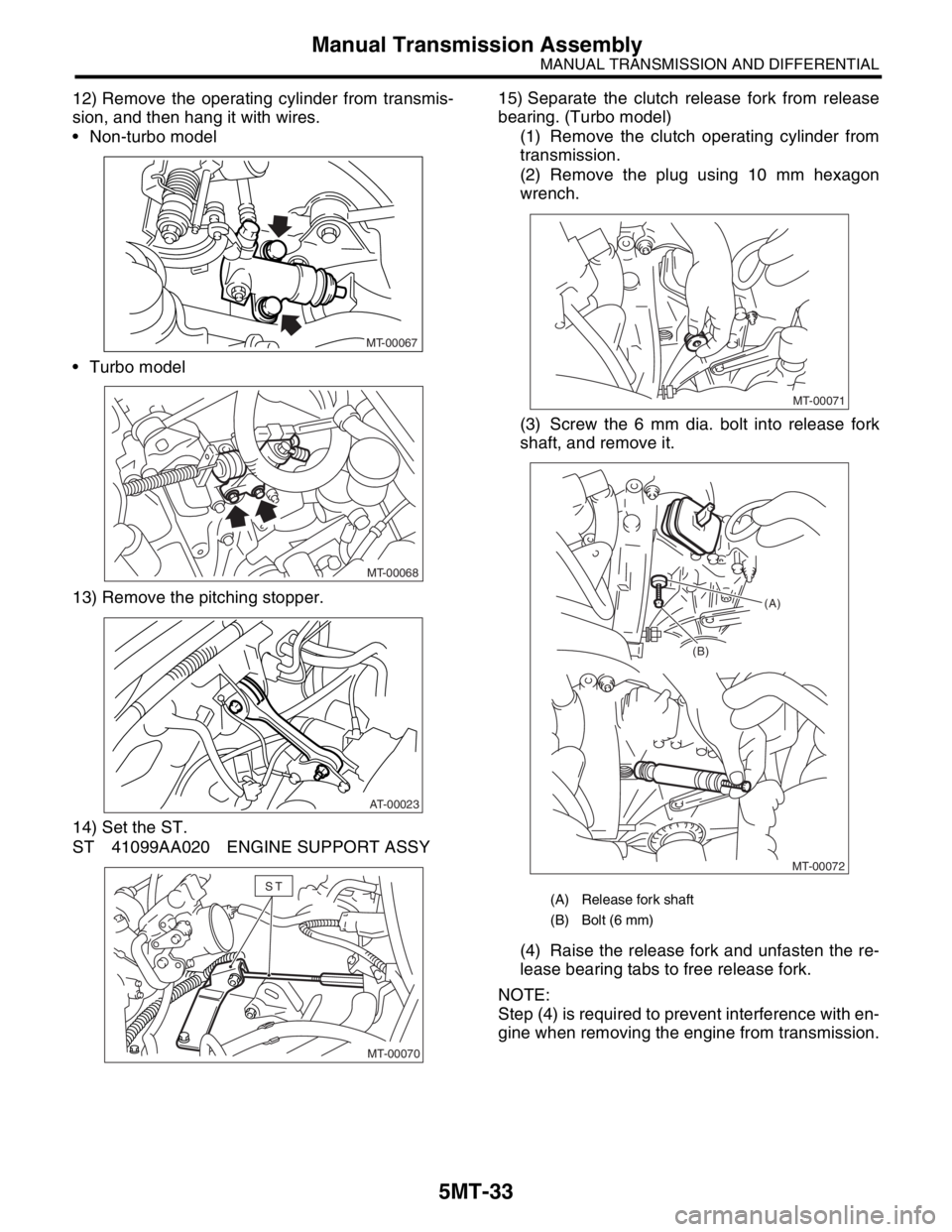
5MT-33
MANUAL TRANSMISSION AND DIFFERENTIAL
Manual Transmission Assembly
12) Remove the operating cylinder from transmis-
sion, and then hang it with wires.
Non-turbo model
Turbo model
13) Remove the pitching stopper.
14) Set the ST.
ST 41099AA020 ENGINE SUPPORT ASSY15) Separate the clutch release fork from release
bearing. (Turbo model)
(1) Remove the clutch operating cylinder from
transmission.
(2) Remove the plug using 10 mm hexagon
wrench.
(3) Screw the 6 mm dia. bolt into release fork
shaft, and remove it.
(4) Raise the release fork and unfasten the re-
lease bearing tabs to free release fork.
NOTE:
Step (4) is required to prevent interference with en-
gine when removing the engine from transmission.
MT-00067
MT-00068
AT-00023
MT-00070
ST(A) Release fork shaft
(B) Bolt (6 mm)
MT-00071
MT-00072 (B)(A)
Page 2869 of 2870

CL-43
CLUTCH SYSTEM
General Diagnostic Table
2. CLUTCH PEDAL
3. DIAGNOSTIC DIAGRAM OF CLUTCH DRAG
4. Noisy clutch
Examine whether the noise is generated
when the clutch is disengaged, engaged,
or partially engaged.(a) Broken, worn or unlubricated release
bearingReplace the release bearing.
(b) Insufficient lubrication of pilot bearing Replace.
(c) Loose clutch disc hub Replace the clutch disc.
(d) Loose torsion spring retainer Replace the clutch disc.
(e) Deteriorated or broken torsion spring Replace the clutch disc.
5. Clutch grabs.
When starting the vehicle with the clutch
partially engaged, the clutch engages
suddenly and the vehicle jumps instead
of making a smooth start.(a) Grease or oil on facing Replace the clutch disc.
(b) Deteriorated cushioning spring Replace the clutch disc.
(c) Worn or rusted spline of clutch disc or
main shaftTake off rust, apply grease or replace the
clutch disc or main shaft.
(d) Deteriorated or broken torsion spring Replace the clutch disc.
(e) Loose engine mounting Retighten or replace the mounting.
(f) Deteriorated diaphragm spring Replace.
Trouble Corrective action
Insufficient pedal play Adjust pedal play.
Clutch pedal free play insufficient Adjust pedal free play.
Excessively worn and damaged pedal shaft and/or bushing Replace the bushing and/or shaft with a new one.
Step Check Yes No
1 CHECK GEAR NOISE.
1) Start the engine.
2) Disengage the clutch and shift quickly from
neutral to reverse in idling condition.Is there any abnormal noise
from the transmission gear?Go to step 2.Clutch is normal.
2 CHECK GEAR NOISE.
Disengage the clutch at idle and shift from neu-
tral to reverse within 0.5 — 1.0 seconds.Is there any abnormal noise
from the transmission gear?Go to step 3.Defective trans-
mission or exces-
sive clutch drag
torque. Inspect the
pilot bearing,
clutch disc, trans-
mission and clutch
disc hub spline.
3 CHECK GEAR NOISE.
1) Disengage the clutch at idle and shift from
neutral to reverse within 0.5 — 1.0 seconds.
2) With the clutch disengaged, shift from N to
R, R to N several times.Is there any abnormal noise
from the transmission gear?Defect in clutch
disengaging.
Inspect the clutch
disc, clutch cover,
clutch release, and
clutch pedal free
play.Clutch and fly-
wheel seizure.
Inspect the clutch
disc, spline of
clutch disc hub. Symptom Possible cause Corrective