warning SUBARU FORESTER 2004 Service Repair Manual
[x] Cancel search | Manufacturer: SUBARU, Model Year: 2004, Model line: FORESTER, Model: SUBARU FORESTER 2004Pages: 2870, PDF Size: 38.67 MB
Page 2139 of 2870

EN(H4DOTC 2.5)-115
ENGINE (DIAGNOSTIC)
Diagnostic Procedure with Diagnostic Trouble Code (DTC)
T: DTC P0171 SYSTEM TOO LEAN (BANK 1)
NOTE:
For diagnostic procedure, refer to DTC P0172.
U: DTC P0172 SYSTEM TOO RICH (BANK 1)
DTC DETECTING CONDITION:
Two consecutive driving cycles with fault
TROUBLE SYMPTOM:
Erroneous idling
Engine stalls.
Poor driving performance
CAUTION:
After repair or replacement of faulty parts, conduct Clear Memory Mode
Step Check Yes No
1 CHECK EXHAUST SYSTEM.Are there holes or loose bolts
on exhaust system?Repair exhaust
system.Go to step 2.
2 CHECK AIR INTAKE SYSTEM.Are there holes, loose bolts or
disconnection of hose on air
intake system?Repair air intake
system.Go to step 3.
3 CHECK FUEL PRESSURE.
Warning:
Place “NO FIRE” signs near the working
area.
Be careful not to spill fuel.
1) Release the fuel pressure.
(1) Disconnect the connector from fuel
pump relay.
(2) Start the engine and run it until it stalls.
(3) After the engine stalls, crank it for five
more seconds.
(4) Turn the ignition switch to OFF.
2) Connect the connector to fuel pump relay.
3) Disconnect the fuel delivery hose from fuel
filter, and connect the fuel pressure gauge.
4) Install the fuel filler cap.
5) Start the engine and idle while gear posi-
tion is neutral.
6) Measure the fuel pressure while discon-
necting pressure regulator vacuum hose from
intake manifold.
Warning:
Release fuel pressure before removing the
fuel pressure gauge.
N
OTE:
If fuel pressure does not increase, squeeze the
fuel return hose 2 to 3 times, then measure fuel
pressure again.Is measured value 284 — 314
kPa (2.9 — 3.2 kg/cm
2, 41 —
46 psi)?Go to step 4.Repair the follow-
ing items.
Fuel pressure is
too high:
Clogged fuel
return line or
bent hose
Fuel pressure is
too low:
Improper fuel
pump discharge
Clogged fuel
supply line
Page 2140 of 2870

EN(H4DOTC 2.5)-116
ENGINE (DIAGNOSTIC)
Diagnostic Procedure with Diagnostic Trouble Code (DTC)
4 CHECK FUEL PRESSURE.
After connecting the pressure regulator vac-
uum hose, measure fuel pressure.
Warning:
Release fuel pressure before removing the
fuel pressure gauge.
N
OTE:
If fuel pressure does not increase, squeeze
fuel return hose 2 to 3 times, then measure
fuel pressure again.
If out of specification as measured at this
step, check or replace pressure regulator and
pressure regulator vacuum hose.Is measured value 206 — 235
kPa (2.1 — 2.4 kg/cm
2, 30 —
34 psi)?Go to step 5.Repair the follow-
ing items.
Fuel pressure is
too high:
Faulty pres-
sure regulator
Clogged fuel
return line or
bent hose
Fuel pressure is
too low:
Faulty pres-
sure regulator
Improper fuel
pump discharge
Clogged fuel
supply line
5 CHECK ENGINE COOLANT TEMPERATURE
SENSOR.
1) Start the engine and warm-up completely.
2) Read the data of engine coolant tempera-
ture sensor signal using Subaru Select Monitor
or the OBD-II general scan tool.
NOTE:
Subaru Select Monitor
For detailed operation procedure, refer to
“READ CURRENT DATA SHOWN ON DIS-
PLAY FOR ENGINE”.
OBD-II general scan tool
For detailed operation procedures, refer to the
OBD-II General Scan Tool Operation Manual.Is engine coolant temperature
more than 60°C (140°F)?Go to step 6.Replace the
engine coolant
temperature sen-
sor.
26, Engine Cool-
ant Temperature
Sensor.>
6 CHECK MASS AIR FLOW AND INTAKE AIR
TEMPERATURE SENSOR
1) Start and warm-up the engine until engine
coolant temperature is greater than 60°C
(140°F).
2) Place the shift lever in neutral position.
3) Turn the A/C switch to OFF.
4) Turn all accessory switches to OFF.
5) Read the data of mass air flow and intake
air temperature sensor signal using Subaru
Select Monitor or the OBD-II general scan tool.
N
OTE:
Subaru Select Monitor
For detailed operation procedure, refer to
“READ CURRENT DATA SHOWN ON DIS-
PLAY FOR ENGINE”.
OBD-II general scan tool
For detailed operation procedures, refer to the
OBD-II General Scan Tool Operation Manual.Is the measured value within
the following?
Ignition ON: 73.3 — 106.6 kPa
(550 — 800 mmHg, 21.65 —
31.50 inHg) Idling: 24.0 — 41.3
kPa (180 — 310 mmHg, 7.09
— 12.20 inHg)Go to step 7.Replace the mass
air flow and intake
air temperature
sensor.
30, Mass Air Flow
and Intake Air
Temperature Sen-
sor.> Step Check Yes No
Page 2463 of 2870

4AT(H4SO)-4
AUTOMATIC TRANSMISSION (DIAGNOSTIC)
Check List for Interview
2. Check List for Interview
A: CHECK
Check the following items when problem has occurred.
NOTE:
Use copies of this page for interviewing customers.
Customer’s name
Date of purchase
Date of repair
Trans. model TRANSMISSION VIN
Odometer readingkm/h (miles)
Frequency❏ Continuous ❏ Intermittent ( times a day)
Weather❏ Fine ❏ Cloudy ❏ Rainy ❏ Snowy
❏ Others
()
Place❏ High ❏ Suburbs ❏ Inner city ❏ Uphill ❏ Rough road
❏ Others
()
Outdoor temperature❏ Hot ❏ Wa r m ❏ Cool ❏ Cold
Vehicle speedkm/h (MPH)
AT warning light (POWER indicator
light)❏ Continuously lit❏ Not lit
Select lever position❏ P ❏ R ❏ N ❏ D ❏ 3 ❏ 2 ❏ 1
Driving condition❏ Not affected
❏ At racing
❏ While decelerating❏ At starting
❏ While accelerating
❏ While turning (❏ RH/❏
LH)❏ While idling
❏ While cruising
POWER switch❏ ON ❏ OFF
HOLD switch❏ ON ❏ OFF
Symptoms❏ No up-shift
❏ No down-shift
❏ No kick down
❏ Vehicle does not move (❏ Any position ❏ Particular position)
❏ Lock-up malfunction
❏ Noise or vibration
❏ Shift shock or slip
❏ Select lever does not move
❏ Others
()
Page 2465 of 2870
4AT(H4SO)-6
AUTOMATIC TRANSMISSION (DIAGNOSTIC)
General Description
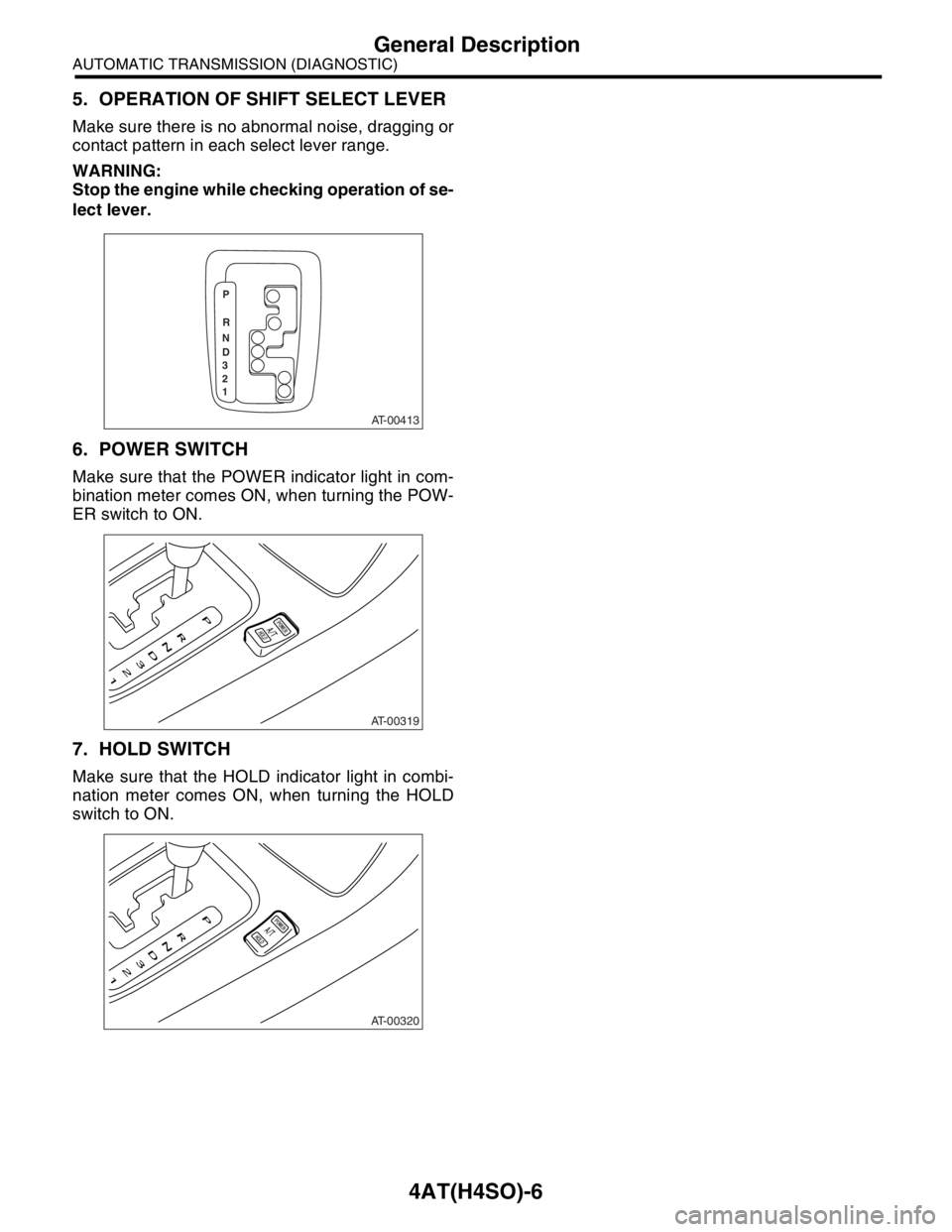
5. OPERATION OF SHIFT SELECT LEVER
Make sure there is no abnormal noise, dragging or
contact pattern in each select lever range.
WARNING:
Stop the engine while checking operation of se-
lect lever.
6. POWER SWITCH
Make sure that the POWER indicator light in com-
bination meter comes ON, when turning the POW-
ER switch to ON.
7. HOLD SWITCH
Make sure that the HOLD indicator light in combi-
nation meter comes ON, when turning the HOLD
switch to ON.
AT-00413
P
R
N
D
3
2
1
AT-00319
AT-00320
Page 2467 of 2870
4AT(H4SO)-8
AUTOMATIC TRANSMISSION (DIAGNOSTIC)
Electrical Components Location
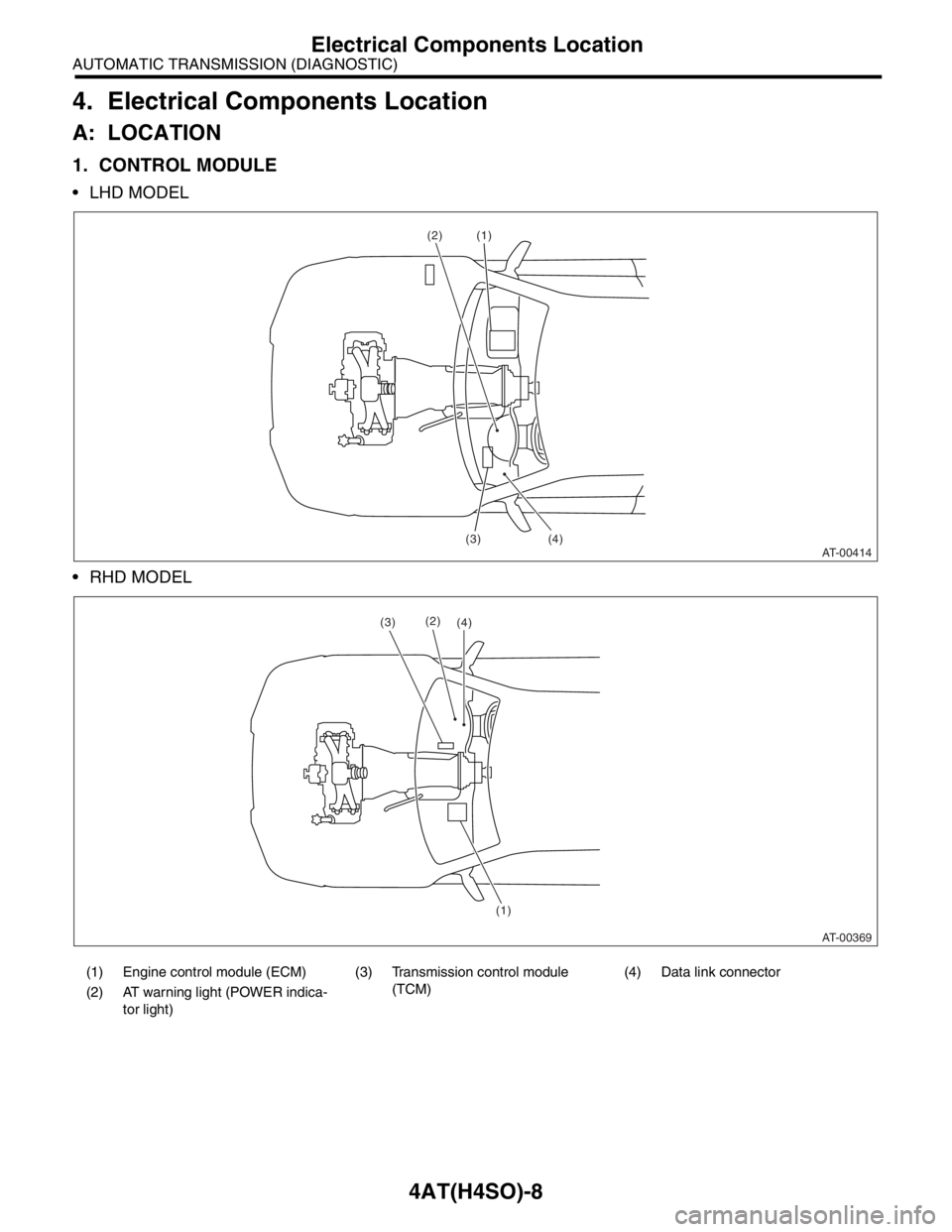
4. Electrical Components Location
A: LOCATION
1. CONTROL MODULE
LHD MODEL
RHD MODEL
(1) Engine control module (ECM) (3) Transmission control module
(TCM)(4) Data link connector
(2) AT warning light (POWER indica-
tor light)
AT-00414
(1) (2)
(3) (4)
AT-00369 (2)
(4)
(1)
(3)
Page 2472 of 2870

4AT(H4SO)-13
AUTOMATIC TRANSMISSION (DIAGNOSTIC)
Transmission Control Module (TCM) I/O Signal
Inhibitor
switch“2” range
switchB55 6Select lever in “2” range Less than 1
—
Select lever in any other
than “2” rangeMore than 8
“1” range
switchB55 7Select lever in “1” range Less than 1
—
Select lever in any other
than “1” rangeMore than 8
Brake switch B55 12Brake pedal depressed More than 10.5
—
Brake pedal released Less than 1
Kick-down switch B55 11Throttle fully opened Less than 1
—
Throttle fully closed More than 6.5
AT OIL TEMP warning light B56 10Light ON Less than 1
—
Light OFF More than 9
Throttle position sensor B54 3Throttle fully closed 0.2 — 1.0
—
Throttle fully open 4.2 — 4.7
Throttle position sensor
power supplyB54 2Ignition switch ON (with
engine OFF)4.8 — 5.3 —
ATF temperature sensor B54 11ATF temperature 20°C
(68°F)1.6 — 2.0 2.1 k — 2.9 k
ATF temperature 80°C
(176°F)0.4 — 0.9 275 — 375
Rear vehicle speed sensor B55 24Vehicle stopped 0
450 — 650
Vehicle speed at least 20
km/h (12 MPH)More than 1 (AC range)
Front vehicle speed sensor B55 18Vehicle stopped 0
450 — 650
Vehicle speed at least 20
km/h (12 MPH)More than 1 (AC range)
Torque converter turbine
speed sensorB55 8Engine idling after warm-
up (D range)0
450 — 650
Engine idling after warm-
up (N range)More than 1 (AC range)
Vehicle speed output signal B56 17Vehicle speed at most 10
km/h (6 MPH)Less than 1 ←
→ More than 4—
Engine speed signal B55 17Ignition switch ON (with
engine OFF)More than 10.5
—
Ignition switch ON (with
engine ON)8 — 11
Cruise set signal B55 22When cruise control is set
(SET lamp ON)Less than 1
—
When cruise control is not
set (SET lamp OFF)More than 6.5
Torque control signal 1 B56 5Ignition switch ON (with
engine ON)More than 4 —
Torque control signal 2 B56 14Ignition switch ON (with
engine ON)More than 4 —
Torque control cut signal B55 10Ignition switch ON
(After engine is warmed-up)8—
Intake manifold pressure
signalB54 1 Engine idling after warm-up 0.4 — 1.6 —
Shift solenoid 1 B54 221st or 4th gear More than 9
10 — 16
2nd or 3rd gear Less than 1
Shift solenoid 2 B54 51st or 2nd gear More than 9
10 — 16
3rd or 4th gear Less than 1 Check with ignition switch ON.
ContentConnector
No.Terminal No. Measuring conditions Voltage (V)Resistance
to chassis
ground (Ω)
Page 2475 of 2870

4AT(H4SO)-16
AUTOMATIC TRANSMISSION (DIAGNOSTIC)
Transmission Control Module (TCM) I/O Signal
(1) Transmission control module
(TCM)(17) “P” range indicator light (35) Torque control signal 2
(18) “P” range switch (36) Torque control signal 1
(2) Cruise control module (19) “R” range indicator light (37) Intake manifold pressure signal
(3) ABS control module (20) “R” range switch (38) AT diagnostics signal
(4) Ignition switch (21) “N” range indicator light (39) Engine control module (ECM)
(5) Brake switch (22) “N” range switch (40) ATF temperature sensor
(6) Brake light (23) “D” range indicator light (41) Torque converter turbine speed
sensor
(7) Battery (24) “D” range switch
(8) Combination meter (Speedome-
ter circuit)(25) “3” range indicator light (42) Rear vehicle speed sensor
(26) “3” range switch (43) Front vehicle speed sensor
(9) AT OIL TEMP warning light (27) “2” range indicator light (44) Shift solenoid 1
(10) FWD indicator light (28) “2” range switch (45) Shift solenoid 2
(11) POWER indicator light (29) “1” range indicator light (46) 2-4 brake timing solenoid
(12) FWD switch (30) “1” range switch (47) Line pressure duty solenoid
(13) POWER switch (31) Data link connector (48) 2-4 brake duty solenoid
(14) Kick-down switch (32) Throttle position sensor (49) Lock-up duty solenoid
(15) Hold indicator light (33) Engine speed signal (50) Low clutch timing solenoid
(16) HOLD switch (34) Torque control cut signal (51) Transfer duty solenoid
Page 2481 of 2870

4AT(H4SO)-22
AUTOMATIC TRANSMISSION (DIAGNOSTIC)
Inspection Mode
8. Inspection Mode
A: OPERATION
Shift the select lever to “D” range, and drive continu-
ously for 10 seconds or more at 60 km/h (37 MPH).
WARNING:
Observe the road traffic law.
Page 2506 of 2870

4AT(H4SO)-47
AUTOMATIC TRANSMISSION (DIAGNOSTIC)
Diagnostic Procedure with Diagnostic Trouble Code (DTC)
Step Check Yes No
1 CHECK HARNESS CONNECTOR BETWEEN
TCM AND TRANSMISSION.
1) Turn the ignition switch to OFF.
2) Disconnect the connector from TCM and
transmission.
3) Measure the resistance of harness
between TCM and transmission connector.
Connector & terminal
(B55) No. 18 — (B11) No. 17:Is the resistance less than 1
Ω?Go to step 2.Repair the open
circuit in harness
between TCM and
transmission con-
nector.
2 CHECK HARNESS CONNECTOR BETWEEN
TCM AND TRANSMISSION.
Measure the resistance of harness between
TCM and transmission connector.
Connector & terminal
(B54) No. 10 — (B11) No. 18:Is the resistance less than 1
Ω?Go to step 3.Repair the open
circuit in harness
between TCM and
transmission con-
nector, and poor
contact in cou-
pling connector.
3 CHECK HARNESS CONNECTOR BETWEEN
TCM AND TRANSMISSION.
Measure the resistance of harness between
TCM and chassis ground.
Connector & terminal
(B54) No. 10 — Chassis ground:Is the resistance more than 1
MΩ?Go to step 4.Repair the short
circuit in harness
between TCM and
transmission con-
nector.
4 CHECK HARNESS CONNECTOR BETWEEN
TCM AND TRANSMISSION.
Measure the resistance of harness between
TCM and chassis ground.
Connector & terminal
(B55) No. 18 — Chassis ground:Is the resistance more than 1
MΩ?Go to step 5.Repair the short
circuit in harness
between TCM and
transmission con-
nector, and poor
contact in cou-
pling connector.
5 CHECK FRONT VEHICLE SPEED SENSOR.
Measure the resistance between transmission
connector receptacle’s terminals.
Connector & terminal
(T4) No. 17 — No. 18:Is the resistance 450 — 650
Ω?Go to step 6.Replace the front
vehicle speed sen-
sor.
Speed Sensor.>
6 PREPARE OSCILLOSCOPE.Do you have an oscilloscope? Go to step 9.Go to step 7.
7 PREPARE SUBARU SELECT MONITOR.Do you have a Subaru Select
Monitor?Go to step 10.Go to step 8.
8 CHECK INPUT SIGNAL FOR TCM.
1) Connect all connectors.
2) Lift-up or raise the vehicle and place rigid
rack.
NOTE:
Raise all wheels off floor.
3) Start the engine and set vehicle in 20 km/h
(12 MPH) condition.
NOTE:
The speed difference between front and rear
wheels may light the ABS warning light, but this
indicates no malfunction. When AT control diag-
nosis is finished, perform the ABS memory
clearance procedure of on-board diagnostics
system.
4) Measure the voltage between TCM con-
nector terminals.
Connector & terminal
(B55) No. 18 (+) — (B54) No. 10 (
−):Is the voltage more than AC 1
V?Even if the
POWER indicator
light was blinking,
the circuit has
returned to a nor-
mal condition at
this time. A tempo-
rary poor contact
or harness may be
the cause. Repair
the harness or
connector in the
front vehicle speed
sensor circuit.Go to step 11.
Page 2507 of 2870

4AT(H4SO)-48
AUTOMATIC TRANSMISSION (DIAGNOSTIC)
Diagnostic Procedure with Diagnostic Trouble Code (DTC)
9 CHECK FRONT VEHICLE SPEED SENSOR
USING OSCILLOSCOPE.
1) Connect all connectors.
2) Lift-up the vehicle and place rigid rack.
N
OTE:
Raise all wheels off ground.
3) Set the oscilloscope to TCM connector ter-
minals.
Connector & terminal
Positive probe; (B55) No. 18
Earth lead; (B54) No. 10
4) Start the engine, and drive the wheels
slowly.
N
OTE:
The speed difference between front and rear
wheels may light the ABS warning light, but this
indicates no malfunctions. When AT control di-
agnosis is finished, perform the ABS memory
clearance procedure of self-diagnosis system.
5) Measure the signal voltage indicated on
oscilloscope.Is the voltage more than AC 4
V?Even if the
POWER indicator
light was blinking,
the circuit has
returned to a nor-
mal condition at
this time. A tempo-
rary poor contact
or harness may be
the cause. Repair
the harness or
connector in front
vehicle speed sen-
sor circuit.Go to step 11.
10 CHECK INPUT SIGNAL FOR TCM USING
SUBARU SELECT MONITOR.
1) Connect all connectors.
2) Connect the Subaru Select Monitor to data
link connector.
3) Lift-up or raise the vehicle and place rigid
rack.
N
OTE:
Raise all wheels off floor.
4) Turn the ignition switch to ON and turn Sub-
aru Select Monitor switch to ON.
5) Start the engine.
6) Read the data of vehicle speed using Sub-
aru Select Monitor.
Compare the speedometer with Subaru
Select Monitor indications.
Vehicle speed is indicated in “km/h” or
“MPH”.
7) Slowly increase the vehicle speed to 60 km/
h (37 MPH).
N
OTE:
The speed difference between front and rear
wheels may light the ABS warning light, but this
indicates no malfunction. When AT control diag-
nosis is finished, perform the ABS memory
clearance procedure of on-board diagnostics
system.
tion increase as Subaru Select
Monitor data increases?Even if the
POWER indicator
light was blinking,
the circuit has
returned to a nor-
mal condition at
this time. A tempo-
rary poor connec-
tor or harness may
be the cause.
Repair the har-
ness or connector
in front vehicle
speed sensor cir-
cuit.Go to step 11.
11 CHECK POOR CONTACT.Is there poor contact in front
vehicle speed sensor circuit?Repair the poor
contact.Replace the TCM.
trol Module
(TCM).> Step Check Yes No