warning SUBARU FORESTER 2004 Service Repair Manual
[x] Cancel search | Manufacturer: SUBARU, Model Year: 2004, Model line: FORESTER, Model: SUBARU FORESTER 2004Pages: 2870, PDF Size: 38.67 MB
Page 1413 of 2870
FU(H4DOTC)-58
FUEL INJECTION (FUEL SYSTEM)
Fuel Filler Pipe
26.Fuel Filler Pipe
A: REMOVAL
WARNING:
Place “NO FIRE” signs near working area.
Be careful not to spill fuel on floor.
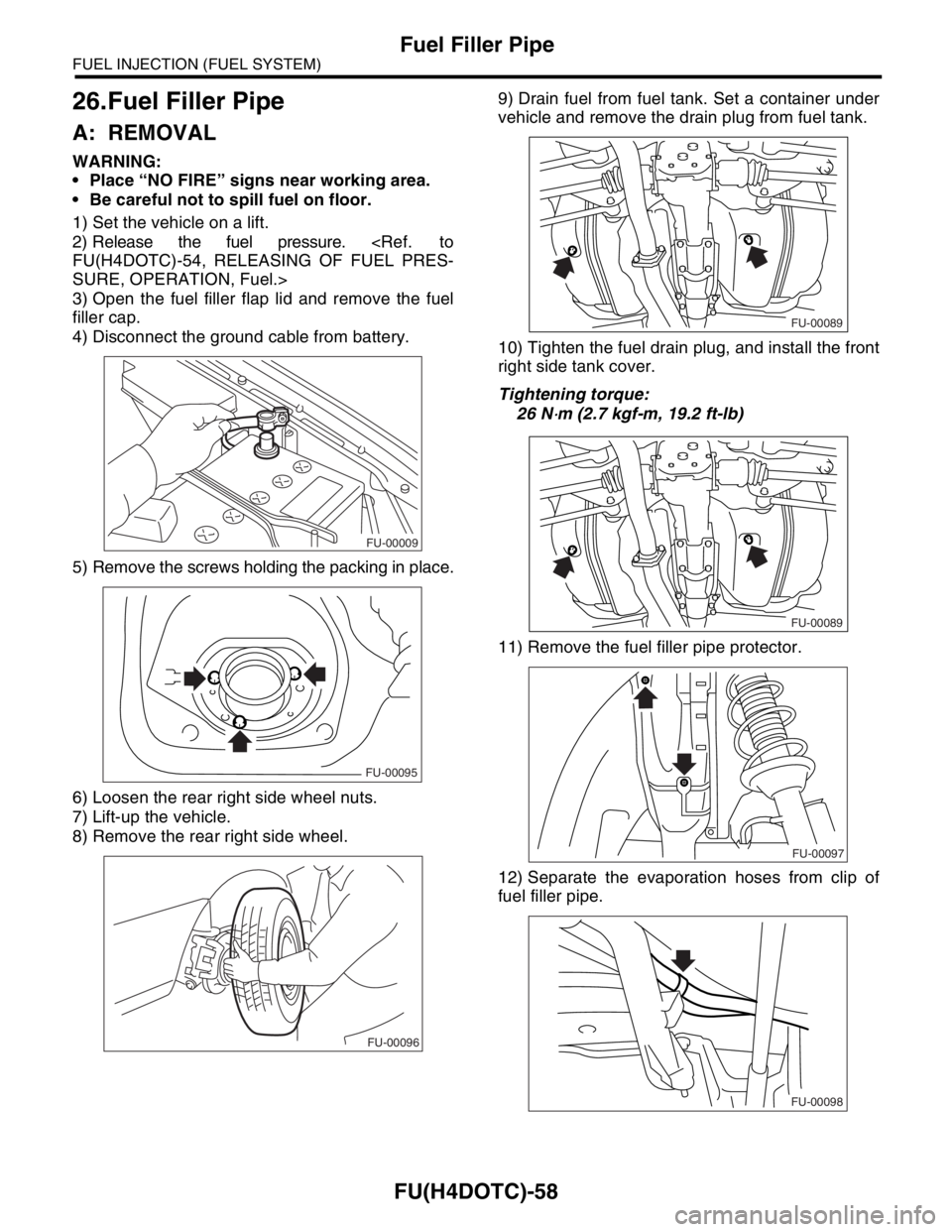
1) Set the vehicle on a lift.
2) Release the fuel pressure.
SURE, OPERATION, Fuel.>
3) Open the fuel filler flap lid and remove the fuel
filler cap.
4) Disconnect the ground cable from battery.
5) Remove the screws holding the packing in place.
6) Loosen the rear right side wheel nuts.
7) Lift-up the vehicle.
8) Remove the rear right side wheel.9) Drain fuel from fuel tank. Set a container under
vehicle and remove the drain plug from fuel tank.
10) Tighten the fuel drain plug, and install the front
right side tank cover.
Tightening torque:
26 N
⋅m (2.7 kgf-m, 19.2 ft-lb)
11) Remove the fuel filler pipe protector.
12) Separate the evaporation hoses from clip of
fuel filler pipe.
FU-00009
FU-00095
FU-00096
FU-00089
FU-00089
FU-00097
FU-00098
Page 1417 of 2870
FU(H4DOTC)-62
FUEL INJECTION (FUEL SYSTEM)
Fuel Pump
27.Fuel Pump
A: REMOVAL
WARNING:
Place “NO FIRE” signs near working area.
Be careful not to spill fuel on floor.
NOTE:
Fuel pump assembly consists of fuel pump and fuel
level sensor.
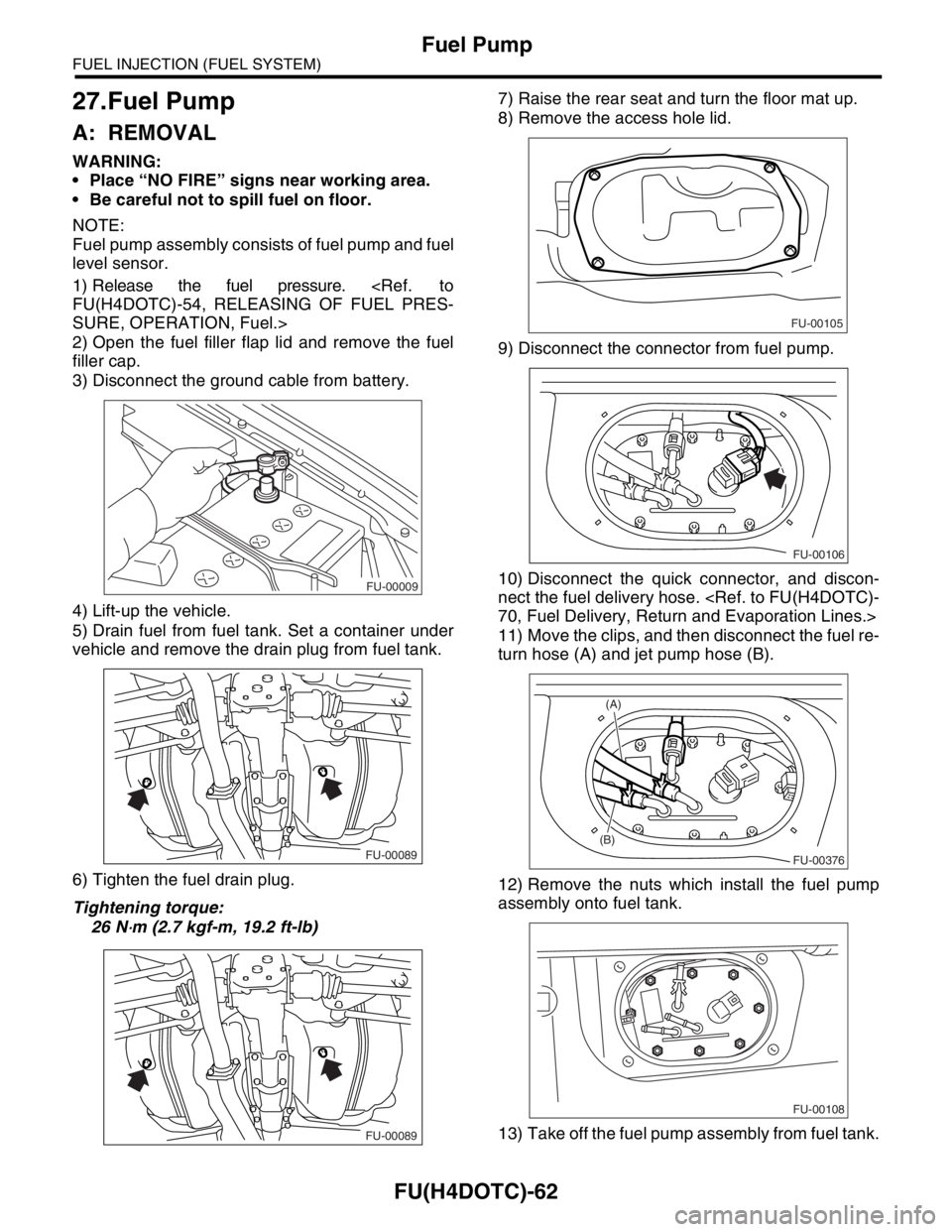
1) Release the fuel pressure.
SURE, OPERATION, Fuel.>
2) Open the fuel filler flap lid and remove the fuel
filler cap.
3) Disconnect the ground cable from battery.
4) Lift-up the vehicle.
5) Drain fuel from fuel tank. Set a container under
vehicle and remove the drain plug from fuel tank.
6) Tighten the fuel drain plug.
Tightening torque:
26 N
⋅m (2.7 kgf-m, 19.2 ft-lb)7) Raise the rear seat and turn the floor mat up.
8) Remove the access hole lid.
9) Disconnect the connector from fuel pump.
10) Disconnect the quick connector, and discon-
nect the fuel delivery hose.
11) Move the clips, and then disconnect the fuel re-
turn hose (A) and jet pump hose (B).
12) Remove the nuts which install the fuel pump
assembly onto fuel tank.
13) Take off the fuel pump assembly from fuel tank.
FU-00009
FU-00089
FU-00089
FU-00105
FU-00106
FU-00376
(B)
(A)
FU-00108
Page 1418 of 2870
FU(H4DOTC)-63
FUEL INJECTION (FUEL SYSTEM)
Fuel Pump
B: INSTALLATION
NOTE:
Replace the gaskets with new ones.
(1) Ensure sealing portion is free from fuel or for-
eign particles before installation.
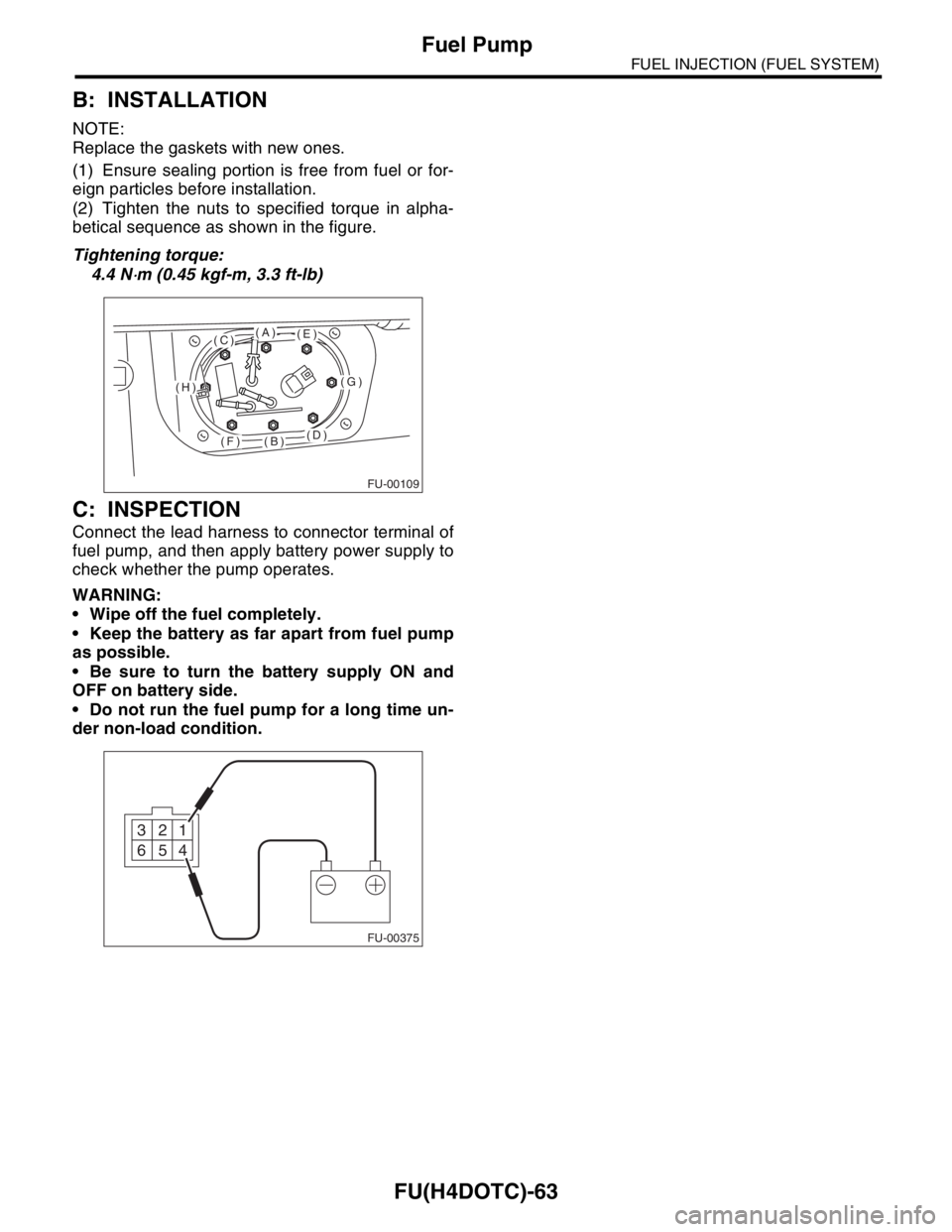
(2) Tighten the nuts to specified torque in alpha-
betical sequence as shown in the figure.
Tightening torque:
4.4 N
⋅m (0.45 kgf-m, 3.3 ft-lb)
C: INSPECTION
Connect the lead harness to connector terminal of
fuel pump, and then apply battery power supply to
check whether the pump operates.
WARNING:
Wipe off the fuel completely.
Keep the battery as far apart from fuel pump
as possible.
Be sure to turn the battery supply ON and
OFF on battery side.
Do not run the fuel pump for a long time un-
der non-load condition.
FU-00109
(A)
(B)
(C)
(D)
(E)
(F)
(G)(H)
FU-00375
1 2 3
4 5 6
Page 1419 of 2870
FU(H4DOTC)-64
FUEL INJECTION (FUEL SYSTEM)
Fuel Level Sensor
28.Fuel Level Sensor
A: REMOVAL
WARNING:
Place “NO FIRE” signs near working area.
Be careful not to spill fuel on floor.
NOTE:
Fuel level sensor is built in fuel pump assembly.
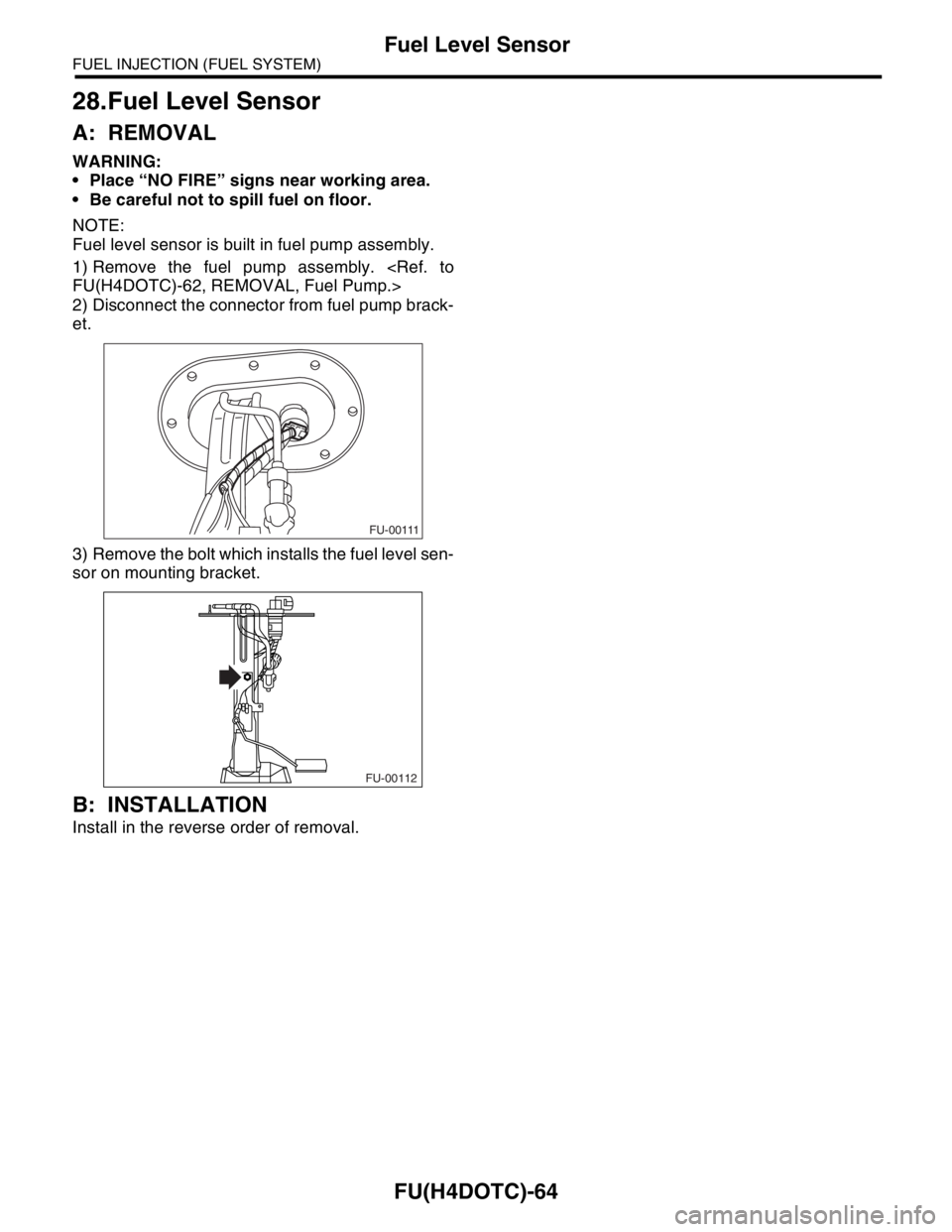
1) Remove the fuel pump assembly.
2) Disconnect the connector from fuel pump brack-
et.
3) Remove the bolt which installs the fuel level sen-
sor on mounting bracket.
B: INSTALLATION
Install in the reverse order of removal.
FU-00111
FU-00112
Page 1420 of 2870
FU(H4DOTC)-65
FUEL INJECTION (FUEL SYSTEM)
Fuel Sub Level Sensor
29.Fuel Sub Level Sensor
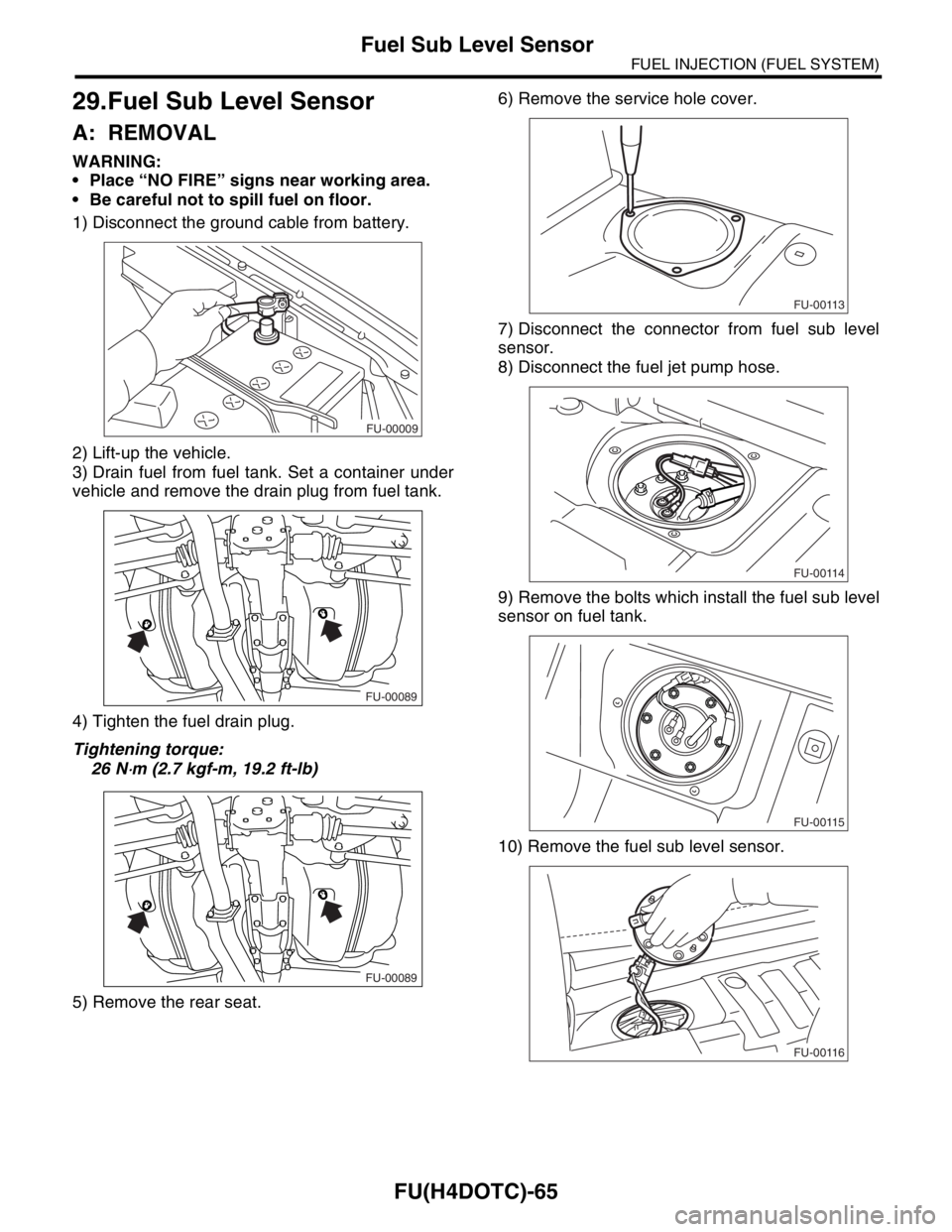
A: REMOVAL
WARNING:
Place “NO FIRE” signs near working area.
Be careful not to spill fuel on floor.
1) Disconnect the ground cable from battery.
2) Lift-up the vehicle.
3) Drain fuel from fuel tank. Set a container under
vehicle and remove the drain plug from fuel tank.
4) Tighten the fuel drain plug.
Tightening torque:
26 N
⋅m (2.7 kgf-m, 19.2 ft-lb)
5) Remove the rear seat.6) Remove the service hole cover.
7) Disconnect the connector from fuel sub level
sensor.
8) Disconnect the fuel jet pump hose.
9) Remove the bolts which install the fuel sub level
sensor on fuel tank.
10) Remove the fuel sub level sensor.
FU-00009
FU-00089
FU-00089
FU-00113
FU-00114
FU-00115
FU-00116
Page 1422 of 2870
FU(H4DOTC)-67
FUEL INJECTION (FUEL SYSTEM)
Fuel Filter
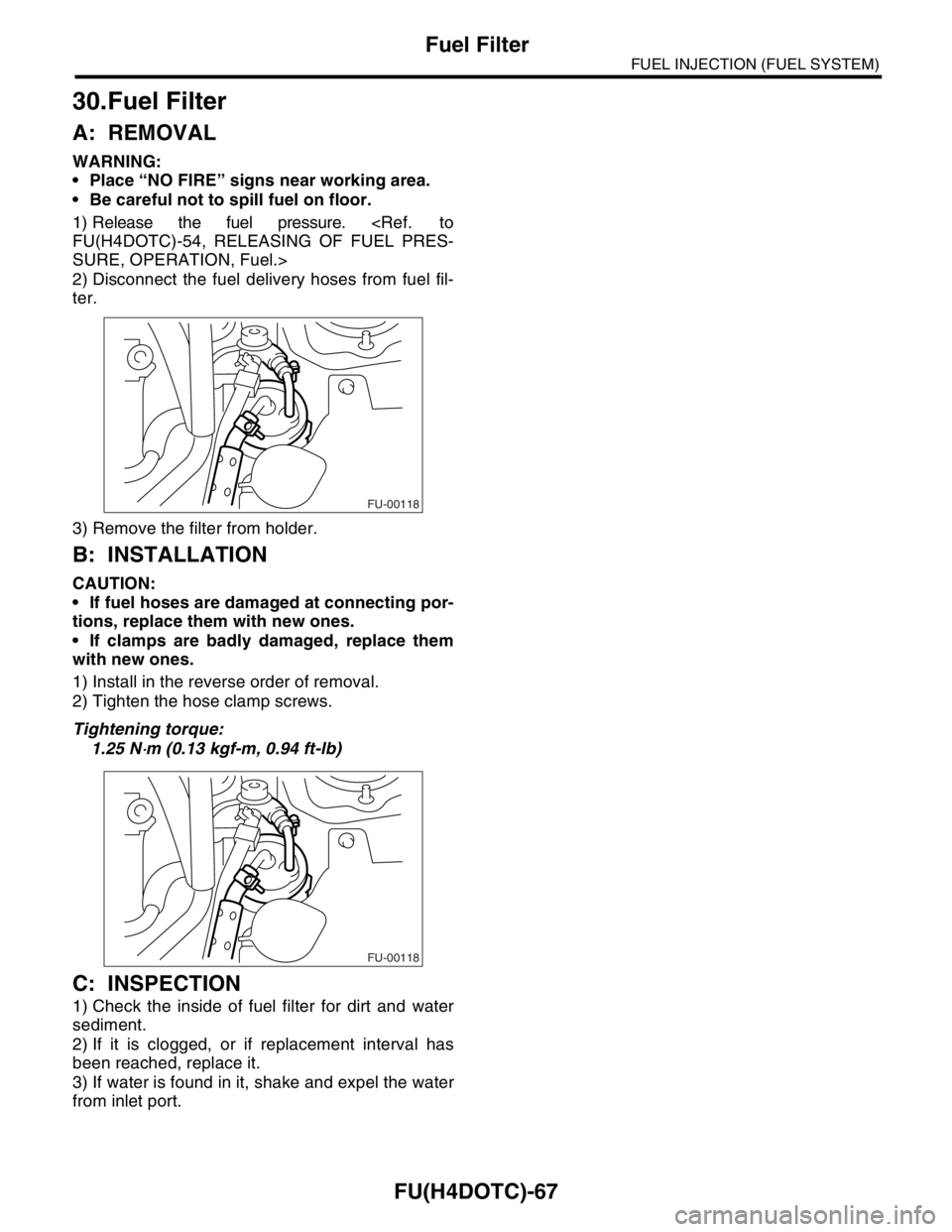
30.Fuel Filter
A: REMOVAL
WARNING:
Place “NO FIRE” signs near working area.
Be careful not to spill fuel on floor.
1) Release the fuel pressure.
SURE, OPERATION, Fuel.>
2) Disconnect the fuel delivery hoses from fuel fil-
ter.
3) Remove the filter from holder.
B: INSTALLATION
CAUTION:
If fuel hoses are damaged at connecting por-
tions, replace them with new ones.
If clamps are badly damaged, replace them
with new ones.
1) Install in the reverse order of removal.
2) Tighten the hose clamp screws.
Tightening torque:
1.25 N
⋅m (0.13 kgf-m, 0.94 ft-lb)
C: INSPECTION
1) Check the inside of fuel filter for dirt and water
sediment.
2) If it is clogged, or if replacement interval has
been reached, replace it.
3) If water is found in it, shake and expel the water
from inlet port.
FU-00118
FU-00118
Page 1423 of 2870
FU(H4DOTC)-68
FUEL INJECTION (FUEL SYSTEM)
Fuel Cut Valve
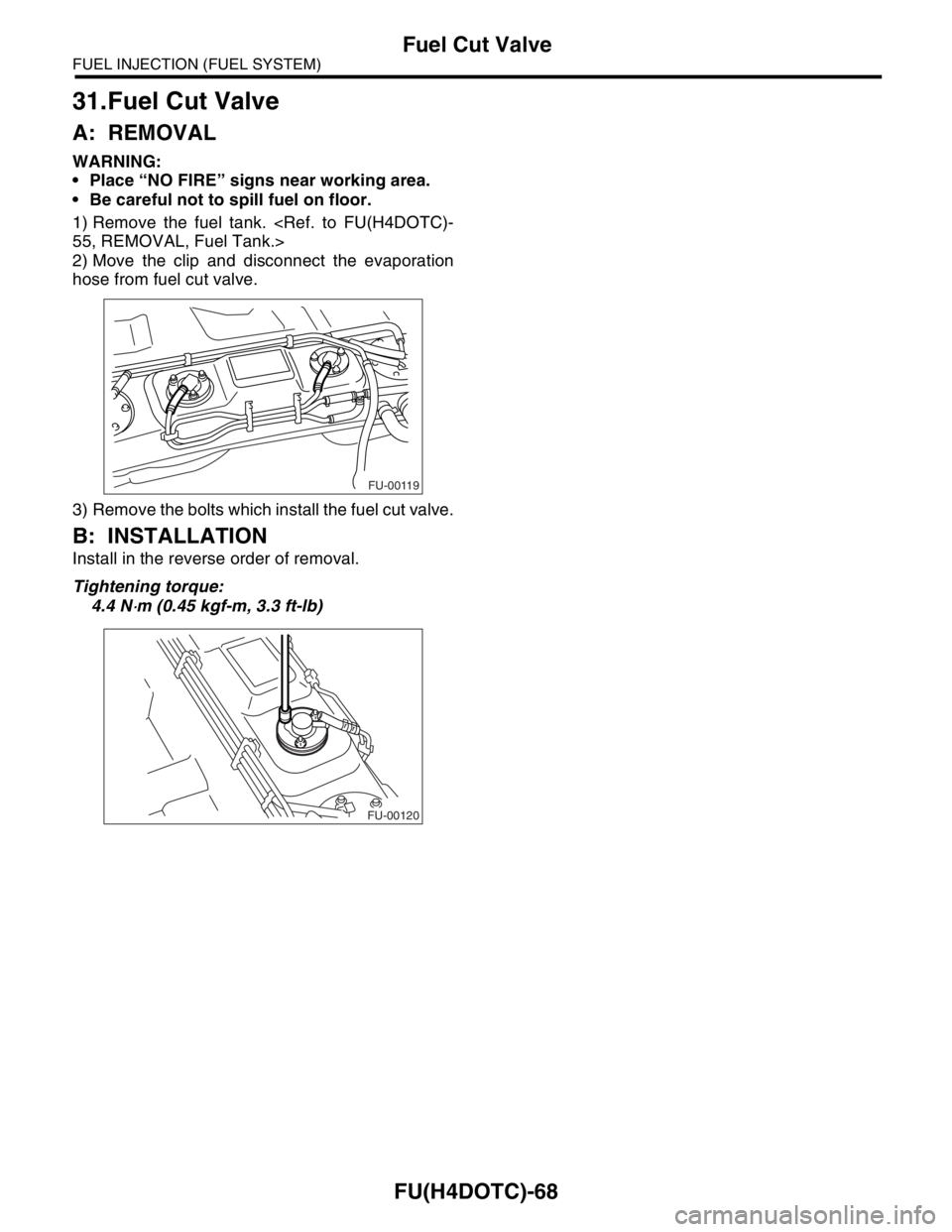
31.Fuel Cut Valve
A: REMOVAL
WARNING:
Place “NO FIRE” signs near working area.
Be careful not to spill fuel on floor.
1) Remove the fuel tank.
2) Move the clip and disconnect the evaporation
hose from fuel cut valve.
3) Remove the bolts which install the fuel cut valve.
B: INSTALLATION
Install in the reverse order of removal.
Tightening torque:
4.4 N
⋅m (0.45 kgf-m, 3.3 ft-lb)
FU-00119
FU-00120
Page 1491 of 2870
ME(H4DOTC)-35
MECHANICAL
Engine Oil Pressure
6. Engine Oil Pressure
A: INSPECTION
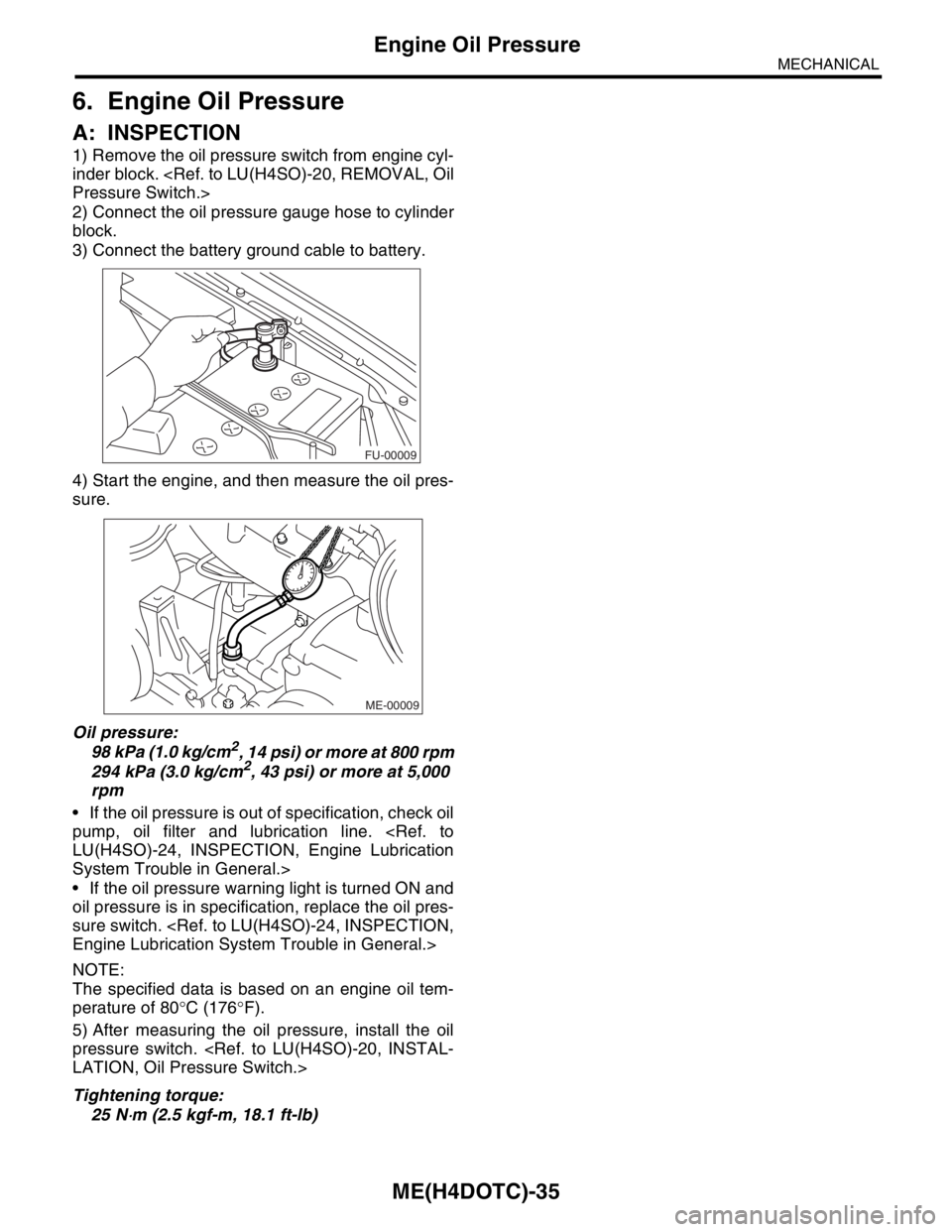
1) Remove the oil pressure switch from engine cyl-
inder block.
2) Connect the oil pressure gauge hose to cylinder
block.
3) Connect the battery ground cable to battery.
4) Start the engine, and then measure the oil pres-
sure.
Oil pressure:
98 kPa (1.0 kg/cm
2, 14 psi) or more at 800 rpm
294 kPa (3.0 kg/cm2, 43 psi) or more at 5,000
rpm
If the oil pressure is out of specification, check oil
pump, oil filter and lubrication line.
System Trouble in General.>
If the oil pressure warning light is turned ON and
oil pressure is in specification, replace the oil pres-
sure switch.
NOTE:
The specified data is based on an engine oil tem-
perature of 80°C (176°F).
5) After measuring the oil pressure, install the oil
pressure switch.
Tightening torque:
25 N
⋅m (2.5 kgf-m, 18.1 ft-lb)
FU-00009
ME-00009
Page 1635 of 2870

EN(H4DOTC)-5
ENGINE (DIAGNOSTIC)
Check List for Interview
2. CHECK LIST NO. 2
Check the following items about the vehicle’s state when malfunction indicator light turns on.
NOTE:
Use copies of this page for interviewing customers.
a) Other warning lights or indicators turn on. ❏ Yes / ❏ No
❏ Low fuel warning light
❏ Charge indicator light
❏ AT diagnostic indicator light
❏ ABS Warning Light
❏ Oil pressure indicator light
b) Fuel level
Lack of gasoline: ❏ Yes / ❏ No
Indicator position of fuel gauge:
Had run out of gas before: ❏ Ye s / ❏ No
c) Intentional connecting or disconnecting of harness connectors or spark plug cords: ❏ Yes / ❏ No
What:
d) Intentional connecting or disconnecting of hoses: ❏ Ye s / ❏ No
What:
e) Installing of other parts except genuine parts: ❏ Ye s / ❏ No
What:
Where:
f) Occurrence of noise: ❏ Yes / ❏ No
From where:
What kind:
g) Occurrence of smell: ❏ Yes / ❏ No
From where:
What kind:
h) Intrusion of water into engine compartment or passenger compartment: ❏ Yes / ❏ No
i) Troubles occurred
❏ Engine does not start.
❏ Engine stalls during idling.
❏ Engine stalls while driving.
❏ Engine speed decreases.
❏ Engine speed does not decrease.
❏ Rough idling
❏ Poor acceleration
❏ Back fire
❏ After fire
❏ Does not shift.
❏ Excessive shift shock
Page 1637 of 2870
EN(H4DOTC)-7
ENGINE (DIAGNOSTIC)
General Description
12) Observe the following cautions when installing
a radio in MFI equipped models.
CAUTION:
The antenna must be kept as far apart as pos-
sible from the control unit. (The ECM is located
under the steering column, inside of the instru-
ment panel lower trim panel.)
The antenna feeder must be placed as far
apart as possible from the ECM and MFI har-
ness.
Carefully adjust the antenna for correct
matching.
When mounting a large power type radio, pay
special attention to the three items above men-
tioned.
Incorrect installation of the radio may affect
the operation of the ECM.
13) Before disconnecting the fuel hose, disconnect
the fuel pump connector and crank the engine for
more than five seconds to release pressure in the
fuel system.If engine starts during this operation,
run it until it stops.
14) Problems in the electronic-controlled automatic
transmission may be caused by failure of the en-
gine, the electronic control system, the transmis-
sion proper, or by a combination of these.These
three causes (engine, electronic control system,
transmission) must be distinguished clearly when
performing diagnostics.
15) Diagnostics should be conducted by rotating
with simple, easy operations and proceeding to
complicated, difficult operations.The most impor-
tant thing in diagnostics is to understand the cus-
tomer’s complaint, and distinguish between the
three causes.
16) On the model with ABS, when performing driv-
ing test in jacked-up or lifted-up position, some-
times the warning light may be lit, but this is not a
malfunction of the system.The reason for this is the
speed difference between the front and rear
wheels.After diagnosis of engine control system,
perform the ABS memory clearance procedure of
self-diagnosis function.
B: INSPECTION
Before performing diagnostics, check the following
items which might affect engine problems:
1. BATTERY
1) Measure battery voltage and specific gravity of
electrolyte.
Standard voltage: 12 V
Specific gravity: Above 1.2602) Check the condition of the main and other fuses,
and harnesses and connectors.Also check for
proper grounding.
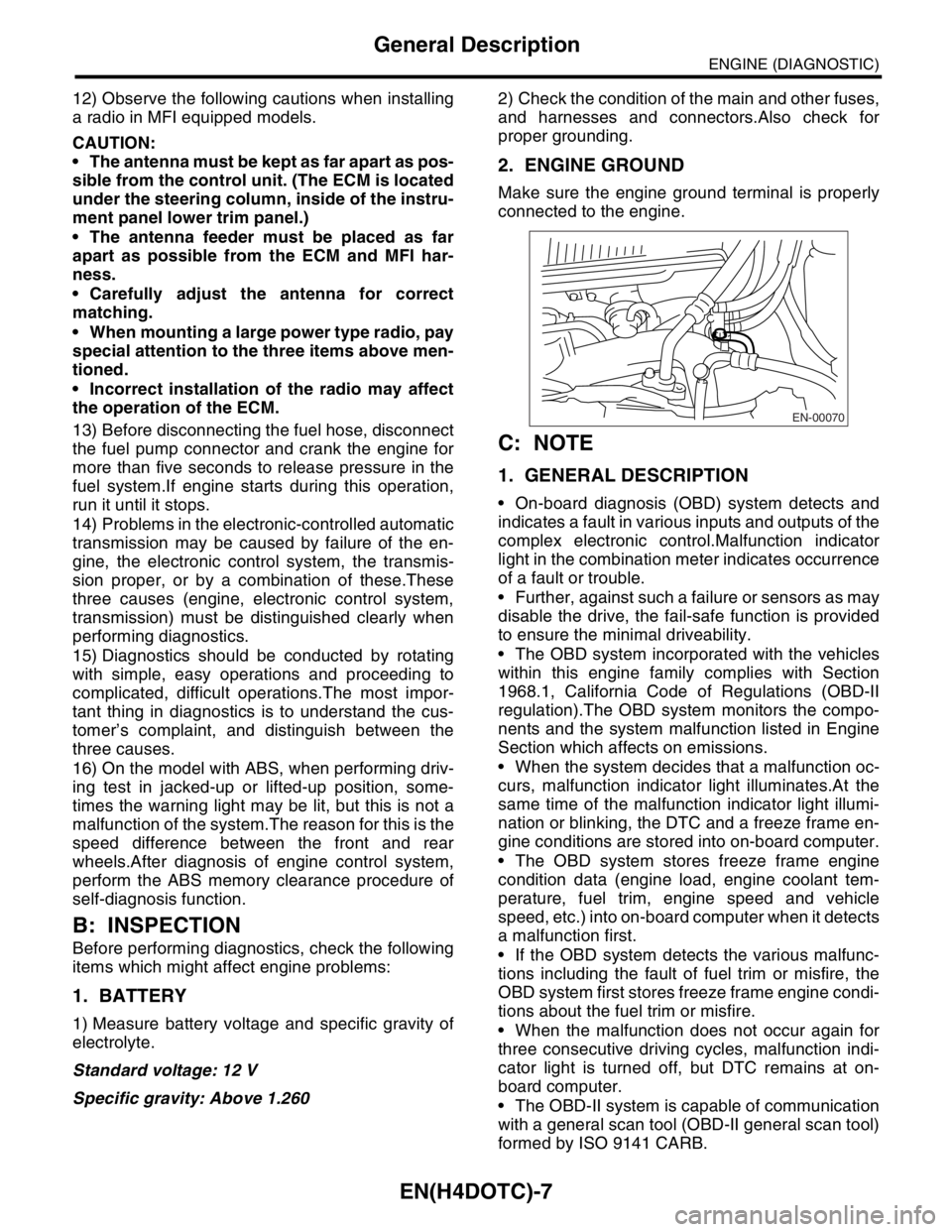
2. ENGINE GROUND
Make sure the engine ground terminal is properly
connected to the engine.
C: NOTE
1. GENERAL DESCRIPTION
On-board diagnosis (OBD) system detects and
indicates a fault in various inputs and outputs of the
complex electronic control.Malfunction indicator
light in the combination meter indicates occurrence
of a fault or trouble.
Further, against such a failure or sensors as may
disable the drive, the fail-safe function is provided
to ensure the minimal driveability.
The OBD system incorporated with the vehicles
within this engine family complies with Section
1968.1, California Code of Regulations (OBD-II
regulation).The OBD system monitors the compo-
nents and the system malfunction listed in Engine
Section which affects on emissions.
When the system decides that a malfunction oc-
curs, malfunction indicator light illuminates.At the
same time of the malfunction indicator light illumi-
nation or blinking, the DTC and a freeze frame en-
gine conditions are stored into on-board computer.
The OBD system stores freeze frame engine
condition data (engine load, engine coolant tem-
perature, fuel trim, engine speed and vehicle
speed, etc.) into on-board computer when it detects
a malfunction first.
If the OBD system detects the various malfunc-
tions including the fault of fuel trim or misfire, the
OBD system first stores freeze frame engine condi-
tions about the fuel trim or misfire.
When the malfunction does not occur again for
three consecutive driving cycles, malfunction indi-
cator light is turned off, but DTC remains at on-
board computer.
The OBD-II system is capable of communication
with a general scan tool (OBD-II general scan tool)
formed by ISO 9141 CARB.
EN-00070