Back up SUBARU TRIBECA 2009 1.G Service Workshop Manual
[x] Cancel search | Manufacturer: SUBARU, Model Year: 2009, Model line: TRIBECA, Model: SUBARU TRIBECA 2009 1.GPages: 2453, PDF Size: 46.32 MB
Page 1781 of 2453
GD(H6DO)-169
Diagnostic Trouble Code (DTC) Detecting Criteria
GENERAL DESCRIPTION
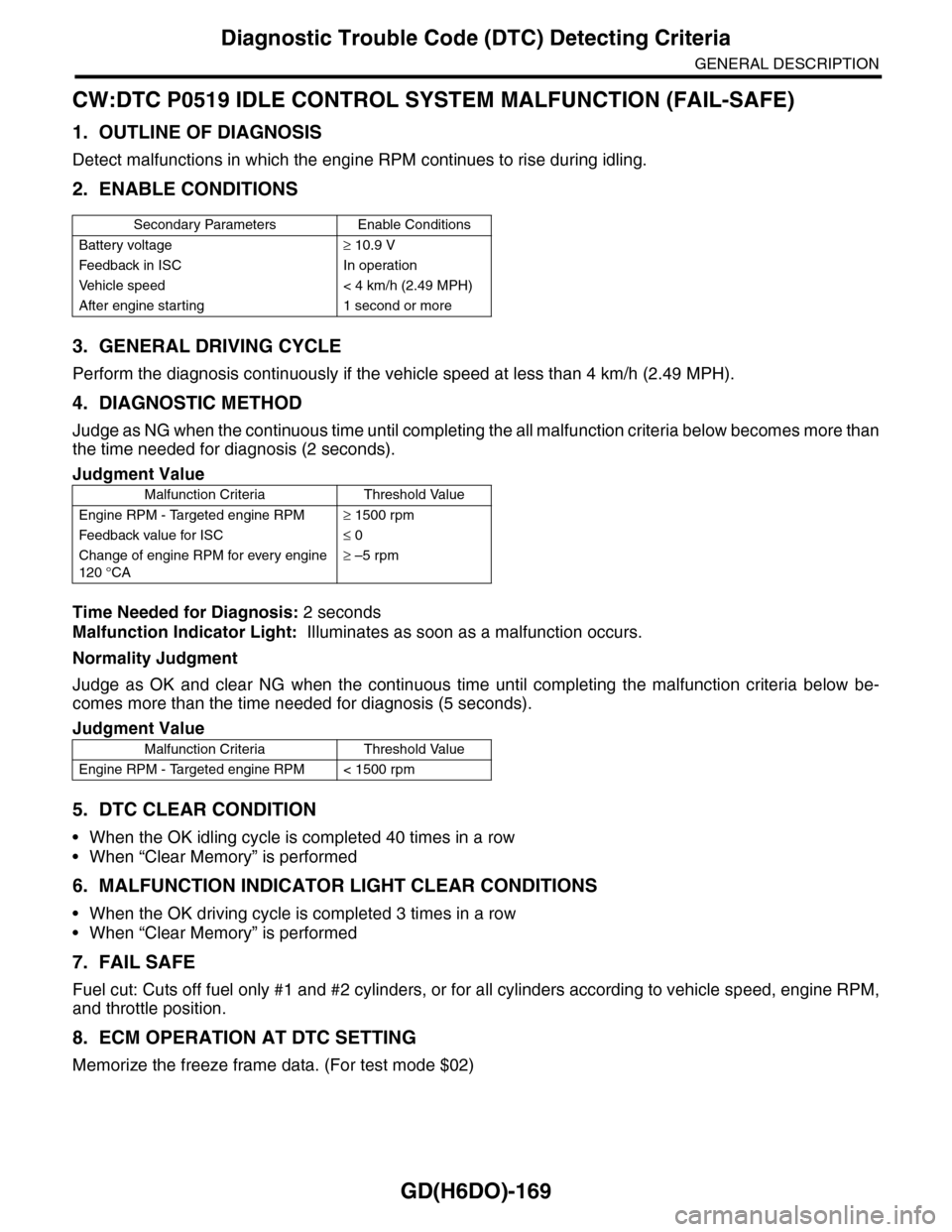
CW:DTC P0519 IDLE CONTROL SYSTEM MALFUNCTION (FAIL-SAFE)
1. OUTLINE OF DIAGNOSIS
Detect malfunctions in which the engine RPM continues to rise during idling.
2. ENABLE CONDITIONS
3. GENERAL DRIVING CYCLE
Perform the diagnosis continuously if the vehicle speed at less than 4 km/h (2.49 MPH).
4. DIAGNOSTIC METHOD
Judge as NG when the continuous time until completing the all malfunction criteria below becomes more than
the time needed for diagnosis (2 seconds).
Time Needed for Diagnosis: 2 seconds
Malfunction Indicator Light: Illuminates as soon as a malfunction occurs.
Normality Judgment
Judge as OK and clear NG when the continuous time until completing the malfunction criteria below be-
comes more than the time needed for diagnosis (5 seconds).
5. DTC CLEAR CONDITION
•When the OK idling cycle is completed 40 times in a row
•When “Clear Memory” is performed
6. MALFUNCTION INDICATOR LIGHT CLEAR CONDITIONS
•When the OK driving cycle is completed 3 times in a row
•When “Clear Memory” is performed
7. FAIL SAFE
Fuel cut: Cuts off fuel only #1 and #2 cylinders, or for all cylinders according to vehicle speed, engine RPM,
and throttle position.
8. ECM OPERATION AT DTC SETTING
Memorize the freeze frame data. (For test mode $02)
Secondary Parameters Enable Conditions
Battery voltage≥ 10.9 V
Feedback in ISC In operation
Ve h i c l e s p e e d < 4 k m / h ( 2 . 4 9 M P H )
After engine starting 1 second or more
Judgment Value
Malfunction Criteria Threshold Value
Engine RPM - Targeted engine RPM≥ 1500 rpm
Feedback value for ISC≤ 0
Change of engine RPM for every engine
120 °CA
≥ –5 rpm
Judgment Value
Malfunction Criteria Threshold Value
Engine RPM - Targeted engine RPM < 1500 rpm
Page 1794 of 2453
GD(H6DO)-182
Diagnostic Trouble Code (DTC) Detecting Criteria
GENERAL DESCRIPTION
DF:DTC P1152 O2 SENSOR CIRCUIT RANGE/PERFORMANCE (LOW) (BANK 1
SENSOR 1)
1. OUTLINE OF DIAGNOSIS
Detect that λ value remains low.
Judge as NG when lambda value is abnormal in accordance with λ value of front oxygen (A/F) sensor and
running conditions such as vehicle speed, amount of intake air engine coolant temperature, sub feedback
control, etc.
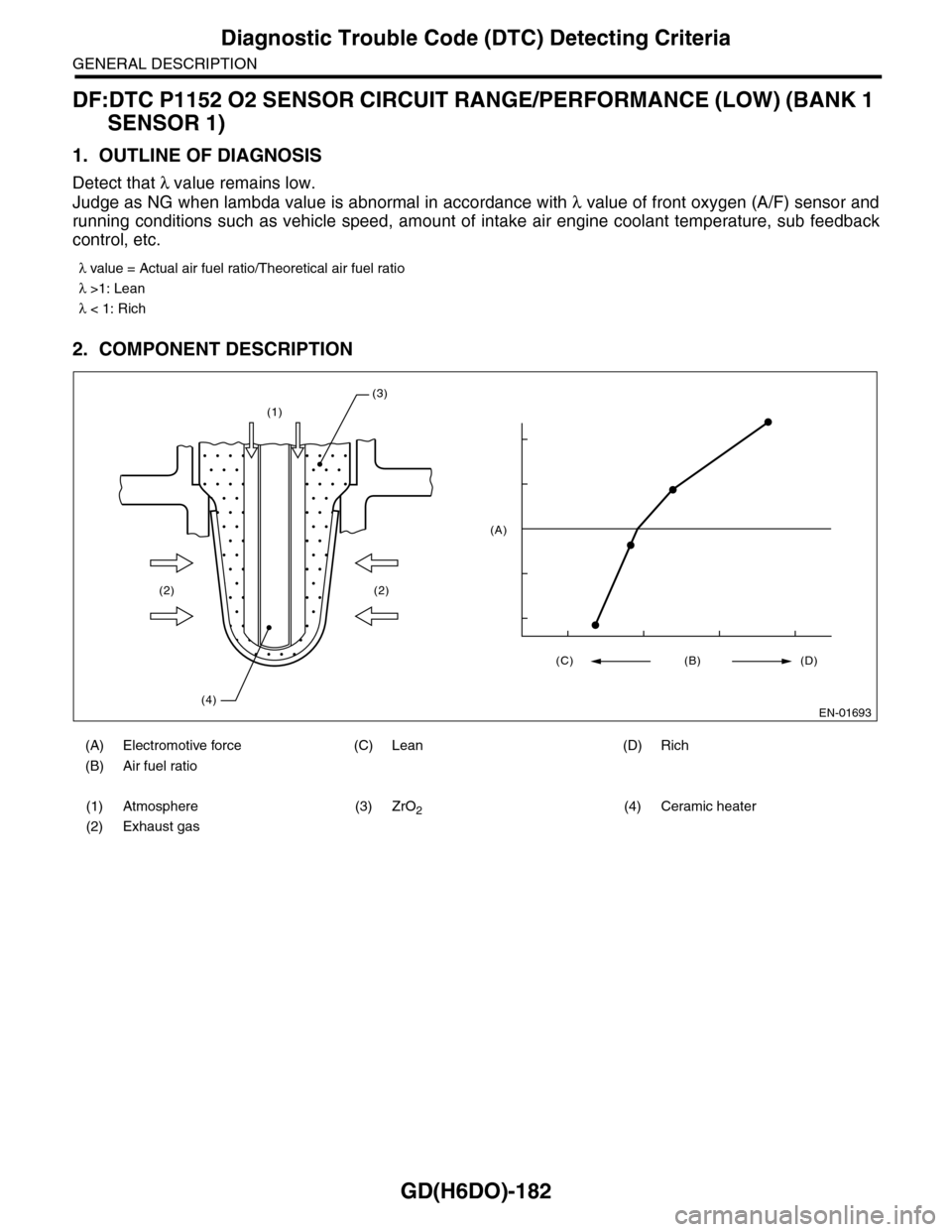
2. COMPONENT DESCRIPTION
λ value = Actual air fuel ratio/Theoretical air fuel ratio
λ >1: Lean
λ < 1: Rich
(A) Electromotive force (C) Lean (D) Rich
(B) Air fuel ratio
(1) Atmosphere (3) ZrO2(4) Ceramic heater
(2) Exhaust gas
(1)
(2)
(4)
(2)
(3)
EN-01693
(C) (B) (D)
(A)
Page 1795 of 2453
GD(H6DO)-183
Diagnostic Trouble Code (DTC) Detecting Criteria
GENERAL DESCRIPTION
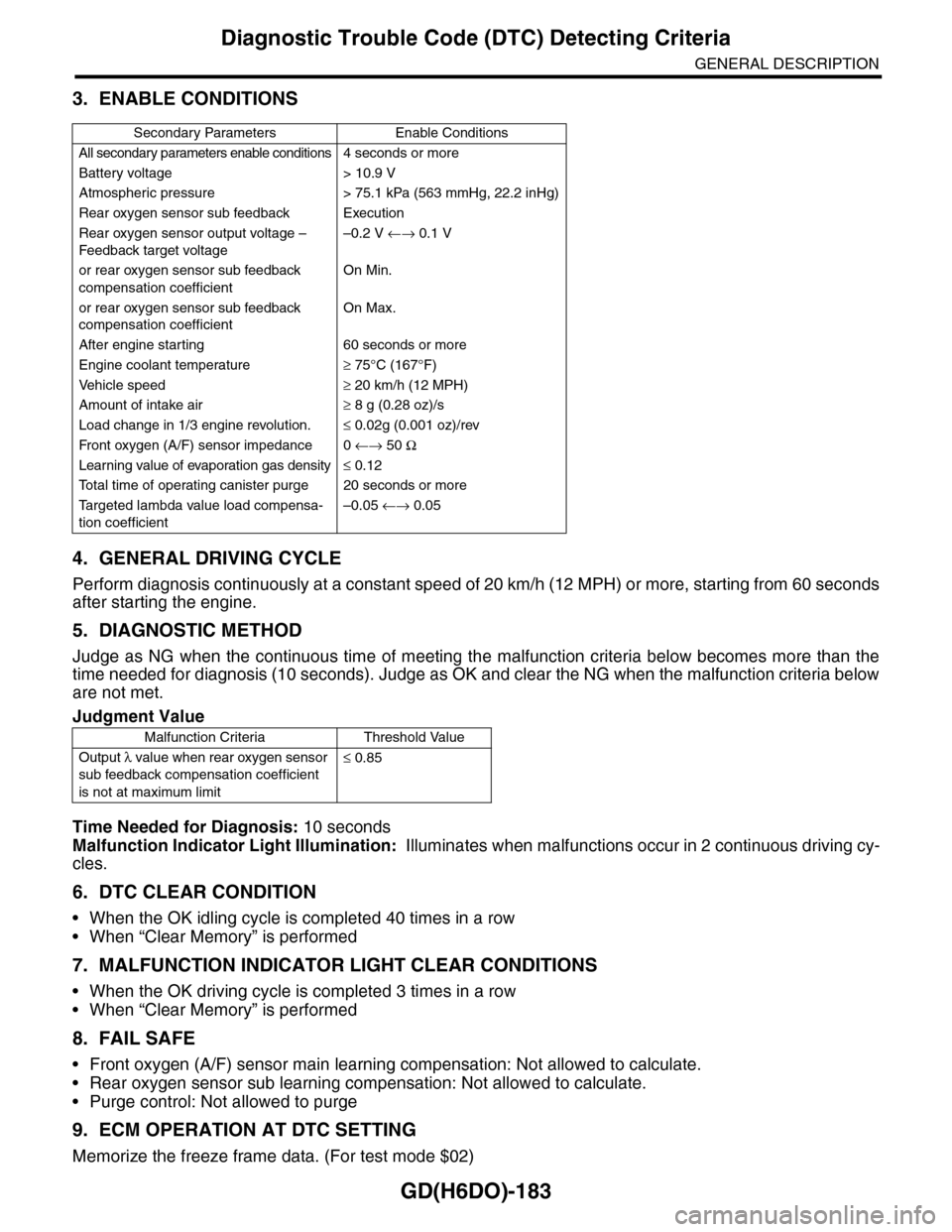
3. ENABLE CONDITIONS
4. GENERAL DRIVING CYCLE
Perform diagnosis continuously at a constant speed of 20 km/h (12 MPH) or more, starting from 60 seconds
after starting the engine.
5. DIAGNOSTIC METHOD
Judge as NG when the continuous time of meeting the malfunction criteria below becomes more than the
time needed for diagnosis (10 seconds). Judge as OK and clear the NG when the malfunction criteria below
are not met.
Time Needed for Diagnosis: 10 seconds
Malfunction Indicator Light Illumination: Illuminates when malfunctions occur in 2 continuous driving cy-
cles.
6. DTC CLEAR CONDITION
•When the OK idling cycle is completed 40 times in a row
•When “Clear Memory” is performed
7. MALFUNCTION INDICATOR LIGHT CLEAR CONDITIONS
•When the OK driving cycle is completed 3 times in a row
•When “Clear Memory” is performed
8. FAIL SAFE
•Front oxygen (A/F) sensor main learning compensation: Not allowed to calculate.
•Rear oxygen sensor sub learning compensation: Not allowed to calculate.
•Purge control: Not allowed to purge
9. ECM OPERATION AT DTC SETTING
Memorize the freeze frame data. (For test mode $02)
Secondary Parameters Enable Conditions
All secondary parameters enable conditions4 seconds or more
Battery voltage > 10.9 V
Atmospheric pressure > 75.1 kPa (563 mmHg, 22.2 inHg)
Rear oxygen sensor sub feedback Execution
Rear oxygen sensor output voltage –
Feedback target voltage
–0.2 V ←→ 0.1 V
or rear oxygen sensor sub feedback
compensation coefficient
On Min.
or rear oxygen sensor sub feedback
compensation coefficient
On Max.
After engine starting 60 seconds or more
Engine coolant temperature≥ 75°C (167°F)
Ve h i c l e s p e e d≥ 20 km/h (12 MPH)
Amount of intake air≥ 8 g (0.28 oz)/s
Load change in 1/3 engine revolution.≤ 0.02g (0.001 oz)/rev
Fr o nt ox yg e n ( A / F) s en so r im pe d an c e 0 ←→ 50 Ω
Learning value of evaporation gas density≤ 0.12
To t a l t i m e o f o p e r a t i n g c a n i s t e r p u r g e 2 0 s e c o n d s o r m o r e
Ta r g e t e d l a m b d a v a l u e l o a d c o m p e n s a -
tion coefficient
–0.05 ←→ 0.05
Judgment Value
Malfunction Criteria Threshold Value
Output λ value when rear oxygen sensor
sub feedback compensation coefficient
is not at maximum limit
≤ 0.85
Page 1796 of 2453
GD(H6DO)-184
Diagnostic Trouble Code (DTC) Detecting Criteria
GENERAL DESCRIPTION
DG:DTC P1153 O2 SENSOR CIRCUIT RANGE/PERFORMANCE (HIGH) (BANK 1
SENSOR 1)
1. OUTLINE OF DIAGNOSIS
Detect that λ value remains high.
Judge as NG when lambda value is abnormal in accordance with λ value of front oxygen (A/F) sensor and
running conditions such as vehicle speed, amount of intake air engine coolant temperature, sub feedback
control, etc.
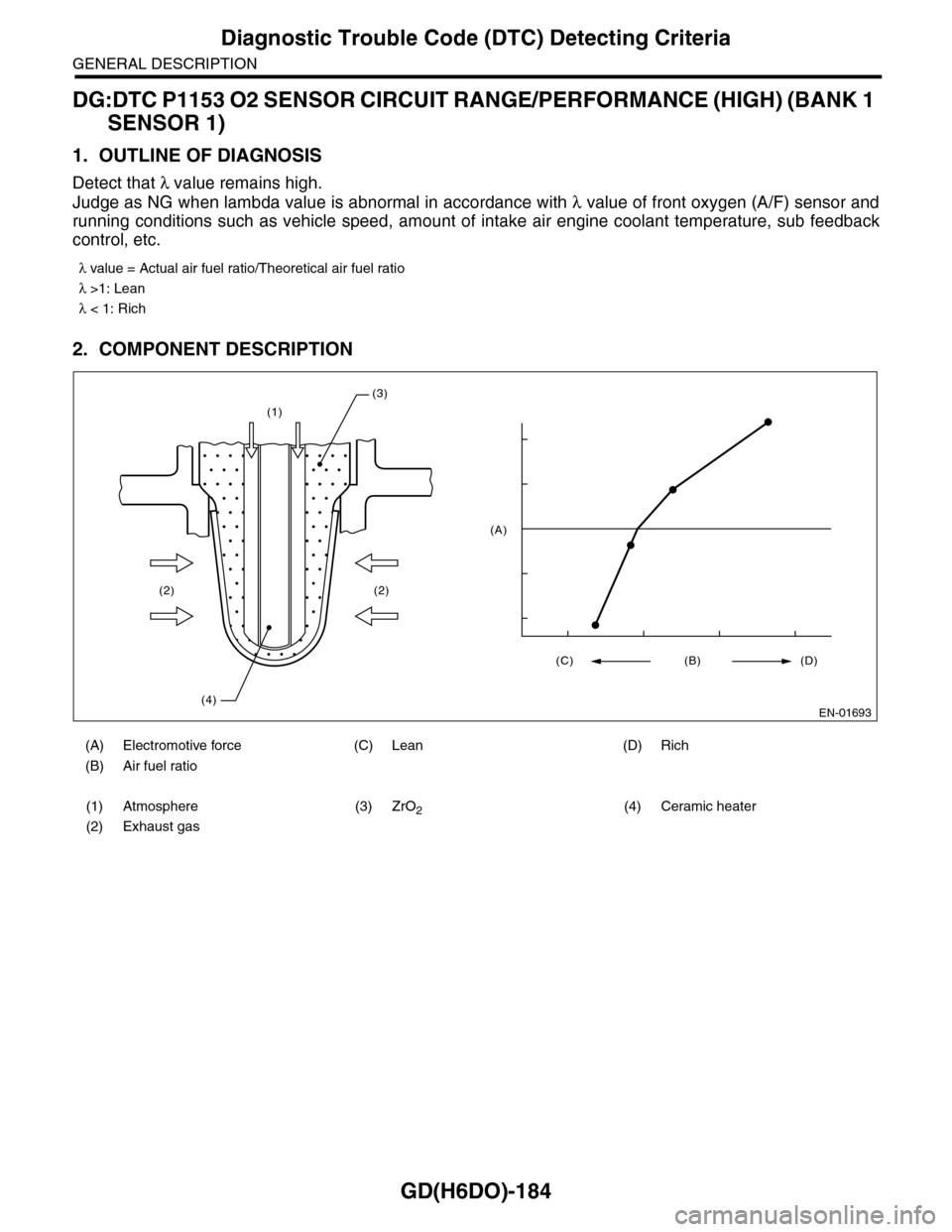
2. COMPONENT DESCRIPTION
λ value = Actual air fuel ratio/Theoretical air fuel ratio
λ >1: Lean
λ < 1: Rich
(A) Electromotive force (C) Lean (D) Rich
(B) Air fuel ratio
(1) Atmosphere (3) ZrO2(4) Ceramic heater
(2) Exhaust gas
(1)
(2)
(4)
(2)
(3)
EN-01693
(C) (B) (D)
(A)
Page 1797 of 2453
GD(H6DO)-185
Diagnostic Trouble Code (DTC) Detecting Criteria
GENERAL DESCRIPTION
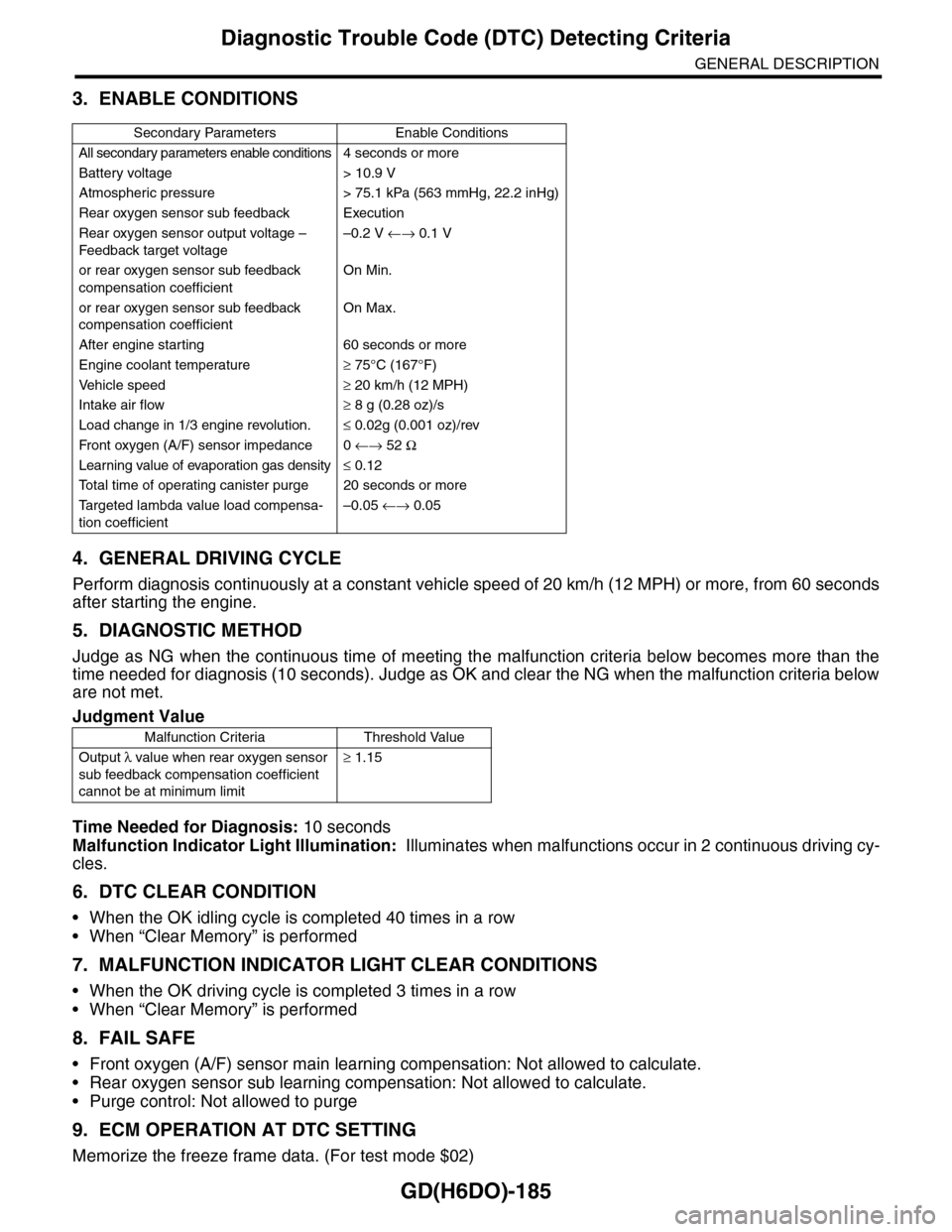
3. ENABLE CONDITIONS
4. GENERAL DRIVING CYCLE
Perform diagnosis continuously at a constant vehicle speed of 20 km/h (12 MPH) or more, from 60 seconds
after starting the engine.
5. DIAGNOSTIC METHOD
Judge as NG when the continuous time of meeting the malfunction criteria below becomes more than the
time needed for diagnosis (10 seconds). Judge as OK and clear the NG when the malfunction criteria below
are not met.
Time Needed for Diagnosis: 10 seconds
Malfunction Indicator Light Illumination: Illuminates when malfunctions occur in 2 continuous driving cy-
cles.
6. DTC CLEAR CONDITION
•When the OK idling cycle is completed 40 times in a row
•When “Clear Memory” is performed
7. MALFUNCTION INDICATOR LIGHT CLEAR CONDITIONS
•When the OK driving cycle is completed 3 times in a row
•When “Clear Memory” is performed
8. FAIL SAFE
•Front oxygen (A/F) sensor main learning compensation: Not allowed to calculate.
•Rear oxygen sensor sub learning compensation: Not allowed to calculate.
•Purge control: Not allowed to purge
9. ECM OPERATION AT DTC SETTING
Memorize the freeze frame data. (For test mode $02)
Secondary Parameters Enable Conditions
All secondary parameters enable conditions4 seconds or more
Battery voltage > 10.9 V
Atmospheric pressure > 75.1 kPa (563 mmHg, 22.2 inHg)
Rear oxygen sensor sub feedback Execution
Rear oxygen sensor output voltage –
Feedback target voltage
–0.2 V ←→ 0.1 V
or rear oxygen sensor sub feedback
compensation coefficient
On Min.
or rear oxygen sensor sub feedback
compensation coefficient
On Max.
After engine starting 60 seconds or more
Engine coolant temperature≥ 75°C (167°F)
Ve h i c l e s p e e d≥ 20 km/h (12 MPH)
Intake air flow≥ 8 g (0.28 oz)/s
Load change in 1/3 engine revolution.≤ 0.02g (0.001 oz)/rev
Fr o nt ox yg e n ( A / F) s en so r im pe d an c e 0 ←→ 52 Ω
Learning value of evaporation gas density≤ 0.12
To t a l t i m e o f o p e r a t i n g c a n i s t e r p u r g e 2 0 s e c o n d s o r m o r e
Ta r g e t e d l a m b d a v a l u e l o a d c o m p e n s a -
tion coefficient
–0.05 ←→ 0.05
Judgment Value
Malfunction Criteria Threshold Value
Output λ value when rear oxygen sensor
sub feedback compensation coefficient
cannot be at minimum limit
≥ 1.15
Page 1804 of 2453
GD(H6DO)-192
Diagnostic Trouble Code (DTC) Detecting Criteria
GENERAL DESCRIPTION
DM:DTC P1560 BACK-UP VOLTAGE CIRCUIT MALFUNCTION
1. OUTLINE OF DIAGNOSIS
Detect the open/short circuit of back-up power supply circuit.
Judge as NG when the backup power voltage is low.
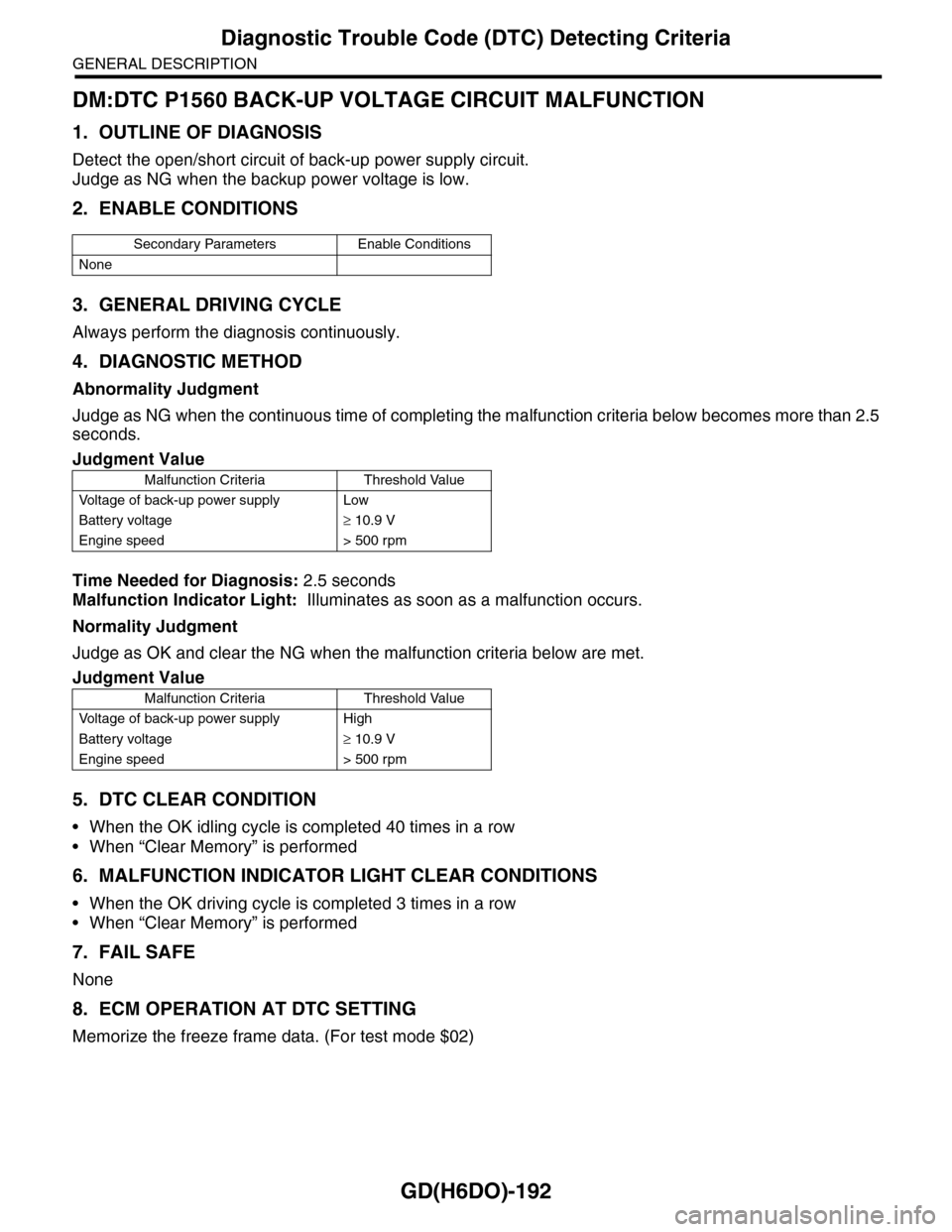
2. ENABLE CONDITIONS
3. GENERAL DRIVING CYCLE
Always perform the diagnosis continuously.
4. DIAGNOSTIC METHOD
Abnormality Judgment
Judge as NG when the continuous time of completing the malfunction criteria below becomes more than 2.5
seconds.
Time Needed for Diagnosis: 2.5 seconds
Malfunction Indicator Light: Illuminates as soon as a malfunction occurs.
Normality Judgment
Judge as OK and clear the NG when the malfunction criteria below are met.
5. DTC CLEAR CONDITION
•When the OK idling cycle is completed 40 times in a row
•When “Clear Memory” is performed
6. MALFUNCTION INDICATOR LIGHT CLEAR CONDITIONS
•When the OK driving cycle is completed 3 times in a row
•When “Clear Memory” is performed
7. FAIL SAFE
None
8. ECM OPERATION AT DTC SETTING
Memorize the freeze frame data. (For test mode $02)
Secondary Parameters Enable Conditions
None
Judgment Value
Malfunction Criteria Threshold Value
Vo l t a g e o f b a c k - u p p o w e r s u p p l y L o w
Battery voltage≥ 10.9 V
Engine speed > 500 rpm
Judgment Value
Malfunction Criteria Threshold Value
Vo l t a g e o f b a c k - u p p o w e r s u p p l y H i g h
Battery voltage≥ 10.9 V
Engine speed > 500 rpm
Page 1809 of 2453
GD(H6DO)-197
Diagnostic Trouble Code (DTC) Detecting Criteria
GENERAL DESCRIPTION
DY:DTC P2096 POST CATALYST FUEL TRIM SYSTEM TOO LEAN (BANK 1)
1. OUTLINE OF DIAGNOSIS
Detect the malfunction of fuel system from the size of the sub feedback learning value.
Control the sub feedback learning and judge as NG when the learning value is in the lean zone.
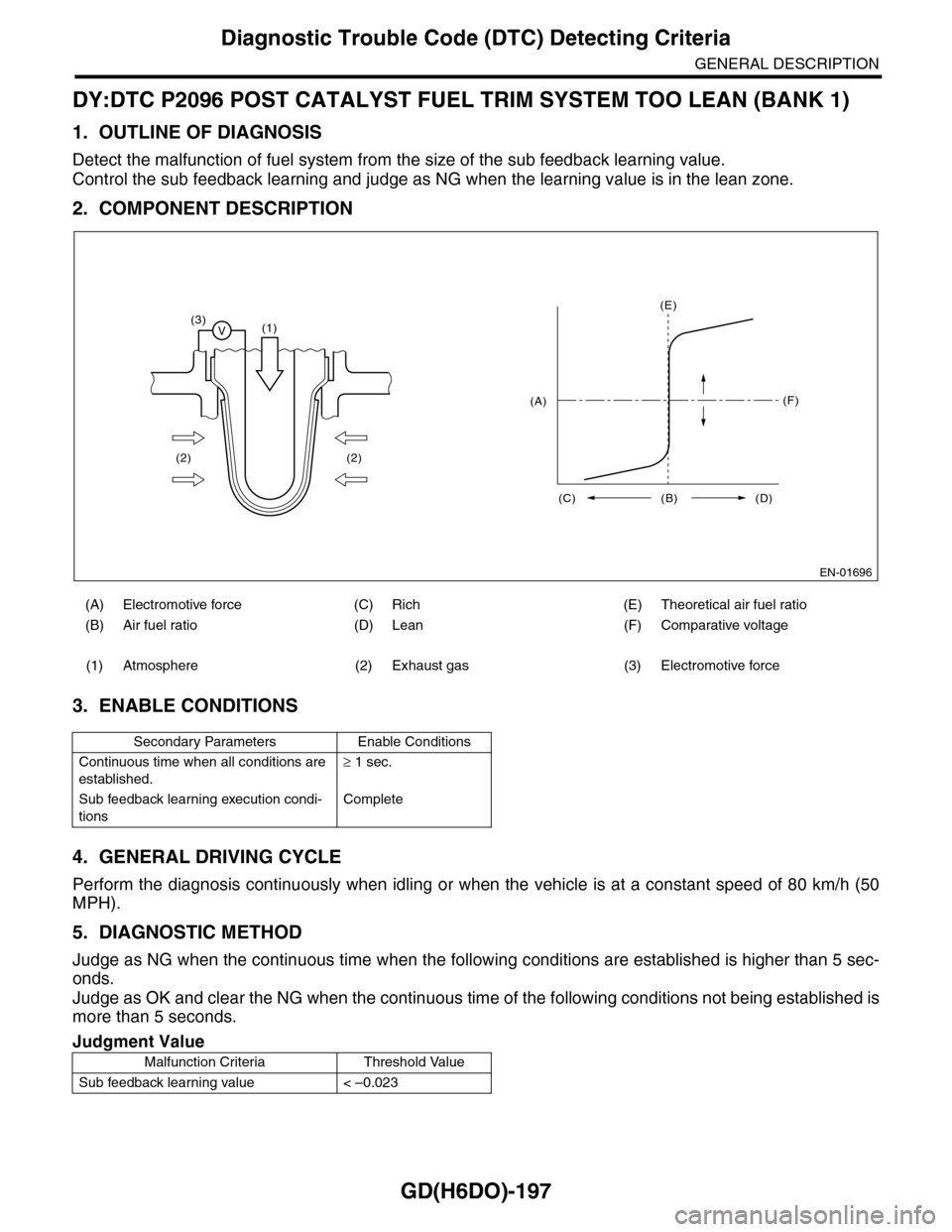
2. COMPONENT DESCRIPTION
3. ENABLE CONDITIONS
4. GENERAL DRIVING CYCLE
Perform the diagnosis continuously when idling or when the vehicle is at a constant speed of 80 km/h (50
MPH).
5. DIAGNOSTIC METHOD
Judge as NG when the continuous time when the following conditions are established is higher than 5 sec-
onds.
Judge as OK and clear the NG when the continuous time of the following conditions not being established is
more than 5 seconds.
(A) Electromotive force (C) Rich (E) Theoretical air fuel ratio
(B) Air fuel ratio (D) Lean (F) Comparative voltage
(1) Atmosphere (2) Exhaust gas (3) Electromotive force
Secondary Parameters Enable Conditions
Continuous time when all conditions are
established.
≥ 1 sec.
Sub feedback learning execution condi-
tions
Complete
Judgment Value
Malfunction Criteria Threshold Value
Sub feedback learning value < –0.023
EN-01696
(3)V(1)
(2) (2)
(E)
(F)
(C) (B) (D)
(A)
Page 1811 of 2453
GD(H6DO)-199
Diagnostic Trouble Code (DTC) Detecting Criteria
GENERAL DESCRIPTION
DZ:DTC P2097 POST CATALYST FUEL TRIM SYSTEM TOO RICH (BANK 1)
1. OUTLINE OF DIAGNOSIS
Detect the malfunction of fuel system from the size of the sub feedback learning value.
Sub feedback learning is being performed. When the learning value goes to the rich side, judge as NG.
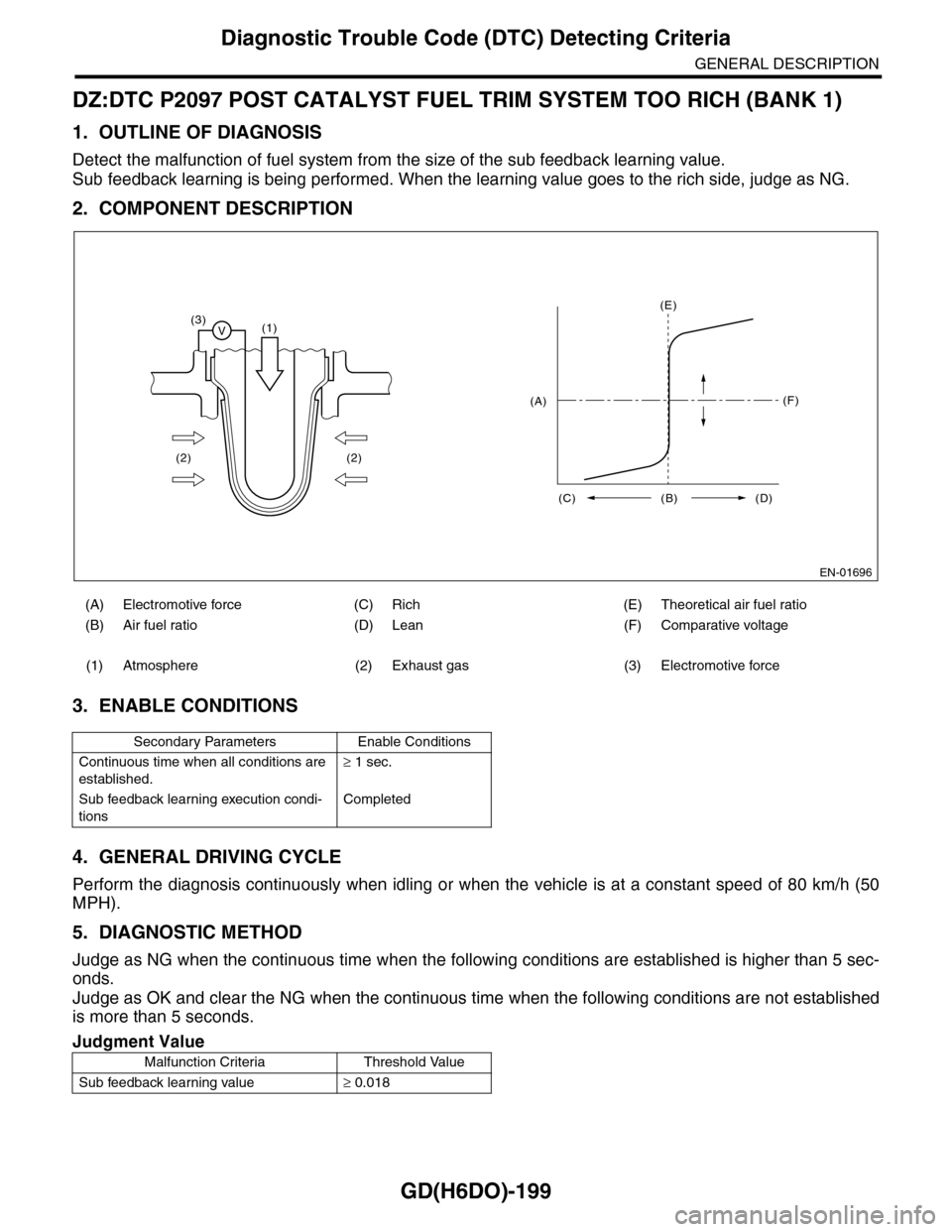
2. COMPONENT DESCRIPTION
3. ENABLE CONDITIONS
4. GENERAL DRIVING CYCLE
Perform the diagnosis continuously when idling or when the vehicle is at a constant speed of 80 km/h (50
MPH).
5. DIAGNOSTIC METHOD
Judge as NG when the continuous time when the following conditions are established is higher than 5 sec-
onds.
Judge as OK and clear the NG when the continuous time when the following conditions are not established
is more than 5 seconds.
(A) Electromotive force (C) Rich (E) Theoretical air fuel ratio
(B) Air fuel ratio (D) Lean (F) Comparative voltage
(1) Atmosphere (2) Exhaust gas (3) Electromotive force
Secondary Parameters Enable Conditions
Continuous time when all conditions are
established.
≥ 1 sec.
Sub feedback learning execution condi-
tions
Completed
Judgment Value
Malfunction Criteria Threshold Value
Sub feedback learning value≥ 0.018
EN-01696
(3)V(1)
(2) (2)
(E)
(F)
(C) (B) (D)
(A)
Page 1846 of 2453
IN(H6DO)-4
Air Cleaner Element
INTAKE (INDUCTION)
2. Air Cleaner Element
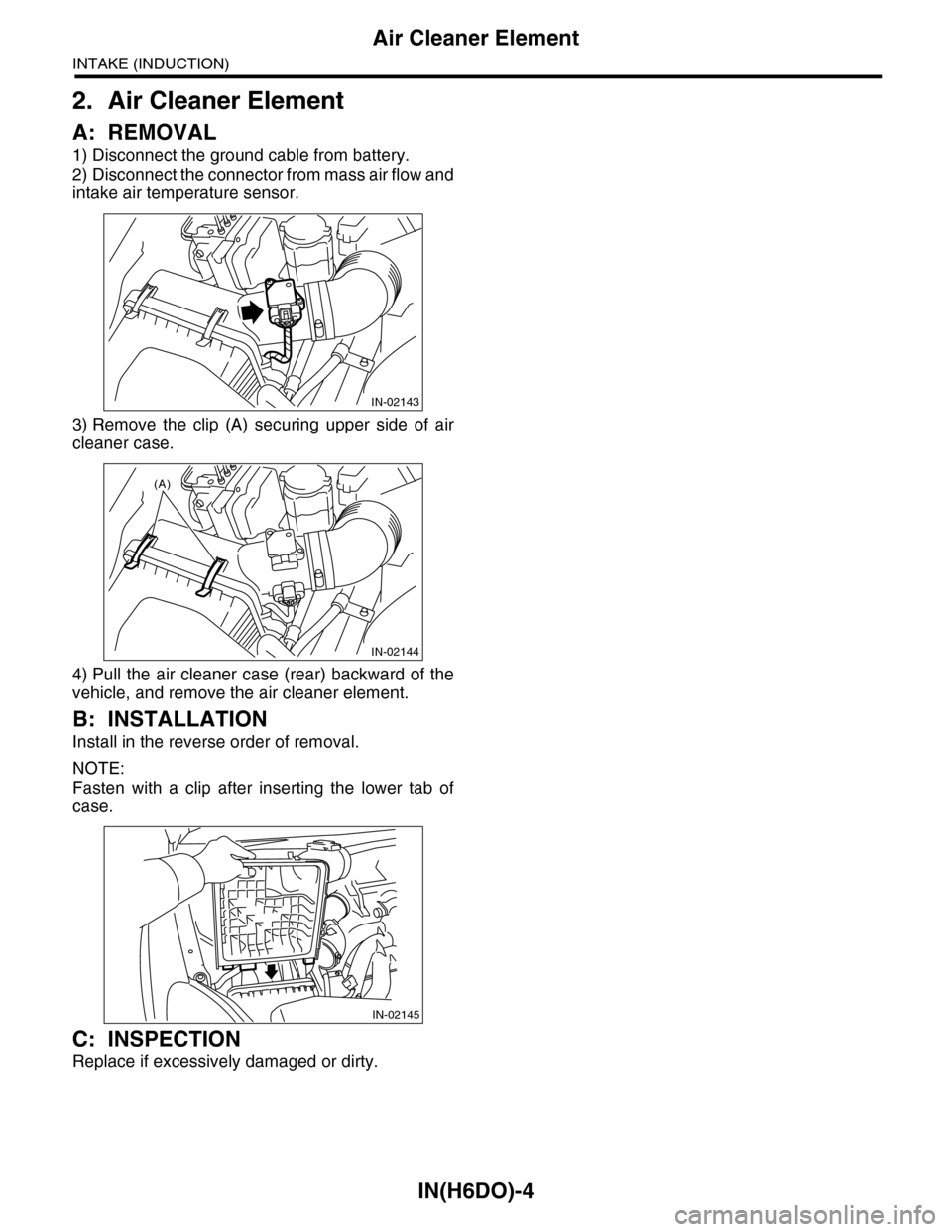
A: REMOVAL
1) Disconnect the ground cable from battery.
2) Disconnect the connector from mass air flow and
intake air temperature sensor.
3) Remove the clip (A) securing upper side of air
cleaner case.
4) Pull the air cleaner case (rear) backward of the
vehicle, and remove the air cleaner element.
B: INSTALLATION
Install in the reverse order of removal.
NOTE:
Fasten with a clip after inserting the lower tab of
case.
C: INSPECTION
Replace if excessively damaged or dirty.
IN-02143
IN-02144
(A)
IN-02145
Page 1920 of 2453
ME(H6DO)-54
Camshaft
MECHANICAL
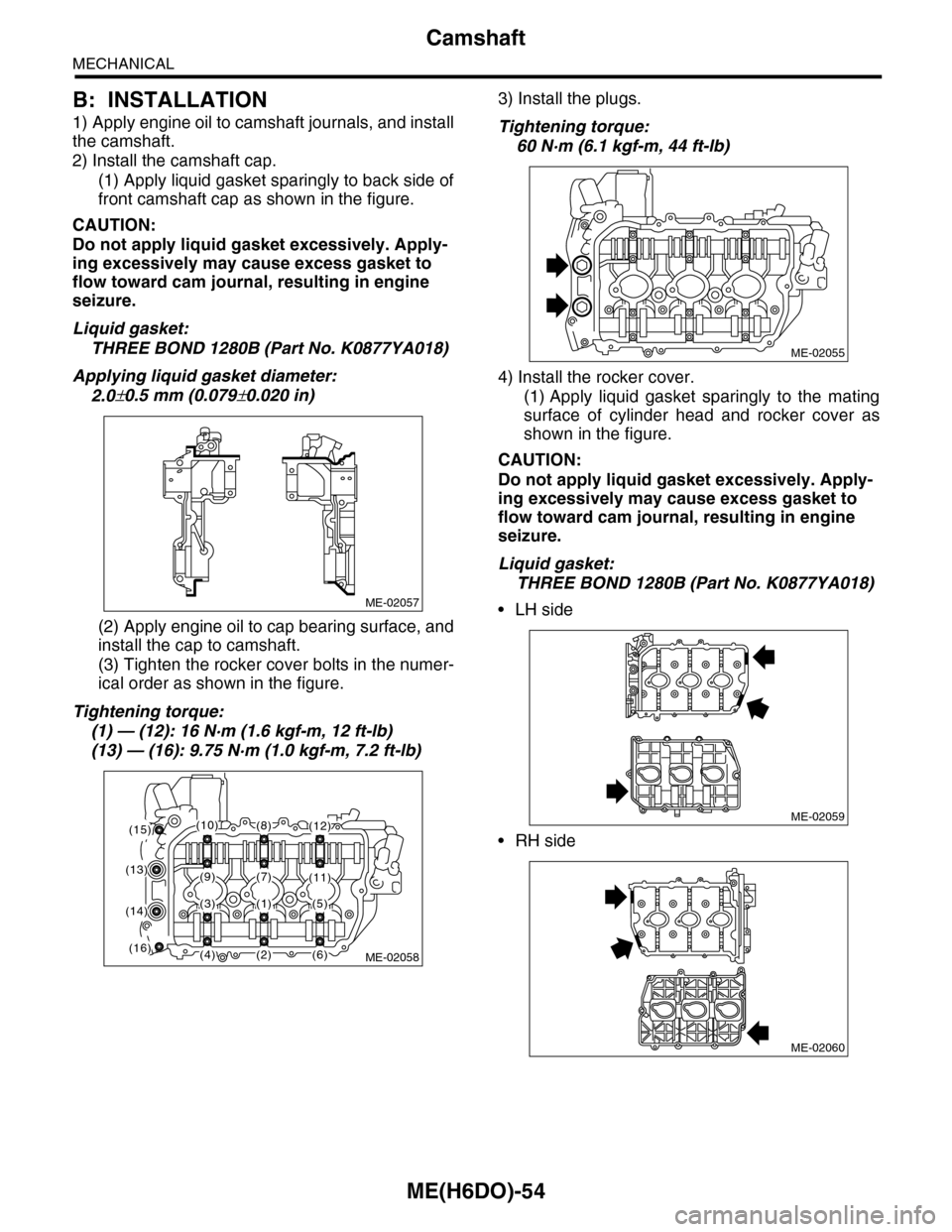
B: INSTALLATION
1) Apply engine oil to camshaft journals, and install
the camshaft.
2) Install the camshaft cap.
(1) Apply liquid gasket sparingly to back side of
front camshaft cap as shown in the figure.
CAUTION:
Do not apply liquid gasket excessively. Apply-
ing excessively may cause excess gasket to
flow toward cam journal, resulting in engine
seizure.
Liquid gasket:
THREE BOND 1280B (Part No. K0877YA018)
Applying liquid gasket diameter:
2.0±0.5 mm (0.079±0.020 in)
(2) Apply engine oil to cap bearing surface, and
install the cap to camshaft.
(3) Tighten the rocker cover bolts in the numer-
ical order as shown in the figure.
Tightening torque:
(1) — (12): 16 N·m (1.6 kgf-m, 12 ft-lb)
(13) — (16): 9.75 N·m (1.0 kgf-m, 7.2 ft-lb)
3) Install the plugs.
Tightening torque:
60 N·m (6.1 kgf-m, 44 ft-lb)
4) Install the rocker cover.
(1) Apply liquid gasket sparingly to the mating
surface of cylinder head and rocker cover as
shown in the figure.
CAUTION:
Do not apply liquid gasket excessively. Apply-
ing excessively may cause excess gasket to
flow toward cam journal, resulting in engine
seizure.
Liquid gasket:
THREE BOND 1280B (Part No. K0877YA018)
•LH side
•RH side
ME-02057
ME-02058
(1)
(2)
(8)
(7)(9)
(3)
(4)
(5)
(6)
(10)
(11)(13)
(14)
(15)
(16)
(12)
ME-02055
ME-02059
ME-02060