ESP SUBARU TRIBECA 2014 1.G Workshop Manual
[x] Cancel search | Manufacturer: SUBARU, Model Year: 2014, Model line: TRIBECA, Model: SUBARU TRIBECA 2014 1.GPages: 426, PDF Size: 6.37 MB
Page 302 of 426
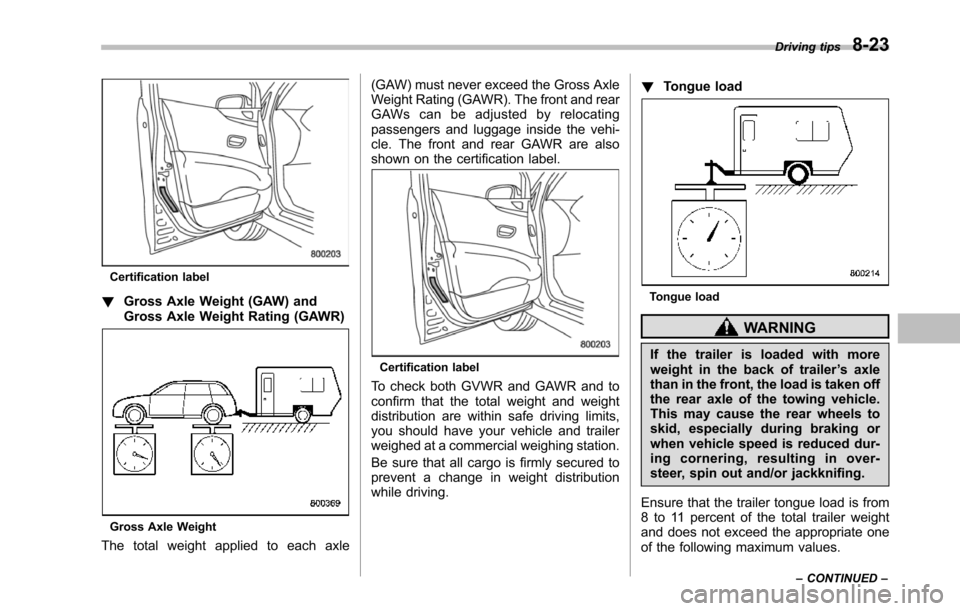
Certification label
!Gross Axle Weight (GAW) andGross Axle Weight Rating (GAWR)
Gross Axle Weight
The total weight applied to each axle
(GAW) must never exceed the Gross AxleWeight Rating (GAWR). The front and rearGAWs can be adjusted by relocatingpassengers and luggage inside the vehi-cle. The front and rear GAWR are alsoshown on the certification label.
Certification label
To check both GVWR and GAWR and toconfirm that the total weight and weightdistribution are within safe driving limits,you shouldhave your vehicle and trailerweighed at a commercial weighing station.
Be sure that all cargo is firmly secured toprevent a change in weight distributionwhile driving.
!Tongue load
Tongue load
WARNING
If the trailer is loaded with moreweight in the back of trailer’s axlethan in the front, the load is taken offthe rear axle of the towing vehicle.This may cause the rear wheels toskid, especially during braking orwhen vehicle speed is reduced dur-ing cornering, resulting in over-steer, spin out and/or jackknifing.
Ensure that the trailer tongue load is from8 to 11 percent of the total trailer weightand does not exceed the appropriate oneof the following maximum values.
Driving tips8-23
–CONTINUED–
Page 309 of 426
9-2In case of emergency
If you park your vehicle in an
emergency
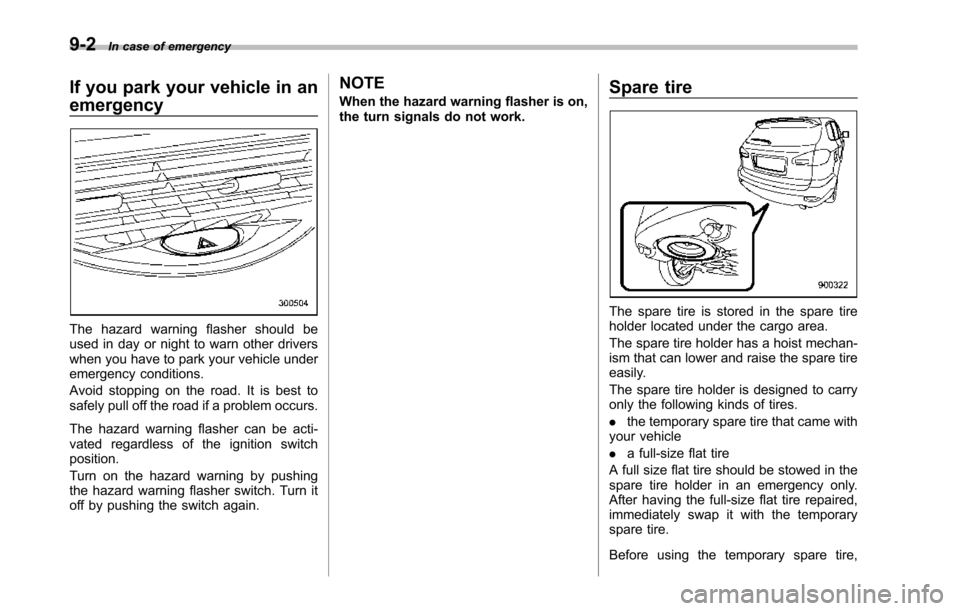
The hazard warning flasher should beused in day or night to warn other driverswhen you have to park your vehicle underemergency conditions.
Avoid stopping on the road. It is best tosafely pull off the road if a problem occurs.
The hazard warning flasher can be acti-vated regardless of the ignition switchposition.
Turn on the hazard warning by pushingthe hazard warning flasher switch. Turn itoff by pushing the switch again.
NOTE
When the hazard warning flasher is on,the turn signals do not work.
Spare tire
The spare tire is stored in the spare tireholder located under the cargo area.
The spare tire holder has a hoist mechan-ism that can lower and raise the spare tireeasily.
The sparetire holder is designed to carryonly the following kinds of tires.
.the temporary spare tire that came withyour vehicle
.a full-size flat tire
A full size flat tire should be stowed in thespare tire holder in an emergency only.After having the full-size flat tire repaired,immediately swap it with the temporaryspare tire.
Before using the temporary spare tire,
Page 312 of 426
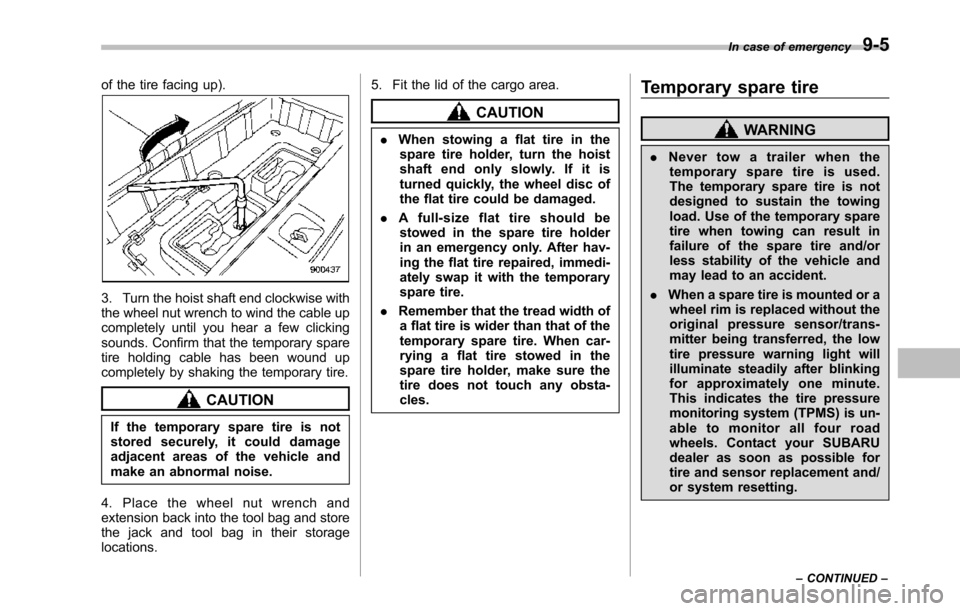
of the tire facing up).
3. Turn the hoist shaft end clockwise withthe wheel nut wrench to wind the cable upcompletely until you hear a few clickingsounds.Confirm that the temporary sparetire holding cable has been wound upcompletely by shaking the temporary tire.
CAUTION
If the temporary spare tire is notstored securely, it could damageadjacent areas of the vehicle andmake an abnormal noise.
4. Place the wheel nut wrench andextension back into the tool bag and storethe jackand tool bag in their storagelocations.
5. Fit the lid of the cargo area.
CAUTION
.When stowing a flat tire in thespare tire holder, turn the hoistshaft end only slowly. If it isturned quickly, the wheel disc ofthe flat tire could be damaged.
.Afull-sizeflattireshouldbestowed in the spare tire holderin an emergency only. After hav-ingthe flat tire repaired, immedi-ately swap it with the temporaryspare tire.
.Remember that the tread width ofa flat tire is wider than that of thetemporary spare tire. When car-rying a flat tire stowed in thespare tire holder, make sure thetiredoes not touch any obsta-cles.
Temporary spare tire
WARNING
.Never tow a trailer when thetemporary spare tire is used.The temporary spare tire is notdesigned to sustain the towingload. Use of the temporary sparetire when towing can result infailure of the spare tire and/orless stability of the vehicle andmay lead to an accident.
.When a spare tire is mounted or awheel rim is replaced without theoriginal pressure sensor/trans-mitter being transferred, the lowtire pressure warning light willilluminate steadily after blinkingfor approximately one minute.This indicates the tire pressuremonitoring system (TPMS) is un-able to monitor all four roadwheels. Contact your SUBARUdealer as soon as possible fortire and sensor replacement and/or system resetting.
In case of emergency9-5
–CONTINUED–
Page 317 of 426
9-10In case of emergency
holder.
Refer to“Spare tire”F9-2 for its location,instructions and precautions.
CAUTION
.When stowing a flat tire in thespare tire holder, turn the hoistshaft end only slowly. If it isturned quickly, the wheel disc ofthe flat tire could be damaged.
.Afull-sizeflattireshouldbestowed in the spare tire holderin an emergency only. After hav-ing the flat tire repaired, immedi-ately swap it with the temporaryspare tire.
.Remember that the tread width ofa flat tire is wider than that of thetemporary spare tire. When car-rying a flat tire stowed in thespare tire holder, make sure thetire does not touch any obsta-cles.
WARNING
Never place a tire or tire changingtools in the passenger compartmentafter changing wheels. In a suddenstop or collisions, loose equipment
could strike occupants and causeinjury. Store the tire and all tools inthe proper place.
&Tire pressure monitoring
system (TPMS)
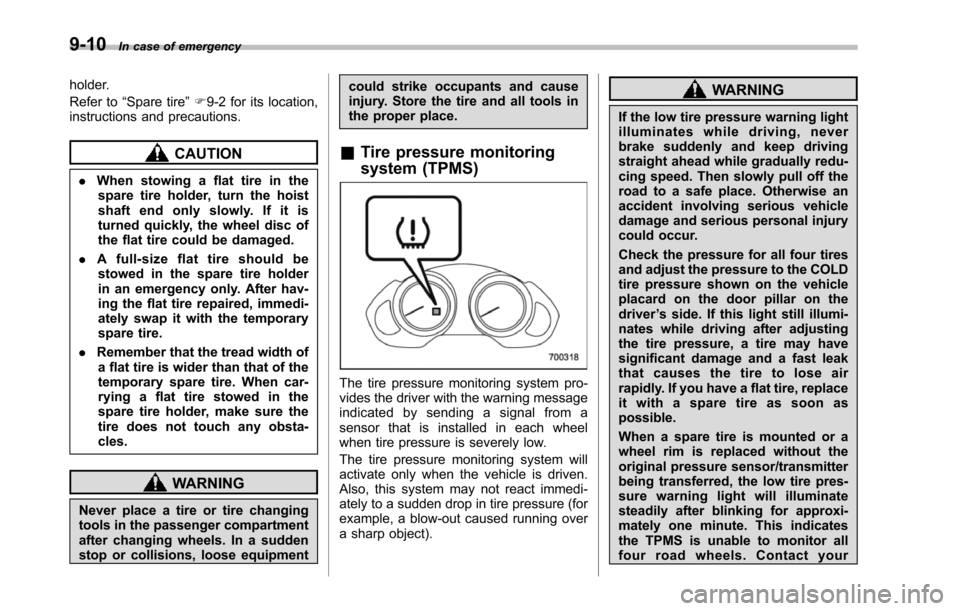
The tire pressure monitoring system pro-vides the driver with the warning messageindicated by sending a signal from asensor that is installed in each wheelwhen tire pressure is severely low.
The tire pressure monitoring system willactivate only when the vehicle is driven.Also, this system may not react immedi-ately to a sudden drop in tire pressure (forexample, a blow-out caused running overa sharp object).
WARNING
If the low tire pressure warning lightilluminates while driving, neverbrake suddenly and keep drivingstraight ahead while gradually redu-cing speed. Then slowly pull off theroad to a safe place. Otherwise anaccident involving serious vehicledamageand serious personal injurycould occur.
Check the pressure for all four tiresand adjust the pressure to the COLDtire pressure shown on the vehicleplacard on the door pillar on thedriver’s side. If this light still illumi-nates while driving after adjustingthe tire pressure, a tire may havesignificant damage and a fast leakthat causes the tire to lose airrapidly. If you have a flat tire, replaceit with a spare tire as soon aspossible.
When a spare tire is mounted or awheel rim is replaced without theoriginal pressure sensor/transmitterbeing transferred, the low tire pres-sure warning light will illuminatesteadily afterblinking for approxi-mately one minute. This indicatesthe TPMS is unable to monitor allfour road wheels. Contact your
Page 320 of 426
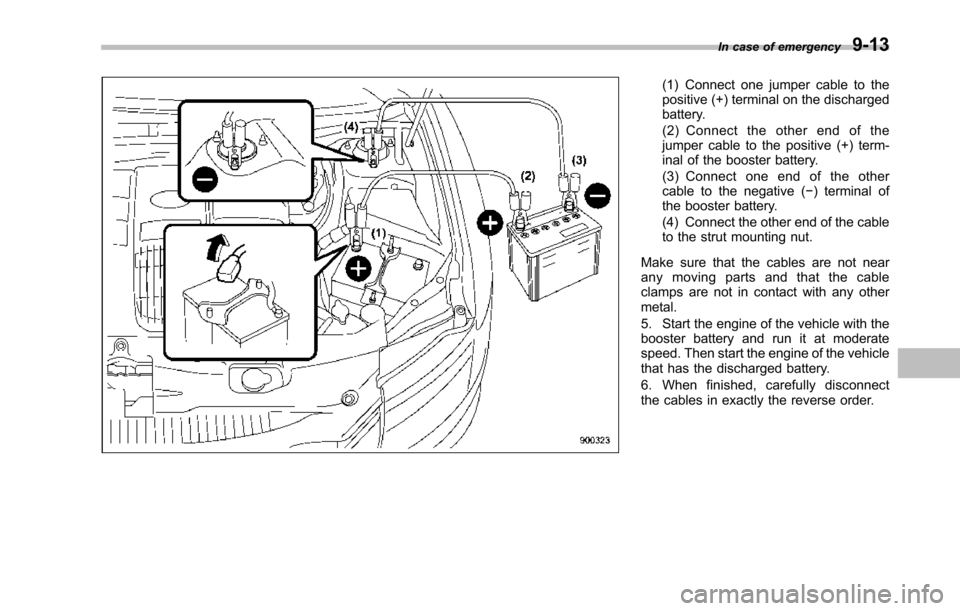
(1) Connect one jumper cable to thepositive (+) terminal on the dischargedbattery.(2) Connect the other end of thejumper cable to the positive (+) term-inal of the booster battery.(3) Connect one end of the othercable to the negative (!) terminal ofthe booster battery.(4) Connect the other end of the cableto the strut mounting nut.
Make sure that the cables are not nearany moving parts and that the cableclamps are not in contact with any othermetal.
5. Start the engine of the vehicle with thebooster batteryand run it at moderatespeed. Then start the engine of the vehiclethat has the discharged battery.
6. When finished, carefully disconnectthe cables in exactly the reverse order.
In case of emergency9-13
Page 331 of 426
10-4Appearance care
Corrosion protection
Your SUBARU has been designed andbuilt to resist corrosion. Special materialsand protective finishes have been used onmost parts of the vehicle to help maintainfine appearance, strength, and reliableoperation.
&Most common causes of
corrosion
The most common causes of corrosionare:
1. The accumulation of moisture retain-ing dirt and debris in body panel sections,cavities,and other areas.
2. Damage to paint and other protectivecoatings caused by gravel and stonechips or minor accidents.
Corrosion is accelerated on the vehiclewhen:
1. It is exposed to road salt or dustcontrol chemicals, or used in coastalareas where there is more salt in the air,or in areas where there is considerableindustrial pollution.
2. It is driven in areas of high humidity,especially when temperatures range justabove freezing.
3. Dampness in certain parts of thevehicle remainsfor a long time, even
though other parts of the vehicle may bedry.
4. High temperatures will cause corro-sion to parts of the vehicle which cannotdry quickly due to lack of proper ventila-tion.
&To help prevent corrosion
Wash the vehicle regularly to preventcorrosion of the body and suspensioncomponents. Also, wash the vehiclepromptly after driving on any of thefollowing surfaces.
.roads that have been salted to preventthem from freezing in winter
.mud, sand, or gravel
.coastal roads
After the winter has ended, it is recom-mended that the underbody be given avery thorough washing.
Before the beginning of winter, check thecondition of underbody components, suchas the exhaust system, fuel and brakelines, brake cables, suspension, steeringsystem, floor pan, and fenders. If any ofthem are found to be rusted, they shouldbe given an appropriate rust preventiontreatment or should be replaced. Contactyour SUBARU dealer to perform this kindof maintenance and treatment if you need
assistance.
Repair chips and scratches in the paint assoon as you find them.
Check the interior of the vehicle for waterand dirt accumulation under the floor matsbecause that could cause corrosion.Occasionally check under the mats tomake sure the area is dry.
Keep your garage dry. Do not park yourvehicle in a damp, poorly ventilatedgarage. In such a garage, corrosion canbe caused by dampness. If you wash thevehicle in the garage or put the vehicleinto the garage when wet or covered withsnow, that can cause dampness.
If your vehicle is operated in cold weatherand/or in areas where road salts and othercorrosive materials are used, the doorhinges and locks, and hood latch shouldbe inspected and lubricated periodically.
Page 352 of 426
Brake pedal
Check the brake pedal free play andreserve distance according to the main-tenance schedule in the“Warranty andMaintenance Booklet”.
&Checking the brake pedal
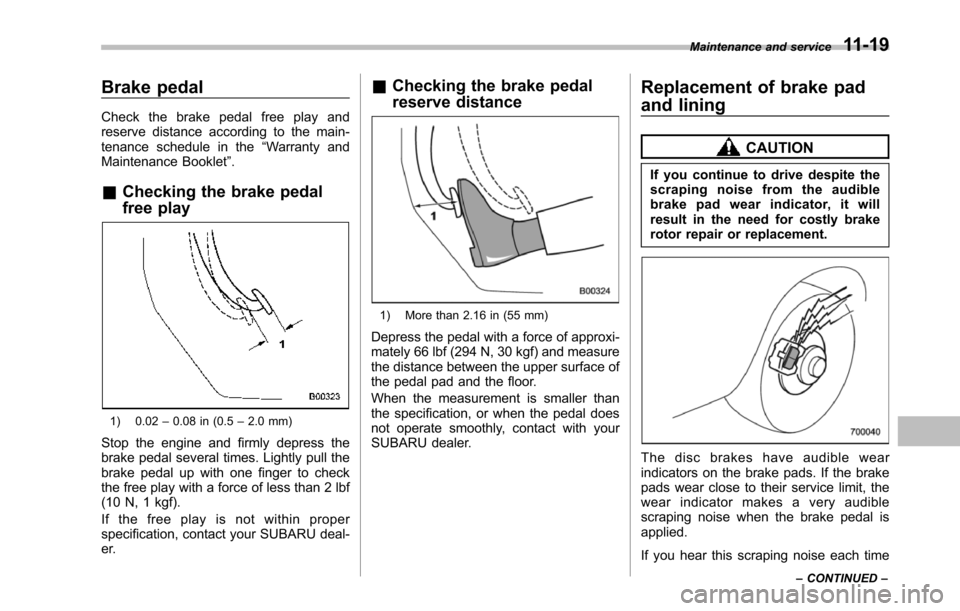
free play
1) 0.02–0.08 in (0.5–2.0 mm)
Stop the engine and firmly depress thebrake pedal several times. Lightly pull thebrake pedal up with one finger to checkthe free play with a force of less than 2 lbf(10 N, 1 kgf).
If the free play is not within properspecification, contact your SUBARU deal-er.
&Checking the brake pedal
reserve distance
1) More than 2.16 in (55 mm)
Depress the pedal with a force of approxi-mately 66 lbf (294 N, 30 kgf) and measurethe distance between the upper surface ofthe pedal pad and the floor.
When the measurement is smaller thanthe specification, or when the pedal doesnot operate smoothly, contact with yourSUBARU dealer.
Replacement of brake pad
and lining
CAUTION
If you continue to drive despite thescraping noise from the audiblebrake pad wear indicator, it willresult in the need for costly brakerotor repair or replacement.
The disc brakes have audible wearindicators on the brake pads. If the brakepads wear close to their service limit, thewear indicator makes a very audiblescraping noise when the brake pedal isapplied.
If you hear this scraping noise each time
Maintenance and service11-19
–CONTINUED–
Page 354 of 426
Tires and wheels
&Types of tires
You should be familiar with type of tirespresent on your vehicle.
!All season tires
The factory-installed tires on your newvehicle are all season tires.
All season tires are designed to providean adequate measure of traction, handlingand braking performance in year-rounddriving including snowy and icy roadconditions. However all season tires donot offer as much traction performance aswinter (snow) tires in heavy or loose snowor on icy roads.
All season tires are identified by“ALLSEASON”and/or“M+S”(Mud & Snow) onthe tire sidewall.
!Summer tires
Summer tires are high-speed capabilitytires best suited for highway driving underdry conditions.
Summer tires are inadequate for drivingon slippery roads such as on snow-covered or icy roads.
If you drive your vehicle on snow-coveredor icy roads, we strongly recommend theuse of winter (snow) tires.
When installing winter tires, be sure to
replace all four tires.
!Winter (snow) tires
Winter tires are best suited for driving onsnow-covered and icy roads. Howeverwinter tires do not perform as well assummer tires and all season tires on roadsother than snow-covered and icy roads.
&Tire pressure monitoring
system (TPMS)
The tire pressure monitoring system pro-vides the driver with a warning messageby sending a signal from a sensor that isinstalled in each wheel when tire pressureis severely low. The tire pressure monitor-ing system will activate only when thevehicle is driven. Also, this system maynot react immediately to a sudden drop intire pressure (for example, a blow-outcausedby running over a sharp object).
If you adjust the tire pressures in a warmgarage and will then drive the vehicle incold outside air, the resulting drop in tirepressures may cause the low tire pressurewarning light to illuminate. To avoid thisproblem when adjusting the tire pressuresin a warm garage, inflate the tires topressures higher than those shown on thetire placard. Specifically, inflate them by anextra 1 psi (6.9 kPa, 0.07 kgf/cm2) forevery difference of 108F (5.68C) between
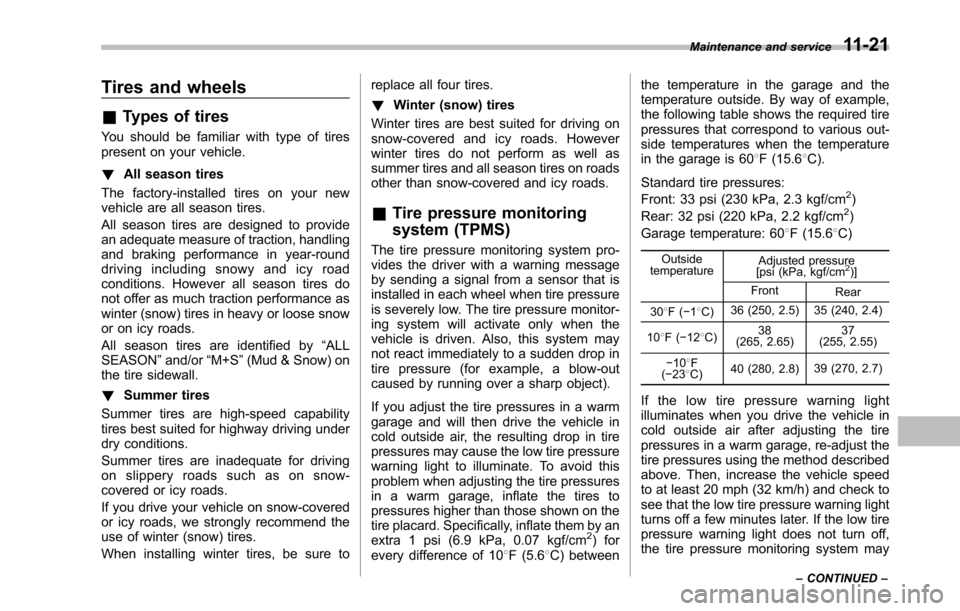
the temperature in the garage and thetemperature outside. By way of example,the following table shows the required tirepressures that correspond to various out-side temperatures when the temperaturein the garage is 608F (15.68C).
Standard tire pressures:
Front: 33 psi (230 kPa, 2.3 kgf/cm2)
Rear: 32 psi (220 kPa, 2.2 kgf/cm2)
Garage temperature: 608F (15.68C)
OutsidetemperatureAdjusted pressure[psi (kPa, kgf/cm2)]
FrontRear
308F(!18C)36 (250, 2.5) 35 (240, 2.4)
108F(!128C)38(265, 2.65)37(255, 2.55)
!108F(!238C)40 (280, 2.8)39 (270, 2.7)
If the low tire pressure warning lightilluminates when you drive the vehicle incold outside air after adjusting the tirepressures in a warm garage, re-adjust thetire pressures using the method describedabove. Then, increase the vehicle speedto at least 20 mph (32 km/h) and check tosee that the low tire pressure warning lightturns off a few minutes later. If the low tirepressure warning light does not turn off,the tire pressure monitoring system may
Maintenance and service11-21
–CONTINUED–
Page 356 of 426
that cannot be seen with the naked eye.This type of damage does not becomeevident until time has passed. Try notto drive over curbs, potholes or onother rough surfaces. If doing so isunavoidable, keep the vehicle’s speeddown to a walking pace or less, andapproach the curbs as squarely aspossible. Also, make sure the tires arenot pressed against the curb when youpark the vehicle..If you feel unusual vibration whiledriving or find it difficult to steer thevehicle in a straight line, one of thetires and/or wheels may be damaged.Drive slowly to the nearest authorizedSUBARU dealer and have the vehicleinspected.
&Tire pressures and wear
Maintaining the correct tire pressureshelps to maximize the tires’service livesand is essential for good running perfor-mance. Check and, if necessary, adjustthe pressure of each tire (including thespare) at least once a month (for example,during a fuel stop) and before any longjourney.
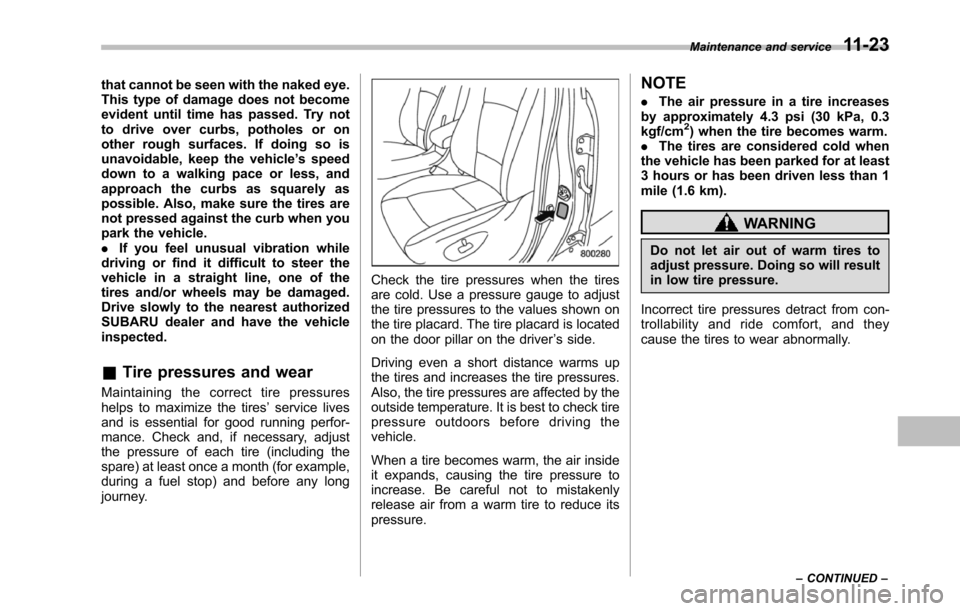
Check the tire pressures when the tiresare cold. Use a pressure gauge to adjustthe tirepressures to the values shown onthe tire placard. The tire placard is locatedon the door pillar on the driver’s side.
Driving even a short distance warms upthe tires and increases the tire pressures.Also, the tire pressures are affected by theoutside temperature. It is best to check tirepressure outdoors before driving thevehicle.
When a tire becomes warm, the air insideit expands, causing the tire pressure toincrease. Be careful not to mistakenlyreleaseair from a warm tire to reduce itspressure.
NOTE
.The air pressure in a tire increasesby approximately 4.3 psi (30 kPa, 0.3kgf/cm2) when the tire becomes warm..The tires are considered cold whenthe vehicle has been parked for at least3 hours or has been driven less than 1mile (1.6 km).
WARNING
Do not let air out of warm tires toadjust pressure. Doing so will resultin low tire pressure.
Incorrect tire pressures detract from con-trollability and ride comfort, and theycause the tires to wear abnormally.
Maintenance and service11-23
–CONTINUED–
Page 357 of 426
11-24Maintenance and service
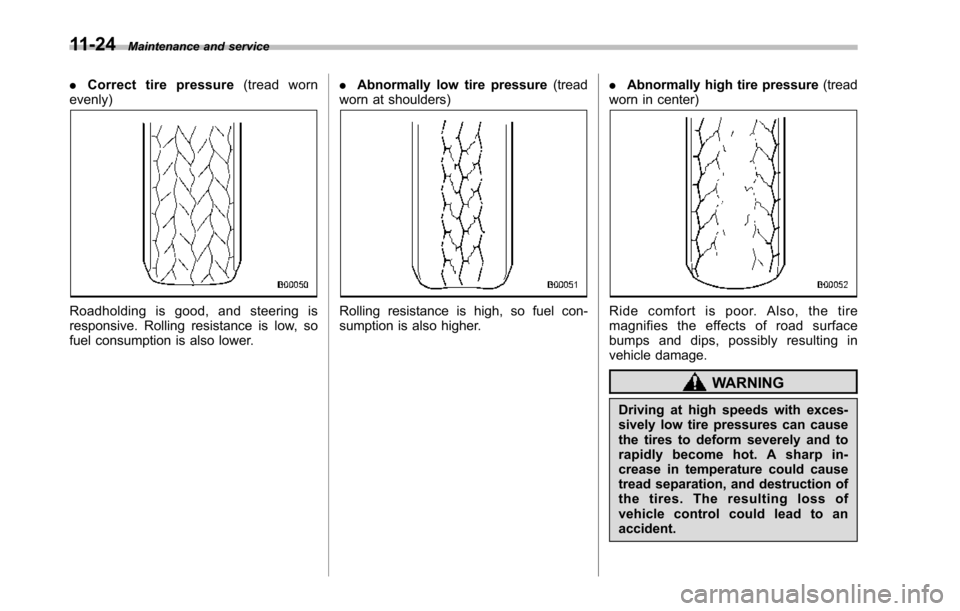
.Correct tire pressure(tread wornevenly)
Roadholding is good, and steering isresponsive.Rolling resistance is low, sofuel consumption is also lower.
.Abnormally low tire pressure(treadworn at shoulders)
Rolling resistance is high, so fuel con-sumption is also higher.
.Abnormally high tire pressure(treadworn in center)
Ride comfort is poor. Also, the tiremagnifies the effects of road surfacebumps and dips, possibly resulting invehicle damage.
WARNING
Driving at high speeds with exces-sively low tire pressures can causethe tires to deform severely and torapidly become hot. A sharp in-crease in temperature could causetread separation, and destruction ofthe tires. The resulting loss ofvehicle control could lead to anaccident.