warning TOYOTA 86 2017 Owners Manual
[x] Cancel search | Manufacturer: TOYOTA, Model Year: 2017, Model line: 86, Model: TOYOTA 86 2017Pages: 428, PDF Size: 5.25 MB
Page 260 of 428
2604-3. Do-it-yourself maintenance
■ Engine oil consumption
A certain amount of engine oil will be consumed while driving. In the follow-
ing situations, oil consumption may increase, and engine oil may need to be
refilled in between oil maintenance intervals.
● When the engine is new, for example directly after purchasing the vehicle
or after replacing the engine
● If low quality oil or oil of an inappropriate viscosity is used
● When driving at high engine speeds or with a heavy load, or when driving
while accelerating or decelerating frequently
● When leaving the engine idling for a long time, or when driving frequently
through heavy traffic
WARNING■ Used engine oil
● Used engine oil contains potentially harmful contaminants which may
cause skin disorders such as inflammation or skin cancer, so care should
be taken to avoid prolonged and repeated contact. To remove used engine
oil from your skin, wash thoroughly with soap and water.
● Dispose of used oil and filters only in a safe and acceptable manner. Do
not dispose of used oil and filters in household trash, in sewers or onto the
ground.
Call your Toyota dealer, service station or auto parts store for information
concerning recycling or disposal.
● Do not leave used engine oil within the reach of children.
Page 262 of 428
2624-3. Do-it-yourself maintenance
■ Coolant selection
Only use “TOYOTA Genuine 50/50 Pre-mixed Super Long Life Coolant
BLUE” or similar high-quality ethylene glycol-based non-silicate, non-amine,
non-nitrite, and non-borate coolant with long-life hybrid organic acid technol-
ogy.
“TOYOTA Genuine 50/50 Pre-mixed Super Long Life Coolant BLUE” is a
mixture of 50% coolant and 50% deionized water. (Enabled: -31 ° F [-35 ° C])
For more details about engine coolant, contact your Toyota dealer.
WARNING■ When the engine is hot
Do not remove the radiator cap.
The cooling system may be under pressure and may spray hot coolant if the
cap is removed, causing serious injuries, such as burns.
NOTICE■ When adding engine coolant
Coolant is neither plain water nor straight antifreeze. The correct mixture of
water and antifreeze must be used to provide proper lubrication, corrosion
protection and cooling. Be sure to read the antifreeze or coolant label.
■ If you spill coolant
Be sure to wash it off with water to prevent it from damaging parts or paint.
Page 263 of 428
2634-3. Do-it-yourself maintenance
4
Maintenance and care Radiator and condenser
Check the radiator and condenser and clear away any foreign
objects.
If either of the above parts are ex tremely dirty or you are not sure of
their condition, have y our vehicle checked by your Toyota dealer.
Brake fluid
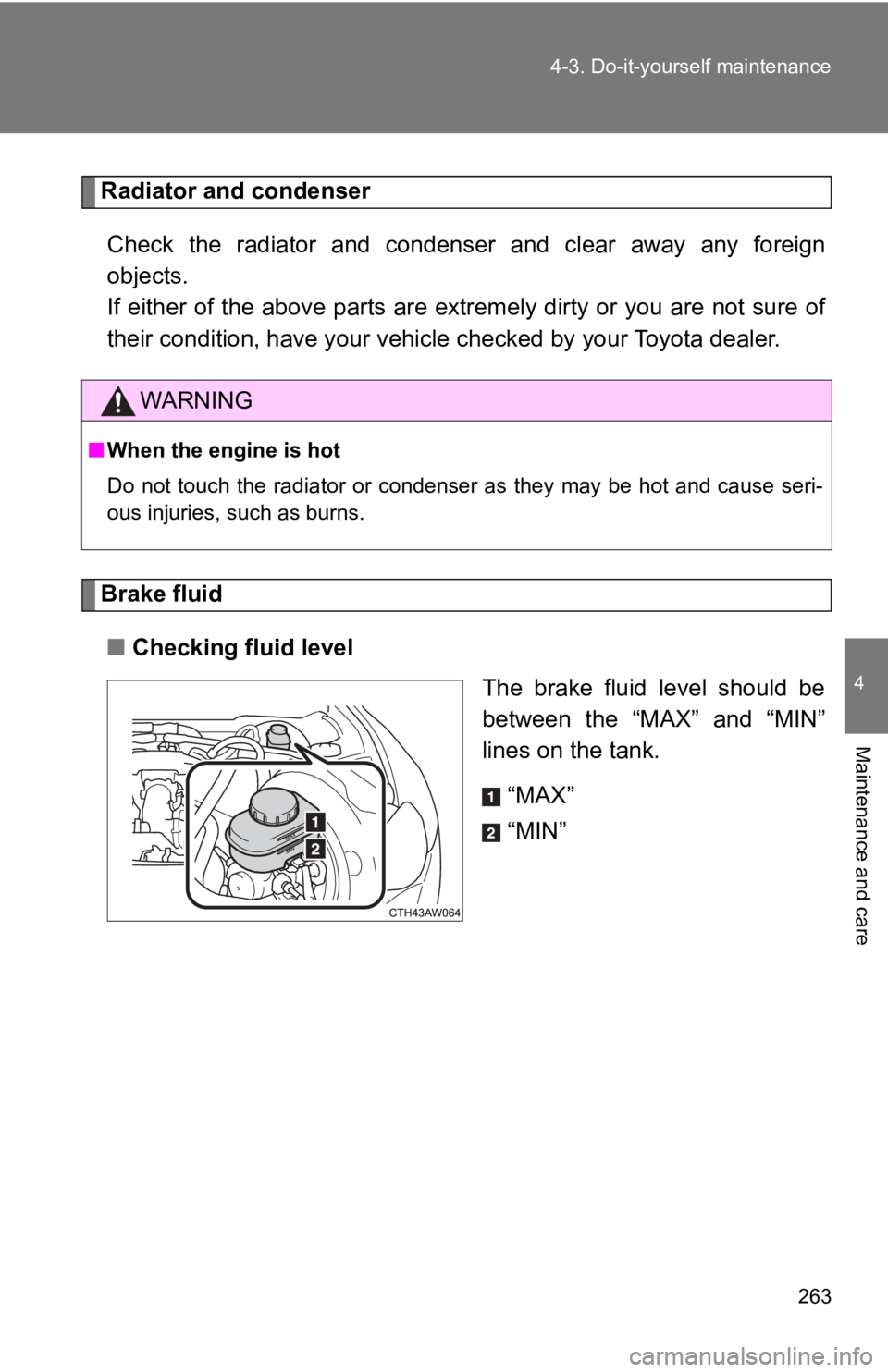
■ Checking fluid level
The brake fluid level should be
between the “MAX” and “MIN”
lines on the tank.
“MAX”
“MIN”WARNING■ When the engine is hot
Do not touch the radiator or condenser as they may be hot and cause seri-
ous injuries, such as burns.
Page 264 of 428
2644-3. Do-it-yourself maintenance
■ Adding fluid
Make sure to check the fluid type and prepare the necessary items. Fluid type
FMVSS No.116 fresh DOT 3 or DOT 4 brake fluid
Items
Clean funnel
■ Brake fluid can absorb moisture from the air
Excess moisture in the fluid can cause a dangerous loss of braking effi-
ciency. Use only newly opened brake fluid.
WARNING■ When filling the reservoir
Take care because brake fluid can harm your hands or eyes and damage
painted surfaces.
If fluid gets in your eyes, flush your eyes with clean water immediately.
If you still experience discomfort, see a doctor.
NOTICE■ If the fluid level is low or high
It is normal for the brake fluid level to go down slightly as the brake pads
wear or when the fluid level in the accumulator is high.
If the reservoir needs frequent refilling, it may indicate a serious problem.
Page 267 of 428
2674-3. Do-it-yourself maintenance
4
Maintenance and care WARNING■ Chemicals in the battery
A battery contains poisonous and corrosive sulfuric acid and may produce
hydrogen gas which is flammable and explosive. To reduce the risk of death
or serious injury, take the following precautions while working on or near the
battery:
● Do not cause sparks by touching the battery terminals with tools.
● Do not smoke or light a match near the battery.
● Avoid contact with eyes, skin and clothes.
● Never inhale or swallow electrolyte.
● Wear protective safety glasses when working near the battery.
● Keep children away from the battery.
■ Where to safely charge the battery
Always charge the battery in an open area. Do not charge the battery in a
garage or closed room where there is not sufficient ventilation.
■ Emergency measures regarding electrolyte
● If electrolyte gets in your eyes
Flush your eyes with clean water for at least 15 minutes and get immedi-
ate medical attention. If possible, continue to apply water with a sponge or
cloth while traveling to the nearest medical facility.
● If electrolyte gets on your skin
Wash the affected area thoroughly. If you feel pain or burning, get medical
attention immediately.
● If electrolyte gets on your clothes
It can soak through clothing on to your skin. Immediately take off the cloth-
ing and follow the procedure above if necessary.
● If you accidentally swallow electrolyte
Drink a large quantity of water or milk. Get emergency medical attention
immediately.
Page 269 of 428
2694-3. Do-it-yourself maintenance
4
Maintenance and care WARNING■ When adding washer fluid
Do not add washer fluid when the engine is hot or running, as washer fluid
contains alcohol and may catch fire if spilled on the engine etc.
NOTICE■ Washer fluid
Do not use soapy water or engine antifreeze instead of washer fluid.
Doing so may cause streaking on the vehicle’s painted surfaces.
■ Diluting washer fluid
Dilute washer fluid with water as necessary.
Refer to the freezing temperatures listed on the label of the washer fluid bot-
tle.
Page 271 of 428
2714-3. Do-it-yourself maintenance
4
Maintenance and care
Installing tire pressure warning valves and transmitters
When replacing tires or wheels, tire pressure warning valves and
transmitters must also be installed.
When new tire pressure warning valves and transmitters are
installed, new tire pressure warning valve and transmitter ID codes
must be registered in the tire pr essure warning computer and tire
pressure warning system must be initialized. Have tire pressure
warning valve and transmitter ID codes registered by your Toyota
dealer. ( → P. 271)
Registering ID codes
The tire pressure warning valve and transmitter is equipped with a
unique ID code. When replacing a tire pressure warning valve and
transmitter, it is necessary to regi ster the ID code. Have the ID code
registered by your Toyota dealer.■ The tire pressure warning system
Your Toyota is equipped with a ti re pressure warning system that
uses tire pressure warning valves and transmitters to detect low
tire inflation pressure before serious problems arise.
( → P. 320)
Page 272 of 428

2724-3. Do-it-yourself maintenance
■
When to replace your vehicle’s tires
Tires should be replaced if: ●
The treadwear indicators are showing on a tire.●
You have tire damage such as cuts, splits, cracks deep enough to
expose the fabric or bulges indicating internal damage●
A tire goes flat repeatedly or ca nnot be properly repaired due to the
size or location of a cut or other damage
If you are not sure, consult with your Toyota dealer.■
Replacing tires and wheels
If the ID code of the tire pressure warning valve and transmitter is not
registered, the tire pressure warni ng system will not work properly. After
driving for about 20 minutes, the ti re pressure warning light comes on
after blinking for 1 minute to indicate a system malfunction.■
Tire life
Any tire over 6 years old must be checked by a qualified technician even
if they have seldom or never been used or damage is not obvious.
■
If the tread wears down below 0.16 in. (4 mm) on snow tires
The effectiveness of snow tires is lost.
■
Low profile tires
Generally, low profile tire s will wear more rapidly and tire gr ip perfor-
mance will be reduced on snowy and/ or icy roads when compared to
standard tires. Be sure to use snow tires or tire chains on snowy and/or
icy roads and drive carefully at a speed appropriate for road and weather
conditions.
Page 274 of 428

2744-3. Do-it-yourself maintenance
■
Initializing the tire pr essure warning system
Initialize the system with the tire infl ation pressure adjusted to the speci-
fied level.■
Routine tire inflation pressure checks
The tire pressure warning system doe s not replace routine tire inflation
pressure checks. Make sure to check tire inflation pressure as part of
your routine of daily vehicle checks.■
Tire pressure warning system certification
MODEL/FCC IDs:
Transmitter: PAXPMVC010
Receiver: HYQ23AAC
For vehicles sold in the U.S.A.
This device complies with part 15 of the FCC Rules. Operation is subject
to the following two conditions: (1) This device may not cause harmful
interference, and (2) this device must accept any interference received,
including interference that may cause undesired operation.
FCC WARNING:
Changes or modifications not expre ssly approved by the party responsi-
ble for compliance could void the user's authority to operate the equip-
ment.
For vehicles sold in Canada
NOTE:
This device complies with Industry Canada’s licence-exempt RSSs. Opera-
tion is subject to the following two conditions: (1) This device may not cause
interference; and (2) This device must accept any interference, including
interference that may cause undesired operation of the device.
NOTE:
Le présent appareil est conforme aux CNR d’Industrie Canada applicables
aux appareils radio exempts de licence. L’exploitation est autorisée aux
deux conditions suivantes: (1) l’appareil ne doit pas produire de brouillage;
(2) l’utilisateur de l’appareil doit accept er tout brouillage radioélectrique subi,
même si le brouillage est susceptible d’en compromettre le fonctionnement.
Page 275 of 428
2754-3. Do-it-yourself maintenance
4
Maintenance and care WARNING■
Tire pressure warning system operation
The tire pressure warning system may not provide warning immediately
if a tire bursts or if sudden air leakage occurs.■
When inspecting or replacing tires
Observe the following precautions to prevent accidents.
Failure to do so may cause damage to parts of the drive train, as well as
dangerous handling characteristics, which may lead to an accident
resulting in death or serious injury.●
Make sure to install 4 tires that are of the specified size, and that all 4
tires are the same size, same maker, same brand and tread pattern.●
Do not use tire sizes other than those recommended by Toyota.●
Only use radial tires.●
Do not mix summer, all season and snow tires.
●
Do not use tires that have been used on another vehicle.
Do not use tires if you do not know how they were used previously.
NOTICE■
Repairing or replacing tires, wheels, tire pressure warning valves,
transmitters and tire valve caps
●
When removing or fitting the wheels, tires or the tire pressure warning
valves and transmitters, contact your Toyota dealer as the tire pres-
sure warning valves and transmitters may be damaged if not handled
correctly.
●
Make sure to install the tire valve caps. If the tire valve caps are not
installed, water could enter the tire pressure warning valves and the
tire pressure warning valves could be bound.
●
When replacing tire valve caps, do not use tire valve caps other than
those specified. The cap may become stuck.