warning TOYOTA 86 2017 Owners Manual
[x] Cancel search | Manufacturer: TOYOTA, Model Year: 2017, Model line: 86, Model: TOYOTA 86 2017Pages: 428, PDF Size: 5.25 MB
Page 280 of 428
2804-3. Do-it-yourself maintenance
WARNING■
Proper inflation is critical to save tire performance
Keep your tires properly inflated.
If the tires are not properly inflated, the following conditions may occur
which could lead to an accident resulting in death or serious injury: ●
Excessive wear●
Uneven wear●
Poor handling●
Possibility of blowouts resulting from overheated tires●
Air leaking from between tire and wheel●
Wheel deformation and/or tire damage●
Greater possibility of tire damage while driving (due to road hazards,
expansion joints, sharp edges in the road, etc.)
NOTICE■
When inspecting and adjusting tire inflation pressure
Be sure to reinstall the tire valve caps.
If a valve cap is not installed, dirt or moisture may ge t into the valve and
cause an air leak, resulting in decreased tire inflation pressure.
Page 282 of 428
2824-3. Do-it-yourself maintenance
■
When replacing wheels
The wheels of your Toyota are equipped with tire pressure warning
valves and transmitters that allow the tire pressure warning system to
provide advanced warning in the event of a loss in tire inflation pressure.
Whenever wheels are replaced, the tire pressure warning valves and
transmitters must be installed. ( → P. 271)
WARNING■
When replacing wheels ●
Do not use wheels that are a different size from those recommended in
the Owner’s Manual, as this may result in loss of handling control.●
Never use an inner tube in a leaking wheel which is designed for a
tubeless tire. Doing so may result in an accident, causing death or seri-
ous injury.
■
When installing the wheel nuts
●
Never use oil or grease on the wheel bolts or wheel nuts.
Oil and grease may cause the wheel nuts to be excessively tightened,
leading to bolt or disc wheel damage. In addition, the oil or grease can
cause the wheel nuts to loosen and the wheel may fall off, causing an
accident and resulting in death or serious injury. Remove any oil or
grease from the wheel bolts or wheel nuts. ●
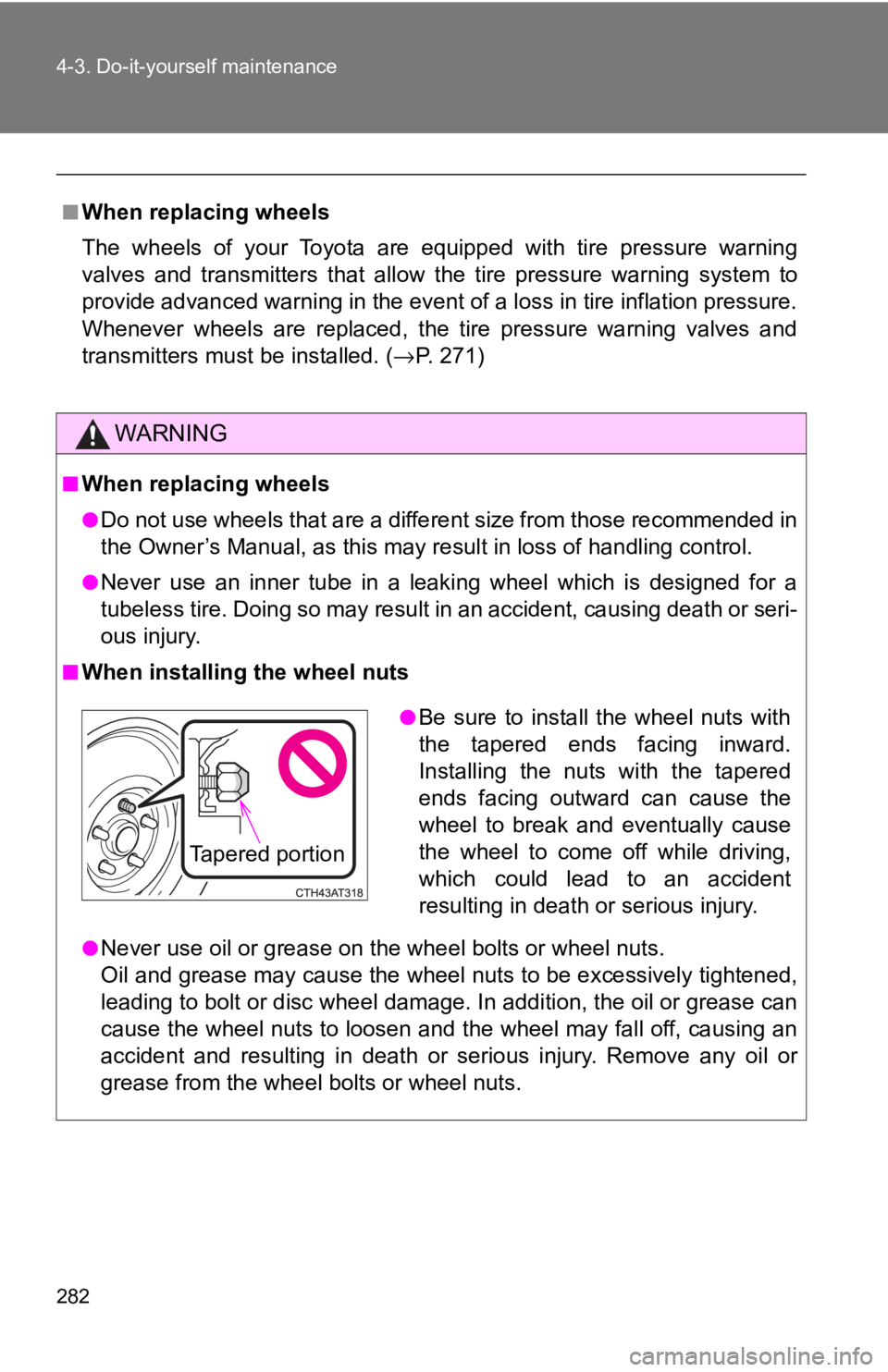
Be sure to install the wheel nuts with
the tapered ends facing inward.
Installing the nuts with the tapered
ends facing outward can cause the
wheel to break and eventually cause
the wheel to come off while driving,
which could lead to an accident
resulting in death or serious injury.Tapered portion
Page 283 of 428
2834-3. Do-it-yourself maintenance
4
Maintenance and care NOTICE■
Replacing tire inflation pressure warning valves and transmitters ●
Because tire repair or replacement may affect the tire pressure warn-
ing valves and transmitters, make sure to have tires serviced by your
Toyota dealer or other qualified service shop. In addition, make sure to
purchase your tire pressure warning valves and transmitters at your
Toyota dealer.●
Ensure that only genuine Toyota wheels are used on your vehicle.
Tire pressure warning valves and transmitters may not work properly
with non-genuine wheels.
Page 288 of 428
2884-3. Do-it-yourself maintenance
■ Use a CR2016 lithium battery
● Batteries can be purchased at your Toyota dealer, local electrical appli-
ance shops or camera stores.
● Replace only with the same or equivalent type recommended by the
manufacturer.
● Dispose of used batteries according to local laws.
■ If the key battery is depleted
The following symptoms may occur:
● The wireless remote control will not function properly.
● The operational range will be reduced.
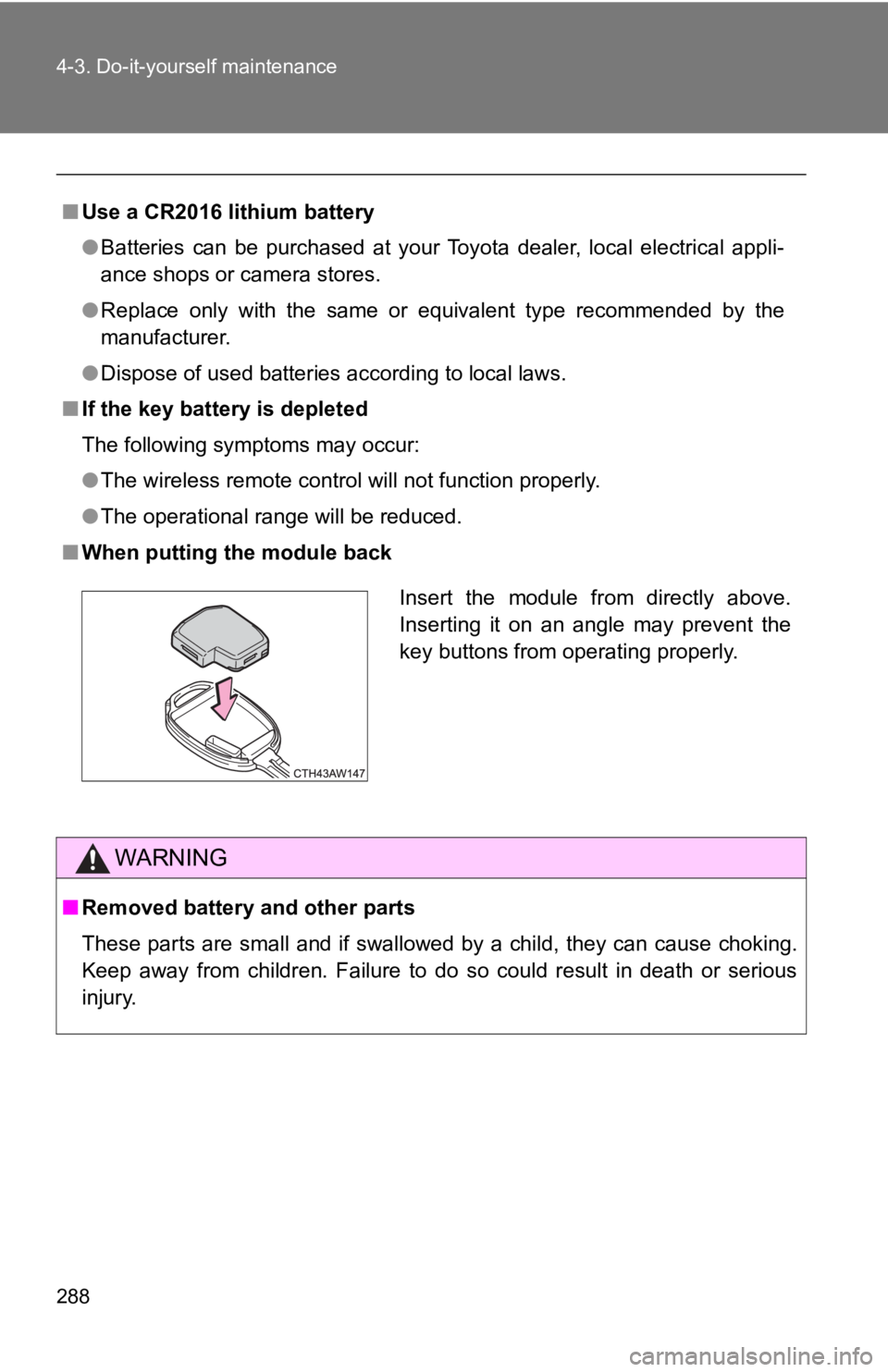
■ When putting the module back
WARNING■ Removed battery and other parts
These parts are small and if swallowed by a child, they can cause choking.
Keep away from children. Failure to do so could result in death or serious
injury. Insert the module from directly above.
Inserting it on an angle may prevent the
key buttons from operating properly.
Page 297 of 428
2974-3. Do-it-yourself maintenance
4
Maintenance and care ■ After a fuse is replaced
● If the lights do not turn on even after the fuse has been replaced, a bulb
may need replacement. ( → P. 298)
● If the replaced fuse blows again, have the vehicle inspected by your
Toyota dealer.
■ If there is an overload in the circuits
The fuses are designed to blow, protecting the wiring harness from damage.
WARNING■ To prevent system breakdowns and vehicle fire
Observe the following precautions.
Failing to do so may cause damage to the vehicle, and possibly a fire or
injury.
● Never use a fuse of a higher amperage rating than indicated, or use any
other object in place of a fuse.
● Always use a genuine Toyota fuse or equivalent.
● Do not modify the fuse or the fuse box.
NOTICE■ Before replacing fuses
Have the cause of electrical overload determined and repaired by your
Toyota dealer.
Page 304 of 428
3044-3. Do-it-yourself maintenance
WARNING■ Replacing light bulbs
● Turn off the lights. Do not attempt to replace the bulb immediately after
turning off the lights.
The bulbs become very hot and may cause burns.
● Do not touch the glass portion of the light bulb with bare hands. When it is
unavoidable to hold the glass portion, use and hold with a clean dry cloth
to avoid getting moisture and oils on the bulb.
Also, if the bulb is scratched or dropped, it may blow out or crack.
● Fully install the light bulbs and any parts used to secure them. Failure to
do so may result in heat damage, fire, or water entering a light unit. This
may damage the light or cause condensation to build up on the inner side
of the lens.
■ When changing the back-up lights
Stop the engine and wait until the exhaust pipes have cooled down suffi-
ciently. The lights are located near the exhaust pipe and touching a hot
exhaust pipe can cause burns.
■ To prevent damage or fire
Make sure bulbs are fully seated and locked.
Page 305 of 428
When trouble arises
5
3055-1. Essential information
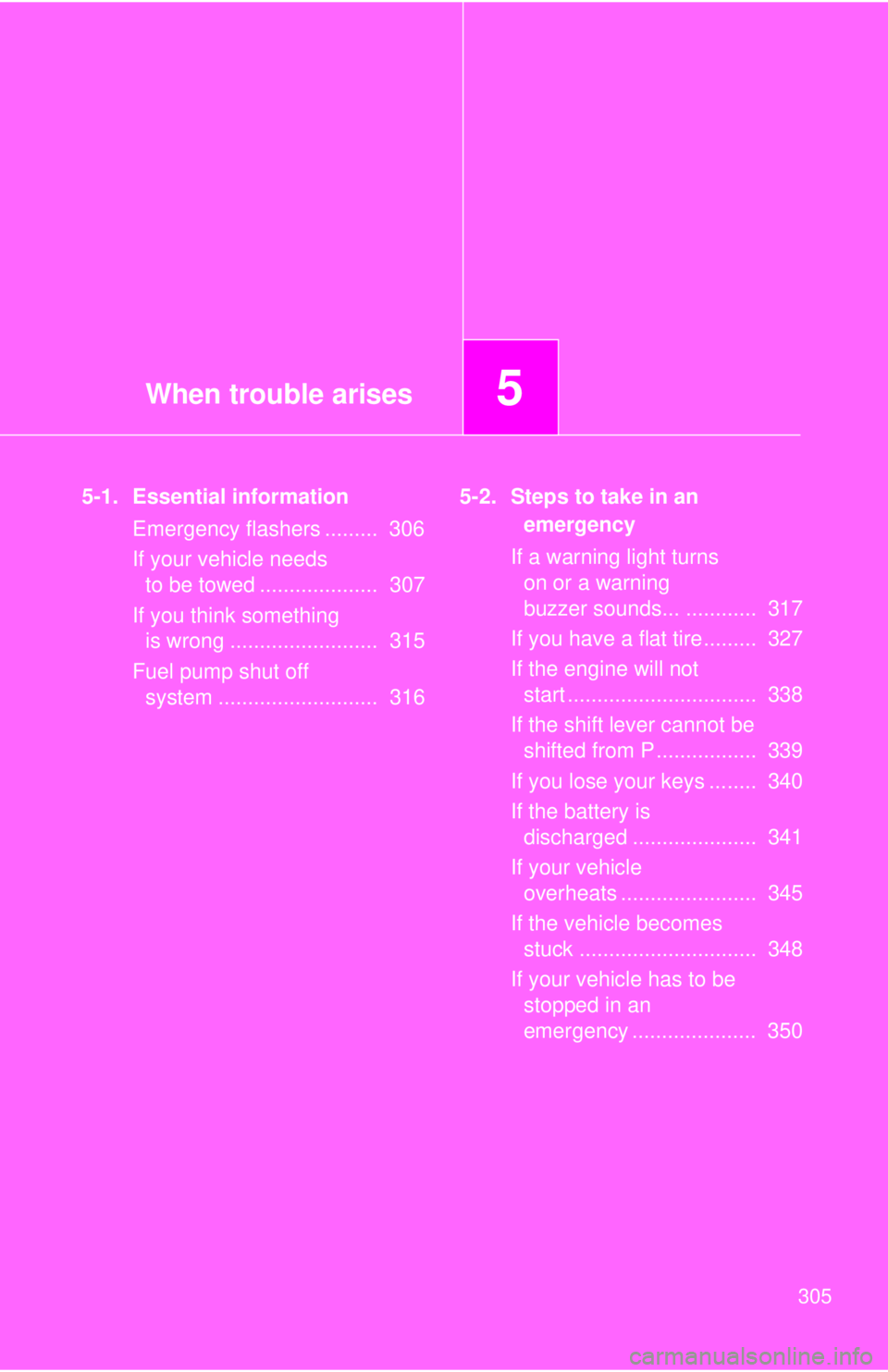
Emergency flashers ......... 306
If your vehicle needs
to be towed .................... 307
If you think something
is wrong ......................... 315
Fuel pump shut off
system ........................... 316 5-2. Steps to take in an
emergency
If a warning light turns
on or a warning
buzzer sounds... ............ 317
If you have a flat tire......... 327
If the engine will not
start ................................ 338
If the shift lever cannot be
shifted from P................. 339
If you lose your keys ........ 340
If the battery is
discharged ..................... 341
If your vehicle
overheats ....................... 345
If the vehicle becomes
stuck .............................. 348
If your vehicle has to be
stopped in an
emergency ..................... 350
Page 308 of 428
3085-1. Essential information
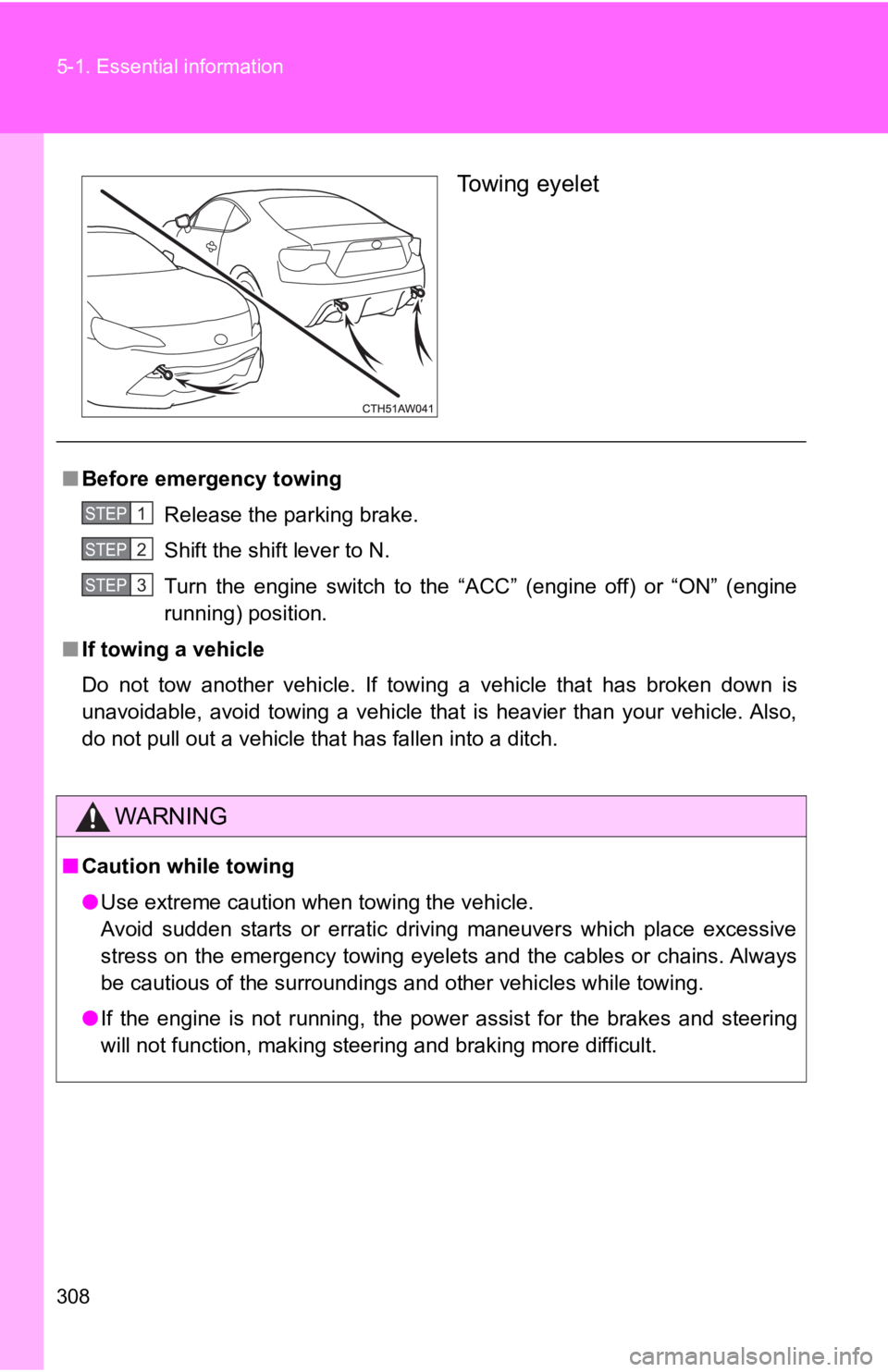
Towing eyelet
■ Before emergency towing
Release the parking brake.
Shift the shift lever to N.
Turn the engine switch to the “ACC” (engine off) or “ON” (engine
running) position.
■ If towing a vehicle
Do not tow another vehicle. If towing a vehicle that has broken down is
unavoidable, avoid towing a vehicle that is heavier than your vehicle. Also,
do not pull out a vehicle that has fallen into a ditch.
WARNING■ Caution while towing
● Use extreme caution when towing the vehicle.
Avoid sudden starts or erratic driving maneuvers which place excessive
stress on the emergency towing eyelets and the cables or chains. Always
be cautious of the surroundings and other vehicles while towing.
● If the engine is not running, the power assist for the brakes and steering
will not function, making steering and braking more difficult. STEP 1
STEP 2
STEP 3
Page 312 of 428
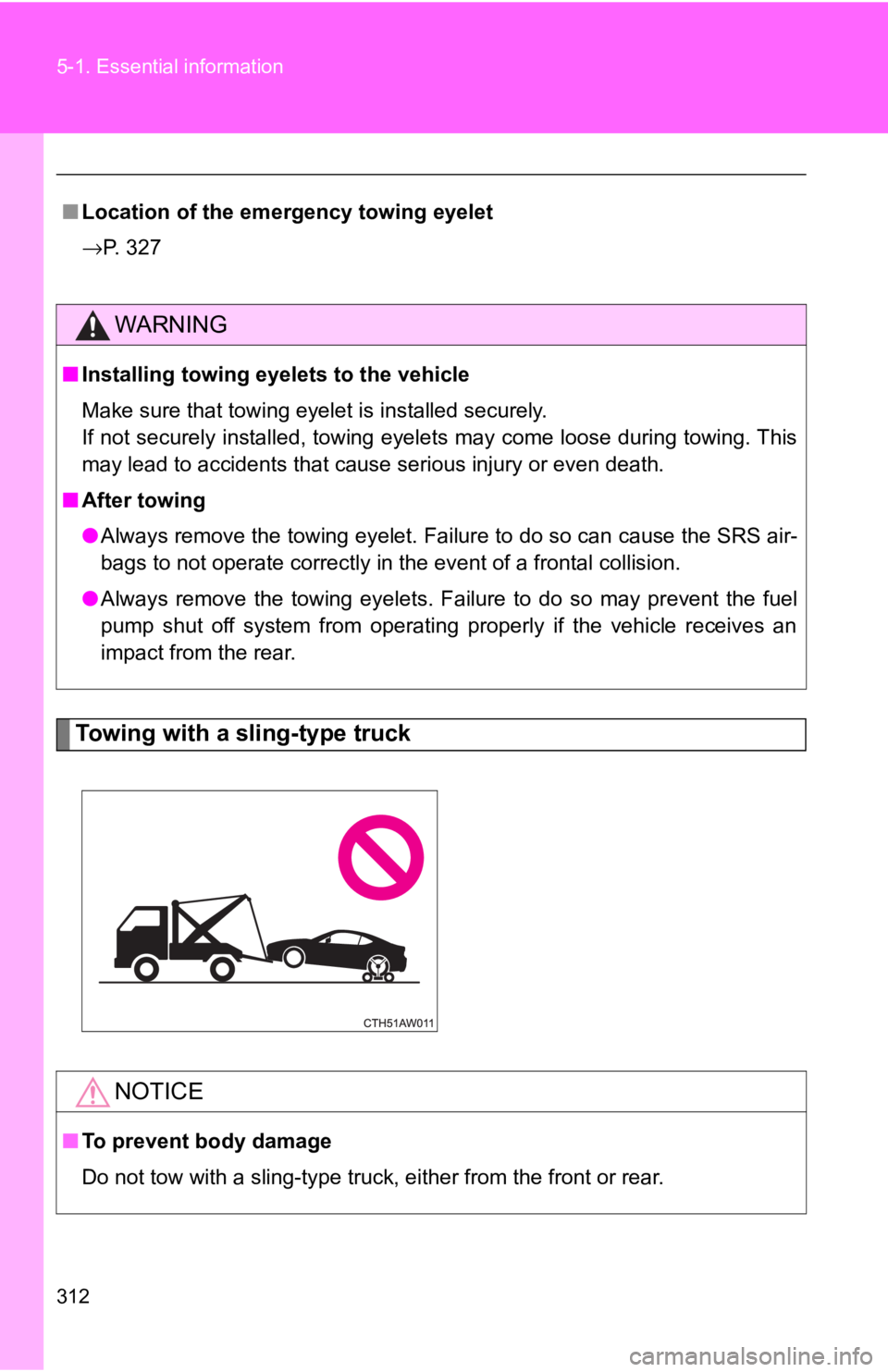
3125-1. Essential information
Towing with a sling-type truck■ Location of the emergency towing eyelet
→ P. 327
WARNING■ Installing towing eyelets to the vehicle
Make sure that towing eyelet is installed securely.
If not securely installed, towing eyelets may come loose during towing. This
may lead to accidents that cause serious injury or even death.
■ After towing
● Always remove the towing eyelet. Failure to do so can cause the SRS air-
bags to not operate correctly in the event of a frontal collision.
● Always remove the towing eyelets. Failure to do so may prevent the fuel
pump shut off system from operating properly if the vehicle receives an
impact from the rear.
NOTICE
■ To prevent body damage
Do not tow with a sling-type truck, either from the front or rear.
Page 317 of 428

5
When trouble arises
3175-2. Steps to take in an emergency
If a warning light turns on or a warning buzzer sounds... Stop the vehicle immediately. Continuing to drive the vehicle
may be dangerous.
The following warning indicates a possible problem in the brake sys-
tem. Immediately stop the vehicl e in a safe place and contact your
Toyota dealer.
Stop the vehicle immediately.
The following warning indicates the possibility of damage to the vehi-
cle that may lead to an accident. Immediately stop the vehicle in a
safe place and contact your Toyota dealer. Warning light Warning light/Details
(U.S.A.)
(Canada) Brake system warning light
• Low brake fluid
• Malfunction in the brake system
This light also comes on when the parking brake is not
released. If the light turns off after the parking brake is fully
released the system is operating normally.
Warning light Warning light/Details
Charging system warning light
Indicates a malfunction in the vehicle’s charging system.
Low engine oil pressure warning light
Indicates that the engine oil pressure is too low.Calmly perform the following actions if any of the warning lights turn
on or flash. If a light turns on or flashes, but then tu rns off, this does
not necessarily indicate a malfunction in the system.