warning TOYOTA 86 2017 Manual PDF
[x] Cancel search | Manufacturer: TOYOTA, Model Year: 2017, Model line: 86, Model: TOYOTA 86 2017Pages: 428, PDF Size: 5.25 MB
Page 194 of 428
1942-4. Using other driving systems
■ Notes for hill-start assist control
● A slight jolt may be felt when starting off backward with the shift lever in R
and then moving forward.
● If the braking power of hill-start assist control is insufficient, depress the
brake pedal.
● While the vehicle is stopped, make sure to depress the brake pedal.
■ The system may be malfunctioning when
In the following situations, the system may be malfunctioning. Have the vehi-
cle inspected by your Toyota dealer.
● The slip indicator is illuminated.
● The hill-start assist control ON indicator turns off and a buzzer sounds.
WARNING■ Hill-start assist control precautions
● Do not overly rely on hill-start assist control. Hill-start assist control may
not operate effectively on steep inclines and roads covered with ice.
● Unlike the parking brake, hill-start assist control is not intended to hold the
vehicle stationary for an extended period of time. Do not attempt to use
hill-start assist control to hold the vehicle on an incline, as doing so may
lead to an accident.
● Do not stop the engine while hill-start assist control is operating, as hill-
start assist control will stop operating, possibly leading to an accident.
Page 197 of 428

1972-5. Driving information
2
When driving As shown in the example above, if the number of occupants
increases, the cargo and luggage load will be reduced by an amount
that equals the increased weight due to the additional occupants. In
other words, if an increase in the number of occupants causes an
excess of the total load capacity (combined weight of occupants plus
cargo and luggage load), you must reduce the cargo and luggage on
your vehicle.
WARNING■
Things that must not be carried in the trunk
The following things may cause a fire if loaded in the trunk: ●
Receptacles containing gasoline●
Aerosol cans
Page 198 of 428

1982-5. Driving information
WARNING■
Storage precautions
Observe the following precautions.
Failure to do so may result in death or serious injury.●
Stow cargo and luggage in the trunk whenever possible.●
To prevent cargo and luggage from sliding forward during braking, do
not stack anything in the enlarged trunk. Keep cargo and luggage low,
as close to the floor as possible.●
When you fold down the rear seats, long items should not be placed
directly behind the front seats.●
Never allow anyone to ride in the enlarged trunk. It is not designed for
passengers. They should ride in t heir seats with their seat belts prop-
erly fastened. Otherwise, they are much more likely to suffer death or
serious bodily injury, in the event of sudden braking, sudden swerving
or an accident.
●
Do not place cargo or luggage in or on the following locations as the
item may get under the clutch, brake or accelerator pedal and prevent
the pedals from being depressed properly, block the driver’s vision, or
hit the driver or passengers, causing an accident:
• At the feet of the driver
• On the front passenger or rear seats (when stacking items)
• On the package tray
• On the instrument panel
• On the dashboard
●
Secure all items in the occupant compartment, as they may shift and
injure someone during sudden braking, sudden swerving or an acci-
dent.
■
Capacity and distribution
●
Do not exceed the maximum axle weight rating or the total vehicle
weight rating.
●
Even if the total load of occupant's weight and the cargo load is less
than the total load capacity, do not apply the load unevenly. Improper
loading may cause deterioration of steering or braking control which
may cause death or serious injury.
Page 199 of 428
1992-5. Driving information
2
When driving
Vehicle load limits
■
Total load capacity and seating capacity
These details are described on the tire and loading information label.
( → P. 277)
WARNING
■
Overloading the vehicle
Do not overload the vehicle.
It may not only cause damage to the ti res, but also degrade steering and
braking ability, resulting in an accident. Vehicle load limits include total load capacity, seating capacity,
towing capacity and cargo capacity.
■ Total load capacity (vehicle capacity weight): ( → P. 354)Total load capacity means the combin ed weight of occupants, cargo
and luggage.
■ Seating capacity Seating capacity means the maxi mum number of occupants whose
estimated average weight is 150 lb. (68 kg) per person.
■ Towing capacity Toyota does not recommend towing a trailer with your vehicle.
■ Cargo capacity Cargo capacity may increase or decrease depending on the weight
and the number of occupants.
Page 203 of 428
2032-5. Driving information
2
When driving WARNING■
Driving with snow tires
Observe the following precautions to reduce the risk of accidents.
Failure to do so may result in a loss of vehicle control and cause death or
serious injury. ●
Use tires of the specified size, and that are the same size, same
maker, same brand and tread pattern. ●
Maintain the recommended level of air pressure.●
Do not drive in excess of 75 mph (120 km/h), regardless of the type of
snow tires being used.●
Use snow tires on all, not just some wheels.
NOTICE■
Repairing or replacing snow tires
Request repairs or replacement of snow tires from Toyota dealers or
legitimate tire retailers.
This is because the removal and attachment of snow tires affects the
operation of the tire pressure warning valves and transmitters.
■
Fitting tire chains
The tire pressure warning valves and transmitters may not function cor-
rectly when tire chains are fitted.
Page 214 of 428

2143-1. Using the air cond itioning system and defogger
WARNING■ To prevent the windshield from fogging up
Do not set the air outlet selection dial to during cool air operation in
extremely humid weather. The difference between the temperature of the
outside air and that of the windshield can cause the outer surface of the
windshield to fog up, blocking your vision.
NOTICE■ To prevent battery discharge
Do not leave the air conditioning system on longer than necessary when the
engine is stopped.
Page 215 of 428
2153-1. Using the air conditioning system and defogger
3
Interior features
Rear window and outside r ear view mirror defoggers
■ The defoggers can be operated when
The engine switch is in the “ON” position.
■ The outside rear view mi rror defoggers (vehicles with outside rear view
mirror defoggers)
Turning the rear window defogger on will turn the outside rear view mirror
defoggers on.
WARNING
■ When the outside rear view mirror defoggers are on (vehicles with out-
side rear view mirror defoggers)
Do not touch the outside surface of the rear view mirrors, as they can
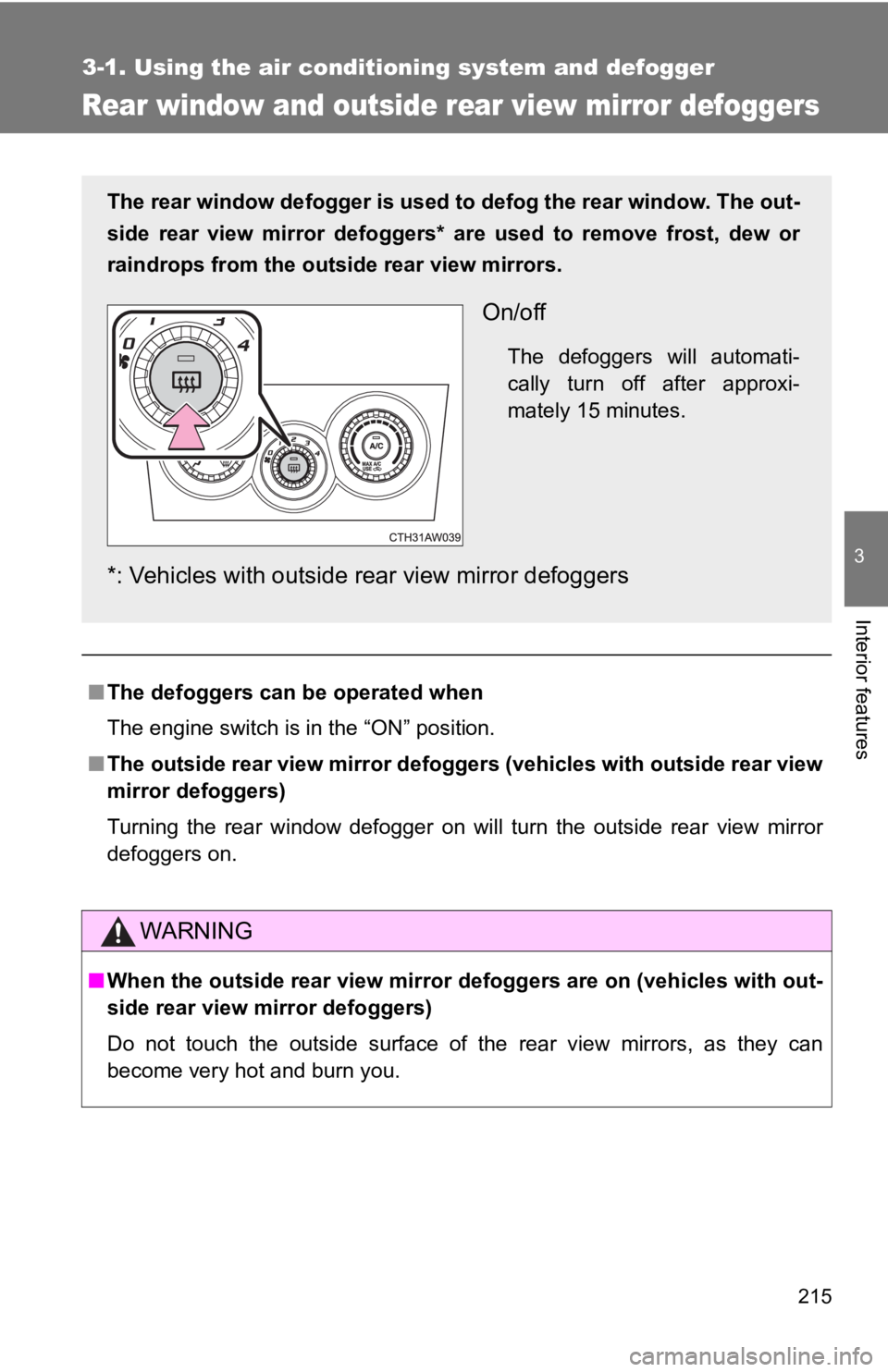
become very hot and burn you.The rear window defogger is used to defog the rear window. The out-
side rear view mirror defoggers* are used to remove frost, dew or
raindrops from the outs ide rear view mirrors.
On/off The defoggers will automati-
cally turn off after approxi-
mately 15 minutes.
*: Vehicles with outside rear view mirror defoggers
Page 218 of 428
2183-2. Using the audio system
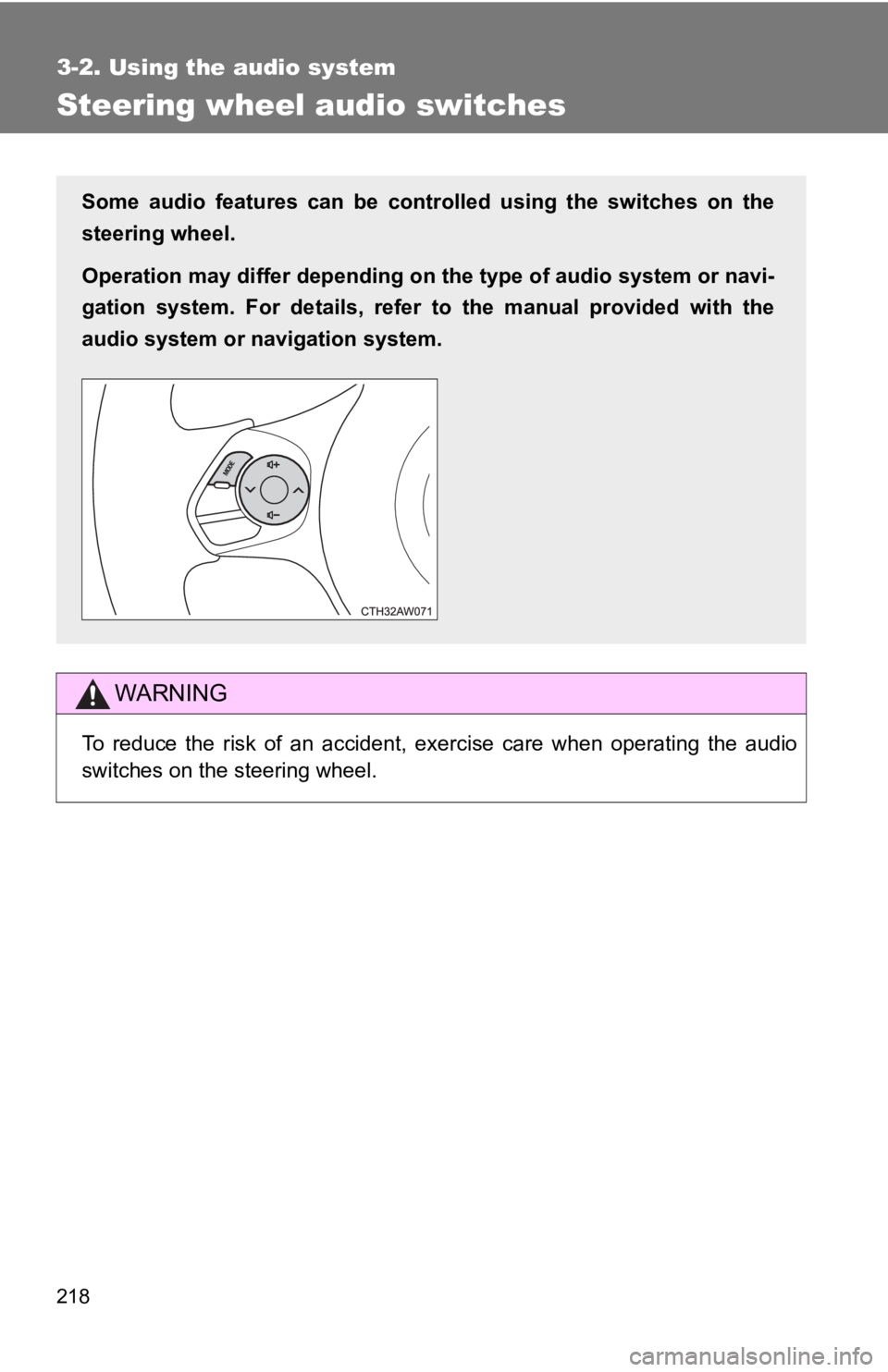
Steering wheel audio switches
WARNINGTo reduce the risk of an accident, exercise care when operating the audio
switches on the steering wheel.Some audio features can be controlled using the switches on the
steering wheel.
Operation may differ depending on th e type of audio system or navi-
gation system. For details, refer to the manual provided with the
audio system or navigation system.
Page 222 of 428
2223-4. Using the storage features
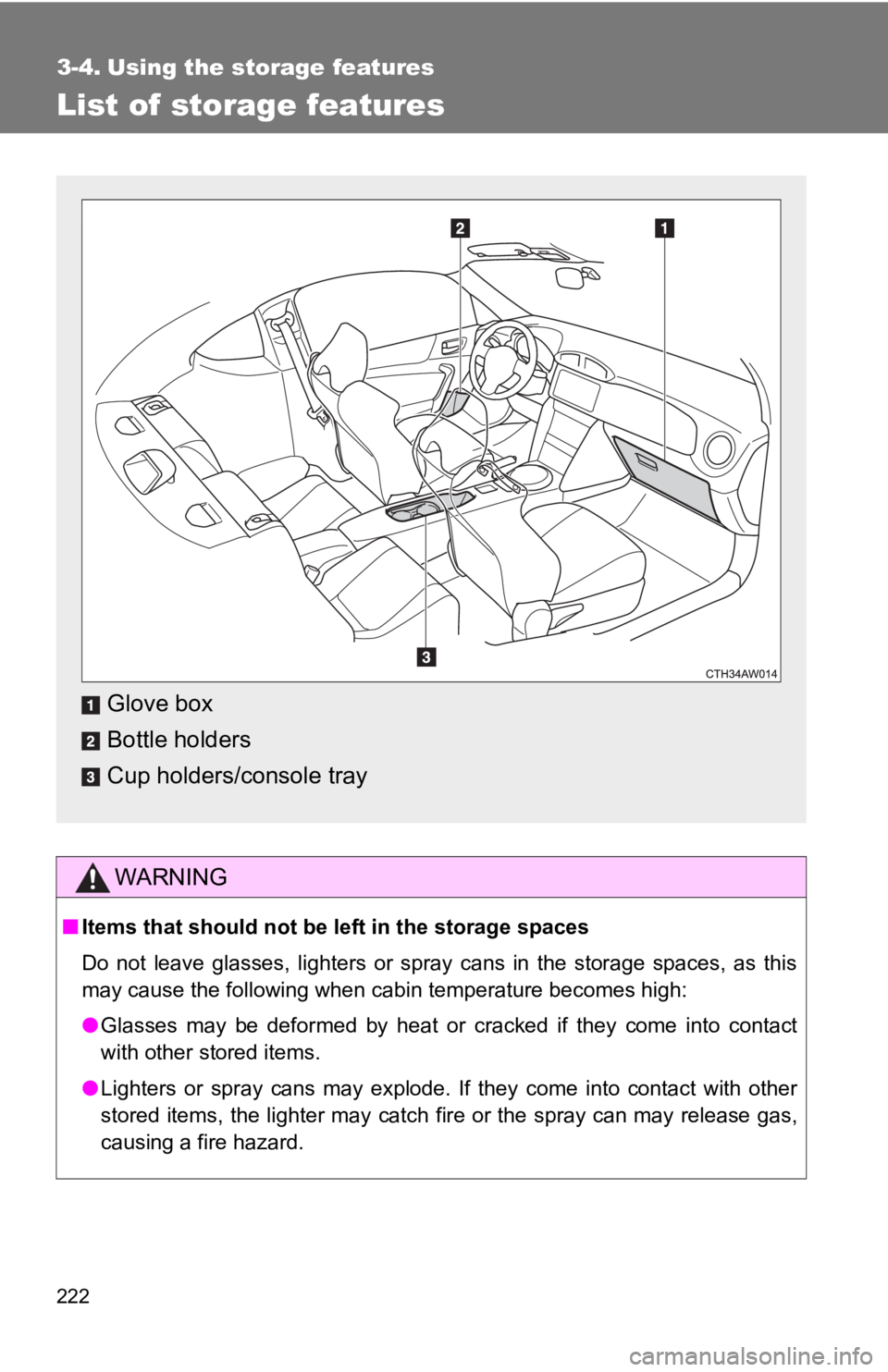
List of storage features
WARNING
■ Items that should not be left in the storage spaces
Do not leave glasses, lighters or spray cans in the storage spaces, as this
may cause the following when cabin temperature becomes high:
● Glasses may be deformed by heat or cracked if they come into contact
with other stored items.
● Lighters or spray cans may explode. If they come into contact with other
stored items, the lighter may catch fire or the spray can may release gas,
causing a fire hazard.Glove box
Bottle holders
Cup holders/console tray
Page 223 of 428
2233-4. Using the storage features
3
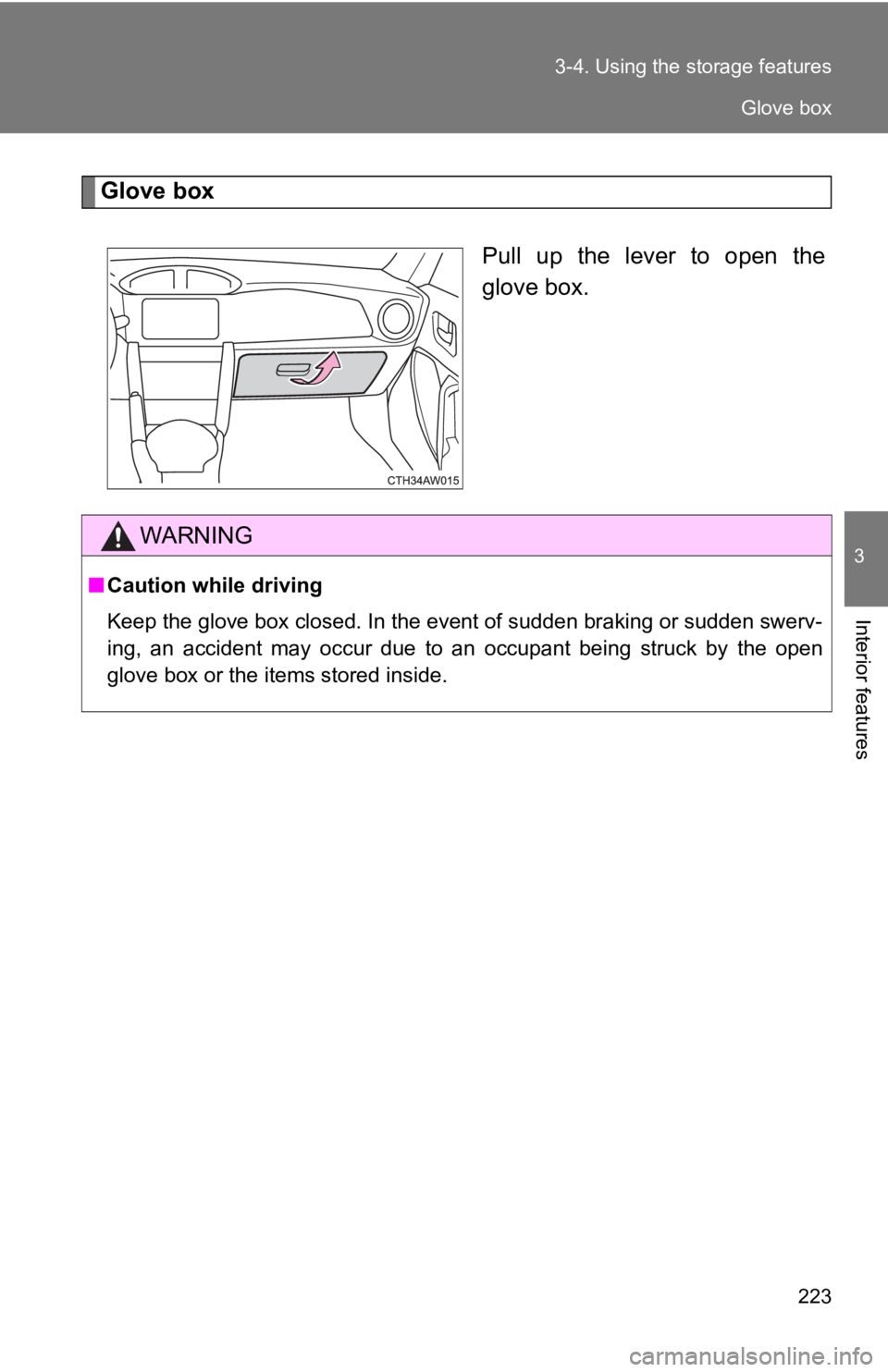
Interior features Glove box
Pull up the lever to open the
glove box.
WARNING■ Caution while driving
Keep the glove box closed. In the event of sudden braking or sudden swerv-
ing, an accident may occur due to an occupant being struck by the open
glove box or the items stored inside. Glove box