engine TOYOTA 86 2017 Owner's Manual
[x] Cancel search | Manufacturer: TOYOTA, Model Year: 2017, Model line: 86, Model: TOYOTA 86 2017Pages: 428, PDF Size: 5.25 MB
Page 109 of 428

1091-7. Safety information
1
Before driving If the front passenger’s frontal airbag ON indicator illuminates and the OFF indicator turns off
even when an infant or a small child is in a child restraint system (including booster seat)
This can be caused by the child restraint system being installed incor-
rectly. Perform the following.
The engine switch is turned to the “LOCK” position.
Remove the child restraint syst em from the seat. By referring
to the child restraint manufact urer’s recommendations as well
as the child restraint system in stallation procedure in “child
restraint system”, correctly rein stall the child re straint system.
The engine switch is turned to the “ON” position and make
sure that the front passenger’s frontal airbag ON indicator
turns off and the OFF indicator illuminates.
If the ON indicator still remain s illuminated while the OFF indi-
cator turns off, perform the following.
• Ensure that no article is pl aced on the seat other than the
child restraint system and the child occupant.
• Ensure that the backward-for ward position and seatback of
front passenger seat are locked into place securely by mov-
ing the seat back and forth.
If the ON indicator still remain s illuminated while the OFF indi-
cator turns off after taking the relevant corrective actions
described above, relocate the ch ild restraint system to the
rear seat and immedi ately contact your Toyota dealer for an
inspection.STEP 1
STEP 2
STEP 3
STEP 4
STEP 5
Page 127 of 428
When driving
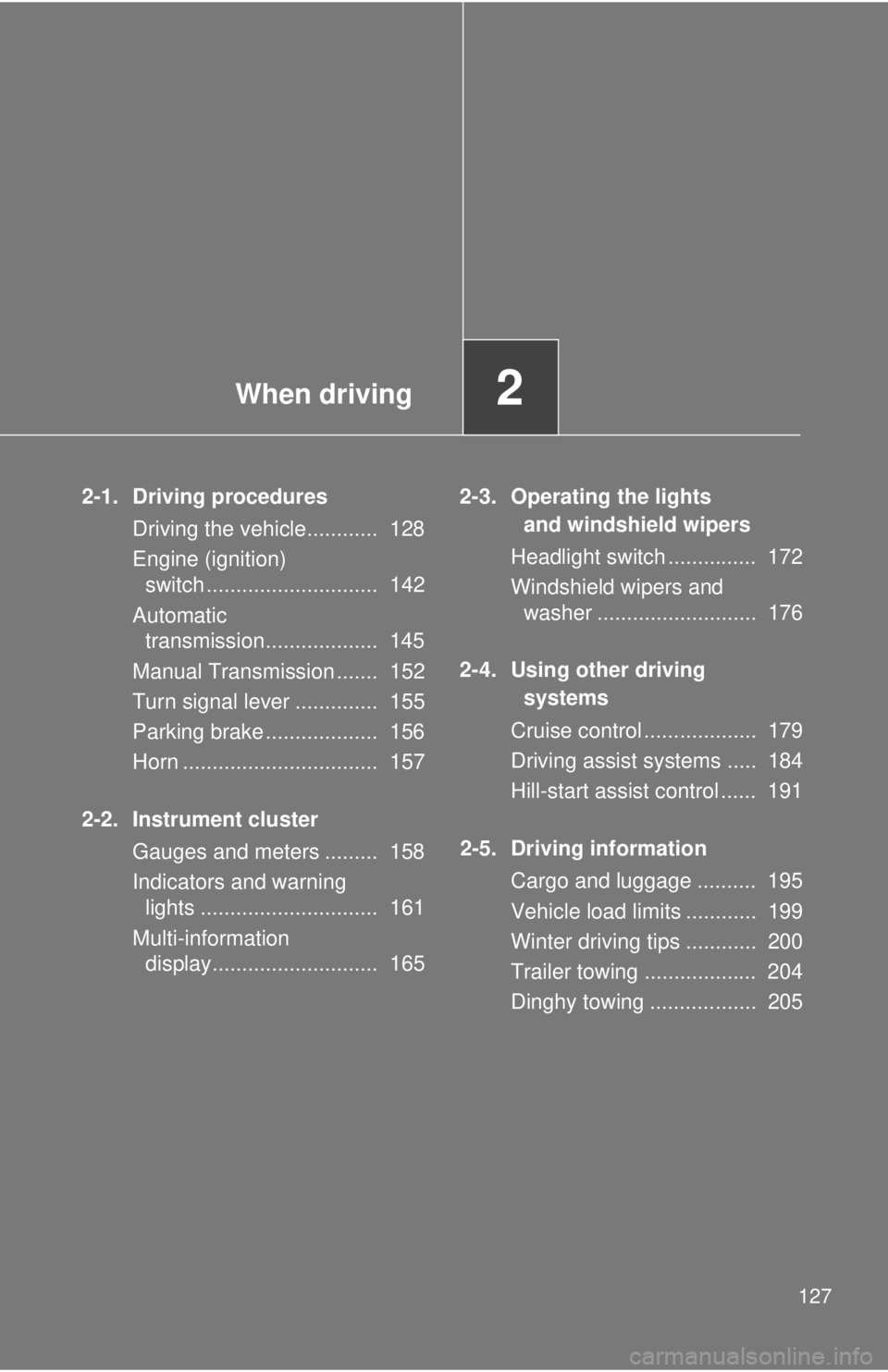
2
1272-1. Driving procedures
Driving the vehicle............ 128
Engine (ignition)
switch ............................. 142
Automatic
transmission................... 145
Manual Transmission ....... 152
Turn signal lever .............. 155
Parking brake ................... 156
Horn ................................. 157
2-2. Instrument cluster
Gauges and meters ......... 158
Indicators and warning
lights .............................. 161
Multi-information
display............................ 165 2-3. Operating the lights
and windshield wipers
Headlight switch ............... 172
Windshield wipers and
washer ........................... 176
2-4. Using other driving
systems
Cruise control ................... 179
Driving assist systems ..... 184
Hill-start assist control ...... 191
2-5. Driving information
Cargo and luggage .......... 195
Vehicle load limits ............ 199
Winter driving tips ............ 200
Trailer towing ................... 204
Dinghy towing .................. 205
Page 128 of 428
1282-1. Driving procedures
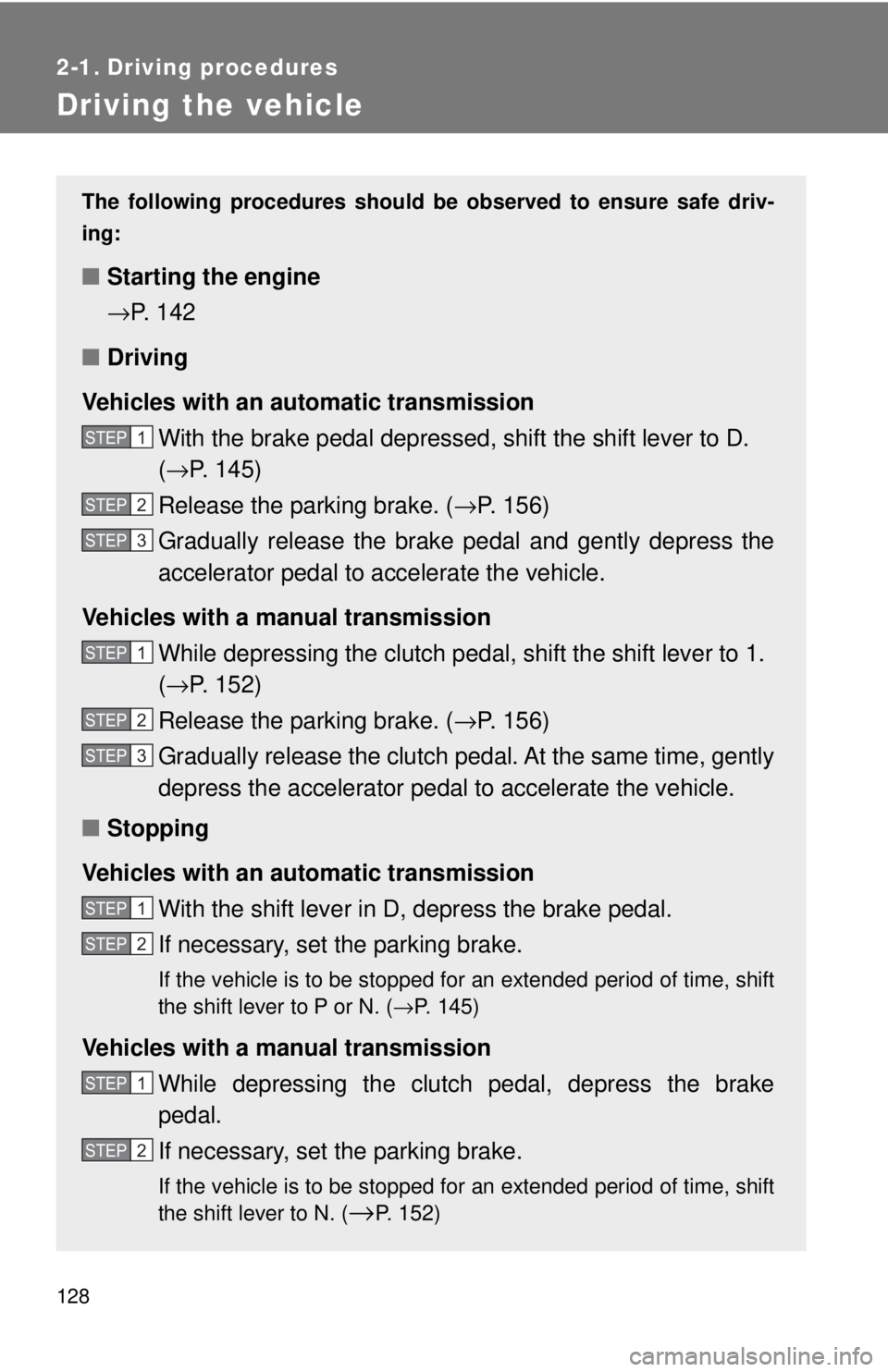
Driving the vehicle The following procedures should be observed to ensure safe driv-
ing:
■ Starting the engine
→ P. 142
■ Driving
Vehicles with an au tomatic transmission
With the brake pedal depressed, shift the shift lever to D.
( → P. 145)
Release the parking brake. ( → P. 156)
Gradually release the brake pedal and gently depress the
accelerator pedal to accelerate the vehicle.
Vehicles with a manual transmission
While depressing the clutch pedal , shift the shift lever to 1.
( → P. 152)
Release the parking brake. ( → P. 156)
Gradually release the clutch pedal. At the same time, gently
depress the accelerator pedal to accelerate the vehicle.
■ Stopping
Vehicles with an au tomatic transmission
With the shift lever in D, depress the brake pedal.
If necessary, set the parking brake. If the vehicle is to be stopped for an extended period of time, shift
the shift lever to P or N. ( → P. 145)
Vehicles with a manual transmission
While depressing the clutch pedal, depress the brake
pedal.
If necessary, set the parking brake.
If the vehicle is to be stopped for an extended period of time, shift
the shift lever to N. (
→ P. 152) STEP 1
STEP 2
STEP 3
STEP 1
STEP 2
STEP 3
STEP 1
STEP 2
STEP 1
STEP 2
Page 129 of 428
1292-1. Driving procedures
2
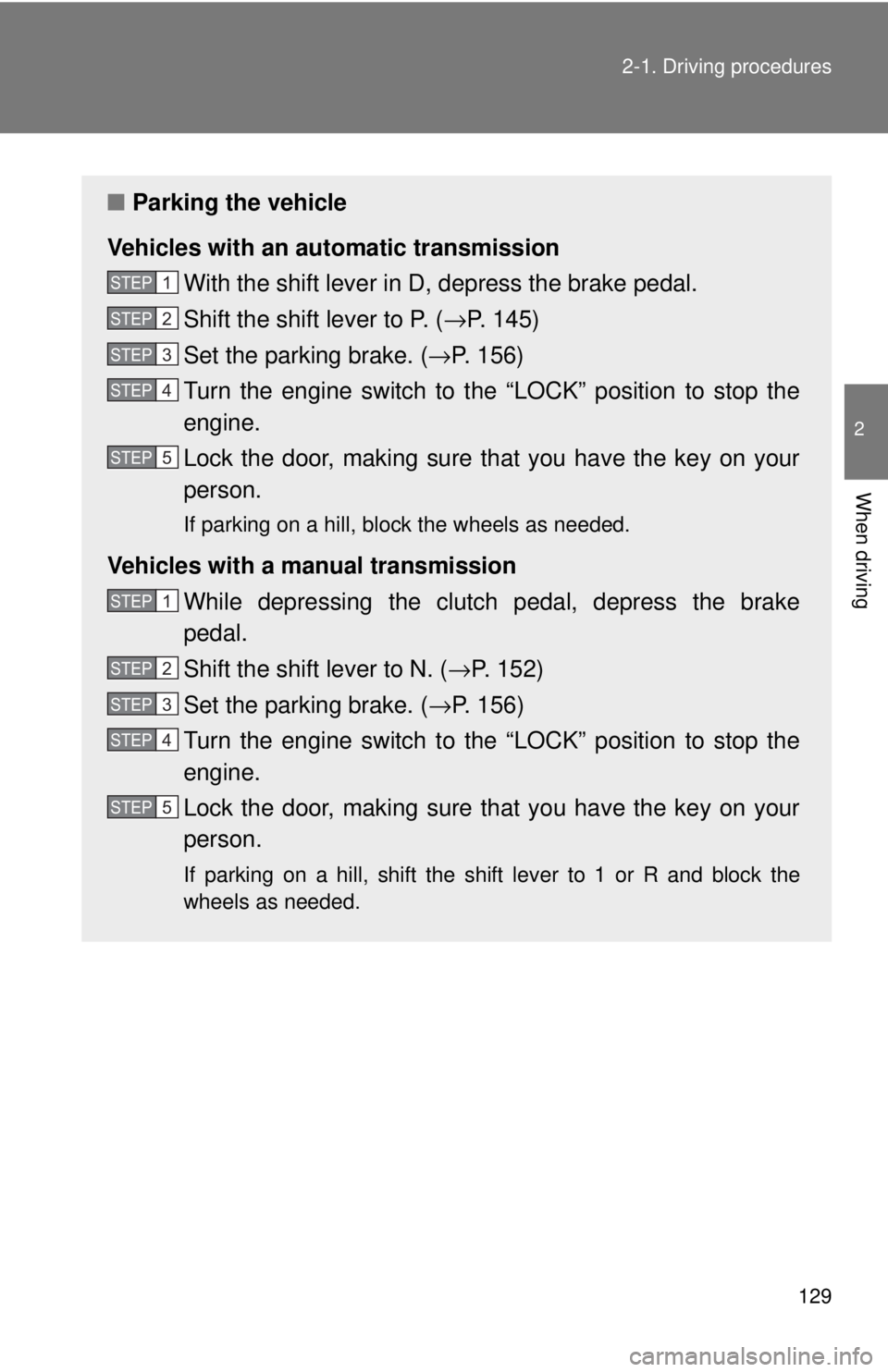
When driving ■ Parking the vehicle
Vehicles with an au tomatic transmission
With the shift lever in D, depress the brake pedal.
Shift the shift lever to P. ( → P. 145)
Set the parking brake. ( → P. 156)
Turn the engine switch to the “LOCK” position to stop the
engine.
Lock the door, making sure that you have the key on your
person. If parking on a hill, block the wheels as needed.
Vehicles with a manual transmission
While depressing the clutch pedal, depress the brake
pedal.
Shift the shift lever to N. ( → P. 152)
Set the parking brake. ( → P. 156)
Turn the engine switch to the “LOCK” position to stop the
engine.
Lock the door, making sure that you have the key on your
person. If parking on a hill, shift the shift lever to 1 or R and block the
wheels as needed.STEP 1
STEP 2
STEP 3
STEP 4
STEP 5
STEP 1
STEP 2
STEP 3
STEP 4
STEP 5
Page 131 of 428

1312-1. Driving procedures
2
When driving ■ Engine speed while driving (vehicles with an automatic transmission)
In the following conditions, the engine speed may become high while driving.
This is due to automatic up-shifting control or down-shifting implementation
to meet driving conditions. It does not indicate sudden acceleration.
● The vehicle is judged to be driving uphill or downhill
● When the accelerator pedal is released
● When driving on curves
● When the brake pedal is firmly depressed
■ New vehicle break-in driving (the first 1000 miles [1600 km])
The performance and long life of your vehicle are dependent on how you
handle and care for your vehicle while it is new. Follow these instructions
during the first 1000 miles (1600 km):
● Do not allow the engine speed to exceed 4000 rpm except in an emer-
gency.
● Do not drive at one constant engine or vehicle speed for a long time,
either fast or slow.
● Avoid starting suddenly and rapid acceleration, except in an emergency.
● Avoid hard braking, except in an emergency.
The same break-in procedures should be applied to an overhauled
engine, newly mounted engine or when brake pads or brake linings are
replaced with new ones.
■ Drum-in-disc type parking brake system
Your vehicle has a drum-in-disc type parking brake system. This type of
brake system needs bedding-down of the brake shoes periodically or when-
ever the parking brake shoes and/or drum are replaced. Have your Toyota
dealer perform the bedding down.
Page 132 of 428
1322-1. Driving procedures
■ After the engine starts
In order to secure a rich exhaust sound when starting the vehicle and envi-
ronmental performance, air intake and exhaust sounds become loud and
vibrations may increase for a little while after the engine starts. This is not a
malfunction.
■ Operating your vehicle in a foreign country
Comply with the relevant vehicle registration laws and confirm the availability
of the correct fuel. ( → P. 357)
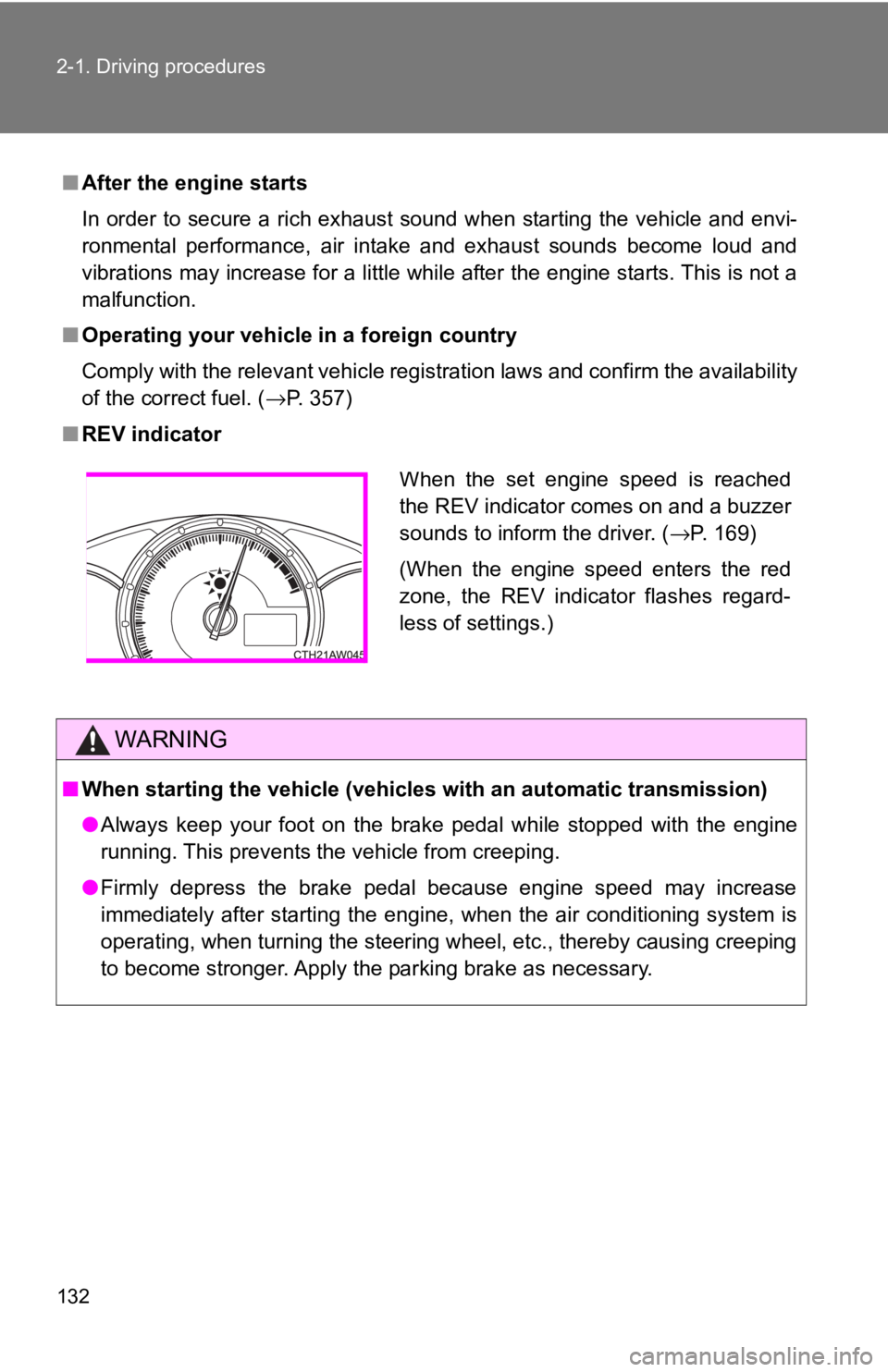
■ REV indicator
WARNING■ When starting the vehicle (vehicles with an automatic transmission)
● Always keep your foot on the brake pedal while stopped with the engine
running. This prevents the vehicle from creeping.
● Firmly depress the brake pedal because engine speed may increase
immediately after starting the engine, when the air conditioning system is
operating, when turning the steering wheel, etc., thereby causing creeping
to become stronger. Apply the parking brake as necessary. When the set engine speed is reached
the REV indicator comes on and a buzzer
sounds to inform the driver. ( → P. 169)
(When the engine speed enters the red
zone, the REV indicator flashes regard-
less of settings.)
Page 133 of 428

1332-1. Driving procedures
2
When driving WARNING■ When driving the vehicle
● Do not drive if you are unfamiliar with the location of the brake and accel-
erator pedals to avoid depressing the wrong pedal.
• Accidentally depressing the accelerator pedal instead of the brake
pedal will result in sudden acceleration that may lead to an accident
that could result in death or serious injury.
• When backing up, you may twist your body around, leading to a diffi-
culty in operating the pedals. Make sure to operate the pedals properly.
• Make sure to keep a correct driving posture even when moving the
vehicle only slightly. This allows you to depress the brake and acceler-
ator pedals properly.
• Depress the brake pedal using your right foot. Depressing the brake
pedal using your left foot may delay response in an emergency, result-
ing in an accident.
● Do not drive the vehicle over or stop the vehicle near flammable materials.
The exhaust system and exhaust gases can be extremely hot. These hot
parts may cause a fire if there is any flammable material nearby.
● On vehicles with an automatic transmission, do not let the vehicle roll
backward while the shift lever is in a driving position, or roll forward while
the shift lever is in R.
Doing so may cause the engine to stall or lead to poor brake and steering
performance, resulting in an accident or damage to the vehicle.
● If the smell of exhaust is noticed inside the vehicle, open the windows and
check that the trunk is closed. Large amounts of exhaust in the vehicle can
cause driver drowsiness and an accident, resulting in death or a serious
health hazard. Have the vehicle inspected by your Toyota dealer immedi-
ately.
● On vehicles with a manual transmission, do not shift the shift lever to R
while the vehicle is moving forward.
Doing so can damage the transmission and may result in a loss of vehicle
control.
● Do not shift the shift lever to a driving position while the vehicle is moving
backward.
Doing so can damage the transmission and may result in a loss of vehicle
control.
Page 134 of 428

1342-1. Driving procedures
WARNING● On vehicles with a manual transmission, do not release the clutch pedal
too quickly. Doing so may propel the vehicle forward, possibly causing an
accident.
● Moving the shift lever to N while the vehicle is moving will disengage the
engine from the transmission. Engine braking is not available when N is
selected.
● During normal driving, do not turn off the engine. Turning the engine off
while driving will not cause loss of steering or braking control, but the
power assist to these systems will be lost. This will make it more difficult to
steer and brake, so you should pull over and stop the vehicle as soon as it
is safe to do so.
However, in the event of an emergency, such as if it becomes impossible
to stop the vehicle in the normal way: → P. 350
● Use engine braking (downshift) to maintain a safe speed when driving
down a steep hill.
Using the brakes continuously may cause the brakes to overheat and lose
effectiveness. ( → P. 146, 152)
● Do not adjust the position of the steering wheel, the seat, or the inside or
outside rear view mirrors while driving.
Doing so may result in a loss of vehicle control that can cause accidents,
resulting in death or serious injury.
● Always check that all passengers' arms, heads or other parts of their body
are not outside the vehicle, as this may result in death or serious injury.
● Do not drive in excess of the speed limit. Even if the legal speed limit per-
mits it, do not drive over 85 mph (140 km/h) unless your vehicle has high-
speed capability tires. Driving over 85 mph (140 km/h) may result in tire
failure, loss of control and possible injury. Be sure to consult a tire dealer
to determine whether the tires on your vehicle are high-speed capability
tires or not before driving at such speeds.
Page 135 of 428

1352-1. Driving procedures
2
When driving WARNING■ When driving on slippery road surfaces
● Sudden braking, acceleration and steering may cause tire slippage and
reduce your ability to control the vehicle, resulting in an accident.
● Sudden acceleration, engine braking due to shifting, or changes in engine
speed could cause the vehicle to skid, resulting in an accident.
● After driving through a puddle, lightly depress the brake pedal to make
sure that the brakes are functioning properly. Wet brake pads may prevent
the brakes from functioning properly. If the brakes on only one side are wet
and not functioning properly, steering control may be affected, resulting in
an accident.
■ When shifting the shift lever
● On vehicles with an automatic transmission, be careful not to shift the shift
lever with the accelerator pedal depressed. Shifting the shift lever to a
gear other than P or N may lead to unexpected rapid acceleration of the
vehicle that may cause an accident and result in death or serious injury.
● Do not place items in the shift lever's surrounding area. It may cause incor-
rect operation.
● If the shift boot is pulled out during cleaning, return it to its previous posi-
tion. If the shift boot is left pulled out, the shift lever may become difficult to
operate.
■ If you hear a squealing or scraping noise (brake pad wear limit indica-
tors)
Have your Toyota dealer check and replace the brake pads as soon as pos-
sible.
Rotor damage may result if the pads are not replaced when needed.
It is dangerous to drive the vehicle when the wear limits of the brake pads
and/or those of the brake discs are exceeded.
Page 136 of 428

1362-1. Driving procedures
WARNING■ When the vehicle is stopped
● Do not race the engine.
If the vehicle is in any gear other than P (vehicles with an automatic trans-
mission only) or N, the vehicle may accelerate suddenly and unexpectedly,
causing an accident.
● Do not leave the vehicle with the engine running for a long time.
If such a situation cannot be avoided, park the vehicle in an open space
and check that exhaust fumes do not enter the vehicle interior.
● On vehicles with an automatic transmission, in order to prevent accidents
due to the vehicle rolling away, always keep depressing the brake pedal
while the engine is running, and apply the parking brake as necessary.
● If the vehicle is stopped on an incline, in order to prevent accidents caused
by the vehicle rolling forward or backward, always depress the brake pedal
and securely apply the parking brake as needed.
● Avoid revving or racing the engine.
Running the engine at high speed while the vehicle is stopped may cause
the exhaust system to overheat, which could result in a fire if combustible
material is nearby.