steering wheel TOYOTA AYGO X 2022 (in English) Service Manual
[x] Cancel search | Manufacturer: TOYOTA, Model Year: 2022, Model line: AYGO X, Model: TOYOTA AYGO X 2022Pages: 494, PDF Size: 92.53 MB
Page 299 of 494
297
7
Owner's Manual_Europe_M99V08_en
7-1. Essential information
When trouble arises
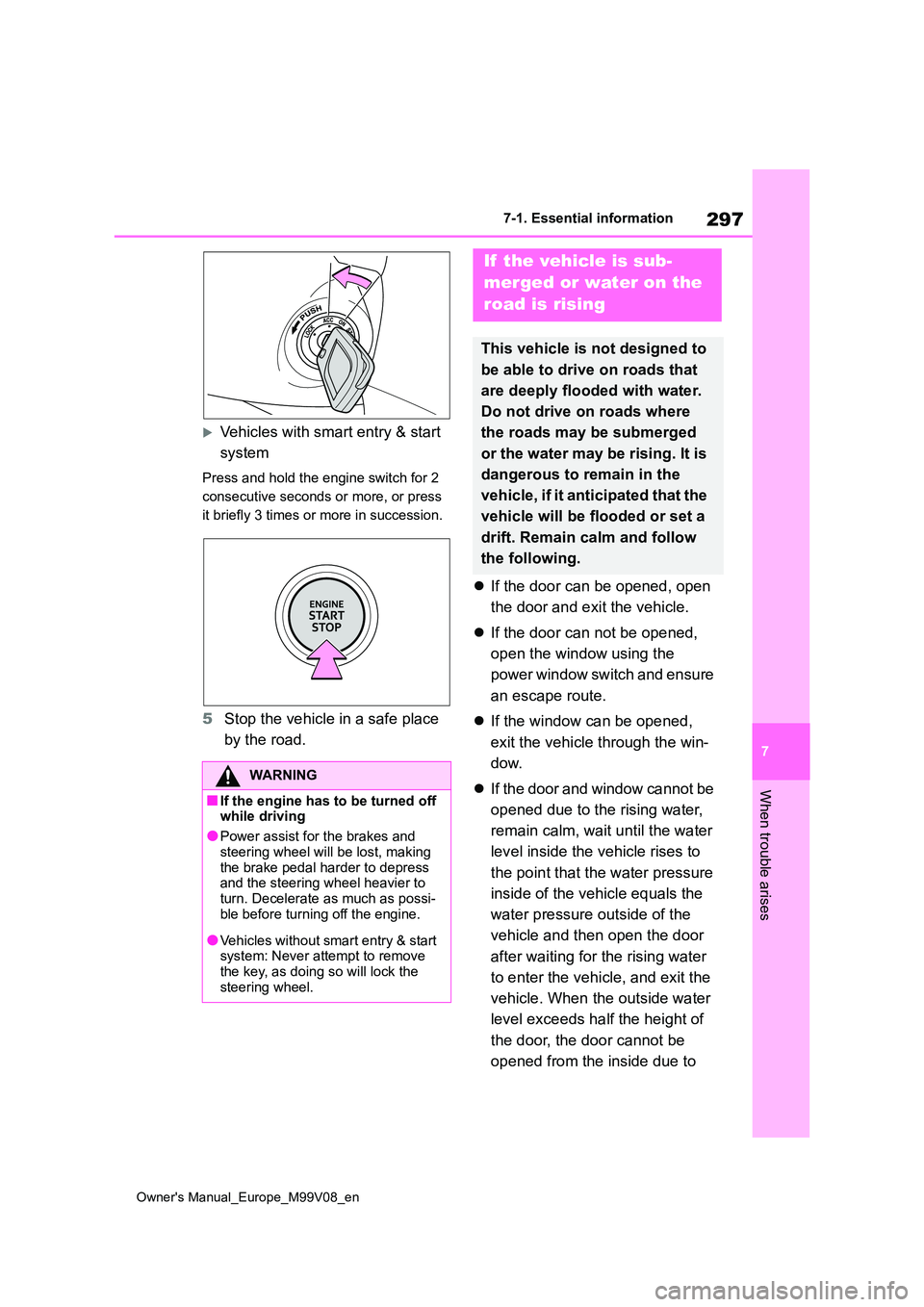
Vehicles with smart entry & start
system
Press and hold the engine switch for 2
consecutive seconds or more, or press
it briefly 3 times or more in succession.
5 Stop the vehicle in a safe place
by the road.
If the door can be opened, open
the door and exit the vehicle.
If the door can not be opened,
open the window using the
power window switch and ensure
an escape route.
If the window can be opened,
exit the vehicle through the win-
dow.
If the door and window cannot be
opened due to the rising water,
remain calm, wait until the water
level inside the vehicle rises to
the point that the water pressure
inside of the vehicle equals the
water pressure outside of the
vehicle and then open the door
after waiting for the rising water
to enter the vehicle, and exit the
vehicle. When the outside water
level exceeds half the height of
the door, the door cannot be
opened from the inside due to
WARNING
■If the engine has to be turned off while driving
●Power assist for the brakes and
steering wheel will be lost, making the brake pedal harder to depress and the steering wheel heavier to
turn. Decelerate as much as possi- ble before turning off the engine.
●Vehicles without smart entry & start system: Never attempt to remove the key, as doing so will lock the
steering wheel.
If the vehicle is sub-
merged or water on the
road is rising
This vehicle is not designed to
be able to drive on roads that
are deeply flooded with water.
Do not drive on roads where
the roads may be submerged
or the water may be rising. It is
dangerous to remain in the
vehicle, if it anticipated that the
vehicle will be flooded or set a
drift. Remain calm and follow
the following.
Page 302 of 494
300
Owner's Manual_Europe_M99V08_en
7-2. Steps to take in an emergency
When using a flat-bed truck to
transport the vehicle, use tire strap-
ping belts. Refer to the owner’s
manual of the flat-bed truck for the
tire strapping method.
In order to suppress vehicle move-
ment during transportation, set the
parking brake and turn the engine
switch off.
If a tow truck is not available in an
emergency, your vehicle may be
temporarily towed using cables or
chains secured to the emergency
towing eyelets. This should only be
attempted on hard surfaced roads
for at most 80 km (50 miles) at
under 30 km/h (18 mph).
A driver must be in the vehicle to
steer and operate the brakes. The
vehicle’s wheels, drivetrain, axles,
steering and brakes must be in
good condition.
For vehicles with Multidrive, only
the front towing eyelets may be
used.
To have your vehicle towed by
another vehicle, the towing eyelet
must be installed to your vehicle.
Install the towing eyelet using the
following procedure.
WARNING
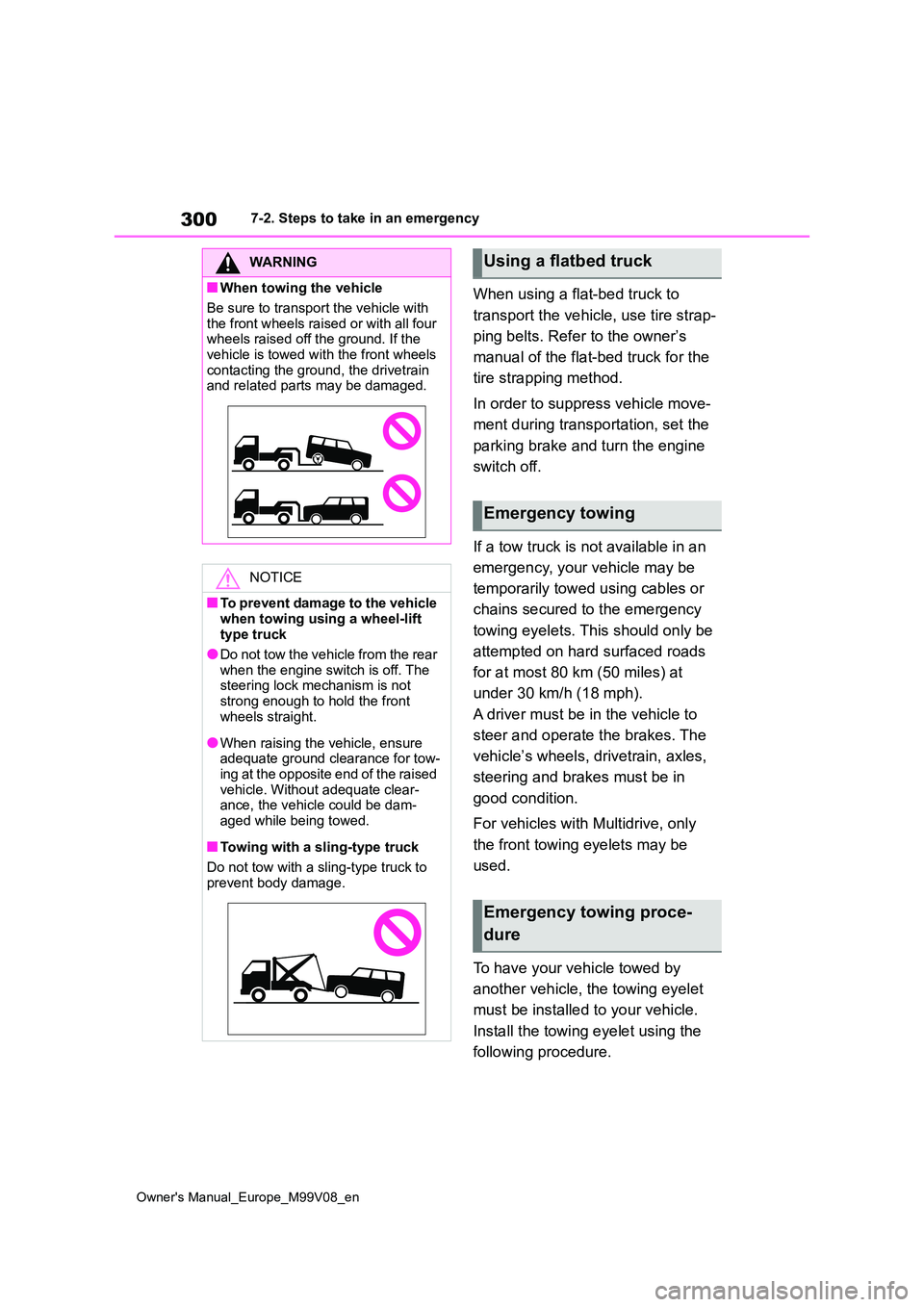
■When towing the vehicle
Be sure to transport the vehicle with
the front wheels raised or with all four wheels raised off the ground. If the vehicle is towed with the front wheels
contacting the ground, the drivetrain and related parts may be damaged.
NOTICE
■To prevent damage to the vehicle
when towing using a wheel-lift type truck
●Do not tow the vehicle from the rear
when the engine switch is off. The steering lock mechanism is not strong enough to hold the front
wheels straight.
●When raising the vehicle, ensure adequate ground clearance for tow-ing at the opposite end of the raised
vehicle. Without adequate clear- ance, the vehicle could be dam-aged while being towed.
■Towing with a sling-type truck
Do not tow with a sling-type truck to
prevent body damage.
Using a flatbed truck
Emergency towing
Emergency towing proce-
dure
Page 303 of 494
301
7
Owner's Manual_Europe_M99V08_en
7-2. Steps to take in an emergency
When trouble arises
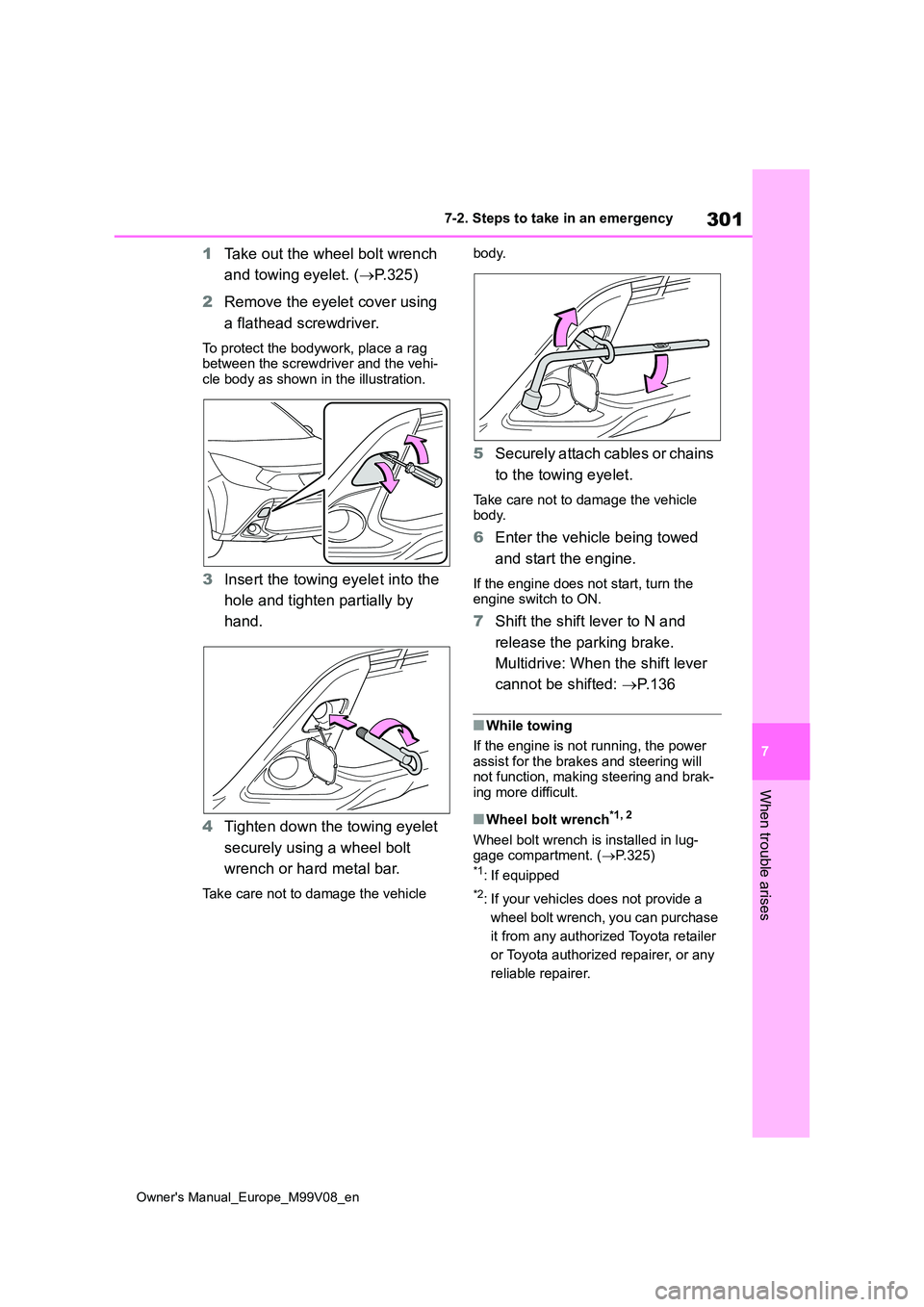
1Take out the wheel bolt wrench
and towing eyelet. ( P.325)
2 Remove the eyelet cover using
a flathead screwdriver.
To protect the bodywork, place a rag between the screwdriver and the vehi-cle body as shown in the illustration.
3 Insert the towing eyelet into the
hole and tighten partially by
hand.
4 Tighten down the towing eyelet
securely using a wheel bolt
wrench or hard metal bar.
Take care not to damage the vehicle
body.
5 Securely attach cables or chains
to the towing eyelet.
Take care not to damage the vehicle body.
6 Enter the vehicle being towed
and start the engine.
If the engine does not start, turn the engine switch to ON.
7 Shift the shift lever to N and
release the parking brake.
Multidrive: When the shift lever
cannot be shifted: P.136
■While towing
If the engine is not running, the power assist for the brakes and steering will not function, making steering and brak-
ing more difficult.
■Wheel bolt wrench*1, 2
Wheel bolt wrench is installed in lug- gage compartment. ( P.325)*1: If equipped
*2: If your vehicles does not provide a
wheel bolt wrench, you can purchase
it from any authorized Toyota retailer
or Toyota authorized repairer, or any
reliable repairer.
Page 312 of 494
310
Owner's Manual_Europe_M99V08_en
7-2. Steps to take in an emergency
WARNING
■If both the ABS and the brake system warning lights remain on
Stop your vehicle in a safe place immediately and contact any autho-rized Toyota retailer or Toyota autho-
rized repairer, or any reliable repairer. The vehicle will become extremely unstable during braking, and the ABS
system may fail, which could cause an accident resulting in death or seri-ous injury.
■When the electric power steer-ing system warning light comes
on
When the light comes on yellow, the assist to the power steering is
restricted. When the light comes on red, the assist to the power steering is lost and handling operations of the
steering wheel become extremely heavy.When steering wheel operations are
heavier than usual, grip the steering wheel firmly and operate it using more force than usual.
■If the tire pressure warning light comes on
Be sure to observe the following pre- cautions.Failure to do so could cause a loss of
vehicle control and result in death or serious injury.
●Stop your vehicle in a safe place as soon as possible. Adjust the tire inflation pressure immediately.
●Vehicles with a compact spare tire and full-size spare tire: If the tire
pressure warning light comes on even after tire inflation pressure adjustment, it is probable that you
have a flat tire. Check the tires. If a tire is flat, change it with the spare tire and have the flat tire repaired
by the nearest any authorized Toy- ota retailer or Toyota authorized repairer, or any reliable repairer.
●Vehicles with emergency tire punc-ture repair kit: If the tire pressure warning light comes on even after
tire inflation pressure adjustment, it is probable that you have a flat tire.Check the tires. If a tire is flat, repair
the flat tire by using emergency tire puncture repair kit.
●Avoid abrupt maneuvering and braking.If the vehicle tires deteriorate, you
could lose control of the steering wheel or the brakes.
■If a blowout or sudden air leak-age should occur
The tire pressure warning system
may not activate immediately.
NOTICE
■To ensure the tire pressure warn- ing system operates properly
Do not install tires with different speci- fications or makers, as the tire pres-sure warning system may not operate
properly.
Page 313 of 494
311
7
Owner's Manual_Europe_M99V08_en
7-2. Steps to take in an emergency
When trouble arises
■Warning messages
The warning messages explained below
may differ from the actual messages according to operation conditions and vehicle specifications.
■Warning buzzer
A buzzer may sound when a message is displayed.The buzzer may not be audible if the
vehicle is in a noisy location or if the audio system volume is high.
■If “Engine Stopped Steering Power Low” is displayed
This message is displayed if the engine
is stopped while driving.
When steering wheel operations are heavier than usual, grip the steering wheel firmly and operate it using more
force than usual.
■If “Auto Power OFF to Conserve Battery” is displayed
Power was cut off due to the automatic
power off function. Next time when start- ing the engine, increase the engine speed slightly and maintain that level for
approximately 5 minutes to recharge the battery.
■If “Headlight System Malfunction Visit Your Dealer” is displayed
The following systems may be malfunc- tioning. Have the vehicle inspected by any authorized Toyota retailer or Toyota
authorized repairer, or any reliable repairer immediately.
●The LED headlight system (if equipped)
●AHB (Automatic High Beam)
■If a message that indicates the mal-function of front camera is dis-played
The following systems may be sus- pended until the problem shown in the message is resolved. ( P.159, 304)
●PCS (Pre-Collision System)
●LTA (Lane Tracing Assist)
●AHB (Automatic High Beam)
●RSA (Road Sign Assist) (if equipped)
●Dynamic radar cruise control
■If a message that indicates the mal- function of radar sensor is dis-played
The following systems may be sus- pended until the problem shown in the message is resolved. ( P.159, 304)
●PCS (Pre-Collision system)
●LTA (Lane Tracing Assist)
●Dynamic radar cruise control
If a warning message is
displayed
The multi-information display
shows warnings for system
malfunctions and incorrectly
performed operations, and
messages that indicate a need
for maintenance. When a mes-
sage is displayed, perform the
appropriate corrective action
for the message.
If a warning message is dis-
played again after the appro-
priate actions have been
performed, contact any autho-
rized Toyota retailer or Toyota
authorized repairer, or any reli-
able repairer.
Additionally, if a warning light
comes on or flashes at the
same time that a warning mes-
sage is displayed, take the
appropriate corrective action
for the warning light. ( P.304)
Page 325 of 494
323
7
Owner's Manual_Europe_M99V08_en
7-2. Steps to take in an emergency
When trouble arises
WARNING
●Parts of the repair kit become hot during operation. Be careful when
handling the repair kit during and after operation. Do not touch the metal part around the connecting
area between the bottle and com- pressor. It will be extremely hot.
●Do not attach the vehicle speed warning sticker to an area other than the one indicated. If the sticker
is attached to an area where an SRS airbag is located, such as the pad of the steering wheel, it may
prevent the SRS airbag from oper- ating properly.
●To avoid risk of burst or severe leakage, do not drop or damage the bottle. Visually inspect the bottle
before use. Do not use a bottle with shock, crack, scratch, leakage or any other damage. In such case,
immediately replace.
■Driving to spread the liquid seal-
ant evenly
Observe the following precautions to reduce the risk of accidents.
Failing to do so may result in a loss of vehicle control and cause death or serious injury.
●Drive the vehicle carefully at a low speed. Be especially careful when
turning and cornering.
●If the vehicle does not drive straight
or you feel a pull through the steer- ing wheel, stop the vehicle and check the following.
• Tire condition. The tire may have separated from the wheel.
• Tire inflation pressure. If the tire inflation pressure is 130 kPa (1.3
kgf/cm2 or bar, 19 psi) or less, the tire may be severely damaged.
NOTICE
■When performing an emergency repair
●A tire should only be repaired with the emergency tire puncture repair kit if the damage is caused by a
sharp object such as nail or screw passing through the tire tread.Do not remove the sharp object
from the tire. Removing the object may widen the opening and disen-able emergency repair with the
repair kit.
●The repair kit is not waterproof.
Make sure that the repair kit is not exposed to water, such as when it is being used in the rain.
●Do not put the repair kit directly onto dusty ground such as sand at
the side of the road. If the repair kit vacuums up dust etc., a malfunc-tion may occur.
●Do not turn the bottle upside down when using it, as doing so may
cause damage to the compressor.
■Precautions for the emergency
tire puncture repair kit
●The repair kit power source should be 12 V DC suitable for vehicle use.
Do not connect the repair kit to any other source.
●If fuel splatters on the repair kit, the repair kit may deteriorate. Take care not to allow fuel to contact it.
●Place the repair kit in a storage to prevent it from being exposed to dirt
or water.
●Store the repair kit in the luggage
compartment out of reach of chil- dren.
●Do not disassemble or modify the repair kit. Do not subject parts such as the air pressure indicator to
impacts. This may cause a malfunc- tion.
Page 333 of 494
331
7
Owner's Manual_Europe_M99V08_en
7-2. Steps to take in an emergency
When trouble arises
WARNING
■When using the compact spare tire (if equipped)
●Remember that the compact spare tire provided is specifically designed for use with your vehicle.
Do not use your compact spare tire on another vehicle.
●Do not use more than one compact spare tires simultaneously.
●Replace the compact spare tire with a standard tire as soon as possible.
●Avoid sudden acceleration, abrupt steering, sudden braking and shift-ing operations that cause sudden
engine braking.
■When the compact spare tire (if
equipped) is attached
The vehicle speed may not be cor- rectly detected, and the following sys-
tems may not operate correctly:
• ABS & Brake assist
• VSC
•TRC
• Automatic High Beam (if equipped)
• Dynamic radar cruise control
• EPS
• PCS (Pre-Collision System)
• LTA (Lane Tracing Assist)
• Tire pressure warning system
• Toyota parking assist-sensor (if
equipped)
• Rear view monitor system (if
equipped)
• Navigation system (if equipped)
■Speed limit when using the com- pact spare tire (if equipped)
Do not drive at speeds in excess of 80
km/h (50 mph) when a compact spare tire is installed on the vehicle.
The compact spare tire is not designed for driving at high speeds. Failure to observe this precaution
may lead to an accident causing death or serious injury.
■After using the tools and jack
Before driving, make sure all the tools and jack are securely in place in their
storage location to reduce the possi- bility of personal injury during a colli-sion or sudden braking.
NOTICE
■Be careful when driving over bumps with the compact spare tire (if equipped) installed on the
vehicle.
The vehicle becomes lower when driving with the compact spare tire
compared to when driving with stan- dard tires. Be careful when driving over uneven road surfaces.
■Driving with tire chains and the compact spare tire (if equipped)
Do not fit tire chains to the compact spare tire. Tire chains may damage the vehicle body and adversely affect
driving performance.
■When replacing the tires
When removing or fitting the wheels, tires or the tire pressure warning valve and transmitter, contact any
authorized Toyota retailer or Toyota authorized repairer, or any reliable repairer as the tire pressure warning
valve and transmitter may be dam- aged if not handled correctly.
Page 352 of 494
350
Owner's Manual_Europe_M99V08_en
8-1. Specifications
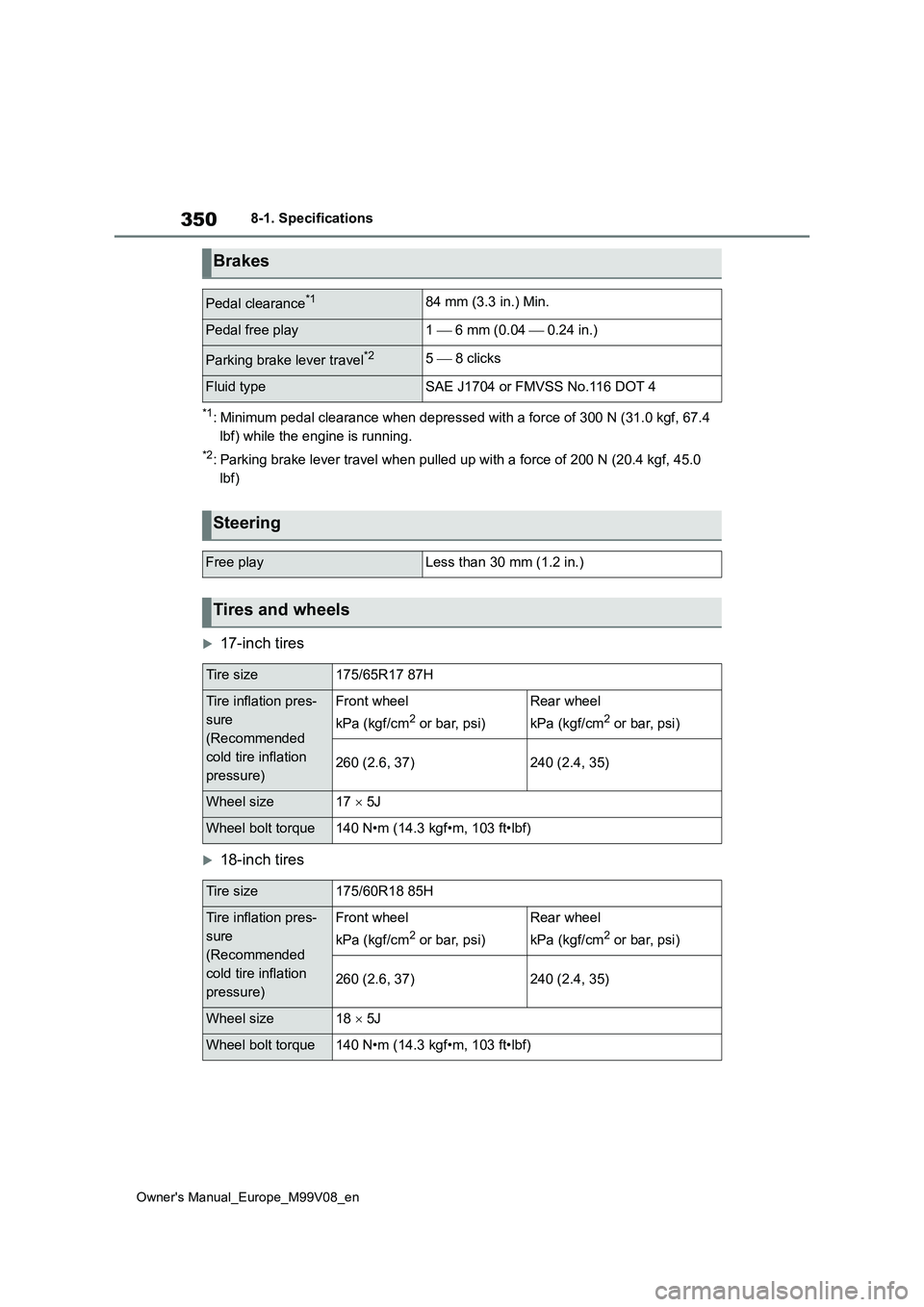
*1: Minimum pedal clearance when depressed with a force of 300 N (31.0 kgf, 67.4
lbf) while the engine is running.
*2: Parking brake lever travel when pulled up with a force of 200 N (20.4 kgf, 45.0
lbf)
17-inch tires
18-inch tires
Brakes
Pedal clearance*184 mm (3.3 in.) Min.
Pedal free play1 6 mm (0.04 0.24 in.)
Parking brake lever travel*25 8 clicks
Fluid typeSAE J1704 or FMVSS No.116 DOT 4
Steering
Free playLess than 30 mm (1.2 in.)
Tires and wheels
Tire size175/65R17 87H
Tire inflation pres-
sure
(Recommended
cold tire inflation
pressure)
Front wheel
kPa (kgf/cm2 or bar, psi)
Rear wheel
kPa (kgf/cm2 or bar, psi)
260 (2.6, 37)240 (2.4, 35)
Wheel size17 5J
Wheel bolt torque140 N•m (14.3 kgf•m, 103 ft•lbf)
Tire size175/60R18 85H
Tire inflation pres-
sure
(Recommended
cold tire inflation
pressure)
Front wheel
kPa (kgf/cm2 or bar, psi)
Rear wheel
kPa (kgf/cm2 or bar, psi)
260 (2.6, 37)240 (2.4, 35)
Wheel size18 5J
Wheel bolt torque140 N•m (14.3 kgf•m, 103 ft•lbf)
Page 366 of 494
364
Owner's Manual_Europe_M99V08_en
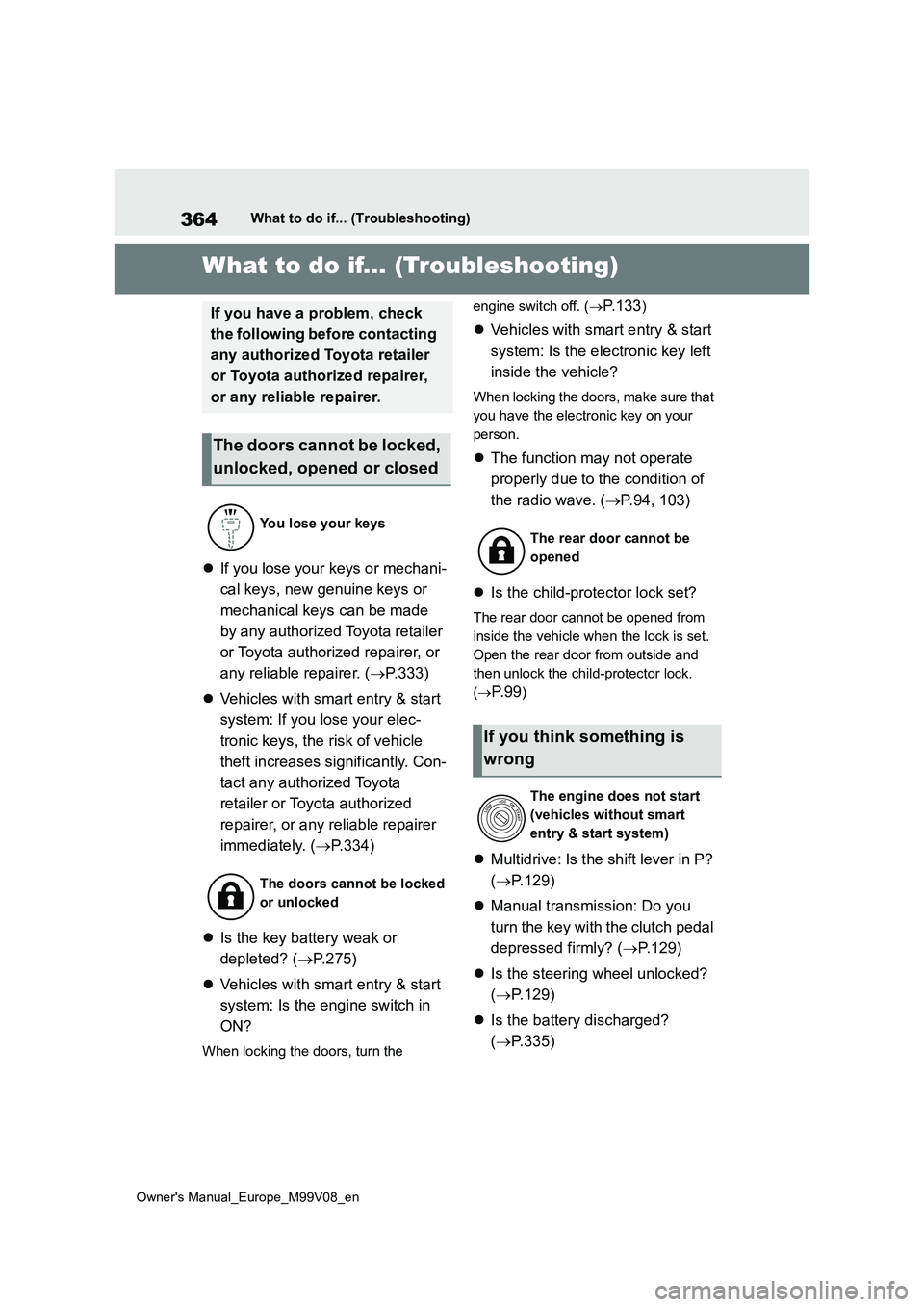
What to do if... (Troubleshooting)
1-1.What to d o if... (Tro ublesho oting)What to do if... (Troubleshooting)
If you lose your keys or mechani-
cal keys, new genuine keys or
mechanical keys can be made
by any authorized Toyota retailer
or Toyota authorized repairer, or
any reliable repairer. ( P.333)
Vehicles with smart entry & start
system: If you lose your elec-
tronic keys, the risk of vehicle
theft increases significantly. Con-
tact any authorized Toyota
retailer or Toyota authorized
repairer, or any reliable repairer
immediately. ( P.334)
Is the key battery weak or
depleted? ( P.275)
Vehicles with smart entry & start
system: Is the engine switch in
ON?
When locking the doors, turn the
engine switch off. ( P.133)
Vehicles with smart entry & start
system: Is the electronic key left
inside the vehicle?
When locking the doors, make sure that
you have the electronic key on your
person.
The function may not operate
properly due to the condition of
the radio wave. ( P.94, 103)
Is the child-protector lock set?
The rear door cannot be opened from
inside the vehicle when the lock is set.
Open the rear door from outside and
then unlock the child-protector lock.
( P. 9 9)
Multidrive: Is the shift lever in P?
( P.129)
Manual transmission: Do you
turn the key with the clutch pedal
depressed firmly? ( P.129)
Is the steering wheel unlocked?
( P.129)
Is the battery discharged?
( P.335)
If you have a problem, check
the following before contacting
any authorized Toyota retailer
or Toyota authorized repairer,
or any reliable repairer.
The doors cannot be locked,
unlocked, opened or closed
You lose your keys
The doors cannot be locked
or unlocked
The rear door cannot be
opened
If you think something is
wrong
The engine does not start
(vehicles without smart
entry & start system)
Page 367 of 494
365
Owner's Manual_Europe_M99V08_en
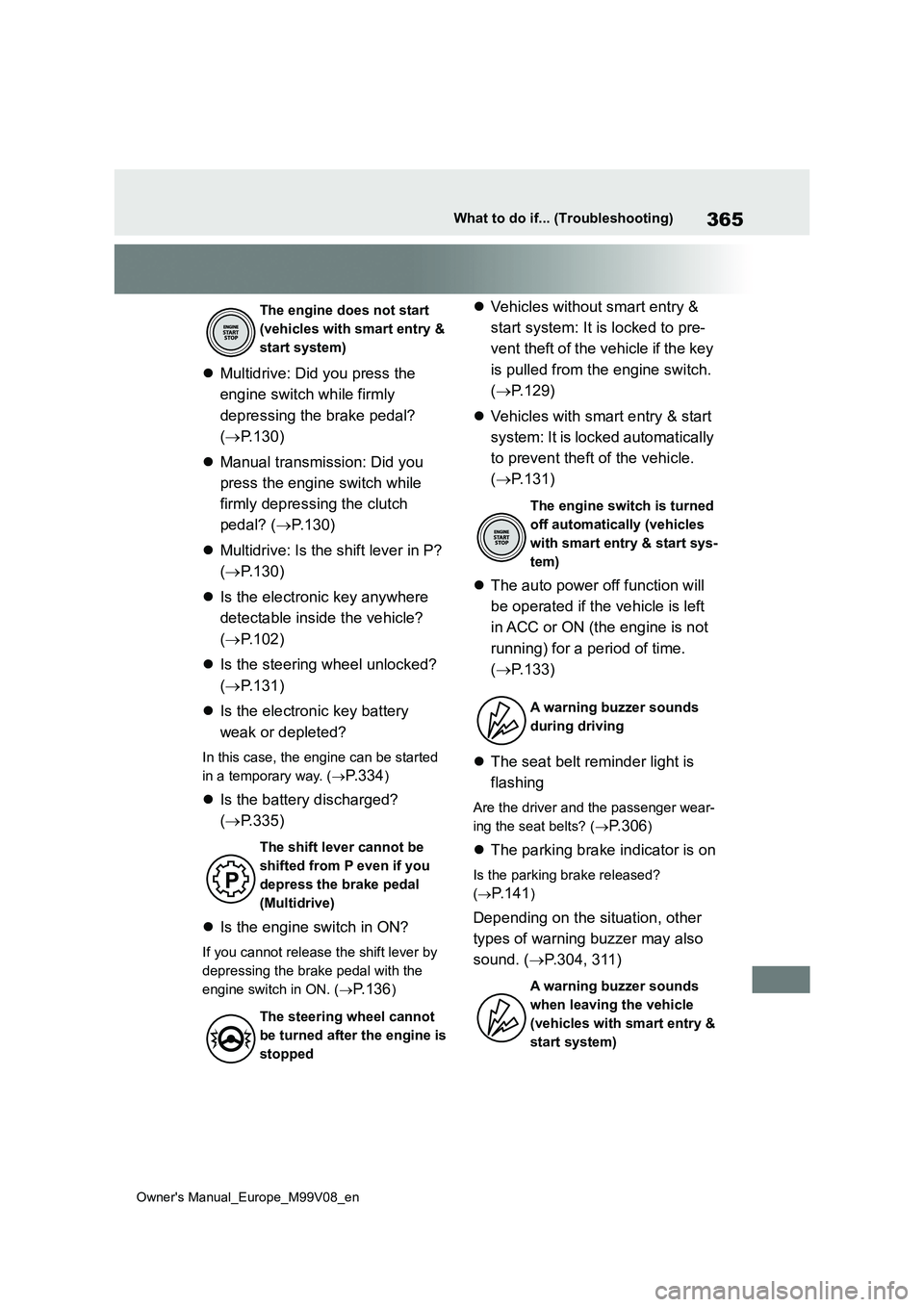
What to do if... (Troubleshooting)
Multidrive: Did you press the
engine switch while firmly
depressing the brake pedal?
( P.130)
Manual transmission: Did you
press the engine switch while
firmly depressing the clutch
pedal? ( P.130)
Multidrive: Is the shift lever in P?
( P.130)
Is the electronic key anywhere
detectable inside the vehicle?
( P.102)
Is the steering wheel unlocked?
( P.131)
Is the electronic key battery
weak or depleted?
In this case, the engine can be started
in a temporary way. ( P.334)
Is the battery discharged?
( P.335)
Is the engine switch in ON?
If you cannot release the shift lever by
depressing the brake pedal with the
engine switch in ON. ( P.136)
Vehicles without smart entry &
start system: It is locked to pre-
vent theft of the vehicle if the key
is pulled from the engine switch.
( P.129)
Vehicles with smart entry & start
system: It is locked automatically
to prevent theft of the vehicle.
( P.131)
The auto power off function will
be operated if the vehicle is left
in ACC or ON (the engine is not
running) for a period of time.
( P.133)
The seat belt reminder light is
flashing
Are the driver and the passenger wear-
ing the seat belts? ( P. 3 0 6)
The parking brake indicator is on
Is the parking brake released?
( P.141)
Depending on the situation, other
types of warning buzzer may also
sound. ( P.304, 311)
The engine does not start
(vehicles with smart entry &
start system)
The shift lever cannot be
shifted from P even if you
depress the brake pedal
(Multidrive)
The steering wheel cannot
be turned after the engine is
stopped
The engine switch is turned
off automatically (vehicles
with smart entry & start sys-
tem)
A warning buzzer sounds
during driving
A warning buzzer sounds
when leaving the vehicle
(vehicles with smart entry &
start system)