steering wheel TOYOTA AYGO X 2022 (in English) Owner's Guide
[x] Cancel search | Manufacturer: TOYOTA, Model Year: 2022, Model line: AYGO X, Model: TOYOTA AYGO X 2022Pages: 494, PDF Size: 92.53 MB
Page 186 of 494
184
Owner's Manual_Europe_M99V08_en
4-5. Using the driving support systems
This mode employs a radar to detect the presence of vehicles up to approx-
imately 100 m (328 ft.) ahead, d etermines the current vehicle-to-vehicle fol-
lowing distance, and operates to maintain a suitable following distance from
the vehicle ahead. The desired vehicle-to-vehicle distance can also be set
by operating the vehicle-to-vehicle distance switch.
When driving on downhill slopes, the vehicle-to-vehicle distanc e may become
shorter.
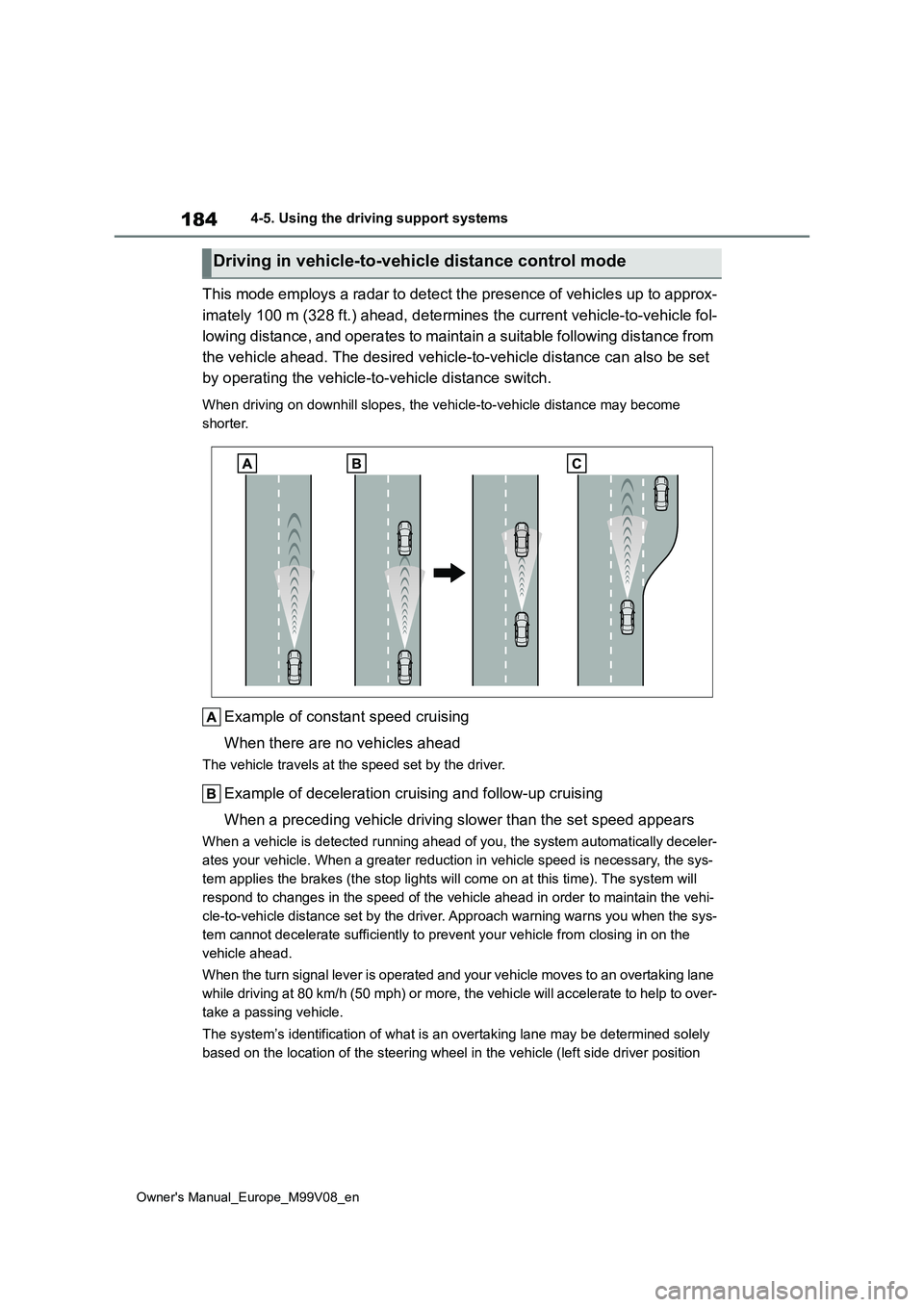
Example of constant speed cruising
When there are no vehicles ahead
The vehicle travels at the speed set by the driver.
Example of deceleration cruising and follow-up cruising
When a preceding vehicle driving slower than the set speed appe ars
When a vehicle is detected running ahead of you, the system automatically deceler-
ates your vehicle. When a greater reduction in vehicle speed is necessary, the sys-
tem applies the brakes (the stop lights will come on at this ti me). The system will
respond to changes in the speed of the vehicle ahead in order t o maintain the vehi-
cle-to-vehicle distance set by the driver. Approach warning war ns you when the sys-
tem cannot decelerate sufficiently to prevent your vehicle from closing in on the
vehicle ahead.
When the turn signal lever is operated and your vehicle moves t o an overtaking lane
while driving at 80 km/h (50 mph) or more, the vehicle will acc elerate to help to over-
take a passing vehicle.
The system’s identification of what is an overtaking lane may b e determined solely
based on the location of the steering wheel in the vehicle (lef t side driver position
Driving in vehicle-to-vehicle distance control mode
Page 193 of 494
191
4
Owner's Manual_Europe_M99V08_en
4-5. Using the driving support systems
Driving
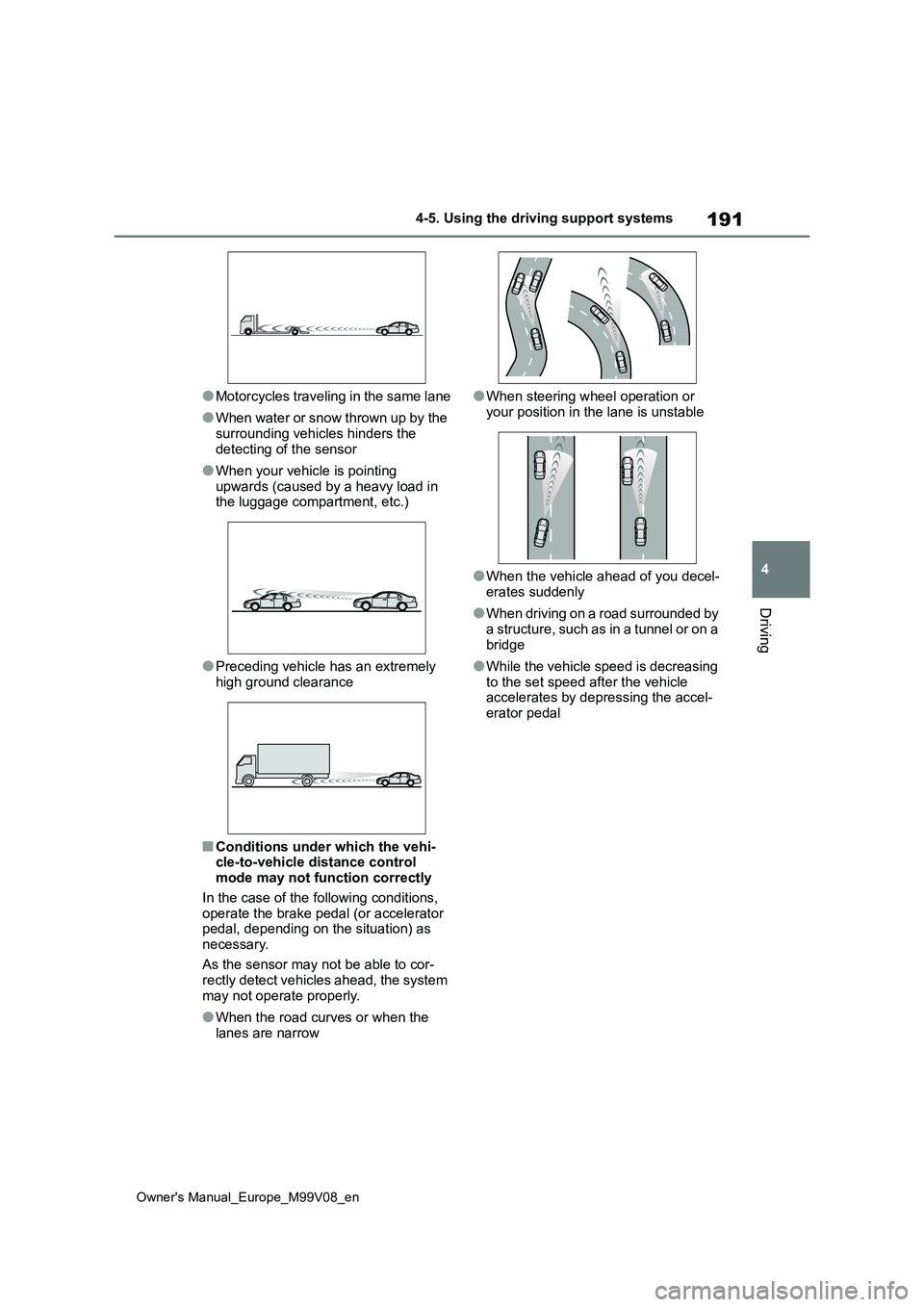
●Motorcycles traveling in the same lane
●When water or snow thrown up by the surrounding vehicles hinders the
detecting of the sensor
●When your vehicle is pointing
upwards (caused by a heavy load in the luggage compartment, etc.)
●Preceding vehicle has an extremely high ground clearance
■Conditions under which the vehi-cle-to-vehicle distance control mode may not function correctly
In the case of the following conditions, operate the brake pedal (or accelerator pedal, depending on the situation) as
necessary.
As the sensor may not be able to cor- rectly detect vehicles ahead, the system
may not operate properly.
●When the road curves or when the
lanes are narrow
●When steering wheel operation or
your position in the lane is unstable
●When the vehicle ahead of you decel-
erates suddenly
●When driving on a road surrounded by
a structure, such as in a tunnel or on a bridge
●While the vehicle speed is decreasing to the set speed after the vehicle accelerates by depressing the accel-
erator pedal
Page 201 of 494
199
4
Owner's Manual_Europe_M99V08_en
4-5. Using the driving support systems
Driving
start automatically.
When the engine starts, the Stop &
Start indicator will turn off.
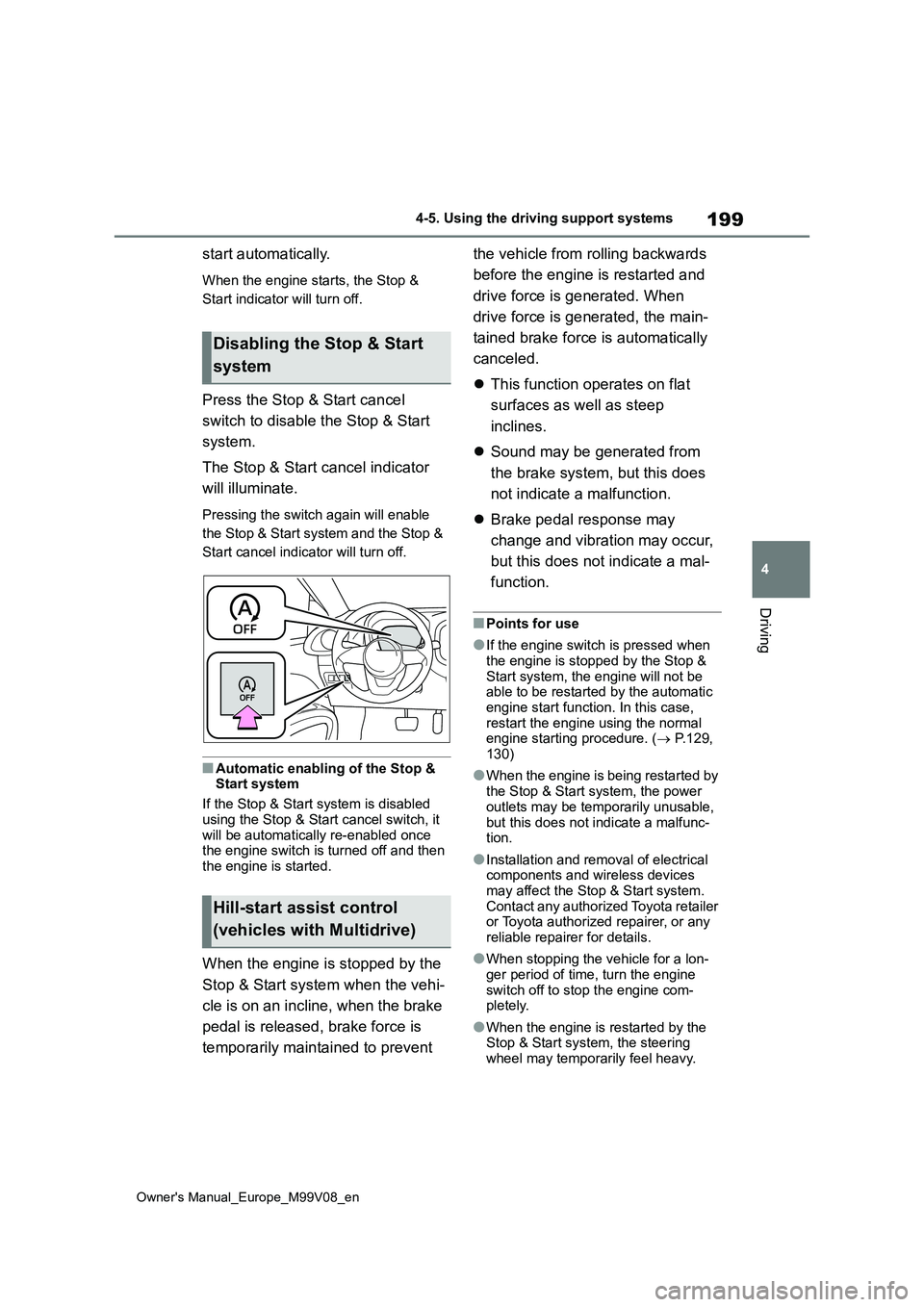
Press the Stop & Start cancel
switch to disable the Stop & Start
system.
The Stop & Start cancel indicator
will illuminate.
Pressing the switch again will enable
the Stop & Start system and the Stop &
Start cancel indicator will turn off.
■Automatic enabling of the Stop & Start system
If the Stop & Start system is disabled
using the Stop & Start cancel switch, it will be automatically re-enabled once the engine switch is turned off and then
the engine is started.
When the engine is stopped by the
Stop & Start system when the vehi-
cle is on an incline, when the brake
pedal is released, brake force is
temporarily maintained to prevent
the vehicle from rolling backwards
before the engine is restarted and
drive force is generated. When
drive force is generated, the main-
tained brake force is automatically
canceled.
This function operates on flat
surfaces as well as steep
inclines.
Sound may be generated from
the brake system, but this does
not indicate a malfunction.
Brake pedal response may
change and vibration may occur,
but this does not indicate a mal-
function.
■Points for use
●If the engine switch is pressed when
the engine is stopped by the Stop & Start system, the engine will not be able to be restarted by the automatic
engine start function. In this case, restart the engine using the normal engine starting procedure. ( P.129,
130)
●When the engine is being restarted by
the Stop & Start system, the power outlets may be temporarily unusable,
but this does not indicate a malfunc- tion.
●Installation and removal of electrical components and wireless devices may affect the Stop & Start system.
Contact any authorized Toyota retailer or Toyota authorized repairer, or any reliable repairer for details.
●When stopping the vehicle for a lon-ger period of time, turn the engine
switch off to stop the engine com- pletely.
●When the engine is restarted by the Stop & Start system, the steering wheel may temporarily feel heavy.
Disabling the Stop & Start
system
Hill-start assist control
(vehicles with Multidrive)
Page 202 of 494
200
Owner's Manual_Europe_M99V08_en
4-5. Using the driving support systems
■Operating conditions
●The Stop & Start system is operational when all of the following conditions
are met: • The vehicle has been driven a certain amount of time.
• The brake pedal is being depressed firmly.• The clutch pedal is not depressed
(vehicles with manual transmission). • The shift lever is in D (vehicles with Multidrive).
• The shift lever is in N (vehicles with manual transmission).• The driver’s seat belt is fastened.
• The driver’s door is closed. • The windshield defogger is off. (vehi-cles without a manual air conditioning
system) • The accelerator pedal is not being depressed (vehicles with Multidrive).
• The engine is adequately warmed up. • The outside temperature is -5°C (23°F) or higher.
• The hood is closed. ( P.201)
●In the following situations the engine
may not be stopped by the Stop & Start system. This is not a malfunction of the Stop & Start system.
• When the air conditioning system is being used.• When the battery is undergoing a peri-
odic recharge. • When the battery is not sufficiently charged, such as if the vehicle has
been parked for a long time and the battery charge has decreased, the electric load is large, the battery fluid
temperature is excessively low or the battery has deteriorated.• When the brake booster vacuum is
low. • When the elapsed time since the engine was restarted is short.
• When the vehicle is stopped fre- quently, such as when in a traffic jam.• When the engine coolant temperature
or transmission fluid temperature is extremely low or high.• When the vehicle is stopped on a
steep incline (vehicles with Multid- rive).
• When the steering wheel is being
operated. • When the vehicle is being driven in a high altitude area.
• When the battery fluid temperature is extremely low or high.• For a while after the battery terminals
have been disconnected and recon- nected.
●When the engine is stopped by the S t o p & S t a r t s y s t e m , t h e e n g i n e w i l l b e restarted automatically if any of the
following conditions are met:
(To enable the engine to be stopped by
the Stop & Start system again, drive the
vehicle.)
• The air conditioning system is turned on. (vehicles without a manual air
conditioning system) • The windshield defogger is turned on. (vehicles without a manual air condi-
tioning system) • The shift lever is shifted from D (vehi-cles with Multidrive).
• The shift lever is shifted from P. (When the engine is stopped by the Stop & Start system when the shift
lever is in P.) (vehicles with Multidrive) • The driver’s seat belt is unfastened.• The driver’s door is opened.
• The Stop & Start cancel switch is pressed.• The steering wheel is operated.
• The accelerator pedal is depressed (vehicles with Multidrive).• The vehicle starts to roll on an incline.
●When the engine is stopped by the Stop & Start system, the engine may
restart automatically in the following situations: (To enable the engine to be stopped by the Stop & Start system
again, drive the vehicle.) • When the brake pedal is pumped or strongly depressed.
• When the air conditioning system is being used.• When a switch of the air conditioning
system is operated (windshield defog- ger switch, etc.).• If the battery charge becomes low.
Page 214 of 494
212
Owner's Manual_Europe_M99V08_en
4-5. Using the driving support systems
drifting to the outer side by perform-
ing inner wheel brake control when
attempting to accelerate while turn-
ing
■Hill-start assist control
Helps to reduce the backward
movement of the vehicle when
starting on an uphill
■EPS (Electric Power Steering)
Employs an electric motor to
reduce the amount of effort needed
to turn the steering wheel.
■Emergency brake signal
When the brakes are applied sud-
denly, the emergency flashers auto-
matically flash to alert the vehicle
behind.
■Secondary Collision Brake
When the SRS airbag sensor
detects a collision and the system
operates, the brakes and brake
lights are automatically controlled
to reduce the vehicle speed and
help reduce the possibility of further
damage due to a secondary colli-
sion.
■When the TRC/VSC systems are
operating
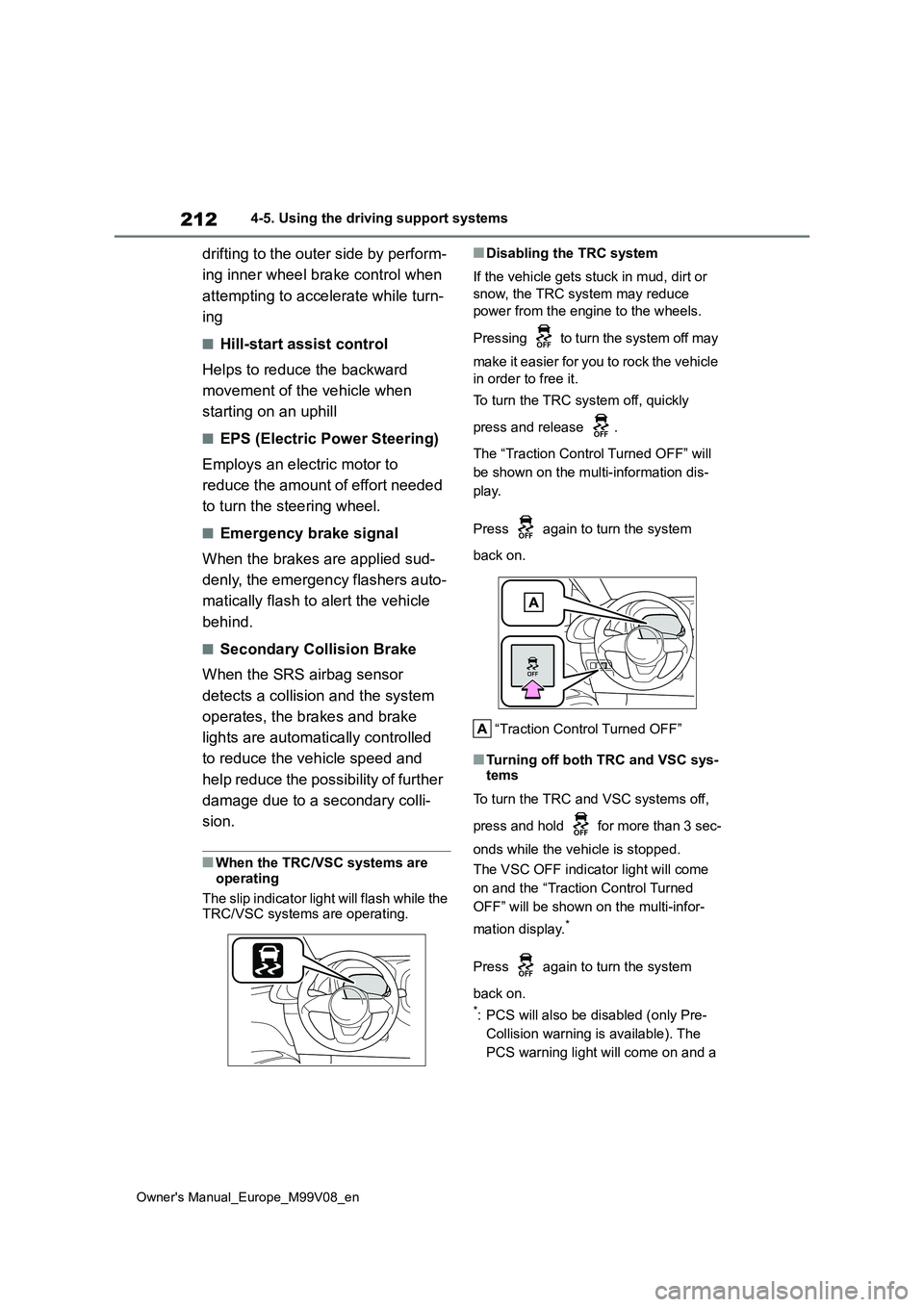
The slip indicator light will flash while the TRC/VSC systems are operating.
■Disabling the TRC system
If the vehicle gets stuck in mud, dirt or
snow, the TRC system may reduce
power from the engine to the wheels.
Pressing to turn the system off may
make it easier for you to rock the vehicle
in order to free it.
To turn the TRC system off, quickly
press and release .
The “Traction Control Turned OFF” will
be shown on the multi-information dis-
play.
Press again to turn the system
back on.
“Traction Control Turned OFF”
■Turning off both TRC and VSC sys- tems
To turn the TRC and VSC systems off,
press and hold for more than 3 sec-
onds while the vehicle is stopped.
The VSC OFF indicator light will come
on and the “Traction Control Turned
OFF” will be shown on the multi-infor-
mation display.*
Press again to turn the system
back on.
*: PCS will also be disabled (only Pre-
Collision warning is available). The
PCS warning light will come on and a
Page 215 of 494
213
4
Owner's Manual_Europe_M99V08_en
4-5. Using the driving support systems
Driving
message will be displayed on the
multi-information display. ( P.171)
■When the message is displayed on
the multi-information display show-
ing that TRC has been disabled
even if has not been pressed
TRC is temporary deactivated. If the
information continues to show, contact any authorized Toyota retailer or Toyota authorized repairer, or any reliable
repairer.
■Operating conditions of hill-start assist control
When all of the following conditions are
met, the hill-start assist control will oper- ate:
●Vehicles with Multidrive: The shift lever is in a position other than P or N (when starting off forward/backward
on an upward incline).
●Vehicles with manual transmission:
The shift lever is in a position other than R when starting off forward on an upward incline, or the shift lever is in
R when starting off backward on an upward incline.
●The vehicle is stopped
●The accelerator pedal is not
depressed
●The parking brake is not engaged
●The engine switch is turned to ON
■Automatic system cancelation of hill-start assist control
The hill-start assist control will turn off in any of the following situations:
●Vehicles with Multidrive: The shift lever is shifted to P or N.
●Vehicles with manual transmission: The shift lever is shifted to R when starting off forward on an upward
incline, or the shift lever is shifted to other than R when starting off back-ward on an upward incline.
●The accelerator pedal is depressed
●The parking brake is engaged
●2 seconds at maximum elapsed after the brake pedal is released
●The engine switch is turned to OFF
■Sounds and vibrations caused by the ABS, brake assist, VSC, TRC
and hill-start assist control sys- tems
●A sound may be heard from the engine compartment when the brake pedal is depressed repeatedly, when
the engine is started or just after the vehicle begins to move. This sound does not indicate that a malfunction
has occurred in any of these systems.
●Any of the following conditions may
occur when the above systems are operating. None of these indicates that a malfunction has occurred.
• Vibrations may be felt through the vehicle body and steering.• A motor sound may be heard also
after the vehicle comes to a stop. • The brake pedal may pulsate slightly after the ABS is activated.
• The brake pedal may move down slightly after the ABS is activated.
■Active Cornering Assist operation sounds and vibrations
When the Active Cornering Assist is operated, operation sounds and vibra-tions may be generated from the brake
system, but this is not a malfunction.
■EPS operation sound
When the steering wheel is operated, a motor sound (whirring sound) may be
heard. This does not indicate a malfunc- tion.
■Automatic reactivation of TRC and VSC systems
After turning the TRC and VSC systems off, the systems will be automatically re-enabled in the following situations:
●When the engine switch is turned off
●If only the TRC system is turned off, the TRC will turn on when vehicle speed increases.
Page 216 of 494
214
Owner's Manual_Europe_M99V08_en
4-5. Using the driving support systems
If both the TRC and VSC systems are
turned off, automatic re-enabling will not occur when vehicle speed increases.
■Operating conditions of Active Cor-
nering Assist
The system operates when the following occurs.
●TRC/VSC can operate
●The driver is attempting to accelerate while turning
●The system detects that the vehicle is drifting to the outer side
●The brake pedal is released
■Reduced effectiveness of the EPS system
The effectiveness of the EPS system is
reduced to prevent the system from overheating when there is frequent steering input over an extended period
of time. The steering wheel may feel heavy as a result. Should this occur, refrain from excessive steering input or
stop the vehicle and turn the engine off. The EPS system should return to nor-mal within 10 minutes.
■Operating conditions of emergency
brake signal
When the following conditions are met, the emergency brake signal will oper-
ates:
●The emergency flashers are off
●Actual vehicle speed is over 55 km/h (35 mph)
●The system judges from the vehicle deceleration that it is a sudden brak-
ing operation.
■Automatic system cancelation of emergency brake signal
The emergency brake signal will be can-
celed in any of the following situations:
●The emergency flashers are turned
on.
●The system judges from the vehicle
deceleration that is not a sudden brak- ing operation.
■Secondary Collision Brake operat-
ing conditions
The system operates when the SRS air- bag sensor detects a collision while the
vehicle is in motion. However, the system does not operate when components are damaged.
■Secondary Collision Brake auto-
matic cancelation
The system is automatically canceled in any of the following situations.
●The vehicle speed drops to approxi-mately 0 km/h (0 mph)
●A certain amount of time elapses during operation
●The accelerator pedal is depressed a large amount
WARNING
■The ABS does not operate effec-tively when
●The limits of tire gripping perfor-
mance have been exceeded (such as excessively worn tires on a snow covered road).
●The vehicle hydroplanes while driv-ing at high speed on wet or slick
roads.
■Stopping distance when the ABS
is operating may exceed that of normal conditions
The ABS is not designed to shorten
the vehicle’s stopping distance. Always maintain a safe distance from the vehicle in front of you, especially
in the following situations:
●When driving on dirt, gravel or
snow-covered roads
●When driving with tire chains
●When driving over bumps in the road
●When driving over roads with pot-holes or uneven surfaces
Page 218 of 494
216
Owner's Manual_Europe_M99V08_en
4-6. Driving tips
4-6.Driving tips
Use fluids that are appropriate to
the prevailing outside tempera-
tures.
• Engine oil
• Engine coolant
• Washer fluid
Have a service technician
inspect the condition of the bat-
tery.
Have the vehicle fitted with four
snow tires or purchase a set of
tire chains for the front tires.
Ensure that all tires are the same size
and brand, and that chains match the
size of the tires*.
*: Tire chains cannot be mounted on
18-inch tires.
Winter driving tips
Carry out the necessary prepa-
rations and inspections before
driving the vehicle in winter.
Always drive the vehicle in a
manner appropriate to the pre-
vailing weather conditions.
Pre-winter preparations
WARNING
■Driving with snow tires
Observe the following precautions to
reduce the risk of accidents. Failure to do so may result in a loss of vehicle control and cause death or
serious injury.
●Use tires of the size specified.
( P.350)
●Maintain the recommended level of air pressure.
●Do not drive at speeds in excess of the speed limit or the speed limit specified for the snow tires being
used.
●Use snow tires on all, not just some
wheels.
■Driving with tire chains (except
18-inch tires)
Observe the following precautions to reduce the risk of accidents.
Failure to do so may result in the vehi- cle being unable to be driven safely, and may cause death or serious
injury.
●Do not drive in excess of the speed
limit specified for the tire chains being used, or 50 km/h (30 mph), whichever is lower.
●Avoid driving on bumpy road sur-faces or over potholes.
●Avoid sudden acceleration, abrupt steering, sudden braking and shift-
ing operations that cause sudden engine braking.
●Slow down sufficiently before enter-ing a curve to ensure that vehicle control is maintained.
●Do not use LTA (Lane Tracing Assist) system.
NOTICE
■Repairing or replacing snow tires
Request repairs or replacement of snow tires from any authorized Toyota
retailer or Toyota authorized repairer, or any reliable repairer or legitimate tire retailers.
This is because the removal and attachment of snow tires affects the operation of the tire pressure warning
valves and transmitters.
Page 243 of 494
241
5
Owner's Manual_Europe_M99V08_en
5-4. Other interior features
Interior features
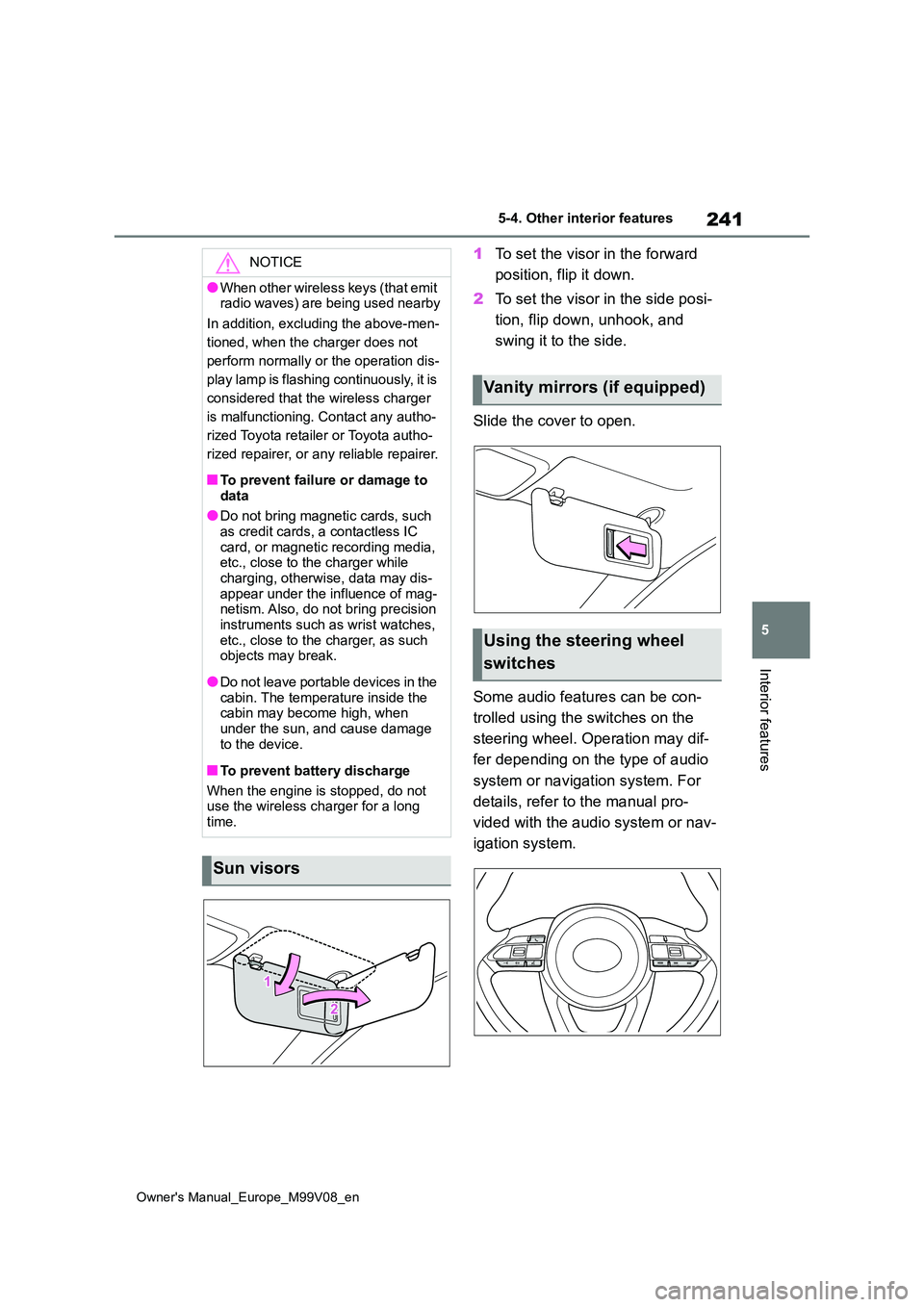
1To set the visor in the forward
position, flip it down.
2 To set the visor in the side posi-
tion, flip down, unhook, and
swing it to the side.
Slide the cover to open.
Some audio features can be con-
trolled using the switches on the
steering wheel. Operation may dif-
fer depending on the type of audio
system or navigation system. For
details, refer to the manual pro-
vided with the audio system or nav-
igation system.
NOTICE
●When other wireless keys (that emit radio waves) are being used nearby
In addition, excluding the above-men-
tioned, when the charger does not
perform normally or the operation dis-
play lamp is flashing continuously, it is
considered that the wireless charger
is malfunctioning. Contact any autho-
rized Toyota retailer or Toyota autho-
rized repairer, or any reliable repairer.
■To prevent failure or damage to
data
●Do not bring magnetic cards, such as credit cards, a contactless IC
card, or magnetic recording media, etc., close to the charger while charging, otherwise, data may dis-
appear under the influence of mag- netism. Also, do not bring precision instruments such as wrist watches,
etc., close to the charger, as such objects may break.
●Do n ot l ea ve po r t ab l e d ev ic es in t he cabin. The temperature inside the cabin may become high, when
under the sun, and cause damage to the device.
■To prevent battery discharge
When the engine is stopped, do not use the wireless charger for a long
time.
Sun visors
Vanity mirrors (if equipped)
Using the steering wheel
switches
Page 290 of 494
288
Owner's Manual_Europe_M99V08_en
6-3. Do-it-yourself maintenance
light is leaking through the mounting.
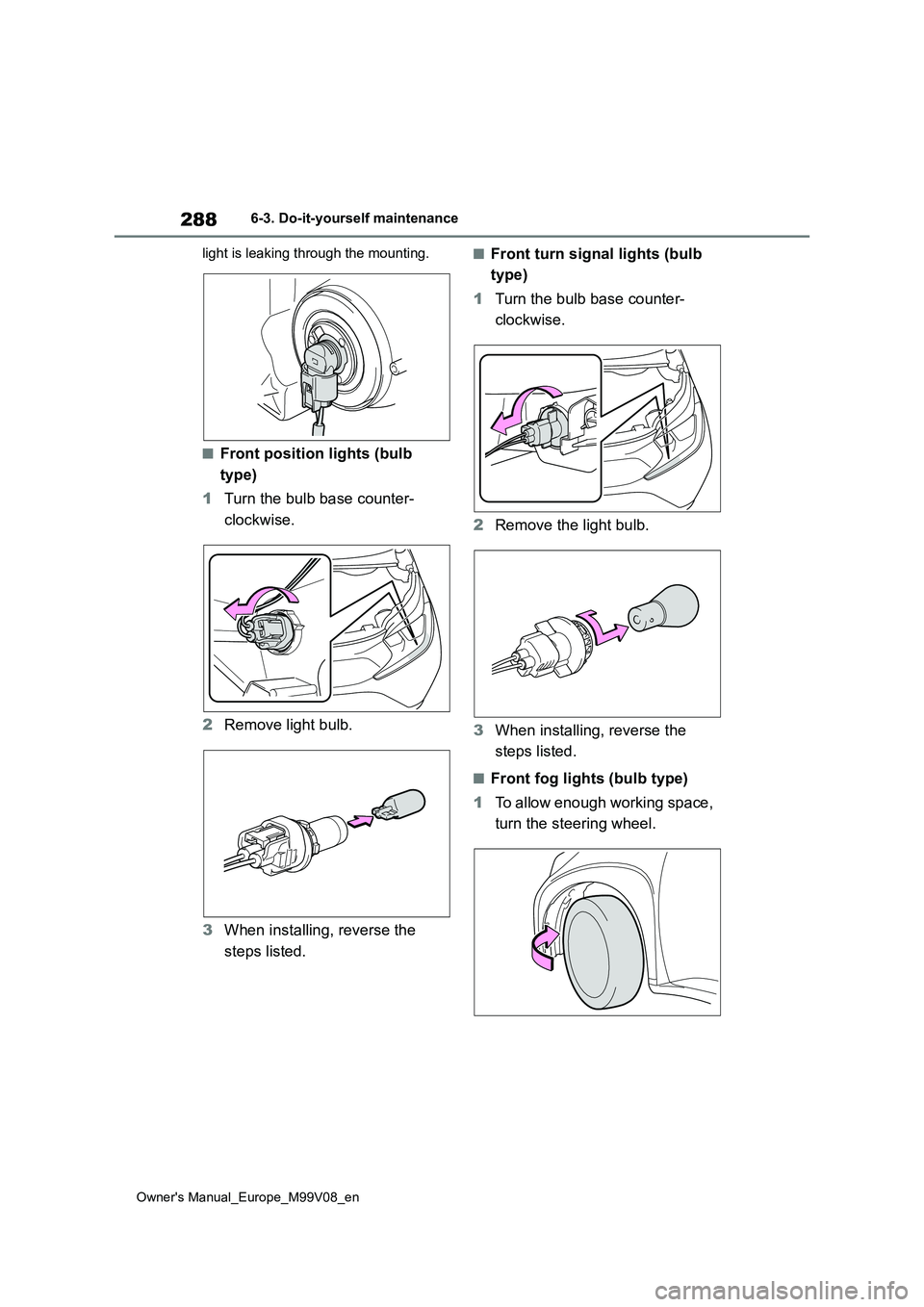
■Front position lights (bulb
type)
1 Turn the bulb base counter-
clockwise.
2 Remove light bulb.
3 When installing, reverse the
steps listed.
■Front turn signal lights (bulb
type)
1 Turn the bulb base counter-
clockwise.
2 Remove the light bulb.
3 When installing, reverse the
steps listed.
■Front fog lights (bulb type)
1 To allow enough working space,
turn the steering wheel.