cooling TOYOTA AYGO X 2022 Owners Manual (in English)
[x] Cancel search | Manufacturer: TOYOTA, Model Year: 2022, Model line: AYGO X, Model: TOYOTA AYGO X 2022Pages: 494, PDF Size: 92.53 MB
Page 223 of 494
221
5
Owner's Manual_Europe_M99V08_en
5-1. Using the air conditioning system and defogger
Interior features
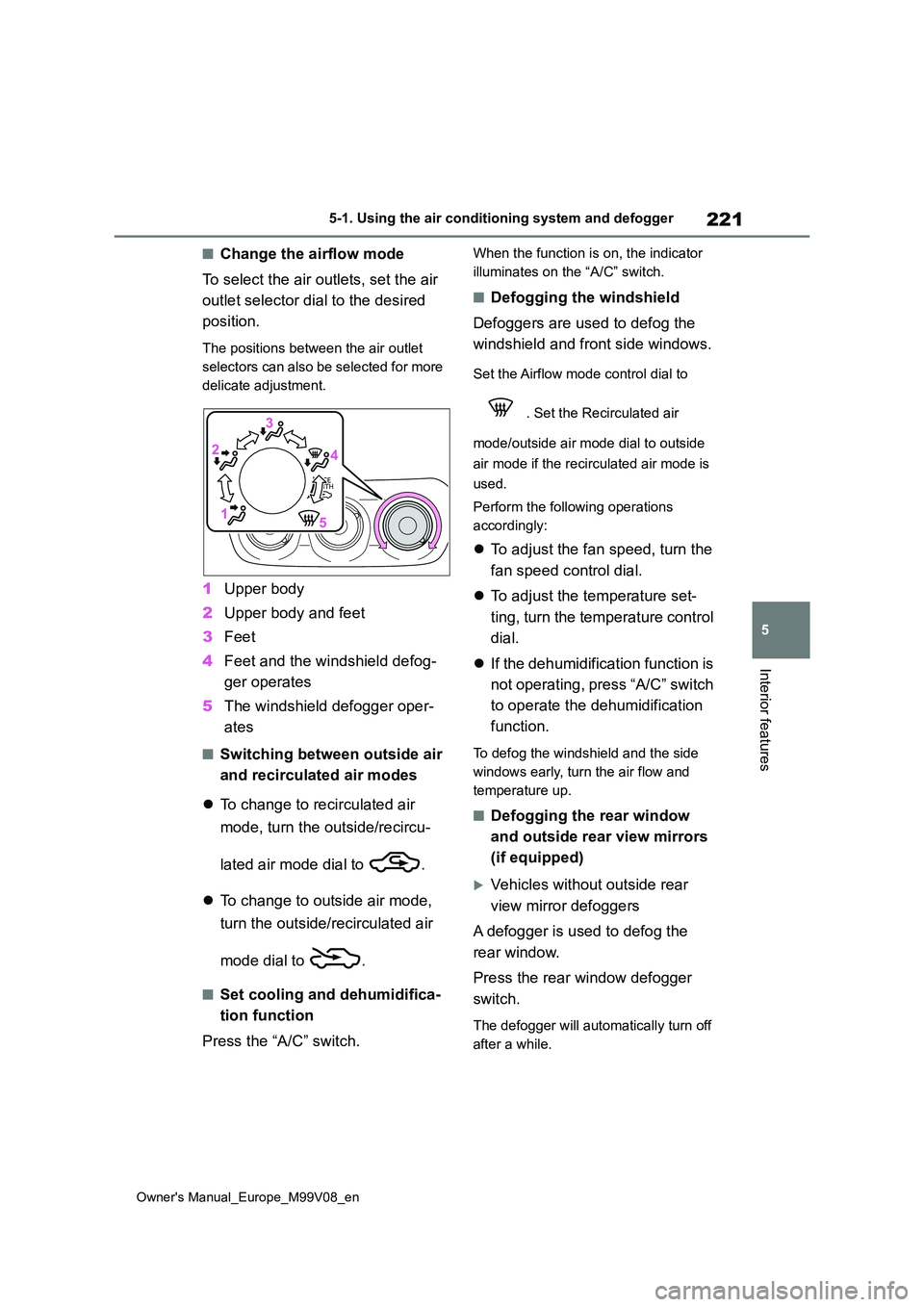
■Change the airflow mode
To select the air outlets, set the air
outlet selector dial to the desired
position.
The positions between the air outlet
selectors can also be selected for more
delicate adjustment.
1 Upper body
2 Upper body and feet
3 Feet
4 Feet and the windshield defog-
ger operates
5 The windshield defogger oper-
ates
■Switching between outside air
and recirculated air modes
To change to recirculated air
mode, turn the outside/recircu-
lated air mode dial to .
To change to outside air mode,
turn the outside/recirculated air
mode dial to .
■Set cooling and dehumidifica-
tion function
Press the “A/C” switch.
When the function is on, the indicator
illuminates on the “A/C” switch.
■Defogging the windshield
Defoggers are used to defog the
windshield and front side windows.
Set the Airflow mode control dial to
. Set the Recirculated air
mode/outside air mode dial to outside
air mode if the recirculated air mode is
used.
Perform the following operations
accordingly:
To adjust the fan speed, turn the
fan speed control dial.
To adjust the temperature set-
ting, turn the temperature control
dial.
If the dehumidification function is
not operating, press “A/C” switch
to operate the dehumidification
function.
To defog the windshield and the side
windows early, turn the air flow and
temperature up.
■Defogging the rear window
and outside rear view mirrors
(if equipped)
Vehicles without outside rear
view mirror defoggers
A defogger is used to defog the
rear window.
Press the rear window defogger
switch.
The defogger will automatically turn off
after a while.
Page 224 of 494
222
Owner's Manual_Europe_M99V08_en
5-1. Using the air conditioning system and defogger
When the rear window defogger switch
is on, the indicator illuminates on the
rear window defogger switch.
Vehicles with outside rear view
mirror defoggers
Defoggers are used to defog the
rear window, and to remove rain-
drops, dew and frost from the out-
side rear view mirrors.
Press the rear window and outside
rear view mirror defoggers switch.
The defoggers will automatically turn off
after a while.
When the rear window and outside rear
view mirror defoggers switch is on, the
indicator illuminates on the rear window
and outside rear view mirror defoggers
switch.
■Fogging up of the windows
●The windows will easily fog up when
the humidity in the vehicle is high. Turning “A/C” switch is on will dehu-midify the air from the outlets and
defog the windshield effectively.
●If you turn “A/C” switch is off, the win-
dows may fog up more easily.
●The windows may fog up if the recir- culated air mode is used.
■When driving on dusty roads
Close all windows. If dust thrown up by
the vehicle is still drawn into the vehicle after closing the windows, it is recom-mended that the air intake mode be set
to outside air mode and the fan speed to any setting except off.
■Outside/recirculated air mode
●Setting to the recirculated air mode temporarily is recommended in pre-venting dirty air from entering the
vehicle interior and helping to cool the vehicle when the outside air tempera-ture is high.
●During cooling operation, setting the
recirculated air mode will also cool the vehicle interior effectively.
■When the outside temperature falls to nearly 0°C (32°F)
The dehumidification function may not operate even when “A/C” switch is pressed.
■Ventilation and air conditioning
odors
●To let fresh air in, set the air condition-
ing system to the outside air mode.
●During use, various odors from inside
and outside the vehicle may enter into and accumulate in the air conditioning system. This may then cause odor to
be emitted from the vents.
●It is recommended that the air condi-
tioning system be set to outside air mode prior to turning the vehicle off.
■Air conditioning filter
P. 2 7 3
WARNING
■To prevent the windshield from fogging up
Do not use the windshield defogger
switch during cool air operation in extremely humid weather. The differ-ence between the temperature of the
outside air and that of the windshield can cause the outer surface of the windshield to fog up, blocking your
vision.
■When the outside rear view mir-
ror defoggers are operating (if equipped)
Do not touch the outside rear view
mirror surfaces, as they can become very hot and burn you.
Page 227 of 494
225
5
Owner's Manual_Europe_M99V08_en
5-1. Using the air conditioning system and defogger
Interior features
■Setting the fan speed
To adjust the fan speed, turn the
fan speed control dial clockwise
(increase) or counterclockwise
(decrease).
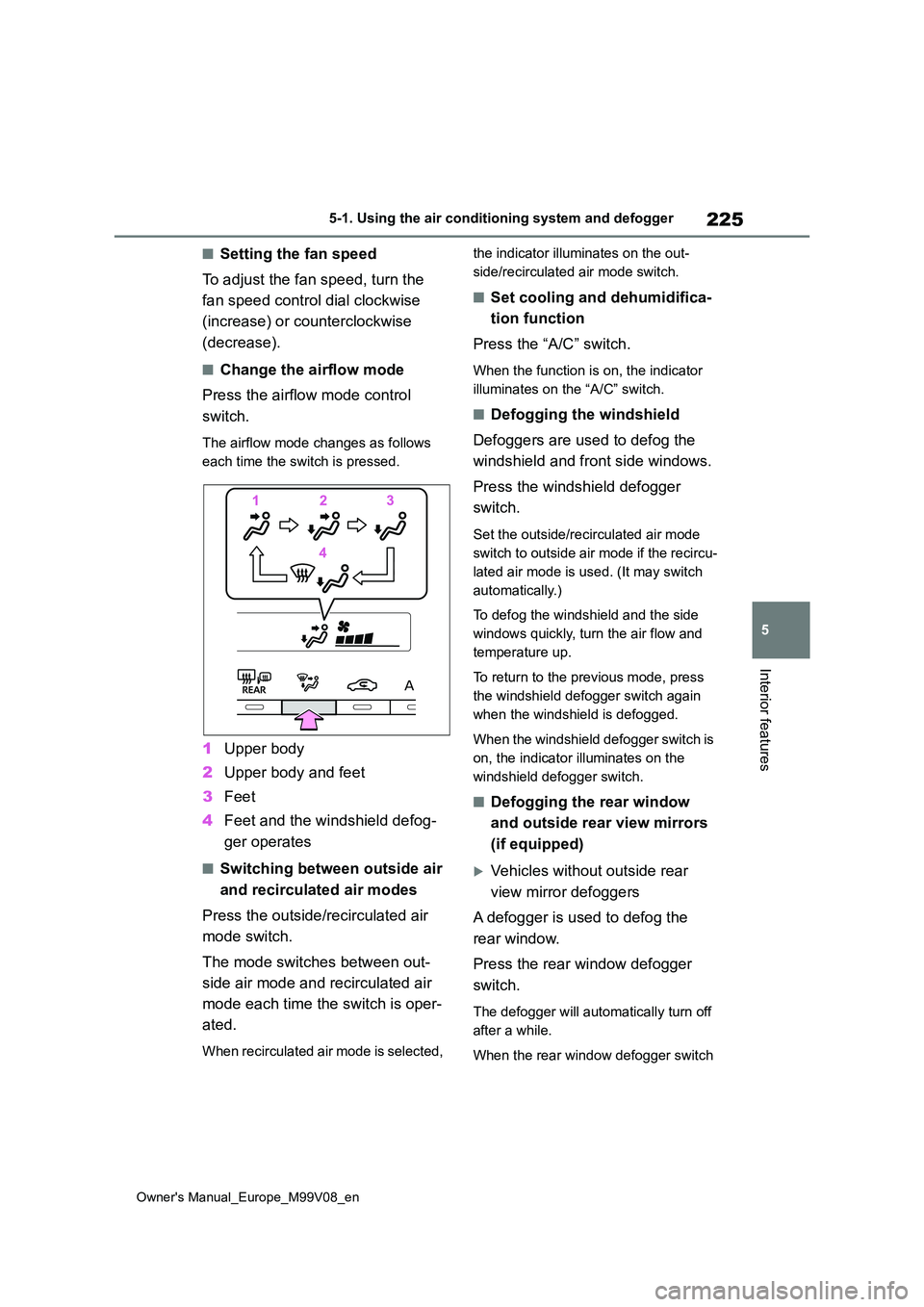
■Change the airflow mode
Press the airflow mode control
switch.
The airflow mode changes as follows
each time the switch is pressed.
1 Upper body
2 Upper body and feet
3 Feet
4 Feet and the windshield defog-
ger operates
■Switching between outside air
and recirculated air modes
Press the outside/recirculated air
mode switch.
The mode switches between out-
side air mode and recirculated air
mode each time the switch is oper-
ated.
When recirculated air mode is selected,
the indicator illuminates on the out-
side/recirculated air mode switch.
■Set cooling and dehumidifica-
tion function
Press the “A/C” switch.
When the function is on, the indicator
illuminates on the “A/C” switch.
■Defogging the windshield
Defoggers are used to defog the
windshield and front side windows.
Press the windshield defogger
switch.
Set the outside/recirculated air mode
switch to outside air mode if the recircu-
lated air mode is used. (It may switch
automatically.)
To defog the windshield and the side
windows quickly, turn the air flow and
temperature up.
To return to the previous mode, press
the windshield defogger switch again
when the windshield is defogged.
When the windshield defogger switch is
on, the indicator illuminates on the
windshield defogger switch.
■Defogging the rear window
and outside rear view mirrors
(if equipped)
Vehicles without outside rear
view mirror defoggers
A defogger is used to defog the
rear window.
Press the rear window defogger
switch.
The defogger will automatically turn off
after a while.
When the rear window defogger switch
Page 256 of 494
254
Owner's Manual_Europe_M99V08_en
6-3. Do-it-yourself maintenance
WARNING
●Do not leave anything that may burn easily, such as paper and
rags, in the engine compartment.
●Do not smoke, cause sparks or
expose an open flame to fuel or the battery. Fuel and battery fumes are flammable.
●Be extremely cautious when work-ing on the battery. It contains poi-
sonous and corrosive sulfuric acid.
●Take care because brake fluid can
harm your hands or eyes and dam- age painted surfaces. If fluid gets on your hands or in your eyes, flush
the affected area with clean water immediately.If you still experience discomfort,
consult a doctor.
■When working near the electric
cooling fan or radiator grille
Be sure the engine switch is OFF. With the engine switch in ON, the
electric cooling fan may automatically start to run if the air conditioning is on and/or the coolant temperature is
high. ( P.261)
■Safety glasses
Wear safety glasses to prevent flying or falling material, fluid spray, etc. from getting in your eyes.
NOTICE
■If you remove the air cleaner fil-ter
Driving with the air cleaner filter removed may cause excessive engine wear due to dirt in the air.
■If the fluid level is low or high
It is normal for the brake fluid level to go down slightly as the brake pads
wear or when the fluid level in the accumulator is high.If the reservoir needs frequent refill-
ing, it may indicate a serious problem.
Page 260 of 494
258
Owner's Manual_Europe_M99V08_en
6-3. Do-it-yourself maintenance
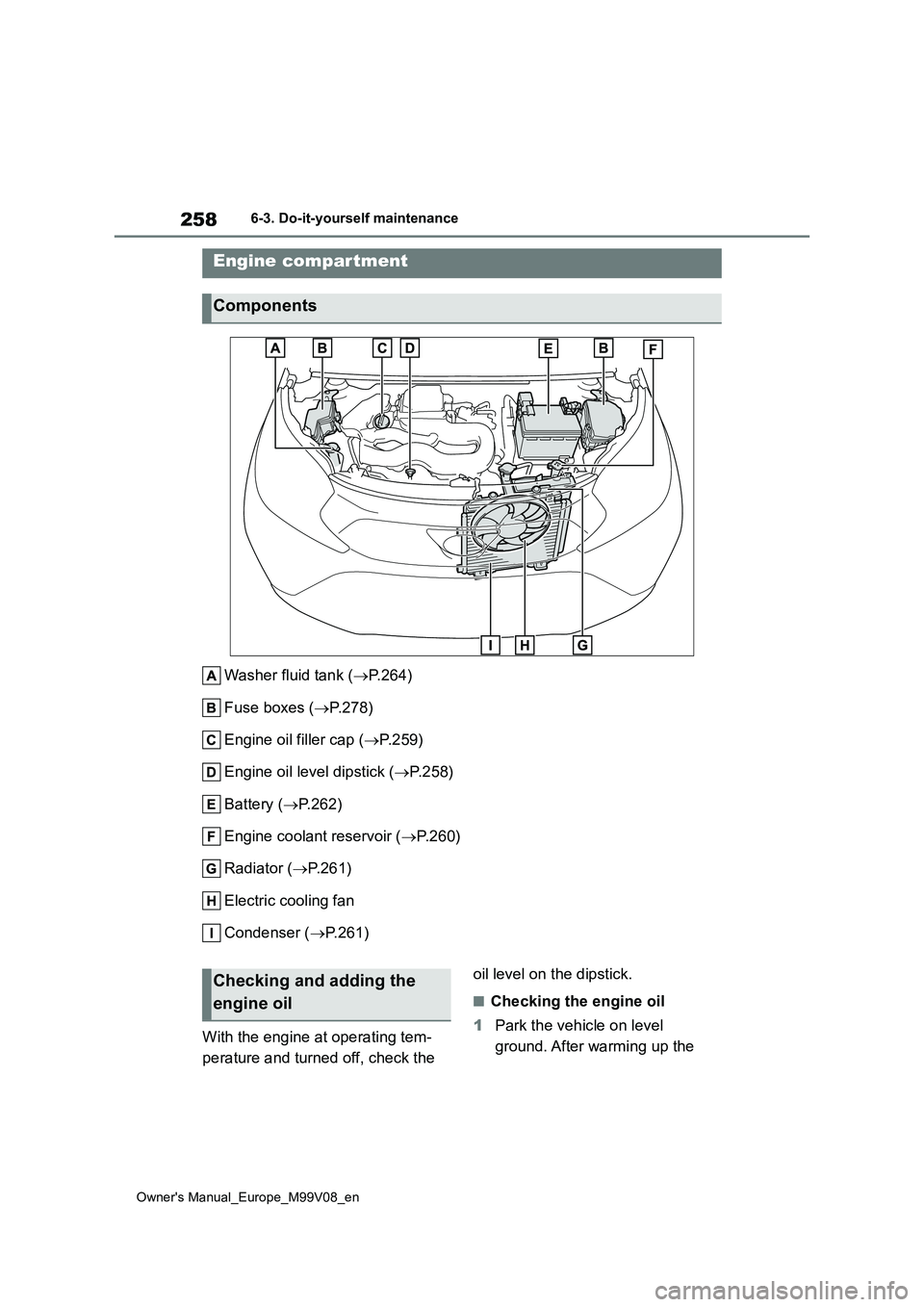
Washer fluid tank (P.264)
Fuse boxes ( P.278)
Engine oil filler cap ( P.259)
Engine oil level dipstick ( P.258)
Battery ( P.262)
Engine coolant reservoir ( P. 2 6 0 )
Radiator ( P.261)
Electric cooling fan
Condenser ( P.261)
With the engine at operating tem-
perature and turned off, check the
oil level on the dipstick.
■Checking the engine oil
1 Park the vehicle on level
ground. After warming up the
Engine compartment
Components
Checking and adding the
engine oil
Page 263 of 494
261
6
Owner's Manual_Europe_M99V08_en
6-3. Do-it-yourself maintenance
Maintenance and care
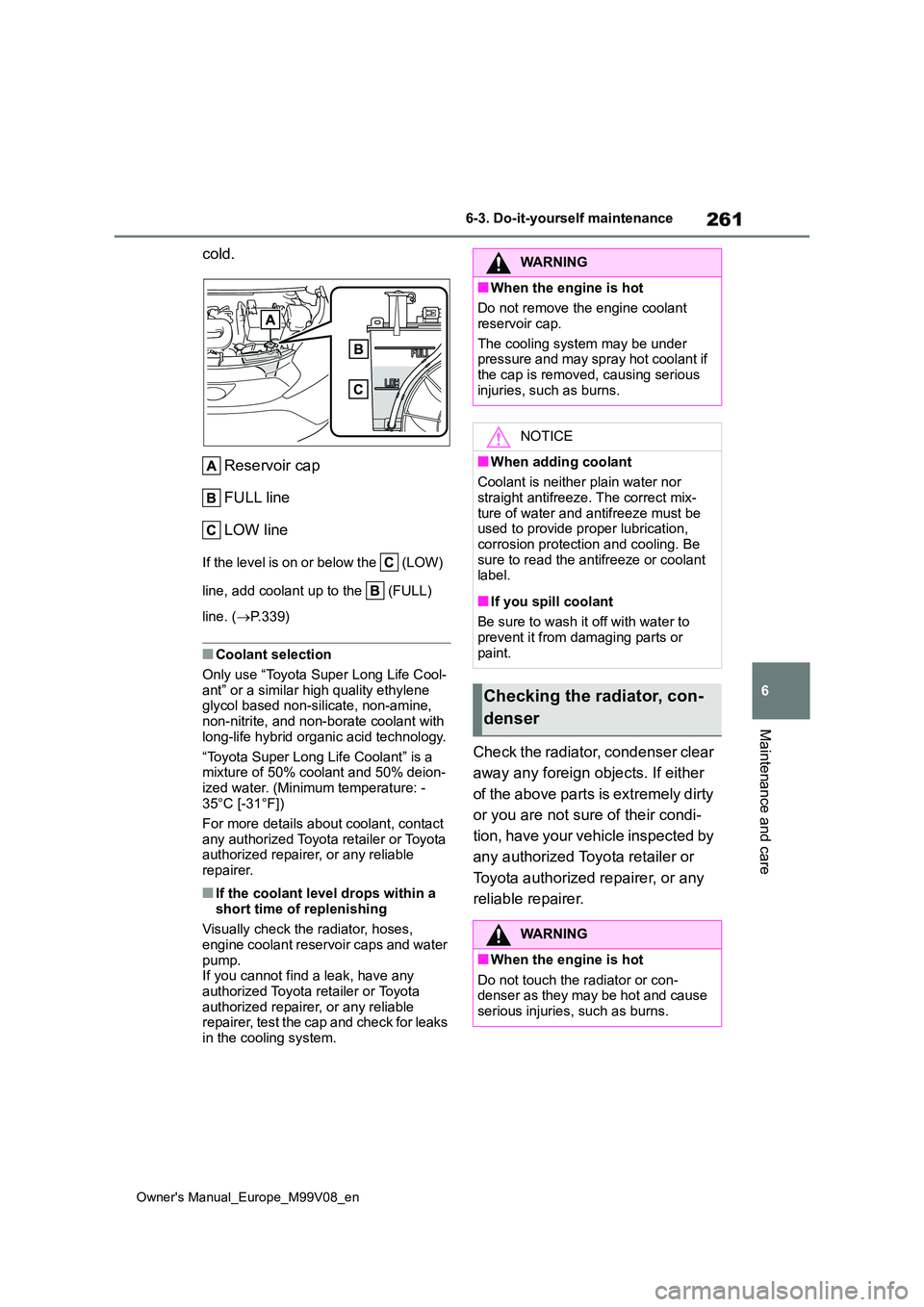
cold.
Reservoir cap
FULL line
LOW line
If the level is on or below the (LOW)
line, add coolant up to the (FULL)
line. ( P.339)
■Coolant selection
Only use “Toyota Super Long Life Cool-
ant” or a similar high quality ethylene glycol based non-silicate, non-amine, non-nitrite, and non-borate coolant with
long-life hybrid organic acid technology.
“Toyota Super Long Life Coolant” is a mixture of 50% coolant and 50% deion-
ized water. (Minimum temperature: - 35°C [-31°F])
For more details about coolant, contact
any authorized Toyota retailer or Toyota authorized repairer, or any reliable repairer.
■If the coolant level drops within a
short time of replenishing
Visually check the radiator, hoses,
engine coolant reservoir caps and water pump.If you cannot find a leak, have any
authorized Toyota retailer or Toyota authorized repairer, or any reliable repairer, test the cap and check for leaks
in the cooling system.
Check the radiator, condenser clear
away any foreign objects. If either
of the above parts is extremely dirty
or you are not sure of their condi-
tion, have your vehicle inspected by
any authorized Toyota retailer or
Toyota authorized repairer, or any
reliable repairer.
WARNING
■When the engine is hot
Do not remove the engine coolant
reservoir cap.
The cooling system may be under pressure and may spray hot coolant if
the cap is removed, causing serious injuries, such as burns.
NOTICE
■When adding coolant
Coolant is neither plain water nor straight antifreeze. The correct mix-
ture of water and antifreeze must be used to provide proper lubrication, corrosion protection and cooling. Be
sure to read the antifreeze or coolant label.
■If you spill coolant
Be sure to wash it off with water to prevent it from damaging parts or
paint.
Checking the radiator, con-
denser
WARNING
■When the engine is hot
Do not touch the radiator or con- denser as they may be hot and cause serious injuries, such as burns.
Page 284 of 494
282
Owner's Manual_Europe_M99V08_en
6-3. Do-it-yourself maintenance
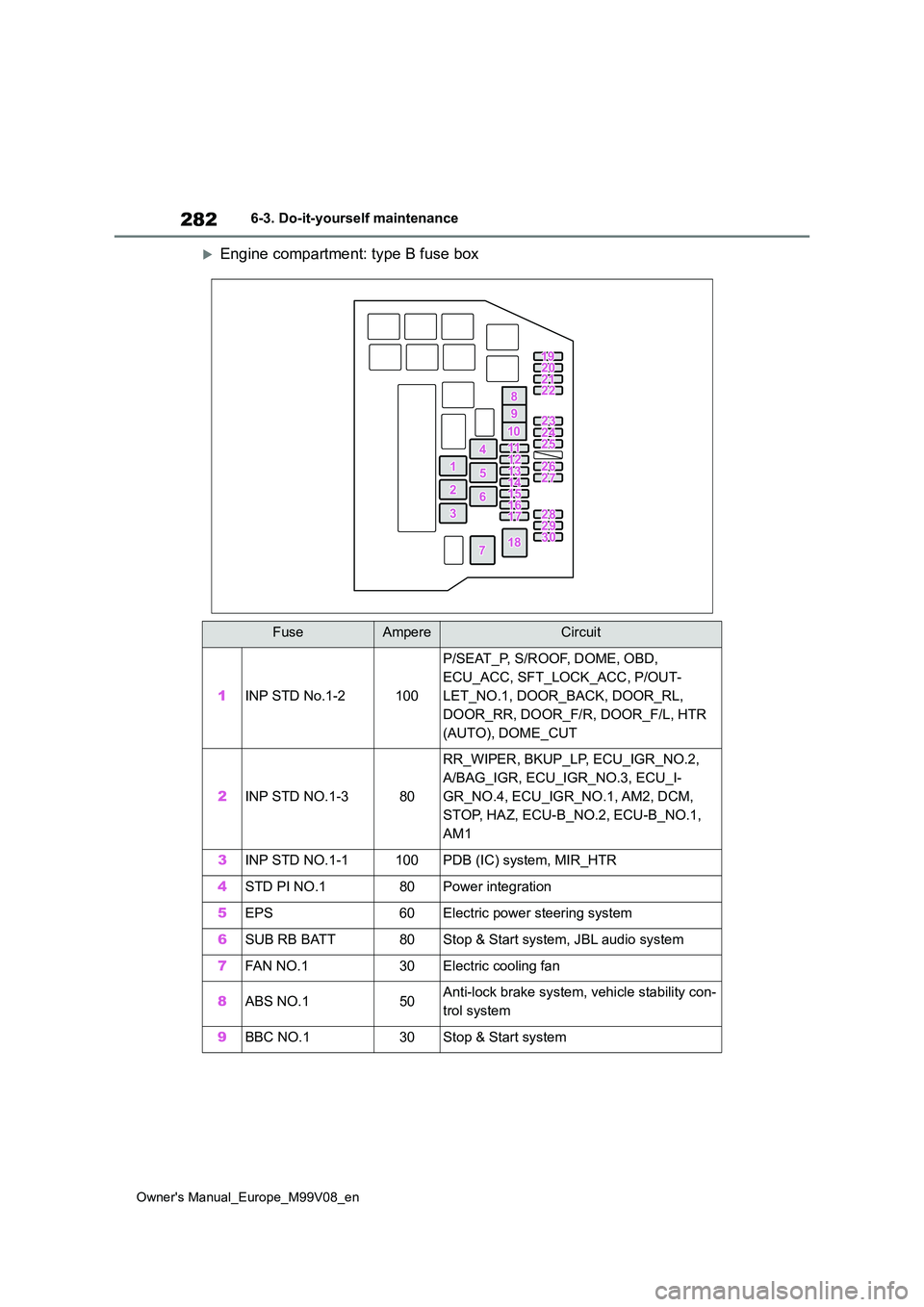
Engine compartment: type B fuse box
FuseAmpereCircuit
1INP STD No.1-2100
P/SEAT_P, S/ROOF, DOME, OBD,
ECU_ACC, SFT_LOCK_ACC, P/OUT-
LET_NO.1, DOOR_BACK, DOOR_RL,
DOOR_RR, DOOR_F/R, DOOR_F/L, HTR
(AUTO), DOME_CUT
2INP STD NO.1-380
RR_WIPER, BKUP_LP, ECU_IGR_NO.2,
A/BAG_IGR, ECU_IGR_NO.3, ECU_I-
GR_NO.4, ECU_IGR_NO.1, AM2, DCM,
STOP, HAZ, ECU-B_NO.2, ECU-B_NO.1,
AM1
3INP STD NO.1-1100PDB (IC) system, MIR_HTR
4STD PI NO.180Power integration
5EPS60Electric power steering system
6SUB RB BATT80Stop & Start system, JBL audio system
7FA N N O. 130Electric cooling fan
8ABS NO.150Anti-lock brake system, vehicle stability con-
trol system
9BBC NO.130Stop & Start system
Page 285 of 494
283
6
Owner's Manual_Europe_M99V08_en
6-3. Do-it-yourself maintenance
Maintenance and care
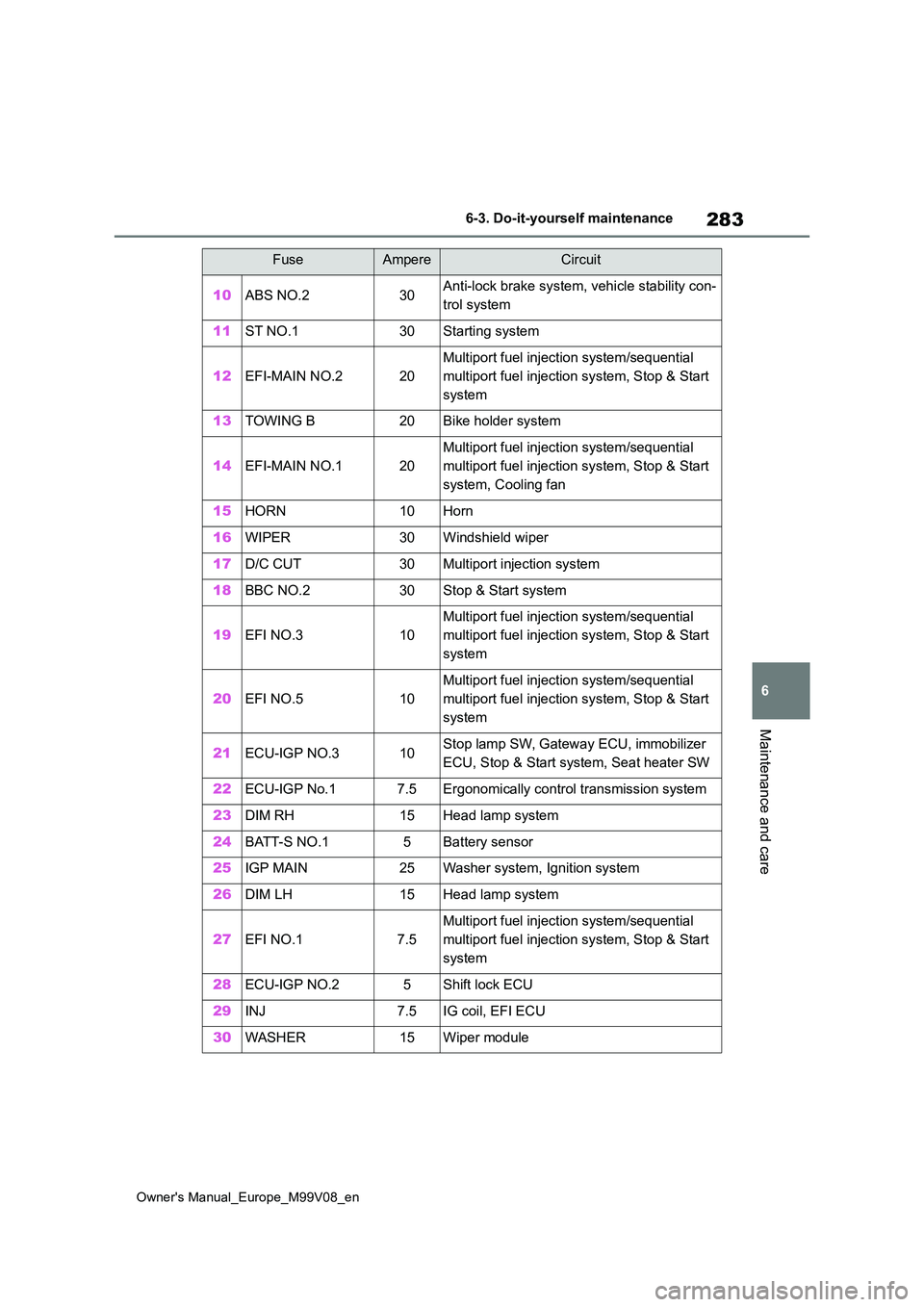
10ABS NO.230Anti-lock brake system, vehicle stability con-
trol system
11ST NO.130Starting system
12EFI-MAIN NO.220
Multiport fuel injection system/sequential
multiport fuel injection system, Stop & Start
system
13TOWING B20Bike holder system
14EFI-MAIN NO.120
Multiport fuel injection system/sequential
multiport fuel injection system, Stop & Start
system, Cooling fan
15HORN10Horn
16WIPER30Windshield wiper
17D/C CUT30Multiport injection system
18BBC NO.230Stop & Start system
19EFI NO.310
Multiport fuel injection system/sequential
multiport fuel injection system, Stop & Start
system
20EFI NO.510
Multiport fuel injection system/sequential
multiport fuel injection system, Stop & Start
system
21ECU-IGP NO.310Stop lamp SW, Gateway ECU, immobilizer
ECU, Stop & Start system, Seat heater SW
22ECU-IGP No.17.5Ergonomically control transmission system
23DIM RH15Head lamp system
24BATT-S NO.15Battery sensor
25IGP MAIN25Washer system, Ignition system
26DIM LH15Head lamp system
27EFI NO.17.5
Multiport fuel injection system/sequential
multiport fuel injection system, Stop & Start
system
28ECU-IGP NO.25Shift lock ECU
29INJ7.5IG coil, EFI ECU
30WASHER15Wiper module
FuseAmpereCircuit
Page 340 of 494
338
Owner's Manual_Europe_M99V08_en
7-2. Steps to take in an emergency
●For details, consult any authorized
Toyota retailer or Toyota authorized repairer, or any reliable repairer.
WARNING
■When removing the battery ter-
minals
Always remove the negative (-) termi- nal first. If the positive (+) terminal
contacts any metal in the surrounding area when the positive (+) terminal is removed, a spark may occur, leading
to a fire in addition to electrical shocks and death or serious injury.
■Avoiding battery fires or explo-sions
Observe the following precautions to
prevent accidentally igniting the flam- mable gas that may be emitted from the battery:
●Make sure each jumper cable is connected to the correct terminal
and that it is not unintentionally in contact with any other than the intended terminal.
●Do not allow the other end of the jumper cable connected to the “+”
terminal to come into contact with any other parts or metal surfaces in the area, such as brackets or
unpainted metal.
●Do not allow the + and - clamps of
the jumper cables to come into con- tact with each other.
●Do not smoke, use matches, ciga-rette lighters or allow open flame near the battery.
■Battery precautions
The battery contains poisonous and
corrosive acidic electrolyte, while related parts contain lead and lead compounds. Observe the following
precautions when handling the bat- tery:
●When working with the battery, always wear safety glasses and take care not to allow any battery
fluids (acid) to come into contact with skin, clothing or the vehicle body.
●Do not lean over the battery.
●In the event that battery fluid comes into contact with the skin or eyes, immediately wash the affected area
with water and seek medical atten- tion. Place a wet sponge or cloth over the affected area until medical
attention can be received.
●Always wash your hands after han-
dling the battery support, terminals, and other battery-related parts.
●Do not allow children near the bat-tery.
■When replacing the battery
●When the vent plug and indicator are close to the hold down clamp,
the battery fluid (sulfuric acid) may leak.
●For information regarding battery replacement, contact any autho-rized Toyota retailer or Toyota
authorized repairer, or any reliable repairer.
NOTICE
■When handling jumper cables
When connecting the jumper cables, ensure that they do not become entangled in the cooling fan or engine
drive belt.
Page 341 of 494
339
7
Owner's Manual_Europe_M99V08_en
7-2. Steps to take in an emergency
When trouble arises
1Stop the vehicle in a safe place
and turn off the air conditioning
system, and then stop the
engine.
2 If you see steam: Carefully lift
the hood after the steam sub-
sides.
If you do not see steam: Care-
fully lift the hood.
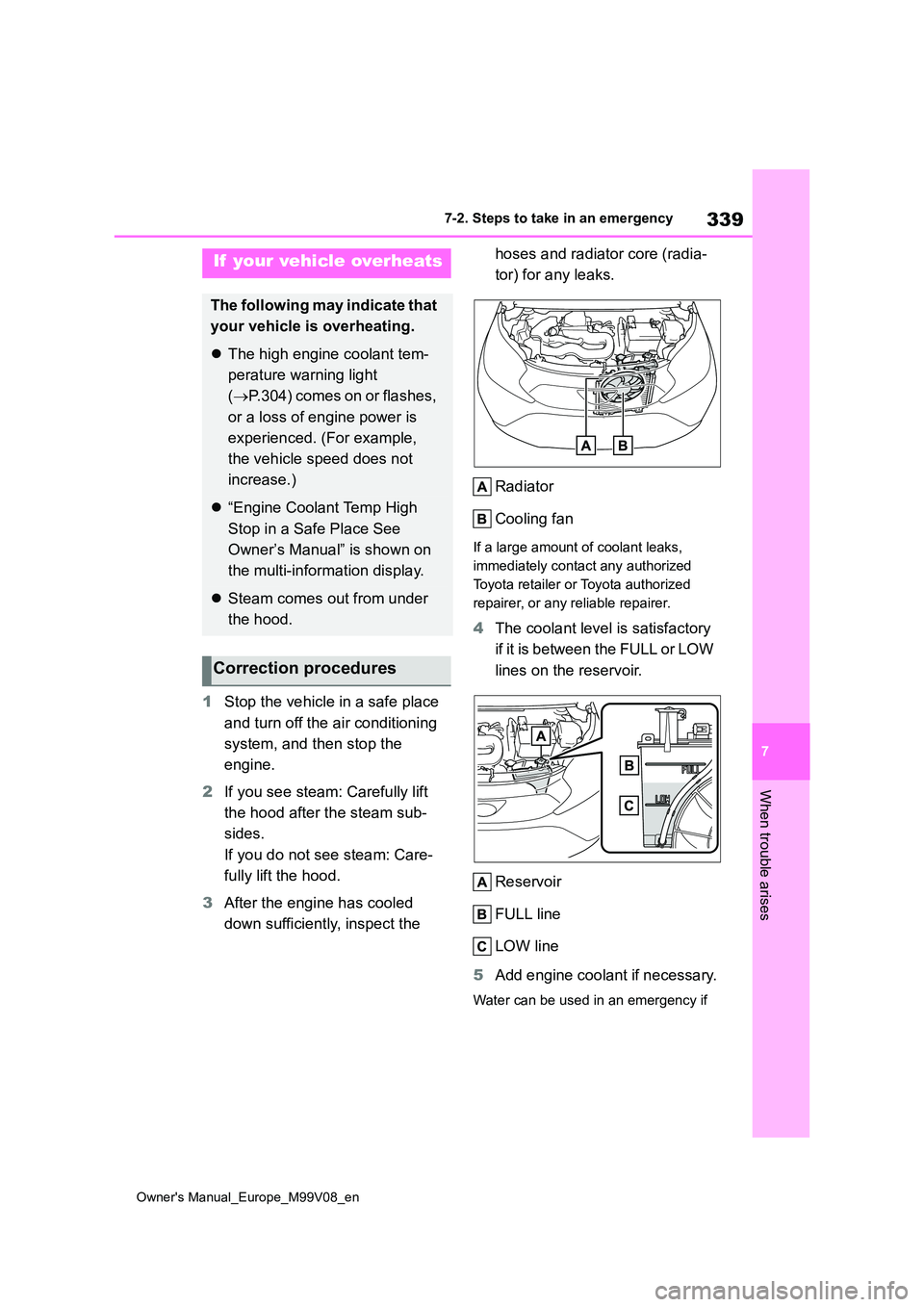
3 After the engine has cooled
down sufficiently, inspect the
hoses and radiator core (radia-
tor) for any leaks.
Radiator
Cooling fan
If a large amount of coolant leaks,
immediately contact any authorized
Toyota retailer or Toyota authorized
repairer, or any reliable repairer.
4 The coolant level is satisfactory
if it is between the FULL or LOW
lines on the reservoir.
Reservoir
FULL line
LOW line
5 Add engine coolant if necessary.
Water can be used in an emergency if
If your vehicle overheats
The following may indicate that
your vehicle is overheating.
The high engine coolant tem-
perature warning light
( P.304) comes on or flashes,
or a loss of engine power is
experienced. (For example,
the vehicle speed does not
increase.)
“Engine Coolant Temp High
Stop in a Safe Place See
Owner’s Manual” is shown on
the multi-information display.
Steam comes out from under
the hood.
Correction procedures