charging TOYOTA iQ EV 2013 Owners Manual (in English)
[x] Cancel search | Manufacturer: TOYOTA, Model Year: 2013, Model line: iQ EV, Model: TOYOTA iQ EV 2013Pages: 444, PDF Size: 7.34 MB
Page 2 of 444
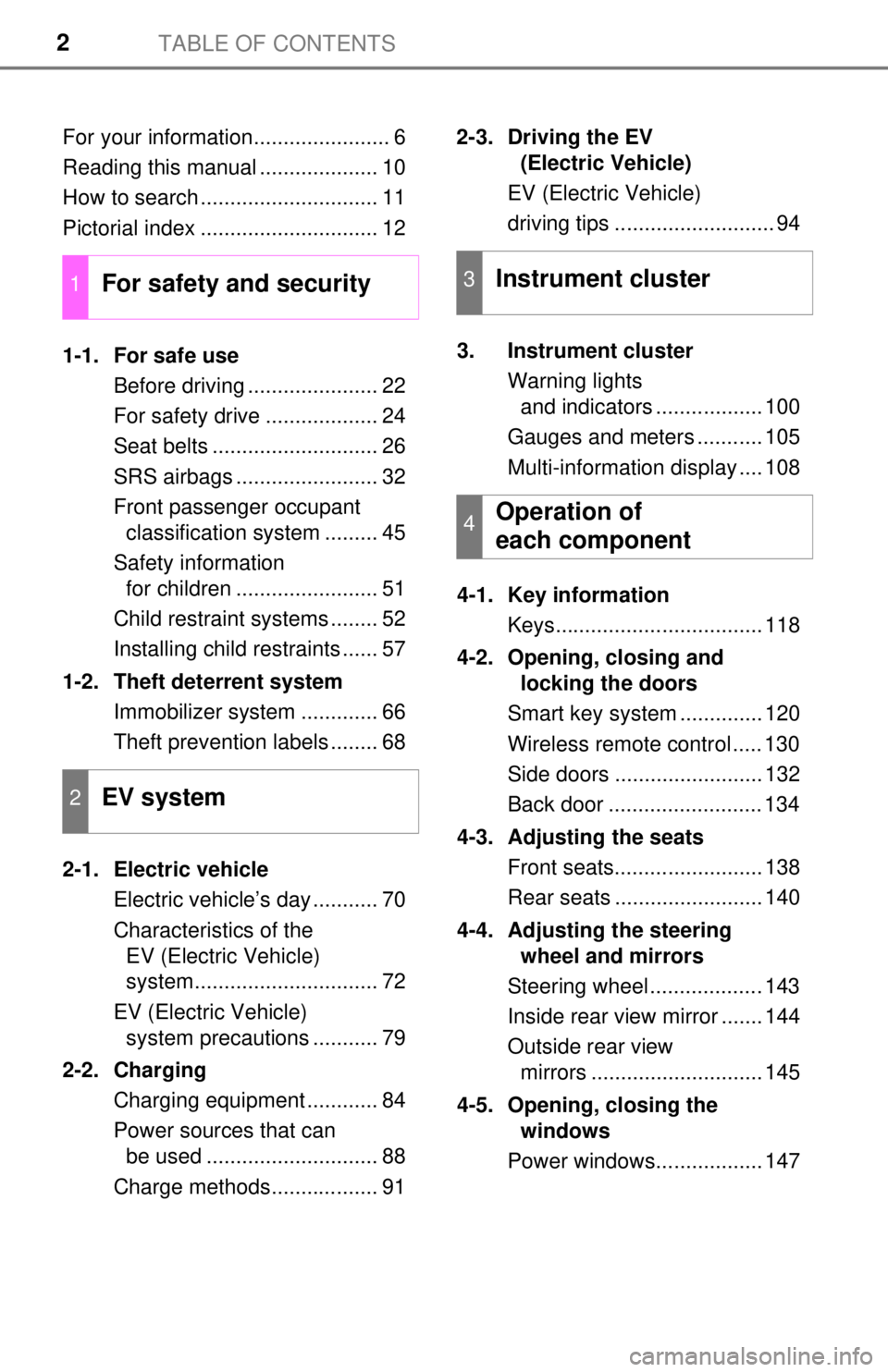
TABLE OF CONTENTS2
For your information....................... 6
Reading this manual .................... 10
How to search .............................. 11
Pictorial index .............................. 12
1-1. For safe useBefore driving ...................... 22
For safety drive ................... 24
Seat belts ............................ 26
SRS airbags ........................ 32
Front passenger occupant classification system ......... 45
Safety information for children ........................ 51
Child restraint systems ........ 52
Installing child restraints ...... 57
1-2. Theft deterrent system Immobilizer system ............. 66
Theft prevention labels ........ 68
2-1. Electric vehicle Electric vehicle’s day ........... 70
Characteristics of the EV (Electric Vehicle)
system............................... 72
EV (Electric Vehicle) system precautions ........... 79
2-2. Charging Charging equipment ............ 84
Power sources that can be used ............................. 88
Charge methods.................. 91 2-3. Driving the EV
(Electric Vehicle)
EV (Electric Vehicle)
driving tips ........................... 94
3. Instrument cluster Warning lights and indicators .................. 100
Gauges and meters ........... 105
Multi-information display .... 108
4-1. Key information Keys................................... 118
4-2. Opening, closing and locking the doors
Smart key system .............. 120
Wireless remote control ..... 130
Side doors ......................... 132
Back door .......................... 134
4-3. Adjusting the seats Front seats......................... 138
Rear seats ......................... 140
4-4. Adjusting the steering wheel and mirrors
Steering wheel ................... 143
Inside rear view mirror ....... 144
Outside rear view mirrors ............................. 145
4-5. Opening, closing the windows
Power windows.................. 147
1For safety and security
2EV system
3Instrument cluster
4Operation of
each component
Page 3 of 444
3
9 8
7
6
5
4
3
10
1
2
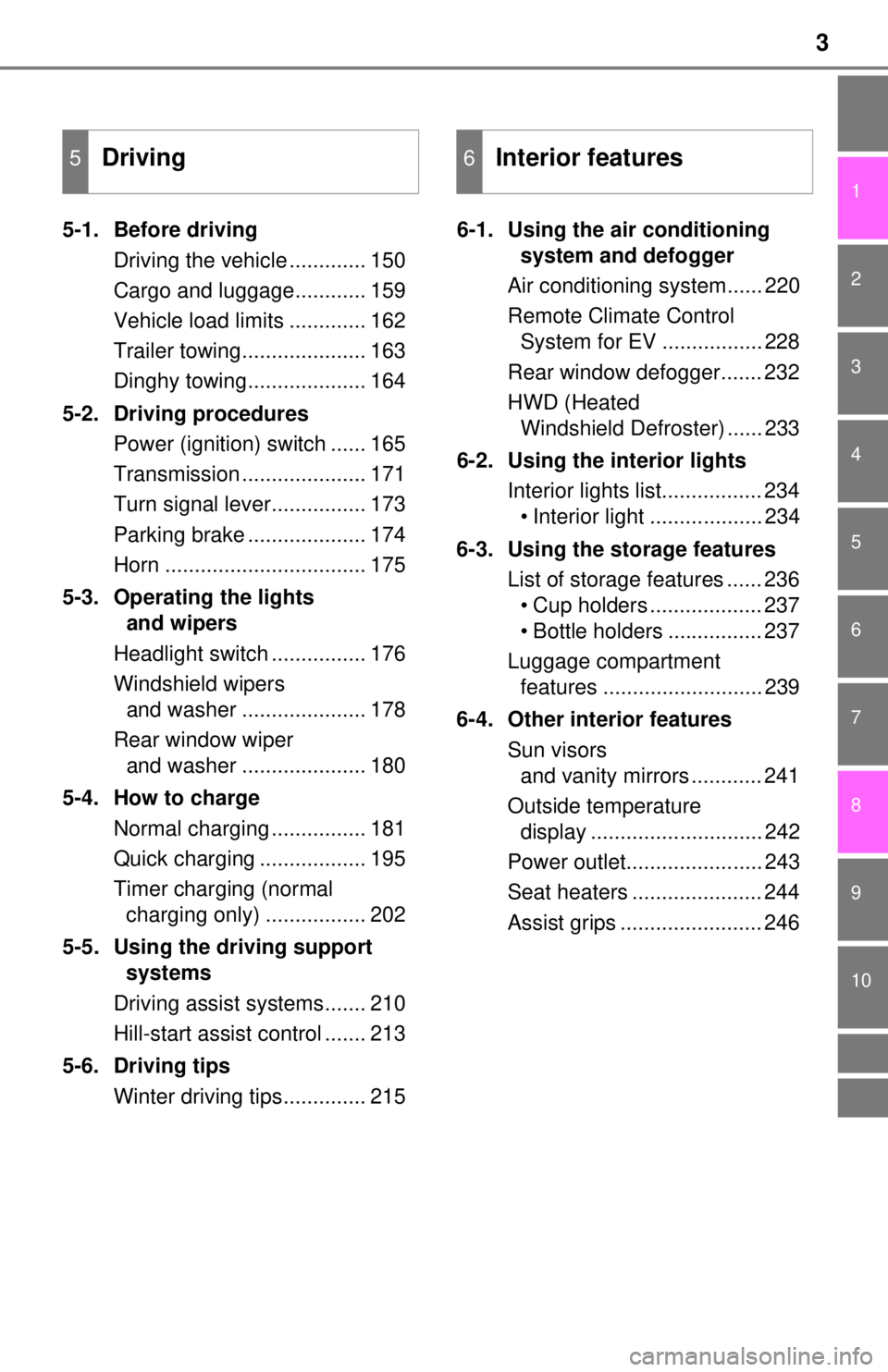
5-1. Before drivingDriving the vehicle ............. 150
Cargo and luggage............ 159
Vehicle load limits ............. 162
Trailer towing..................... 163
Dinghy towing.................... 164
5-2. Driving procedures Power (ignition) switch ...... 165
Transmission ..................... 171
Turn signal lever................ 173
Parking brake .................... 174
Horn .................................. 175
5-3. Operating the lights and wipers
Headlight switch ................ 176
Windshield wipers and washer ..................... 178
Rear window wiper and washer ..................... 180
5-4. How to charge Normal charging ................ 181
Quick charging .................. 195
Timer charging (normal charging only) ................. 202
5-5. Using the driving support systems
Driving assist systems....... 210
Hill-start assist control ....... 213
5-6. Driving tips Winter driving tips.............. 215 6-1. Using the air conditioning
system and defogger
Air conditioning system...... 220
Remote Climate Control System for EV ................. 228
Rear window defogger....... 232
HWD (Heated Windshield Defroster) ...... 233
6-2. Using the interior lights Interior lights list................. 234• Interior light ................... 234
6-3. Using the storage features List of storage features ...... 236• Cup holders ................... 237
• Bottle holders ................ 237
Luggage compartment features ........................... 239
6-4. Other interior features Sun visors and vanity mirrors ............ 241
Outside temperature display ............................. 242
Power outlet....................... 243
Seat heaters ...................... 244
Assist grips ........................ 246
5Driving6Interior features
Page 4 of 444
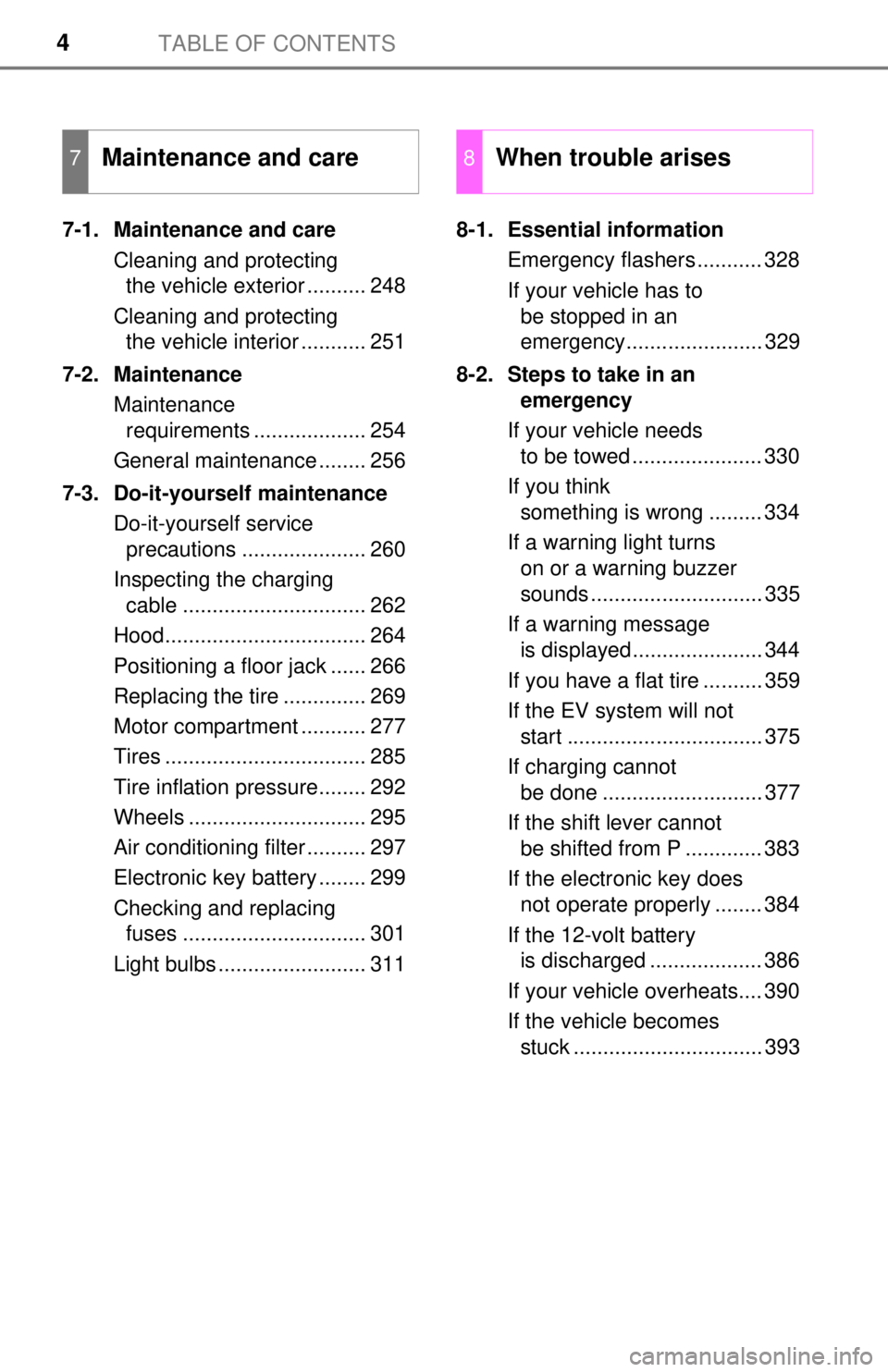
TABLE OF CONTENTS4
7-1. Maintenance and careCleaning and protecting the vehicle exterior .......... 248
Cleaning and protecting the vehicle interior ........... 251
7-2. Maintenance Maintenance requirements ................... 254
General maintenance ........ 256
7-3. Do-it-yourself maintenance Do-it-yourself service precautions ..................... 260
Inspecting the charging cable ............................... 262
Hood.................................. 264
Positioning a floor jack ...... 266
Replacing the tire .............. 269
Motor compartment ........... 277
Tires .................................. 285
Tire inflation pressure........ 292
Wheels .............................. 295
Air conditioning filter .......... 297
Electronic key battery ........ 299
Checking and replacing fuses ............................... 301
Light bulbs ......................... 311 8-1. Essential information
Emergency flashers ........... 328
If your vehicle has to be stopped in an
emergency....................... 329
8-2. Steps to take in an emergency
If your vehicle needs to be towed ...................... 330
If you think something is wrong ......... 334
If a warning light turns on or a warning buzzer
sounds ............................. 335
If a warning message is displayed...................... 344
If you have a flat tire .......... 359
If the EV system will not start ................................. 375
If charging cannot be done ........................... 377
If the shift lever cannot be shifted from P ............. 383
If the electronic key does not operate properly ........ 384
If the 12-volt battery is discharged ................... 386
If your vehicle overheats.... 390
If the vehicle becomes stuck ................................ 393
7Maintenance and care8When trouble arises
Page 13 of 444
13Pictorial index
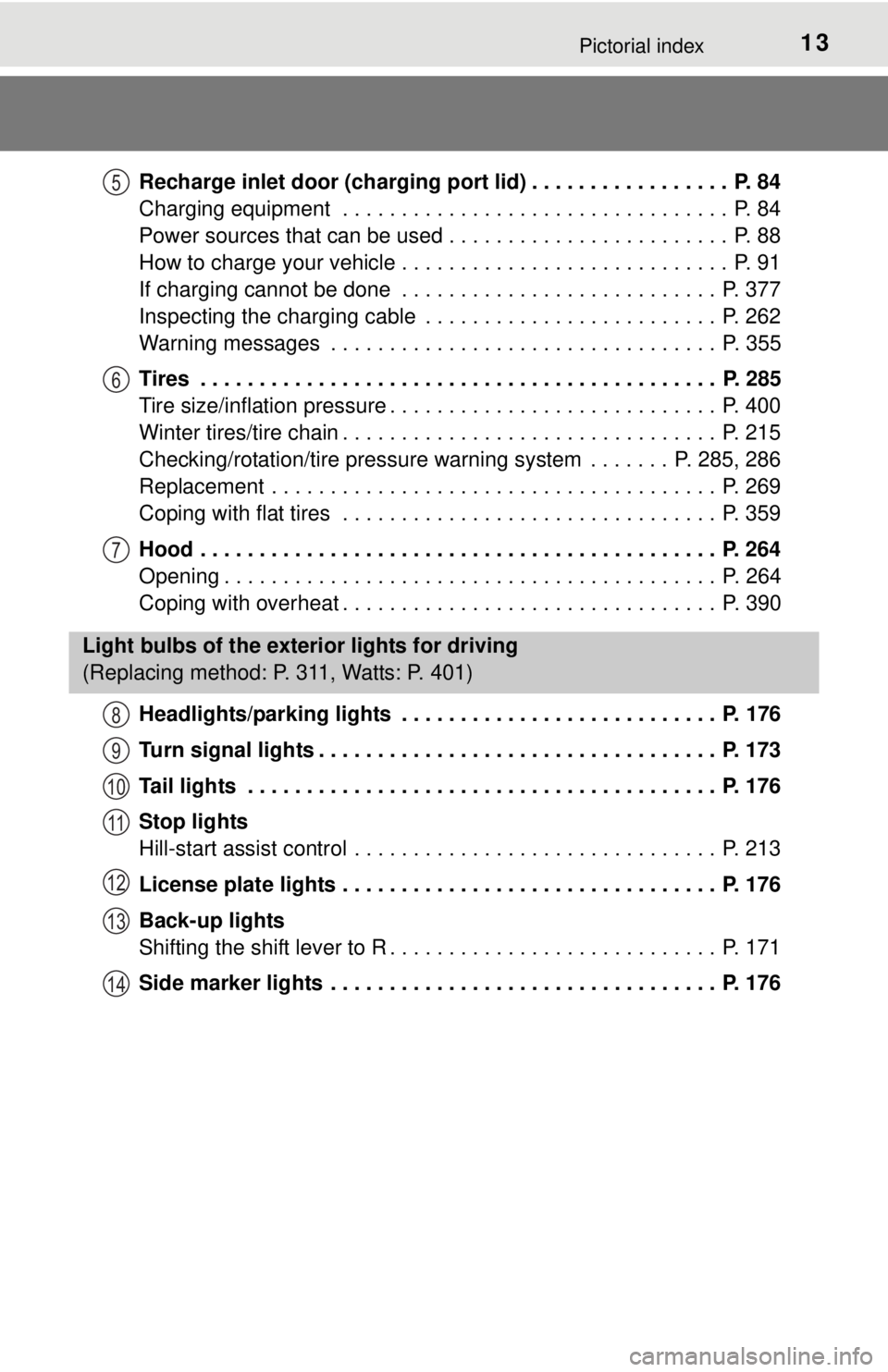
Recharge inlet door (charging port lid) . . . . . . . . . . . . . . . . . P. 84
Charging equipment . . . . . . . . . . . . . . . . . . . . . . . . . . . . . . . . . P. 84
Power sources that can be used . . . . . . . . . . . . . . . . . . . . . . . . P. 88
How to charge your vehicle . . . . . . . . . . . . . . . . . . . . . . . . . . . . P. 91
If charging cannot be done . . . . . . . . . . . . . . . . . . . . . . . . . . . P. 377
Inspecting the charging cable . . . . . . . . . . . . . . . . . . . . . . . . . P. 262
Warning messages . . . . . . . . . . . . . . . . . . . . . . . . . . . . . . . . . P. 355
Tires . . . . . . . . . . . . . . . . . . . . . . . . . . . . . . . . . . . . . . . . . . . . P. 285
Tire size/inflation pressure . . . . . . . . . . . . . . . . . . . . . . . . . . . . P. 400
Winter tires/tire chain . . . . . . . . . . . . . . . . . . . . . . . . . . . . . . . . P. 215
Checking/rotation/tire pressure warning system . . . . . . . P. 285, 286
Replacement . . . . . . . . . . . . . . . . . . . . . . . . . . . . . . . . . . . . . . P. 269
Coping with flat tires . . . . . . . . . . . . . . . . . . . . . . . . . . . . . . . . P. 359
Hood . . . . . . . . . . . . . . . . . . . . . . . . . . . . . . . . . . . . . . . . . . . . P. 264
Opening . . . . . . . . . . . . . . . . . . . . . . . . . . . . . . . . . . . . . . . . . . P. 264
Coping with overheat . . . . . . . . . . . . . . . . . . . . . . . . . . . . . . . . P. 390
Headlights/parking lights . . . . . . . . . . . . . . . . . . . . . . . . . . . P. 176
Turn signal lights . . . . . . . . . . . . . . . . . . . . . . . . . . . . . . . . . . P. 173
Tail lights . . . . . . . . . . . . . . . . . . . . . . . . . . . . . . . . . . . . . . . . P. 176
Stop lights
Hill-start assist control . . . . . . . . . . . . . . . . . . . . . . . . . . . . . . . P. 213
License plate lights . . . . . . . . . . . . . . . . . . . . . . . . . . . . . . . . P. 176
Back-up lights
Shifting the shift lever to R . . . . . . . . . . . . . . . . . . . . . . . . . . . . P. 171
Side marker lights . . . . . . . . . . . . . . . . . . . . . . . . . . . . . . . . . P. 1765
6
7
Light bulbs of the exterior lights for driving
(Replacing method: P. 311, Watts: P. 401)
8
9
10
11
12
13
14
Page 17 of 444
17Pictorial index
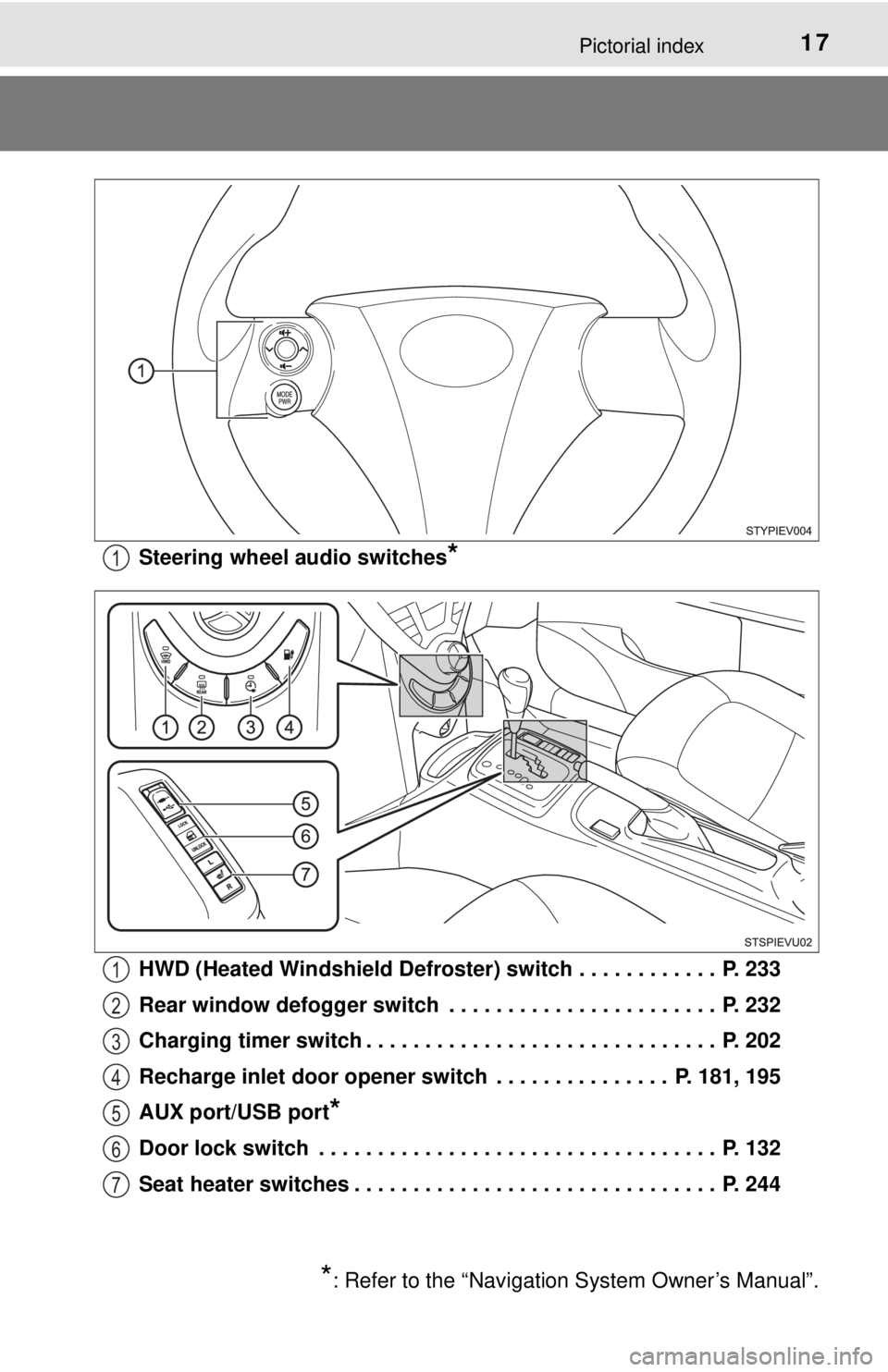
Steering wheel audio switches*
HWD (Heated Windshield Defroster) switch . . . . . . . . . . . . P. 233
Rear window defogger switch . . . . . . . . . . . . . . . . . . . . . . . P. 232
Charging timer switch . . . . . . . . . . . . . . . . . . . . . . . . . . . . . . P. 202
Recharge inlet door opener switch . . . . . . . . . . . . . . . P. 181, 195
AUX port/USB port
*
Door lock switch . . . . . . . . . . . . . . . . . . . . . . . . . . . . . . . . . . P. 132
Seat heater switches . . . . . . . . . . . . . . . . . . . . . . . . . . . . . . . P. 244
*: Refer to the “Navigation System Owner’s Manual”.
1
1
2
3
4
5
6
7
Page 69 of 444

69
EV system2
2-1. Electric vehicleElectric vehicle’s day........... 70
Characteristics of the EV (Electric Vehicle)
system .............................. 72
EV (Electric Vehicle) system precautions ........... 79
2-2. Charging Charging equipment............ 84
Power sources that can be used ............................. 88
Charge methods ................. 91
2-3. Driving the EV (Electric Vehicle)
EV (Electric Vehicle)
driving tips ........................... 94
Page 71 of 444
712-1. Electric vehicle
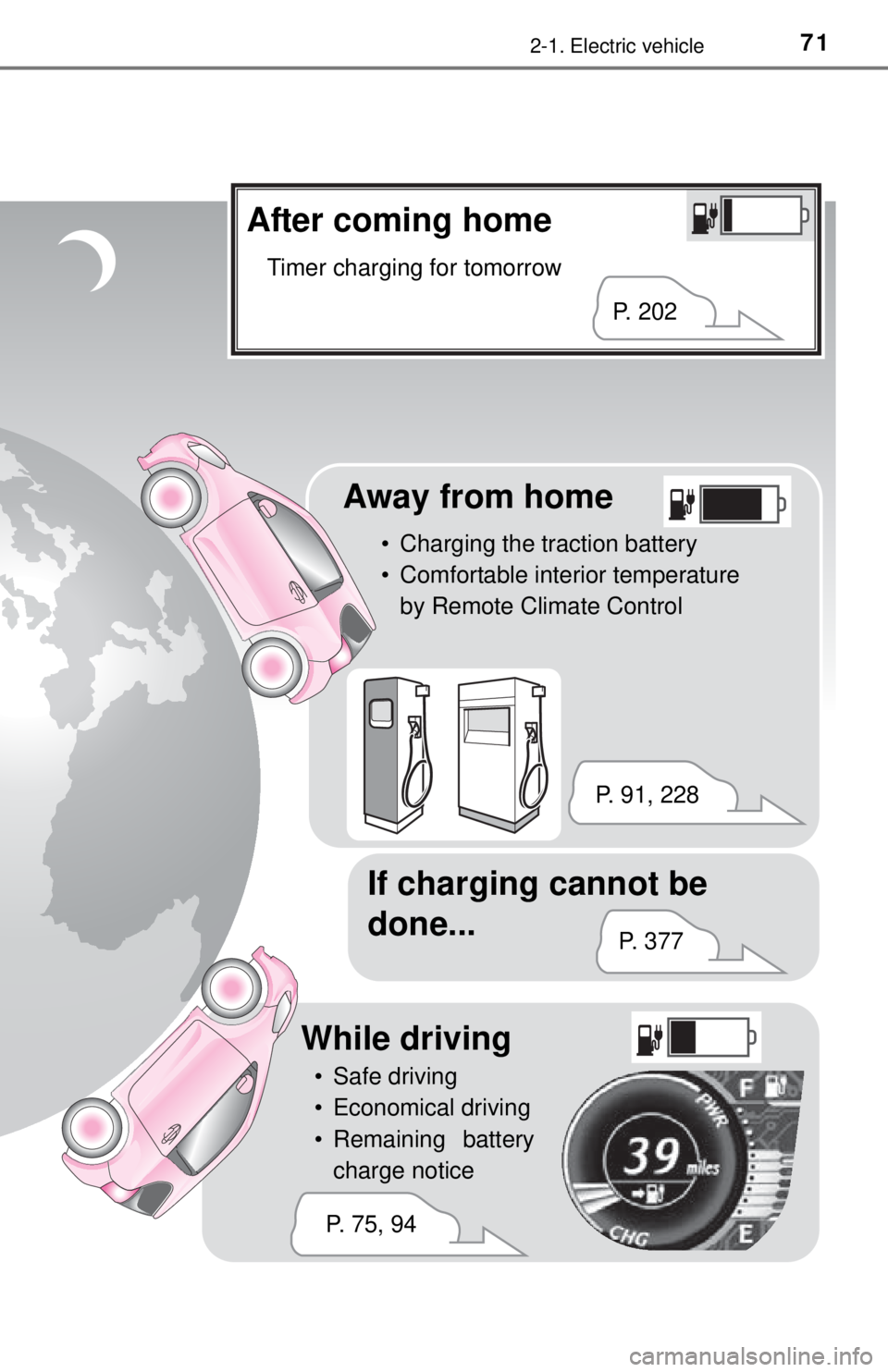
After coming home
Timer charging for tomorrow
Away from home
• Charging the traction battery
• Comfortable interior temperature by Remote Climate Control
If charging cannot be
done...
P. 202
P. 91, 228 P. 3 7 7
While driving
• Safe driving
• Economical driving
• Remaining batterycharge notice
P. 75, 94
Page 73 of 444
732-1. Electric vehicle
2
EV system
◆When braking (regenerative braking)
The electric motor (traction motor) charges the traction battery.
The driving range can be extended by actively using this regenera-
tive braking to store electricity in the traction battery.
◆Charging
The electric vehicle is driven using electricity, received from an
external power source, that is stored in the traction battery. Not only
public charging stations, but also household electrical outlets can
be used for charging. Procedures are different from refueling a con-
ventional vehicle. Theref ore, make sure to read the following thor-
oughly.
● Charging equipment ( P. 84)
● Power sources that can be used ( P. 88)
● How to charge your vehicle ( P. 181, 195)
● If charging cannot be done ( P. 377)
● Inspecting the charging cable ( P. 262)
Page 75 of 444

752-1. Electric vehicle
2
EV system
■Regenerative braking
In the following situations, kinetic energy is converted to electric energy and
deceleration force can be obtained in conjunction with the recharging of the
traction battery.
●The accelerator pedal is released while driving with the shift lever in D, S or
B.
● The brake pedal is depressed while driving with the shift lever in D, S or B.
If “REGENERATIVE BRAKING LIMITED” appears on the multi-information
display, refer to P. 347.
■ 12-volt battery recharging
The 12-volt battery is charged from the traction battery when the EV system
is operated or while the traction battery is being charged.
If the vehicle has not been used for a long time, the 12-volt battery may
become low due to self-discharge. If this occurs, follow the correct proce-
dures. ( P. 386)
■ When not using the vehicle for an extended period of time
P. 191
■ Charging the traction battery
Be sure to maintain the traction battery charge level suitable for your driving
needs.
If the traction battery fully discharges, the vehicle cannot be driven at all.
When the battery becomes low, charge it as soon as possible.
■ If the traction battery becomes low
●If the SOC (State of Charge) warning light flashes, the power used by the air
conditioning system will automatically be restricted and the traction battery’s
remaining charge will be distributed for driving the vehicle. If the traction bat-\
tery fully discharges, driving will not be possible. When the battery becomes
low, charge it as soon as possible.
Page 77 of 444
772-1. Electric vehicle
2
EV system
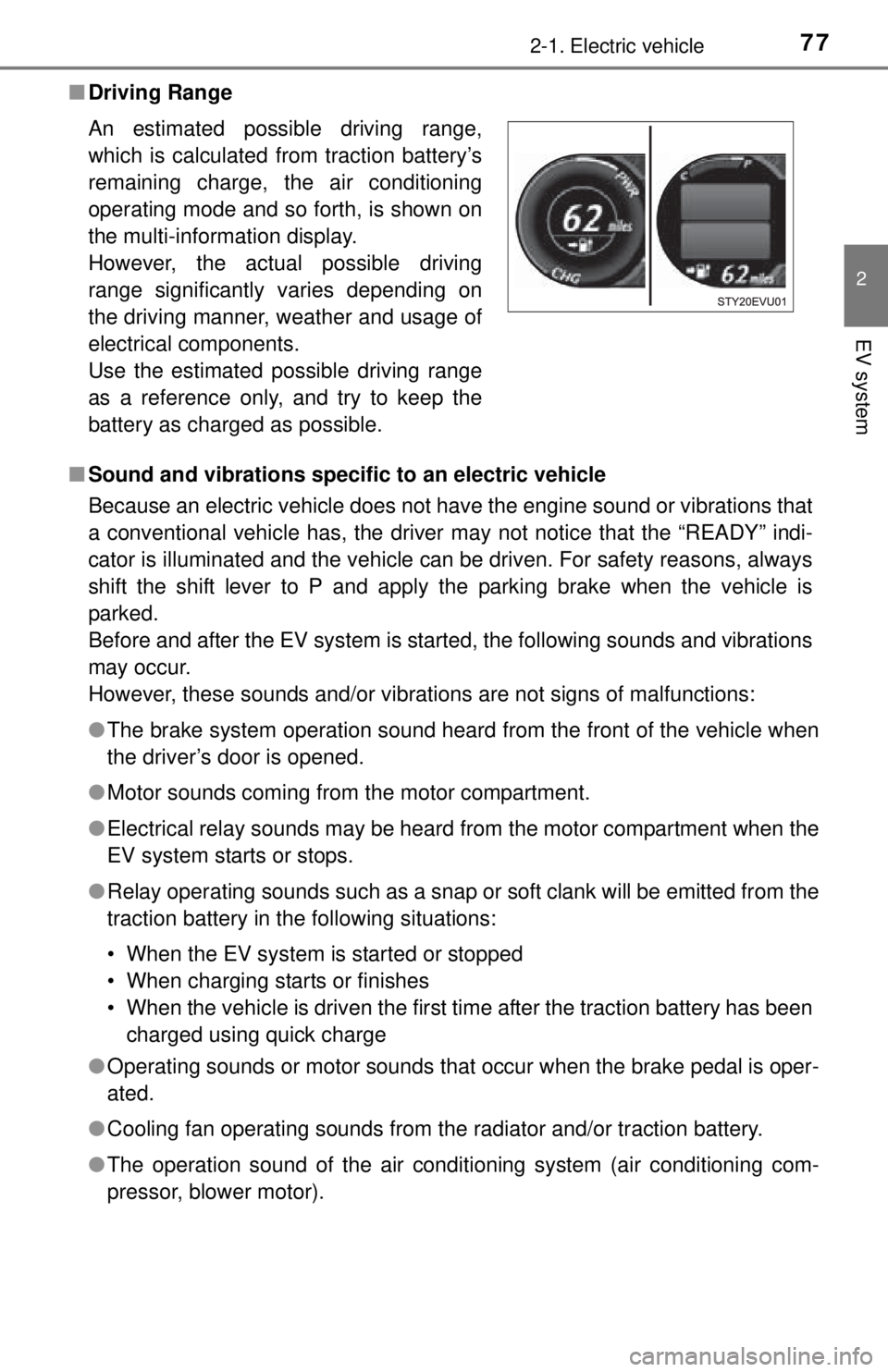
■Driving Range
■ Sound and vibrations speci fic to an electric vehicle
Because an electric vehicle does not have the engine sound or vibrations that
a conventional vehicle has, the driver may not notice that the “READY” indi-
cator is illuminated and the vehicle can be driven. For safety reasons, always
shift the shift lever to P and apply the parking brake when the vehicle is
parked.
Before and after the EV system is started, the following sounds and vibrations
may occur.
However, these sounds and/or vibrations are not signs of malfunctions:
● The brake system operation sound heard from the front of the vehicle when
the driver’s door is opened.
● Motor sounds coming from the motor compartment.
● Electrical relay sounds may be heard from the motor compartment when the
EV system starts or stops.
● Relay operating sounds such as a snap or soft clank will be emitted from the
traction battery in the following situations:
• When the EV system is started or stopped
• When charging starts or finishes
• When the vehicle is driven the first time after the traction battery has been
charged using quick charge
● Operating sounds or motor sounds that occur when the brake pedal is oper-
ated.
● Cooling fan operating sounds from the radiator and/or traction battery.
● The operation sound of the air conditioning system (air conditioning com-
pressor, blower motor).
An estimated possible driving range,
which is calculated from traction battery’s
remaining charge, the air conditioning
operating mode and so forth, is shown on
the multi-information display.
However, the actual possible driving
range significantly varies depending on
the driving manner, weather and usage of
electrical components.
Use the estimated possible driving range
as a reference only, and try to keep the
battery as charged as possible.