brake TOYOTA iQ EV 2013 Owners Manual (in English)
[x] Cancel search | Manufacturer: TOYOTA, Model Year: 2013, Model line: iQ EV, Model: TOYOTA iQ EV 2013Pages: 36, PDF Size: 2.62 MB
Page 6 of 36

61. EV system
Before charging, always check that:
●The parking brake is securely set.
●The shift lever is in P.
●The power switch is off.
●All light switches are turned off. (For example, the headlights, emer-
gency flashers, interior light, etc.)
When the traction battery is charged through charging stations, since
the connector shape and charging procedure may vary depending on
the type of chargers, follow the instructions or procedures provided in
the charger’s instruction manual.
Proceed to step for charging the battery at charging stations.
Prepare the charging cable.
Insert the charging cable’s plug
into the outlet of the external
power source.
Make sure to hold the body of the
plug and insert it firmly into the out-
let.
Important things to check before charging
How to normal charge
(how to quick charge [if equipped]:P. 1 0 )
4
1
2
Page 15 of 36
151. EV system
1
EV system
EV (Electric Vehicle) driving tips
■Driving in D position
The D position allows the most efficient driving.
■Route selection
●Repeated acceleration and deceleration due to traffic conges-
tion, long waits at traffic lights, and driving on steep inclines will
lead to poor power consumption. In order to avoid those situa-
tions as much as possible, check traffic reports before leaving. If
the vehicle is driven in traffic congestion, gently release the brake
pedal to allow the vehicle to move forward slightly, avoid overuse
of the accelerator pedal. Doing so can help minimize unneces-
sary energy consumption.
●Whenever the EV system is started, 3 different possible driving
ranges will be displayed on the multi-information display. If a dif-
ferent route is used for driving, select an appropriate driving
route by taking into account those estimated possible driving dis-
tances.
■When braking the vehicle
Make sure to operate the brakes gently and in good time. A greater
amount of electrical energy can be retained when slowing down.
Unlike the conventional vehicles, the energy consumption effi-
ciency of electric vehicles will decline if they continue driving on
highways or at high average speeds, causing the possible driv-
ing distance to reduce. Therefore, if the remaining charge of the
traction battery is low, avoid relying on the displayed possible
driving distance too much as well as driving on highways. Driv-
ing the vehicle at moderate speeds, the traction battery’s energy
consumption can be controlled.
The following driving tips will contribute to reduction in the bat-
tery consumption and increase in the driving range.
Page 17 of 36

171. EV system
1
EV system
For electric vehicles, the faster the speed, the more power is consumed,
and the driving range decreases. If driven at a speed of approximately
62 mph (100 km/h), compared to approximately 25 mph (40 km/h), the
vehicle’s energy efficiency drops by approximately 40%. For instance,
an electric vehicle can achieve a driving range of approximately 62
miles (100 km) with a constant vehicle speed of 25 mph (40 km/h), how-
ever, driving at 62 mph (100 km/h) will reduce such a driving range to
approximately 32 miles (60 km).
●Control your speed and keep at a constant speed. Also, before
stopping at a toll booth or similar, allow plenty of time to release
the accelerator and gently apply the brakes. A greater amount of
electrical energy can be retained when slowing down.
■Air conditioning on/off
●Switch the air conditioning off when it is not needed. Doing so
can help control excessive electricity and power consumption.
In summer:
In high temperatures, use the recirculated air mode. Doing so will
help to reduce the burden on the air conditioning and reduce
power consumption as well.
In winter:
Excessive or unnecessary heating should be avoided. The use of
the seat heater is effective to avoid excessive power consump-
tion.
●For efficiency, use the Remote Climate Control before departing
while the charging cable is connected.
■Checking tire inflation pressure
Make sure to check the tire inflation pressure frequently. Improper
tire inflation pressure can cause poor power consumption.
Also, as snow tires can cause large amounts of friction, their use on
dry roads will lead to poor power consumption. Use tires that are
appropriate for the season.
■Luggage
Carrying heavy luggage can require excessive energy. Avoid leav-
ing unnecessary luggage in the vehicle.
Page 21 of 36
212. Operation of each component
2
Operation of each component
Power (ignition) switch
Check that the charging cable is disconnected.
Check that the parking brake is set.
Check that the shift lever is set in P.
Firmly depress the brake pedal.
The power switch indicator will turn green. If the indicator does not turn
green, the EV system cannot be started.
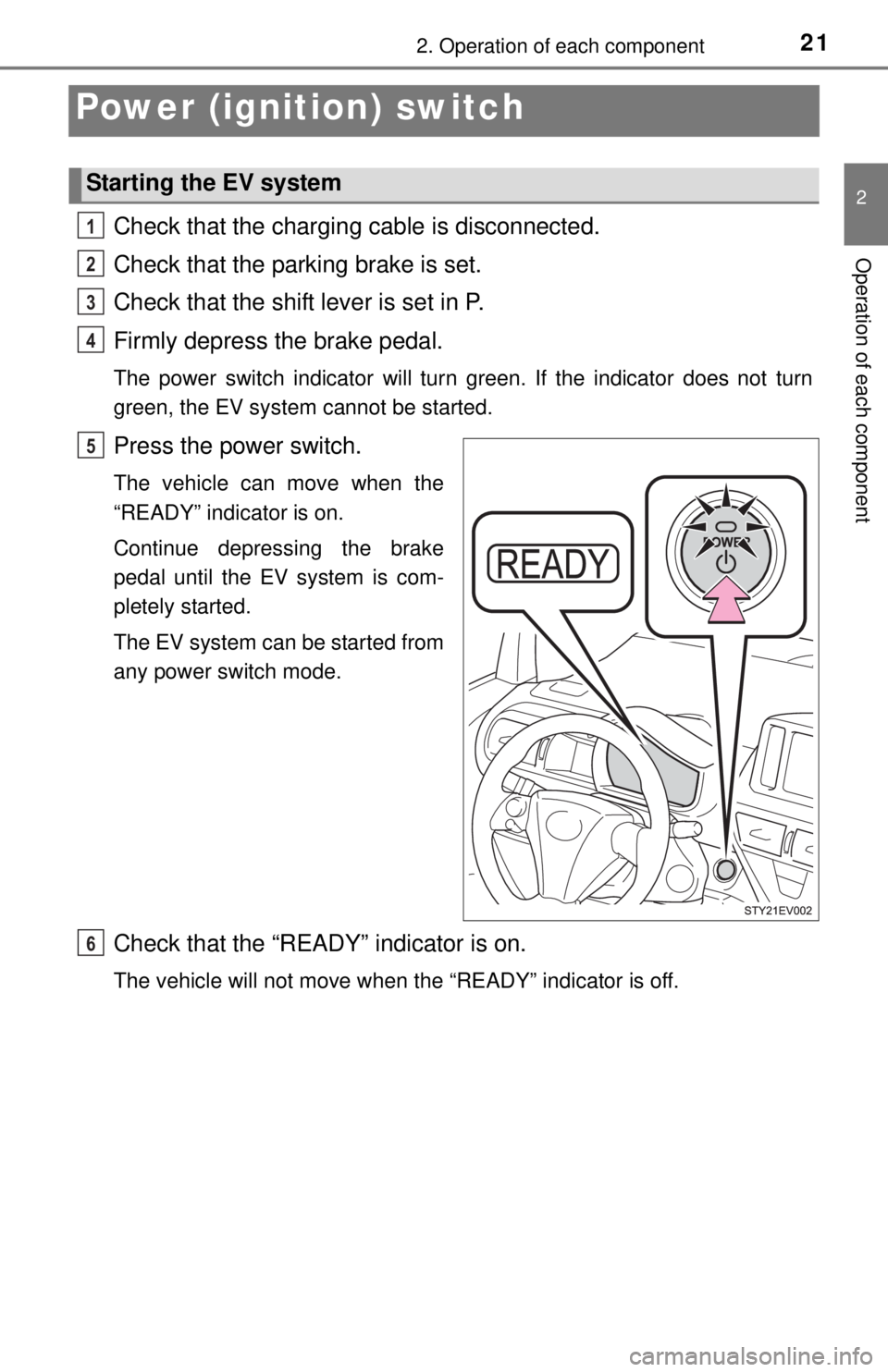
Press the power switch.
The vehicle can move when the
“READY” indicator is on.
Continue depressing the brake
pedal until the EV system is com-
pletely started.
The EV system can be started from
any power switch mode.
Check that the “READY” indicator is on.
The vehicle will not move when the “READY” indicator is off.
Starting the EV system
1
2
3
4
5
6
Page 22 of 36
222. Operation of each component
Depress the brake pedal until the vehicle comes to a complete
stop.
Set the parking brake.
Shift the shift lever to P.
Press the power switch.
Slowly release the brake pedal and check that the indicator on the
power switch is off.
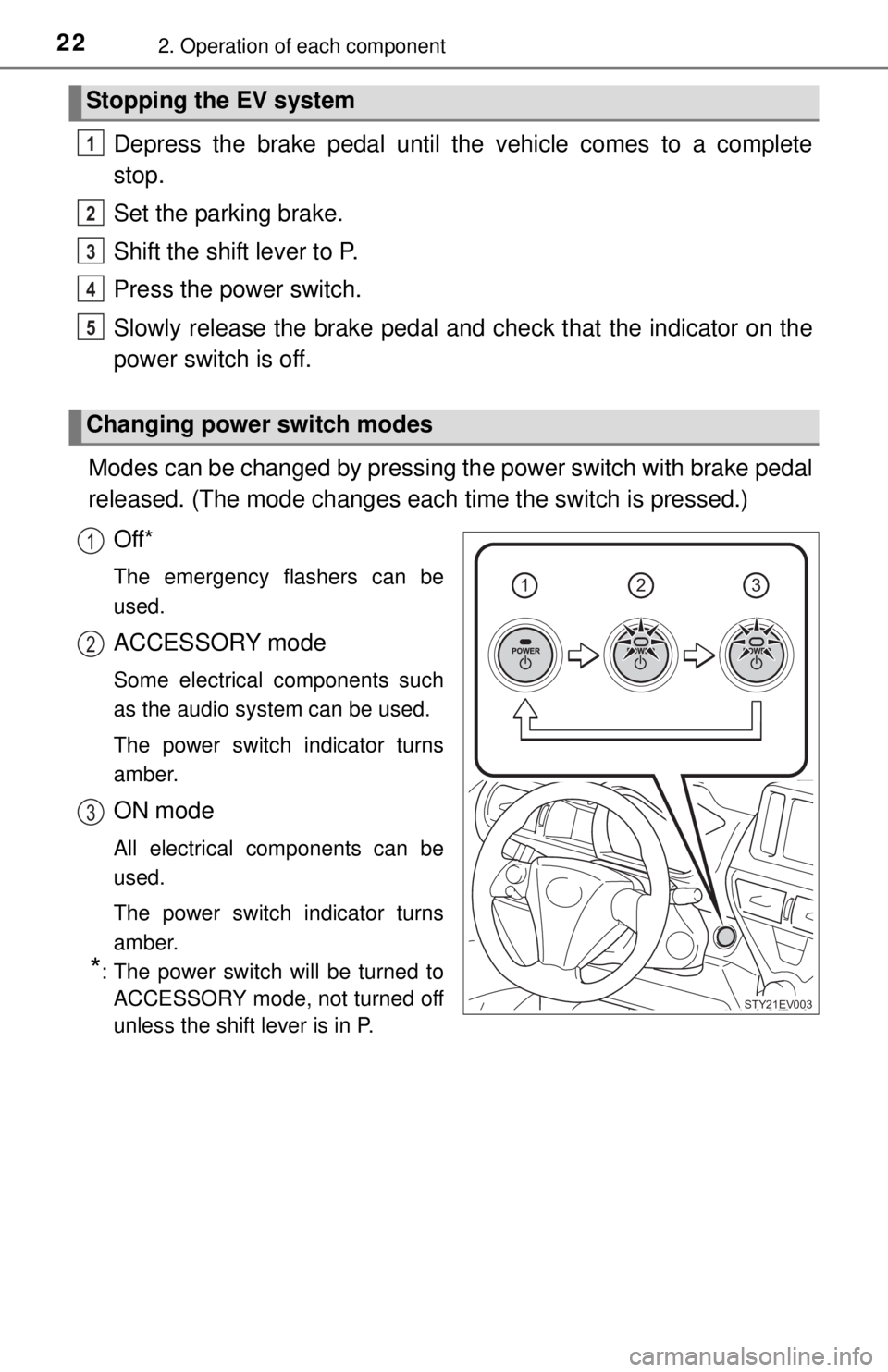
Modes can be changed by pressing the power switch with brake pedal
released. (The mode changes each time the switch is pressed.)
Off*
The emergency flashers can be
used.
ACCESSORY mode
Some electrical components such
as the audio system can be used.
The power switch indicator turns
amber.
ON mode
All electrical components can be
used.
The power switch indicator turns
amber.
*: The power switch will be turned to
ACCESSORY mode, not turned off
unless the shift lever is in P.
Stopping the EV system
Changing power switch modes
1
2
3
4
5
123
STY21EV003
1
2
3
Page 24 of 36

242. Operation of each component
■Operating conditions
The system will only operate if all of the following conditions are met:
●The shift lever is in P.
●The power switch is off.
●All doors are closed.
●The hood is closed.
●The brake pedal is not being depressed.
●The charging cable is plugged in.
●The SOC (State of Charge) gauge is 8/10 or greater.
Page 33 of 36

334. What to do if...
4
What to do if...
If your vehicle has to be stopped in an
emergency
Steadily step on the brake pedal with both feet and firmly depress it.
Do not pump the brake pedal repeatedly as this will increase the effort
required to slow the vehicle.
Shift the shift lever to N.
If the shift lever is shifted to N
After slowing down, stop the vehicle in a safe place by the road.
Stop the EV system.
If the shift lever cannot be shifted to N
Keep depressing the brake pedal with both feet to reduce vehicle
speed as much as possible.
To stop the EV system, press
and hold the power switch for 2
consecutive seconds or more,
or press it briefly 3 times or
more in succession.
Stop the vehicle in a safe place by the road.
Only in an emergency, such as if it becomes impossible to stop
the vehicle in the normal way, stop the vehicle using the follow-
ing procedure:
1
2
3
4
3
Press and hold for 2 seconds or more,
or press briefly 3 times or more
4
CAUTION
■If the EV system has to be turned off while driving
Power assist for the brakes and steering wheel will be lost, making the
brake pedal harder to depress and the steering wheel heavier to turn.
Decelerate as much as possible before turning off the EV system.
5
Page 35 of 36
354. What to do if...
4
What to do if...
Ensure that the shift lever is in P and depress the brake pedal.
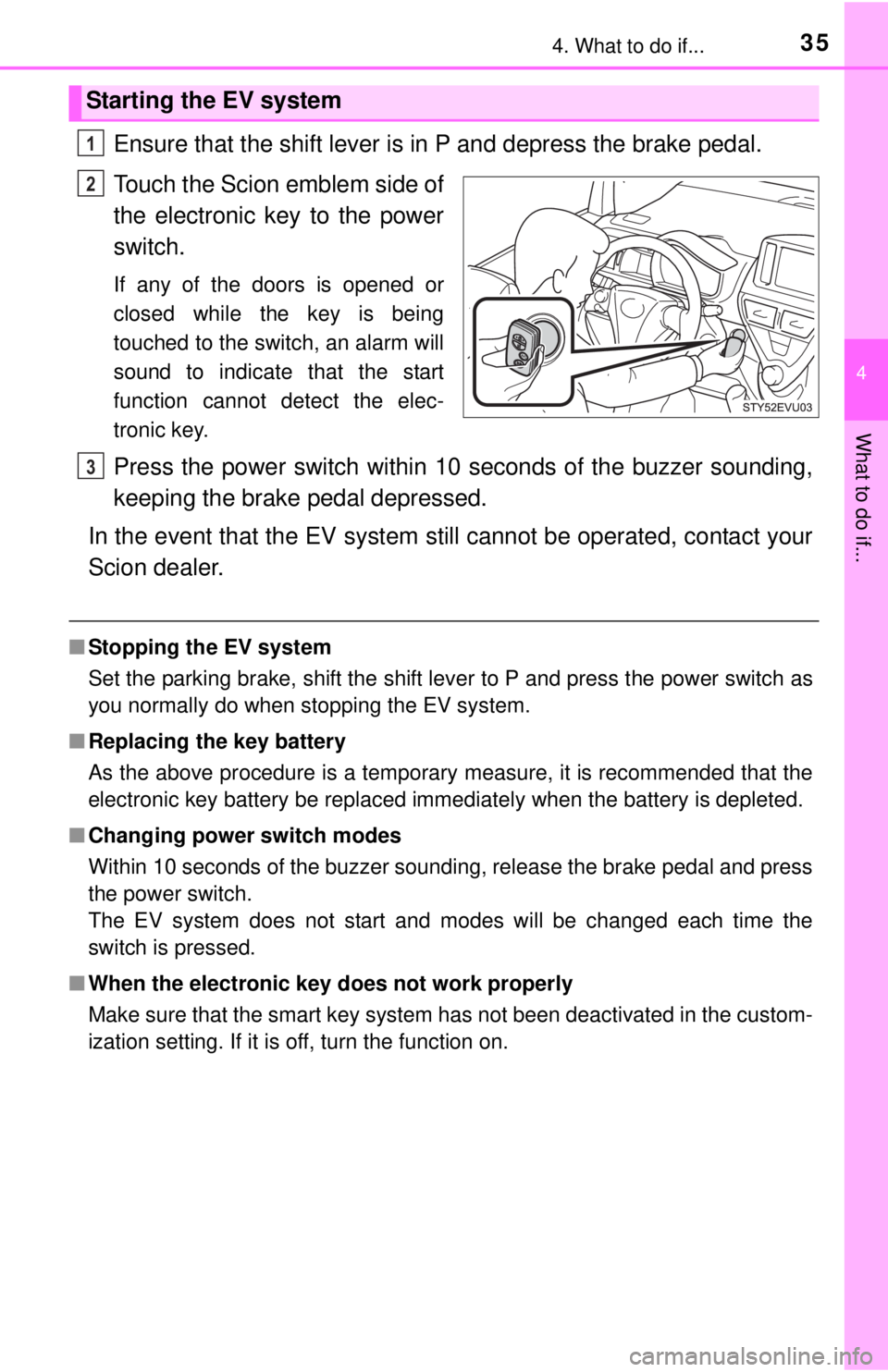
Touch the Scion emblem side of
the electronic key to the power
switch.
If any of the doors is opened or
closed while the key is being
touched to the switch, an alarm will
sound to indicate that the start
function cannot detect the elec-
tronic key.
Press the power switch within 10 seconds of the buzzer sounding,
keeping the brake pedal depressed.
In the event that the EV system still cannot be operated, contact your
Scion dealer.
■Stopping the EV system
Set the parking brake, shift the shift lever to P and press the power switch as
you normally do when stopping the EV system.
■Replacing the key battery
As the above procedure is a temporary measure, it is recommended that the
electronic key battery be replaced immediately when the battery is depleted.
■Changing power switch modes
Within 10 seconds of the buzzer sounding, release the brake pedal and press
the power switch.
The EV system does not start and modes will be changed each time the
switch is pressed.
■When the electronic key does not work properly
Make sure that the smart key system has not been deactivated in the custom-
ization setting. If it is off, turn the function on.
Starting the EV system
1
2
3