warning light TOYOTA MIRAI 2022 User Guide
[x] Cancel search | Manufacturer: TOYOTA, Model Year: 2022, Model line: MIRAI, Model: TOYOTA MIRAI 2022Pages: 556, PDF Size: 17.34 MB
Page 46 of 556
461-1. For safe use
Owners Manual_USA_M62084_en
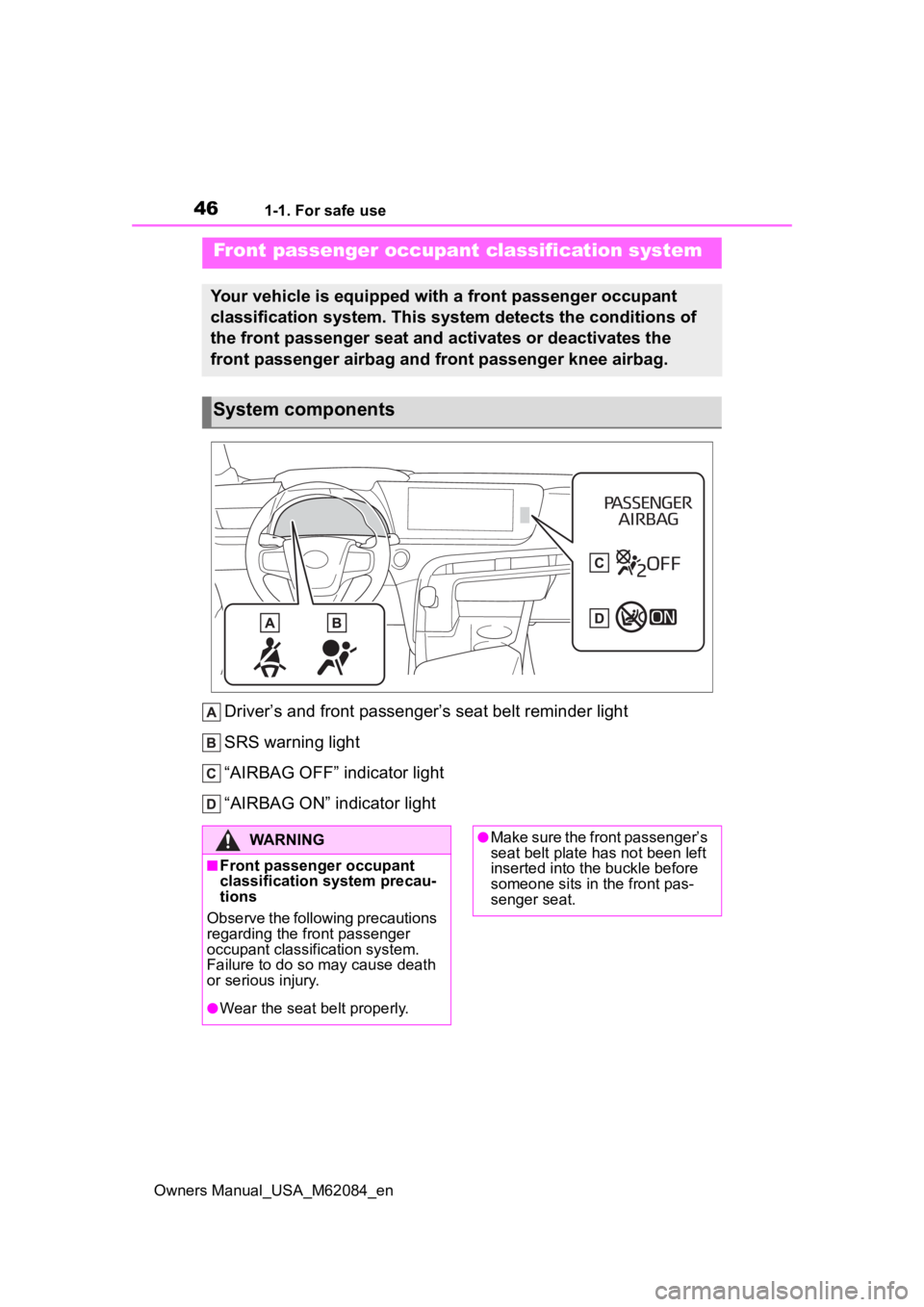
Driver’s and front passenger’s seat belt reminder light
SRS warning light
“AIRBAG OFF” indicator light
“AIRBAG ON” indicator light
Front passenger occupant classification system
Your vehicle is equipped with a front passenger occupant
classification system. This system detects the conditions of
the front passenger seat and activates or deactivates the
front passenger airbag and front passenger knee airbag.
System components
WARNING
■Front passenger occupant
classification system precau-
tions
Observe the following precautions
regarding the front passenger
occupant classification system.
Failure to do so may cause death
or serious injury.
●Wear the seat belt properly.
●Make sure the front passenger’s
seat belt plate has not been left
inserted into the buckle before
someone sits in the front pas-
senger seat.
Page 47 of 556
471-1. For safe use
Owners Manual_USA_M62084_en
1
For safety and security
WARNING
●Make sure the “AIRBAG OFF”
indicator light is not illuminated
when using the seat belt
extender for the front passenger
seat. If the “AIRBAG OFF” indi-
cator light is illuminated, discon-
nect the extender tongue from
the seat belt buckle, and recon-
nect the seat belt. Reconnect
the seat belt extender after
making sure the “AIRBAG ON”
indicator light is illuminated. If
you use the seat belt extender
while the “AIRBAG OFF” indica-
tor light is illum inated, the SRS
airbags for the front passenger
will not activate, which could
cause death or ser ious injury in
the event of a collision.
●Do not apply a heavy load to the
front passenger seat or equip-
ment (e.g. seatback pocket).
●Do not put weight on the front
passenger seat by putting your
hands or feet on the front pas-
senger seat seatback from the
rear passenger seat.
●Do not let a rea r passenger lift
the front passenger seat with
their feet or press on the seat-
back with their legs.
●Do not put objects under the
front passenger seat.
●Do not recline t he front passen-
ger seatback so far that it
touches a rear seat. This may
cause the “AIRBAG OFF” indi-
cator light to be illuminated,
which indicates that the SRS
airbags for the front passenger
will not activate in the event of a
severe accident. If the seatback
touches the rear seat, return the
seatback to a position where it
does not touch the rear seat.
Keep the front passenger seat-
back as upright as possible
when the vehicle is moving.
Reclining the seatback exces-
sively may lessen the effective-
ness of the seat belt system.
●If an adult sits i n the front pas-
senger seat, the “AIRBAG ON”
indicator light i s illuminated. If
the “AIRBAG OFF” indicator is
illuminated, ask the passenger
to sit up straight, well back in
the seat, feet on the floor, and
with the seat belt worn correctly.
If the “AIRBAG OFF” indicator
still remains illumi nated, either
ask the passenger to move to
the rear seat, or if that is not
possible, move the front pas-
senger seat fully rearward.
●When it is unavoidable to install
a forward-facing child restraint
system on the front passenger
seat, install the child restraint
system on the front passenger
seat in the proper order.
( P. 5 4 )
●Do not modify or remove the
front seats.
●Do not kick the front passenger
seat or subject it to severe
impact. Otherwise, the SRS
warning light m ay come on to
indicate a malfu nction of the
front passenger occupant clas-
sification system. In this case,
contact your Toyota dealer
immediately.
Page 48 of 556
481-1. For safe use
Owners Manual_USA_M62084_en
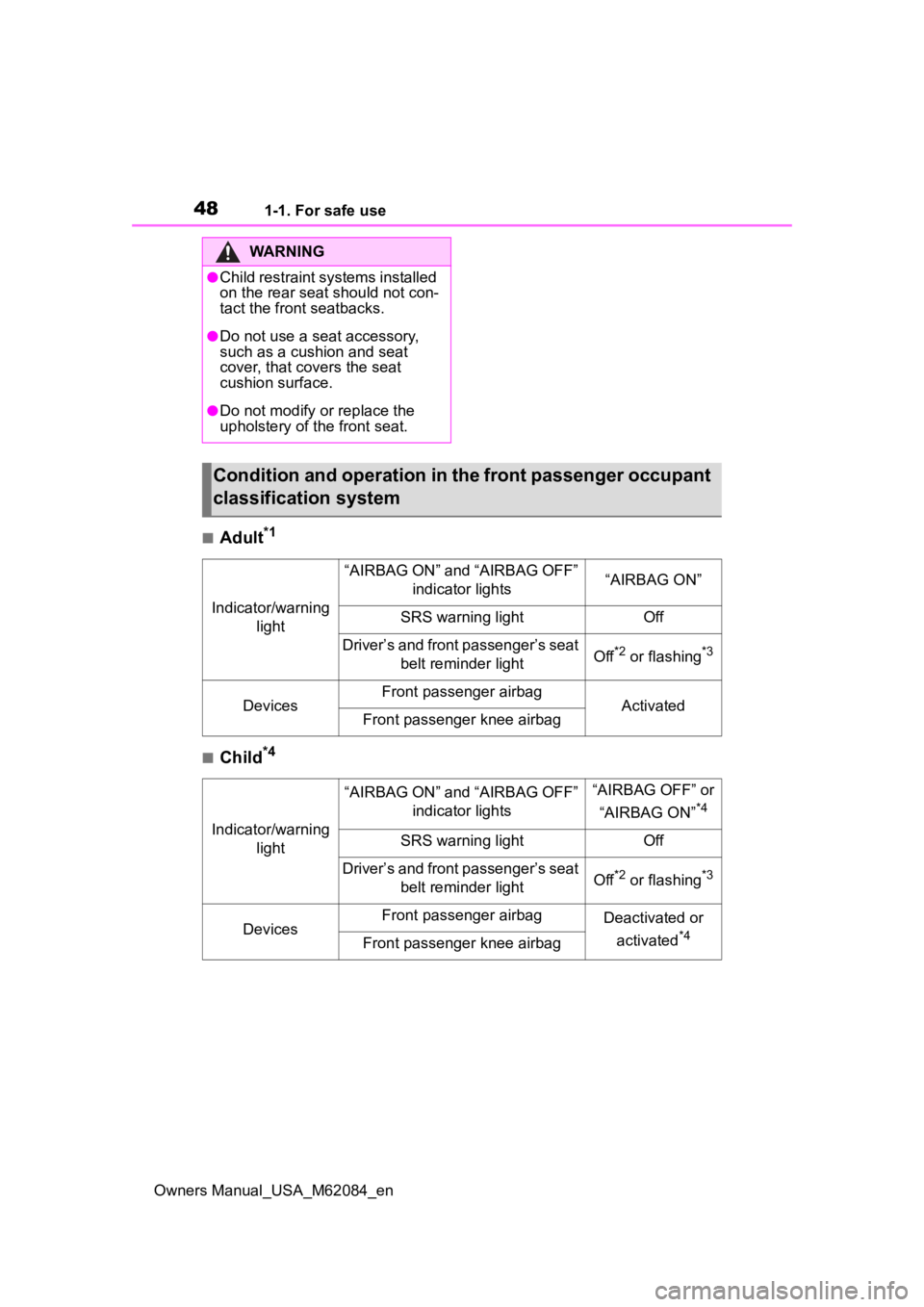
■Adult*1
■Child*4
WARNING
●Child restraint systems installed
on the rear seat should not con-
tact the front seatbacks.
●Do not use a seat accessory,
such as a cushion and seat
cover, that covers the seat
cushion surface.
●Do not modify or replace the
upholstery of the front seat.
Condition and operation in the front passenger occupant
classification system
Indicator/warning light
“AIRBAG ON” and “AIRBAG OFF” indicator lights“AIRBAG ON”
SRS warning lightOff
Driver’s and front passenger’s seat belt reminder lightOff*2 or flashing*3
DevicesFront passenger airbagActivatedFront passenger knee airbag
Indicator/warning light
“AIRBAG ON” and “AIRBAG OFF” indicator lights“AIRBAG OFF” or
“AIRBAG ON”
*4
SRS warning lightOff
Driver’s and front passenger’s seat belt reminder lightOff*2 or flashing*3
DevicesFront passenger airbagDeactivated or
activated
*4Front passenger knee airbag
Page 49 of 556
491-1. For safe use
Owners Manual_USA_M62084_en
1
For safety and security
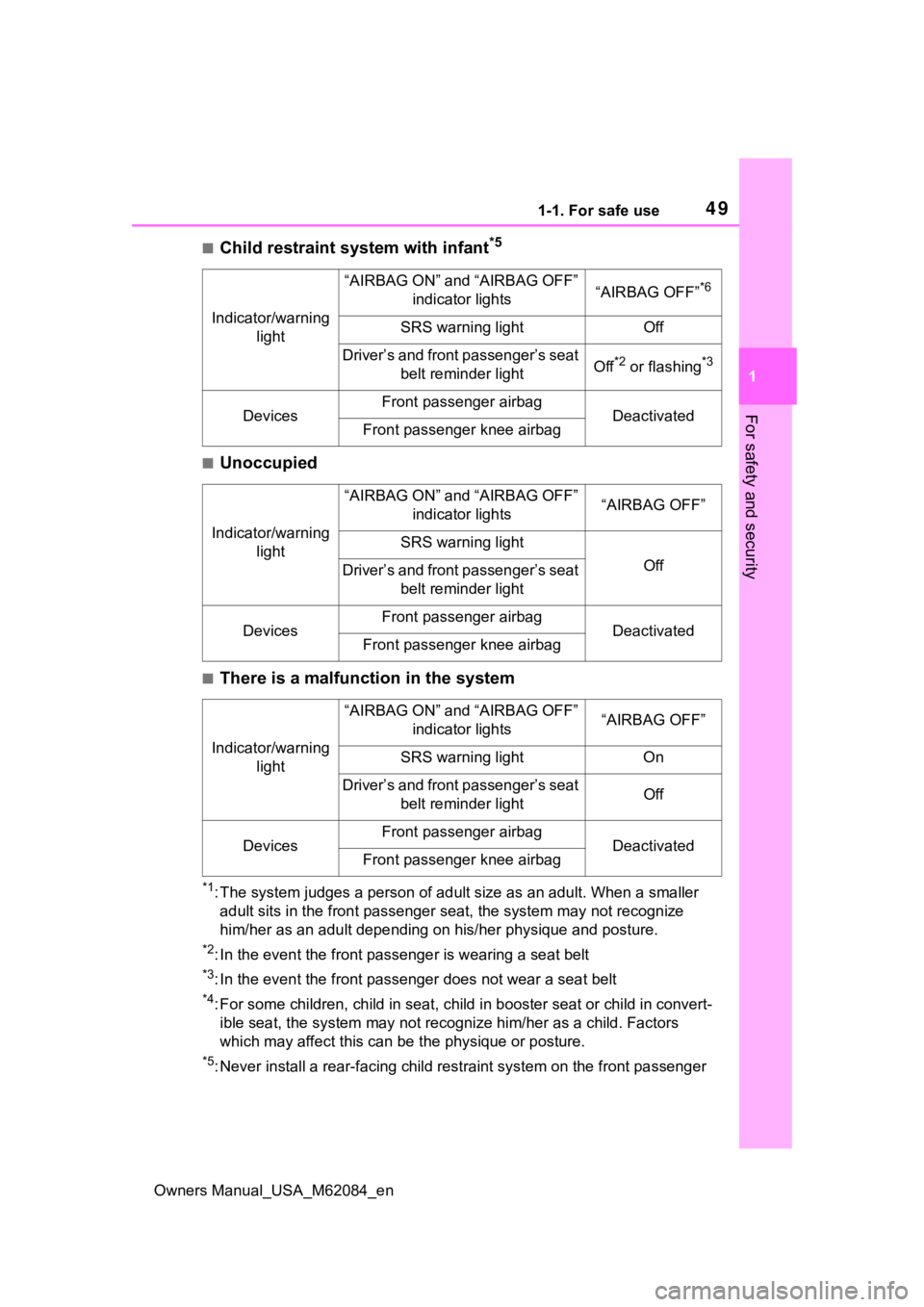
■Child restraint system with infant*5
■Unoccupied
■There is a malfunction in the system
*1: The system judges a person of adult size as an adult. When a smaller
adult sits in the front passenger seat, the system may not recognize
him/her as an adult depending on his/her physique and posture.
*2: In the event the front passenger is wearing a seat belt
*3: In the event the front passen ger does not wear a seat belt
*4: For some children, child in seat, child in booster seat or chi ld in convert-
ible seat, the system may not recognize him/her as a child. Fac tors
which may affect this can be the physique or posture.
*5: Never install a rear-facing ch ild restraint system on the front passenger
Indicator/warning
light
“AIRBAG ON” and “AIRBAG OFF” indicator lights“AIRBAG OFF”*6
SRS warning lightOff
Driver’s and front passenger’s seat belt reminder lightOff*2 or flashing*3
DevicesFront passenger airbagDeactivatedFront passenger knee airbag
Indicator/warning light
“AIRBAG ON” and “AIRBAG OFF” indicator lights“AIRBAG OFF”
SRS warning light
OffDriver’s and front passenger’s seat belt reminder light
DevicesFront passenger airbagDeactivatedFront passenger knee airbag
Indicator/warning light
“AIRBAG ON” and “AIRBAG OFF” indicator lights“AIRBAG OFF”
SRS warning lightOn
Driver’s and front passenger’s seat belt reminder lightOff
DevicesFront passenger airbagDeactivatedFront passenger knee airbag
Page 55 of 556
551-2. Child safety
Owners Manual_USA_M62084_en
1
For safety and security
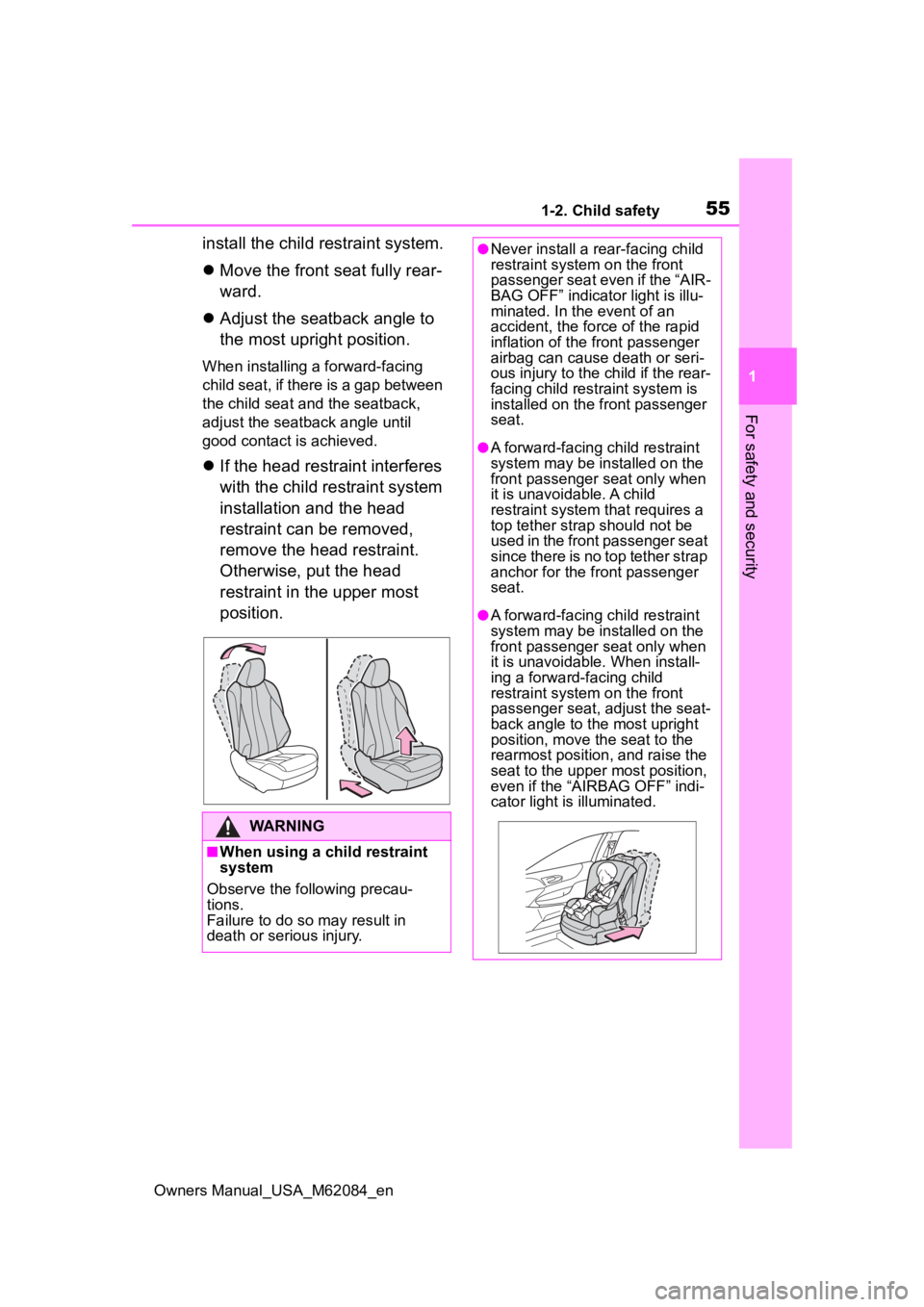
install the child restraint system.
Move the front seat fully rear-
ward.
Adjust the seatback angle to
the most upright position.
When installing a forward-facing
child seat, if there is a gap between
the child seat and the seatback,
adjust the seatback angle until
good contact is achieved.
If the head restraint interferes
with the child restraint system
installation and the head
restraint can be removed,
remove the head restraint.
Otherwise, put the head
restraint in the upper most
position.
WARNING
■When using a child restraint
system
Observe the following precau-
tions.
Failure to do so m ay result in
death or serious injury.
●Never install a rear-facing child
restraint system on the front
passenger seat even if the “AIR-
BAG OFF” indicator light is illu-
minated. In the event of an
accident, the force of the rapid
inflation of the front passenger
airbag can cause death or seri-
ous injury to the child if the rear-
facing child restraint system is
installed on the front passenger
seat.
●A forward-facing child restraint
system may be installed on the
front passenger seat only when
it is unavoidable. A child
restraint system that requires a
top tether strap should not be
used in the front passenger seat
since there is no top tether strap
anchor for the front passenger
seat.
●A forward-facing child restraint
system may be installed on the
front passenger seat only when
it is unavoidable. When install-
ing a forward-facing child
restraint system on the front
passenger seat, adjust the seat-
back angle to the most upright
position, move the seat to the
rearmost position, and raise the
seat to the upper most position,
even if the “AIRBAG OFF” indi-
cator light is illuminated.
Page 81 of 556
812-1. Fuel cell vehicle
Owners Manual_USA_M62084_en
2
Fuel cell system
High-voltage cables (orange)
Fuel cell stack (fuel cell and hydrogen pump)
Air compressor
Air conditioning compressor
■If “Hydrogen Leakage Detected
Visit Your Dealer” is displayed
on the multi-information display
A small amount of hydrogen gas
may be leaking. Have the vehicle
inspected immediately at the near-
est Toyota dealer.
■If “FCV System Shutdown Due
to Hydrogen Leakage Stop in a
Safe Place See Owner’s Man-
ual” is displayed on the multi-
information display
●Hydrogen gas may be leaking.
When hydrogen gas is leaking or
some other malfunction is
detected: P. 8 5
●The air conditioning system will
shut off automatically.
■Running out of fuel
When the vehicle has run out of fuel
and the fuel cell system cannot be
started, refuel the vehicle until the
low fuel level warning light ( P.447)
turns off before try ing to restart. It
may not be able to restart if the refu-
eled amount is too low.
■Fuel cell stack
●Depending on the usage environ-
ment, the fuel ce ll power output
may decline over the life of the
vehicle. However, this will have
almost no effect on driving perfor-
mance.
●In the following situations, the fuel
cell power output may decline
faster than normal driving:
• Extended use in areas with high amounts of dust
• Extended use in areas with high levels of sulfur (such as volcanoes
or hot springs). • Extended use in areas with high
concentrations o f the following
substances:
-Organic solvents, such as paint and
thinner
-Amine-related materials such as
ammonia
-Chlorinated substances such as
salt air and snow-melting agent
• Salt water gets into the air cleaner filter
It is recommended to replace the
air cleaner filter and clean the sur-
rounding components. Have the
vehicle inspected at your Toyota
dealer
• The number of times the fuel cell system is started and stopped is
excessively high
• Extended use in freezing tem- peratures
• Fill fuel with impurities which do not follow ISO-14687
■Hydrogen tanks
●The hydrogen tanks are the high-
pressure storage containers that
are filled with co mpressed hydro-
gen gas. The vehicle can be refu-
eled at hydrogen stations.
●The hydrogen tanks have an expi-
ration date. Vehicles with expired
hydrogen tanks must not be
driven or refueled until the hydro-
gen tanks are replaced. The expi-
ration date is written on the inside
of the fuel door. Consult your Toy-
ota dealer.
●Consult your Toyota dealer if the
hydrogen tanks or valves need to
be disposed.
Page 82 of 556
822-1. Fuel cell vehicle
Owners Manual_USA_M62084_en
■Fuel cell stack coolant
●Fuel cell stack coolant uses a spe-
cifically-designed fluid with high
electrical insulation properties, in
order to safely cool the high-volt-
age fuel cell stack.
●Never add water or other coolants
to the fuel cell stack cooling sys-
tem, as they will cause permanent
damage.
●Consult your Toyota dealer for
replenishing or changing the fuel
cell stack coolant.
■Ion filter
●An ion filter is inst alled in the cool-
ant lines for the fuel cell stack, in
order to maintain the normal insu-
lation properties of the coolant.
●It is necessary to periodically
change the ion filter. ( P.454)
Contact your Toyota dealer for this
periodic maintenance.
■Tailpipe
●When the power switch is turned
off and the fuel cell system is
stopped ( P.174) after driving,
exhaust water is discharged. Be
careful when standing behind the
vehicle to avoid dripping or spray-
ing.
●It is possible to manually purge
the exhaust. Thi s may be desir-
able, for instance, before parking
in a garage. This is done by press-
ing the H
2O switch. ( P.189)
●On cold days, water vapor in the
exhaust may appe ar as a white
mist emitted from the tailpipe. This
is not a malfunction. A white mist
may be emitted from the vehicle
side depending on the wind direc-
tion. If it is a concern, consult with
a Toyota dealer.
●If the tailpipe is blocked, the fuel
cell system will stop.
●In the following state when cold, a
white mist may be emitted. Water
vapor is being emitted as a sys-
tem protection and it is not a mal- function.
• If several minutes have passed after opening the fuel lid, such as
refueling.
• Several hours have passed after the power switch was turned off.
■Hydrogen detectors
When the power switch is turned to
ON, the hydrogen detectors are
activated.
■Power output restriction
When the power output is restricted,
the vehicle may fa il to accelerate or
even decelerate, even though the
accelerator pedal is depressed. If a
safe driving speed cannot be main-
tained, stop the ve hicle in a safe
place away from the traffic. This
may be caused by the following con-
ditions:
●The coolant temperature may be
too high. This can be caused by
driving conditions such as
repeated sudden acceleration and
deceleration, continuous driving
on an incline, continuous driving
at high altitudes with a high load,
etc. In such situations, “FCV sys-
tem overheated Output power
reduced” is displayed on the multi-
information display, and the power
output is restricted. Once the cool-
ant returns to normal temperature,
the power output will retu rn to nor-
mal. ( P.452)
●The remaining fuel may be low.
After the low fuel level warning
light comes on, the output power
will be gradually restricted in order
to extend the possible driving dis-
tance. Once getting to this point,
the remaining driving distance
possible is short. Immediately refill
the vehicle with hydrogen.
●On cold days, the low fuel level
warning light comes on faster than
usual and the output power is
restricted.
■Electromagnetic waves (EMF)
●High-voltage parts and cables in
Page 88 of 556
882-1. Fuel cell vehicle
Owners Manual_USA_M62084_en
■If a warning light comes on, a
warning message is displayed,
or the 12-volt battery connec-
tion is disconnected
The fuel cell system may not be
able to restart.
If the “READY” indicator does not
come on, even when the start pro-
cedure is repeated, contact your
Toyota dealer.
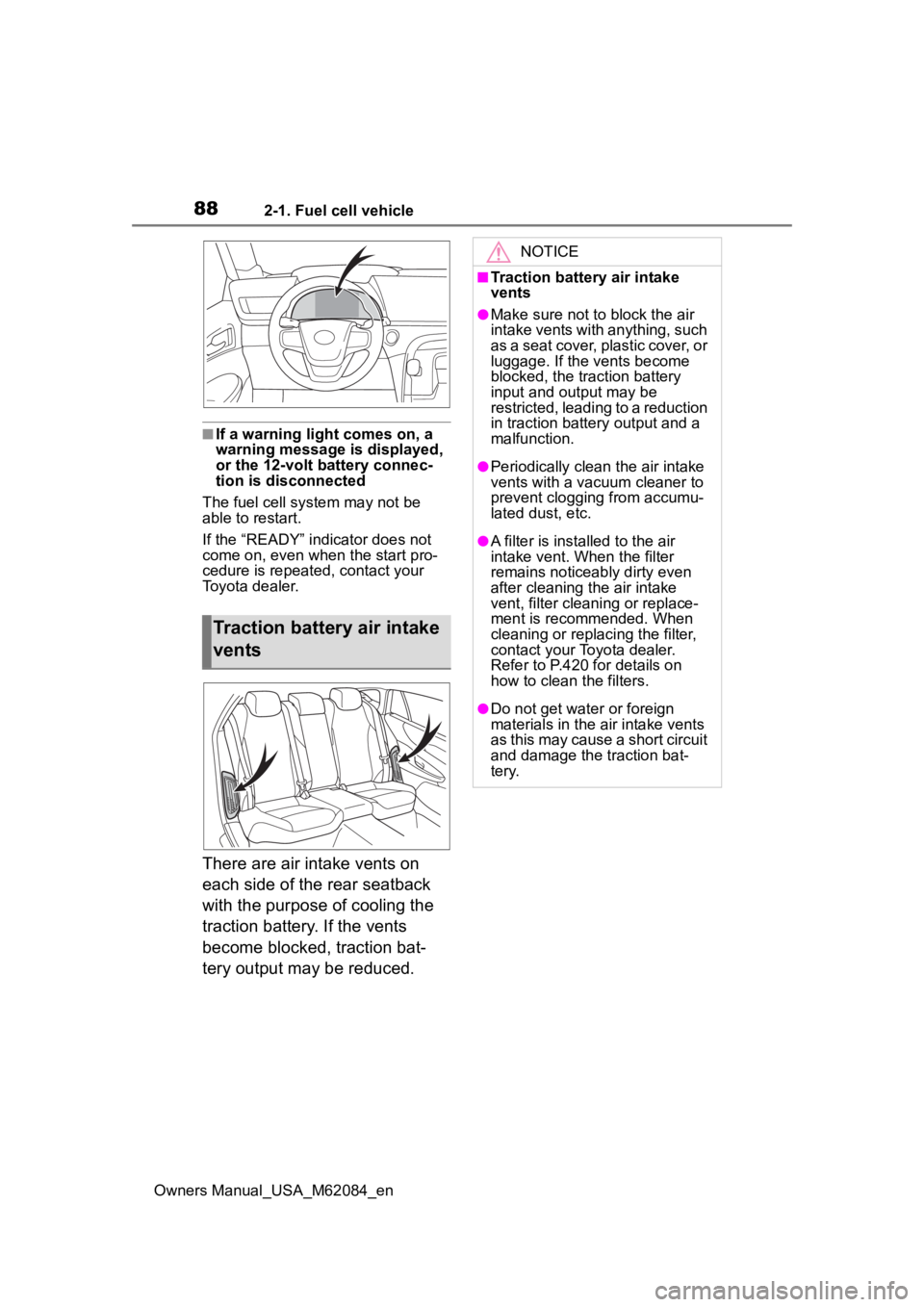
There are air intake vents on
each side of the rear seatback
with the purpose of cooling the
traction battery. If the vents
become blocked, traction bat-
tery output may be reduced.
Traction battery air intake
vents
NOTICE
■Traction battery air intake
vents
●Make sure not to block the air
intake vents with anything, such
as a seat cover, plastic cover, or
luggage. If the vents become
blocked, the traction battery
input and output may be
restricted, leading to a reduction
in traction batte ry output and a
malfunction.
●Periodically clean the air intake
vents with a vacuum cleaner to
prevent clogging from accumu-
lated dust, etc.
●A filter is installed to the air
intake vent. When the filter
remains noticeably dirty even
after cleaning the air intake
vent, filter cleaning or replace-
ment is recommended. When
cleaning or replacing the filter,
contact your Toyota dealer.
Refer to P.420 for details on
how to clean the filters.
●Do not get water or foreign
materials in the air intake vents
as this may cause a short circuit
and damage the traction bat-
tery.
Page 91 of 556
91
Owners Manual_USA_M62084_en
3
3
Vehicle status information and indicators
Vehicle status informa-tion and indicators
3-1. Instrument cluster
Warning lights and indica-tors ............................... 92
Gauges and meters ....... 97
Multi-information display .................................. 100
Head-up display .......... 107
Energy monitor/consump- tion screen/air purification
screen ....................... 111
Page 92 of 556
923-1. Instrument cluster
Owners Manual_USA_M62084_en
3-1.Instrument cluster
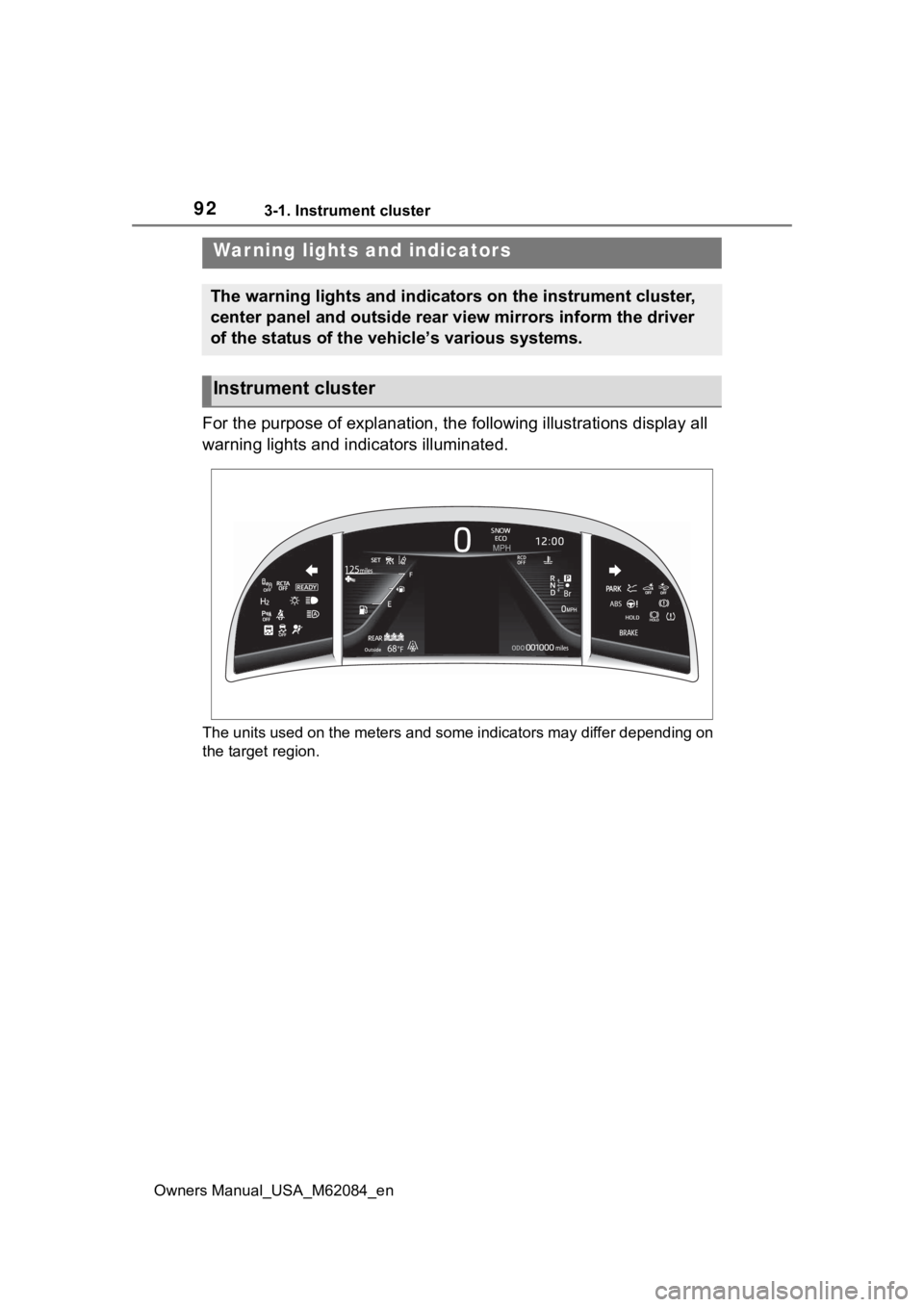
For the purpose of explanation, the following illustrations display all
warning lights and indicators illuminated.
The units used on the meters and some indicators may differ dep ending on
the target region.
War ning lights and indicators
The warning lights and indicators on the instrument cluster,
center panel and outside rear view mirrors inform the driver
of the status of the vehicle’s various systems.
Instrument cluster