coolant TOYOTA MIRAI 2023 User Guide
[x] Cancel search | Manufacturer: TOYOTA, Model Year: 2023, Model line: MIRAI, Model: TOYOTA MIRAI 2023Pages: 572, PDF Size: 17.71 MB
Page 410 of 572
4107-3. Do-it-yourself maintenance
Owners Manual_USA_M62064_en
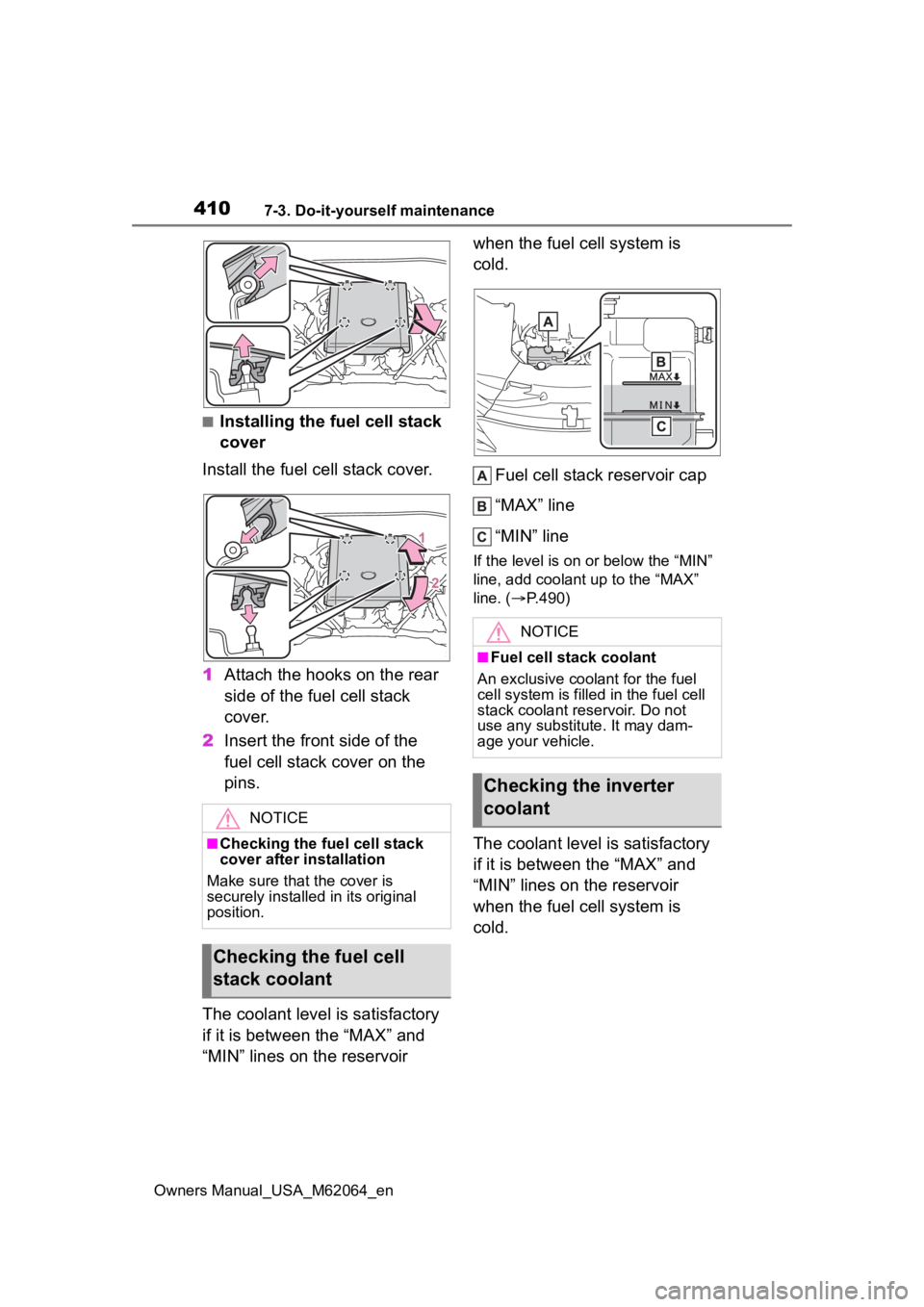
■Installing the fuel cell stack
cover
Install the fuel cell stack cover.
1 Attach the hooks on the rear
side of the fuel cell stack
cover.
2 Insert the front side of the
fuel cell stack cover on the
pins.
The coolant level is satisfactory
if it is between the “MAX” and
“MIN” lines on the reservoir when the fuel cell system is
cold.
Fuel cell stack reservoir cap
“MAX” line
“MIN” line
If the level is on or below the “MIN”
line, add coolant up to the “MAX”
line. ( P.490)
The coolant level is satisfactory
if it is between the “MAX” and
“MIN” lines on the reservoir
when the fuel cell system is
cold.
NOTICE
■Checking the fuel cell stack
cover after installation
Make sure that the cover is
securely installed in its original
position.
Checking the fuel cell
stack coolant
NOTICE
■Fuel cell stack coolant
An exclusive coola nt for the fuel
cell system is filled in the fuel cell
stack coolant reservoir. Do not
use any substitute. It may dam-
age your vehicle.
Checking the inverter
coolant
Page 411 of 572
4117-3. Do-it-yourself maintenance
Owners Manual_USA_M62064_en
7
Maintenance and care
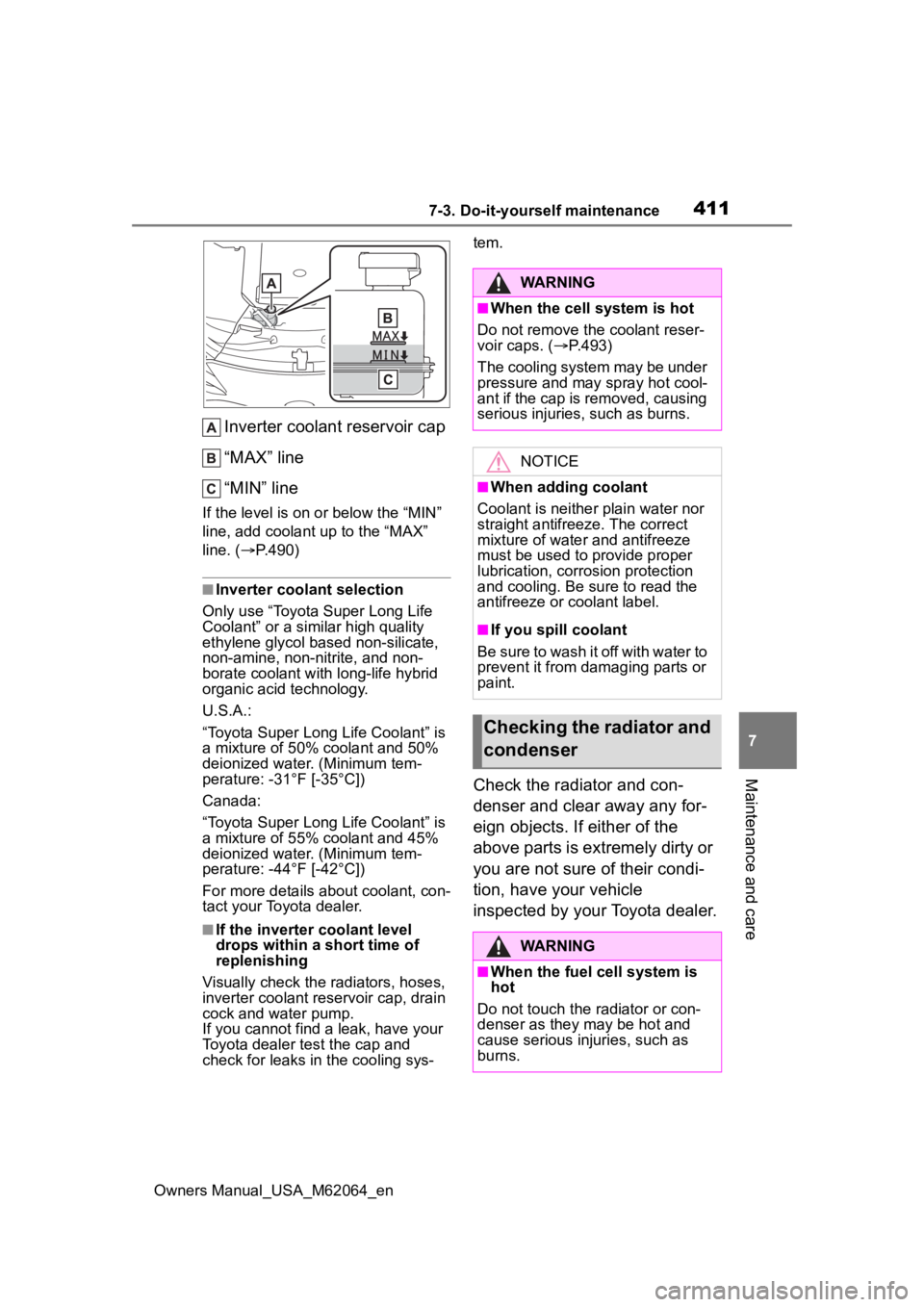
Inverter coolant reservoir cap
“MAX” line
“MIN” line
If the level is on or below the “MIN”
line, add coolant up to the “MAX”
line. ( P.490)
■Inverter coolant selection
Only use “Toyota Super Long Life
Coolant” or a similar high quality
ethylene glycol based non-silicate,
non-amine, non-nitrite, and non-
borate coolant with long-life hybrid
organic acid technology.
U.S.A.:
“Toyota Super Long Life Coolant” is
a mixture of 50% coolant and 50%
deionized water. (Minimum tem-
perature: -31°F [-35°C])
Canada:
“Toyota Super Long Life Coolant” is
a mixture of 55% coolant and 45%
deionized water. (Minimum tem-
perature: -44°F [-42°C])
For more details about coolant, con-
tact your Toyota dealer.
■If the inverter coolant level
drops within a short time of
replenishing
Visually check the radiators, hoses,
inverter coolant reservoir cap, drain
cock and water pump.
If you cannot find a leak, have your
Toyota dealer test the cap and
check for leaks in the cooling sys- tem.
Check the radiator and con-
denser and clear away any for-
eign objects. If either of the
above parts is extremely dirty or
you are not sure of their condi-
tion, have your vehicle
inspected by your Toyota dealer.
WARNING
■When the cell system is hot
Do not remove the coolant reser-
voir caps. ( P.493)
The cooling system may be under
pressure and may spray hot cool-
ant if the cap is removed, causing
serious injuries, such as burns.
NOTICE
■When adding coolant
Coolant is neither plain water nor
straight antifreeze. The correct
mixture of water and antifreeze
must be used to provide proper
lubrication, corrosion protection
and cooling. Be sure to read the
antifreeze or coolant label.
■If you spill coolant
Be sure to wash it off with water to
prevent it from damaging parts or
paint.
Checking the radiator and
condenser
WARNING
■When the fuel cell system is
hot
Do not touch the radiator or con-
denser as they may be hot and
cause serious injuries, such as
burns.
Page 453 of 572
4538-2. Steps to take in an emergency
Owners Manual_USA_M62064_en
8
When trouble arises
Fluid leaks under the vehicle.
(Water dripping from the air
conditioning after use is nor-
mal.)
Flat-looking tires or uneven
tire wear
The high coolant temperature
gauge needle continually
points higher than normal.
Hydrogen gas leakage noises
can be heard. ( P.87)
Excessive tire squeal when
cornering
Strange noises related to the
suspension system
Other noises related to the
fuel cell system
Stumbling or running roughly
Appreciable loss of power
Vehicle pulls heavily to one
side when braking
Vehicle pulls heavily to one
side when driving on a level
road
Loss of brake effectiveness,
spongy feeling, pedal almost
touches the floor
If you think something
is wrong
If you notice any of the fol-
lowing symptoms, your
vehicle probably needs
adjustment or repair. Con-
tact your Toyota dealer as
soon as possible.
Visible symptoms
Audible symptoms
Operational symptoms
Page 455 of 572
4558-2. Steps to take in an emergency
Owners Manual_USA_M62064_en
8
When trouble arises
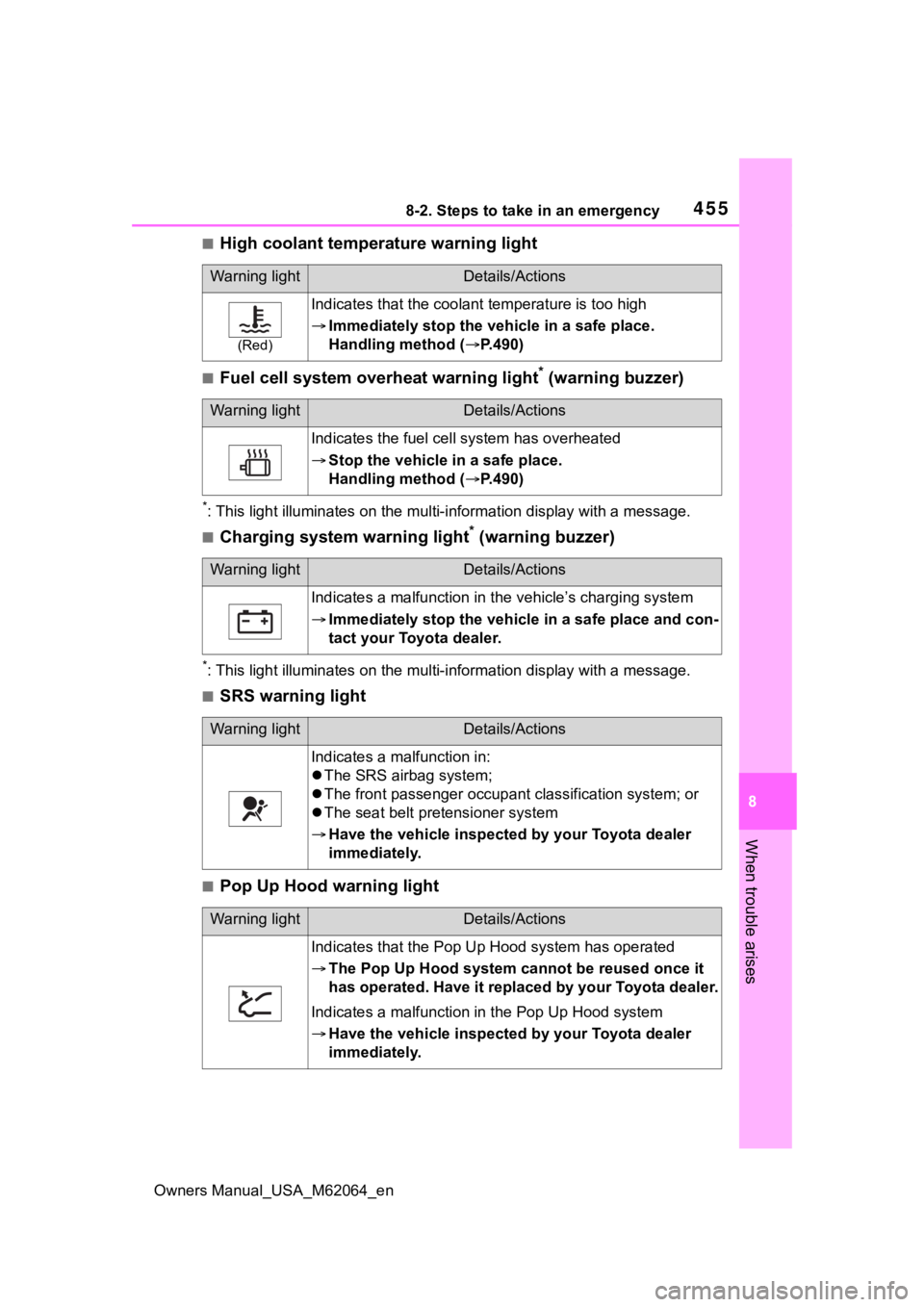
■High coolant temperature warning light
■Fuel cell system overheat warning light* (warning buzzer)
*: This light illuminates on the mu lti-information display with a message.
■Charging system warning light* (warning buzzer)
*: This light illuminates on the mu lti-information display with a message.
■SRS warning light
■Pop Up Hood warning light
Warning lightDetails/Actions
(Red)
Indicates that the coolant temperature is too high
Immediately stop the v ehicle in a safe place.
Handling method ( P.490)
Warning lightDetails/Actions
Indicates the fuel cell system has overheated
Stop the vehicle in a safe place.
Handling method ( P.490)
Warning lightDetails/Actions
Indicates a malfunction in t he vehicle’s charging system
Immediately stop the vehicle in a safe place and con-
tact your Toyota dealer.
Warning lightDetails/Actions
Indicates a malfunction in:
The SRS airbag system;
The front passenger occupant classification system; or
The seat belt pretensioner system
Have the vehicle inspecte d by your Toyota dealer
immediately.
Warning lightDetails/Actions
Indicates that the Pop Up Hood system has operated
The Pop Up Hood system can not be reused once it
has operated. Have it replaced by your Toyota dealer.
Indicates a malfunction in the Pop Up Hood system
Have the vehicle inspecte d by your Toyota dealer
immediately.
Page 490 of 572
4908-2. Steps to take in an emergency
Owners Manual_USA_M62064_en
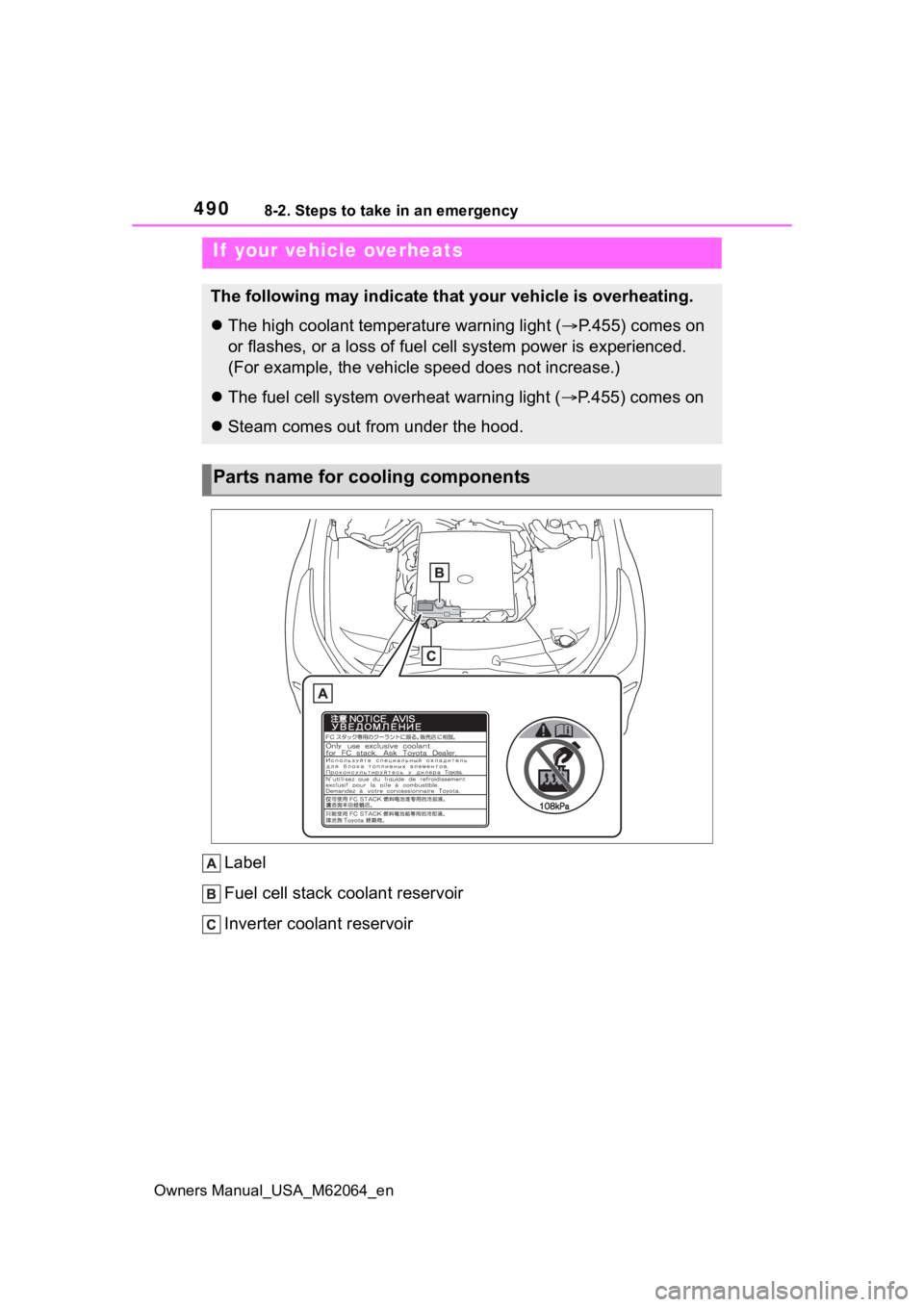
Label
Fuel cell stack coolant reservoir
Inverter coolant reservoir
If your vehicle overheats
The following may indicate that your vehicle is overheating.
The high coolant temperature warning light ( P.455) comes on
or flashes, or a loss of fuel cell system power is experienced.
(For example, the vehicle speed does not increase.)
The fuel cell system overheat warning light ( P.455) comes on
Steam comes out from under the hood.
Parts name for cooling components
Page 491 of 572
4918-2. Steps to take in an emergency
Owners Manual_USA_M62064_en
8
When trouble arises
If the high coolant tempera-
ture warning light comes on or
flashes
1 Stop the vehicle in a safe
place and turn off the air con-
ditioning system, and then
stop the fuel cell system.
2 If you see steam:
Carefully lift the hood after
the steam subsides.
If you do not see steam:
Carefully lift the hood.
3 After the fuel cell system has
cooled down sufficiently,
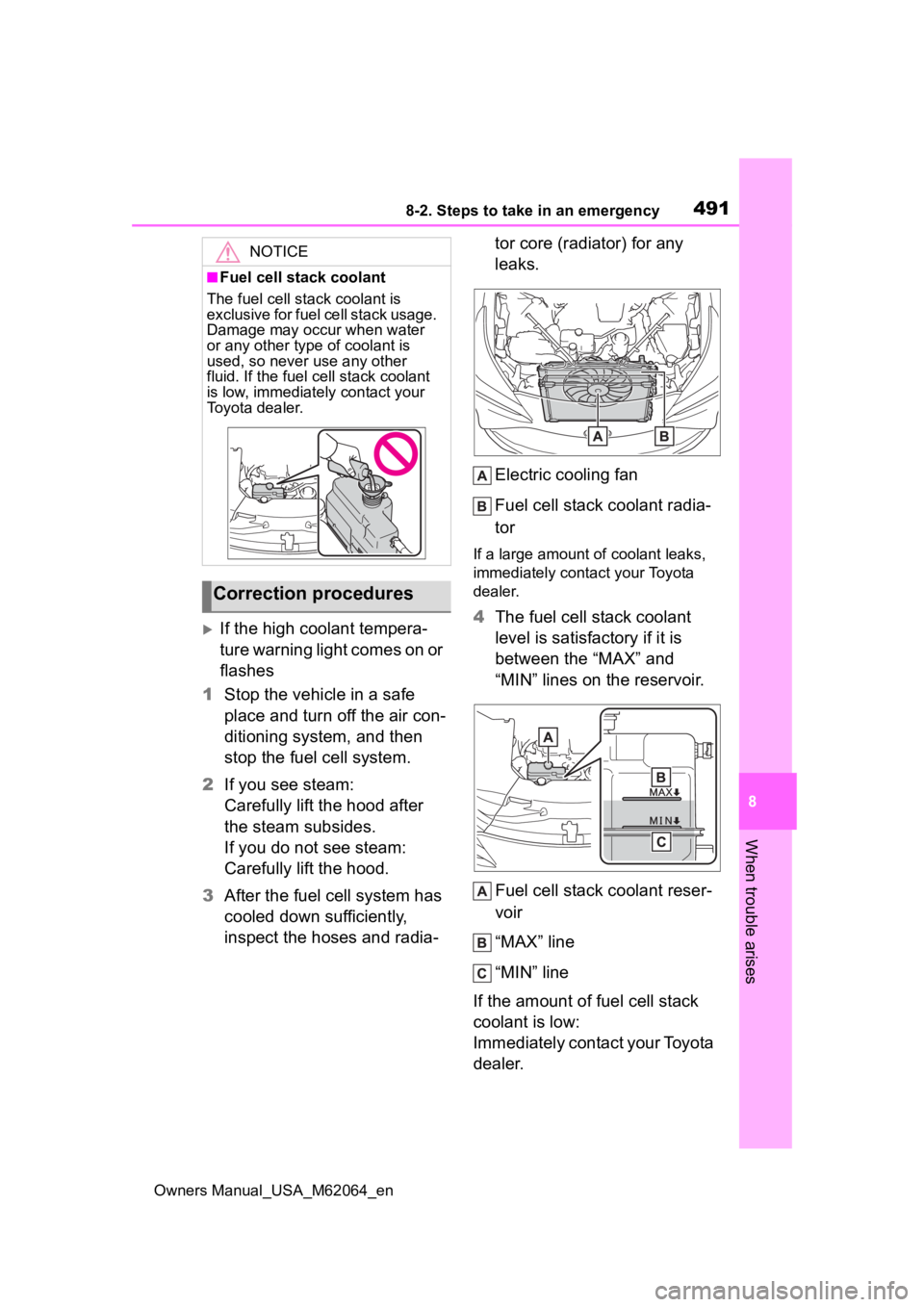
inspect the hoses and radia- tor core (radiator) for any
leaks.
Electric cooling fan
Fuel cell stack coolant radia-
tor
If a large amount of coolant leaks,
immediately contact your Toyota
dealer.
4
The fuel cell stack coolant
level is satisfactory if it is
between the “MAX” and
“MIN” lines on the reservoir.
Fuel cell stack coolant reser-
voir
“MAX” line
“MIN” line
If the amount of fuel cell stack
coolant is low:
Immediately contact your Toyota
dealer.
NOTICE
■Fuel cell stack coolant
The fuel cell stack coolant is
exclusive for fuel cell stack usage.
Damage may occur when water
or any other type of coolant is
used, so never use any other
fluid. If the fuel cell stack coolant
is low, immediately contact your
Toyota dealer.
Correction procedures
Page 492 of 572
4928-2. Steps to take in an emergency
Owners Manual_USA_M62064_en
If the amount of fuel cell stack
coolant is not low:
Have the vehicle inspected at
the nearest Toyota dealer.
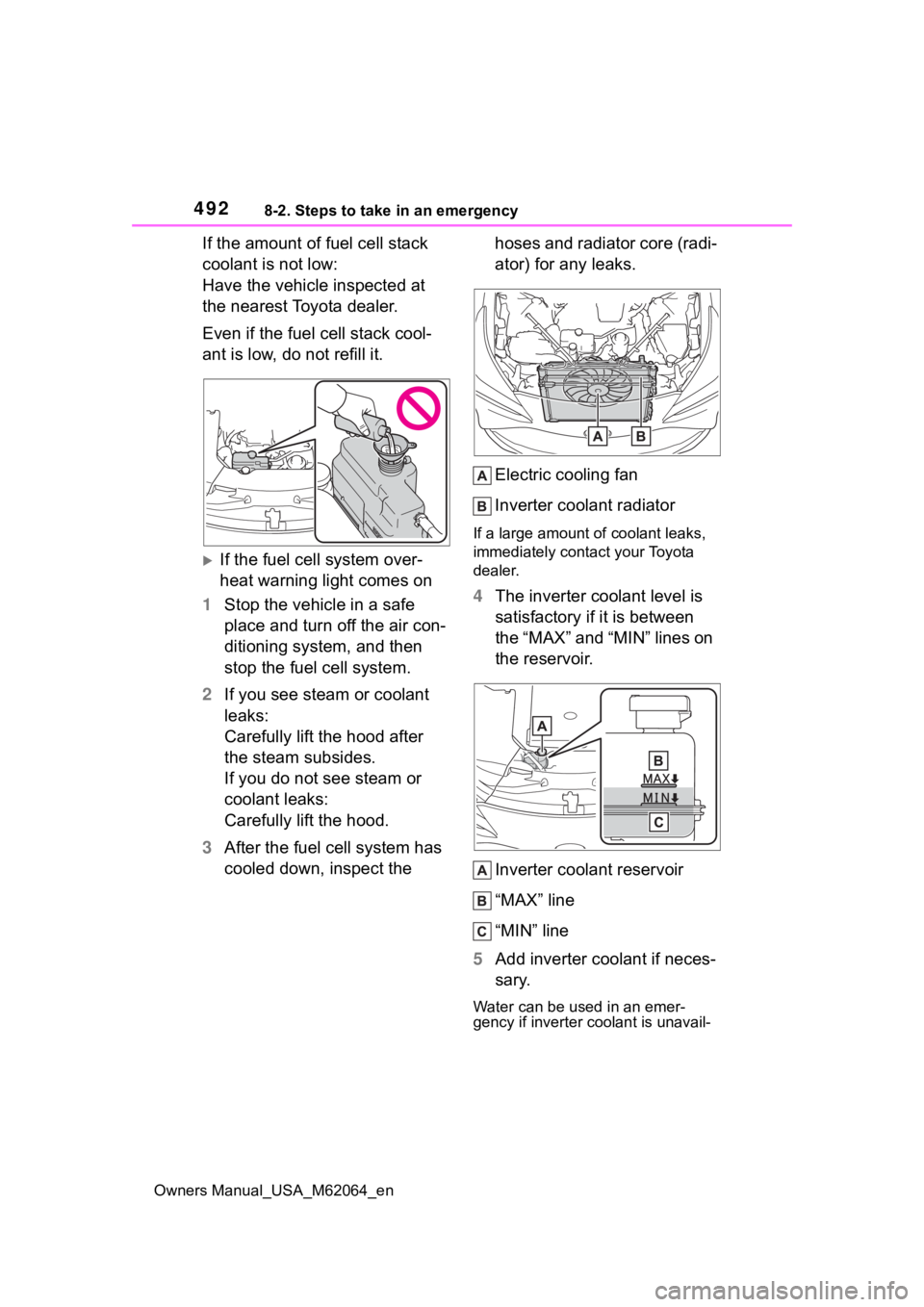
Even if the fuel cell stack cool-
ant is low, do not refill it.
If the fuel cell system over-
heat warning light comes on
1 Stop the vehicle in a safe
place and turn off the air con-
ditioning system, and then
stop the fuel cell system.
2 If you see steam or coolant
leaks:
Carefully lift the hood after
the steam subsides.
If you do not see steam or
coolant leaks:
Carefully lift the hood.
3 After the fuel cell system has
cooled down, inspect the hoses and radiator core (radi-
ator) for any leaks.
Electric cooling fan
Inverter coolant radiator
If a large amount of coolant leaks,
immediately contact your Toyota
dealer.
4
The inverter coolant level is
satisfactory if it is between
the “MAX” and “MIN” lines on
the reservoir.
Inverter coolant reservoir
“MAX” line
“MIN” line
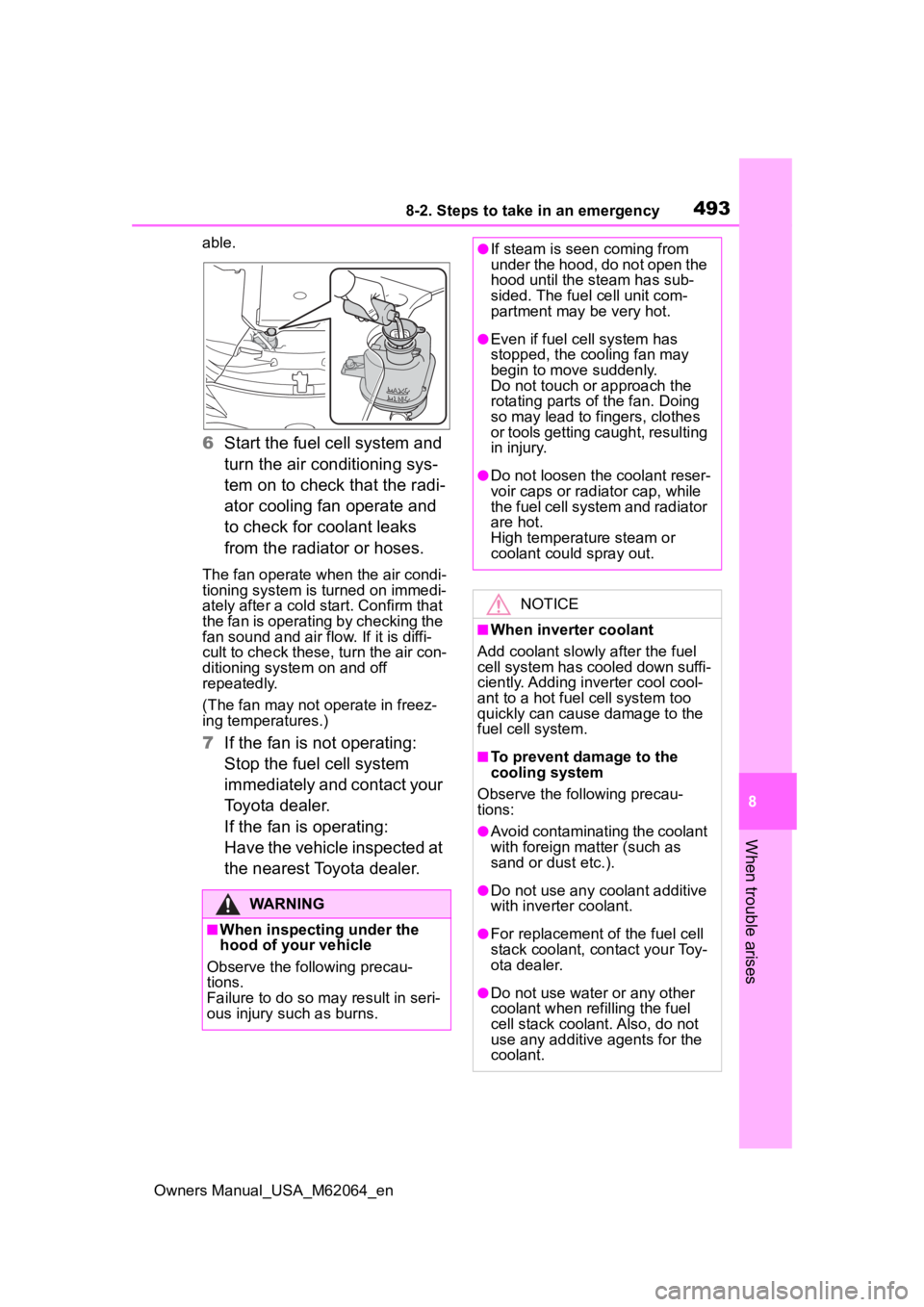
5 Add inverter coolant if neces-
sary.
Water can be used in an emer-
gency if inverter coolant is unavail-
Page 493 of 572
4938-2. Steps to take in an emergency
Owners Manual_USA_M62064_en
8
When trouble arises
able.
6 Start the fuel cell system and
turn the air conditioning sys-
tem on to check that the radi-
ator cooling fan operate and
to check for coolant leaks
from the radiator or hoses.
The fan operate when the air condi-
tioning system is turned on immedi-
ately after a cold s tart. Confirm that
the fan is operating by checking the
fan sound and air flow. If it is diffi-
cult to check these, turn the air con-
ditioning system on and off
repeatedly.
(The fan may not o perate in freez-
ing temperatures.)
7 If the fan is not operating:
Stop the fuel cell system
immediately and contact your
Toyota dealer.
If the fan is operating:
Have the vehicle inspected at
the nearest Toyota dealer.
WARNING
■When inspecting under the
hood of your vehicle
Observe the following precau-
tions.
Failure to do so may result in seri-
ous injury such as burns.
●If steam is seen coming from
under the hood, do not open the
hood until the steam has sub-
sided. The fuel cell unit com-
partment may be very hot.
●Even if fuel cell system has
stopped, the cooling fan may
begin to move suddenly.
Do not touch or approach the
rotating parts of the fan. Doing
so may lead to fingers, clothes
or tools getting caught, resulting
in injury.
●Do not loosen the coolant reser-
voir caps or radia tor cap, while
the fuel cell system and radiator
are hot.
High temperature steam or
coolant could spray out.
NOTICE
■When inverter coolant
Add coolant slowly after the fuel
cell system has cooled down suffi-
ciently. Adding inverter cool cool-
ant to a hot fuel cell system too
quickly can cause damage to the
fuel cell system.
■To prevent damage to the
cooling system
Observe the following precau-
tions:
●Avoid contaminating the coolant
with foreign matter (such as
sand or dust etc.).
●Do not use any coolant additive
with inverter coolant.
●For replacement of the fuel cell
stack coolant, contact your Toy-
ota dealer.
●Do not use water or any other
coolant when refilling the fuel
cell stack coolant. Also, do not
use any additive agents for the
coolant.
Page 499 of 572
4999-1. Specifications
Owners Manual_USA_M62064_en
9
Vehicle specifications
*: The fluid capacity is a reference quantity. If replacement is necessary, contact your Toyota dealer.
Coolant
type
Fuel cell
stack
“Toyota Genuine FC Stack Coolant”
In order to safely cool the fuel cell stack, which
is at high voltages, the fuel cell stack coolant is
an exclusive high insulation product.
Never use water or other kinds of coolants as
they will cause damage.
Coolant changes are unnecessary.
Do not reuse coolant that has been removed
from the radiator.
Coolant is colorless.
Consult your Toyota deale r about replenishing
or changing the fuel cell stack coolant.
Inverter
Use either of the following:
“Toyota Super Long Life Coolant”
Similar high-quality ethylene glycol-based non-
silicate, non-amine, non- nitrite, and non-borate
coolant with long-life hybrid org anic acid tech-
nology
Do not use plain water alone.
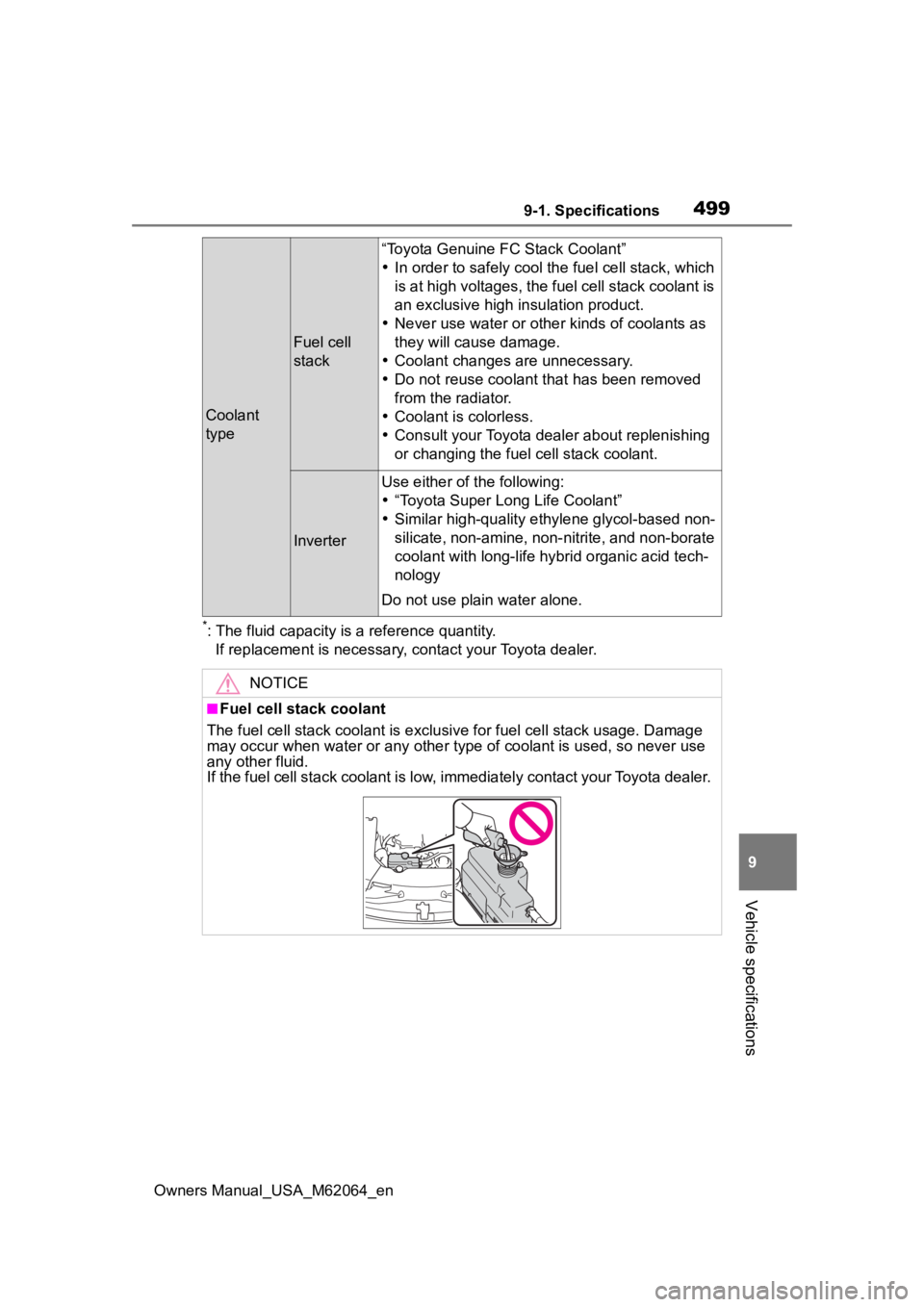
NOTICE
■Fuel cell stack coolant
The fuel cell stack coolant is e xclusive for fuel cell stack usage. Damage
may occur when water or any other type of coolant is used, so n ever use
any other fluid.
If the fuel cell stack coolant is low, immediately contact your Toyota dealer.
Page 506 of 572
5069-1. Specifications
Owners Manual_USA_M62064_enWarning: The temperature grades
of a tire assume that it is properly
inflated and not overloaded.
Excessive speed, underinflation, or
excessive loading, either sepa-
rately or in combination, can cause
heat buildup and possible tire fail-
ure.
Glossary of tire terminology
Tire related termMeaning
Cold tire inflation pressure
Tire pressure when the vehicle has been
parked for three hours or more, or has not
been driven more than
1 mile or 1.5 km
under that condition
Maximum inflation pressure
The maximum cold inf lated pressure to
which a tire may be inflated, shown on the
sidewall of the tire
Recommended inflation pres-
sureCold tire inflation pressure recommended
by a manufacturer
Accessory weight
The combined weight (in excess of those
standard items which may be replaced) of
transmission, power steering, power
brakes, power windows, power seats,
radio and heater, to the extent that these
items are available as factory-installed
equipment (whether installed or not)
Curb weight
The weight of a moto r vehicle with stan-
dard equipment, including the maximum
capacity of fuel, oil and coolant, and if so
equipped, air conditioning and additional
weight optional engine
Maximum loaded vehicle
weight
The sum of:
(a) Curb weight
(b) Accessory weight
(c) Vehicle capacity weight
(d) Production options weight
Normal occupant weight
150 lb. (68 kg) times the number of occu-
pants specified in the second column of
Ta b l e 1
* that follows