ignition TOYOTA PROACE VERSO 2020 Workshop Manual
[x] Cancel search | Manufacturer: TOYOTA, Model Year: 2020, Model line: PROACE VERSO, Model: TOYOTA PROACE VERSO 2020Pages: 418, PDF Size: 39.32 MB
Page 164 of 418
164
Seat belts
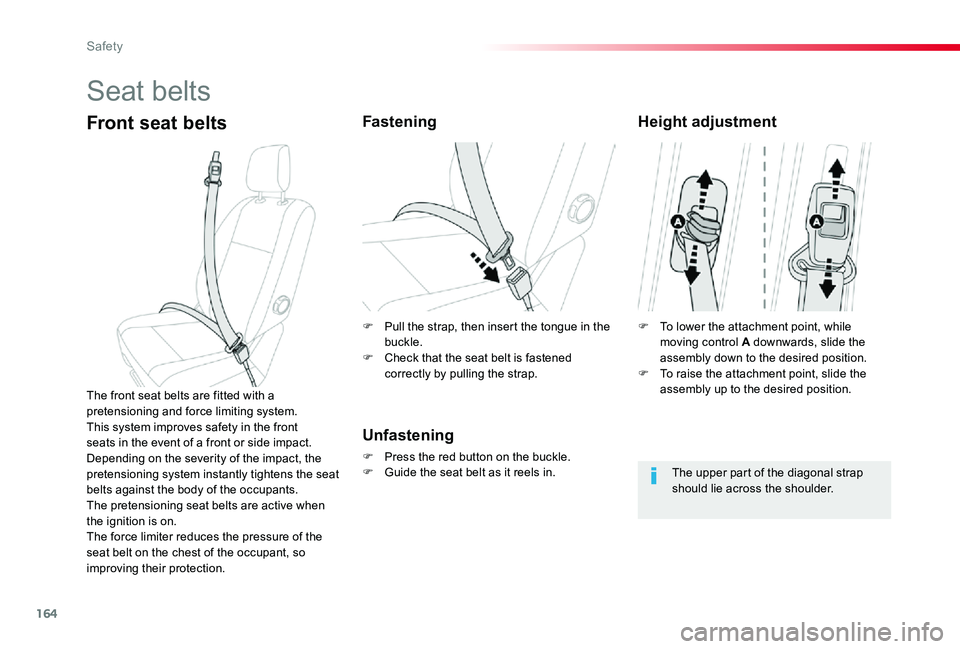
Front seat beltsFastening
Unfastening
F Press the red button on the buckle.F Guide the seat belt as it reels in.
The front seat belts are fitted with a pretensioning and force limiting system.This system improves safety in the front seats in the event of a front or side impact.
Depending on the severity of the impact, the pretensioning system instantly tightens the seat belts against the body of the occupants.The pretensioning seat belts are active when the ignition is on.The force limiter reduces the pressure of the seat belt on the chest of the occupant, so improving their protection.
Height adjustment
The upper part of the diagonal strap should lie across the shoulder.
F To lower the attachment point, while moving control A downwards, slide the assembly down to the desired position.F To raise the attachment point, slide the assembly up to the desired position.
F Pull the strap, then insert the tongue in the buckle.F Check that the seat belt is fastened correctly by pulling the strap.
Safety
Page 166 of 418
166
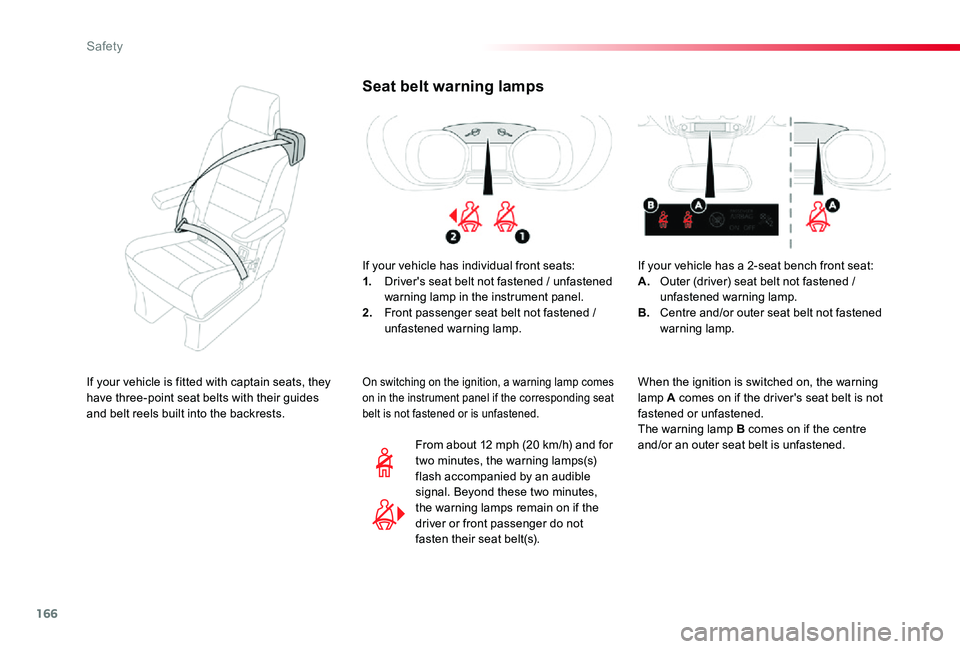
Seat belt warning lamps
If your vehicle has individual front seats:1. Driver's seat belt not fastened / unfastened warning lamp in the instrument panel.2. Front passenger seat belt not fastened / unfastened warning lamp.
From about 12 mph (20 km/h) and for two minutes, the warning lamps(s) flash accompanied by an audible signal. Beyond these two minutes, the warning lamps remain on if the driver or front passenger do not fasten their seat belt(s).
On switching on the ignition, a warning lamp comes on in the instrument panel if the corresponding seat belt is not fastened or is unfastened.
If your vehicle has a 2-seat bench front seat:A. Outer (driver) seat belt not fastened / unfastened warning lamp.B. Centre and/or outer seat belt not fastened warning lamp.
When the ignition is switched on, the warning lamp A comes on if the driver's seat belt is not fastened or unfastened.The warning lamp B comes on if the centre and/or an outer seat belt is unfastened.
If your vehicle is fitted with captain seats, they have three-point seat belts with their guides and belt reels built into the backrests.
Safety
Page 168 of 418
168
Airbags
System designed to contribute towards improving the safety of the occupants (with the exception of the centre seat in rows 2 and 3, if so equipped) in the event of violent collisions. The airbags supplement the action of the seat belts fitted with force limiters.If a collision occurs, the electronic detectors record and analyse the front and side impacts sustained in the impact detection zones:- in the case of a serious impact, the airbags are deployed instantly and contribute towards better protection of the occupants of the vehicle (with the exception of the centre seat in rows 2 and 3, if so equipped); immediately after the impact, the airbags deflate rapidly so that they do not hinder visibility or the exit of the occupants,- in the case of a minor or rear impact or in certain roll-over conditions, the airbags may not be deployed; the seat belt
alone contributes towards ensuring your protection in these situations.
The airbags do not operate when the ignition is switched off.
This equipment will only deploy once. If a second impact occurs (during the same or a subsequent accident), the airbag will not be deployed again.
Deployment of one or more of the airbags is accompanied by a slight emission of smoke and a noise, due to the activation of the pyrotechnic cartridge incorporated in the system.This smoke is not harmful, but sensitive individuals may experience slight irritation.The noise of detonation related to the deployment of one or more airbags may result in a slight loss of hearing for a short time.
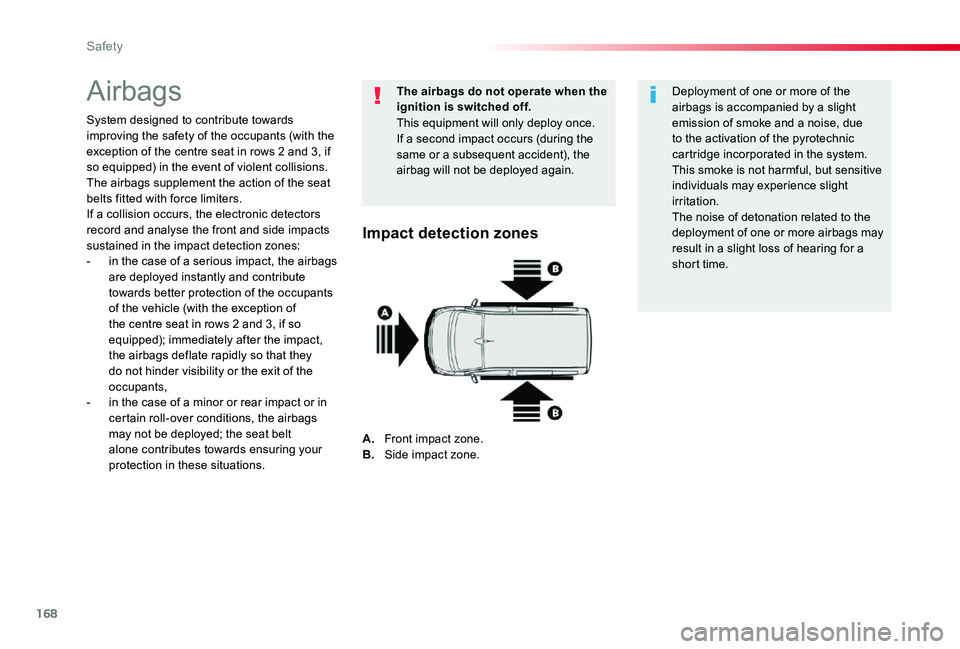
Impact detection zones
A. Front impact zone.
B. Side impact zone.
Safety
Page 170 of 418
170
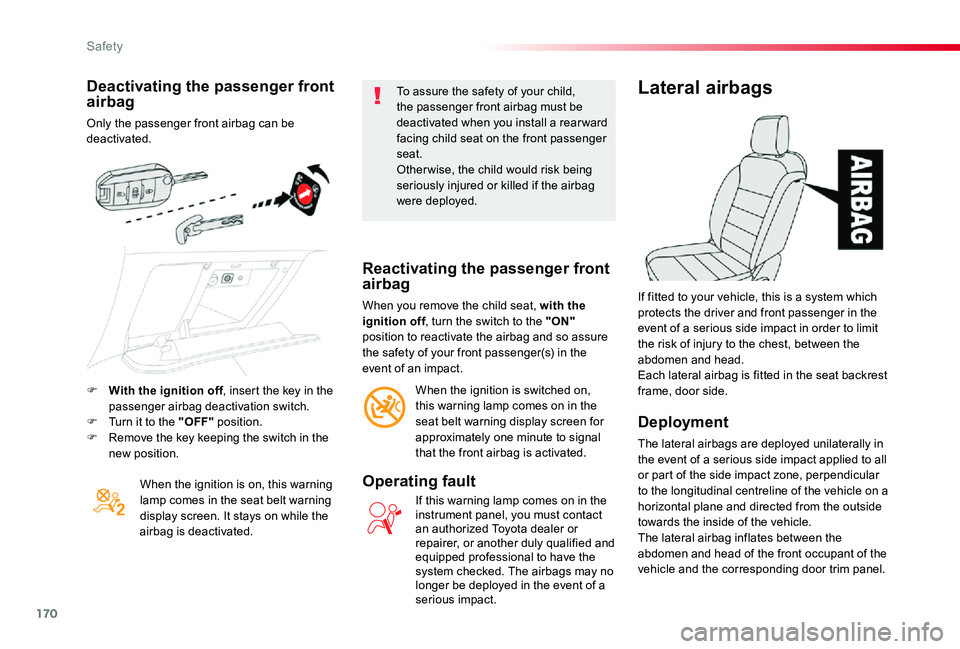
Deactivating the passenger front airbag
Only the passenger front airbag can be deactivated.
When the ignition is on, this warning lamp comes in the seat belt warning display screen. It stays on while the airbag is deactivated.
To assure the safety of your child, the passenger front airbag must be deactivated when you install a rear ward facing child seat on the front passenger seat.Other wise, the child would risk being seriously injured or killed if the airbag were deployed.
Reactivating the passenger front airbag
When you remove the child seat, with the ignition off, turn the switch to the "ON" position to reactivate the airbag and so assure the safety of your front passenger(s) in the event of an impact.
When the ignition is switched on, this warning lamp comes on in the seat belt warning display screen for approximately one minute to signal that the front airbag is activated.
Operating fault
If this warning lamp comes on in the instrument panel, you must contact an authorized Toyota dealer or repairer, or another duly qualified and equipped professional to have the system checked. The airbags may no longer be deployed in the event of a serious impact.
Lateral airbags
Deployment
The lateral airbags are deployed unilaterally in
the event of a serious side impact applied to all or part of the side impact zone, perpendicular to the longitudinal centreline of the vehicle on a horizontal plane and directed from the outside towards the inside of the vehicle.The lateral airbag inflates between the abdomen and head of the front occupant of the vehicle and the corresponding door trim panel.
If fitted to your vehicle, this is a system which protects the driver and front passenger in the event of a serious side impact in order to limit the risk of injury to the chest, between the abdomen and head.Each lateral airbag is fitted in the seat backrest frame, door side.F With the ignition off, insert the key in the passenger airbag deactivation switch.F Turn it to the "OFF" position.F Remove the key keeping the switch in the
new position.
Safety
Page 190 of 418
190
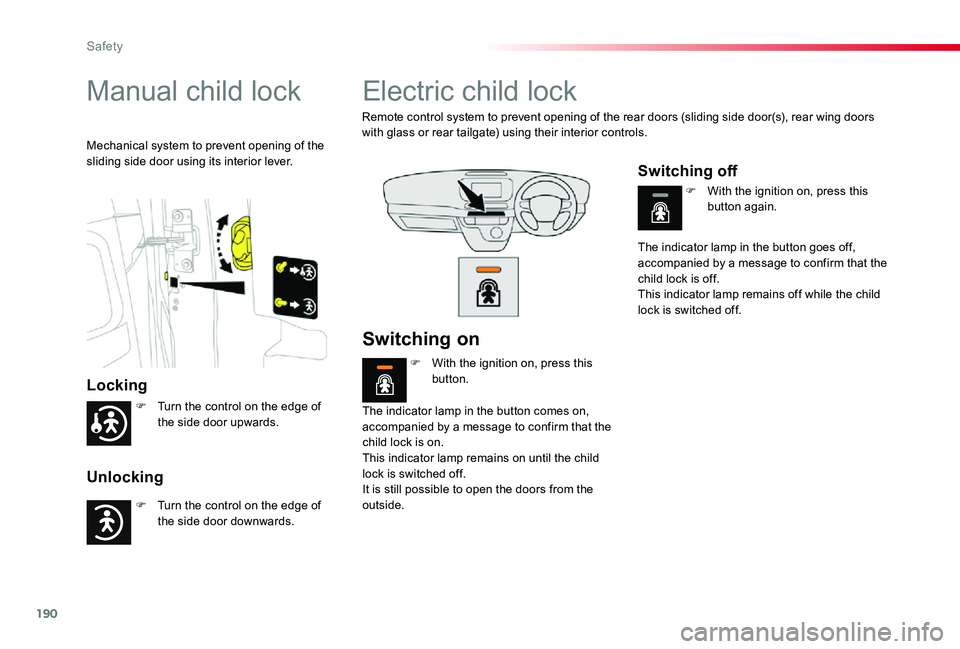
Manual child lock
Locking
Unlocking
Mechanical system to prevent opening of the sliding side door using its interior lever.
Electric child lock
Remote control system to prevent opening of the rear doors (sliding side door(s), rear wing doors with glass or rear tailgate) using their interior controls.
The indicator lamp in the button comes on, accompanied by a message to confirm that the child lock is on.This indicator lamp remains on until the child lock is switched off.It is still possible to open the doors from the outside.
The indicator lamp in the button goes off, accompanied by a message to confirm that the child lock is off.This indicator lamp remains off while the child lock is switched off.
Switching on
F With the ignition on, press this button.
F With the ignition on, press this button again.
Switching off
F Turn the control on the edge of the side door upwards.
F Turn the control on the edge of the side door downwards.
Safety
Page 191 of 418
191
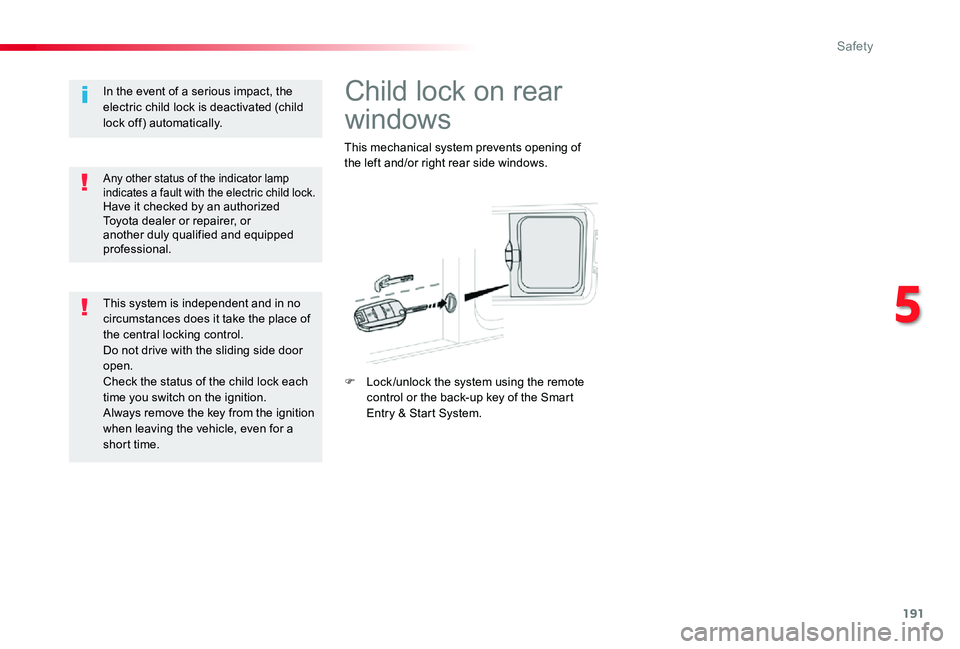
Child lock on rear
windows
This mechanical system prevents opening of the left and/or right rear side windows.
F Lock /unlock the system using the remote control or the back-up key of the Smart Entry & Start System.
Any other status of the indicator lamp indicates a fault with the electric child lock.Have it checked by an authorized Toyota dealer or repairer, or another duly qualified and equipped professional.
In the event of a serious impact, the electric child lock is deactivated (child lock off) automatically.
This system is independent and in no circumstances does it take the place of the central locking control.Do not drive with the sliding side door open.Check the status of the child lock each time you switch on the ignition.Always remove the key from the ignition when leaving the vehicle, even for a short time.
5
Safety
Page 195 of 418
195
Starting-switching off the engine, manual key, remote control
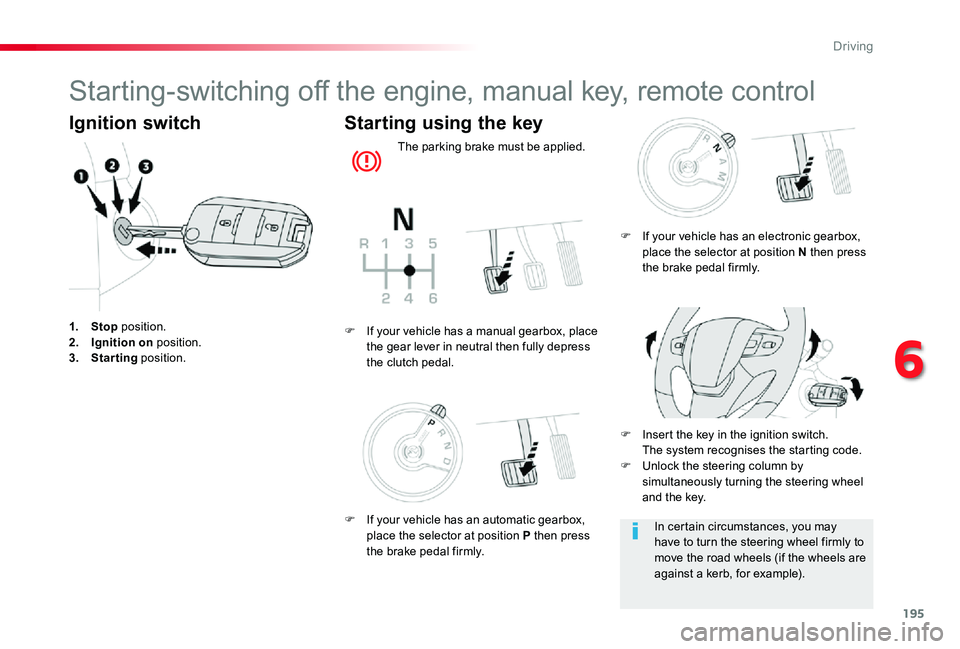
Ignition switch
1. Stop position.2. Ignition on position.3. Starting position.
Starting using the key
The parking brake must be applied.
F Insert the key in the ignition switch. The system recognises the starting code.F Unlock the steering column by simultaneously turning the steering wheel and the key.
F If your vehicle has a manual gearbox, place the gear lever in neutral then fully depress the clutch pedal.
In certain circumstances, you may have to turn the steering wheel firmly to move the road wheels (if the wheels are against a kerb, for example).
F If your vehicle has an electronic gearbox, place the selector at position N then press the brake pedal firmly.
F If your vehicle has an automatic gearbox, place the selector at position P then press the brake pedal firmly.
6
Driving
Page 196 of 418
196
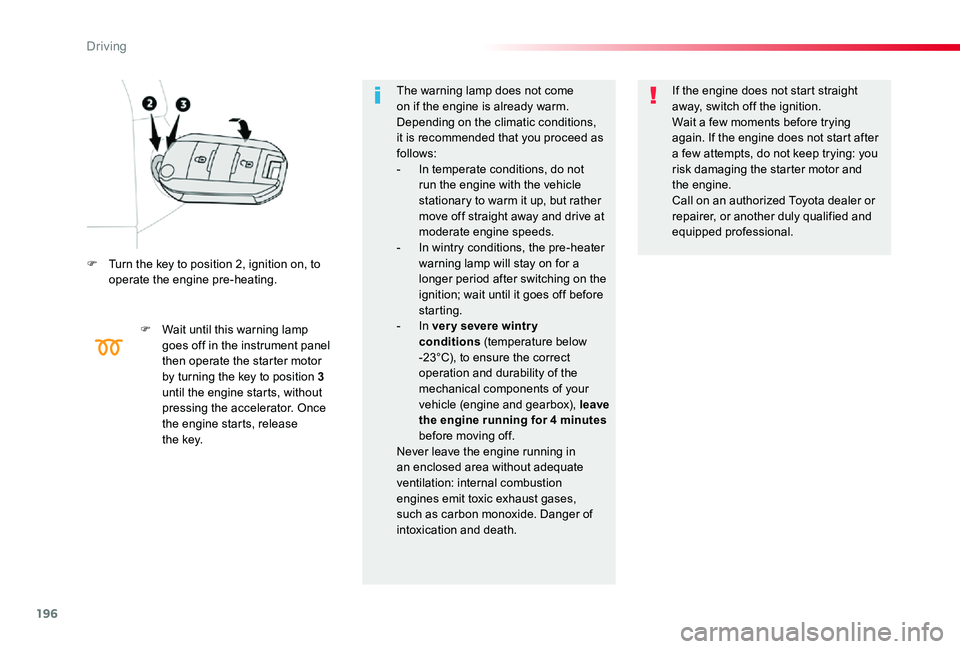
F Turn the key to position 2, ignition on, to operate the engine pre-heating.
F Wait until this warning lamp goes off in the instrument panel then operate the starter motor by turning the key to position 3 until the engine starts, without pressing the accelerator. Once the engine starts, release the key.
The warning lamp does not come on if the engine is already warm. Depending on the climatic conditions, it is recommended that you proceed as follows:- In temperate conditions, do not run the engine with the vehicle stationary to warm it up, but rather move off straight away and drive at moderate engine speeds.- In wintry conditions, the pre-heater warning lamp will stay on for a longer period after switching on the ignition; wait until it goes off before starting.- In ver y severe wintr y conditions (temperature below -23°C), to ensure the correct operation and durability of the mechanical components of your vehicle (engine and gearbox), leave the engine running for 4 minutes before moving off.
Never leave the engine running in an enclosed area without adequate ventilation: internal combustion engines emit toxic exhaust gases, such as carbon monoxide. Danger of intoxication and death.
If the engine does not start straight away, switch off the ignition.Wait a few moments before trying again. If the engine does not start after a few attempts, do not keep trying: you risk damaging the starter motor and the engine.Call on an authorized Toyota dealer or repairer, or another duly qualified and equipped professional.
Driving
Page 197 of 418
197
Avoid attaching heavy objects to the key, which would weigh down on its blade in the ignition switch and could cause a malfunction.
Switching off the engine leads to a loss of braking assistance.
Key left in the "Ignition on" position
If the key has been left in the ignition switch at position 2 (Ignition on), the ignition will be switched off automatically after one hour.To switch the ignition back on, turn the key to position 1 (Stop), then back to position 2 (Ignition on).Never switch off the ignition until the vehicle has been brought to a complete stop.
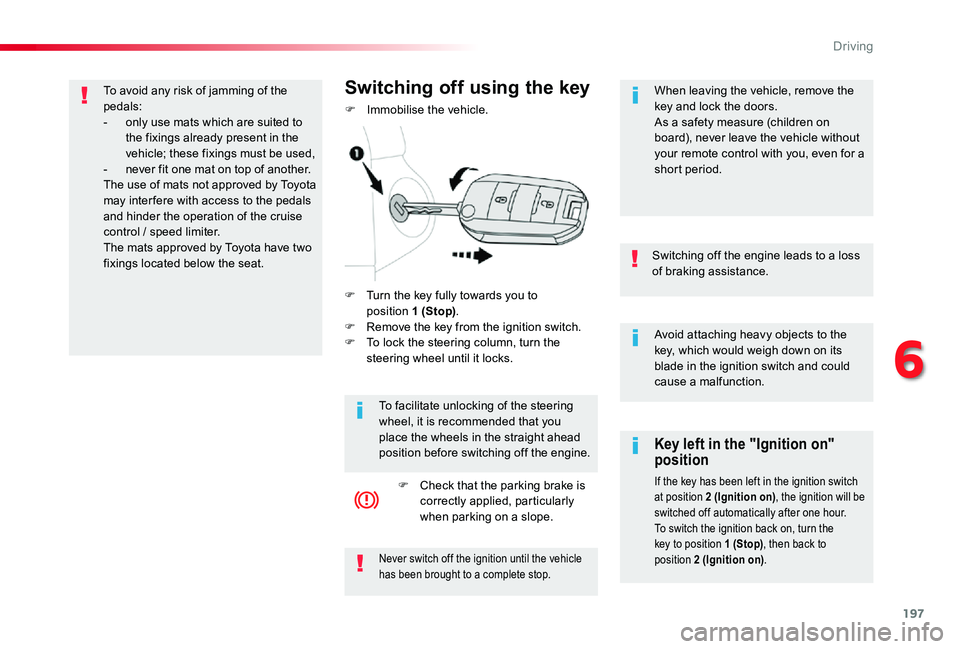
F Turn the key fully towards you to position 1 (Stop).F Remove the key from the ignition switch.F To lock the steering column, turn the steering wheel until it locks.
Switching off using the key
F Immobilise the vehicle.
To facilitate unlocking of the steering wheel, it is recommended that you place the wheels in the straight ahead position before switching off the engine.
F Check that the parking brake is correctly applied, particularly when parking on a slope.
When leaving the vehicle, remove the key and lock the doors.As a safety measure (children on board), never leave the vehicle without your remote control with you, even for a short period.
To avoid any risk of jamming of the pedals:- only use mats which are suited to the fixings already present in the vehicle; these fixings must be used,- never fit one mat on top of another.The use of mats not approved by Toyota may inter fere with access to the pedals and hinder the operation of the cruise control / speed limiter.The mats approved by Toyota have two fixings located below the seat.
6
Driving
Page 199 of 418
199
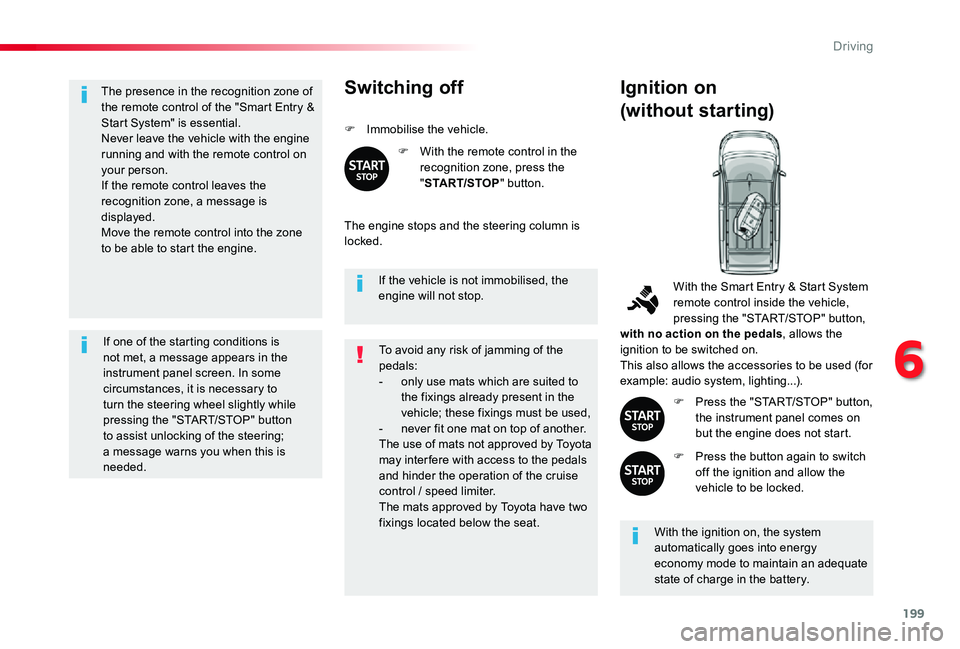
The presence in the recognition zone of the remote control of the "Smart Entry & Start System" is essential.Never leave the vehicle with the engine running and with the remote control on your person.If the remote control leaves the recognition zone, a message is displayed.Move the remote control into the zone to be able to start the engine.
If one of the starting conditions is not met, a message appears in the instrument panel screen. In some circumstances, it is necessary to turn the steering wheel slightly while pressing the "START/STOP" button to assist unlocking of the steering; a message warns you when this is needed.
If the vehicle is not immobilised, the engine will not stop.
Switching off
F Immobilise the vehicle.
F With the remote control in the recognition zone, press the "START/STOP" button.
The engine stops and the steering column is locked.
Ignition on
(without starting)
With the ignition on, the system automatically goes into energy economy mode to maintain an adequate state of charge in the battery.
With the Smart Entry & Start System remote control inside the vehicle, pressing the "START/STOP" button, with no action on the pedals, allows the ignition to be switched on.This also allows the accessories to be used (for example: audio system, lighting...).
F Press the "START/STOP" button, the instrument panel comes on but the engine does not start.
F Press the button again to switch off the ignition and allow the vehicle to be locked.
To avoid any risk of jamming of the pedals:- only use mats which are suited to the fixings already present in the vehicle; these fixings must be used,- never fit one mat on top of another.The use of mats not approved by Toyota
may inter fere with access to the pedals and hinder the operation of the cruise control / speed limiter.The mats approved by Toyota have two fixings located below the seat.
6
Driving