check engine TOYOTA RAV4 1996 Service Owner's Guide
[x] Cancel search | Manufacturer: TOYOTA, Model Year: 1996, Model line: RAV4, Model: TOYOTA RAV4 1996Pages: 1632, PDF Size: 41.64 MB
Page 165 of 1632
steady at 43 MPH for 1997 Avalon, 47 MPH for RAV4 and 37 MPH for all other models. Lightly depress
accelerator pedal. Ensure engine RPM does not change abruptly. Large increase in engine RPM indicates
lock-up function is faulty.
"2" Range Test
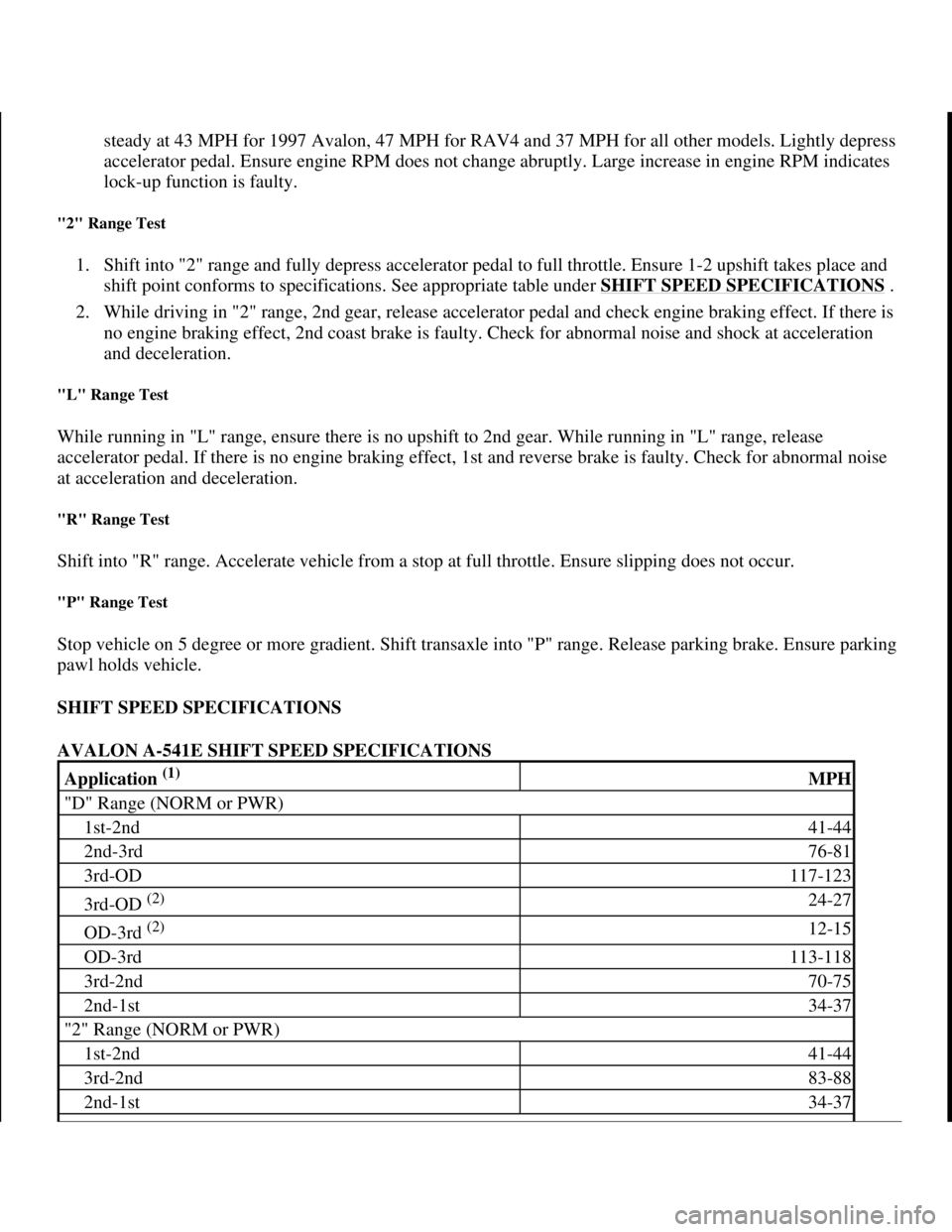
1. Shift into "2" range and fully depress accelerator pedal to full throttle. Ensure 1-2 upshift takes place and
shift point conforms to specifications. See appropriate table under SHIFT SPEED SPECIFICATIONS
.
2. While driving in "2" range, 2nd gear, release accelerator pedal and check engine braking effect. If there is
no engine braking effect, 2nd coast brake is faulty. Check for abnormal noise and shock at acceleration
and deceleration.
"L" Range Test
While running in "L" range, ensure there is no upshift to 2nd gear. While running in "L" range, release
accelerator pedal. If there is no engine braking effect, 1st and reverse brake is faulty. Check for abnormal noise
at acceleration and deceleration.
"R" Range Test
Shift into "R" range. Accelerate vehicle from a stop at full throttle. Ensure slipping does not occur.
"P" Range Test
Stop vehicle on 5 degree or more gradient. Shift transaxle into "P" range. Release parking brake. Ensure parking
pawl holds vehicle.
SHIFT SPEED SPECIFICATIONS
AVALON A-541E SHIFT SPEED SPECIFICATIONS
Application (1)MPH
"D" Range (NORM or PWR)
1st-2nd41-44
2nd-3rd76-81
3rd-OD117-123
3rd-OD (2)24-27
OD-3rd (2)12-15
OD-3rd113-118
3rd-2nd70-75
2nd-1st34-37
"2" Range (NORM or PWR)
1st-2nd41-44
3rd-2nd83-88
2nd-1st34-37
1998 Toyota Avalon XLS
1997-99 AUTOMATIC TRANSMISSIONS Toyota A-540E, A-540H & A-541E Overhaul
Helpmelearn
November-03-08 10:28:17 AMPage 11 © 2005 Mitchell Repair Information Company, LLC.
Page 170 of 1632
STALL SPEED TEST
1. Object of test is to check overall performance of transaxle and engine by measuring maximum stall
speeds in "D" and "R" ranges.
2. Block front and rear wheels. Connect scan tool to DLC3, located under instrument panel. Apply parking
and service brakes. Start engine. Position transmission in "D" range. Fully depress accelerator pedal.
Immediately note highest engine RPM. DO NOT perform test longer than 5 seconds. Repeat test in "R"
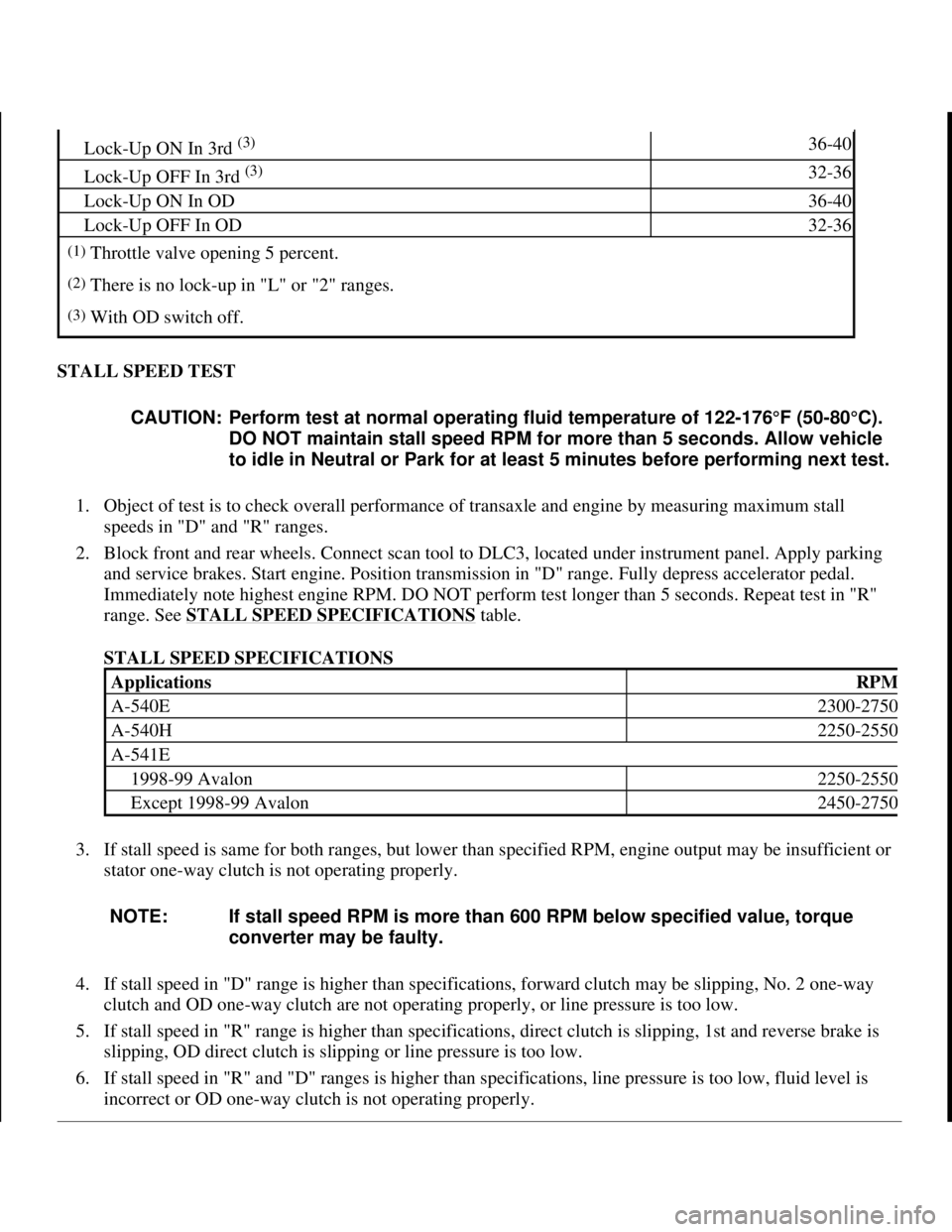
range. See STALL SPEED SPECIFICATIONS
table.
STALL SPEED SPECIFICATIONS
3. If stall speed is same for both ranges, but lower than specified RPM, engine output may be insufficient or
stator one-way clutch is not operating properly.
4. If stall speed in "D" range is higher than specifications, forward clutch may be slipping, No. 2 one-way
clutch and OD one-way clutch are not operating properly, or line pressure is too low.
5. If stall speed in "R" range is higher than specifications, direct clutch is slipping, 1st and reverse brake is
slipping, OD direct clutch is slipping or line pressure is too low.
6. If stall speed in "R" and "D" ranges is higher than specifications, line pressure is too low, fluid level is
incorrect or OD one-wa
y clutch is not operating properly.
Lock-Up ON In 3rd (3)36-40
Lock-Up OFF In 3rd (3)32-36
Lock-Up ON In OD36-40
Lock-Up OFF In OD32-36
(1)Throttle valve opening 5 percent.
(2)There is no lock-up in "L" or "2" ranges.
(3)With OD switch off.
CAUTION: Perform test at normal operating fluid temperature of 122-176°F (50-80°C).
DO NOT maintain stall speed RPM for more than 5 seconds. Allow vehicle
to idle in Neutral or Park for at least 5 minutes before performing next test.
ApplicationsRPM
A-540E2300-2750
A-540H2250-2550
A-541E
1998-99 Avalon2250-2550
Except 1998-99 Avalon2450-2750
NOTE: If stall speed RPM is more than 600 RPM below specified value, torque
converter may be faulty.
1998 Toyota Avalon XLS
1997-99 AUTOMATIC TRANSMISSIONS Toyota A-540E, A-540H & A-541E Overhaul
Helpmelearn
November-03-08 10:28:17 AMPage 16 © 2005 Mitchell Repair Information Company, LLC.
Page 259 of 1632
Avalon, Camry, Celica 2.2L 5S-FE, Corolla 1.6L 4A-FE & Tercel With 3-Speed
Check transmission fluid level and transmission/differential fluid level every 15,000 miles or 24 months.
Transmission/differential fluid reservoir is independent from the transmission. Normal operating conditions
service interval is not available.
Celica 1.8L 7A-FE, Corolla 1.8L 7A-FE, MR2, Paseo, RAV4 & Tercel With 4-Speed, Land Cruiser, Pickup, Previa,
Supra, Tacoma, T100 & 4Runner
Check transmission fluid level every 15,000 miles or 24 months. Differential fluid reservoir is incorporated with
the transmission. Normal operating conditions service interval is not available.
CHECKING FLUID LEVEL
Transmission
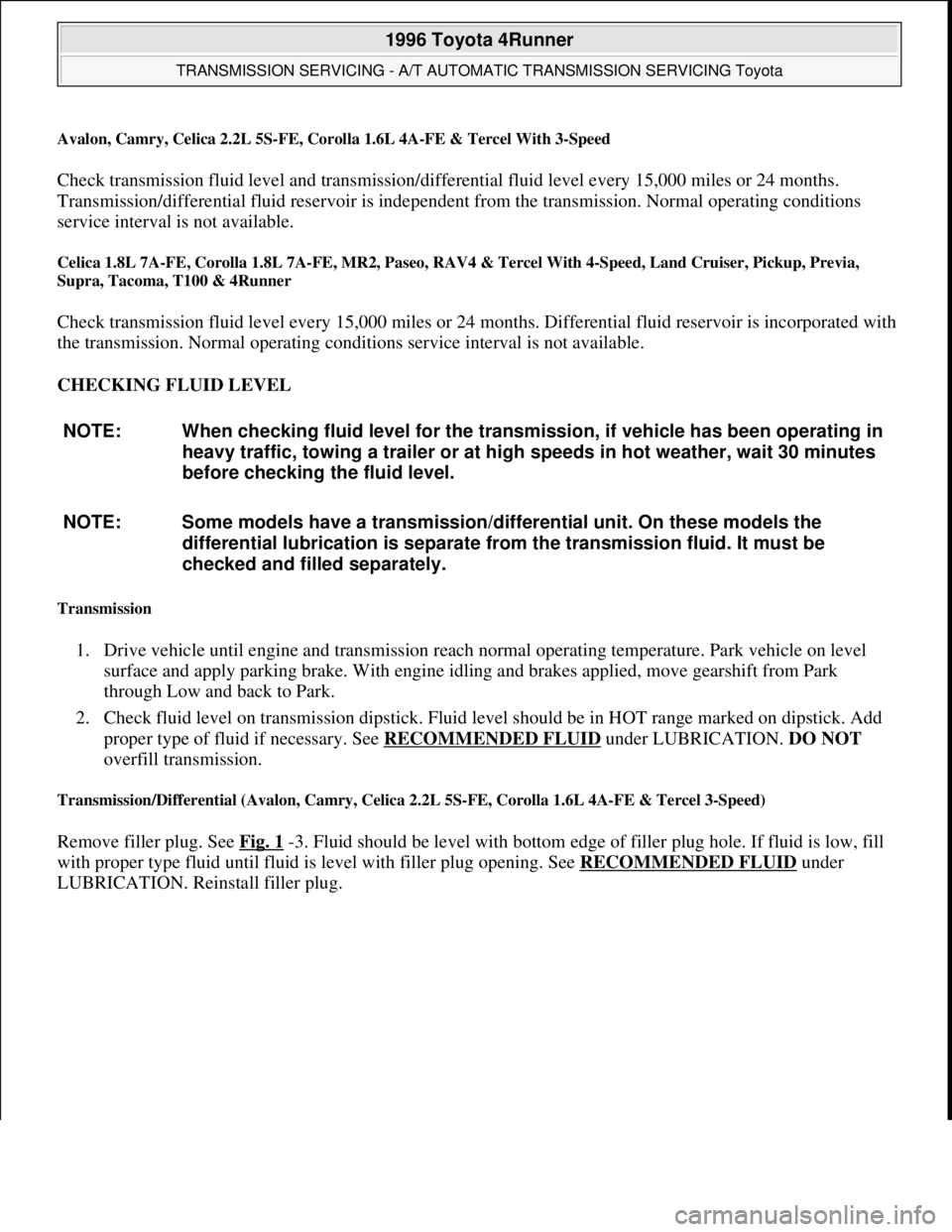
1. Drive vehicle until engine and transmission reach normal operating temperature. Park vehicle on level
surface and apply parking brake. With engine idling and brakes applied, move gearshift from Park
through Low and back to Park.
2. Check fluid level on transmission dipstick. Fluid level should be in HOT range marked on dipstick. Add
proper type of fluid if necessary. See RECOMMENDED FLUID
under LUBRICATION. DO NOT
overfill transmission.
Transmission/Differential (Avalon, Camry, Celica 2.2L 5S-FE, Corolla 1.6L 4A-FE & Tercel 3-Speed)
Remove filler plug. See Fig. 1 -3. Fluid should be level with bottom edge of filler plug hole. If fluid is low, fill
with proper type fluid until fluid is level with filler plug opening. See RECOMMENDED FLUID
under
LUBRICATION. Reinstall filler plu
g. NOTE: When checking fluid level for the transmission, if vehicle has been operating in
heavy traffic, towing a trailer or at high speeds in hot weather, wait 30 minutes
before checking the fluid level.
NOTE: Some models have a transmission/differential unit. On these models the
differential lubrication is separate from the transmission fluid. It must be
checked and filled separately.
1996 Toyota 4Runner
TRANSMISSION SERVICING - A/T AUTOMATIC TRANSMISSION SERVICING Toyota
Microsoft
Tuesday, August 18, 2009 7:18:46 PMPage 3 © 2005 Mitchell Repair Information Company, LLC.
Page 266 of 1632
Transmission (Pickup 4WD W/3.0L V6 & 1995 4Runner 4WD W/V6)
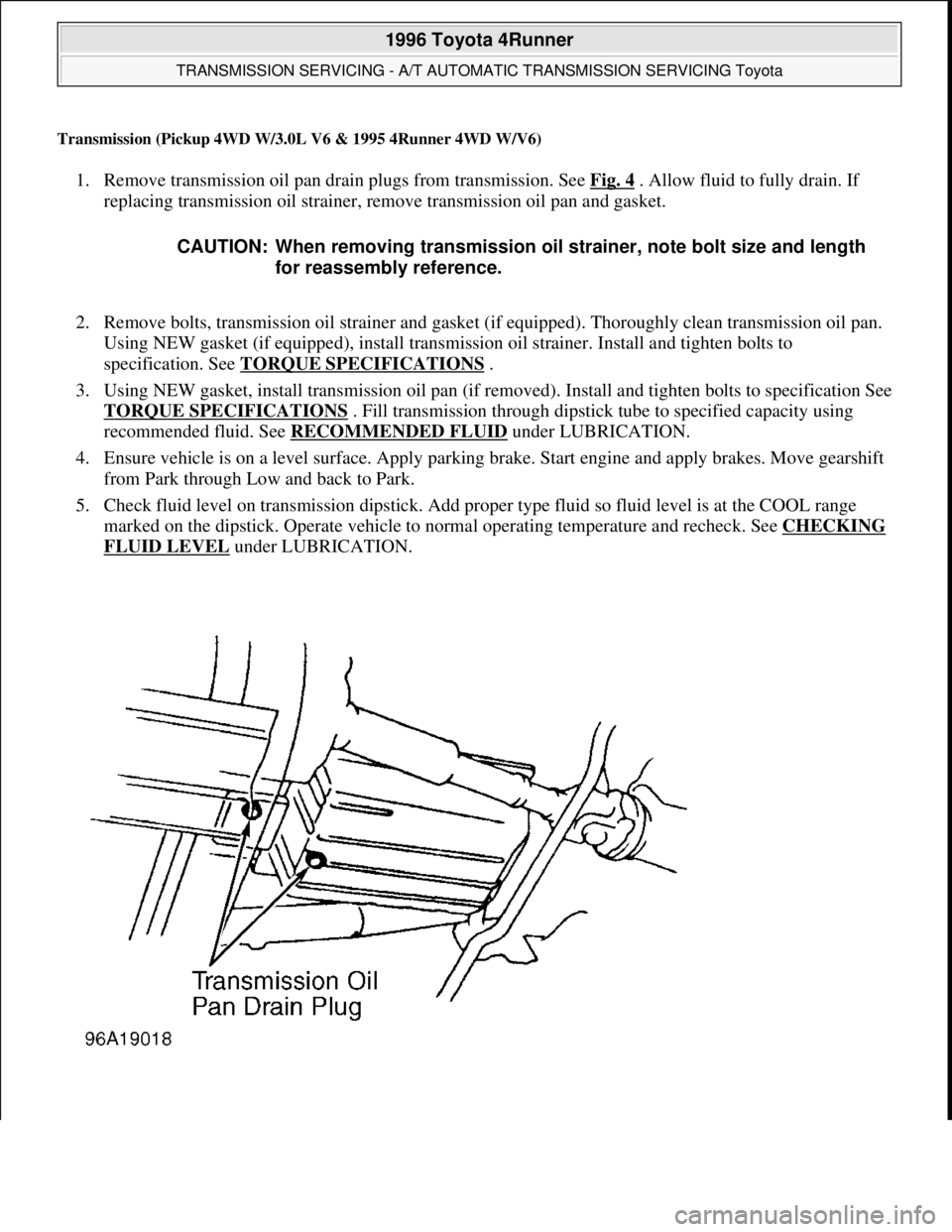
1. Remove transmission oil pan drain plugs from transmission. See Fig. 4 . Allow fluid to fully drain. If
replacing transmission oil strainer, remove transmission oil pan and gasket.
2. Remove bolts, transmission oil strainer and gasket (if equipped). Thoroughly clean transmission oil pan.
Using NEW gasket (if equipped), install transmission oil strainer. Install and tighten bolts to
specification. See TORQUE SPECIFICATIONS
.
3. Using NEW gasket, install transmission oil pan (if removed). Install and tighten bolts to specification See
TORQUE SPECIFICATIONS
. Fill transmission through dipstick tube to specified capacity using
recommended fluid. See RECOMMENDED FLUID
under LUBRICATION.
4. Ensure vehicle is on a level surface. Apply parking brake. Start engine and apply brakes. Move gearshift
from Park through Low and back to Park.
5. Check fluid level on transmission dipstick. Add proper type fluid so fluid level is at the COOL range
marked on the dipstick. Operate vehicle to normal operating temperature and recheck. See CHECKING
FLUID LEVEL under LUBRICATION. CAUTION: When removing transmission oil strainer, note bolt size and length
for reassembly reference.
1996 Toyota 4Runner
TRANSMISSION SERVICING - A/T AUTOMATIC TRANSMISSION SERVICING Toyota
Microsoft
Tuesday, August 18, 2009 7:18:46 PMPage 10 © 2005 Mitchell Repair Information Company, LLC.
Page 267 of 1632
Fig. 4: Identifying Transmission Oil Pan Drain Plugs (Pickup 4WD With 3.0L V6 & 1995 4Runner 4WD
With V6)
Courtesy of TOYOTA MOTOR SALES, U.S.A., INC.
Transmission (All Others)
1. Remove transmission oil pan drain plug from transmission oil pan. Allow fluid to fully drain. If replacing
transmission oil strainer, remove transmission oil pan and gasket.
2. Remove bolts, transmission oil strainer and gasket (if equipped). Thoroughly clean transmission oil pan.
Using NEW gasket (if equipped), install transmission oil strainer. Install and tighten bolts to
specification. See TORQUE SPECIFICATIONS
.
3. Using NEW gasket, install transmission oil pan (if removed). Install and tighten bolts to specification See
TORQUE SPECIFICATIONS
. Fill transmission through dipstick tube to specified capacity using
recommended fluid. See RECOMMENDED FLUID
under LUBRICATION.
4. Ensure vehicle is on a level surface. Apply parking brake. Start engine and apply brakes. Move gearshift
from Park through Low and back to Park.
5. Check fluid level on transmission dipstick. Add proper type fluid so fluid level is at the COOL range
marked on the dipstick. Operate vehicle to normal operating temperature and recheck. See CHECKING
FLUID LEVEL under LUBRICATION.
Transmission Differential (Avalon, Camry, Celica 2.2L 5S-FE, Corolla 1.6L 4A-FE & Tercel 3-Speed)
1. Remove oil filler and drain plugs from differential. See Fig. 1 . Allow fluid to drain. Reinstall drain plug.
2. Fill differential through oil filler plug hole to specified capacity using recommended fluid. See
RECOMMENDED FLUID
under LUBRICATION. Ensure fluid is level with bottom edge of filler plug
hole. Reinstall filler plug.
Transfer Case (Land Cruiser, Pickup, Previa, Tacoma, T100 & 4Runner)
1. Remove filler plug located on rear of transfer case. Remove drain plug from bottom of transfer case.
Allow fluid to drain. Reinstall drain plug.
2. Fill transfer case through oil filler plug hole to specified capacity using recommended fluid. See
RECOMMENDED FLUID
under LUBRICATION. Ensure fluid is level with bottom edge of filler plug
hole. Reinstall filler plug.
Transfer Case (RAV4)
1. Remove drain plug from bottom of transfer case. Allow fluid to drain. Reinstall drain plug. Fill transfer
case through transfer case oil dipstick tube to specified capacity using recommended fluid. See
RECOMMENDED FLUID
under LUBRICATION.
2. Check fluid level on transfer case dipstick. Fluid level should be in the LOW to HIGH range. Add fluid if CAUTION: When removing transmission oil strainer, note bolt size and length
for reassembly reference.
1996 Toyota 4Runner
TRANSMISSION SERVICING - A/T AUTOMATIC TRANSMISSION SERVICING Toyota
Microsoft
Tuesday, August 18, 2009 7:18:46 PMPage 11 © 2005 Mitchell Repair Information Company, LLC.
Page 269 of 1632
step 2). If throttle valve is not fully open, adjust throttle linkage or cable so throttle valve is fully open and
then go to step 2).
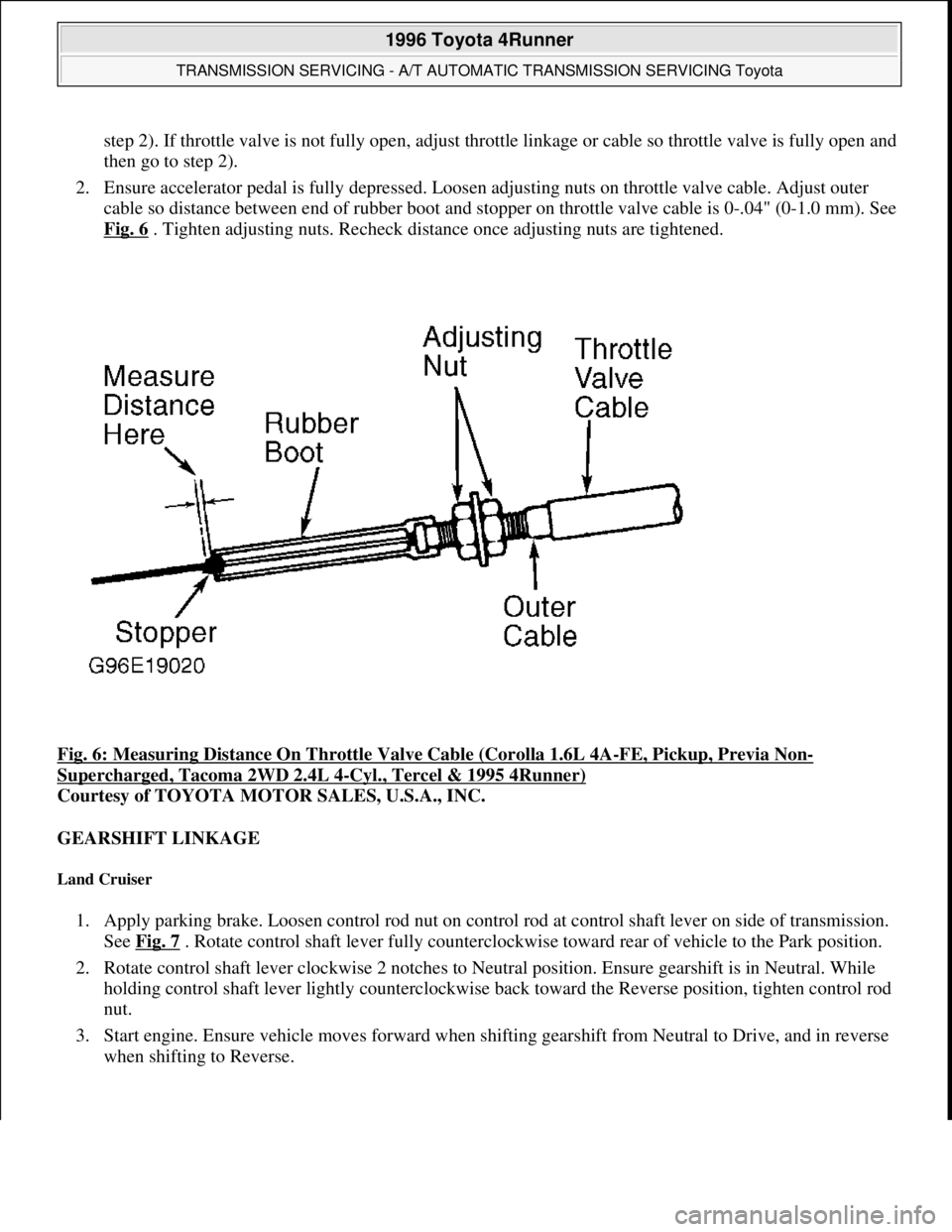
2. Ensure accelerator pedal is fully depressed. Loosen adjusting nuts on throttle valve cable. Adjust outer
cable so distance between end of rubber boot and stopper on throttle valve cable is 0-.04" (0-1.0 mm). See
Fig. 6
. Tighten adjusting nuts. Recheck distance once adjusting nuts are tightened.
Fig. 6: Measuring Distance On Throttle Valve Cable (Corolla 1.6L 4A
-FE, Pickup, Previa Non-
Supercharged, Tacoma 2WD 2.4L 4-Cyl., Tercel & 1995 4Runner)
Courtesy of TOYOTA MOTOR SALES, U.S.A., INC.
GEARSHIFT LINKAGE
Land Cruiser
1. Apply parking brake. Loosen control rod nut on control rod at control shaft lever on side of transmission.
See Fig. 7
. Rotate control shaft lever fully counterclockwise toward rear of vehicle to the Park position.
2. Rotate control shaft lever clockwise 2 notches to Neutral position. Ensure gearshift is in Neutral. While
holding control shaft lever lightly counterclockwise back toward the Reverse position, tighten control rod
nut.
3. Start engine. Ensure vehicle moves forward when shifting gearshift from Neutral to Drive, and in reverse
when shiftin
g to Reverse.
1996 Toyota 4Runner
TRANSMISSION SERVICING - A/T AUTOMATIC TRANSMISSION SERVICING Toyota
Microsoft
Tuesday, August 18, 2009 7:18:46 PMPage 13 © 2005 Mitchell Repair Information Company, LLC.
Page 342 of 1632
BRAKE PEDAL FREE PLAY
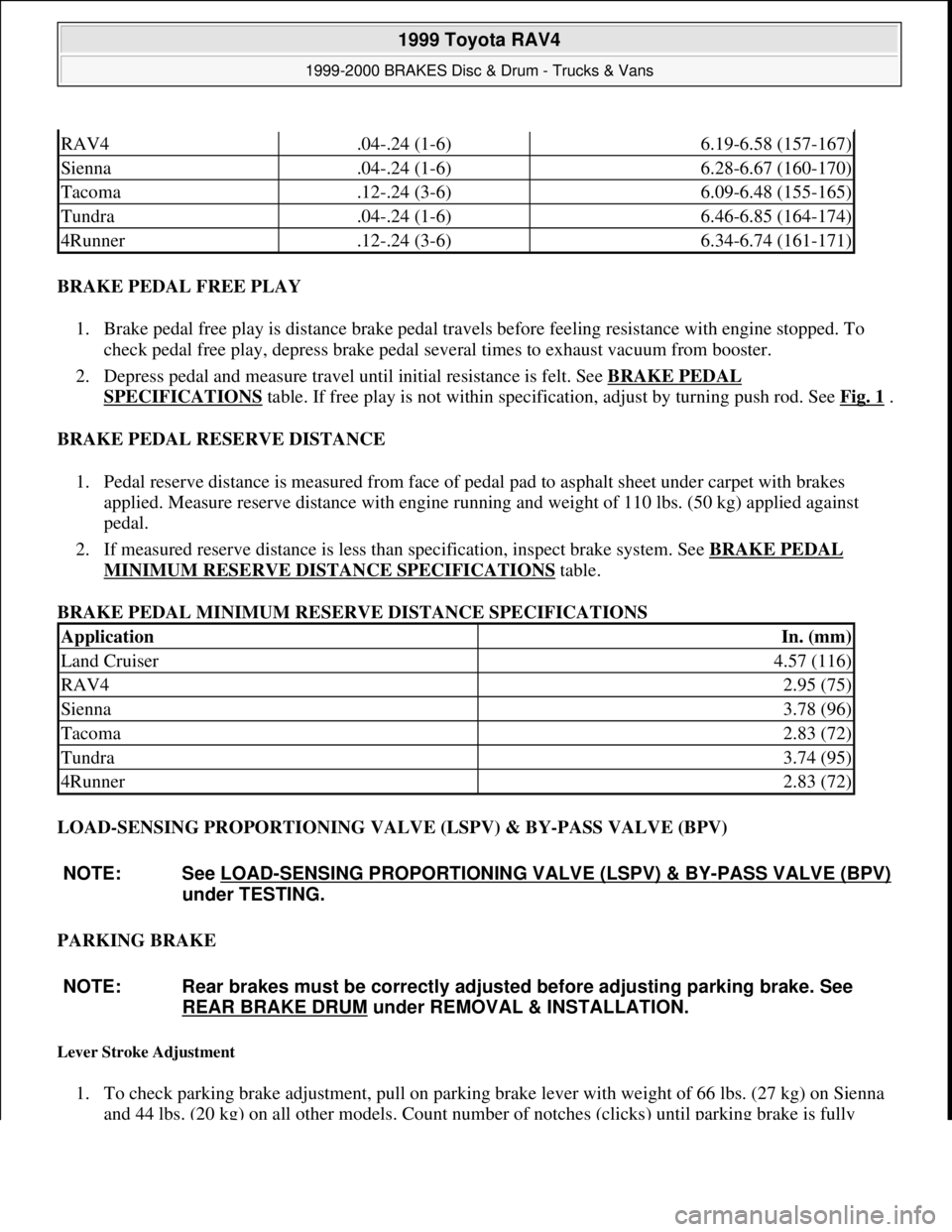
1. Brake pedal free play is distance brake pedal travels before feeling resistance with engine stopped. To
check pedal free play, depress brake pedal several times to exhaust vacuum from booster.
2. Depress pedal and measure travel until initial resistance is felt. See BRAKE PEDAL
SPECIFICATIONS table. If free play is not within specification, adjust by turning push rod. See Fig. 1.
BRAKE PEDAL RESERVE DISTANCE
1. Pedal reserve distance is measured from face of pedal pad to asphalt sheet under carpet with brakes
applied. Measure reserve distance with engine running and weight of 110 lbs. (50 kg) applied against
pedal.
2. If measured reserve distance is less than specification, inspect brake system. See BRAKE PEDAL
MINIMUM RESERVE DISTANCE SPECIFICATIONS table.
BRAKE PEDAL MINIMUM RESERVE DISTANCE SPECIFICATIONS
LOAD-SENSING PROPORTIONING VALVE (LSPV) & BY-PASS VALVE (BPV)
PARKING BRAKE
Lever Stroke Adjustment
1. To check parking brake adjustment, pull on parking brake lever with weight of 66 lbs. (27 kg) on Sienna
and 44 lbs. (20 k
g) on all other models. Count number of notches (clicks) until parking brake is fully
RAV4.04-.24 (1-6)6.19-6.58 (157-167)
Sienna.04-.24 (1-6)6.28-6.67 (160-170)
Tacoma.12-.24 (3-6)6.09-6.48 (155-165)
Tundra.04-.24 (1-6)6.46-6.85 (164-174)
4Runner.12-.24 (3-6)6.34-6.74 (161-171)
ApplicationIn. (mm)
Land Cruiser4.57 (116)
RAV42.95 (75)
Sienna3.78 (96)
Tacoma2.83 (72)
Tundra3.74 (95)
4Runner2.83 (72)
NOTE: See LOAD
-SENSING PROPORTIONING VALVE (LSPV) & BY-PASS VALVE (BPV)
under TESTING.
NOTE: Rear brakes must be correctly adjusted before adjusting parking brake. See
REAR BRAKE DRUM
under REMOVAL & INSTALLATION.
1999 Toyota RAV4
1999-2000 BRAKES Disc & Drum - Trucks & Vans
Microsoft
Sunday, November 22, 2009 10:07:28 AMPage 3 © 2005 Mitchell Repair Information Company, LLC.
Page 344 of 1632
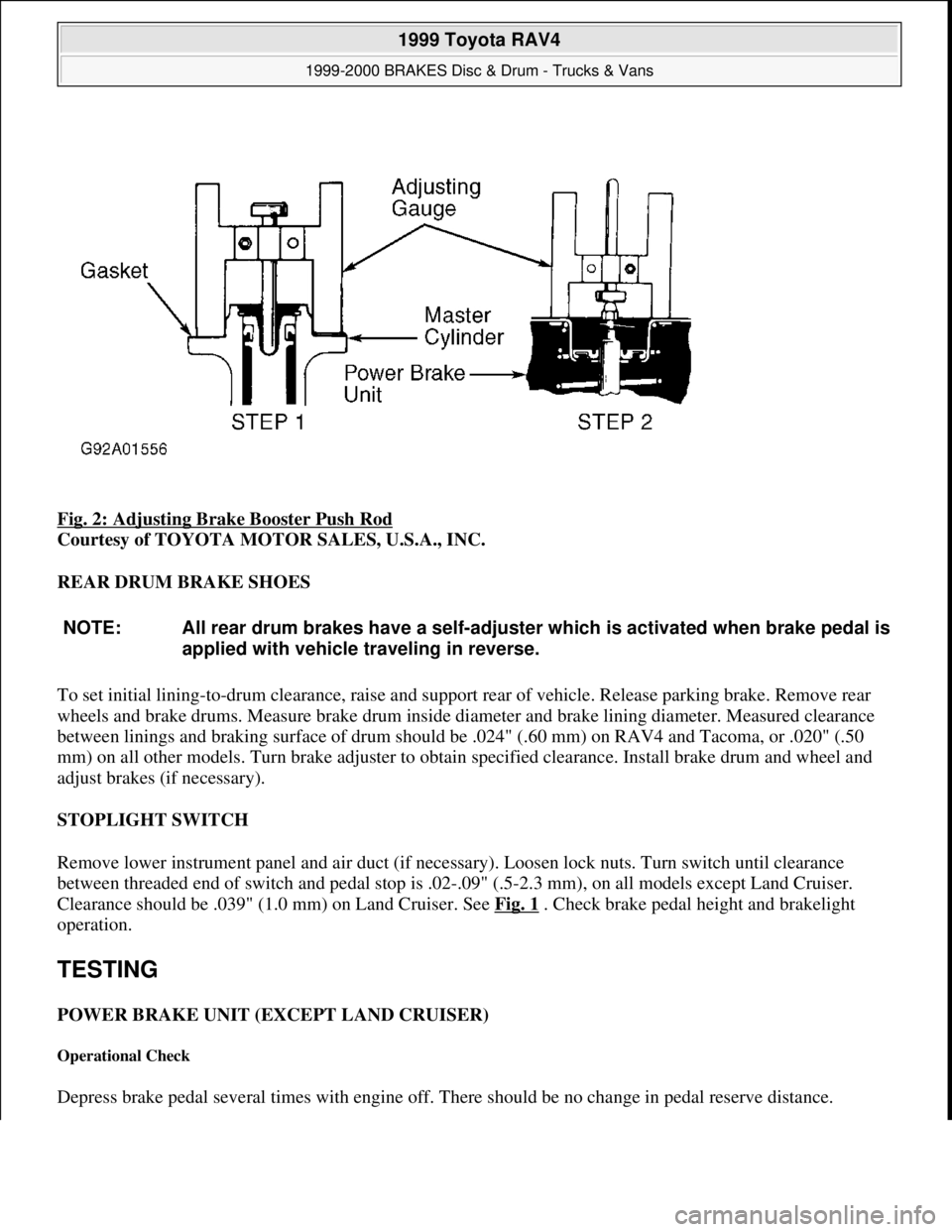
Fig. 2: Adjusting Brake Booster Push Rod
Courtesy of TOYOTA MOTOR SALES, U.S.A., INC.
REAR DRUM BRAKE SHOES
To set initial lining-to-drum clearance, raise and support rear of vehicle. Release parking brake. Remove rear
wheels and brake drums. Measure brake drum inside diameter and brake lining diameter. Measured clearance
between linings and braking surface of drum should be .024" (.60 mm) on RAV4 and Tacoma, or .020" (.50
mm) on all other models. Turn brake adjuster to obtain specified clearance. Install brake drum and wheel and
adjust brakes (if necessary).
STOPLIGHT SWITCH
Remove lower instrument panel and air duct (if necessary). Loosen lock nuts. Turn switch until clearance
between threaded end of switch and pedal stop is .02-.09" (.5-2.3 mm), on all models except Land Cruiser.
Clearance should be .039" (1.0 mm) on Land Cruiser. See Fig. 1
. Check brake pedal height and brakelight
operation.
TESTING
POWER BRAKE UNIT (EXCEPT LAND CRUISER)
Operational Check
Depress brake pedal several times with engine off. There should be no change in pedal reserve distance.
NOTE: All rear drum brakes have a self-adjuster which is activated when brake pedal is
applied with vehicle traveling in reverse.
1999 Toyota RAV4
1999-2000 BRAKES Disc & Drum - Trucks & Vans
Microsoft
Sunday, November 22, 2009 10:07:28 AMPage 5 © 2005 Mitchell Repair Information Company, LLC.
Page 345 of 1632
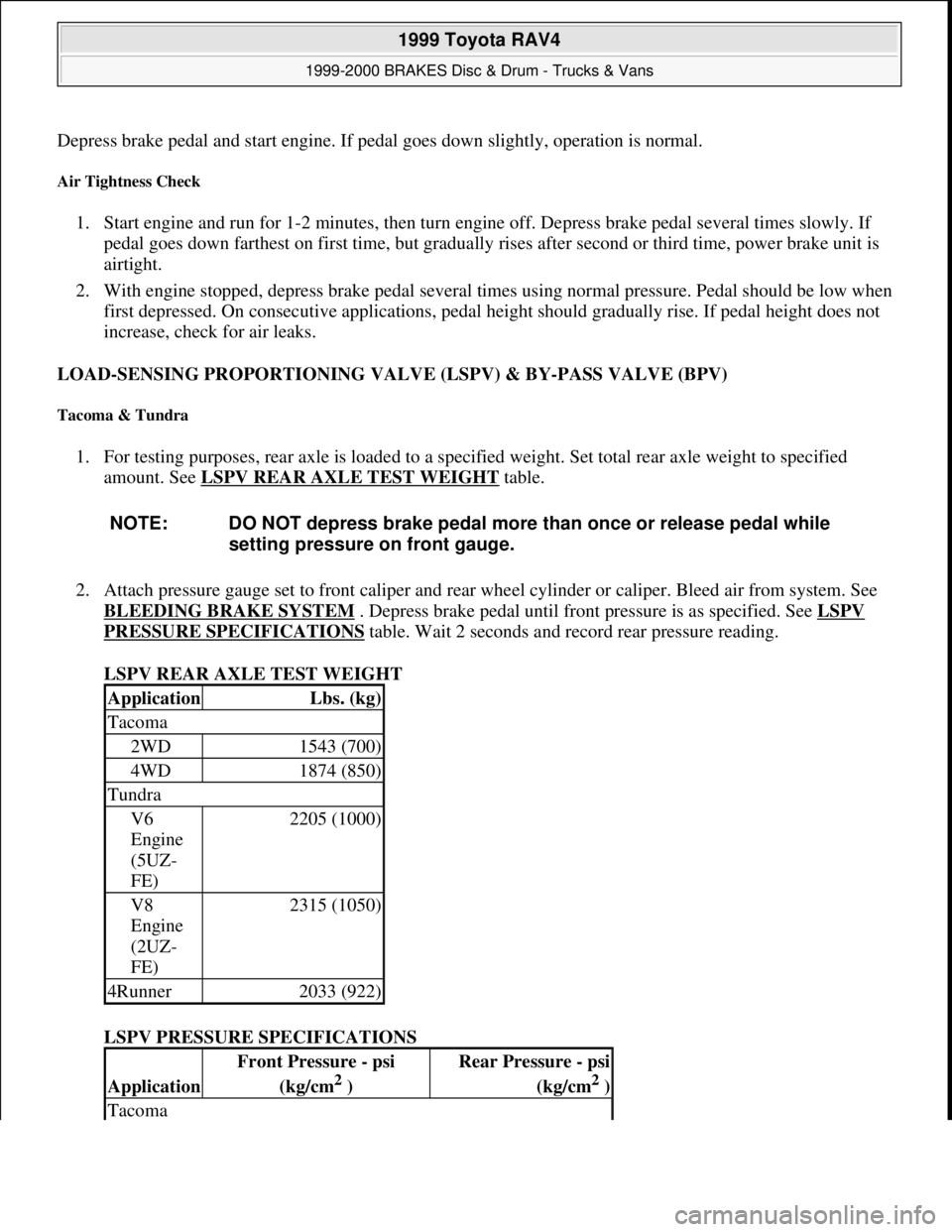
Depress brake pedal and start engine. If pedal goes down slightly, operation is normal.
Air Tightness Check
1. Start engine and run for 1-2 minutes, then turn engine off. Depress brake pedal several times slowly. If
pedal goes down farthest on first time, but gradually rises after second or third time, power brake unit is
airtight.
2. With engine stopped, depress brake pedal several times using normal pressure. Pedal should be low when
first depressed. On consecutive applications, pedal height should gradually rise. If pedal height does not
increase, check for air leaks.
LOAD-SENSING PROPORTIONING VALVE (LSPV) & BY-PASS VALVE (BPV)
Tacoma & Tundra
1. For testing purposes, rear axle is loaded to a specified weight. Set total rear axle weight to specified
amount. See LSPV REAR AXLE TEST WEIGHT
table.
2. Attach pressure gauge set to front caliper and rear wheel cylinder or caliper. Bleed air from system. See
BLEEDING BRAKE SYSTEM
. Depress brake pedal until front pressure is as specified. See LSPV
PRESSURE SPECIFICATIONS table. Wait 2 seconds and record rear pressure reading.
LSPV REAR AXLE TEST WEIGHT
LSPV PRESSURE SPECIFICATIONS NOTE: DO NOT depress brake pedal more than once or release pedal while
setting pressure on front gauge.
ApplicationLbs. (kg)
Tacoma
2WD1543 (700)
4WD1874 (850)
Tundra
V6
Engine
(5UZ-
FE)2205 (1000)
V8
Engine
(2UZ-
FE)2315 (1050)
4Runner2033 (922)
Application
Front Pressure - psi
(kg/cm
2 )
Rear Pressure - psi
(kg/cm
2 )
Tacoma
1999 Toyota RAV4
1999-2000 BRAKES Disc & Drum - Trucks & Vans
Microsoft
Sunday, November 22, 2009 10:07:28 AMPage 6 © 2005 Mitchell Repair Information Company, LLC.
Page 365 of 1632
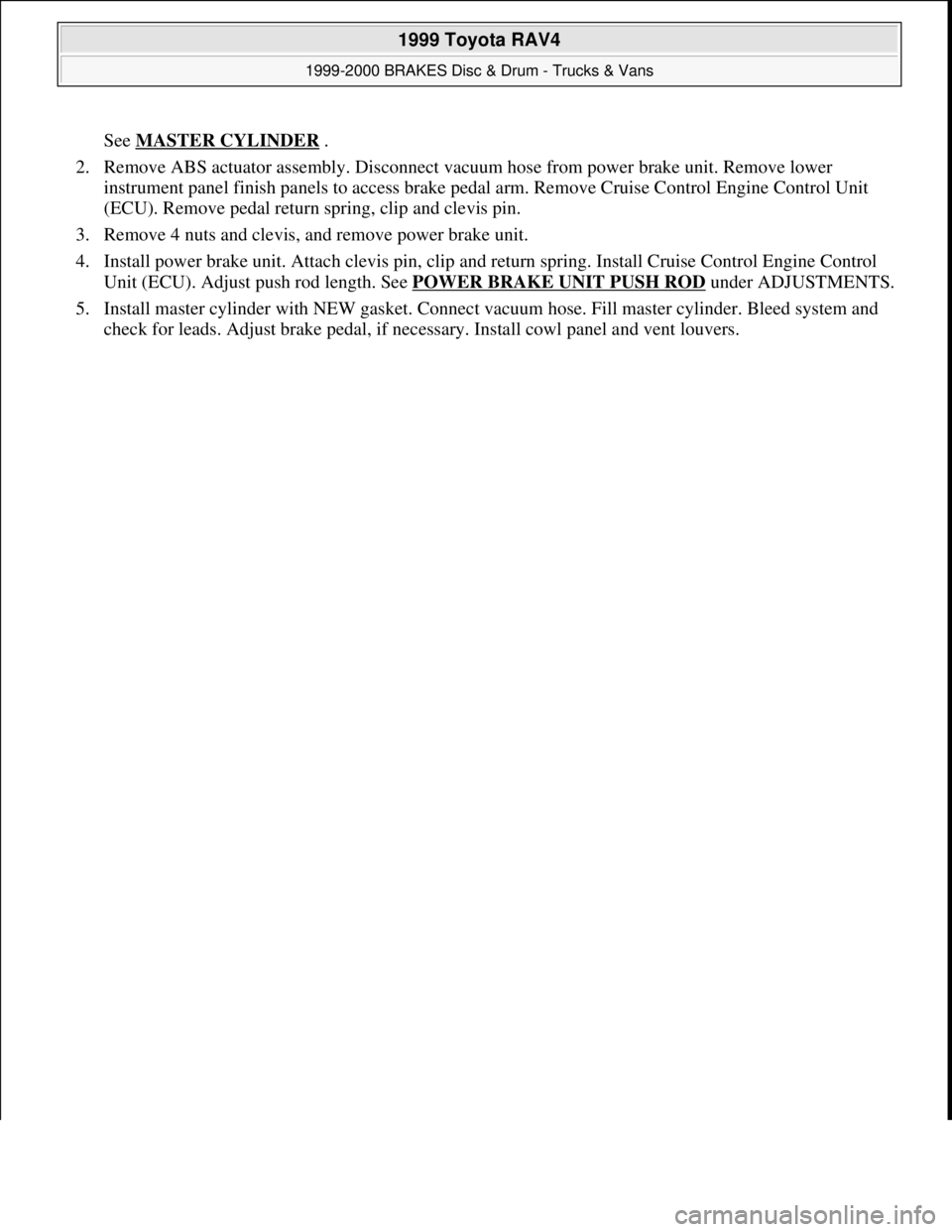
See MASTER CYLINDER .
2. Remove ABS actuator assembly. Disconnect vacuum hose from power brake unit. Remove lower
instrument panel finish panels to access brake pedal arm. Remove Cruise Control Engine Control Unit
(ECU). Remove pedal return spring, clip and clevis pin.
3. Remove 4 nuts and clevis, and remove power brake unit.
4. Install power brake unit. Attach clevis pin, clip and return spring. Install Cruise Control Engine Control
Unit (ECU). Adjust push rod length. See POWER BRAKE UNIT PUSH ROD
under ADJUSTMENTS.
5. Install master cylinder with NEW gasket. Connect vacuum hose. Fill master cylinder. Bleed system and
check for leads. Adjust brake pedal, if necessary. Install cowl panel and vent louvers.
1999 Toyota RAV4
1999-2000 BRAKES Disc & Drum - Trucks & Vans
Microsoft
Sunday, November 22, 2009 10:07:28 AMPage 26 © 2005 Mitchell Repair Information Company, LLC.